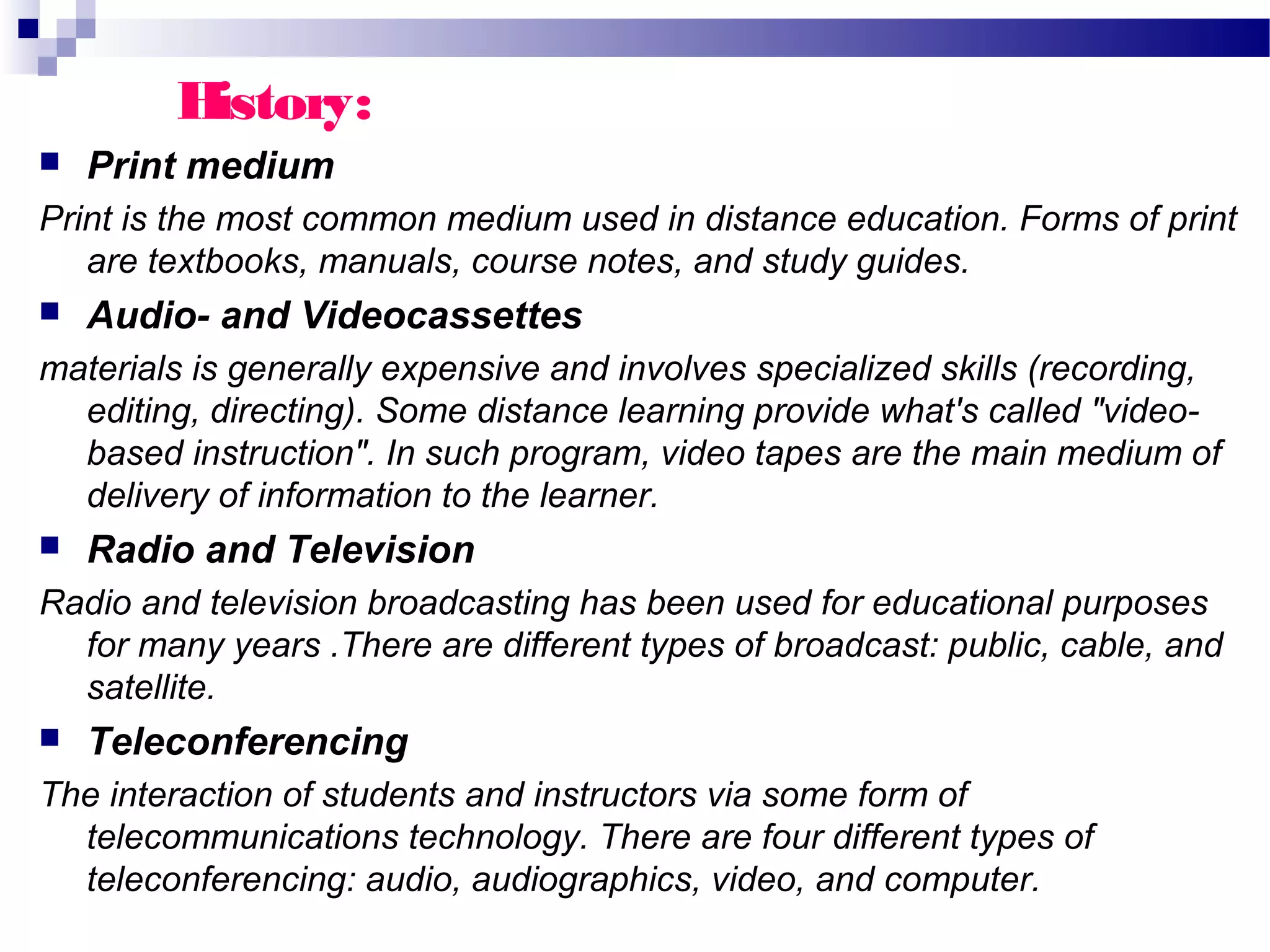
Distance Education
         and the Internet
         TECH4101
                 Lecture One (Week 2)
ahlam sulieman   Defining
                 Distance Education


alabri
                               Interactive Presentation
Definition:
Distance education :  is a field of education that 
focuses on teaching methods and technology with the 
aim of delivering teaching, often on an individual 
basis, to students who are not physically present in a 
traditional educational setting such as a classroom.

distance learning : a process to create and provide 
access to learning when the source of information 
and the learners are separated by time and distance, 
or both.

  http://en.wikipedia.org/wiki/Distance_education
History:
   Print medium
Print is the most common medium used in distance education. Forms of print
   are textbooks, manuals, course notes, and study guides.
   Audio- and Videocassettes
materials is generally expensive and involves specialized skills (recording,
  editing, directing). Some distance learning provide what's called "video-
  based instruction". In such program, video tapes are the main medium of
  delivery of information to the learner.
   Radio and Television
Radio and television broadcasting has been used for educational purposes
  for many years .There are different types of broadcast: public, cable, and
  satellite.
   Teleconferencing
The interaction of students and instructors via some form of
  telecommunications technology. There are four different types of
  teleconferencing: audio, audiographics, video, and computer.
   Audio conferencing
Is most common and least expensive form of teleconferencing.
   Supported with audio samples.
   Audiographic teleconferencing systems
It involve the use of computer or facsimile technology to transmit
    visuals to support the audio. Some computer systems allow the
    transmission of graphics, programs, and data, where each site
    sees anything on the instructor computer screen, besides hearing
    the audio.
   Videoconferencing
It allows learners and instructors to interact face-to-face.
   Computer Conferencing
It allows students and instructors to interact via a computer network.
    This interaction can be through e-mail messages, file transfer,
    chat rooms, real audio and video, and others.
     Computer-Based Instruction
Computer-Based Instruction (CBI) refers to instructional
  programs that the student uses alone on a personal computer.
  The program is usually provided on CD-ROM, in multimedia
  format (graphics, text, sound, and video).
   Web-Based Conferencing
An example of web-based conferencing is CU-SeeMe, the best-
  known web-based conferencing tool. It is a new tool that
  replaces long-distance phone calls over the web and escapes
  long distance charges..
   Web-Based Instruction:
With the fast growth of the Internet, and the fast progress of
  communication, the world wide web is a new promising
  medium for distance learning. With the enormous number of
  resources available online, and the increasing number of
  people who have access to the Internet, web-based instruction
  is considered one of the fastest media for teaching and
  learning.
Definition development:

Distance learning is conventionally defined as... "any
  educational or learning process or system in which the
  teacher and instructor are separated geographically or in
  time from his or her students; or in which students are
  separated from other students or educational resources.
Contemporary distance learning is effected through the
  implementation of computer and electronics technology to
  connect teacher and student in either real or delayed time
  or on an as-needed basis. Content delivery may be
  achieved through a variety of technologies, including
  satellites, computers, cable television, interactive video,
  electronic transmissions via telephone lines, and others.
Distance learning does not preclude traditional learning processes; frequently
it is used in conjunction with in-person classroom or professional training
procedures and practices. It is also called distributed learning.“

The California Distance Learning Project (CDLP) uses the following
definition:
"Distance Learning (DL) is an instructional delivery system that connects
learners with educational resources. DL provides educational access to
learners not enrolled in educational institutions and can augment the learning
opportunities of current students. The implementation of DL is a process that
uses available resources and will evolve to incorporate emerging
technologies.“

This definition was developed in 1997 by a workgroup of adult educators.


http://www.cdlponline.org/index.cfm?fuseaction=whatis&pg=2

Tech4101 1

  • 1.
    Distance Education and the Internet TECH4101 Lecture One (Week 2) ahlam sulieman Defining Distance Education alabri Interactive Presentation
  • 2.
  • 3.
    History:  Print medium Print is the most common medium used in distance education. Forms of print are textbooks, manuals, course notes, and study guides.  Audio- and Videocassettes materials is generally expensive and involves specialized skills (recording, editing, directing). Some distance learning provide what's called "video- based instruction". In such program, video tapes are the main medium of delivery of information to the learner.  Radio and Television Radio and television broadcasting has been used for educational purposes for many years .There are different types of broadcast: public, cable, and satellite.  Teleconferencing The interaction of students and instructors via some form of telecommunications technology. There are four different types of teleconferencing: audio, audiographics, video, and computer.
  • 4.
    Audio conferencing Is most common and least expensive form of teleconferencing. Supported with audio samples.  Audiographic teleconferencing systems It involve the use of computer or facsimile technology to transmit visuals to support the audio. Some computer systems allow the transmission of graphics, programs, and data, where each site sees anything on the instructor computer screen, besides hearing the audio.  Videoconferencing It allows learners and instructors to interact face-to-face.  Computer Conferencing It allows students and instructors to interact via a computer network. This interaction can be through e-mail messages, file transfer, chat rooms, real audio and video, and others.
  • 5.
    Computer-Based Instruction Computer-Based Instruction (CBI) refers to instructional programs that the student uses alone on a personal computer. The program is usually provided on CD-ROM, in multimedia format (graphics, text, sound, and video).  Web-Based Conferencing An example of web-based conferencing is CU-SeeMe, the best- known web-based conferencing tool. It is a new tool that replaces long-distance phone calls over the web and escapes long distance charges..  Web-Based Instruction: With the fast growth of the Internet, and the fast progress of communication, the world wide web is a new promising medium for distance learning. With the enormous number of resources available online, and the increasing number of people who have access to the Internet, web-based instruction is considered one of the fastest media for teaching and learning.
  • 6.
    Definition development: Distance learningis conventionally defined as... "any educational or learning process or system in which the teacher and instructor are separated geographically or in time from his or her students; or in which students are separated from other students or educational resources. Contemporary distance learning is effected through the implementation of computer and electronics technology to connect teacher and student in either real or delayed time or on an as-needed basis. Content delivery may be achieved through a variety of technologies, including satellites, computers, cable television, interactive video, electronic transmissions via telephone lines, and others.
  • 7.
    Distance learning doesnot preclude traditional learning processes; frequently it is used in conjunction with in-person classroom or professional training procedures and practices. It is also called distributed learning.“ The California Distance Learning Project (CDLP) uses the following definition: "Distance Learning (DL) is an instructional delivery system that connects learners with educational resources. DL provides educational access to learners not enrolled in educational institutions and can augment the learning opportunities of current students. The implementation of DL is a process that uses available resources and will evolve to incorporate emerging technologies.“ This definition was developed in 1997 by a workgroup of adult educators. http://www.cdlponline.org/index.cfm?fuseaction=whatis&pg=2