Prepared By :
Kathan R. Thakkar
TYME-2
D15ME158
Sub.: Professional Communication-1 (CS301.01)
Index
 Introduction.
 History.
 Objectives of Distance Education.
 Difference Between Conventional & Distance
Education.
 Types of Distance Learning.
 Advantages & Disadvantages of Distance Learning.
Introduction :
 Definition: It is a method of studying in which
lectures are broadcast or lessons are conducted by
correspondence, without the student needing to
attend a school or college.
 Distance Learning refers to learning remotely without
having a face-to-face interaction with a teacher in a
classroom or it is a way of getting information or
education without direct interaction with the provider
of such information.
History
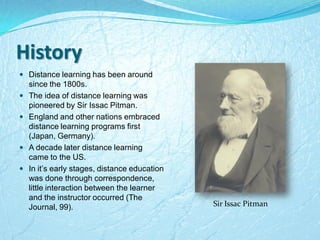
 Distance learning has been around
since the 1800s.
 The idea of distance learning was
pioneered by Sir Issac Pitman.
 England and other nations embraced
distance learning programs first
(Japan, Germany).
 A decade later distance learning
came to the US.
 In it’s early stages, distance education
was done through correspondence,
little interaction between the learner
and the instructor occurred (The
Journal, 99). Sir Issac Pitman
History (Continue...)
 In 1969 vast improvements in the
distance learning process were
made with the introduction of both
written and audio teaching options.
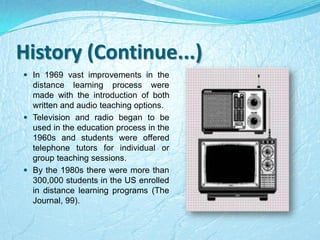
 Television and radio began to be
used in the education process in the
1960s and students were offered
telephone tutors for individual or
group teaching sessions.
 By the 1980s there were more than
300,000 students in the US enrolled
in distance learning programs (The
Journal, 99).
Objectives of Distance Education
 To provide opportunity to those who have missed the conventional mode
of learning.
 To provide equal educational opportunities for higher education through
distance mode for a large segment of the population in various fields of
study.
 To provide flexibility with regard to eligibility for enrollment, age of entry,
choice of courses, methods of learning, conduct of examinations and
operation of the program.
 To complement the programs that existing universities in the country, in
the field of higher learning so as to maintain the highest standards on par
with other institutions in the world.
 To promote integrity in the country through its policies and programs.
 To offer degree courses, diplomas and post graduate programs for the
benefit of the working population.
 To make provision for research and advancement and dissemination of
knowledge.
Difference Between
Conventional & Distance Education
 In conventional education:
teacher plays an essential
role in facilitating learning
and supporting students.
 Prepares lessons,
discusses with students,
 Manages the class, selects
the needed technology,
 Suggests activities, assess
students and provides
reinforcement.
 In distance education:
although DE is recognised by
the separation between the
tutor and learners, an important
role can be played by distance
tutors.
 Suggest learning resources,
 Deliver the instruction,
 Determine the degree of
interaction,
 Select the appropriate form of
assessment.
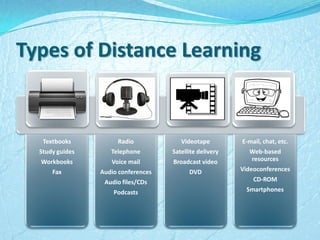
Types of Distance Learning
Textbooks
Study guides
Workbooks
Fax
Radio
Telephone
Voice mail
Audio conferences
Audio files/CDs
Podcasts
Videotape
Satellite delivery
Broadcast video
DVD
E-mail, chat, etc.
Web-based
resources
Videoconferences
CD-ROM
Smartphones
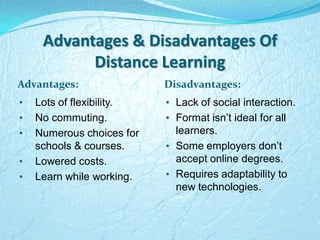
Advantages & Disadvantages Of
Distance Learning
Advantages: Disadvantages:
• Lots of flexibility.
• No commuting.
• Numerous choices for
schools & courses.
• Lowered costs.
• Learn while working.
• Lack of social interaction.
• Format isn’t ideal for all
learners.
• Some employers don’t
accept online degrees.
• Requires adaptability to
new technologies.
Distance Learning

Distance Learning

  • 1.
    Prepared By : KathanR. Thakkar TYME-2 D15ME158 Sub.: Professional Communication-1 (CS301.01)
  • 2.
    Index  Introduction.  History. Objectives of Distance Education.  Difference Between Conventional & Distance Education.  Types of Distance Learning.  Advantages & Disadvantages of Distance Learning.
  • 3.
    Introduction :  Definition:It is a method of studying in which lectures are broadcast or lessons are conducted by correspondence, without the student needing to attend a school or college.  Distance Learning refers to learning remotely without having a face-to-face interaction with a teacher in a classroom or it is a way of getting information or education without direct interaction with the provider of such information.
  • 4.
    History  Distance learninghas been around since the 1800s.  The idea of distance learning was pioneered by Sir Issac Pitman.  England and other nations embraced distance learning programs first (Japan, Germany).  A decade later distance learning came to the US.  In it’s early stages, distance education was done through correspondence, little interaction between the learner and the instructor occurred (The Journal, 99). Sir Issac Pitman
  • 5.
    History (Continue...)  In1969 vast improvements in the distance learning process were made with the introduction of both written and audio teaching options.  Television and radio began to be used in the education process in the 1960s and students were offered telephone tutors for individual or group teaching sessions.  By the 1980s there were more than 300,000 students in the US enrolled in distance learning programs (The Journal, 99).
  • 6.
    Objectives of DistanceEducation  To provide opportunity to those who have missed the conventional mode of learning.  To provide equal educational opportunities for higher education through distance mode for a large segment of the population in various fields of study.  To provide flexibility with regard to eligibility for enrollment, age of entry, choice of courses, methods of learning, conduct of examinations and operation of the program.  To complement the programs that existing universities in the country, in the field of higher learning so as to maintain the highest standards on par with other institutions in the world.  To promote integrity in the country through its policies and programs.  To offer degree courses, diplomas and post graduate programs for the benefit of the working population.  To make provision for research and advancement and dissemination of knowledge.
  • 7.
    Difference Between Conventional &Distance Education  In conventional education: teacher plays an essential role in facilitating learning and supporting students.  Prepares lessons, discusses with students,  Manages the class, selects the needed technology,  Suggests activities, assess students and provides reinforcement.  In distance education: although DE is recognised by the separation between the tutor and learners, an important role can be played by distance tutors.  Suggest learning resources,  Deliver the instruction,  Determine the degree of interaction,  Select the appropriate form of assessment.
  • 8.
    Types of DistanceLearning Textbooks Study guides Workbooks Fax Radio Telephone Voice mail Audio conferences Audio files/CDs Podcasts Videotape Satellite delivery Broadcast video DVD E-mail, chat, etc. Web-based resources Videoconferences CD-ROM Smartphones
  • 9.
    Advantages & DisadvantagesOf Distance Learning Advantages: Disadvantages: • Lots of flexibility. • No commuting. • Numerous choices for schools & courses. • Lowered costs. • Learn while working. • Lack of social interaction. • Format isn’t ideal for all learners. • Some employers don’t accept online degrees. • Requires adaptability to new technologies.