Distance Learning via the
Internet
Prepared By: Veronica Baje
What is Distance Learning?
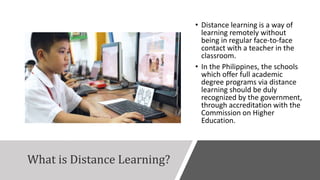
• Distance learning is a way of
learning remotely without
being in regular face-to-face
contact with a teacher in the
classroom.
• In the Philippines, the schools
which offer full academic
degree programs via distance
learning should be duly
recognized by the government,
through accreditation with the
Commission on Higher
Education.
Duly Recognized Distance
Learning Schools in the
Philippines
1. Asian Institute for Distance Education
2. CAP College Foundation
3. CE-Learning
4. Eulogia “Amang” Rodriguez Institute of Science and
Technology
5. Philippine Normal University
6. Philippine Women’s University
7. PUP Open University System
8. Southeast Asia Interdisciplinary Development
Institute
9. University of the City of Manila, Open University
10. University of the Philippines Open University
Types of Distance
Learning
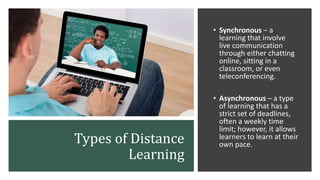
• Synchronous – a
learning that involve
live communication
through either chatting
online, sitting in a
classroom, or even
teleconferencing.
• Asynchronous – a type
of learning that has a
strict set of deadlines,
often a weekly time
limit; however, it allows
learners to learn at their
own pace.
Other Types of Distance
Learning
• Hybrid Distance Learning – hybrid distance learning
combines asynchronous and synchronous learning to
form a structure where learners are required to meet at
a particular time in an internet chat-room or a
classroom.
• Electronic Learning – often known as e-learning, which
enables learners to access course material(s) on a
computer. DVDs, CDs, and different computer-based
tools are always used to deliver electronic learning
courses.
• Fixed Time Online Courses - Fixed time online courses
(or online learning) is another common type of distance
learning that requires learners have access to the
internet. As the name suggests, learners must log in to
their official online learning site at a particular time.
Other Types of Distance
Learning
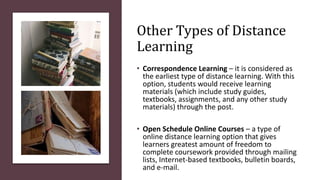
• Correspondence Learning – it is considered as
the earliest type of distance learning. With this
option, students would receive learning
materials (which include study guides,
textbooks, assignments, and any other study
materials) through the post.
• Open Schedule Online Courses – a type of
online distance learning option that gives
learners greatest amount of freedom to
complete coursework provided through mailing
lists, Internet-based textbooks, bulletin boards,
and e-mail.
Development of Web-
Based Courses
1. Determine the course objectives
and desired outcomes.
2. Decide on how to best design the
delivery of the content and
activities.
3. Identify the best teaching
strategies:
• Create web courses
• Prepare exams and quizzes
• Organize online forums, data
base, virtual meetings, etc.
Advantages &
Disadvantages of
Distance Learning
Advantages
• Students can set their own pace of
study.
• It is the decision of the learner as
to when and where to study.
• It doesn't matter where the
student is – they can gain a degree
from anywhere in the world.
• As with a full-time degree, students
may find that they gain useful,
transferable skills, such as planning
and research.
• A distance learning course often
costs less than a full-time degree.
Disadvantages
• Loneliness and
feelings of isolation.
• Unable to develop
social skills.
• Distance learning
providers usually
offer dedicated
support to their
online or distance
learning students.

Distance Learning

  • 1.
    Distance Learning viathe Internet Prepared By: Veronica Baje
  • 2.
    What is DistanceLearning? • Distance learning is a way of learning remotely without being in regular face-to-face contact with a teacher in the classroom. • In the Philippines, the schools which offer full academic degree programs via distance learning should be duly recognized by the government, through accreditation with the Commission on Higher Education.
  • 3.
    Duly Recognized Distance LearningSchools in the Philippines 1. Asian Institute for Distance Education 2. CAP College Foundation 3. CE-Learning 4. Eulogia “Amang” Rodriguez Institute of Science and Technology 5. Philippine Normal University 6. Philippine Women’s University 7. PUP Open University System 8. Southeast Asia Interdisciplinary Development Institute 9. University of the City of Manila, Open University 10. University of the Philippines Open University
  • 4.
    Types of Distance Learning •Synchronous – a learning that involve live communication through either chatting online, sitting in a classroom, or even teleconferencing. • Asynchronous – a type of learning that has a strict set of deadlines, often a weekly time limit; however, it allows learners to learn at their own pace.
  • 5.
    Other Types ofDistance Learning • Hybrid Distance Learning – hybrid distance learning combines asynchronous and synchronous learning to form a structure where learners are required to meet at a particular time in an internet chat-room or a classroom. • Electronic Learning – often known as e-learning, which enables learners to access course material(s) on a computer. DVDs, CDs, and different computer-based tools are always used to deliver electronic learning courses. • Fixed Time Online Courses - Fixed time online courses (or online learning) is another common type of distance learning that requires learners have access to the internet. As the name suggests, learners must log in to their official online learning site at a particular time.
  • 6.
    Other Types ofDistance Learning • Correspondence Learning – it is considered as the earliest type of distance learning. With this option, students would receive learning materials (which include study guides, textbooks, assignments, and any other study materials) through the post. • Open Schedule Online Courses – a type of online distance learning option that gives learners greatest amount of freedom to complete coursework provided through mailing lists, Internet-based textbooks, bulletin boards, and e-mail.
  • 7.
    Development of Web- BasedCourses 1. Determine the course objectives and desired outcomes. 2. Decide on how to best design the delivery of the content and activities. 3. Identify the best teaching strategies: • Create web courses • Prepare exams and quizzes • Organize online forums, data base, virtual meetings, etc.
  • 8.
  • 9.
    Advantages • Students canset their own pace of study. • It is the decision of the learner as to when and where to study. • It doesn't matter where the student is – they can gain a degree from anywhere in the world. • As with a full-time degree, students may find that they gain useful, transferable skills, such as planning and research. • A distance learning course often costs less than a full-time degree.
  • 10.
    Disadvantages • Loneliness and feelingsof isolation. • Unable to develop social skills. • Distance learning providers usually offer dedicated support to their online or distance learning students.

Editor's Notes

  • #5 Synchronous - It is one of the most acclaimed distance learning types that are most suitable for engaging in continuing education programs. Asynchronous - It is also one of the most popular distance learning types because students can communicate with each other seamlessly through online notice/bulletin boards. 
  • #6 Hybrid - With this platform though, students are required to complete their work at their own pace.
  • #7 Correspondence Learning – As soon as they get required these documents, they are required work through them at their own pace and in their own time. Depending on the learning institution chosen, learners may be given a chance to request instructor(s) or tutor(s) for help via telephone, e-mail, post, or instant messaging. Open Schedule - At the start of classes, the learners are given a set of deadlines; however, they are allowed to work on their coursework at their own pace so long the complete the within the time limit. It is best learning options for learners who do not procrastinate or work independently.