Learning Objectives
At the end of the session, the participants should be able
to:
1. define ICT and distance learning;
2. enhance knowledge on components and applications of
ICT;
3. find out some of the advantages and disadvantages of
distance learning;
4. find out the use, importance, challenges and impact of
ICT in distance learning; and
5. find out some of the advantages and disadvantages of
using ICT in distance learning.
Preliminary Activity
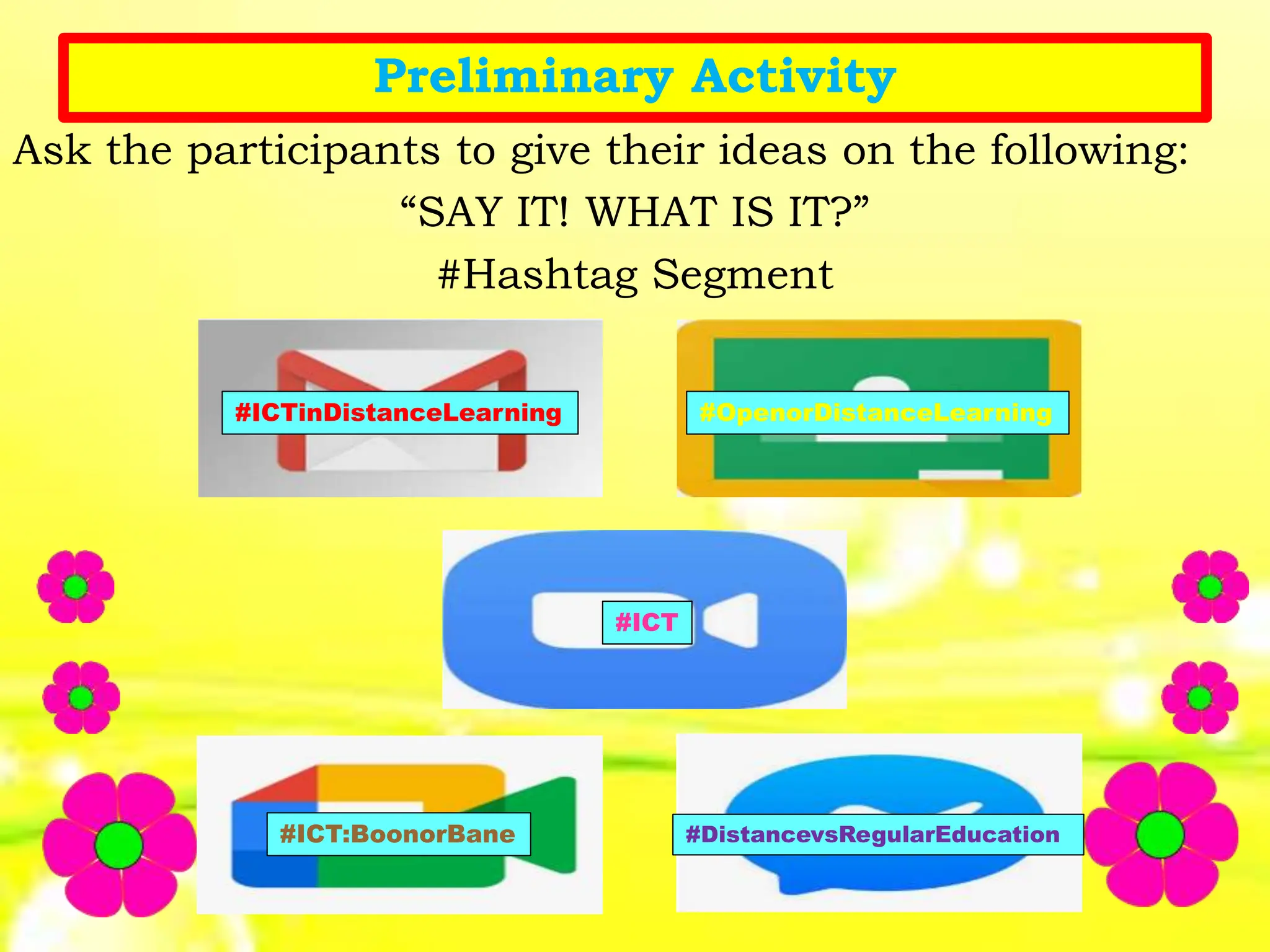
Ask the participants to give their ideas on the following:
“SAY IT! WHAT IS IT?”
#Hashtag Segment
#ICT:BoonorBane
#OpenorDistanceLearning
#ICT
#DistancevsRegularEducation
#ICTinDistanceLearning
Introduction
Education is the basic need of every human being
and today’s technology has a big part in every sphere of
life. In fact, education is the most important investment by
countries, societies, families and individuals for the
future.
A communication network has become an essential
tool in today’s educational environment than ever before.
Today’s society is said to have entered into the age of a
new social revolution, i. e. “information revolution.” 21st
Century has witnessed the explosion of information
technologies. By digital revolution, technologies in
computers, audio – visual devices, and communications
are integrated into a powerful technology – information
technology. The global era is characterized by rapid
advances in technology and expansion of knowledge.
Basically technology is nothing but a tool used in
implementing our ideas and methodology in education.
The application of new technologies in distance
education context provides an appropriate starting point
for delineating the knowledge base required of expert
teachers in today’s global society. Teaching the distance
learners requires different skills to prepare relevant
learning materials to facilitate the construction of
knowledge and learning.
The effective integration of ICT into the educational
system is a complex, multifaceted process that involves
not just technology – indeed given enough initial capital,
getting the technology is the easiest part but also
curriculum and pedagogy, institutional readiness, teacher
competencies and long term financing among others.
Every country as they search for ways of using
modern technology for educational purposes and
development (Soh, 2001). Open and distance education
provides in both developed and developing countries, have
been quick to realize the potential applications of the new
information and communication technology.
It is well documented in the published literature and
on internet sites that on a worldwide basis the ICT an
increasingly important role in education and training.
Furthermore, it has been demonstrated that the use of ICT
can improve the quality student learning experiences and
make education and training opportunities available to a
broader spectrum of the population in developing
countries. At present educators are excited by the success
of information technologies and want to implant them into
instruction. They extol information technologies as the
solution to break the barriers of time and space and fulfill
the dream of life long education.
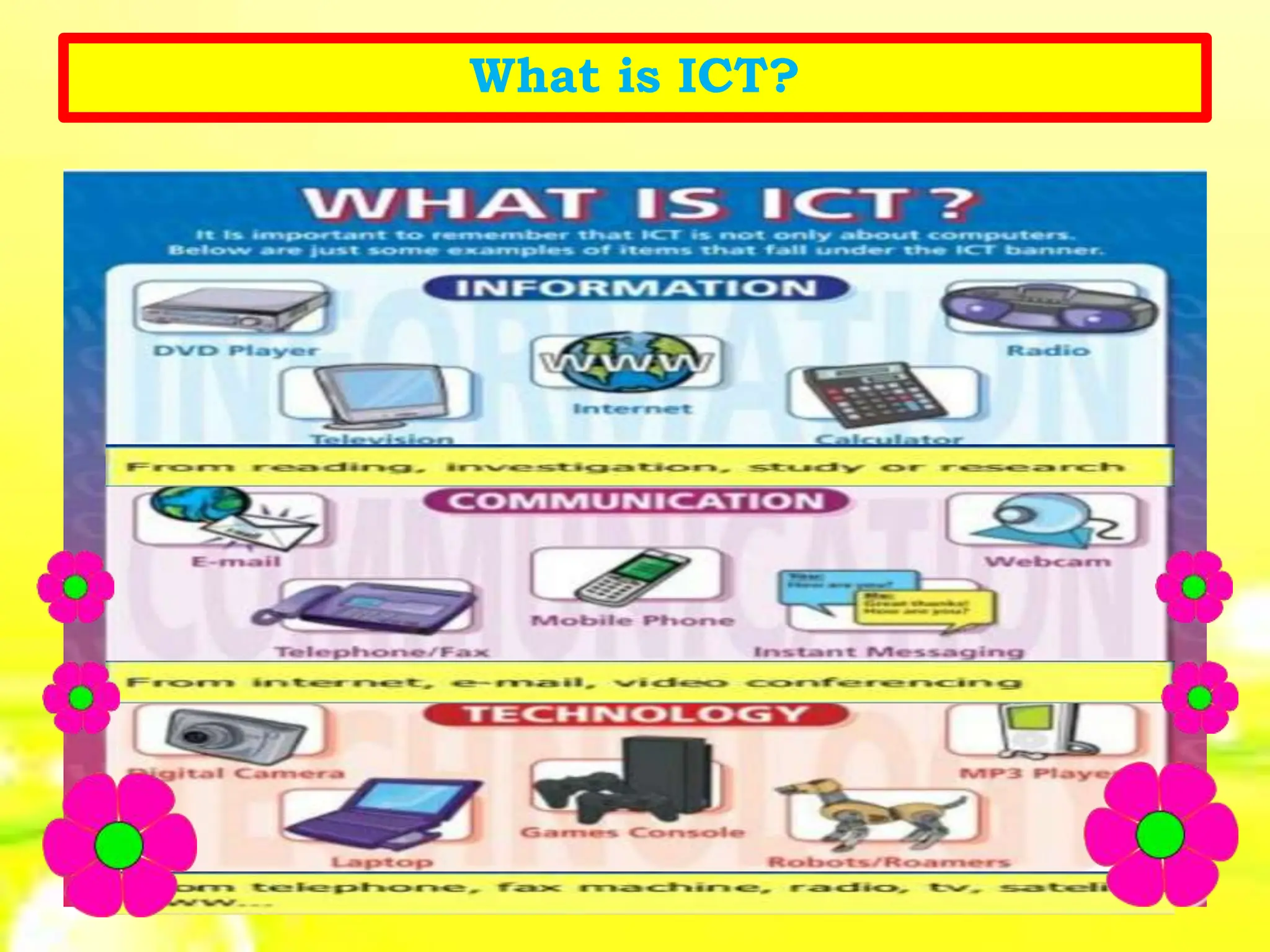
What is ICT?
Information and Communication Technology (ICT)
●the scientific, technological and engineering disciplines
and the management techniques used to handle transmit
information with men and machines (UNESCO).
●those technologies, which enable society to create,
collect, consolidate, communicate, manage and process.
●use of hardware and software for efficient management of
information.
●the infrastructure and components that enable modern
computing.
●although there is no single universal definition of ICT. In
general ICT means all devices, networking components,
applications and systems that are combined and allow
people and organizations to communicate in a digital
world.
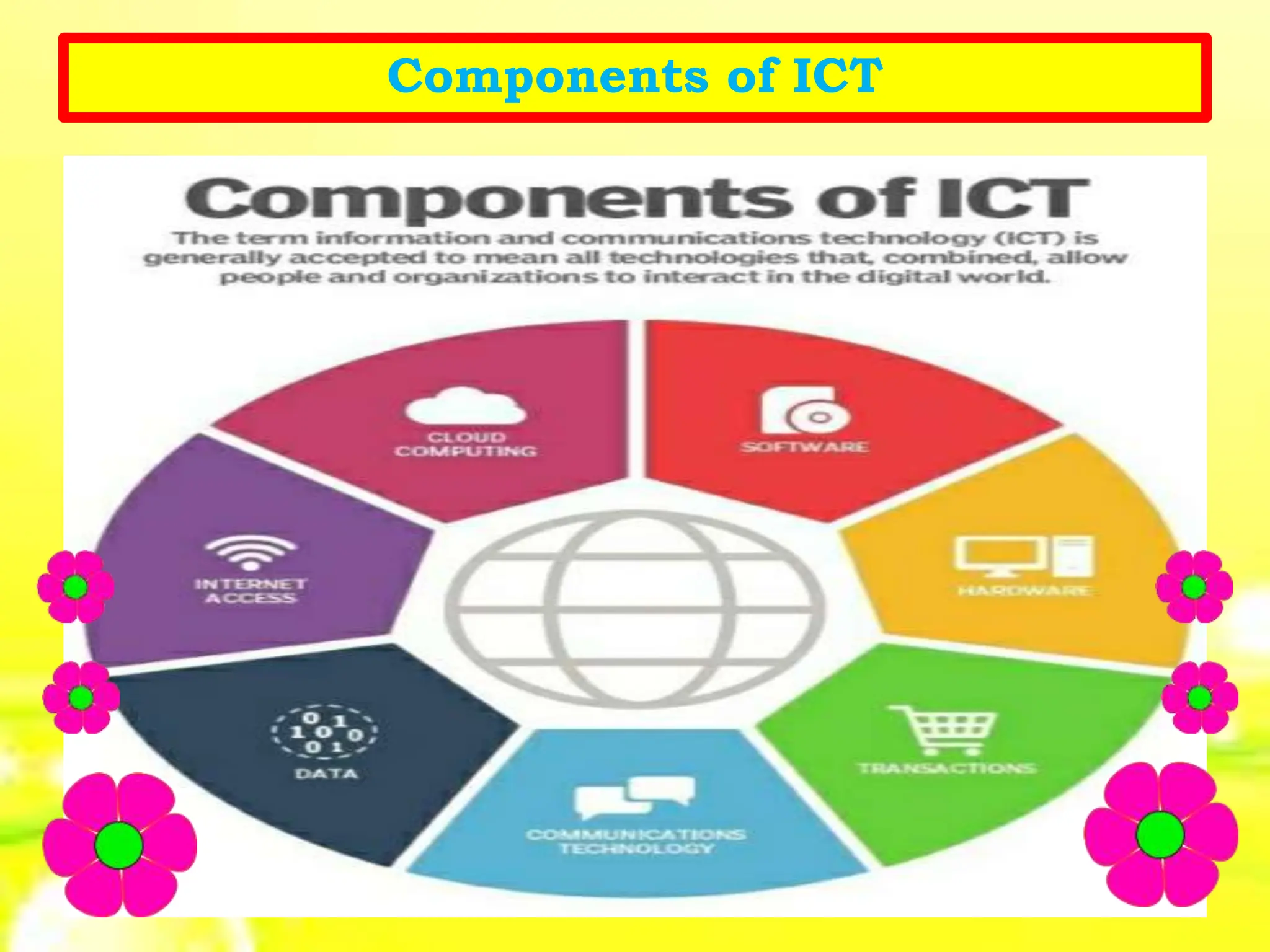
Components of ICT
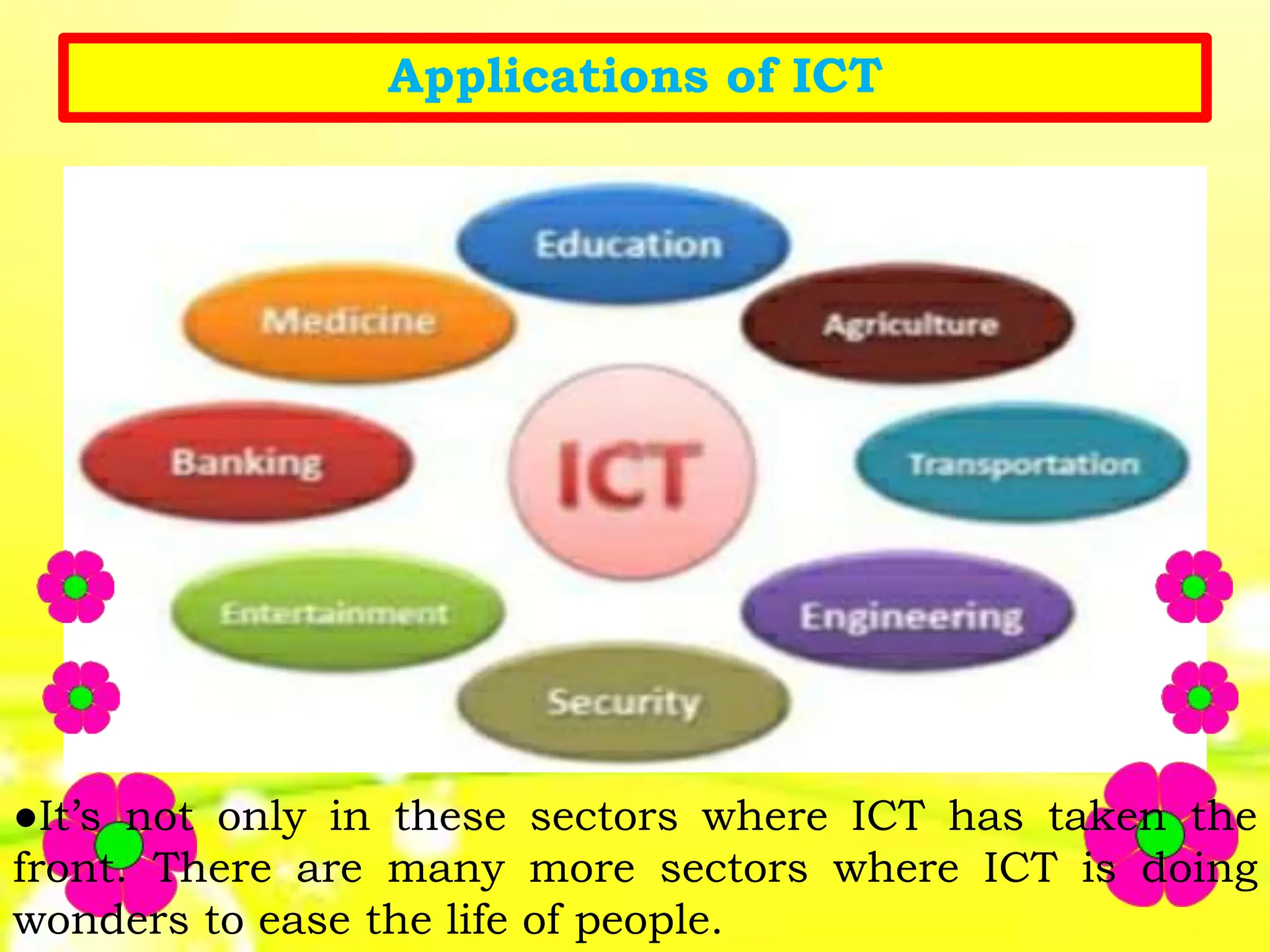
Applications of ICT
●It’s not only in these sectors where ICT has taken the
front. There are many more sectors where ICT is doing
wonders to ease the life of people.
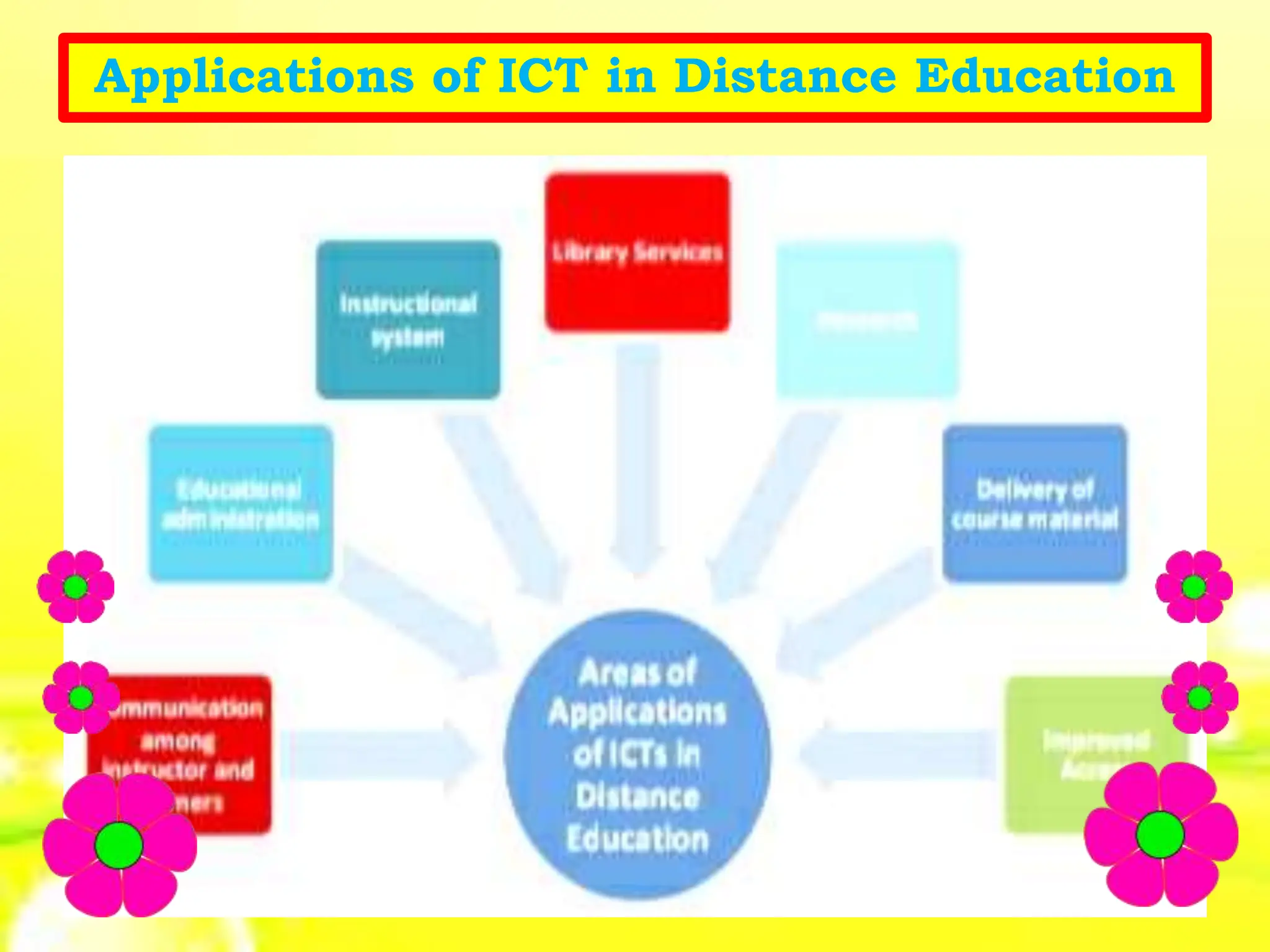
Applications of ICT in Distance Education
What is Distance Learning?
●It refers to a learning delivery modality where a learner is
given materials or access to resources and he/she
undertakes self-directed study at home or in another
venue.
●Instruction and learning that are delivered remotely as a
whole course or through a large portion.
●Technology plays a vital role in allowing distance learning
to happen synchronously or asynchronously.
●The four types of Distance Learning are:
○Modular Distance Learning
○Online Distance Learning
○TV-Based Instruction/Radio-Based Instruction
○Blended Distance Learning
Let the participants watch the video on Distance Learning.
With the advancement in communication technology
a variety of audio – visual media – radio, television
broadcast, video cassettes, video compact disc, video text,
CD, computer and other innovative techniques are used
for effective transmission of knowledge to the learners at a
distance and open learning system. Open and distance
learning is the second chance for those who are not able
to continue their studies due to certain reason. Distance
education on demand has been a way of reaching
students who are unable to attend a traditional classroom
base course. Due to increasing pressure in higher
education, distance education is a reality in the present
world. By definition, distance education denotes an
educational experience where the teacher and the learner
are not face-to-face during the teaching and learning
process. The word “distance” in itself denotes separation
of isolation and hence the criteria of being isolated are a
“given” in distance education.
Distance education has developed in parallel with
the evolution of technology. However, there is far more
important driving force that has directed the evolution of
distance education. We are referring specifically to the
vision that access to all levels of education should be
widened and that distance education is a significant force
in achieving that vision.
The ideal opening opportunity for education is an
old and has emerged in different ways in different
countries, but the particular connection to distance
education, that can be documented, can be traced directly
to the American visionary, Charles Wedemeyer.
Wedemeyer promoted a simple but powerful belief that
communication technologies make it possible to meet
every individual’s fundamental right to learn, in other
words, access to education should be and could be “open.”
Wedemeyer realized that conventional face-to-face
instruction would not be able to attain this vision,
because it was not possible for everybody to attend classes
at specific places and at specific times. For example,
adults who had to leave school and begin working, would
not be able to attend conventional universities that taught
at specific places at specific times. Wedemeyer realized
that his vision could not be achieved unless the barriers of
time and space associated with face-to-face teaching could
be broken, hence his passion and extensive research to
promote and refine distance education. In the early days,
the concept “distance education” was not widely used, but
Wedemeyer (1978) called it “independent study” which he
defined “Independent study encompasses several
teaching-learning arrangements in which teachers and
learners carry out their essential tasks and
responsibilities apart from one another, communicating in
a variety ways.
“Distance education is planned learning that
normally occurs in a different place from teaching
necessitating special techniques of course design.
Instruction, special method of communication by
electronic and other media and special organization and
administrative arrangements.” (Moore and Kearsly)
Distance education, also called open or distance
learning is a form of education which there is normally a
separation between teachers and learners. Distance
learning is a form of delivering education and instruction,
often on an individual basis, to students who aren’t
physically present in a traditional setting such as a
classroom. Distance learning provides access to learning
when the source of information and the learners are
separated by time and distance, or both.
Distance learning can also be refer to as type of
education, typically college level, where students work on
their own at home or at the office and communicate with
faculty and other conferencing, chat rooms, bulletin
boards, instant messaging and other forms of computer
based communication.
Open and distance learning is defined by the
Commonwealth of learning as “a way of providing learning
opportunities that is characterized by the separation of
teacher and learner in time, or place or both time and
place; learning that is certified in some way by an
institution or agency; the use of variety of media including
print and electronic; two way communications that allow
learners and tutors to interact; the possibility of
occasional face to face meetings; and specialized division
of labor in the production and delivery course.
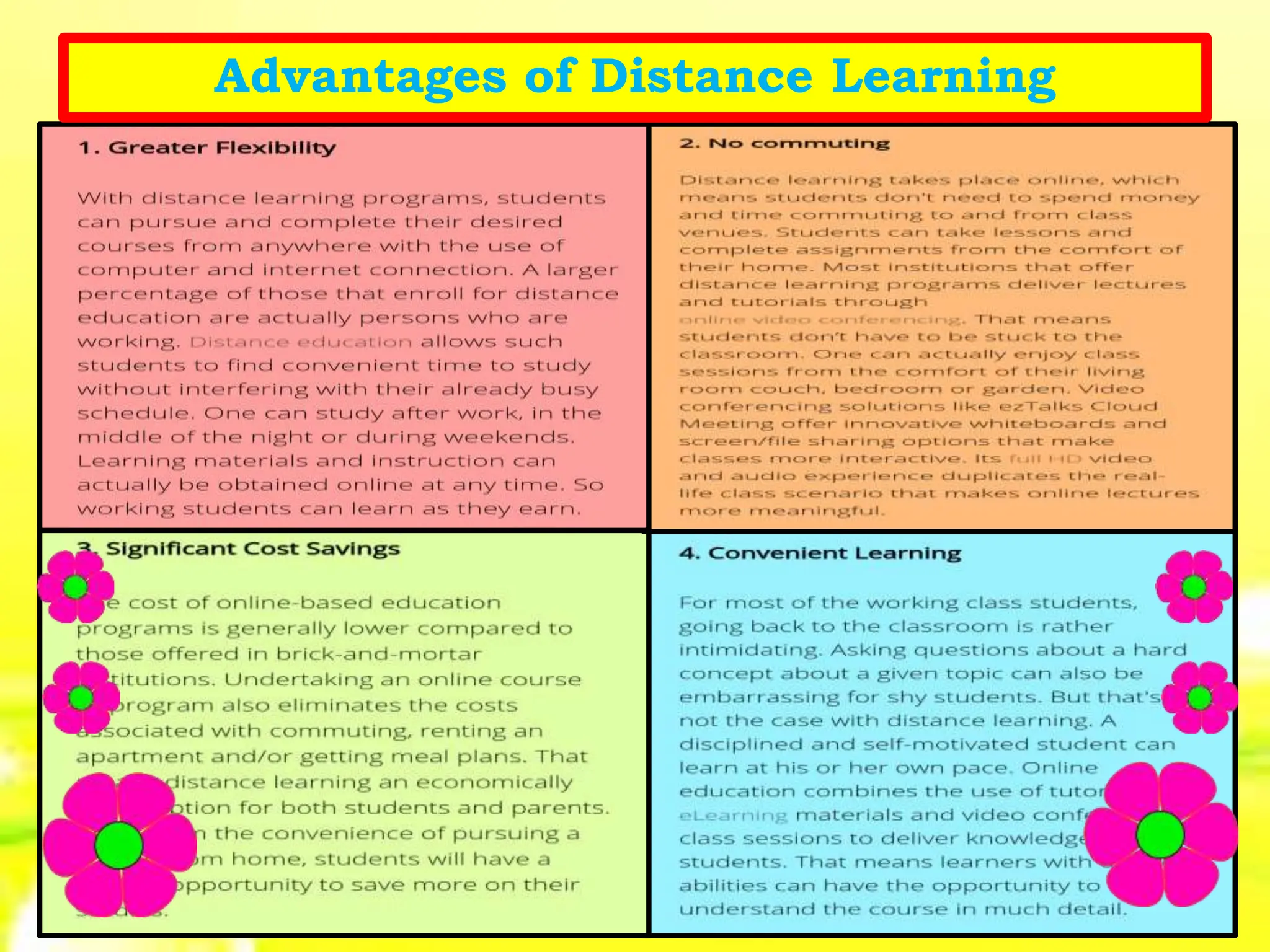
Advantages of Distance Learning
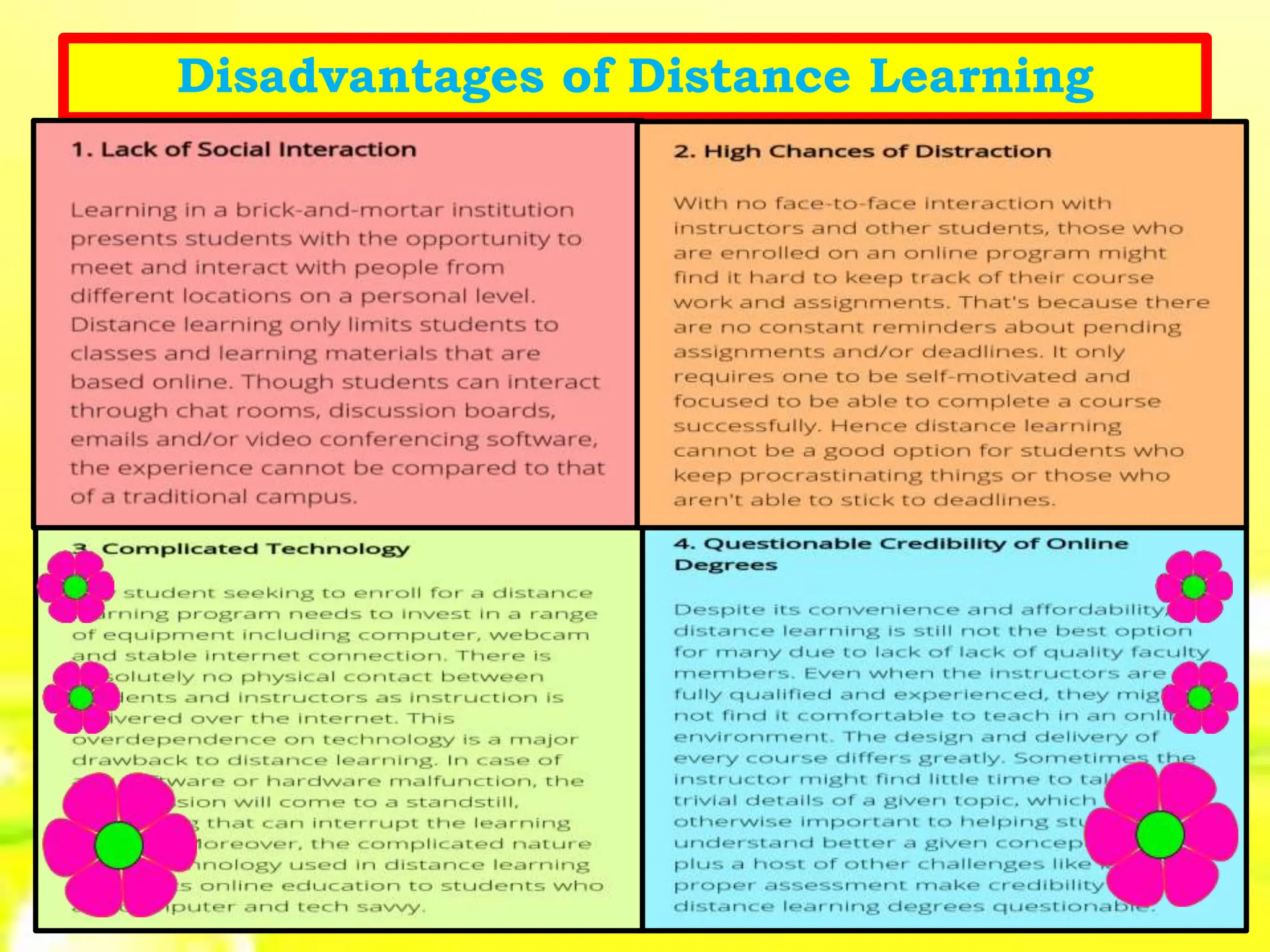
Disadvantages of Distance Learning
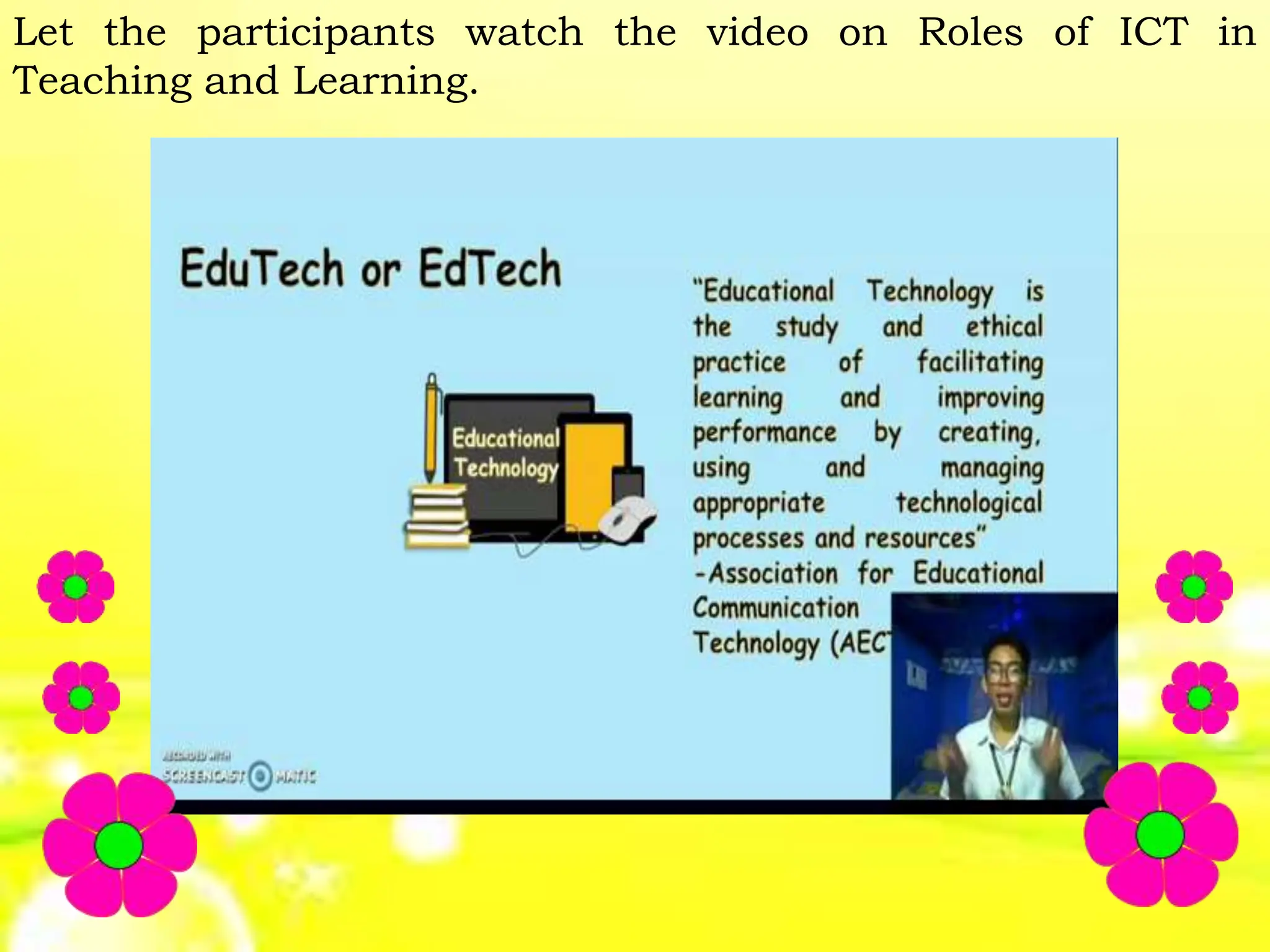
Let the participants watch the video on Roles of ICT in
Teaching and Learning.
Use and Importance of ICT in Distance Learning
ICT are a potentially powerful tool for extending
educational opportunities, formal and non-formal. ICTs
also facilitate access to experts, resource persons,
researchers, professionals, mentors, business leaders, and
peers all over the world. For developing countries ICT have
the potential for increasing access to and improving the
relevance and quality education. ICTs stand for
information and communication technologies are defined,
for the purpose of this primer, as a “diverse set
technological tools and resources used to communicate,
and to create, disseminate, store and manage
information.” These technologies include computers, the
internet, broadcasting technologies (radio, television) and
telephony (Victoria, 2002). This may include all types of
learning technologies such as print, audio, video and the
computer. The use of computers in open and distance
education has provided new pedagogical strategies in
distance learning as well as giving more autonomy to the
distance learners.
Technology has become a part of our life on campus,
at home, and in the office. The modern technologies used
in open and distance learning are telephone tutoring,
teleconferencing, audio graphics, video conferencing drill
and practice, fiber optics, teletext, and videotext,
multimedia and hypermedia CAI, e-books, the “Internet”,
the “World Wide Web” (www), or the “Information Super
Highway” on-line database, on-line discussion, call-in
course on demand, satellite, talk-back TV etc. All of these
technologies should have a place in the knowledge base of
expert teachers. A potentially useful framework for
organizing such a knowledge base is provided by the
emergence of different generations of distance education
(Taylor, 1995).
In the concept of new technology, distance learning
provides multimedia-based education content to the
student utilizing standard data networking, protocols and
infrastructure. The main advantages of using technologies
in distance education are cost effectiveness, independence
of time and place, quality of education access resulting
from the mass production of course materials, teaching a
lot of students simultaneously, and finding a lot of
educational resources.
Haddad and Draxler (2002) identify at least five
levels of technology use in education: presentation,
demonstration, drill and practice, interaction, and
collaboration. Each of the different ICTs–print,
audio/video cassettes, radio and TV broadcasts,
computers or the Internet – may be used for presentation
and demonstration, the most basic of the five levels.
Except for video technologies, drill and practice may like-
wise be performed using the the whole range of
technologies. On the other hand, networked computers
and the Internet are the ICTs that enable interactive and
collaborative learning best; their full potential as
educational tools will remain unrealized if they are used
merely for presentation and demonstration. The objectives
of using technology must be very clear.
Technology is nothing but an enabling tool and it is
the deconstruction of the course into its core experiences
and its communication to the student regardless and its
communication to the student regardless of its delivery
mechanism that is crucial (Coble, 1996). The technology
which can be integrated into the distance education
system, based on our experiences, the following factors
should be considered: Accessibility, Cost Effectiveness,
Human Acceptance and Pedagogical Suitability.
Emerging technologies have thus far afforded the
development of a new generation of distance education
using voice mail, e-mail, teleconferencing and computer-
based integrated telecommunications and multimedia
technology. It is hoped that these new educational
technologies will enrich the distance interaction between
teacher and student and the production of highly
interactive self-paced learning packages used in the
distance learning environment. This will be greatly
beneficial to the distance learners who carry out their
learning anytime and anywhere.
The information and communication technology-
based media is very important for distance learners. In
open and distance education different types of
technologies and media are used to transfer education to
the learners. Rumble (1986, 1994) said that four media
namely: print, audio, television, computer are available
for teaching purposes, in one technological form or
another. A medium is a generic form of communication
associated with particular ways of presenting knowledge.
According to Prof. Bates (1993, 1995) there are five
important media in education: direct human contract (face
to face), text (including still graphics), audio, television
and computing media (e. g. internet, online technologies).
The use of each media gives both variety and the chance
of accommodating different learning styles. He goes on to
argue that it is better to use a limited range of
technologies in order to reduce redundancy and wasteful
expenditure; provided all the main media are covered. One
medium may serve a teaching function better than
another in a particular area. The potential of each
technology varies according to how it is used. It is now a
days more widely recognized that no single medium can
be effective for all kinds of learning needs and that each
technology has its own strength and weakness. For
example, TV is very effective for teaching/learning,
requiring pictorial or graphical illustrations, whereas print
material is very effective and cost-efficient for the
transmission of detailed information. Furthermore, the
socio-economic, political cultural and geographical
background of learners can influence their ability to learn
using different forms of technology. A number of factors
need to be taken into consideration when deciding upon
the use of any of the available technologies for course
delivery and other purposes. These include factors such
as affordability, availability, access and the unique
pedagogical characteristics of the particular technological
application, instructional objectives, financial resources
available at the institution and student personal
resources. The appropriate use of media and technology
has provided information access to all students in remote,
rural and urban areas as well as across nations.
There are many factors that need to be taken into
consideration before deciding on the appropriate use of
media and technology. Siddique (1987) stated that
selection of appropriate media for a learning package is a
complex decision influenced by a variety of considerations,
such as the specific learning objectives of the unit, the
nature of subject matter, learners background and
experiences and the characteristics of the target group as
well as practical constraints including availability of
infrastructure and financial resources. However,
managing technology is no simple task.
The emergence of new global economy has serious
implications for the nature and purpose of educational
institutions. Hence it is timely that academicians
collaborate and cooperate at the regional, national and
international level in the optimum utilization of technology
to enhance the academic pursuit of knowledge while at the
same time to achieving the noble mission of quality
education for citizen of the universe. The teacher’s guiding
is the key factor in ensuring and enhancing the education
quality in any education form.
Unquestionably, ICTs has impacted on the quality
and quantity of teaching, learning, and research in
distance education. Therefore, ICT provides opportunities
for distance education students, academic and non-
academic staff to communicate with one another more
effectively during formal and informal teaching and
learning (Yusuf, 2005).
Distance education serves as alternative in order to
provide some relief and can sometimes save students a
significant amount of money as opposed to traditional
education. With the help of ICT, distance education help
to save students a considerable amount financially by
removing the cost of transportation andor accommodation.
Influence of ICT in distance saves students from the
economic burden of high priced course textbooks. Many
textbooks are now available as electronic textbooks,
known as e-textbook which can offer digital textbooks. ICT
in distance education provides equal access regardless of
socio-economic status or income, area of residence,
gender, race, age or cost per students.
It is a flexible medium of instruction adaptable to
any educational level. For instance, young students can be
taught through this system to acquire a high school
certificate requirement for University entry, just as adult
or a school teacher can be trained using the electronic
distance learning system to acquire higher qualification.
ICT in distance education assist students to
promote good learning experiences and thereby, allow
students to obtain higher satisfaction with their online
learning. For example, students can review their lessons
more than manipulate the coursework to fit their learning
by focusing more on their weaker topics while breezing
through concepts that they already have or can easily
grasp.
ICT in distance learning opens up educational
opportunity to those who because of distance, physical
inadequacies, and work commitments cannot make them
available for normal schooling.
ICT in distance learning introduced new pedagogy
on a large scale primarily because the technical capacity
provided by technology that is, conferencing and others to
address traditional barriers to education.
It is relatively cheaper when compared with normal
school system due to the fact that certain hinge overhead
outlays are not incurred. For instance, to eliminates
building of physical structures to the minimum and also
reduces considerably the number of teachers to be
Employed to adequately cater for students.
Therefore, effective manpower training is crucial
using ICTs, because ICTs are tools on the one hand can
facilitates human resources development, and on the
other hand, helps us to take full advantage of the
potential of technology to enhance quality student
learning via distance education (UNESCO, 2003).
Some of the Challenges of ICT in Distance Learning
According to Yusuf (2006, pp. 22-29), successful
distance education cannot be assured without the use of
effective communication and technological tools (e-mail,
fax, internet, television, radio, etc.)
● There is shortage and high cost of equipment, software
and information compared to situations in the
industrialized nations.
● The need for the integration of new ICT literacy
knowledge into academic courses and programmes.
● Access to information and communication technology
facilities still remains highly inadequate and distributed
not equally throughout the country.
● The capacity of teachers and educators to manage e-
learning programs still remains low. While some do not
have adequate sills, others are averse to using ICT.
● There is inadequate collaboration between the various
stakeholders and agencies to check duplication and
efficient utilization of the few available ICT resources.
● There is insufficient equipment and slow internet
connectivity in most parts of the country.
● There is also unreliable access to electricity in our
country etc.
Advantages of ICT in Distance Learning
The advantages of using ICT in distance education system
are as follows:
1. Faster and flexible course delivery: ICT technologies
have made it possible to deliver lessons/courses in a
faster and easier manner in distance education by
using computer-based or internet-based technologies.
2. Improved and increased access: ICTs have the
capable to expand access for higher education as well
as secondary education among people. ICTs enables
distance education institutions to provide knowledge
within reach of all. ICTs provide the opportunity of
conducting thousands of classes on hundereds of
subjects and courses available anytime, at any place,
as per the need and convenience of learners.
3. Enhanced pedagogical and course design skills:
Pedagogy is the art and science of teaching. Pedagogical
knowledge is essential while using ICTs in course delivery
at any stage of education. ICTs offer flexibility in an
organization and design of courses in a suitable and
effective manner that facilitates development of
knowledge, skills and competences among learners.
4. Educational administration and management:
Various areas of educational administration and
management require ICT help at different levels. At school
and colleges, at universities, there are different
programmes available for registration, digital record
keeping of staff and students. Academic Management
Information System, Financial Management Information
System, Student or Staff Database and Examination Data
Base are some examples.
5. Enhanced collaboration and interaction: Usage of
ICTs encourages interaction encourages interaction and
collaboration between teachers and learners, and among
learners in distance education. Collaboration and
interaction among students creates environment for
learning. Communication tools like telephone, cellphone,
SMS, online forums, chat, blogs, social media flatforms
and e-mail etc. can made communication and discussion
of meaningful learning experience among learners.
6. Preparation of teaching-learning materials: With the
use of word processing programmes, ICTs are helpful for
teachers in preparing their own instructional and visual
materials. Programmes like Powerpoint, Paint and
Photoshop help teachers to prepare various instructional
materials. Internet provides a lot of material and
information in searching required subject matter or
helping aid.
7. Library and information service: Library and
information services are very essential for academic
process of an educational institution. Majority of
educational institutions arrange ICT facilities in library
services for teachers and students accessibility.
Bibliographical searches for instructions, learning and
research work, accessing online database and
repositories. Internet has made library services easier,
faster and more efficient.
8. Evaluation: Sending online assignment, questionnaires
and submitting responses online, participating in
discussion, blogs are modern approaches of evaluations
which are being applied successfully with the help of ICTs.
Massive Online Open Courses (MOOCs) are one of the best
examples for this kind of online learning and evaluation.
9. Research: Research includes Formulation of
hypothesis, Preparation of objectives, Data collection,
Interpretation and analysis and Reporting as important
areas. E-mail, computer programs like MS Word, MS
Excel, and Statistical Package for Social Sciences (SPSS)
are very useful technologies in the research. Literature
review can be performed easily by using online search
engines and Meta search engines.
Disadvantages of ICT in Distance Learning
The disadvantages of using ICT in distance education
system are as follows:
1. Misleading and misguiding information
2. Risk of cyber attacks and hacks
3. A risk to the traditional book and handwriting
methods
4. Implementing computers and the internet for ICT
replace the convention education curriculums
5. Managing courses online is difficult
6. Misuse of technology
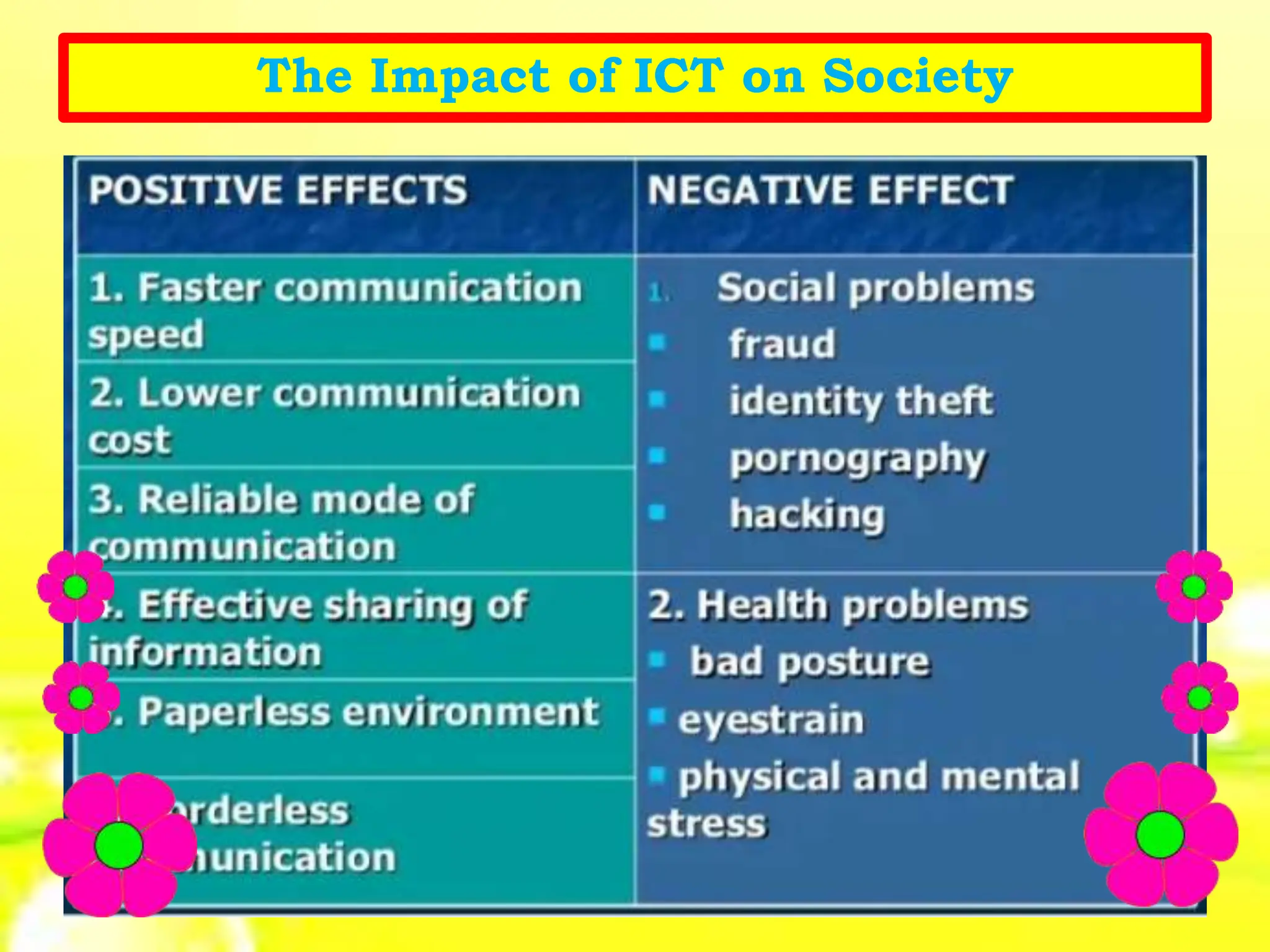
The Impact of ICT on Society
Individual Activity
Let the participants make an essay on the topic given.
To end the session, let the participants watch the video on
21st Century Education.
Information and Communication Technology in Distance Learning.pptx

Information and Communication Technology in Distance Learning.pptx

  • 2.
    Learning Objectives At theend of the session, the participants should be able to: 1. define ICT and distance learning; 2. enhance knowledge on components and applications of ICT; 3. find out some of the advantages and disadvantages of distance learning; 4. find out the use, importance, challenges and impact of ICT in distance learning; and 5. find out some of the advantages and disadvantages of using ICT in distance learning.
  • 3.
    Preliminary Activity Ask theparticipants to give their ideas on the following: “SAY IT! WHAT IS IT?” #Hashtag Segment #ICT:BoonorBane #OpenorDistanceLearning #ICT #DistancevsRegularEducation #ICTinDistanceLearning
  • 4.
    Introduction Education is thebasic need of every human being and today’s technology has a big part in every sphere of life. In fact, education is the most important investment by countries, societies, families and individuals for the future. A communication network has become an essential tool in today’s educational environment than ever before. Today’s society is said to have entered into the age of a new social revolution, i. e. “information revolution.” 21st Century has witnessed the explosion of information technologies. By digital revolution, technologies in computers, audio – visual devices, and communications are integrated into a powerful technology – information technology. The global era is characterized by rapid advances in technology and expansion of knowledge.
  • 5.
    Basically technology isnothing but a tool used in implementing our ideas and methodology in education. The application of new technologies in distance education context provides an appropriate starting point for delineating the knowledge base required of expert teachers in today’s global society. Teaching the distance learners requires different skills to prepare relevant learning materials to facilitate the construction of knowledge and learning. The effective integration of ICT into the educational system is a complex, multifaceted process that involves not just technology – indeed given enough initial capital, getting the technology is the easiest part but also curriculum and pedagogy, institutional readiness, teacher competencies and long term financing among others.
  • 6.
    Every country asthey search for ways of using modern technology for educational purposes and development (Soh, 2001). Open and distance education provides in both developed and developing countries, have been quick to realize the potential applications of the new information and communication technology. It is well documented in the published literature and on internet sites that on a worldwide basis the ICT an increasingly important role in education and training. Furthermore, it has been demonstrated that the use of ICT can improve the quality student learning experiences and make education and training opportunities available to a broader spectrum of the population in developing countries. At present educators are excited by the success of information technologies and want to implant them into instruction. They extol information technologies as the solution to break the barriers of time and space and fulfill the dream of life long education.
  • 7.
  • 8.
    Information and CommunicationTechnology (ICT) ●the scientific, technological and engineering disciplines and the management techniques used to handle transmit information with men and machines (UNESCO). ●those technologies, which enable society to create, collect, consolidate, communicate, manage and process. ●use of hardware and software for efficient management of information. ●the infrastructure and components that enable modern computing. ●although there is no single universal definition of ICT. In general ICT means all devices, networking components, applications and systems that are combined and allow people and organizations to communicate in a digital world.
  • 9.
  • 10.
    Applications of ICT ●It’snot only in these sectors where ICT has taken the front. There are many more sectors where ICT is doing wonders to ease the life of people.
  • 11.
    Applications of ICTin Distance Education
  • 12.
    What is DistanceLearning? ●It refers to a learning delivery modality where a learner is given materials or access to resources and he/she undertakes self-directed study at home or in another venue. ●Instruction and learning that are delivered remotely as a whole course or through a large portion. ●Technology plays a vital role in allowing distance learning to happen synchronously or asynchronously. ●The four types of Distance Learning are: ○Modular Distance Learning ○Online Distance Learning ○TV-Based Instruction/Radio-Based Instruction ○Blended Distance Learning
  • 13.
    Let the participantswatch the video on Distance Learning.
  • 14.
    With the advancementin communication technology a variety of audio – visual media – radio, television broadcast, video cassettes, video compact disc, video text, CD, computer and other innovative techniques are used for effective transmission of knowledge to the learners at a distance and open learning system. Open and distance learning is the second chance for those who are not able to continue their studies due to certain reason. Distance education on demand has been a way of reaching students who are unable to attend a traditional classroom base course. Due to increasing pressure in higher education, distance education is a reality in the present world. By definition, distance education denotes an educational experience where the teacher and the learner are not face-to-face during the teaching and learning process. The word “distance” in itself denotes separation of isolation and hence the criteria of being isolated are a “given” in distance education.
  • 15.
    Distance education hasdeveloped in parallel with the evolution of technology. However, there is far more important driving force that has directed the evolution of distance education. We are referring specifically to the vision that access to all levels of education should be widened and that distance education is a significant force in achieving that vision. The ideal opening opportunity for education is an old and has emerged in different ways in different countries, but the particular connection to distance education, that can be documented, can be traced directly to the American visionary, Charles Wedemeyer. Wedemeyer promoted a simple but powerful belief that communication technologies make it possible to meet every individual’s fundamental right to learn, in other words, access to education should be and could be “open.”
  • 16.
    Wedemeyer realized thatconventional face-to-face instruction would not be able to attain this vision, because it was not possible for everybody to attend classes at specific places and at specific times. For example, adults who had to leave school and begin working, would not be able to attend conventional universities that taught at specific places at specific times. Wedemeyer realized that his vision could not be achieved unless the barriers of time and space associated with face-to-face teaching could be broken, hence his passion and extensive research to promote and refine distance education. In the early days, the concept “distance education” was not widely used, but Wedemeyer (1978) called it “independent study” which he defined “Independent study encompasses several teaching-learning arrangements in which teachers and learners carry out their essential tasks and responsibilities apart from one another, communicating in a variety ways.
  • 17.
    “Distance education isplanned learning that normally occurs in a different place from teaching necessitating special techniques of course design. Instruction, special method of communication by electronic and other media and special organization and administrative arrangements.” (Moore and Kearsly) Distance education, also called open or distance learning is a form of education which there is normally a separation between teachers and learners. Distance learning is a form of delivering education and instruction, often on an individual basis, to students who aren’t physically present in a traditional setting such as a classroom. Distance learning provides access to learning when the source of information and the learners are separated by time and distance, or both.
  • 18.
    Distance learning canalso be refer to as type of education, typically college level, where students work on their own at home or at the office and communicate with faculty and other conferencing, chat rooms, bulletin boards, instant messaging and other forms of computer based communication. Open and distance learning is defined by the Commonwealth of learning as “a way of providing learning opportunities that is characterized by the separation of teacher and learner in time, or place or both time and place; learning that is certified in some way by an institution or agency; the use of variety of media including print and electronic; two way communications that allow learners and tutors to interact; the possibility of occasional face to face meetings; and specialized division of labor in the production and delivery course.
  • 19.
  • 20.
  • 21.
    Let the participantswatch the video on Roles of ICT in Teaching and Learning.
  • 22.
    Use and Importanceof ICT in Distance Learning ICT are a potentially powerful tool for extending educational opportunities, formal and non-formal. ICTs also facilitate access to experts, resource persons, researchers, professionals, mentors, business leaders, and peers all over the world. For developing countries ICT have the potential for increasing access to and improving the relevance and quality education. ICTs stand for information and communication technologies are defined, for the purpose of this primer, as a “diverse set technological tools and resources used to communicate, and to create, disseminate, store and manage information.” These technologies include computers, the internet, broadcasting technologies (radio, television) and telephony (Victoria, 2002). This may include all types of learning technologies such as print, audio, video and the computer. The use of computers in open and distance
  • 23.
    education has providednew pedagogical strategies in distance learning as well as giving more autonomy to the distance learners. Technology has become a part of our life on campus, at home, and in the office. The modern technologies used in open and distance learning are telephone tutoring, teleconferencing, audio graphics, video conferencing drill and practice, fiber optics, teletext, and videotext, multimedia and hypermedia CAI, e-books, the “Internet”, the “World Wide Web” (www), or the “Information Super Highway” on-line database, on-line discussion, call-in course on demand, satellite, talk-back TV etc. All of these technologies should have a place in the knowledge base of expert teachers. A potentially useful framework for organizing such a knowledge base is provided by the emergence of different generations of distance education (Taylor, 1995).
  • 24.
    In the conceptof new technology, distance learning provides multimedia-based education content to the student utilizing standard data networking, protocols and infrastructure. The main advantages of using technologies in distance education are cost effectiveness, independence of time and place, quality of education access resulting from the mass production of course materials, teaching a lot of students simultaneously, and finding a lot of educational resources. Haddad and Draxler (2002) identify at least five levels of technology use in education: presentation, demonstration, drill and practice, interaction, and collaboration. Each of the different ICTs–print, audio/video cassettes, radio and TV broadcasts, computers or the Internet – may be used for presentation and demonstration, the most basic of the five levels. Except for video technologies, drill and practice may like-
  • 25.
    wise be performedusing the the whole range of technologies. On the other hand, networked computers and the Internet are the ICTs that enable interactive and collaborative learning best; their full potential as educational tools will remain unrealized if they are used merely for presentation and demonstration. The objectives of using technology must be very clear. Technology is nothing but an enabling tool and it is the deconstruction of the course into its core experiences and its communication to the student regardless and its communication to the student regardless of its delivery mechanism that is crucial (Coble, 1996). The technology which can be integrated into the distance education system, based on our experiences, the following factors should be considered: Accessibility, Cost Effectiveness, Human Acceptance and Pedagogical Suitability.
  • 26.
    Emerging technologies havethus far afforded the development of a new generation of distance education using voice mail, e-mail, teleconferencing and computer- based integrated telecommunications and multimedia technology. It is hoped that these new educational technologies will enrich the distance interaction between teacher and student and the production of highly interactive self-paced learning packages used in the distance learning environment. This will be greatly beneficial to the distance learners who carry out their learning anytime and anywhere. The information and communication technology- based media is very important for distance learners. In open and distance education different types of technologies and media are used to transfer education to the learners. Rumble (1986, 1994) said that four media namely: print, audio, television, computer are available
  • 27.
    for teaching purposes,in one technological form or another. A medium is a generic form of communication associated with particular ways of presenting knowledge. According to Prof. Bates (1993, 1995) there are five important media in education: direct human contract (face to face), text (including still graphics), audio, television and computing media (e. g. internet, online technologies). The use of each media gives both variety and the chance of accommodating different learning styles. He goes on to argue that it is better to use a limited range of technologies in order to reduce redundancy and wasteful expenditure; provided all the main media are covered. One medium may serve a teaching function better than another in a particular area. The potential of each technology varies according to how it is used. It is now a days more widely recognized that no single medium can be effective for all kinds of learning needs and that each
  • 28.
    technology has itsown strength and weakness. For example, TV is very effective for teaching/learning, requiring pictorial or graphical illustrations, whereas print material is very effective and cost-efficient for the transmission of detailed information. Furthermore, the socio-economic, political cultural and geographical background of learners can influence their ability to learn using different forms of technology. A number of factors need to be taken into consideration when deciding upon the use of any of the available technologies for course delivery and other purposes. These include factors such as affordability, availability, access and the unique pedagogical characteristics of the particular technological application, instructional objectives, financial resources available at the institution and student personal resources. The appropriate use of media and technology has provided information access to all students in remote,
  • 29.
    rural and urbanareas as well as across nations. There are many factors that need to be taken into consideration before deciding on the appropriate use of media and technology. Siddique (1987) stated that selection of appropriate media for a learning package is a complex decision influenced by a variety of considerations, such as the specific learning objectives of the unit, the nature of subject matter, learners background and experiences and the characteristics of the target group as well as practical constraints including availability of infrastructure and financial resources. However, managing technology is no simple task. The emergence of new global economy has serious implications for the nature and purpose of educational institutions. Hence it is timely that academicians collaborate and cooperate at the regional, national and international level in the optimum utilization of technology
  • 30.
    to enhance theacademic pursuit of knowledge while at the same time to achieving the noble mission of quality education for citizen of the universe. The teacher’s guiding is the key factor in ensuring and enhancing the education quality in any education form. Unquestionably, ICTs has impacted on the quality and quantity of teaching, learning, and research in distance education. Therefore, ICT provides opportunities for distance education students, academic and non- academic staff to communicate with one another more effectively during formal and informal teaching and learning (Yusuf, 2005). Distance education serves as alternative in order to provide some relief and can sometimes save students a significant amount of money as opposed to traditional education. With the help of ICT, distance education help to save students a considerable amount financially by removing the cost of transportation andor accommodation.
  • 31.
    Influence of ICTin distance saves students from the economic burden of high priced course textbooks. Many textbooks are now available as electronic textbooks, known as e-textbook which can offer digital textbooks. ICT in distance education provides equal access regardless of socio-economic status or income, area of residence, gender, race, age or cost per students. It is a flexible medium of instruction adaptable to any educational level. For instance, young students can be taught through this system to acquire a high school certificate requirement for University entry, just as adult or a school teacher can be trained using the electronic distance learning system to acquire higher qualification. ICT in distance education assist students to promote good learning experiences and thereby, allow students to obtain higher satisfaction with their online learning. For example, students can review their lessons
  • 32.
    more than manipulatethe coursework to fit their learning by focusing more on their weaker topics while breezing through concepts that they already have or can easily grasp. ICT in distance learning opens up educational opportunity to those who because of distance, physical inadequacies, and work commitments cannot make them available for normal schooling. ICT in distance learning introduced new pedagogy on a large scale primarily because the technical capacity provided by technology that is, conferencing and others to address traditional barriers to education. It is relatively cheaper when compared with normal school system due to the fact that certain hinge overhead outlays are not incurred. For instance, to eliminates building of physical structures to the minimum and also reduces considerably the number of teachers to be
  • 33.
    Employed to adequatelycater for students. Therefore, effective manpower training is crucial using ICTs, because ICTs are tools on the one hand can facilitates human resources development, and on the other hand, helps us to take full advantage of the potential of technology to enhance quality student learning via distance education (UNESCO, 2003).
  • 34.
    Some of theChallenges of ICT in Distance Learning According to Yusuf (2006, pp. 22-29), successful distance education cannot be assured without the use of effective communication and technological tools (e-mail, fax, internet, television, radio, etc.) ● There is shortage and high cost of equipment, software and information compared to situations in the industrialized nations. ● The need for the integration of new ICT literacy knowledge into academic courses and programmes. ● Access to information and communication technology facilities still remains highly inadequate and distributed not equally throughout the country. ● The capacity of teachers and educators to manage e- learning programs still remains low. While some do not have adequate sills, others are averse to using ICT.
  • 35.
    ● There isinadequate collaboration between the various stakeholders and agencies to check duplication and efficient utilization of the few available ICT resources. ● There is insufficient equipment and slow internet connectivity in most parts of the country. ● There is also unreliable access to electricity in our country etc.
  • 36.
    Advantages of ICTin Distance Learning The advantages of using ICT in distance education system are as follows: 1. Faster and flexible course delivery: ICT technologies have made it possible to deliver lessons/courses in a faster and easier manner in distance education by using computer-based or internet-based technologies. 2. Improved and increased access: ICTs have the capable to expand access for higher education as well as secondary education among people. ICTs enables distance education institutions to provide knowledge within reach of all. ICTs provide the opportunity of conducting thousands of classes on hundereds of subjects and courses available anytime, at any place, as per the need and convenience of learners.
  • 37.
    3. Enhanced pedagogicaland course design skills: Pedagogy is the art and science of teaching. Pedagogical knowledge is essential while using ICTs in course delivery at any stage of education. ICTs offer flexibility in an organization and design of courses in a suitable and effective manner that facilitates development of knowledge, skills and competences among learners. 4. Educational administration and management: Various areas of educational administration and management require ICT help at different levels. At school and colleges, at universities, there are different programmes available for registration, digital record keeping of staff and students. Academic Management Information System, Financial Management Information System, Student or Staff Database and Examination Data Base are some examples.
  • 38.
    5. Enhanced collaborationand interaction: Usage of ICTs encourages interaction encourages interaction and collaboration between teachers and learners, and among learners in distance education. Collaboration and interaction among students creates environment for learning. Communication tools like telephone, cellphone, SMS, online forums, chat, blogs, social media flatforms and e-mail etc. can made communication and discussion of meaningful learning experience among learners. 6. Preparation of teaching-learning materials: With the use of word processing programmes, ICTs are helpful for teachers in preparing their own instructional and visual materials. Programmes like Powerpoint, Paint and Photoshop help teachers to prepare various instructional materials. Internet provides a lot of material and information in searching required subject matter or helping aid.
  • 39.
    7. Library andinformation service: Library and information services are very essential for academic process of an educational institution. Majority of educational institutions arrange ICT facilities in library services for teachers and students accessibility. Bibliographical searches for instructions, learning and research work, accessing online database and repositories. Internet has made library services easier, faster and more efficient. 8. Evaluation: Sending online assignment, questionnaires and submitting responses online, participating in discussion, blogs are modern approaches of evaluations which are being applied successfully with the help of ICTs. Massive Online Open Courses (MOOCs) are one of the best examples for this kind of online learning and evaluation.
  • 40.
    9. Research: Researchincludes Formulation of hypothesis, Preparation of objectives, Data collection, Interpretation and analysis and Reporting as important areas. E-mail, computer programs like MS Word, MS Excel, and Statistical Package for Social Sciences (SPSS) are very useful technologies in the research. Literature review can be performed easily by using online search engines and Meta search engines.
  • 41.
    Disadvantages of ICTin Distance Learning The disadvantages of using ICT in distance education system are as follows: 1. Misleading and misguiding information 2. Risk of cyber attacks and hacks 3. A risk to the traditional book and handwriting methods 4. Implementing computers and the internet for ICT replace the convention education curriculums 5. Managing courses online is difficult 6. Misuse of technology
  • 42.
    The Impact ofICT on Society
  • 43.
    Individual Activity Let theparticipants make an essay on the topic given.
  • 44.
    To end thesession, let the participants watch the video on 21st Century Education.

Editor's Notes

  • #4 Let the selected participants share their ideas. (3-5 minutes) #ICTinDistanceLearning (Red) - Teodulo H. Abiga #OpenorDistanceLearning (Yellow) - Frelyn S. Mahayag #ICT (Pink) - Janielyn C. Saplad #ICT:BoonorBane (Brown) - Elny H. Fegi #DistancevsRegularEducation (Violet) - Rochelle Y. Arendain
  • #8 INFORMATION – facts provided or learned about something or someone. COMMUNICATION – is the process of sending and receiving messages through verbal or non-verbal means. TECHNOLOGY – the application of scientific knowledge to the practical aims of human life or, as it is sometimes phrased, to change and manipulation of the human environment.
  • #10 SOFTWARE – is the term used to describe the programs run by a computer. For hardware to function, the correct software needs to be installed. CLOUD COMPUTING – is the on-demand availability of computer system resources, especially data storage (cloud storage) and computing power, without direct active management by the user.
  • #13 MODULAR DISTANCE LEARNING – refers to a learning delivery that is in the form of individualized instruction where learners use self-learning modules (SLMs) in print or digital format, whichever is applicable in the context of the learner, with the guidance of any member of the family or other stakeholder in the community trained to serve as learning facilitators. ONLINE DISTANCE LEARNING – refers to a learning delivery modality where the teacher facilitates learning and engages learners’ active participation using various technologies connected to the internet while they are geographically remote from each other. TV – BASED INSTRUCTION / RADIO – BASED INSTRUCTION – refers to the use of television or radio programs on channels or stations dedicated to providing learning content to learners as a form of distance education. BLENDED DISTANCE LEARNING – any combination of the above DL types. Thus: -MDL and ODL -MDL and TVBI/RBI -ODL and TVBI/RBI -ODL, TVBI/RBI and MDL
  • #14 E-LEARNING – is an inclusive term that describes educational technology that electronically or technologically supports learning and teaching. It includes numerous types of media that deliver text, audio, images, animation, and streaming video, and includes technology applications and processes such as audio or video tape, satellite TV, CD-ROM, and computer-based learning, web-based learning and virtual learning. TYPES OF E-LEARNING: SYNCHRONOUS LEARNING - It refers to the exchange of ideas and information with one or more participants during the same period of time. - Examples are face-to-face discussion, online real-time live teacher instruction and feedback, skype conversations, virtual classrooms. ASYNCHRONOUS LEARNING - It is self-paced and allows participants to engage in the exchange of ideas or information without the dependency of other participants involvement at the same time. - Examples are email, blogs, wikis, and discussion board, as well as web-supported textbooks, hypertext documents, audio video courses.
  • #18 DISTANCE EDUCATION – is that in which you can study through learning materials and technologies without any teacher. You can go to school only to fulfill your attendance. – teaching and learning in which learning normally occurs in a different place from teaching. It is often used synonymously with distance learning. However, distance education typically refers to distributed learning resources in academic settings. REGULAR EDUCATION – is that where you go to school and interact with teacher and students. You need to go to school regularly. DISTANCE LEARNING – it refers to a learning delivery modality where a learner is given materials or access to resources and he/she undertakes self-directed study at home or in another venue. – term often used as synonymous with distance education, not strictly correct since distance education includes teaching as well as learning. Distance learning is a system and a process that connects learners with distributed learning resources. OPEN LEARNING – has two main thrusts: enhanced student access; and the development of student autonomy. These are achieved through widening student choice over aspects of the learning process. Choice may be widened over the time and place of study and over the curriculum itself, once access has been gained: choices, for example, of content, pace, method media and assessment. These curriculum choices develop great autonomy: through the structured and supported exercise of choice in their learning, students work more independently. – is used to describe learning situations in which learners have flexibility to choose from a variety of options in relation to the time, place, instructional methods, modes of access, and other factors related to their learning processes. – is a philosophy aimed at widening access and personal choice in learning.
  • #24 TELECONFERENCING – means meeting through a telecommunications medium. It is a generic term for linking people between two or more locations by electronics. There are at least six types of teleconferencing: audio, audiographic, computer, video, business television, and distance education.