Dissertation Presentation
Presented by:
Sirajuddin
15/pmsw/10
Under the supervision of
Mr Siddaramu B.
Contents
 Title of the study
 Introduction
 Review of literature
 Research methodology
 Major findings of the research
 Limitation of the study
 Social work intervention
 Recommendation for further studies
 Implication
 Summary and Conclusion
Title of the study
The Awareness and Perception Regarding Contraception among
Muslim youth (male): A study of Gautam Buddh Nagar (U.P)
Introduction
Currently India is the second most populous country in the world
contributing 20% of births worldwide.(W.H.O, 2006)
The analysis show that socio economic factors do not explain lower
user of family planning and higher fertility among Muslims
The reason may be a greater opposing of family planning among
Muslim which is indicated in survey done by world health organization
as their main reason for not currently using and not intending to use
family planning in future.
Review of literature
The understanding the topic the literature review is done on the
following topics:
• Literature related to the knowledge and awareness about contraception
• Literature review related to perception towards contraception
• Literature review related to practice of contraception
Review of Literature
Author Year Major Findings
Rajat Kapoor 2008 It was found that majority of youths had heard of contraceptives
(89%) but awareness regarding use and side-effects was low.
Dehre K. L. 2003 awareness was low for modern contraception and contraceptive
prevalence (21%) was very low. If the population can be
sensitized to the idea that Islam does not necessarily discourage
contraception.
Saxena N. C. 2003 It was found that total of 55.2% of subjects were aware of
contraceptive methods. Permanent methods were known to
nearly 50% subjects but acceptance was very less. 5% only
majority of women had a favourable attitude towards family
planning but knowledge of using long-acting new methods is
still low, which need to be promoted.
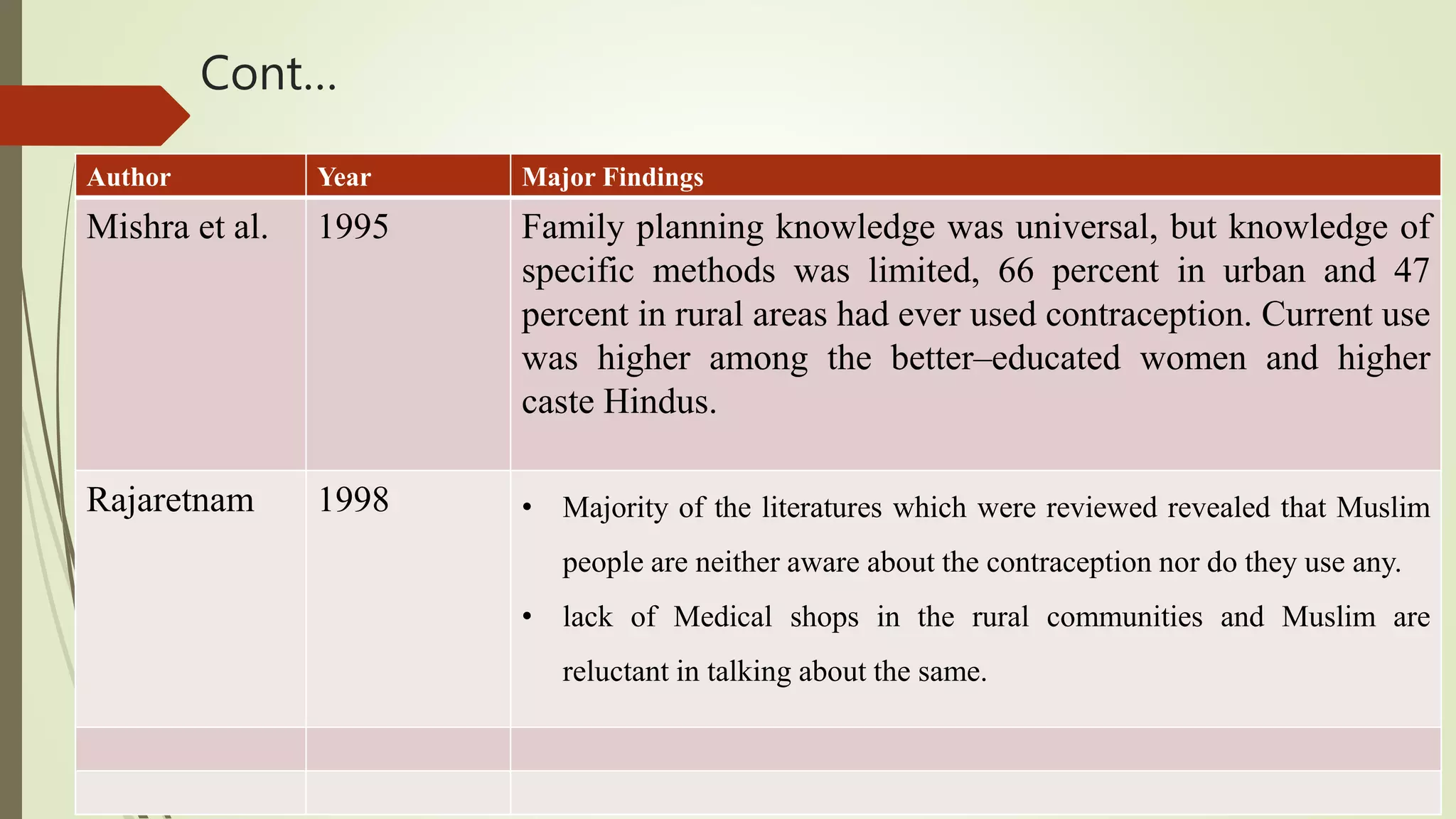
Cont…
Author Year Major Findings
Mishra et al. 1995 Family planning knowledge was universal, but knowledge of
specific methods was limited, 66 percent in urban and 47
percent in rural areas had ever used contraception. Current use
was higher among the better–educated women and higher
caste Hindus.
Rajaretnam 1998 • Majority of the literatures which were reviewed revealed that Muslim
people are neither aware about the contraception nor do they use any.
• lack of Medical shops in the rural communities and Muslim are
reluctant in talking about the same.
Methodology
 AIM OF THE STUDY :
To understand the awareness and perception regarding contraception among Muslim youth (Male)
in Gautam Buddh Nagar (U.P)
 OBJECTIVE OF THE STUDY:
 To understand level of awareness regarding contraception among Muslim youth (male).
 To understand the perception of Muslim youth (male) regarding the use of Contraception
methods.
 To analyse the challenges in accessing the contraceptive service by Muslim youth (male).
Cont.
OPERATIONAL DEFINITION
Youth
Contraception
RESEARCH DESIGN:
Descriptive Research
Sample and sampling
 Universe- the universe of the study was greater Noida.
 Sample Unit – for the present study the sample unit was Married Muslim
Youth(Male).
 Inclusion Criteria:
Muslim Youth (Male) who were married and under the age group of 21 to 40 was
included in the study.
Exclusion Criteria:
Muslim Youth (male) who were below the age of 21 years and who had Sexual diseases
were excluded from the study.
Cont…
Sample Size: 80 married Muslim youth(male) were selected for
the collection of the data from the greater Noida.
Sample technique
Non probability sampling technique
Cont.
Data Collection
For the study the primary source of data used
Tools
Socio-Demographic Schedule
Interview schedule
Con…
 Data Analysis:
The data which was collected was analyzed through SPSS (Statistical Package for Social
Sciences).
 Ethical Consideration:
Informant consent was taken from the respondents about his willingness to participate in the
study after explaining the purpose of the study. The interview schedule prepared for data
collection was not contain any discriminating or unacceptable language that could be
offensive to any members. All the information collected was kept confidential. If any one of
them wanted to go in between the interview he was allowed to go.
Major finding of the study
 Majority of the respondents were uneducated or level of education was very low.
 Majority of the respondents were involved in the labour class due to lack of
education.
 50 % of the respondents had 4-8 number of children which shows higher birth rate in
comparison to other and 38.3% of the respondents had 1-4 children.
 Significant number of the respondents has heard about the any type of contraception.
 Majority of the respondents have knowledge about only condom and very less
percentage number of the respondent has knowledge about other contraception
method.
Cont.
 Majority (71%) of the respondents know about the contraception through the friends
and very less percentage of the respondents know about the contraception through
the family members.
 Around 67.5% of the respondents did not use any method of contraception.
 Majority of the respondents were not aware about the family planning.
 More than 75% of the respondents have knowledge about the provision in Islam for
the Contraception.
 More than 62.5% of the respondents do not know about the expiry date due to lack
of education.
 Around 67.5 % of the respondents said that no one comfortable in talking about the
contraception. It was not common in society.
0
20
40
60
PREVENTION
OF
PREGNANCY
INDUCING
ABORTION
SEXUAL
ABSISTENCE
PREVENTING
BIRTH
Series 1 Column1 Column2 5000-10000 10000-15000 15000-20000 20000-25000
61.30%
17.50%
11.30% 10.00%
Series 1 Series 2 Series 3
Meaning of contraception Financial condition
51.3
31.3
15
2.5
one year Two Year Three Year four Year
45
31.3
23.8
Good
Bad
Do not know
0% 20% 40% 60% 80% 100%
Prevent the pregnancy
Prevent Only STD
Space Child birth
Prevent Both Pregnancy and STD
43.8
22.5
16.3
17.5
Axis Title
Series 1 Column1 Column2
Brother/Sister
1%
Friends
71%
Tv/Radio
28%
Perception use of contraception
Minimum gap between children
Reason for using contraception
Source of contraception knowledge
0%
20%
40%
60%
80%
100%
Condom Permanent
method
Injection Traditional
Method
58.8 23.8 15 2.5
Series 1 Column1 Column2
One child,
1.3
Two
Children,
17.5
Three
Children,
23.8
More than
Three
Children,
57.5
0
10
20
30
40
50
60
70
ONE CHILD TWO CHILDREN THREE
CHILDREN
MORE THAN
THREE
CHILDREN
13.8
21.3
65
0
0.2
0.4
0.6
0.8
1
1.2
-20
0
20
40
60
80
100
Close Nearby Far
Volume Column1 Column2 Column3 Column4
Distance of medical shop
Family desire number of childrenWhich contraceptive are effective
Ever use of
contraception
Frequency Percent
No 54 67.5
Yes 26 32.5
Total 80 100
Use of contraception
Attitude towards contraception
Attitude towards
contraception
Frequency Percent
Not common in our society to
discuss
54 67.5
Shame to discuss/embarrass to
discuss
26 32.5
Total 80 100
Reason for not Using
Contraception
Frequency Percent
Had side effect 10 12.5
Cultural Restriction 53 66.3
Having more children 17 21.3
Total 80 100
Reason for not using contraception
Nature of medical
shopkeeper
Frequency Percent
No 25 31.3
Yes 55 68.8
Total 80 100
Nature of shopkeeper
Limitation of the study
 The study sample size was small due to which a clear cut generalisation cannot be
made.
 Only male Muslim members were studied, due to which the perception of women
was not taken into account.
 The study was conducted in a particular area only so it cannot be generalised to
other areas.
Social Work Intervention
On a micro level a social worker can work with families and use
counselling to tell them the consequences of not using the contraception
and benefit of using contraception.
A social worker can collaborate with the influential person who aware
about the Islamic knowledge as well has knowledge about the
contraception. Through it the myths of not using the contraception should
be tackle.
A social worker can conduct awareness programme about the
contraception and help to establish a medical shop in the community.
A social worker can collaboration with non-government organization who
works on family planning.
Recommendation for further studies
The researcher for further study must take into account the female
members as well.
The researcher for further study must take into consideration other area
greater Noida and compare it with the current study.
Sample size of the study must be more than the current study has taken
to ensure generalisation of the facts.
The researcher should conduct study on topic other than knowledge
and perception about contraception among married Muslim youth.
Implication of the Study
There are very less studies available for family planning among Muslim
community in India. This study will provide a gist of use of contraception
and other family planning techniques used by the Muslim Community in
India. This study will provide a view of Muslim Community towards the
use of contraception and family planning. Also this study will help
government to make adequate and efficient policies for the use of
contraception and family planning.
Summary and Conclusion
 After analysing results it can be concluded that there is lack of awareness among
the Muslim Population. The reason for their unawareness are that they are reluctant
to change, lack of education, their socio-economic background and lack of
availability of Chemists shop in their areas.
 The people believe that kids are the gift of God and using contraception would
offend God. Also they live in a constant fear of getting attacked by people of other
religion or/and getting eliminated from the society because of their religion. They
believe that having more children will help them during communal violence.
Thank You

contraception

  • 1.
  • 2.
    Contents  Title ofthe study  Introduction  Review of literature  Research methodology  Major findings of the research  Limitation of the study  Social work intervention  Recommendation for further studies  Implication  Summary and Conclusion
  • 3.
    Title of thestudy The Awareness and Perception Regarding Contraception among Muslim youth (male): A study of Gautam Buddh Nagar (U.P)
  • 4.
    Introduction Currently India isthe second most populous country in the world contributing 20% of births worldwide.(W.H.O, 2006) The analysis show that socio economic factors do not explain lower user of family planning and higher fertility among Muslims The reason may be a greater opposing of family planning among Muslim which is indicated in survey done by world health organization as their main reason for not currently using and not intending to use family planning in future.
  • 5.
    Review of literature Theunderstanding the topic the literature review is done on the following topics: • Literature related to the knowledge and awareness about contraception • Literature review related to perception towards contraception • Literature review related to practice of contraception
  • 6.
    Review of Literature AuthorYear Major Findings Rajat Kapoor 2008 It was found that majority of youths had heard of contraceptives (89%) but awareness regarding use and side-effects was low. Dehre K. L. 2003 awareness was low for modern contraception and contraceptive prevalence (21%) was very low. If the population can be sensitized to the idea that Islam does not necessarily discourage contraception. Saxena N. C. 2003 It was found that total of 55.2% of subjects were aware of contraceptive methods. Permanent methods were known to nearly 50% subjects but acceptance was very less. 5% only majority of women had a favourable attitude towards family planning but knowledge of using long-acting new methods is still low, which need to be promoted.
  • 7.
    Cont… Author Year MajorFindings Mishra et al. 1995 Family planning knowledge was universal, but knowledge of specific methods was limited, 66 percent in urban and 47 percent in rural areas had ever used contraception. Current use was higher among the better–educated women and higher caste Hindus. Rajaretnam 1998 • Majority of the literatures which were reviewed revealed that Muslim people are neither aware about the contraception nor do they use any. • lack of Medical shops in the rural communities and Muslim are reluctant in talking about the same.
  • 8.
    Methodology  AIM OFTHE STUDY : To understand the awareness and perception regarding contraception among Muslim youth (Male) in Gautam Buddh Nagar (U.P)  OBJECTIVE OF THE STUDY:  To understand level of awareness regarding contraception among Muslim youth (male).  To understand the perception of Muslim youth (male) regarding the use of Contraception methods.  To analyse the challenges in accessing the contraceptive service by Muslim youth (male).
  • 9.
  • 10.
    Sample and sampling Universe- the universe of the study was greater Noida.  Sample Unit – for the present study the sample unit was Married Muslim Youth(Male).  Inclusion Criteria: Muslim Youth (Male) who were married and under the age group of 21 to 40 was included in the study. Exclusion Criteria: Muslim Youth (male) who were below the age of 21 years and who had Sexual diseases were excluded from the study.
  • 11.
    Cont… Sample Size: 80married Muslim youth(male) were selected for the collection of the data from the greater Noida. Sample technique Non probability sampling technique
  • 12.
    Cont. Data Collection For thestudy the primary source of data used Tools Socio-Demographic Schedule Interview schedule
  • 13.
    Con…  Data Analysis: Thedata which was collected was analyzed through SPSS (Statistical Package for Social Sciences).  Ethical Consideration: Informant consent was taken from the respondents about his willingness to participate in the study after explaining the purpose of the study. The interview schedule prepared for data collection was not contain any discriminating or unacceptable language that could be offensive to any members. All the information collected was kept confidential. If any one of them wanted to go in between the interview he was allowed to go.
  • 14.
    Major finding ofthe study  Majority of the respondents were uneducated or level of education was very low.  Majority of the respondents were involved in the labour class due to lack of education.  50 % of the respondents had 4-8 number of children which shows higher birth rate in comparison to other and 38.3% of the respondents had 1-4 children.  Significant number of the respondents has heard about the any type of contraception.  Majority of the respondents have knowledge about only condom and very less percentage number of the respondent has knowledge about other contraception method.
  • 15.
    Cont.  Majority (71%)of the respondents know about the contraception through the friends and very less percentage of the respondents know about the contraception through the family members.  Around 67.5% of the respondents did not use any method of contraception.  Majority of the respondents were not aware about the family planning.  More than 75% of the respondents have knowledge about the provision in Islam for the Contraception.  More than 62.5% of the respondents do not know about the expiry date due to lack of education.  Around 67.5 % of the respondents said that no one comfortable in talking about the contraception. It was not common in society.
  • 16.
    0 20 40 60 PREVENTION OF PREGNANCY INDUCING ABORTION SEXUAL ABSISTENCE PREVENTING BIRTH Series 1 Column1Column2 5000-10000 10000-15000 15000-20000 20000-25000 61.30% 17.50% 11.30% 10.00% Series 1 Series 2 Series 3 Meaning of contraception Financial condition
  • 17.
    51.3 31.3 15 2.5 one year TwoYear Three Year four Year 45 31.3 23.8 Good Bad Do not know 0% 20% 40% 60% 80% 100% Prevent the pregnancy Prevent Only STD Space Child birth Prevent Both Pregnancy and STD 43.8 22.5 16.3 17.5 Axis Title Series 1 Column1 Column2 Brother/Sister 1% Friends 71% Tv/Radio 28% Perception use of contraception Minimum gap between children Reason for using contraception Source of contraception knowledge
  • 18.
    0% 20% 40% 60% 80% 100% Condom Permanent method Injection Traditional Method 58.823.8 15 2.5 Series 1 Column1 Column2 One child, 1.3 Two Children, 17.5 Three Children, 23.8 More than Three Children, 57.5 0 10 20 30 40 50 60 70 ONE CHILD TWO CHILDREN THREE CHILDREN MORE THAN THREE CHILDREN 13.8 21.3 65 0 0.2 0.4 0.6 0.8 1 1.2 -20 0 20 40 60 80 100 Close Nearby Far Volume Column1 Column2 Column3 Column4 Distance of medical shop Family desire number of childrenWhich contraceptive are effective
  • 19.
    Ever use of contraception FrequencyPercent No 54 67.5 Yes 26 32.5 Total 80 100 Use of contraception Attitude towards contraception Attitude towards contraception Frequency Percent Not common in our society to discuss 54 67.5 Shame to discuss/embarrass to discuss 26 32.5 Total 80 100
  • 20.
    Reason for notUsing Contraception Frequency Percent Had side effect 10 12.5 Cultural Restriction 53 66.3 Having more children 17 21.3 Total 80 100 Reason for not using contraception Nature of medical shopkeeper Frequency Percent No 25 31.3 Yes 55 68.8 Total 80 100 Nature of shopkeeper
  • 21.
    Limitation of thestudy  The study sample size was small due to which a clear cut generalisation cannot be made.  Only male Muslim members were studied, due to which the perception of women was not taken into account.  The study was conducted in a particular area only so it cannot be generalised to other areas.
  • 22.
    Social Work Intervention Ona micro level a social worker can work with families and use counselling to tell them the consequences of not using the contraception and benefit of using contraception. A social worker can collaborate with the influential person who aware about the Islamic knowledge as well has knowledge about the contraception. Through it the myths of not using the contraception should be tackle. A social worker can conduct awareness programme about the contraception and help to establish a medical shop in the community. A social worker can collaboration with non-government organization who works on family planning.
  • 23.
    Recommendation for furtherstudies The researcher for further study must take into account the female members as well. The researcher for further study must take into consideration other area greater Noida and compare it with the current study. Sample size of the study must be more than the current study has taken to ensure generalisation of the facts. The researcher should conduct study on topic other than knowledge and perception about contraception among married Muslim youth.
  • 24.
    Implication of theStudy There are very less studies available for family planning among Muslim community in India. This study will provide a gist of use of contraception and other family planning techniques used by the Muslim Community in India. This study will provide a view of Muslim Community towards the use of contraception and family planning. Also this study will help government to make adequate and efficient policies for the use of contraception and family planning.
  • 25.
    Summary and Conclusion After analysing results it can be concluded that there is lack of awareness among the Muslim Population. The reason for their unawareness are that they are reluctant to change, lack of education, their socio-economic background and lack of availability of Chemists shop in their areas.  The people believe that kids are the gift of God and using contraception would offend God. Also they live in a constant fear of getting attacked by people of other religion or/and getting eliminated from the society because of their religion. They believe that having more children will help them during communal violence.
  • 26.