SSR Inst. Int. J. Life Sci. ISSN (O): 2581-8740 | ISSN (P): 2581-8732
Dawra et al., 2020
DOI: 10.21276/SSR-IIJLS.2020.6.1.2
Copyright © 2015–2020| SSR-IIJLS by Society for Scientific Research under a CC BY-NC 4.0 International License Volume 06 | Issue 01 | Page 2455
Knowledge, Attitude and Practices of Contraceptive Methods in
Women of Reproductive Age Group in an Urban District of Haryana
Sanjana Dawra1
, Sarita Goyal2
*, Mahesh Chander Gupta3
1
Junior Resident, Department of Pharmacology, Pt. B.D. Sharma, Post Graduate Institute of Medical Sciences, Rohtak
(Haryana), India
2
Associate Professor, Department of Pharmacology, Pt. B.D. Sharma, Post Graduate Institute of Medical Sciences, Rohtak
(Haryana), India
3
Senior Professor and Head, Department of Pharmacology, Pt. B.D. Sharma, Post Graduate Institute of Medical Sciences,
Rohtak (Haryana), India
*Address for Correspondence: Dr. Sarita Goyal, Associate Professor, Department of Pharmacology, Pt. B.D. Sharma,
PGIMS Rohtak, Haryana 124001, India
E-mail: drsaritagoyal@rediffmail.com
Received: 08 Jul 2019/ Revised: 19 Sep 2019/ Accepted: 14 Dec 2019
ABSTRACT
Background: India ranks 2nd
amongst the world’s most populous countries with a birth rate of 19 births/1000 population and is
projected to attain the first position by 2024, surpassing the population of China. Awareness regarding contraceptive practices can
have multiple health and economic benefits.
Methods: This was a cross-sectional questionnaire-based study, done among 260 women between the age group of 18–50 years,
who was questioned by a pre-set proforma, which included the details of knowledge, attitude, and practice regarding
contraceptive use.
Results: Mean age of the study participants was 26.3 years. Around 97.69% of women had heard about contraception. The most
common contraceptive used i.e. condom 38.07%, followed by pills (24.61%) and IUDs (13.64%). Implants, diaphragms, female
condoms were the least practiced methods of contraception. Maximum women (71.53%) had gained knowledge regarding
contraception through TV, radio or newspapers. Almost every working woman was aware of contraception and around 95% of
housewives had heard of contraceptive practices. 42.85% and 18.26% housewives and working women, respectively felt the
awkwardness in asking about contraceptives. More than 70% of working women believed in encouraging their family members
regarding contraceptive practices, followed by housewives.
Conclusion: Occupation was an important factor related to the adoption and understanding of the concept of family planning in
the population. There should be increased counseling of couples as well as the family members, regarding contraceptive methods,
and it should be two-way communication.
Key-words: Attitude, Contraceptives, Knowledge, Practice, Population growth, Unsustainable population
INTRODUCTION
Awareness, attitude and understanding of the
responsibilities of the residents of a nation towards their
land constitute the heart of its feasible growth and
development. Out of all the issues, which India is fighting
in the current scenario, uncontrolled population growth
is the most important limiting factor, which halts the
How to cite this article
Dawra S, Goyal S, Gupta MC. Knowledge, Attitude and Practices of
Contraceptive Methods in Women of Reproductive Age Group in
an Urban District of Haryana. SSR Inst. Int. J. Life Sci., 2020; 6(1):
2455-2461.
Access this article online
https://iijls.com/
progressive development of the nation.
Family planning is the key to slowing unsustainable
population growth that has multiple negative impacts on
the economy, environment and maternal as well as
infant health. Family planning refers to a conscious effort
by a couple to limit or space the number of children;
they have through the use of contraceptive methods [1]
.
WHO has defined family planning as giving a chance to
society to determine the number of children and
pregnancy spacing through contraceptive methods [2]
.
According to Tsehaye et al. [3]
, maternal and infant
mortality can be reduced by a minimum of 25% through
appropriate family planning programs and birth spacing
in developing countries. India was the first country in the
Research Article
SSR Inst. Int. J. Life Sci. ISSN (O): 2581-8740 | ISSN (P): 2581-8732
Dawra et al., 2020
DOI: 10.21276/SSR-IIJLS.2020.6.1.2
Copyright © 2015–2020| SSR-IIJLS by Society for Scientific Research under a CC BY-NC 4.0 International License Volume 06 | Issue 01 | Page 2456
world to implement a national population control
programme in year 1952 but is still struggling to contain
the baby boom [4]
. India ranks 2nd
amongst the world’s
most populous countries with a birth rate of 19
births/1,000 population and is projected to be the
world's most populous country by 2024, surpassing the
population of China [5]
. Many efficacious methods of
contraception, such as condoms, pills, diaphragms, IUDs,
implant, male sterilization (vasectomy), female
sterilization (tubectomy) are easily available. Despite
these many alternatives, the incidence of unwanted
pregnancies still remains high in many countries.
According to Singh et al. [6]
15·6 million abortions (range
14·1 million–17·3 million) took place in India in 2015,
giving an abortion rate of 47·0 (42·2–52·1) per 1000
women aged 15–49 years. These findings give an
impression that the majority of women are unaware of
the need for contraception and many have still not
identified an ideal method of contraception, which fits
their lifestyle and meets their personal requirements [7]
.
Increased usage of contraceptives during the postpartum
period and spacing a new pregnancy to at least 3 years
after the previous birth substantially reduces the rates of
maternal and infant mortality by preventing unwanted
pregnancies [8]
. According to Conde et al. [9]
, there is an
increased risk of maternal morbidity and complications
in pregnancies with women with short birth intervals
(<24 months). Acceptance and adoption of contraceptive
practices can control unwanted pregnancies, thus
reducing the potential complications related to them, as
well as have a significant positive impact on women’s
general health and quality of life due to their physical
and psychological growth [10]
. The perception of family
planning by women is also dependent on good
knowledge and has a great impact on their attitudes and
practices [11]
. Women could potentially be benefiting
from increased awareness and guidance on
contraceptive practices and can be assured that their
chosen method is the best suitable method according to
their individual needs. Most of the reproductive age
women have little or incorrect information about family
planning methods. Even, when they are aware of some
names of contraceptives, they don’t know where to avail
them or how to use them. In order to follow old
traditions and misleading information that is being
passed in their family for generations, women tend to
have negative attitudes about their health problems,
newer techniques and the importance of family planning
[12]
. This study was conducted with an objective to assess
the knowledge, attitude and practices (KAP) of family
planning methods and various socio-demographic
parameters and enhance the contraceptive practices
among the women in an urban area of Haryana, so as to
have a positive impact on their beliefs regarding the use
of contraceptive methods.
MATERIALS AND METHODS
Study design and participants- It was a cross-sectional
study conducted in the area of Rohtak district, Haryana
by the Department of Pharmacology, Pt. B.D. Sharma,
PGIMS, Rohtak, India from July 2019 to September 2019.
The study participants were enrolled by conducting a
survey of both married and unmarried women attending
the Outpatient Departments (OPD) in PGIMS Rohtak,
Haryana. Prior consent was obtained from the
participants before the interview.
Inclusion Criteria- Women in the reproductive age group
residing in that area.
Exclusion Criteria- Women, who refused to participate in
the study.
Study design- A pre-tested; pre-designed questionnaire
was used by the investigator to interview the selected
participants. A total of 260 women of reproductive age
group (16–50 years) were enrolled in the study and
asked about the questions included in the study. The
questionnaire had two domains, the first domain
consisted of 7 demographic questions and second
domain consisted of 12 questions that assessed their
knowledge, attitude and practices of contraception. The
questionnaire included information regarding age,
education, occupation, religion, knowledge, attitude,
practices towards various family planning methods etc.
The questionnaire was first validated by conducting a
pilot study on 30 women and the required changes were
made in the proforma.
Statistical Analysis: The collected data was entered into
an excel sheet and it was analyzed using percentage and
test of proportions. The responses to the schedule by
each participant were entered into an excel sheet. The
data was tabulated and statistical analysis done by using
SPSS (Statistical Package for the Social Sciences)
software, version 23.0. This study was conducted to
SSR Inst. Int. J. Life Sci. ISSN (O): 2581-8740 | ISSN (P): 2581-8732
Dawra et al., 2020
DOI: 10.21276/SSR-IIJLS.2020.6.1.2
Copyright © 2015–2020| SSR-IIJLS by Society for Scientific Research under a CC BY-NC 4.0 International License Volume 06 | Issue 01 | Page 2457
assess current levels of usage and awareness of different
forms of contraception, reasons for choosing or changing
methods and sources of information.
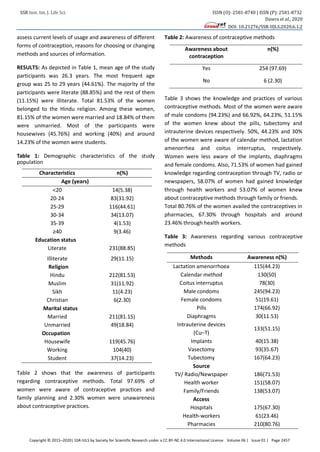
RESULTS: As depicted in Table 1, mean age of the study
participants was 26.3 years. The most frequent age
group was 25 to 29 years (44.61%). The majority of the
participants were literate (88.85%) and the rest of them
(11.15%) were illiterate. Total 81.53% of the women
belonged to the Hindu religion. Among these women,
81.15% of the women were married and 18.84% of them
were unmarried. Most of the participants were
housewives (45.76%) and working (40%) and around
14.23% of the women were students.
Table 1: Demographic characteristics of the study
population
Characteristics n(%)
Age (years)
<20 14(5.38)
20-24 83(31.92)
25-29 116(44.61)
30-34 34(13.07)
35-39 4(1.53)
≥40 9(3.46)
Education status
Literate 231(88.85)
Illiterate 29(11.15)
Religion
Hindu 212(81.53)
Muslim 31(11.92)
Sikh 11(4.23)
Christian 6(2.30)
Marital status
Married 211(81.15)
Unmarried 49(18.84)
Occupation
Housewife 119(45.76)
Working 104(40)
Student 37(14.23)
Table 2 shows that the awareness of participants
regarding contraceptive methods. Total 97.69% of
women were aware of contraceptive practices and
family planning and 2.30% women were unawareness
about contraceptive practices.
Table 2: Awareness of contraceptive methods
Awareness about
contraception
n(%)
Yes 254 (97.69)
No 6 (2.30)
Table 3 shows the knowledge and practices of various
contraceptive methods. Most of the women were aware
of male condoms (94.23%) and 66.92%, 64.23%, 51.15%
of the women knew about the pills, tubectomy and
intrauterine devices respectively. 50%, 44.23% and 30%
of the women were aware of calendar method, lactation
amenorrhea and coitus interruptus, respectively.
Women were less aware of the implants, diaphragms
and female condoms. Also, 71.53% of women had gained
knowledge regarding contraception through TV, radio or
newspapers, 58.07% of women had gained knowledge
through health workers and 53.07% of women knew
about contraceptive methods through family or friends.
Total 80.76% of the women availed the contraceptives in
pharmacies, 67.30% through hospitals and around
23.46% through health workers.
Table 3: Awareness regarding various contraceptive
methods
Methods Awareness n(%)
Lactation amenorrhoea 115(44.23)
Calendar method 130(50)
Coitus interruptus 78(30)
Male condoms 245(94.23)
Female condoms 51(19.61)
Pills 174(66.92)
Diaphragms 30(11.53)
Intrauterine devices
(Cu–T)
133(51.15)
Implants 40(15.38)
Vasectomy 93(35.67)
Tubectomy 167(64.23)
Source
TV/ Radio/Newspaper 186(71.53)
Health worker 151(58.07)
Family/Friends 138(53.07)
Access
Hospitals 175(67.30)
Health-workers 61(23.46)
Pharmacies 210(80.76)
SSR Inst. Int. J. Life Sci. ISSN (O): 2581-8740 | ISSN (P): 2581-8732
Dawra et al., 2020
DOI: 10.21276/SSR-IIJLS.2020.6.1.2
Copyright © 2015–2020| SSR-IIJLS by Society for Scientific Research under a CC BY-NC 4.0 International License Volume 06 | Issue 01 | Page 2458
As depicted in Table 4, 92.30% of women believed that
using contraception was beneficial, 73.07% of women
encouraged their family members to support
contraception, 33.07% of women were embarrassed,
while buying or asking about contraception, 17.69% of
women had difficulty in availing contraceptives.
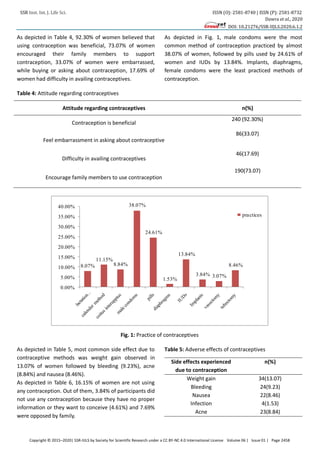
As depicted in Fig. 1, male condoms were the most
common method of contraception practiced by almost
38.07% of women, followed by pills used by 24.61% of
women and IUDs by 13.84%. Implants, diaphragms,
female condoms were the least practiced methods of
contraception.
Table 4: Attitude regarding contraceptives
Attitude regarding contraceptives n(%)
Contraception is beneficial
240 (92.30%)
Feel embarrassment in asking about contraceptive
86(33.07)
Difficulty in availing contraceptives
46(17.69)
Encourage family members to use contraception
190(73.07)
8.07%
11.15%
8.84%
38.07%
24.61%
1.53%
13.84%
3.84% 3.07%
8.46%
0.00%
5.00%
10.00%
15.00%
20.00%
25.00%
30.00%
35.00%
40.00%
practices
Fig. 1: Practice of contraceptives
As depicted in Table 5, most common side effect due to
contraceptive methods was weight gain observed in
13.07% of women followed by bleeding (9.23%), acne
(8.84%) and nausea (8.46%).
As depicted in Table 6, 16.15% of women are not using
any contraception. Out of them, 3.84% of participants did
not use any contraception because they have no proper
information or they want to conceive (4.61%) and 7.69%
were opposed by family.
Table 5: Adverse effects of contraceptives
Side effects experienced
due to contraception
n(%)
Weight gain 34(13.07)
Bleeding 24(9.23)
Nausea 22(8.46)
Infection 4(1.53)
Acne 23(8.84)
SSR Inst. Int. J. Life Sci. ISSN (O): 2581-8740 | ISSN (P): 2581-8732
Dawra et al., 2020
DOI: 10.21276/SSR-IIJLS.2020.6.1.2
Copyright © 2015–2020| SSR-IIJLS by Society for Scientific Research under a CC BY-NC 4.0 International License Volume 06 | Issue 01 | Page 2459
Table 6: Reasons for not using any contraception
n(%)
Women not using any
contraception
42(16.15)
Reasons n(%)
Want to get pregnant 12(4.61)
No proper information 10(3.84)
Family opposes 20(7.69)
As depicted in Table 7, the majority of the working
women and students have heard of at least one family
planning method and almost 90% thought that using
contraception is beneficial. Students and housewives
were almost embarrassed at the same level, whereas
working women were least embarrassed (18.26%)
regarding the discussion of contraception. More than
70% of working women and students believed in
encouraging their family members regarding
contraception, followed by housewives.
Table 7: Knowledge, attitude and practices of women
according to their occupation
Housewives
(n =119)
Working
(n =104)
Students
(n=37)
Heard of
contraception
113(94.95%) 104(100%) 37(100%)
Contraception
is beneficial
108(90.75%) 99(95.19%) 33(89.18%)
Feel
embarrassment
in asking about
contraceptive
51(42.85%) 19(18.26%) 16(43.24%)
Encourage
family members
to use
contraception
82(68.90%) 81(77.88%) 27(72.97%)
DISCUSSION
This study evaluated the data of 260 participants, most
of them (44.61%) were in the age group of 25–29 years.
88.84% of the participants were literate, 81.15% of the
women were married and 81.53% of the women
belonged to the Hindu religion. Most of the participants
were housewives (45.61%) and working (40%) and
around 14.23% of the women were students. According
to NFHS-4 around 99% of women in Haryana had
knowledge regarding any one of the contraceptive
methods [13]
. According to this study, around 97.69% of
women had heard of contraception. In the present study,
the most common contraceptive used was condom
(38.07%), followed by pills (24.61%) and IUDs (13.64%).
Implants, diaphragms, female condoms are the least
practiced methods of contraception which was also
similar to the study by Kashyap and Prasad [14]
according
to which most of the women were using male condoms
(55%) followed by oral contraceptive pills (OCPs) (26%),
intrauterine contraceptive device (13%). According to
the study of Nigar [15]
barrier method (condoms) was in
practice by 26.8%, pills in 5.6%, Cu T users were 3.2%
and 1.2% were using DMPA (Depo-Medroxyprogesterone
Acetate) for contraception.
Due to their low cost, availability and convenience, oral
pills and condoms are the most preferred contraceptive
methods [16]
. In this study, it was observed that the
majority of women (71.53%) had gained knowledge
regarding contraception through TV, radio or
newspapers, followed by health workers and family or
friends. This observation was also consistent with the
study of Kashyap and Prasad [14]
according to which a
major source of knowledge about family planning
methods was mass media (54%), health facility (42%),
followed by personal relations i.e. spouse, friends, and
relatives (34%), and magazines (21%). In another study,
most patients came to know about contraception from
television, doctors and other healthcare giver [17]
.
According to Sharma and Valente [18]
women, who was
exposed to Radio programmes had significantly
discussed family planning with their spouse. In around
8% of women, it was observed that the reason for not
using contraception was an opposition to the family or
husband. In a study, it was observed that wives are
more likely to use contraception if their husband
approve of it, or couples discuss this topic which each
other and plan accordingly Lasee and Becker [19]
.
According to Hemavarneshwari et al. [20]
around 7.2% of
women were opposed by family members. In this study,
it was observed that weight gain followed by bleeding
(9.23%), acne (8.84%) and nausea (8.46%) were the most
common side effect associated with contraceptive
methods. According to Thapa et al. [21]
, commonest side
effects were weight gain and menstrual irregularities
SSR Inst. Int. J. Life Sci. ISSN (O): 2581-8740 | ISSN (P): 2581-8732
Dawra et al., 2020
DOI: 10.21276/SSR-IIJLS.2020.6.1.2
Copyright © 2015–2020| SSR-IIJLS by Society for Scientific Research under a CC BY-NC 4.0 International License Volume 06 | Issue 01 | Page 2460
followed by heavy bleeding (20.5%) and amenorrhea
(18.2%). According to this study, most working women
and students believed in encouraging their family
members regarding contraception and were less
embarrassed in asking about contraceptive practices,
followed by housewives. It has been observed in various
studies that more empowerment and education of
women can change their attitude and beliefs regarding
their safety, health promotion and could improve the use
of contraceptives [21,22]
. The adoption of Family planning
is not just related to control the birth rate, it is also
associated with programmes, policies, interventions,
awareness, information and practices which provide all
the individuals with the ability to understand and
promote measures for better health outcomes [23]
.
Konkane et al. [24]
mentioned that encouragement and a
good knowledge of healthcare workers, thus decreasing
the fear of side effects and myths, and counseling of
husbands are very important to improve the
perspectives regarding contraceptive use among the
population. The government needs to improve the
education provided by family planning healthcare
workers [25]
.
CONCLUSIONS
Occupation and literacy are the utmost important factors
for understanding of the concept of family planning in
the population. Family members play an important role
in supporting women for the adoption of family planning
therefore the involvement of family members during the
counseling sessions should be increased, thus limiting
the myths and misbelieve regarding contraceptive
practices.
Mass media and health workers played an important role
in educating women, the internet can be used or social
media can be utilized in this era to grab the attention of
people regarding these practices.
ACKNOWLEDGMENTS
I gratefully acknowledge Dr. M.C. Gupta and Dr Sarita
Goyal. Their ever available guidance, ability to pinpoint
minor details, inexhaustible encouragement and efforts
on suggesting, designing, advising and improving the
study has enabled me to complete the study. I also
acknowledge the participants for their support and
patience.
CONTRIBUTION OF AUTHORS
Research concept- Dr. MC Gupta, Dr. Sarita Goyal, Dr.
Sanjana Dawra
Research design- Dr. MC Gupta, Dr. Sarita Goyal, Dr.
Sanjana Dawra
Supervision- Dr. MC Gupta, Dr. Sarita Goyal
Data collection- Dr. Sanjana Dawra
Data analysis and Interpretation- Dr. MC Gupta, Dr.
Sarita Goyal, Dr. Sanjana Dawra
Literature search- Dr. MC Gupta, Dr. Sarita Goyal, Dr.
Sanjana Dawra
Writing article- Dr. MC Gupta, Dr. Sarita Goyal, Dr.
Sanjana Dawra
Critical review- Dr. MC Gupta, Dr. Sarita Goyal
Article editing- Dr. MC Gupta, Dr. Sarita Goyal
Final approval- Dr. MC Gupta, Dr. Sarita Goyal
REFERENCES
[1] Etefagh M, Shojaeizadeh D, Nori K, Sadeghi R. The
effect of education to reduce depression rate in
women with a history of tubal ligation surgery. J.
Educ. Community Health, 2014; 1(1): 55-61.
[2] World health organization [Internet]. Family
planning/contraception. (Accessed on 17/11/2019).
Available from: http://who.int/en/news-room/fact-
sheets/detail/family-planning-contraception, 2018.
[3] Tsehaye WT, Mengistu D, Birhanu E, Berhe KK.
Assessment of preference and its determinant
factors to ward modern contraceptive methods
among women of reproductive age group in shire
Indaselassie town, Northern Ethiopia. Int. J. Family
Med., 2013; 2: 34-40.
[4] Renjhen P, Kumar A, Pattanshetty S, Sagir A, Minoli
C. A study on knowledge, attitude and practice of
contraception among college students in Sikkim,
India. J. Gynecol. Assoc., 2010; 11: 78-81.
[5] United Nations Department of Economic and Social
Affairs [Internet]. [Accessed on 17/11/2019]. World
Population Prospects, 2017. Available from:
https://www.un.org/development/desa/publications
/world-population-prospects-the-2017-revision.html,
2017.
[6] Singh S, Shekhar C, Acharya R, Moore AM, Stillman
M, et al. The incidence of abortion and unintended
pregnancy in India in 2015. Lancet, 2018; 6: 111-18.
[7] Finer LB, Henshaw SK. Disparities in rates of
unintended pregnancy in the United States, 1994
SSR Inst. Int. J. Life Sci. ISSN (O): 2581-8740 | ISSN (P): 2581-8732
Dawra et al., 2020
DOI: 10.21276/SSR-IIJLS.2020.6.1.2
Copyright © 2015–2020| SSR-IIJLS by Society for Scientific Research under a CC BY-NC 4.0 International License Volume 06 | Issue 01 | Page 2461
and 2001. Perspect. Sex Reprod. Health, 2006; 38:
90–96.
[8] RVernon. Meeting the family planning needs of
postpartum women. Stud. Fam. Plann., 2009; 40(3):
235-45.
[9] Conde AA, Belizán JM. Maternal morbidity and
mortality associated with interpregnancy interval:
cross sectional study. BMJ, 2000; 321(7271): 1255-
59.
[10]Wiebe ER, Littman L, Kaczorowski J. Knowledge and
attitudes about contraception and abortion in
Canada, US, UK, France and Australia. Gynecol.
Obstet., 2015; 5(9): 1–10.
[11]Aryretey R, Kotoh AM, Hindin MJ. Knowledge,
perceptions and ever use of modern contraception
among women in east district, Ghana. Afr. J. Reprod.
Health, 2010; 14(4): 27-32.
[12]Johnson S, Pion C, Jennings V. Current methods and
attitudes of women towards contraception in Europe
and America. Reprod. Health, 2013; 10: 1-9.
[13]National Family Health Survey (NFHS-4), India, 2015-
16: Haryana (Internet). (accessed on 17/11/2019).
Available from: https://dhsprogram.com/pubs/pdf/
FR339/ FR339.pdf.
[14]Kashyap P, Prasad S. Assessing the knowledge,
attitude and practice of contraception in semi-urban
area in India: a qualitative assessment of
contraceptive usage. IJMRHS, 2018; 7(10): 150-54.
[15]Nigar A. Contraceptive awareness, and practices
among rural women in Lucknow. IJOGR, 2018; 5(4):
454-57.
[16]Schindler AE. Non-contraceptive benefits of oral
hormonal contraceptives. I. J. E. M., 2013; 11: 41-47.
[17]Nath J, Islam F. A Study on the Knowledge, Attitude
and Practice about Contraception in Postpartum
Women of North India. IJSR, 2015; 4(12): 456-58.
[18]Sharma M, Valente T. Spousal communication and
family planning adoption: effects of a radio drama
serial in Nepal. Int. Fam. Plan. Perspect., 2002; 28:
16-25.
[19]Lasee A, Becker S. Husband wife communication
about family planning and contraceptive use in
Kenya. Int. Fam. Plan. Perspect., 1997; 23(1): 15-20.
[20]Hemavarneshwari S, Mangala S, Subrahmanyam G.
Knowledge and attitude towards family planning
practices among non-acceptors in a rural area in
Bangalore, India. Int. J. Res. Med. Sci., 2015; 3(12):
3611-13.
[21]Thapa P, Pokharel N, Shrestha M. Knowledge,
Attitude and Practices of Contraception among the
Married Women of Reproductive Age Group in
Selected Wards of Dharan Sub-Metropolitan City. J.
Contracept. Study, 2018; 3: 1-8.
[22]Shaikh B, Haran D, Hatcher J. Women’s social
position and health seeking behaviors: Is the
healthcare system accessible and responsive in
Pakistan?. Health Care Women. Int., 2008; 29: 945-
1059.
[23]Hajira S, Kishore K. Assessment of knowledge about
contraceptive methods among Bangalore Urban
Women. M. I. M. C., 2014; 1(9): 508-13.
[24]Kokane AM, Palanivel C, Mahajan PB, Nair K, Bipin
BB. Assessment of knowledge and practice of
contraception among antenatal cases attending ANC.
Clinic. Indian J. Maternal Child Health, 2011; 13(4):
2-8.
[25]Ajong AB, Njotang PN, Yakum MN, Essi MJ, Essiben F,
et al. Determinants of unmet need for family
planning among women in urban Cameroon : a cross
sectional survey in the Biyem-Assi Health District,
Yaounde. BMC Women’s Health, 2016; 16(4): 1–8.
Open Access Policy:
Authors/Contributors are responsible for originality, contents, correct references, and ethical issues. SSR-IIJLS publishes all articles under Creative
Commons Attribution- Non-Commercial 4.0 International License (CC BY-NC). https://creativecommons.org/licenses/by-nc/4.0/legalcode

Knowledge_Attitude_Practices_Contraceptive_Methods_Women_Reproductive_Age_Group.pdf

  • 1.
    SSR Inst. Int.J. Life Sci. ISSN (O): 2581-8740 | ISSN (P): 2581-8732 Dawra et al., 2020 DOI: 10.21276/SSR-IIJLS.2020.6.1.2 Copyright © 2015–2020| SSR-IIJLS by Society for Scientific Research under a CC BY-NC 4.0 International License Volume 06 | Issue 01 | Page 2455 Knowledge, Attitude and Practices of Contraceptive Methods in Women of Reproductive Age Group in an Urban District of Haryana Sanjana Dawra1 , Sarita Goyal2 *, Mahesh Chander Gupta3 1 Junior Resident, Department of Pharmacology, Pt. B.D. Sharma, Post Graduate Institute of Medical Sciences, Rohtak (Haryana), India 2 Associate Professor, Department of Pharmacology, Pt. B.D. Sharma, Post Graduate Institute of Medical Sciences, Rohtak (Haryana), India 3 Senior Professor and Head, Department of Pharmacology, Pt. B.D. Sharma, Post Graduate Institute of Medical Sciences, Rohtak (Haryana), India *Address for Correspondence: Dr. Sarita Goyal, Associate Professor, Department of Pharmacology, Pt. B.D. Sharma, PGIMS Rohtak, Haryana 124001, India E-mail: drsaritagoyal@rediffmail.com Received: 08 Jul 2019/ Revised: 19 Sep 2019/ Accepted: 14 Dec 2019 ABSTRACT Background: India ranks 2nd amongst the world’s most populous countries with a birth rate of 19 births/1000 population and is projected to attain the first position by 2024, surpassing the population of China. Awareness regarding contraceptive practices can have multiple health and economic benefits. Methods: This was a cross-sectional questionnaire-based study, done among 260 women between the age group of 18–50 years, who was questioned by a pre-set proforma, which included the details of knowledge, attitude, and practice regarding contraceptive use. Results: Mean age of the study participants was 26.3 years. Around 97.69% of women had heard about contraception. The most common contraceptive used i.e. condom 38.07%, followed by pills (24.61%) and IUDs (13.64%). Implants, diaphragms, female condoms were the least practiced methods of contraception. Maximum women (71.53%) had gained knowledge regarding contraception through TV, radio or newspapers. Almost every working woman was aware of contraception and around 95% of housewives had heard of contraceptive practices. 42.85% and 18.26% housewives and working women, respectively felt the awkwardness in asking about contraceptives. More than 70% of working women believed in encouraging their family members regarding contraceptive practices, followed by housewives. Conclusion: Occupation was an important factor related to the adoption and understanding of the concept of family planning in the population. There should be increased counseling of couples as well as the family members, regarding contraceptive methods, and it should be two-way communication. Key-words: Attitude, Contraceptives, Knowledge, Practice, Population growth, Unsustainable population INTRODUCTION Awareness, attitude and understanding of the responsibilities of the residents of a nation towards their land constitute the heart of its feasible growth and development. Out of all the issues, which India is fighting in the current scenario, uncontrolled population growth is the most important limiting factor, which halts the How to cite this article Dawra S, Goyal S, Gupta MC. Knowledge, Attitude and Practices of Contraceptive Methods in Women of Reproductive Age Group in an Urban District of Haryana. SSR Inst. Int. J. Life Sci., 2020; 6(1): 2455-2461. Access this article online https://iijls.com/ progressive development of the nation. Family planning is the key to slowing unsustainable population growth that has multiple negative impacts on the economy, environment and maternal as well as infant health. Family planning refers to a conscious effort by a couple to limit or space the number of children; they have through the use of contraceptive methods [1] . WHO has defined family planning as giving a chance to society to determine the number of children and pregnancy spacing through contraceptive methods [2] . According to Tsehaye et al. [3] , maternal and infant mortality can be reduced by a minimum of 25% through appropriate family planning programs and birth spacing in developing countries. India was the first country in the Research Article
  • 2.
    SSR Inst. Int.J. Life Sci. ISSN (O): 2581-8740 | ISSN (P): 2581-8732 Dawra et al., 2020 DOI: 10.21276/SSR-IIJLS.2020.6.1.2 Copyright © 2015–2020| SSR-IIJLS by Society for Scientific Research under a CC BY-NC 4.0 International License Volume 06 | Issue 01 | Page 2456 world to implement a national population control programme in year 1952 but is still struggling to contain the baby boom [4] . India ranks 2nd amongst the world’s most populous countries with a birth rate of 19 births/1,000 population and is projected to be the world's most populous country by 2024, surpassing the population of China [5] . Many efficacious methods of contraception, such as condoms, pills, diaphragms, IUDs, implant, male sterilization (vasectomy), female sterilization (tubectomy) are easily available. Despite these many alternatives, the incidence of unwanted pregnancies still remains high in many countries. According to Singh et al. [6] 15·6 million abortions (range 14·1 million–17·3 million) took place in India in 2015, giving an abortion rate of 47·0 (42·2–52·1) per 1000 women aged 15–49 years. These findings give an impression that the majority of women are unaware of the need for contraception and many have still not identified an ideal method of contraception, which fits their lifestyle and meets their personal requirements [7] . Increased usage of contraceptives during the postpartum period and spacing a new pregnancy to at least 3 years after the previous birth substantially reduces the rates of maternal and infant mortality by preventing unwanted pregnancies [8] . According to Conde et al. [9] , there is an increased risk of maternal morbidity and complications in pregnancies with women with short birth intervals (<24 months). Acceptance and adoption of contraceptive practices can control unwanted pregnancies, thus reducing the potential complications related to them, as well as have a significant positive impact on women’s general health and quality of life due to their physical and psychological growth [10] . The perception of family planning by women is also dependent on good knowledge and has a great impact on their attitudes and practices [11] . Women could potentially be benefiting from increased awareness and guidance on contraceptive practices and can be assured that their chosen method is the best suitable method according to their individual needs. Most of the reproductive age women have little or incorrect information about family planning methods. Even, when they are aware of some names of contraceptives, they don’t know where to avail them or how to use them. In order to follow old traditions and misleading information that is being passed in their family for generations, women tend to have negative attitudes about their health problems, newer techniques and the importance of family planning [12] . This study was conducted with an objective to assess the knowledge, attitude and practices (KAP) of family planning methods and various socio-demographic parameters and enhance the contraceptive practices among the women in an urban area of Haryana, so as to have a positive impact on their beliefs regarding the use of contraceptive methods. MATERIALS AND METHODS Study design and participants- It was a cross-sectional study conducted in the area of Rohtak district, Haryana by the Department of Pharmacology, Pt. B.D. Sharma, PGIMS, Rohtak, India from July 2019 to September 2019. The study participants were enrolled by conducting a survey of both married and unmarried women attending the Outpatient Departments (OPD) in PGIMS Rohtak, Haryana. Prior consent was obtained from the participants before the interview. Inclusion Criteria- Women in the reproductive age group residing in that area. Exclusion Criteria- Women, who refused to participate in the study. Study design- A pre-tested; pre-designed questionnaire was used by the investigator to interview the selected participants. A total of 260 women of reproductive age group (16–50 years) were enrolled in the study and asked about the questions included in the study. The questionnaire had two domains, the first domain consisted of 7 demographic questions and second domain consisted of 12 questions that assessed their knowledge, attitude and practices of contraception. The questionnaire included information regarding age, education, occupation, religion, knowledge, attitude, practices towards various family planning methods etc. The questionnaire was first validated by conducting a pilot study on 30 women and the required changes were made in the proforma. Statistical Analysis: The collected data was entered into an excel sheet and it was analyzed using percentage and test of proportions. The responses to the schedule by each participant were entered into an excel sheet. The data was tabulated and statistical analysis done by using SPSS (Statistical Package for the Social Sciences) software, version 23.0. This study was conducted to
  • 3.
    SSR Inst. Int.J. Life Sci. ISSN (O): 2581-8740 | ISSN (P): 2581-8732 Dawra et al., 2020 DOI: 10.21276/SSR-IIJLS.2020.6.1.2 Copyright © 2015–2020| SSR-IIJLS by Society for Scientific Research under a CC BY-NC 4.0 International License Volume 06 | Issue 01 | Page 2457 assess current levels of usage and awareness of different forms of contraception, reasons for choosing or changing methods and sources of information. RESULTS: As depicted in Table 1, mean age of the study participants was 26.3 years. The most frequent age group was 25 to 29 years (44.61%). The majority of the participants were literate (88.85%) and the rest of them (11.15%) were illiterate. Total 81.53% of the women belonged to the Hindu religion. Among these women, 81.15% of the women were married and 18.84% of them were unmarried. Most of the participants were housewives (45.76%) and working (40%) and around 14.23% of the women were students. Table 1: Demographic characteristics of the study population Characteristics n(%) Age (years) <20 14(5.38) 20-24 83(31.92) 25-29 116(44.61) 30-34 34(13.07) 35-39 4(1.53) ≥40 9(3.46) Education status Literate 231(88.85) Illiterate 29(11.15) Religion Hindu 212(81.53) Muslim 31(11.92) Sikh 11(4.23) Christian 6(2.30) Marital status Married 211(81.15) Unmarried 49(18.84) Occupation Housewife 119(45.76) Working 104(40) Student 37(14.23) Table 2 shows that the awareness of participants regarding contraceptive methods. Total 97.69% of women were aware of contraceptive practices and family planning and 2.30% women were unawareness about contraceptive practices. Table 2: Awareness of contraceptive methods Awareness about contraception n(%) Yes 254 (97.69) No 6 (2.30) Table 3 shows the knowledge and practices of various contraceptive methods. Most of the women were aware of male condoms (94.23%) and 66.92%, 64.23%, 51.15% of the women knew about the pills, tubectomy and intrauterine devices respectively. 50%, 44.23% and 30% of the women were aware of calendar method, lactation amenorrhea and coitus interruptus, respectively. Women were less aware of the implants, diaphragms and female condoms. Also, 71.53% of women had gained knowledge regarding contraception through TV, radio or newspapers, 58.07% of women had gained knowledge through health workers and 53.07% of women knew about contraceptive methods through family or friends. Total 80.76% of the women availed the contraceptives in pharmacies, 67.30% through hospitals and around 23.46% through health workers. Table 3: Awareness regarding various contraceptive methods Methods Awareness n(%) Lactation amenorrhoea 115(44.23) Calendar method 130(50) Coitus interruptus 78(30) Male condoms 245(94.23) Female condoms 51(19.61) Pills 174(66.92) Diaphragms 30(11.53) Intrauterine devices (Cu–T) 133(51.15) Implants 40(15.38) Vasectomy 93(35.67) Tubectomy 167(64.23) Source TV/ Radio/Newspaper 186(71.53) Health worker 151(58.07) Family/Friends 138(53.07) Access Hospitals 175(67.30) Health-workers 61(23.46) Pharmacies 210(80.76)
  • 4.
    SSR Inst. Int.J. Life Sci. ISSN (O): 2581-8740 | ISSN (P): 2581-8732 Dawra et al., 2020 DOI: 10.21276/SSR-IIJLS.2020.6.1.2 Copyright © 2015–2020| SSR-IIJLS by Society for Scientific Research under a CC BY-NC 4.0 International License Volume 06 | Issue 01 | Page 2458 As depicted in Table 4, 92.30% of women believed that using contraception was beneficial, 73.07% of women encouraged their family members to support contraception, 33.07% of women were embarrassed, while buying or asking about contraception, 17.69% of women had difficulty in availing contraceptives. As depicted in Fig. 1, male condoms were the most common method of contraception practiced by almost 38.07% of women, followed by pills used by 24.61% of women and IUDs by 13.84%. Implants, diaphragms, female condoms were the least practiced methods of contraception. Table 4: Attitude regarding contraceptives Attitude regarding contraceptives n(%) Contraception is beneficial 240 (92.30%) Feel embarrassment in asking about contraceptive 86(33.07) Difficulty in availing contraceptives 46(17.69) Encourage family members to use contraception 190(73.07) 8.07% 11.15% 8.84% 38.07% 24.61% 1.53% 13.84% 3.84% 3.07% 8.46% 0.00% 5.00% 10.00% 15.00% 20.00% 25.00% 30.00% 35.00% 40.00% practices Fig. 1: Practice of contraceptives As depicted in Table 5, most common side effect due to contraceptive methods was weight gain observed in 13.07% of women followed by bleeding (9.23%), acne (8.84%) and nausea (8.46%). As depicted in Table 6, 16.15% of women are not using any contraception. Out of them, 3.84% of participants did not use any contraception because they have no proper information or they want to conceive (4.61%) and 7.69% were opposed by family. Table 5: Adverse effects of contraceptives Side effects experienced due to contraception n(%) Weight gain 34(13.07) Bleeding 24(9.23) Nausea 22(8.46) Infection 4(1.53) Acne 23(8.84)
  • 5.
    SSR Inst. Int.J. Life Sci. ISSN (O): 2581-8740 | ISSN (P): 2581-8732 Dawra et al., 2020 DOI: 10.21276/SSR-IIJLS.2020.6.1.2 Copyright © 2015–2020| SSR-IIJLS by Society for Scientific Research under a CC BY-NC 4.0 International License Volume 06 | Issue 01 | Page 2459 Table 6: Reasons for not using any contraception n(%) Women not using any contraception 42(16.15) Reasons n(%) Want to get pregnant 12(4.61) No proper information 10(3.84) Family opposes 20(7.69) As depicted in Table 7, the majority of the working women and students have heard of at least one family planning method and almost 90% thought that using contraception is beneficial. Students and housewives were almost embarrassed at the same level, whereas working women were least embarrassed (18.26%) regarding the discussion of contraception. More than 70% of working women and students believed in encouraging their family members regarding contraception, followed by housewives. Table 7: Knowledge, attitude and practices of women according to their occupation Housewives (n =119) Working (n =104) Students (n=37) Heard of contraception 113(94.95%) 104(100%) 37(100%) Contraception is beneficial 108(90.75%) 99(95.19%) 33(89.18%) Feel embarrassment in asking about contraceptive 51(42.85%) 19(18.26%) 16(43.24%) Encourage family members to use contraception 82(68.90%) 81(77.88%) 27(72.97%) DISCUSSION This study evaluated the data of 260 participants, most of them (44.61%) were in the age group of 25–29 years. 88.84% of the participants were literate, 81.15% of the women were married and 81.53% of the women belonged to the Hindu religion. Most of the participants were housewives (45.61%) and working (40%) and around 14.23% of the women were students. According to NFHS-4 around 99% of women in Haryana had knowledge regarding any one of the contraceptive methods [13] . According to this study, around 97.69% of women had heard of contraception. In the present study, the most common contraceptive used was condom (38.07%), followed by pills (24.61%) and IUDs (13.64%). Implants, diaphragms, female condoms are the least practiced methods of contraception which was also similar to the study by Kashyap and Prasad [14] according to which most of the women were using male condoms (55%) followed by oral contraceptive pills (OCPs) (26%), intrauterine contraceptive device (13%). According to the study of Nigar [15] barrier method (condoms) was in practice by 26.8%, pills in 5.6%, Cu T users were 3.2% and 1.2% were using DMPA (Depo-Medroxyprogesterone Acetate) for contraception. Due to their low cost, availability and convenience, oral pills and condoms are the most preferred contraceptive methods [16] . In this study, it was observed that the majority of women (71.53%) had gained knowledge regarding contraception through TV, radio or newspapers, followed by health workers and family or friends. This observation was also consistent with the study of Kashyap and Prasad [14] according to which a major source of knowledge about family planning methods was mass media (54%), health facility (42%), followed by personal relations i.e. spouse, friends, and relatives (34%), and magazines (21%). In another study, most patients came to know about contraception from television, doctors and other healthcare giver [17] . According to Sharma and Valente [18] women, who was exposed to Radio programmes had significantly discussed family planning with their spouse. In around 8% of women, it was observed that the reason for not using contraception was an opposition to the family or husband. In a study, it was observed that wives are more likely to use contraception if their husband approve of it, or couples discuss this topic which each other and plan accordingly Lasee and Becker [19] . According to Hemavarneshwari et al. [20] around 7.2% of women were opposed by family members. In this study, it was observed that weight gain followed by bleeding (9.23%), acne (8.84%) and nausea (8.46%) were the most common side effect associated with contraceptive methods. According to Thapa et al. [21] , commonest side effects were weight gain and menstrual irregularities
  • 6.
    SSR Inst. Int.J. Life Sci. ISSN (O): 2581-8740 | ISSN (P): 2581-8732 Dawra et al., 2020 DOI: 10.21276/SSR-IIJLS.2020.6.1.2 Copyright © 2015–2020| SSR-IIJLS by Society for Scientific Research under a CC BY-NC 4.0 International License Volume 06 | Issue 01 | Page 2460 followed by heavy bleeding (20.5%) and amenorrhea (18.2%). According to this study, most working women and students believed in encouraging their family members regarding contraception and were less embarrassed in asking about contraceptive practices, followed by housewives. It has been observed in various studies that more empowerment and education of women can change their attitude and beliefs regarding their safety, health promotion and could improve the use of contraceptives [21,22] . The adoption of Family planning is not just related to control the birth rate, it is also associated with programmes, policies, interventions, awareness, information and practices which provide all the individuals with the ability to understand and promote measures for better health outcomes [23] . Konkane et al. [24] mentioned that encouragement and a good knowledge of healthcare workers, thus decreasing the fear of side effects and myths, and counseling of husbands are very important to improve the perspectives regarding contraceptive use among the population. The government needs to improve the education provided by family planning healthcare workers [25] . CONCLUSIONS Occupation and literacy are the utmost important factors for understanding of the concept of family planning in the population. Family members play an important role in supporting women for the adoption of family planning therefore the involvement of family members during the counseling sessions should be increased, thus limiting the myths and misbelieve regarding contraceptive practices. Mass media and health workers played an important role in educating women, the internet can be used or social media can be utilized in this era to grab the attention of people regarding these practices. ACKNOWLEDGMENTS I gratefully acknowledge Dr. M.C. Gupta and Dr Sarita Goyal. Their ever available guidance, ability to pinpoint minor details, inexhaustible encouragement and efforts on suggesting, designing, advising and improving the study has enabled me to complete the study. I also acknowledge the participants for their support and patience. CONTRIBUTION OF AUTHORS Research concept- Dr. MC Gupta, Dr. Sarita Goyal, Dr. Sanjana Dawra Research design- Dr. MC Gupta, Dr. Sarita Goyal, Dr. Sanjana Dawra Supervision- Dr. MC Gupta, Dr. Sarita Goyal Data collection- Dr. Sanjana Dawra Data analysis and Interpretation- Dr. MC Gupta, Dr. Sarita Goyal, Dr. Sanjana Dawra Literature search- Dr. MC Gupta, Dr. Sarita Goyal, Dr. Sanjana Dawra Writing article- Dr. MC Gupta, Dr. Sarita Goyal, Dr. Sanjana Dawra Critical review- Dr. MC Gupta, Dr. Sarita Goyal Article editing- Dr. MC Gupta, Dr. Sarita Goyal Final approval- Dr. MC Gupta, Dr. Sarita Goyal REFERENCES [1] Etefagh M, Shojaeizadeh D, Nori K, Sadeghi R. The effect of education to reduce depression rate in women with a history of tubal ligation surgery. J. Educ. Community Health, 2014; 1(1): 55-61. [2] World health organization [Internet]. Family planning/contraception. (Accessed on 17/11/2019). Available from: http://who.int/en/news-room/fact- sheets/detail/family-planning-contraception, 2018. [3] Tsehaye WT, Mengistu D, Birhanu E, Berhe KK. Assessment of preference and its determinant factors to ward modern contraceptive methods among women of reproductive age group in shire Indaselassie town, Northern Ethiopia. Int. J. Family Med., 2013; 2: 34-40. [4] Renjhen P, Kumar A, Pattanshetty S, Sagir A, Minoli C. A study on knowledge, attitude and practice of contraception among college students in Sikkim, India. J. Gynecol. Assoc., 2010; 11: 78-81. [5] United Nations Department of Economic and Social Affairs [Internet]. [Accessed on 17/11/2019]. World Population Prospects, 2017. Available from: https://www.un.org/development/desa/publications /world-population-prospects-the-2017-revision.html, 2017. [6] Singh S, Shekhar C, Acharya R, Moore AM, Stillman M, et al. The incidence of abortion and unintended pregnancy in India in 2015. Lancet, 2018; 6: 111-18. [7] Finer LB, Henshaw SK. Disparities in rates of unintended pregnancy in the United States, 1994
  • 7.
    SSR Inst. Int.J. Life Sci. ISSN (O): 2581-8740 | ISSN (P): 2581-8732 Dawra et al., 2020 DOI: 10.21276/SSR-IIJLS.2020.6.1.2 Copyright © 2015–2020| SSR-IIJLS by Society for Scientific Research under a CC BY-NC 4.0 International License Volume 06 | Issue 01 | Page 2461 and 2001. Perspect. Sex Reprod. Health, 2006; 38: 90–96. [8] RVernon. Meeting the family planning needs of postpartum women. Stud. Fam. Plann., 2009; 40(3): 235-45. [9] Conde AA, Belizán JM. Maternal morbidity and mortality associated with interpregnancy interval: cross sectional study. BMJ, 2000; 321(7271): 1255- 59. [10]Wiebe ER, Littman L, Kaczorowski J. Knowledge and attitudes about contraception and abortion in Canada, US, UK, France and Australia. Gynecol. Obstet., 2015; 5(9): 1–10. [11]Aryretey R, Kotoh AM, Hindin MJ. Knowledge, perceptions and ever use of modern contraception among women in east district, Ghana. Afr. J. Reprod. Health, 2010; 14(4): 27-32. [12]Johnson S, Pion C, Jennings V. Current methods and attitudes of women towards contraception in Europe and America. Reprod. Health, 2013; 10: 1-9. [13]National Family Health Survey (NFHS-4), India, 2015- 16: Haryana (Internet). (accessed on 17/11/2019). Available from: https://dhsprogram.com/pubs/pdf/ FR339/ FR339.pdf. [14]Kashyap P, Prasad S. Assessing the knowledge, attitude and practice of contraception in semi-urban area in India: a qualitative assessment of contraceptive usage. IJMRHS, 2018; 7(10): 150-54. [15]Nigar A. Contraceptive awareness, and practices among rural women in Lucknow. IJOGR, 2018; 5(4): 454-57. [16]Schindler AE. Non-contraceptive benefits of oral hormonal contraceptives. I. J. E. M., 2013; 11: 41-47. [17]Nath J, Islam F. A Study on the Knowledge, Attitude and Practice about Contraception in Postpartum Women of North India. IJSR, 2015; 4(12): 456-58. [18]Sharma M, Valente T. Spousal communication and family planning adoption: effects of a radio drama serial in Nepal. Int. Fam. Plan. Perspect., 2002; 28: 16-25. [19]Lasee A, Becker S. Husband wife communication about family planning and contraceptive use in Kenya. Int. Fam. Plan. Perspect., 1997; 23(1): 15-20. [20]Hemavarneshwari S, Mangala S, Subrahmanyam G. Knowledge and attitude towards family planning practices among non-acceptors in a rural area in Bangalore, India. Int. J. Res. Med. Sci., 2015; 3(12): 3611-13. [21]Thapa P, Pokharel N, Shrestha M. Knowledge, Attitude and Practices of Contraception among the Married Women of Reproductive Age Group in Selected Wards of Dharan Sub-Metropolitan City. J. Contracept. Study, 2018; 3: 1-8. [22]Shaikh B, Haran D, Hatcher J. Women’s social position and health seeking behaviors: Is the healthcare system accessible and responsive in Pakistan?. Health Care Women. Int., 2008; 29: 945- 1059. [23]Hajira S, Kishore K. Assessment of knowledge about contraceptive methods among Bangalore Urban Women. M. I. M. C., 2014; 1(9): 508-13. [24]Kokane AM, Palanivel C, Mahajan PB, Nair K, Bipin BB. Assessment of knowledge and practice of contraception among antenatal cases attending ANC. Clinic. Indian J. Maternal Child Health, 2011; 13(4): 2-8. [25]Ajong AB, Njotang PN, Yakum MN, Essi MJ, Essiben F, et al. Determinants of unmet need for family planning among women in urban Cameroon : a cross sectional survey in the Biyem-Assi Health District, Yaounde. BMC Women’s Health, 2016; 16(4): 1–8. Open Access Policy: Authors/Contributors are responsible for originality, contents, correct references, and ethical issues. SSR-IIJLS publishes all articles under Creative Commons Attribution- Non-Commercial 4.0 International License (CC BY-NC). https://creativecommons.org/licenses/by-nc/4.0/legalcode