can be defined as
philosophical reflection on
how best to arrange our
collective life - our political
institutions and our social
practices, such as our
economic system and our
pattern of family life.
been practiced for as long as human
beings have regarded their collective
arrangements not as immutable and
part of the natural order but as
potentially open to change, and
therefore as standing in need of
philosophical justification.
Liberalism
Emphasizes individual rights, democracy, and
a market-based economy. Thinkers like John Locke
and John Stuart Mill have influenced liberal
thought.
Conservatism-
Values tradition, authority, and social stability.
Thinkers such as Edmund Burke are foundational
to conservative philosophy.
Socialism
Advocates for collective ownership of the
means of production and seeks to address economic
inequalities. Karl Marx's ideas are central to
socialist thought.
Feminism
Examines how gender influences power
dynamics in politics and seeks to address gender-
based inequalities. Various feminist theories
contribute to this field.
Communitarianism
Stresses the importance of community and
shared values in political decision-making. Thinkers
like Alasdair MacIntyre are associated with
communitarian thought.
Libertarianism
Prioritizes individual freedom and minimal
government intervention. Thinkers like Robert
Nozick have contributed to libertarian philosophy.
Postmodernism
Challenges traditional political theories,
emphasizing the role of language, power, and
identity in shaping political reality.
Environmentalism
Focuses on the relationship between politics
and the environment, addressing issues such as
sustainability and ecological justice.
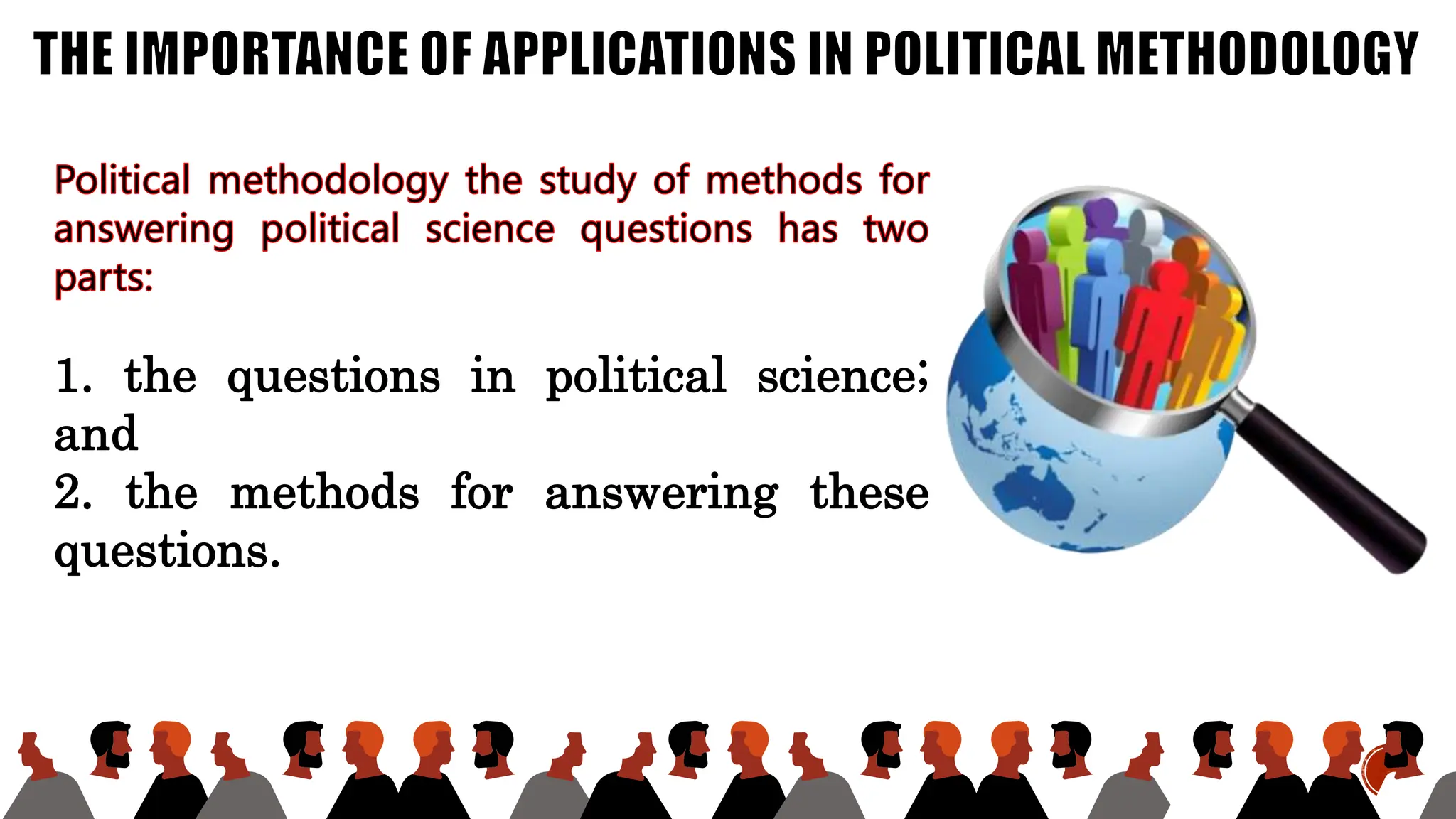
Political methodology is about finding the
most scientific method conditional upon the
stage of the research process, the data
availability, and question of interest.
King, Keohane, and Verba (1994)
1. the questions in political science;
and
2. the methods for answering these
questions.
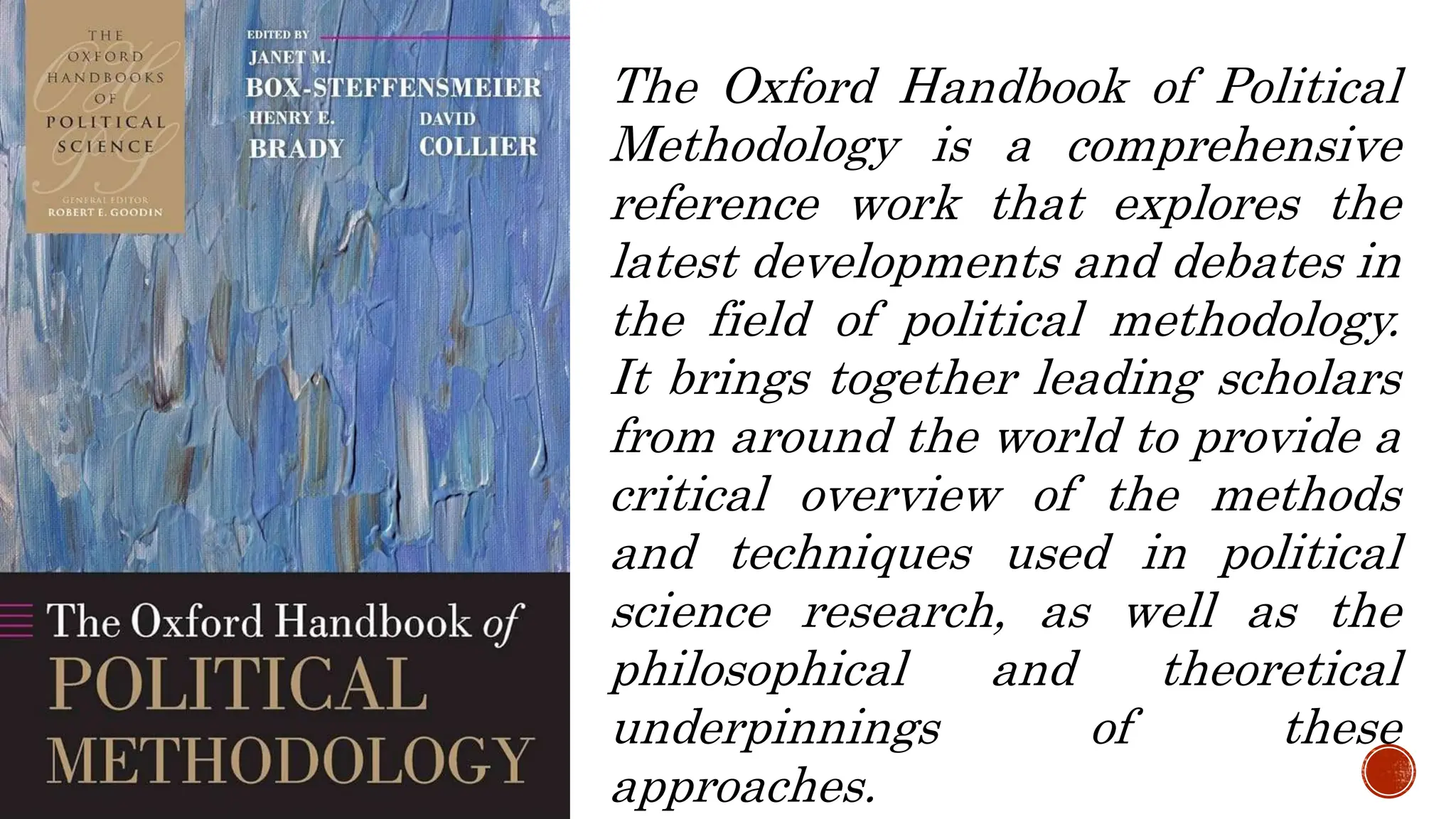
By: The Oxford Handbook of Political Methodology
The Oxford Handbook of Political
Methodology is a comprehensive
reference work that explores the
latest developments and debates in
the field of political methodology.
It brings together leading scholars
from around the world to provide a
critical overview of the methods
and techniques used in political
science research, as well as the
philosophical and theoretical
underpinnings of these
approaches.
Surveys and Experiments: Gathering data through
questionnaires or controlled experiments to analyze
political behavior.
Statistical Analysis: Using statistical tools to analyze
large datasets and draw conclusions about political
phenomena.
Qualitative Methods
Case Studies: In-depth examination
of a particular instance or case to
understand broader political patterns.
Interviews and Focus Groups:
Collecting firsthand information
through direct engagement with
individuals or groups.
Content Analysis: Analyzing textual
or visual data, such as speeches,
media, or documents.
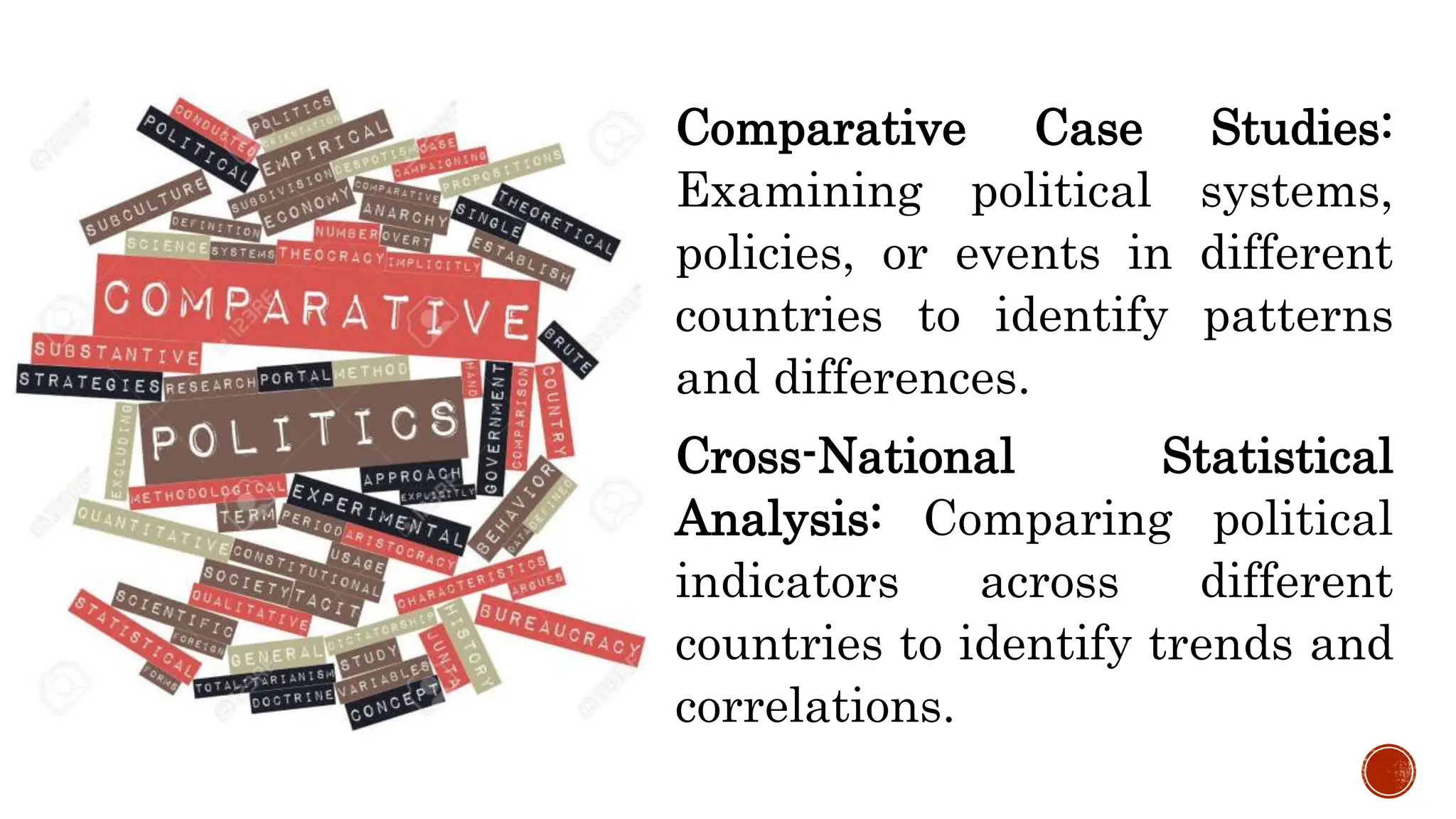
Comparative Case Studies:
Examining political systems,
policies, or events in different
countries to identify patterns
and differences.
Cross-National Statistical
Analysis: Comparing political
indicators across different
countries to identify trends and
correlations.
Historical Institutionalism:
Examining historical processes
and institutions to understand
their impact on current political
structures.
Historical-Causal Analysis:
Investigating the causal
relationships between historical
events and political outcomes.
Formal Modeling
Game Theory: Using mathematical models to
study strategic interactions among rational
decision-makers.
Mathematical Models of Political Processes:
Applying mathematical models to study political
phenomena, such as voting behavior or coalition
formation.
Policy Evaluation:
Assessing the effectiveness
and impact of government
policies.
Cost-Benefit Analysis:
Evaluating the costs and
benefits of different policy
options.
Social Network Analysis: Studying
relationships and interactions between
actors in a political system.
Policy Network Analysis: Examining the
relationships among actors involved in
policy-making.
Political methods may be as diverse as the
political landscape itself, but one thing is
clear: with the right tools and techniques,
we can punch through the noise and get
to the heart of what really matters in
politics.
is a subfield of political science
that involves the study and
comparison of different political
systems and institutions across
different countries. It aims to
analyze and understand the
similarities and differences in the
political structures, processes,
and outcomes in various
countries.
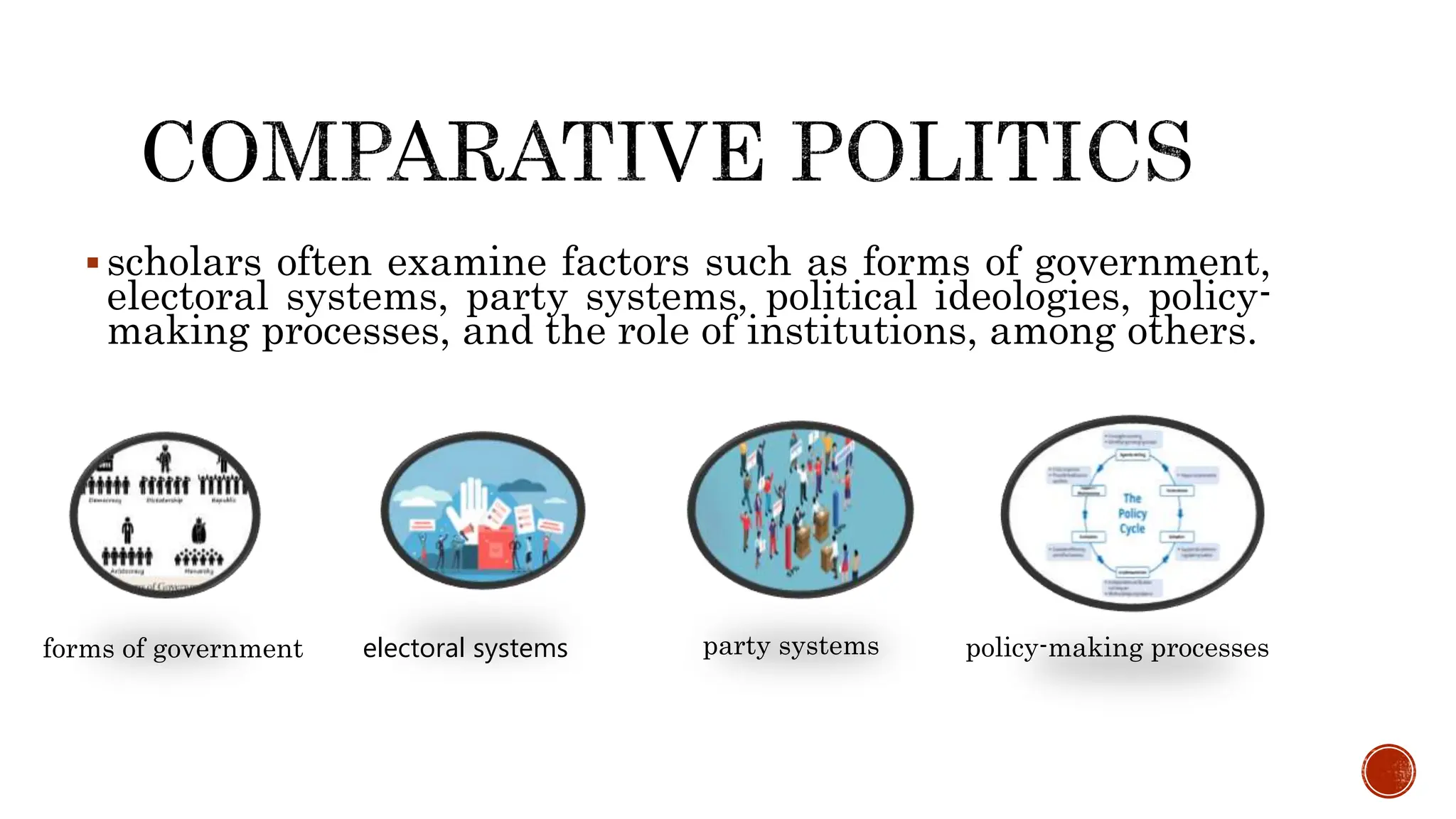
 scholars often examine factors such as forms of government,
electoral systems, party systems, political ideologies, policy-
making processes, and the role of institutions, among others.
forms of government electoral systems party systems policy-making processes
the identification of patterns, trends, and
causal relationships in political
phenomena across different contexts.
 It also facilitates the development of
theories and generalizations about
political behavior, political development,
and the functioning of political
institutions.
The comparative approach allows the identification
of patterns, trends, and causal relationships in
political phonemona across different context. It is
also facilitates the development of theories and
generalizations about political behavior, political
development, and the functioning of political
institutions.
International relations is
the study of the interaction
of nation-states and non-
governmental
organizations in fields such
as politics, economics, and
security.
Examining the Levels of State Behavior
Professionals studying international relations often
determine the level at which they will analyze a state’s
behavior:
System Level Analysis:
State Level Analysis:
Organizational Level
AnalysisIndividual Level Analysis.
Realism
Realism focuses on the notion that states work
to increase their own power relative to other states.
Liberalism (Idealism)
Liberalism recognizes that states share broad
ties, thus making it difficult to define singular
independent national interests.
is a discipline which is concerned with the
organization and the formulation and
implementation of public policies for the
welfare of the people. It functions in a
political setting in order to accomplish the
goals and objectives, which are formulated by
the political decision-makers.
Bureaucracy
The administrative structure and
hierarchical organization through which
public policies are executed.
Policy Implementation
The process of putting government
policies into action.
Public Servants
Individuals employed by the government
to perform administrative tasks.
Public Finance
Managing government budgets,
expenditures, and financial resources to fund
public programs and services.
Public Policy
Analysis Assessing the effectiveness and
impact of government policies, proposing
improvements, and ensuring that policies
align with public interests.
PUBLIC POLICY
WHAT IS PUBLIC POLICY ?
Public Policy is a set of laws,
guidelines and actions decided and
taken by governments in favor of
the public.
WHY IS PUBLIC POLICY IMPORTANT?
 Public policy plays a crucial role in
forming the guidelines and principal
of society, so they’re a necessary part
of governing and politics
WHAT IS PUBLIC HEALTH POLICY?
 deals with the different laws
and guidelines that are in
place and are meant to keep a
population healthy.
EXAMPLE OF PUBLIC POLICY
Abortion
1
Gun
Rights
2
Taxes
3
Labor
4
TYPES OF
PUBLIC
POLICY
 Distributive
 Redistributive
 Regulatory
 Constituent
 Substantive
Distributive
Public Policy
are specially planned for some particular segments
of society and are focused on solving societal issues
such as health services, public welfare, etc.
REDISTRIBUTIVE PUBLIC
POLICY
is when the government policies
are developed and implemented
to redistribute government funds
or other resources to benefit a
particular group.
Regulatory
Public Policy
is when a government introduces laws and
regulations to clearly define the boundaries of
what is allowed versus what is not allowed.
Constituent
Public Policy
relates to how government structured.
Substantive
Public Policy
are concerned with general welfare and
development opportunities, economic
stabilization, law and order enforcement, etc.
CONCLUSION
Public policies are decisions
taken by the government in
order to achieve certains goals
and objectives. It is important
to understand of public
policies, because they affect our
daily lives.

DIVISIONS OF POLITICAL SCIENCE PRESENTATION

  • 2.
    can be definedas philosophical reflection on how best to arrange our collective life - our political institutions and our social practices, such as our economic system and our pattern of family life.
  • 3.
    been practiced foras long as human beings have regarded their collective arrangements not as immutable and part of the natural order but as potentially open to change, and therefore as standing in need of philosophical justification.
  • 4.
    Liberalism Emphasizes individual rights,democracy, and a market-based economy. Thinkers like John Locke and John Stuart Mill have influenced liberal thought. Conservatism- Values tradition, authority, and social stability. Thinkers such as Edmund Burke are foundational to conservative philosophy.
  • 5.
    Socialism Advocates for collectiveownership of the means of production and seeks to address economic inequalities. Karl Marx's ideas are central to socialist thought. Feminism Examines how gender influences power dynamics in politics and seeks to address gender- based inequalities. Various feminist theories contribute to this field.
  • 6.
    Communitarianism Stresses the importanceof community and shared values in political decision-making. Thinkers like Alasdair MacIntyre are associated with communitarian thought. Libertarianism Prioritizes individual freedom and minimal government intervention. Thinkers like Robert Nozick have contributed to libertarian philosophy.
  • 7.
    Postmodernism Challenges traditional politicaltheories, emphasizing the role of language, power, and identity in shaping political reality. Environmentalism Focuses on the relationship between politics and the environment, addressing issues such as sustainability and ecological justice.
  • 9.
    Political methodology isabout finding the most scientific method conditional upon the stage of the research process, the data availability, and question of interest. King, Keohane, and Verba (1994)
  • 10.
    1. the questionsin political science; and 2. the methods for answering these questions.
  • 11.
    By: The OxfordHandbook of Political Methodology
  • 12.
    The Oxford Handbookof Political Methodology is a comprehensive reference work that explores the latest developments and debates in the field of political methodology. It brings together leading scholars from around the world to provide a critical overview of the methods and techniques used in political science research, as well as the philosophical and theoretical underpinnings of these approaches.
  • 13.
    Surveys and Experiments:Gathering data through questionnaires or controlled experiments to analyze political behavior. Statistical Analysis: Using statistical tools to analyze large datasets and draw conclusions about political phenomena.
  • 14.
    Qualitative Methods Case Studies:In-depth examination of a particular instance or case to understand broader political patterns. Interviews and Focus Groups: Collecting firsthand information through direct engagement with individuals or groups. Content Analysis: Analyzing textual or visual data, such as speeches, media, or documents.
  • 15.
    Comparative Case Studies: Examiningpolitical systems, policies, or events in different countries to identify patterns and differences. Cross-National Statistical Analysis: Comparing political indicators across different countries to identify trends and correlations.
  • 16.
    Historical Institutionalism: Examining historicalprocesses and institutions to understand their impact on current political structures. Historical-Causal Analysis: Investigating the causal relationships between historical events and political outcomes.
  • 17.
    Formal Modeling Game Theory:Using mathematical models to study strategic interactions among rational decision-makers. Mathematical Models of Political Processes: Applying mathematical models to study political phenomena, such as voting behavior or coalition formation.
  • 18.
    Policy Evaluation: Assessing theeffectiveness and impact of government policies. Cost-Benefit Analysis: Evaluating the costs and benefits of different policy options.
  • 19.
    Social Network Analysis:Studying relationships and interactions between actors in a political system. Policy Network Analysis: Examining the relationships among actors involved in policy-making.
  • 20.
    Political methods maybe as diverse as the political landscape itself, but one thing is clear: with the right tools and techniques, we can punch through the noise and get to the heart of what really matters in politics.
  • 21.
    is a subfieldof political science that involves the study and comparison of different political systems and institutions across different countries. It aims to analyze and understand the similarities and differences in the political structures, processes, and outcomes in various countries.
  • 22.
     scholars oftenexamine factors such as forms of government, electoral systems, party systems, political ideologies, policy- making processes, and the role of institutions, among others. forms of government electoral systems party systems policy-making processes
  • 23.
    the identification ofpatterns, trends, and causal relationships in political phenomena across different contexts.  It also facilitates the development of theories and generalizations about political behavior, political development, and the functioning of political institutions.
  • 27.
    The comparative approachallows the identification of patterns, trends, and causal relationships in political phonemona across different context. It is also facilitates the development of theories and generalizations about political behavior, political development, and the functioning of political institutions.
  • 28.
    International relations is thestudy of the interaction of nation-states and non- governmental organizations in fields such as politics, economics, and security.
  • 29.
    Examining the Levelsof State Behavior Professionals studying international relations often determine the level at which they will analyze a state’s behavior: System Level Analysis: State Level Analysis: Organizational Level AnalysisIndividual Level Analysis.
  • 30.
    Realism Realism focuses onthe notion that states work to increase their own power relative to other states. Liberalism (Idealism) Liberalism recognizes that states share broad ties, thus making it difficult to define singular independent national interests.
  • 31.
    is a disciplinewhich is concerned with the organization and the formulation and implementation of public policies for the welfare of the people. It functions in a political setting in order to accomplish the goals and objectives, which are formulated by the political decision-makers.
  • 32.
    Bureaucracy The administrative structureand hierarchical organization through which public policies are executed. Policy Implementation The process of putting government policies into action.
  • 33.
    Public Servants Individuals employedby the government to perform administrative tasks. Public Finance Managing government budgets, expenditures, and financial resources to fund public programs and services.
  • 34.
    Public Policy Analysis Assessingthe effectiveness and impact of government policies, proposing improvements, and ensuring that policies align with public interests.
  • 35.
  • 36.
    WHAT IS PUBLICPOLICY ? Public Policy is a set of laws, guidelines and actions decided and taken by governments in favor of the public.
  • 37.
    WHY IS PUBLICPOLICY IMPORTANT?  Public policy plays a crucial role in forming the guidelines and principal of society, so they’re a necessary part of governing and politics
  • 38.
    WHAT IS PUBLICHEALTH POLICY?  deals with the different laws and guidelines that are in place and are meant to keep a population healthy.
  • 39.
    EXAMPLE OF PUBLICPOLICY Abortion 1 Gun Rights 2 Taxes 3 Labor 4
  • 40.
    TYPES OF PUBLIC POLICY  Distributive Redistributive  Regulatory  Constituent  Substantive
  • 41.
    Distributive Public Policy are speciallyplanned for some particular segments of society and are focused on solving societal issues such as health services, public welfare, etc.
  • 42.
    REDISTRIBUTIVE PUBLIC POLICY is whenthe government policies are developed and implemented to redistribute government funds or other resources to benefit a particular group.
  • 43.
    Regulatory Public Policy is whena government introduces laws and regulations to clearly define the boundaries of what is allowed versus what is not allowed.
  • 44.
    Constituent Public Policy relates tohow government structured.
  • 45.
    Substantive Public Policy are concernedwith general welfare and development opportunities, economic stabilization, law and order enforcement, etc.
  • 46.
    CONCLUSION Public policies aredecisions taken by the government in order to achieve certains goals and objectives. It is important to understand of public policies, because they affect our daily lives.

Editor's Notes

  • #3 (Sometimes a distinction is made between political and social philosophy, but I shall use ‘political philosophy’ in a broad sense to include both.) Political philosophers seek to establish basic principles that will, for instance, justify a particular form of state, show that individuals have certain inalienable rights, or tell us how a society’s material resources should be shared among its members.
  • #4 It can be found in many different cultures, and has taken a wide variety of forms. There are two reasons for this diversity. First, the methods and approaches used by political philosophers reflect the general philosophical tendencies of their epoch. Developments in epistemology and ethics, for instance, alter the assumptions on which political philosophy can proceed. But second, the political philosopher’s agenda is largely set by the pressing political issues of the day.
  • #5 It can be found in many different cultures, and has taken a wide variety of forms. There are two reasons for this diversity. First, the methods and approaches used by political philosophers reflect the general philosophical tendencies of their epoch. Developments in epistemology and ethics, for instance, alter the assumptions on which political philosophy can proceed. But second, the political philosopher’s agenda is largely set by the pressing political issues of the day.
  • #6 It can be found in many different cultures, and has taken a wide variety of forms. There are two reasons for this diversity. First, the methods and approaches used by political philosophers reflect the general philosophical tendencies of their epoch. Developments in epistemology and ethics, for instance, alter the assumptions on which political philosophy can proceed. But second, the political philosopher’s agenda is largely set by the pressing political issues of the day.
  • #7 It can be found in many different cultures, and has taken a wide variety of forms. There are two reasons for this diversity. First, the methods and approaches used by political philosophers reflect the general philosophical tendencies of their epoch. Developments in epistemology and ethics, for instance, alter the assumptions on which political philosophy can proceed. But second, the political philosopher’s agenda is largely set by the pressing political issues of the day.
  • #8 It can be found in many different cultures, and has taken a wide variety of forms. There are two reasons for this diversity. First, the methods and approaches used by political philosophers reflect the general philosophical tendencies of their epoch. Developments in epistemology and ethics, for instance, alter the assumptions on which political philosophy can proceed. But second, the political philosopher’s agenda is largely set by the pressing political issues of the day.
  • #36 NOTE: To change the image on this slide, select the picture and delete it. Then click the Pictures icon in the placeholder to insert your own image.