ELEKTRONIKOS ĮTAISAI 2009
VGTU EF ESK stanislovas.staras@el.vgtu.lt
1
DISPLAY DEVICES
ELEKTRONIKOS ĮTAISAI 2009
VGTU EF ESK stanislovas.staras@el.vgtu.lt
2
Display devices
Display devices are used for the visual presentation of information.
1. Analog display devices (cathode-ray tubes)
• Oscilloscope tubes
• TV CRTs
2. Digital display devices
• LED (including OLED) displays
• VF (vacuum fluorescent ) displays
• LCD (liquid crystal) displays
• Nixie tube displays and PDPs (plasma display panels)
• Electroluminescent displays (ELDs)
3. Others:
• Electronic paper
• Using principles of nanoelectronics (carbon nanotubes, nanocrystals)
• Laser TV
ELEKTRONIKOS ĮTAISAI 2009
VGTU EF ESK stanislovas.staras@el.vgtu.lt
3
FLAT PANEL DISPLAYS
CRTs are relatively fragile and bulky.
Other types of thinner displays were developed. They are often called flat
panel displays.
Most flat-panel displays form digits or characters with combination of
segments or dots. The arrangement of these elements is called the display
font.
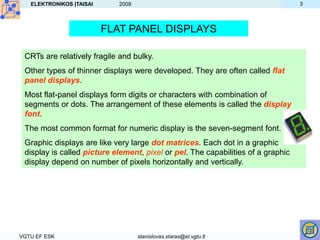
The most common format for numeric display is the seven-segment font.
Graphic displays are like very large dot matrices. Each dot in a graphic
display is called picture element, pixel or pel. The capabilities of a graphic
display depend on number of pixels horizontally and vertically.
ELEKTRONIKOS ĮTAISAI 2009
VGTU EF ESK stanislovas.staras@el.vgtu.lt
4
Flat panel displays requiring continuous refresh:
DLP (Digital Light Processing)
Plasma displays
Liquid crystal displays (LCDs)
Organic light-emitting diode displays (OLEDs)
Light-emitting diode display (LED)
Electroluminescent displays (ELDs)
Surface-conduction electron-emitter displays (SEDs)
Field emission displays (FEDs)
Nano-emissive display (NEDs)
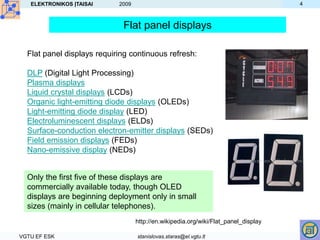
Only the first five of these displays are
commercially available today, though OLED
displays are beginning deployment only in small
sizes (mainly in cellular telephones).
http://en.wikipedia.org/wiki/Flat_panel_display
Flat panel displays
ELEKTRONIKOS ĮTAISAI 2009
VGTU EF ESK stanislovas.staras@el.vgtu.lt
5
LED displays
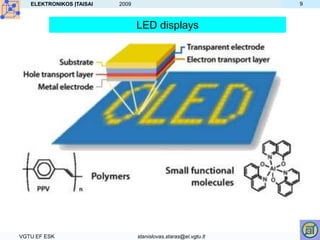
Light emitting diodes are used in LED displays.
Operation of the LED displays is based on the injection luminescence.
LED displays are available in many different sizes and shapes.
Usually LED displays radiate red, orange, yellow or green light.
They have a wide operating temperature range, are inexpensive, easily
interfaced to digital logic, easily multiplexed, do not require high voltages
and have fast response time.
The viewing angle is good and display of arbitrary numbers of digits is
easily assembled.
ELEKTRONIKOS ĮTAISAI 2009
VGTU EF ESK stanislovas.staras@el.vgtu.lt
6
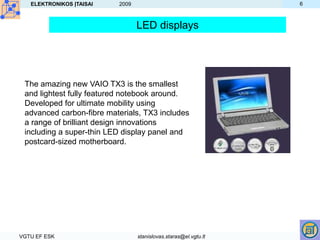
The amazing new VAIO TX3 is the smallest
and lightest fully featured notebook around.
Developed for ultimate mobility using
advanced carbon-fibre materials, TX3 includes
a range of brilliant design innovations
including a super-thin LED display panel and
postcard-sized motherboard.
LED displays
ELEKTRONIKOS ĮTAISAI 2009
VGTU EF ESK stanislovas.staras@el.vgtu.lt
7
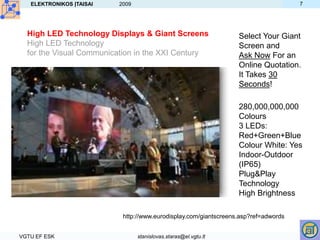
High LED Technology Displays & Giant Screens
High LED Technology
for the Visual Communication in the XXI Century
http://www.eurodisplay.com/giantscreens.asp?ref=adwords
Select Your Giant
Screen and
Ask Now For an
Online Quotation.
It Takes 30
Seconds!
280,000,000,000
Colours
3 LEDs:
Red+Green+Blue
Colour White: Yes
Indoor-Outdoor
(IP65)
Plug&Play
Technology
High Brightness
ELEKTRONIKOS ĮTAISAI 2009
VGTU EF ESK stanislovas.staras@el.vgtu.lt
8
LED displays
The World Largest 3D LED Display
static.flickr.com
ELEKTRONIKOS ĮTAISAI 2009
VGTU EF ESK stanislovas.staras@el.vgtu.lt
9
LED displays
ELEKTRONIKOS ĮTAISAI 2009
VGTU EF ESK stanislovas.staras@el.vgtu.lt
10
Vacuum fluorescent displays
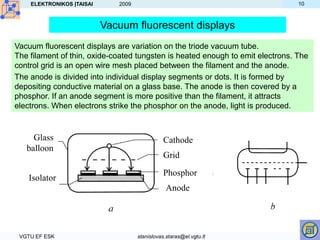
Vacuum fluorescent displays are variation on the triode vacuum tube.
The filament of thin, oxide-coated tungsten is heated enough to emit electrons. The
control grid is an open wire mesh placed between the filament and the anode.
The anode is divided into individual display segments or dots. It is formed by
depositing conductive material on a glass base. The anode is then covered by a
phosphor. If an anode segment is more positive than the filament, it attracts
electrons. When electrons strike the phosphor on the anode, light is produced.
Glass
balloon
Isolator
Cathode
Grid
Phosphor
Anode
ELEKTRONIKOS ĮTAISAI 2009
VGTU EF ESK stanislovas.staras@el.vgtu.lt
11
Filament consists of tungsten coated with the oxidized Ba, Sr and Ca. Powered filament generates
heat and emits thermal electrons which are dispersed and selected by the grid electrode and reach
the anode electrode. On the anode electrode, display pattern is formed with phosphor which emit light.
Most vacuum fluorescent displays emit a blue-green light which is a nearly
optimum colour because it is near the peak of the human eye’s response.
Some extra indicators may use a phosphor that produces a different color of
light, for example, orange.
Vacuum fluorescent displays
ELEKTRONIKOS ĮTAISAI 2009
VGTU EF ESK stanislovas.staras@el.vgtu.lt
12
Some displays can show only digits or alphanumeric characters. They are
called segment displays, because they are composed of several segments
that switch on and off. There are several types:
Seven segment display (most common, digits only)
Fourteen segment display
Sixteen segment display
Vacuum fluorescent displays
ELEKTRONIKOS ĮTAISAI 2009
VGTU EF ESK stanislovas.staras@el.vgtu.lt
13
Gas discharge displays and plasma display panels
A neon bulb is the simplest gas discharge display. Two electrodes are
scaled in a glass bulb filled with a mixture of neon and argon gas. When
high enough voltage is applied (typically 100 to 200 V), an electrical
discharge begins in the gas. Free electrons acquire high kinetic energies
from the electric field. When they collide with gas atoms they transfer this
energy to the atoms, thereby exciting them into energy levels above the
ground state. The atoms may then lose energy radiatively and return to the
ground state. Then the gas emits orange-red light. The ionised gas is
called plasma and gas displays are therefore often called plasma displays.
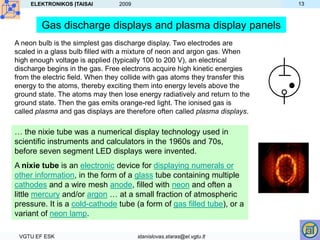
… the nixie tube was a numerical display technology used in
scientific instruments and calculators in the 1960s and 70s,
before seven segment LED displays were invented.
A nixie tube is an electronic device for displaying numerals or
other information, in the form of a glass tube containing multiple
cathodes and a wire mesh anode, filled with neon and often a
little mercury and/or argon … at a small fraction of atmospheric
pressure. It is a cold-cathode tube (a form of gas filled tube), or a
variant of neon lamp.
ELEKTRONIKOS ĮTAISAI 2009
VGTU EF ESK stanislovas.staras@el.vgtu.lt
14
http://upload.wikimedia.org/wikipedia/en/3/39/Nixie.gif
The most common form of nixie tube has ten cathodes in the shapes of the
numerals 0 to 9 (and occasionally a decimal point or two), but there are also
types that show various letters, signs and symbols. Each cathode can be made
to glow in the characteristic neon red-orange color by applying about 170 volts
DC at a few milliamps between a cathode and the anode.
Gas discharge displays and plasma display panels
ELEKTRONIKOS ĮTAISAI 2009
VGTU EF ESK stanislovas.staras@el.vgtu.lt
15
Gas discharge displays and plasma display panels
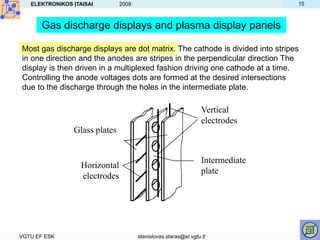
Most gas discharge displays are dot matrix. The cathode is divided into stripes
in one direction and the anodes are stripes in the perpendicular direction The
display is then driven in a multiplexed fashion driving one cathode at a time.
Controlling the anode voltages dots are formed at the desired intersections
due to the discharge through the holes in the intermediate plate.
Glass plates
Horizontal
electrodes
Vertical
electrodes
Intermediate
plate
ELEKTRONIKOS ĮTAISAI 2009
VGTU EF ESK stanislovas.staras@el.vgtu.lt
16
Gas discharge displays and plasma display panels
There are many varieties of gas discharge displays. The most basic type is
called dc plasma, but the future of gas discharge displays lies in ac plasma
technology.
The structure of the ac plasma
display cell
Glass
plates
Transparent
electrodes
Gas
cavity
Dielectric
layers
ELEKTRONIKOS ĮTAISAI 2009
VGTU EF ESK stanislovas.staras@el.vgtu.lt
17
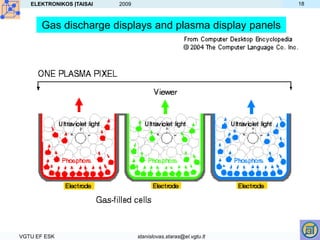
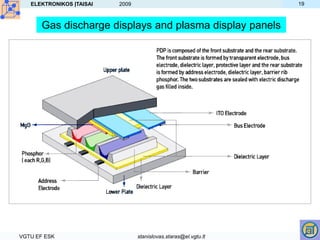
A grid of tiny electrodes applies an electric current to the individual
cells, causing the gas (a mix of neon and xenon) in the cells to ionize.
This ionized gas (plasma) emits high-frequency UV rays, which
stimulate the cells' phosphors, causing them to glow the desired color.
Gas discharge displays and plasma display panels
ELEKTRONIKOS ĮTAISAI 2009
VGTU EF ESK stanislovas.staras@el.vgtu.lt
18
Gas discharge displays and plasma display panels
ELEKTRONIKOS ĮTAISAI 2009
VGTU EF ESK stanislovas.staras@el.vgtu.lt
19
Gas discharge displays and plasma display panels
ELEKTRONIKOS ĮTAISAI 2009
VGTU EF ESK stanislovas.staras@el.vgtu.lt
20
Two HDTV-capable plasma panel designs
http://www.plasmadepot.com/plasmatv/howplasmaworks.html
Gas discharge displays and plasma display panels
ELEKTRONIKOS ĮTAISAI 2009
VGTU EF ESK stanislovas.staras@el.vgtu.lt
21
Panasonic has completely
redesigned all major components
of this ninth generation plasma
panel. The phosphors and other
panel materials have been
upgraded to improve light output
efficiency; the ribs and electrodes
have been reconfigured with new
shapes; and the gas mixture has
been altered. The result is a
dramatic improvement in picture
performance, even when viewed
in a bright living room.
Gas discharge displays and plasma display panels
High Performance –
9th Generation Panel
ELEKTRONIKOS ĮTAISAI 2009
VGTU EF ESK stanislovas.staras@el.vgtu.lt
22
Liquid crystal displays
The heart of all liquid crystal displays (LCDs) is a liquid crystal itself. A liquid
crystal is a substance that flows like a liquid, but its molecules orient themselves
in the manner of a crystal.
In the cholesteric crystals molecules form planes. A plane has nematic-like
structure, but with each plane molecules change their direction.
As a result the molecules display a helical twist through the material.
There are three basic types of ordering in liquid crystals which are termed nematic,
cholesteric and smectic.
ELEKTRONIKOS ĮTAISAI 2009
VGTU EF ESK stanislovas.staras@el.vgtu.lt
23
Liquid crystal displays
When a nematic liquid crystal material comes into contact with a solid surface
molecules become aligned either perpendicular to the surface (homeotropic
ordering) or parallel to the surface (homogeneous ordering). These two forms
can be produced by suitable treatment of the surface.
The most important electrical characteristic of liquid crystal materials is that the
direction of the molecules can be controlled by the electric field. Usually the
molecules tend to be orientated along the electric field.
ELEKTRONIKOS ĮTAISAI 2009
VGTU EF ESK stanislovas.staras@el.vgtu.lt
24
Liquid crystal displays
Most of the LCDs use twisted nematic cells.
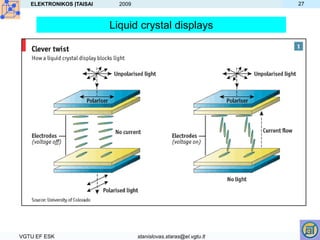
When a beam of polarised light is incident on the cell the liquid causes
rotation of polarisation plane.
A strong enough electric field changes orientation of molecules and in this
state the molecules have no effect on an incident light beam.
ELEKTRONIKOS ĮTAISAI 2009
VGTU EF ESK stanislovas.staras@el.vgtu.lt
25
Liquid crystal displays
In the most common type of LCD cell based on twisted nematic field effect, two
sheets of glass form the main structure. Between the sheets of glass there is a
very thin layer of liquid crystal material. The inner surface of each piece of glass
is coated with a transparent, conductive layer of metal oxide. The sandwich is
completed with a polarizer on the outside of each piece of glass and a reflector
on the back of the display.
ELEKTRONIKOS ĮTAISAI 2009
VGTU EF ESK stanislovas.staras@el.vgtu.lt
26
Liquid crystal displays
Transmission LCD displays do not have the reflector and
must be provided with rear illumination. They operate in a
very similar fashion to the reflective displays.
Colour displays are possible by incorporating colour filters.
An LCD cell consumes only microwatts of power over a
thousand times less than LED displays.
LCDs can operate on voltages as low as 2 to 3 V and are
easily driven by MOS IC drivers.
LCDs also have their disadvantages. They cannot be seen
in the dark, have a limited viewing angle and a limited
temperature range.
ELEKTRONIKOS ĮTAISAI 2009
VGTU EF ESK stanislovas.staras@el.vgtu.lt
27
Liquid crystal displays
ELEKTRONIKOS ĮTAISAI 2009
VGTU EF ESK stanislovas.staras@el.vgtu.lt
28
The left column electrode is at the same
potential level as the row electrode. To the
right column electrode (red), a different
voltage is applied. In this way, an electric field
is generated in the right pixel oriented
perpendicular to the glass surfaces.
On the picture one can see that the rubbing
direction of the alignment layers (green) on
top and bottom substrate are chosen
perpendicular to each other. Due to this
choice, the director in the left pixel makes a
homogeneous turn of 90° from bottom to top.
Therefore, this type of LCD is called a
'Twisted Nematic LCD' (TN-LCD). If a voltage
is applied to the electrode, the director
reorients to become perpendicular to the
surfaces (right pixel).
http://www.elis.ugent.be/ELISgroups/lcd/lc/lc3.php
Liquid crystal displays
ELEKTRONIKOS ĮTAISAI 2009
VGTU EF ESK stanislovas.staras@el.vgtu.lt
29
THE END

Display devices

  • 1.
    ELEKTRONIKOS ĮTAISAI 2009 VGTUEF ESK stanislovas.staras@el.vgtu.lt 1 DISPLAY DEVICES
  • 2.
    ELEKTRONIKOS ĮTAISAI 2009 VGTUEF ESK stanislovas.staras@el.vgtu.lt 2 Display devices Display devices are used for the visual presentation of information. 1. Analog display devices (cathode-ray tubes) • Oscilloscope tubes • TV CRTs 2. Digital display devices • LED (including OLED) displays • VF (vacuum fluorescent ) displays • LCD (liquid crystal) displays • Nixie tube displays and PDPs (plasma display panels) • Electroluminescent displays (ELDs) 3. Others: • Electronic paper • Using principles of nanoelectronics (carbon nanotubes, nanocrystals) • Laser TV
  • 3.
    ELEKTRONIKOS ĮTAISAI 2009 VGTUEF ESK stanislovas.staras@el.vgtu.lt 3 FLAT PANEL DISPLAYS CRTs are relatively fragile and bulky. Other types of thinner displays were developed. They are often called flat panel displays. Most flat-panel displays form digits or characters with combination of segments or dots. The arrangement of these elements is called the display font. The most common format for numeric display is the seven-segment font. Graphic displays are like very large dot matrices. Each dot in a graphic display is called picture element, pixel or pel. The capabilities of a graphic display depend on number of pixels horizontally and vertically.
  • 4.
    ELEKTRONIKOS ĮTAISAI 2009 VGTUEF ESK stanislovas.staras@el.vgtu.lt 4 Flat panel displays requiring continuous refresh: DLP (Digital Light Processing) Plasma displays Liquid crystal displays (LCDs) Organic light-emitting diode displays (OLEDs) Light-emitting diode display (LED) Electroluminescent displays (ELDs) Surface-conduction electron-emitter displays (SEDs) Field emission displays (FEDs) Nano-emissive display (NEDs) Only the first five of these displays are commercially available today, though OLED displays are beginning deployment only in small sizes (mainly in cellular telephones). http://en.wikipedia.org/wiki/Flat_panel_display Flat panel displays
  • 5.
    ELEKTRONIKOS ĮTAISAI 2009 VGTUEF ESK stanislovas.staras@el.vgtu.lt 5 LED displays Light emitting diodes are used in LED displays. Operation of the LED displays is based on the injection luminescence. LED displays are available in many different sizes and shapes. Usually LED displays radiate red, orange, yellow or green light. They have a wide operating temperature range, are inexpensive, easily interfaced to digital logic, easily multiplexed, do not require high voltages and have fast response time. The viewing angle is good and display of arbitrary numbers of digits is easily assembled.
  • 6.
    ELEKTRONIKOS ĮTAISAI 2009 VGTUEF ESK stanislovas.staras@el.vgtu.lt 6 The amazing new VAIO TX3 is the smallest and lightest fully featured notebook around. Developed for ultimate mobility using advanced carbon-fibre materials, TX3 includes a range of brilliant design innovations including a super-thin LED display panel and postcard-sized motherboard. LED displays
  • 7.
    ELEKTRONIKOS ĮTAISAI 2009 VGTUEF ESK stanislovas.staras@el.vgtu.lt 7 High LED Technology Displays & Giant Screens High LED Technology for the Visual Communication in the XXI Century http://www.eurodisplay.com/giantscreens.asp?ref=adwords Select Your Giant Screen and Ask Now For an Online Quotation. It Takes 30 Seconds! 280,000,000,000 Colours 3 LEDs: Red+Green+Blue Colour White: Yes Indoor-Outdoor (IP65) Plug&Play Technology High Brightness
  • 8.
    ELEKTRONIKOS ĮTAISAI 2009 VGTUEF ESK stanislovas.staras@el.vgtu.lt 8 LED displays The World Largest 3D LED Display static.flickr.com
  • 9.
    ELEKTRONIKOS ĮTAISAI 2009 VGTUEF ESK stanislovas.staras@el.vgtu.lt 9 LED displays
  • 10.
    ELEKTRONIKOS ĮTAISAI 2009 VGTUEF ESK stanislovas.staras@el.vgtu.lt 10 Vacuum fluorescent displays Vacuum fluorescent displays are variation on the triode vacuum tube. The filament of thin, oxide-coated tungsten is heated enough to emit electrons. The control grid is an open wire mesh placed between the filament and the anode. The anode is divided into individual display segments or dots. It is formed by depositing conductive material on a glass base. The anode is then covered by a phosphor. If an anode segment is more positive than the filament, it attracts electrons. When electrons strike the phosphor on the anode, light is produced. Glass balloon Isolator Cathode Grid Phosphor Anode
  • 11.
    ELEKTRONIKOS ĮTAISAI 2009 VGTUEF ESK stanislovas.staras@el.vgtu.lt 11 Filament consists of tungsten coated with the oxidized Ba, Sr and Ca. Powered filament generates heat and emits thermal electrons which are dispersed and selected by the grid electrode and reach the anode electrode. On the anode electrode, display pattern is formed with phosphor which emit light. Most vacuum fluorescent displays emit a blue-green light which is a nearly optimum colour because it is near the peak of the human eye’s response. Some extra indicators may use a phosphor that produces a different color of light, for example, orange. Vacuum fluorescent displays
  • 12.
    ELEKTRONIKOS ĮTAISAI 2009 VGTUEF ESK stanislovas.staras@el.vgtu.lt 12 Some displays can show only digits or alphanumeric characters. They are called segment displays, because they are composed of several segments that switch on and off. There are several types: Seven segment display (most common, digits only) Fourteen segment display Sixteen segment display Vacuum fluorescent displays
  • 13.
    ELEKTRONIKOS ĮTAISAI 2009 VGTUEF ESK stanislovas.staras@el.vgtu.lt 13 Gas discharge displays and plasma display panels A neon bulb is the simplest gas discharge display. Two electrodes are scaled in a glass bulb filled with a mixture of neon and argon gas. When high enough voltage is applied (typically 100 to 200 V), an electrical discharge begins in the gas. Free electrons acquire high kinetic energies from the electric field. When they collide with gas atoms they transfer this energy to the atoms, thereby exciting them into energy levels above the ground state. The atoms may then lose energy radiatively and return to the ground state. Then the gas emits orange-red light. The ionised gas is called plasma and gas displays are therefore often called plasma displays. … the nixie tube was a numerical display technology used in scientific instruments and calculators in the 1960s and 70s, before seven segment LED displays were invented. A nixie tube is an electronic device for displaying numerals or other information, in the form of a glass tube containing multiple cathodes and a wire mesh anode, filled with neon and often a little mercury and/or argon … at a small fraction of atmospheric pressure. It is a cold-cathode tube (a form of gas filled tube), or a variant of neon lamp.
  • 14.
    ELEKTRONIKOS ĮTAISAI 2009 VGTUEF ESK stanislovas.staras@el.vgtu.lt 14 http://upload.wikimedia.org/wikipedia/en/3/39/Nixie.gif The most common form of nixie tube has ten cathodes in the shapes of the numerals 0 to 9 (and occasionally a decimal point or two), but there are also types that show various letters, signs and symbols. Each cathode can be made to glow in the characteristic neon red-orange color by applying about 170 volts DC at a few milliamps between a cathode and the anode. Gas discharge displays and plasma display panels
  • 15.
    ELEKTRONIKOS ĮTAISAI 2009 VGTUEF ESK stanislovas.staras@el.vgtu.lt 15 Gas discharge displays and plasma display panels Most gas discharge displays are dot matrix. The cathode is divided into stripes in one direction and the anodes are stripes in the perpendicular direction The display is then driven in a multiplexed fashion driving one cathode at a time. Controlling the anode voltages dots are formed at the desired intersections due to the discharge through the holes in the intermediate plate. Glass plates Horizontal electrodes Vertical electrodes Intermediate plate
  • 16.
    ELEKTRONIKOS ĮTAISAI 2009 VGTUEF ESK stanislovas.staras@el.vgtu.lt 16 Gas discharge displays and plasma display panels There are many varieties of gas discharge displays. The most basic type is called dc plasma, but the future of gas discharge displays lies in ac plasma technology. The structure of the ac plasma display cell Glass plates Transparent electrodes Gas cavity Dielectric layers
  • 17.
    ELEKTRONIKOS ĮTAISAI 2009 VGTUEF ESK stanislovas.staras@el.vgtu.lt 17 A grid of tiny electrodes applies an electric current to the individual cells, causing the gas (a mix of neon and xenon) in the cells to ionize. This ionized gas (plasma) emits high-frequency UV rays, which stimulate the cells' phosphors, causing them to glow the desired color. Gas discharge displays and plasma display panels
  • 18.
    ELEKTRONIKOS ĮTAISAI 2009 VGTUEF ESK stanislovas.staras@el.vgtu.lt 18 Gas discharge displays and plasma display panels
  • 19.
    ELEKTRONIKOS ĮTAISAI 2009 VGTUEF ESK stanislovas.staras@el.vgtu.lt 19 Gas discharge displays and plasma display panels
  • 20.
    ELEKTRONIKOS ĮTAISAI 2009 VGTUEF ESK stanislovas.staras@el.vgtu.lt 20 Two HDTV-capable plasma panel designs http://www.plasmadepot.com/plasmatv/howplasmaworks.html Gas discharge displays and plasma display panels
  • 21.
    ELEKTRONIKOS ĮTAISAI 2009 VGTUEF ESK stanislovas.staras@el.vgtu.lt 21 Panasonic has completely redesigned all major components of this ninth generation plasma panel. The phosphors and other panel materials have been upgraded to improve light output efficiency; the ribs and electrodes have been reconfigured with new shapes; and the gas mixture has been altered. The result is a dramatic improvement in picture performance, even when viewed in a bright living room. Gas discharge displays and plasma display panels High Performance – 9th Generation Panel
  • 22.
    ELEKTRONIKOS ĮTAISAI 2009 VGTUEF ESK stanislovas.staras@el.vgtu.lt 22 Liquid crystal displays The heart of all liquid crystal displays (LCDs) is a liquid crystal itself. A liquid crystal is a substance that flows like a liquid, but its molecules orient themselves in the manner of a crystal. In the cholesteric crystals molecules form planes. A plane has nematic-like structure, but with each plane molecules change their direction. As a result the molecules display a helical twist through the material. There are three basic types of ordering in liquid crystals which are termed nematic, cholesteric and smectic.
  • 23.
    ELEKTRONIKOS ĮTAISAI 2009 VGTUEF ESK stanislovas.staras@el.vgtu.lt 23 Liquid crystal displays When a nematic liquid crystal material comes into contact with a solid surface molecules become aligned either perpendicular to the surface (homeotropic ordering) or parallel to the surface (homogeneous ordering). These two forms can be produced by suitable treatment of the surface. The most important electrical characteristic of liquid crystal materials is that the direction of the molecules can be controlled by the electric field. Usually the molecules tend to be orientated along the electric field.
  • 24.
    ELEKTRONIKOS ĮTAISAI 2009 VGTUEF ESK stanislovas.staras@el.vgtu.lt 24 Liquid crystal displays Most of the LCDs use twisted nematic cells. When a beam of polarised light is incident on the cell the liquid causes rotation of polarisation plane. A strong enough electric field changes orientation of molecules and in this state the molecules have no effect on an incident light beam.
  • 25.
    ELEKTRONIKOS ĮTAISAI 2009 VGTUEF ESK stanislovas.staras@el.vgtu.lt 25 Liquid crystal displays In the most common type of LCD cell based on twisted nematic field effect, two sheets of glass form the main structure. Between the sheets of glass there is a very thin layer of liquid crystal material. The inner surface of each piece of glass is coated with a transparent, conductive layer of metal oxide. The sandwich is completed with a polarizer on the outside of each piece of glass and a reflector on the back of the display.
  • 26.
    ELEKTRONIKOS ĮTAISAI 2009 VGTUEF ESK stanislovas.staras@el.vgtu.lt 26 Liquid crystal displays Transmission LCD displays do not have the reflector and must be provided with rear illumination. They operate in a very similar fashion to the reflective displays. Colour displays are possible by incorporating colour filters. An LCD cell consumes only microwatts of power over a thousand times less than LED displays. LCDs can operate on voltages as low as 2 to 3 V and are easily driven by MOS IC drivers. LCDs also have their disadvantages. They cannot be seen in the dark, have a limited viewing angle and a limited temperature range.
  • 27.
    ELEKTRONIKOS ĮTAISAI 2009 VGTUEF ESK stanislovas.staras@el.vgtu.lt 27 Liquid crystal displays
  • 28.
    ELEKTRONIKOS ĮTAISAI 2009 VGTUEF ESK stanislovas.staras@el.vgtu.lt 28 The left column electrode is at the same potential level as the row electrode. To the right column electrode (red), a different voltage is applied. In this way, an electric field is generated in the right pixel oriented perpendicular to the glass surfaces. On the picture one can see that the rubbing direction of the alignment layers (green) on top and bottom substrate are chosen perpendicular to each other. Due to this choice, the director in the left pixel makes a homogeneous turn of 90° from bottom to top. Therefore, this type of LCD is called a 'Twisted Nematic LCD' (TN-LCD). If a voltage is applied to the electrode, the director reorients to become perpendicular to the surfaces (right pixel). http://www.elis.ugent.be/ELISgroups/lcd/lc/lc3.php Liquid crystal displays
  • 29.
    ELEKTRONIKOS ĮTAISAI 2009 VGTUEF ESK stanislovas.staras@el.vgtu.lt 29 THE END