Disney Consumer Products
Submitted By: Yujata
Submitted To: Dr. Sameer Mathur
Introduction
 Disney Consumer Products (DCP) is a subsidiary and
business segment of The Walt Disney
Company,involved in merchandising the Disney
brand.
 Disney brand is synonymous to fun and magic.
 Company’s main aim has always been on “focusing
nutrition to children”.
 From toys, apps and apparels to book and games,
DCP brings characters to life, through innovative and
engaging physical products, inspiring the imaginations
of young .
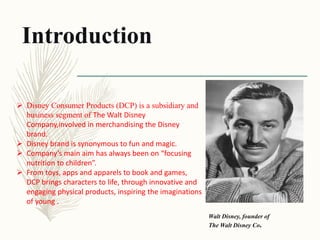
Walt Disney, founder of
The Walt Disney Co.
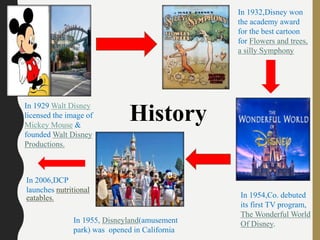
In 1929 Walt Disney
licensed the image of
Mickey Mouse &
founded Walt Disney
Productions.
In 1932,Disney won
the academy award
for the best cartoon
for Flowers and trees,
a silly Symphony
In 1954,Co. debuted
its first TV program,
The Wonderful World
Of Disney.
History
In 1955, Disneyland(amusement
park) was opened in California
In 2006,DCP
launches nutritional
eatables.
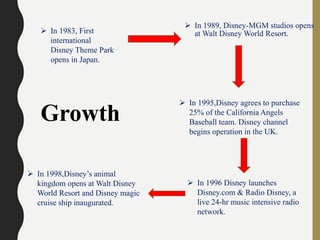
 In 1983, First
international
Disney Theme Park
opens in Japan.
 In 1989, Disney-MGM studios opens
at Walt Disney World Resort.
 In 1995,Disney agrees to purchase
25% of the California Angels
Baseball team. Disney channel
begins operation in the UK.
 In 1996 Disney launches
Disney.com & Radio Disney, a
live 24-hr music intensive radio
network.
 In 1998,Disney’s animal
kingdom opens at Walt Disney
World Resort and Disney magic
cruise ship inaugurated.
Growth
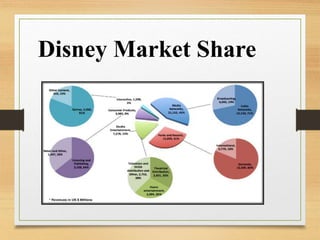
Disney Market Share
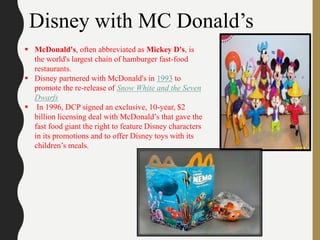
Disney with MC Donald’s
 McDonald's, often abbreviated as Mickey D's, is
the world's largest chain of hamburger fast-food
restaurants.
 Disney partnered with McDonald's in 1993 to
promote the re-release of Snow White and the Seven
Dwarfs
 In 1996, DCP signed an exclusive, 10-year, $2
billion licensing deal with McDonald’s that gave the
fast food giant the right to feature Disney characters
in its promotions and to offer Disney toys with its
children’s meals.
Current Situation
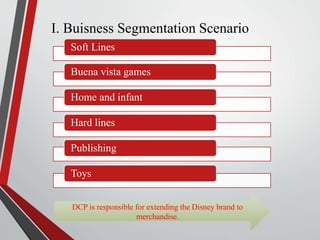
I. Buisness Segmentation Scenario
Soft Lines
Buena vista games
Home and infant
Hard lines
Publishing
Toys
DCP is responsible for extending the Disney brand to
merchandise.
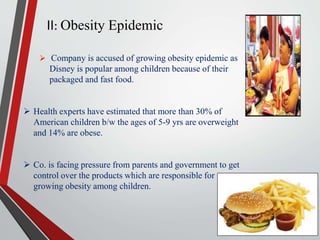
II: Obesity Epidemic
 Company is accused of growing obesity epidemic as
Disney is popular among children because of their
packaged and fast food.
 Health experts have estimated that more than 30% of
American children b/w the ages of 5-9 yrs are overweight
and 14% are obese.
 Co. is facing pressure from parents and government to get
control over the products which are responsible for
growing obesity among children.
III. Licensed Packaged
Foods
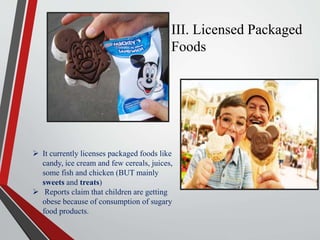
 It currently licenses packaged foods like
candy, ice cream and few cereals, juices,
some fish and chicken (BUT mainly
sweets and treats)
 Reports claim that children are getting
obese because of consumption of sugary
food products.
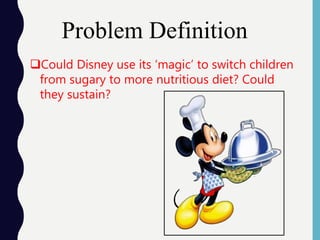
Problem Definition
Could Disney use its ‘magic’ to switch children
from sugary to more nutritious diet? Could
they sustain?
Challenges
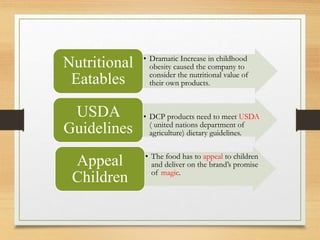
• Dramatic Increase in childhood
obesity caused the company to
consider the nutritional value of
their own products.
Nutritional
Eatables
• DCP products need to meet USDA
( united nations department of
agriculture) dietary guidelines.
USDA
Guidelines
• The food has to appeal to children
and deliver on the brand’s promise
of magic.
Appeal
Children
Solutions
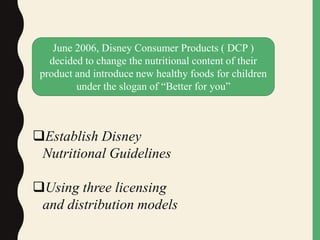
June 2006, Disney Consumer Products ( DCP )
decided to change the nutritional content of their
product and introduce new healthy foods for children
under the slogan of “Better for you”
Establish Disney
Nutritional Guidelines
Using three licensing
and distribution models
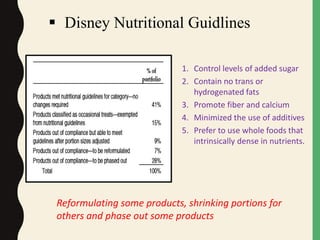
 Disney Nutritional Guidlines
1. Control levels of added sugar
2. Contain no trans or
hydrogenated fats
3. Promote fiber and calcium
4. Minimized the use of additives
5. Prefer to use whole foods that
intrinsically dense in nutrients.
Reformulating some products, shrinking portions for
others and phase out some products
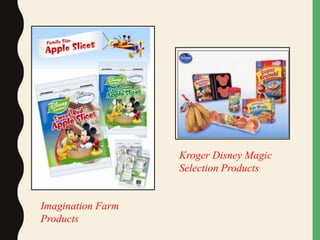
Imagination Farm
Products
Kroger Disney Magic
Selection Products
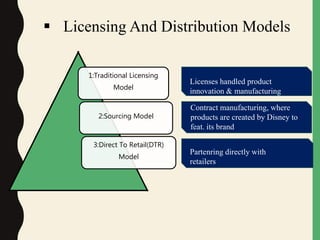
 Licensing And Distribution Models
1:Traditional Licensing
Model
2:Sourcing Model
3:Direct To Retail(DTR)
Model
Contract manufacturing, where
products are created by Disney to
feat. its brand
Licenses handled product
innovation & manufacturing
Partenring directly with
retailers
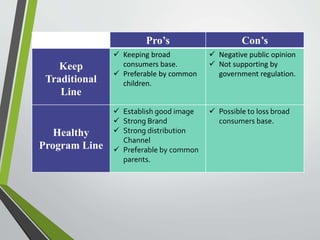
Alternatives
Pro’s Con’s
Keep
Traditional
Line
 Keeping broad
consumers base.
 Preferable by common
children.
 Negative public opinion
 Not supporting by
government regulation.
Healthy
Program Line
 Establish good image
 Strong Brand
 Strong distribution
Channel
 Preferable by common
parents.
 Possible to loss broad
consumers base.
Analysis
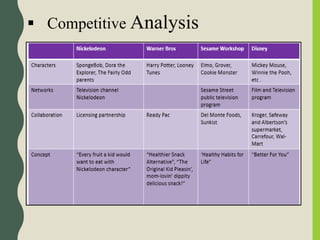
 Competitive Analysis
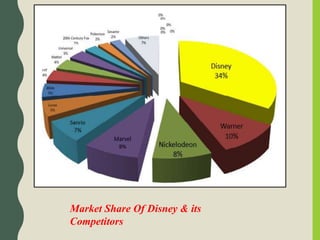
Market Share Of Disney & its
Competitors
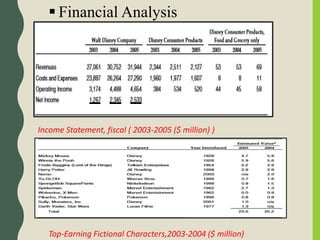
 Financial Analysis
Top-Earning Fictional Characters,2003-2004 ($ million)
Income Statement, fiscal ( 2003-2005 ($ million) )
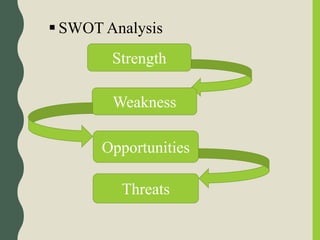
 SWOT Analysis
Strength
Weakness
Opportunities
Threats
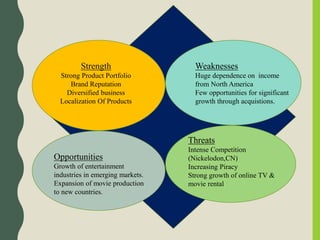
Strength
Strong Product Portfolio
Brand Reputation
Diversified business
Localization Of Products
Weaknesses
Huge dependence on income
from North America
Few opportunities for significant
growth through acquistions.
Opportunities
Growth of entertainment
industries in emerging markets.
Expansion of movie production
to new countries.
Threats
Intense Competition
(Nickelodon,CN)
Increasing Piracy
Strong growth of online TV &
movie rental
THANK YOU

Disney consumer products

  • 1.
    Disney Consumer Products SubmittedBy: Yujata Submitted To: Dr. Sameer Mathur
  • 2.
    Introduction  Disney ConsumerProducts (DCP) is a subsidiary and business segment of The Walt Disney Company,involved in merchandising the Disney brand.  Disney brand is synonymous to fun and magic.  Company’s main aim has always been on “focusing nutrition to children”.  From toys, apps and apparels to book and games, DCP brings characters to life, through innovative and engaging physical products, inspiring the imaginations of young . Walt Disney, founder of The Walt Disney Co.
  • 3.
    In 1929 WaltDisney licensed the image of Mickey Mouse & founded Walt Disney Productions. In 1932,Disney won the academy award for the best cartoon for Flowers and trees, a silly Symphony In 1954,Co. debuted its first TV program, The Wonderful World Of Disney. History In 1955, Disneyland(amusement park) was opened in California In 2006,DCP launches nutritional eatables.
  • 4.
     In 1983,First international Disney Theme Park opens in Japan.  In 1989, Disney-MGM studios opens at Walt Disney World Resort.  In 1995,Disney agrees to purchase 25% of the California Angels Baseball team. Disney channel begins operation in the UK.  In 1996 Disney launches Disney.com & Radio Disney, a live 24-hr music intensive radio network.  In 1998,Disney’s animal kingdom opens at Walt Disney World Resort and Disney magic cruise ship inaugurated. Growth
  • 5.
  • 6.
    Disney with MCDonald’s  McDonald's, often abbreviated as Mickey D's, is the world's largest chain of hamburger fast-food restaurants.  Disney partnered with McDonald's in 1993 to promote the re-release of Snow White and the Seven Dwarfs  In 1996, DCP signed an exclusive, 10-year, $2 billion licensing deal with McDonald’s that gave the fast food giant the right to feature Disney characters in its promotions and to offer Disney toys with its children’s meals.
  • 7.
  • 8.
    I. Buisness SegmentationScenario Soft Lines Buena vista games Home and infant Hard lines Publishing Toys DCP is responsible for extending the Disney brand to merchandise.
  • 9.
    II: Obesity Epidemic Company is accused of growing obesity epidemic as Disney is popular among children because of their packaged and fast food.  Health experts have estimated that more than 30% of American children b/w the ages of 5-9 yrs are overweight and 14% are obese.  Co. is facing pressure from parents and government to get control over the products which are responsible for growing obesity among children.
  • 10.
    III. Licensed Packaged Foods It currently licenses packaged foods like candy, ice cream and few cereals, juices, some fish and chicken (BUT mainly sweets and treats)  Reports claim that children are getting obese because of consumption of sugary food products.
  • 11.
    Problem Definition Could Disneyuse its ‘magic’ to switch children from sugary to more nutritious diet? Could they sustain?
  • 12.
  • 13.
    • Dramatic Increasein childhood obesity caused the company to consider the nutritional value of their own products. Nutritional Eatables • DCP products need to meet USDA ( united nations department of agriculture) dietary guidelines. USDA Guidelines • The food has to appeal to children and deliver on the brand’s promise of magic. Appeal Children
  • 14.
  • 15.
    June 2006, DisneyConsumer Products ( DCP ) decided to change the nutritional content of their product and introduce new healthy foods for children under the slogan of “Better for you” Establish Disney Nutritional Guidelines Using three licensing and distribution models
  • 16.
     Disney NutritionalGuidlines 1. Control levels of added sugar 2. Contain no trans or hydrogenated fats 3. Promote fiber and calcium 4. Minimized the use of additives 5. Prefer to use whole foods that intrinsically dense in nutrients. Reformulating some products, shrinking portions for others and phase out some products
  • 17.
  • 18.
     Licensing AndDistribution Models 1:Traditional Licensing Model 2:Sourcing Model 3:Direct To Retail(DTR) Model Contract manufacturing, where products are created by Disney to feat. its brand Licenses handled product innovation & manufacturing Partenring directly with retailers
  • 19.
  • 20.
    Pro’s Con’s Keep Traditional Line  Keepingbroad consumers base.  Preferable by common children.  Negative public opinion  Not supporting by government regulation. Healthy Program Line  Establish good image  Strong Brand  Strong distribution Channel  Preferable by common parents.  Possible to loss broad consumers base.
  • 21.
  • 22.
  • 23.
    Market Share OfDisney & its Competitors
  • 24.
     Financial Analysis Top-EarningFictional Characters,2003-2004 ($ million) Income Statement, fiscal ( 2003-2005 ($ million) )
  • 25.
  • 26.
    Strength Strong Product Portfolio BrandReputation Diversified business Localization Of Products Weaknesses Huge dependence on income from North America Few opportunities for significant growth through acquistions. Opportunities Growth of entertainment industries in emerging markets. Expansion of movie production to new countries. Threats Intense Competition (Nickelodon,CN) Increasing Piracy Strong growth of online TV & movie rental
  • 27.