Content :
1.HISTORY
2.CURRENT SITUATION
3.PROBLEM AND CHALLENGES
4.ANALYSIS
5.RECOMMENDATION
6.CONCLUSION
HISTORY
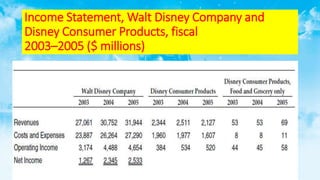
Income Statement, Walt Disney Company and
Disney Consumer Products, fiscal
2003–2005 ($ millions)
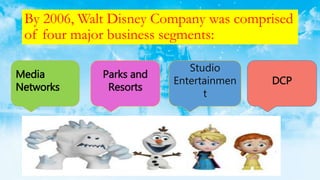
By 2006, Walt Disney Company was comprised
of four major business segments:
Media
Networks
Parks and
Resorts
Studio
Entertainmen
t
DCP
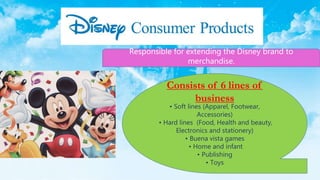
Responsible for extending the Disney brand to
merchandise.
Consists of 6 lines of
business
• Soft lines (Apparel, Footwear,
Accessories)
• Hard lines (Food, Health and beauty,
Electronics and stationery)
• Buena vista games
• Home and infant
• Publishing
• Toys
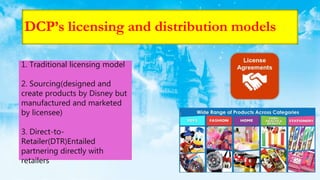
DCP’s licensing and distribution models
1. Traditional licensing model
2. Sourcing(designed and
create products by Disney but
manufactured and marketed
by licensee)
3. Direct-to-
Retailer(DTR)Entailed
partnering directly with
retailers
Current
Situation
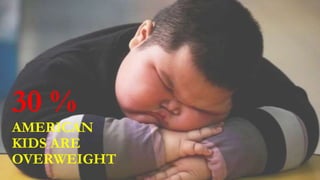
30 %
AMERICAN
KIDS ARE
OVERWEIGHT
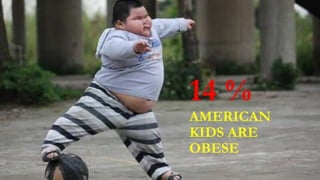
14 %
AMERICAN
KIDS ARE
OBESE
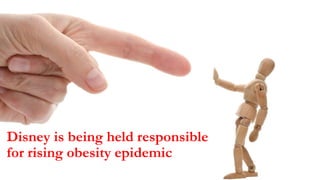
Disney is being held responsible
for rising obesity epidemic
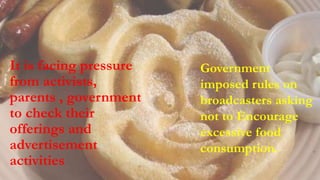
It is facing pressure
from activists,
parents , government
to check their
offerings and
advertisement
activities
Government
imposed rules on
broadcasters asking
not to Encourage
excessive food
consumption.
With changing
licensing models,
retail industry
consolidation
and the obesity
epidemic,
DCP sees this as
an opportunity to
broaden and
rationalize its
product
offerings.
PROBLEMS
AND
CHALLENGES
Could Disney use its ‘magic’ to
switch children from sugary to
more nutritious diet? Could they
sustain?
Can Disney meet the
nutritional guidelines setup
by FDA?
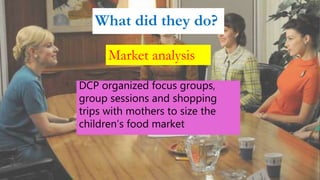
What did they do?
Market analysis
DCP organized focus groups,
group sessions and shopping
trips with mothers to size the
children’s food market
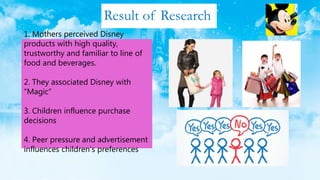
Result of Research
1. Mothers perceived Disney
products with high quality,
trustworthy and familiar to line of
food and beverages.
2. They associated Disney with
“Magic”
3. Children influence purchase
decisions
4. Peer pressure and advertisement
influences children’s preferences
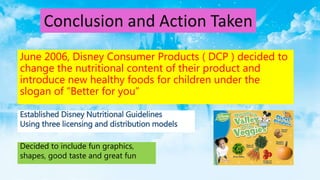
June 2006, Disney Consumer Products ( DCP ) decided to
change the nutritional content of their product and
introduce new healthy foods for children under the
slogan of “Better for you”
Conclusion and Action Taken
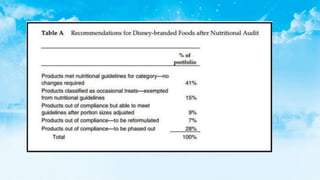
Established Disney Nutritional Guidelines
Using three licensing and distribution models
Decided to include fun graphics,
shapes, good taste and great fun
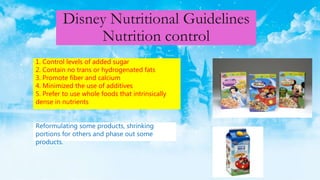
Disney Nutritional Guidelines
Nutrition control
1. Control levels of added sugar
2. Contain no trans or hydrogenated fats
3. Promote fiber and calcium
4. Minimized the use of additives
5. Prefer to use whole foods that intrinsically
dense in nutrients
Reformulating some products, shrinking
portions for others and phase out some
products.
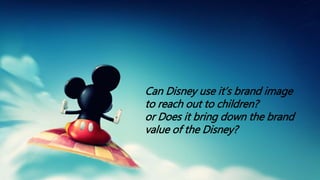
Can Disney use it’s brand image
to reach out to children?
or Does it bring down the brand
value of the Disney?
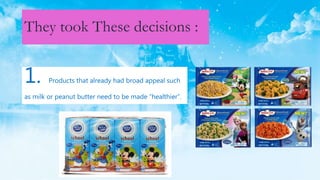
They took These decisions :
1. Products that already had broad appeal such
as milk or peanut butter need to be made “healthier”.
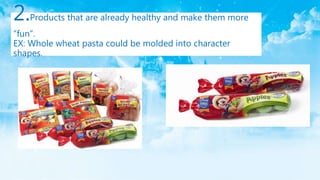
2.Products that are already healthy and make them more
“fun”.
EX: Whole wheat pasta could be molded into character
shapes.
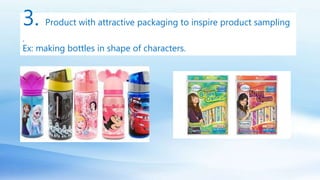
3. Product with attractive packaging to inspire product sampling
.
Ex: making bottles in shape of characters.
Who will be their competitors and
how will they face them?
Their Competitions……
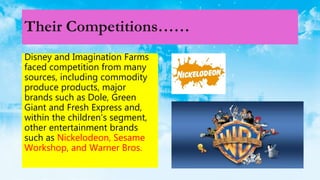
Disney and Imagination Farms
faced competition from many
sources, including commodity
produce products, major
brands such as Dole, Green
Giant and Fresh Express and,
within the children’s segment,
other entertainment brands
such as Nickelodeon, Sesame
Workshop, and Warner Bros.
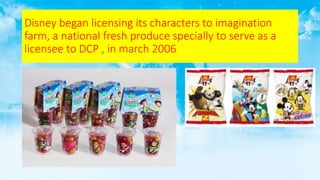
Disney began licensing its characters to imagination
farm, a national fresh produce specially to serve as a
licensee to DCP , in march 2006
What are some of the
risks faced by DCP?
Pricing & Value
Disney Gardens products were
priced competitively within the
produce department, DCP
managers understood that its
products had to be affordable.
Legacy
Though they were confident
that the products would be
healthful, child-friendly and fun,
they had been subject to vocal
criticism in the past and
expected to encounter some
skepticism as a result.
They focused their attention on
DCP’s current strategy rather
than its legacy.
Differentiation & Competition
DCP managers believed that
the combination of a broad
product line, wide distribution
and the Disney brand would
win over Moms
Growth and distribution
Disney wanted to license or
develop additional lines. DCP
managers believed that the
company could differentiate
additional lines using
characters, brand and price.
ANALYSIS
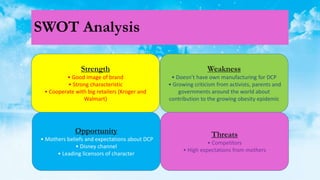
SWOT Analysis
Strength
• Good image of brand
• Strong characteristic
• Cooperate with big retailers (Kroger and
Walmart)
Weakness
• Doesn’t have own manufacturing for DCP
• Growing criticism from activists, parents and
governments around the world about
contribution to the growing obesity epidemic
Opportunity
• Mothers beliefs and expectations about DCP
• Disney channel
• Leading licensors of character
Threats
• Competitors
• High expectations from mothers
RECOMMENDATION
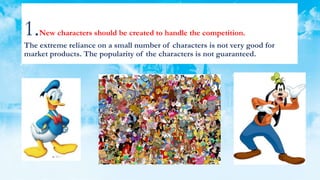
1.New characters should be created to handle the competition.
The extreme reliance on a small number of characters is not very good for
market products. The popularity of the characters is not guaranteed.
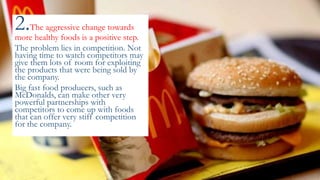
2.The aggressive change towards
more healthy foods is a positive step.
The problem lies in competition. Not
having time to watch competitors may
give them lots of room for exploiting
the products that were being sold by
the company.
Big fast food producers, such as
McDonalds, can make other very
powerful partnerships with
competitors to come up with foods
that can offer very stiff competition
for the company.
3. Healthy Food campaign for parents.
Parents must also tell their children about
the advantage of healthy foods and give
the children healthy foods on the right
proportion.
Parents must understand the importance
and advantages if their children consume
healthy foods on a right proportion.
Tell the parents that Disney already has
the products that meets the healthy food
standards.
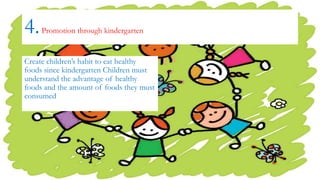
4.Promotion through kindergarten
Create children’s habit to eat healthy
foods since kindergarten Children must
understand the advantage of healthy
foods and the amount of foods they must
consumed
CONCLUSION
The application of good business development
strategies defines the success of DCP.
The development of products in accordance
with the current market requirements enables
the company to position itself as the leader in
the healthy foods production which has the
potential to sustain the business model.
Further implements of new marketing strategies
will bring the company to a new level of world
entertainment and food industry, and the
competitors may only attempt to catch up.
DISCLAIMER :
Created by Sudhanshu Jaiswal, IIITD & M Kancheepuram, during a
marketing internship by Prof. Sameer Mathur, IIM Lucknow

Disney consumer products

  • 2.
    Content : 1.HISTORY 2.CURRENT SITUATION 3.PROBLEMAND CHALLENGES 4.ANALYSIS 5.RECOMMENDATION 6.CONCLUSION
  • 3.
  • 5.
    Income Statement, WaltDisney Company and Disney Consumer Products, fiscal 2003–2005 ($ millions)
  • 6.
    By 2006, WaltDisney Company was comprised of four major business segments: Media Networks Parks and Resorts Studio Entertainmen t DCP
  • 7.
    Responsible for extendingthe Disney brand to merchandise. Consists of 6 lines of business • Soft lines (Apparel, Footwear, Accessories) • Hard lines (Food, Health and beauty, Electronics and stationery) • Buena vista games • Home and infant • Publishing • Toys
  • 8.
    DCP’s licensing anddistribution models 1. Traditional licensing model 2. Sourcing(designed and create products by Disney but manufactured and marketed by licensee) 3. Direct-to- Retailer(DTR)Entailed partnering directly with retailers
  • 10.
  • 11.
  • 12.
  • 13.
    Disney is beingheld responsible for rising obesity epidemic
  • 14.
    It is facingpressure from activists, parents , government to check their offerings and advertisement activities Government imposed rules on broadcasters asking not to Encourage excessive food consumption.
  • 15.
    With changing licensing models, retailindustry consolidation and the obesity epidemic, DCP sees this as an opportunity to broaden and rationalize its product offerings.
  • 16.
  • 17.
    Could Disney useits ‘magic’ to switch children from sugary to more nutritious diet? Could they sustain?
  • 18.
    Can Disney meetthe nutritional guidelines setup by FDA?
  • 19.
    What did theydo? Market analysis DCP organized focus groups, group sessions and shopping trips with mothers to size the children’s food market
  • 20.
    Result of Research 1.Mothers perceived Disney products with high quality, trustworthy and familiar to line of food and beverages. 2. They associated Disney with “Magic” 3. Children influence purchase decisions 4. Peer pressure and advertisement influences children’s preferences
  • 21.
    June 2006, DisneyConsumer Products ( DCP ) decided to change the nutritional content of their product and introduce new healthy foods for children under the slogan of “Better for you” Conclusion and Action Taken Established Disney Nutritional Guidelines Using three licensing and distribution models Decided to include fun graphics, shapes, good taste and great fun
  • 22.
    Disney Nutritional Guidelines Nutritioncontrol 1. Control levels of added sugar 2. Contain no trans or hydrogenated fats 3. Promote fiber and calcium 4. Minimized the use of additives 5. Prefer to use whole foods that intrinsically dense in nutrients Reformulating some products, shrinking portions for others and phase out some products.
  • 24.
    Can Disney useit’s brand image to reach out to children? or Does it bring down the brand value of the Disney?
  • 25.
    They took Thesedecisions : 1. Products that already had broad appeal such as milk or peanut butter need to be made “healthier”.
  • 26.
    2.Products that arealready healthy and make them more “fun”. EX: Whole wheat pasta could be molded into character shapes.
  • 27.
    3. Product withattractive packaging to inspire product sampling . Ex: making bottles in shape of characters.
  • 28.
    Who will betheir competitors and how will they face them?
  • 29.
    Their Competitions…… Disney andImagination Farms faced competition from many sources, including commodity produce products, major brands such as Dole, Green Giant and Fresh Express and, within the children’s segment, other entertainment brands such as Nickelodeon, Sesame Workshop, and Warner Bros.
  • 30.
    Disney began licensingits characters to imagination farm, a national fresh produce specially to serve as a licensee to DCP , in march 2006
  • 31.
    What are someof the risks faced by DCP?
  • 32.
    Pricing & Value DisneyGardens products were priced competitively within the produce department, DCP managers understood that its products had to be affordable.
  • 33.
    Legacy Though they wereconfident that the products would be healthful, child-friendly and fun, they had been subject to vocal criticism in the past and expected to encounter some skepticism as a result. They focused their attention on DCP’s current strategy rather than its legacy.
  • 34.
    Differentiation & Competition DCPmanagers believed that the combination of a broad product line, wide distribution and the Disney brand would win over Moms
  • 35.
    Growth and distribution Disneywanted to license or develop additional lines. DCP managers believed that the company could differentiate additional lines using characters, brand and price.
  • 36.
  • 38.
    SWOT Analysis Strength • Goodimage of brand • Strong characteristic • Cooperate with big retailers (Kroger and Walmart) Weakness • Doesn’t have own manufacturing for DCP • Growing criticism from activists, parents and governments around the world about contribution to the growing obesity epidemic Opportunity • Mothers beliefs and expectations about DCP • Disney channel • Leading licensors of character Threats • Competitors • High expectations from mothers
  • 39.
  • 40.
    1.New characters shouldbe created to handle the competition. The extreme reliance on a small number of characters is not very good for market products. The popularity of the characters is not guaranteed.
  • 41.
    2.The aggressive changetowards more healthy foods is a positive step. The problem lies in competition. Not having time to watch competitors may give them lots of room for exploiting the products that were being sold by the company. Big fast food producers, such as McDonalds, can make other very powerful partnerships with competitors to come up with foods that can offer very stiff competition for the company.
  • 42.
    3. Healthy Foodcampaign for parents. Parents must also tell their children about the advantage of healthy foods and give the children healthy foods on the right proportion. Parents must understand the importance and advantages if their children consume healthy foods on a right proportion. Tell the parents that Disney already has the products that meets the healthy food standards.
  • 43.
    4.Promotion through kindergarten Createchildren’s habit to eat healthy foods since kindergarten Children must understand the advantage of healthy foods and the amount of foods they must consumed
  • 44.
  • 45.
    The application ofgood business development strategies defines the success of DCP. The development of products in accordance with the current market requirements enables the company to position itself as the leader in the healthy foods production which has the potential to sustain the business model. Further implements of new marketing strategies will bring the company to a new level of world entertainment and food industry, and the competitors may only attempt to catch up.
  • 47.
    DISCLAIMER : Created bySudhanshu Jaiswal, IIITD & M Kancheepuram, during a marketing internship by Prof. Sameer Mathur, IIM Lucknow