
Design a course supported with multimedia and online learning The adaptation as a fundamental. Antonio Chenoll. Universidade Católica Portuguesa. A.Chenoll S-ICT Viena 2011
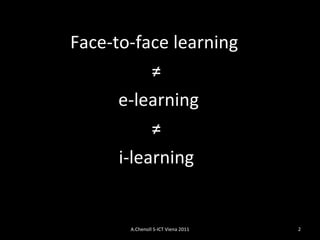
Face-to-face learning  ≠ e-learning ≠ i-learning A.Chenoll S-ICT Viena 2011
Important questions What do the students need?  What are their expectations for this course? How t he y learn? What specific objectives must be taken into account?  A.Chenoll S-ICT Viena 2011
A.Chenoll S-ICT Viena 2011
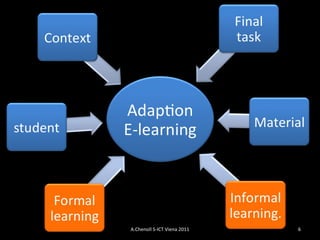
Adaptation to The students The educational context  T he  material The format of the final tasks   A.Chenoll S-ICT Viena 2011
A.Chenoll S-ICT Viena 2011
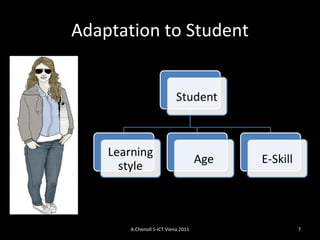
Adaptation to Student A.Chenoll S-ICT Viena 2011
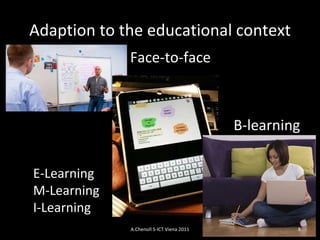
Adaption to the educational context Face-to-face E-Learning M-Learning I-Learning B-learning A.Chenoll S-ICT Viena 2011
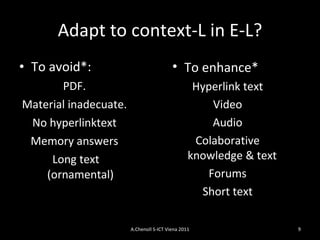
Adapt to context-L in E-L? To avoid*: PDF. Material inadecuate. No hyperlink text Memory answers Long text (ornamental) To enhance* Hyperlink text Video Audio Colaborative knowledge & text  Forums Short text A.Chenoll S-ICT Viena 2011
Adaption to material Cognitive Theory of Multimedia Learning  (Mayer, 2005) Assumptions: The  double channel Limited capacity   Active processing   A.Chenoll S-ICT Viena 2011
Adaption of the final Task Online environment   >  Online final task. Social exercises > Social final task. BUT Give attention to learning styles Diferent style, diferent final task A.Chenoll S-ICT Viena 2011
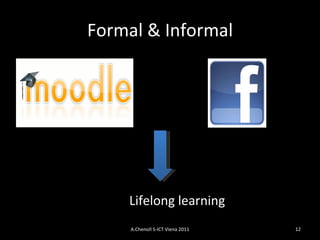
Formal & Informal Lifelong learning A.Chenoll S-ICT Viena 2011
Formal & Informal Combine academic life and social life. Mixed forma-l & informal-l Lifelong learning A.Chenoll S-ICT Viena 2011
Conclusions We must to adapt our course to the learning context in all senses. Its more difficult, complicated, requirs more work, but thats e-learning… This is the real lifelong learning. A.Chenoll S-ICT Viena 2011
The end… A.Chenoll S-ICT Viena 2011

Diseño

  • 1.
    Design a coursesupported with multimedia and online learning The adaptation as a fundamental. Antonio Chenoll. Universidade Católica Portuguesa. A.Chenoll S-ICT Viena 2011
  • 2.
    Face-to-face learning ≠ e-learning ≠ i-learning A.Chenoll S-ICT Viena 2011
  • 3.
    Important questions Whatdo the students need? What are their expectations for this course? How t he y learn? What specific objectives must be taken into account? A.Chenoll S-ICT Viena 2011
  • 4.
  • 5.
    Adaptation to Thestudents The educational context T he material The format of the final tasks A.Chenoll S-ICT Viena 2011
  • 6.
  • 7.
    Adaptation to StudentA.Chenoll S-ICT Viena 2011
  • 8.
    Adaption to theeducational context Face-to-face E-Learning M-Learning I-Learning B-learning A.Chenoll S-ICT Viena 2011
  • 9.
    Adapt to context-Lin E-L? To avoid*: PDF. Material inadecuate. No hyperlink text Memory answers Long text (ornamental) To enhance* Hyperlink text Video Audio Colaborative knowledge & text Forums Short text A.Chenoll S-ICT Viena 2011
  • 10.
    Adaption to materialCognitive Theory of Multimedia Learning (Mayer, 2005) Assumptions: The double channel Limited capacity Active processing A.Chenoll S-ICT Viena 2011
  • 11.
    Adaption of thefinal Task Online environment > Online final task. Social exercises > Social final task. BUT Give attention to learning styles Diferent style, diferent final task A.Chenoll S-ICT Viena 2011
  • 12.
    Formal & InformalLifelong learning A.Chenoll S-ICT Viena 2011
  • 13.
    Formal & InformalCombine academic life and social life. Mixed forma-l & informal-l Lifelong learning A.Chenoll S-ICT Viena 2011
  • 14.
    Conclusions We mustto adapt our course to the learning context in all senses. Its more difficult, complicated, requirs more work, but thats e-learning… This is the real lifelong learning. A.Chenoll S-ICT Viena 2011
  • 15.
    The end… A.ChenollS-ICT Viena 2011

Editor's Notes

  • #2 In this presentation we will try to share some of the technics appliqued in a Spanish course with one main rules. T he adaptation.
  • #6 Aqu í la notas