Can E-Learning replaces classroom learning: A
Study of effectiveness
PRESENTED BY
ARAVIND J 18MCS1004
KIRAN BASKAR S18MCC1001
E-Learning
E-Learning is becoming a recent phenomenon.
Due to the vast improvement of computer technologies, more and more schools and
institutions are applying this concept.
It supports collaboration among students as well as between student and professor in
schools and institutions.
Online learning enable people around the world access for information they need and
this enables knowledge to be distributed widely.
It has been applied in school, college and business widely.
Formats
E-Learning is an online education that is delivered in a synchronous or asynchronous
format.
1. Synchronous format is a condition where lessons are carried out in real-time and led
by instructor.
2. Asynchronous format is self-paced whereby each individual progresses according to
one’s pace.
E-Learning requires the use of a network environment, also known as “cyberspace”.
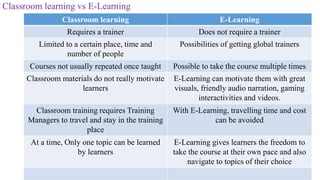
Classroom learning vs E-Learning
Classroom learning E-Learning
Requires a trainer Does not require a trainer
Limited to a certain place, time and
number of people
Possibilities of getting global trainers
Courses not usually repeated once taught Possible to take the course multiple times
Classroom materials do not really motivate
learners
E-Learning can motivate them with great
visuals, friendly audio narration, gaming
interactivities and videos.
Classroom training requires Training
Managers to travel and stay in the training
place
With E-Learning, travelling time and cost
can be avoided
At a time, Only one topic can be learned
by learners
E-Learning gives learners the freedom to
take the course at their own pace and also
navigate to topics of their choice
Virtual Classroom
The concept of Virtual Classroom is an extension from E-Learning, which occurs when there is
a physical separation of instructor and student
Virtual Classroom makes use of live broadcast, interactive video and electronic mail (e-mail).
This electronic networking provides access to various resources, and e-mail enables student to
communicate with friends, instructors, and even technical experts easily.
This provides student with the opportunity to personally communicate with relevant parties
and exchanging ideas.
To implement Virtual Classroom successfully, there are a few criteria to be followed:
-Appropriate to the technology
-Consistent with the instructor’s philosophy and style of teaching
-Convenient, accessible and relevant to students
-Highly interactive
-Well-organized and well presented.
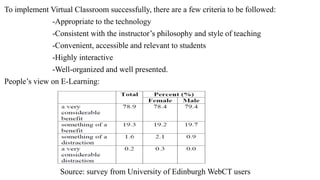
People’s view on E-Learning:
Source: survey from University of Edinburgh WebCT users
Benefits of E-Learning
1.Convenience and Flexibility
2.High Level of Interaction
3.High Levels of Participation, Engagement and Concentration
4. Saves money
5. Provide a paperless environment.
6. More mobility and portable.
7. Teaching materials of e-learning are easy to be store.
8. Contents of e-learning are easier to understand
9.Higher accessibility of e-learning contents.
Drawbacks of E-Learning
1.Technology Issue
2.Inappropriate Content
3.Cultural Acceptance
4.Learning has poor interactivity between students and teacher or lecturer compare with
conventional learning.
5.E-learning is only available to PC users.

E learning vs conventional learning

  • 1.
    Can E-Learning replacesclassroom learning: A Study of effectiveness PRESENTED BY ARAVIND J 18MCS1004 KIRAN BASKAR S18MCC1001
  • 2.
    E-Learning E-Learning is becominga recent phenomenon. Due to the vast improvement of computer technologies, more and more schools and institutions are applying this concept. It supports collaboration among students as well as between student and professor in schools and institutions. Online learning enable people around the world access for information they need and this enables knowledge to be distributed widely. It has been applied in school, college and business widely.
  • 3.
    Formats E-Learning is anonline education that is delivered in a synchronous or asynchronous format. 1. Synchronous format is a condition where lessons are carried out in real-time and led by instructor. 2. Asynchronous format is self-paced whereby each individual progresses according to one’s pace. E-Learning requires the use of a network environment, also known as “cyberspace”.
  • 4.
    Classroom learning vsE-Learning Classroom learning E-Learning Requires a trainer Does not require a trainer Limited to a certain place, time and number of people Possibilities of getting global trainers Courses not usually repeated once taught Possible to take the course multiple times Classroom materials do not really motivate learners E-Learning can motivate them with great visuals, friendly audio narration, gaming interactivities and videos. Classroom training requires Training Managers to travel and stay in the training place With E-Learning, travelling time and cost can be avoided At a time, Only one topic can be learned by learners E-Learning gives learners the freedom to take the course at their own pace and also navigate to topics of their choice
  • 5.
    Virtual Classroom The conceptof Virtual Classroom is an extension from E-Learning, which occurs when there is a physical separation of instructor and student Virtual Classroom makes use of live broadcast, interactive video and electronic mail (e-mail). This electronic networking provides access to various resources, and e-mail enables student to communicate with friends, instructors, and even technical experts easily. This provides student with the opportunity to personally communicate with relevant parties and exchanging ideas.
  • 6.
    To implement VirtualClassroom successfully, there are a few criteria to be followed: -Appropriate to the technology -Consistent with the instructor’s philosophy and style of teaching -Convenient, accessible and relevant to students -Highly interactive -Well-organized and well presented. People’s view on E-Learning: Source: survey from University of Edinburgh WebCT users
  • 7.
    Benefits of E-Learning 1.Convenienceand Flexibility 2.High Level of Interaction 3.High Levels of Participation, Engagement and Concentration 4. Saves money 5. Provide a paperless environment. 6. More mobility and portable. 7. Teaching materials of e-learning are easy to be store. 8. Contents of e-learning are easier to understand 9.Higher accessibility of e-learning contents.
  • 8.
    Drawbacks of E-Learning 1.TechnologyIssue 2.Inappropriate Content 3.Cultural Acceptance 4.Learning has poor interactivity between students and teacher or lecturer compare with conventional learning. 5.E-learning is only available to PC users.