Diseases of eye
By ; Dr. Bushra Ahmad
GLUCOMA;
Group of diseases characterized by increase intraocular pressure which causes damage
of optic nerve resulting in blindness.
CAUSES;
• drainage of aqueous humor thru trabecula is blocked
• Inc. intraocular pressure
• rises above 60 mmHg
• optic nerve fibers at optic disk are compressed
• initially Dec. visual field
• eventually blindness
Early treatment eyes protected
otherwise lost
Infants Infantile Glaucoma
Child hood Juvenile Glaucoma
Types ;
Two types
• Primary opera angle glaucoma ( POAG )
• Primary angle closure glaucoma ( PACG )
POAG ;
• Common 80 %
• No visible obstruction
• Cause not known
• Gradual Inc. pressure
PACG ;
• Visible obstruction of drainage
• Iris is pushed against corners preventing drainage of aq.
Humor
• Pressure rises over period of few hours
CAUSES ;
• Diabetes
• Inflammation
• Injury
• Drugs
SYMPTOMS ;
POAG :
• Silent chronic disease without any early symptoms
• Later heaviness around eyeball
• Headache
• Visual field reduction
EARLY SYMPTOMS ;
• Pain in eye brows
• Headache
• Nausea
• Blurred vision
TREATMENT ;
No cure but prevent further damage of optic nerve
• Eye drops or Medicine alone
• Laser Treatment
• Surgery
CATARACT ;
Opacity or cloudiness in natural lens of eye.
• Major cause of blindness worldwide
• Develop in old age after 55 to 60 years
• Lens cloudy light rays can’t pass vision blurred
• Lens in sealed capsule old cells die & accumulate within
capsule accumulation of fluid + degeneration of
pretension lens fiber
CAUSES ;
• Eye injuries
• Previous eye surgery
• Diabetes
• Drugs
• Sunlight
• Alcoholism
• Large quantity of salt
SYMPTOMS ;
• Glared
• Blurred vision
• Poor night vision
• Diplopia in affected eye
• Fading of colors
TREATMENT ;
• Only surgery
Natural lens replaced with permanent plastic IOL implant
2 Methods
1. Extra capsular extraction cold technique
2. Phacoemulsification
NIGHT BLINDNESS ;
Loss of vision when light in the environment becomes dim.
CAUSES ;
• Deficiency of vit. A
Deficiency of vit. A is due to
• Diet
• Dec. absorption of vit. A from intestine
TREATMENT ;
• Vit. A before visual receptors start degenerating
EFFECTS OF LESION AT DIFFERENT
LEVELS OF :
ANOPIA ;
loss of vision in one visual field is known as anopia.
HEMIANOPIA ;
loss of vision in one half of visual field is known as hemianopia.
TYPES OF HEMIANOPIA ;
1. Homonymous hemianopia
2. Heteronymous hemianopia
EFFECT OF LESION OF OPTIC NERVE;
Lesion in one optic nerve will cause total blindness or
anopia.
CAUSE ;
• Increased intracranial pressure
EFFECT OF LESION OF OPTIC
CHIASMA ;
Pressure on uncrossed lateral fibers by aneurgsmal dilation of
carotid artery causes blindness in temporal part of retina of
same side.
If lateral fibers of both sides are affected the vision is lost in
nasal half of both visual fields causing biursal hemianopia.
Compression of nasal fibers i.e. crossed fibers by pituitary tumor
causes bitemporal hemianopia
EFFECT OF LESION OF OPTIC TRACT , LAT.
GENICULATE BODY & OPTIC RADIATION;
Lesion of optic tract or lat. Geniculate body or optic
radiation causes homonymous hemianopia.
EFFECT OF LESION OF VISUAL CORTEX ;
Lesion of upper or lower part of visual cortex leads to inferior
or superior homonymous hemianopia
MACULAR SPARING ;
The phenomena in which the muscular vision is retained
(unaffected) in conditions of hemianopia is called macular
sparing.
Only the bilateral lesion of visual cortex causes total blindness.
ARGYLL ROBERTSON PUPIL ;
Clinical condition in which the light reflex is lost
but the accommodation reflex is present. It is
common in tertiary syphilis. It also occur bcz of
lesion in Edinger Westphol nucleus , diabetes &
alcoholic neuropath.
HORNER SYNDROME ;
It is eye disorder caused by damage to cervical sympathetic nerve. It is
also called Bernard Horner Syndrome, Claude Bernard Storner
Syndrome or oculosympathetic palsy.
SYMPTOMS ;
• Ptosis
• Swelling of lower eyelid
• Meiosis
• Enophthalamus
• Absence of sweating on affected side of face
PRESBYOPIA ;
In old age the amplitude of accommodation is
decreased & the near point is a way from the eye. This
condition is called presbyopia.
COLOR BLINDNESS ;
CAUSES ;
• Trauma
• Chronic diseases
• Drugs
• Toxins
• Alcoholism
• Aging
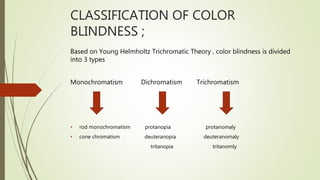
CLASSIFICATION OF COLOR
BLINDNESS ;
Based on Young Helmholtz Trichromatic Theory , color blindness is divided
into 3 types
Monochromatism Dichromatism Trichromatism
• rod monochromatism protanopia protanomaly
• cone chromatism deuteranopia deuteranomaly
tritanopia tritanomly
FIELD OF VISION ;
Part of external world seen by one eye when it is fixed in one
direction is called field of vision or visual field of eye.
Binocular Vision;
Vision in which both eyes are used together.
Monocular Vision;
Vision in which each eye is used separately.
DIVISION OF VISUAL FIELD ;
• Temporal field (extend up to about 100 )
• Nasal field (extends up to 60 )
• Upper field (extends up to 60 )
• Lower field (extends up to 75 )
CORRESPONDING RETINAL POINTS;
These are the areas in retina of both eyes on which the light
rays from the object falls. It occurs in Binocular vision.
The two images developed on retina of both eyes are fused into
single sensation so we see the objects with single image.
DIPLOPIA ;(Means Double Vision)
While looking at an object if the eyeballs are directed in
such a way that the light rays from object do not fall
upon the corresponding point on the retina of both
eyes a double vision occurs i.e. one single object is seen
as two
CAUSES;
• Paralysis
• Myasthenia gravis
• Alcoholic intoxication
• Lesion in 3, 4, & 5 cranial nerves, oculomotor
nucleus, red nucleus also result in diplopia.
EXPERIMENTAL DIPLOPIA;
Diplopia can be produced experimentally by following
methods ,
1. Applying pressure from outer side of one eye.
2. By holding an object like pen or pencil vertically in
front of face at about 5cm from roof of nose.
BLIND SPOT ;
Small area of retina where visual receptors are absent.
VISUAL FIELD & RETINA ;
Light rays from different halves of each visual field do
not fall on same halves of the retina. Light rays from
temporal part of visual field falls on half of retina of
that eye.
MAPPING OF VISUAL FIELD ;
The shape & extent of visual field is mapped out
by means of an instrument called Goldman
Perimeter & this technique is called perimetery.
Diseases of eye

Diseases of eye

  • 1.
    Diseases of eye By; Dr. Bushra Ahmad
  • 2.
    GLUCOMA; Group of diseasescharacterized by increase intraocular pressure which causes damage of optic nerve resulting in blindness. CAUSES; • drainage of aqueous humor thru trabecula is blocked • Inc. intraocular pressure • rises above 60 mmHg • optic nerve fibers at optic disk are compressed • initially Dec. visual field • eventually blindness
  • 3.
    Early treatment eyesprotected otherwise lost Infants Infantile Glaucoma Child hood Juvenile Glaucoma
  • 4.
    Types ; Two types •Primary opera angle glaucoma ( POAG ) • Primary angle closure glaucoma ( PACG )
  • 5.
    POAG ; • Common80 % • No visible obstruction • Cause not known • Gradual Inc. pressure
  • 6.
    PACG ; • Visibleobstruction of drainage • Iris is pushed against corners preventing drainage of aq. Humor • Pressure rises over period of few hours CAUSES ; • Diabetes • Inflammation • Injury • Drugs
  • 7.
    SYMPTOMS ; POAG : •Silent chronic disease without any early symptoms • Later heaviness around eyeball • Headache • Visual field reduction EARLY SYMPTOMS ; • Pain in eye brows • Headache • Nausea • Blurred vision
  • 8.
    TREATMENT ; No curebut prevent further damage of optic nerve • Eye drops or Medicine alone • Laser Treatment • Surgery
  • 9.
    CATARACT ; Opacity orcloudiness in natural lens of eye. • Major cause of blindness worldwide • Develop in old age after 55 to 60 years • Lens cloudy light rays can’t pass vision blurred • Lens in sealed capsule old cells die & accumulate within capsule accumulation of fluid + degeneration of pretension lens fiber
  • 10.
    CAUSES ; • Eyeinjuries • Previous eye surgery • Diabetes • Drugs • Sunlight • Alcoholism • Large quantity of salt
  • 11.
    SYMPTOMS ; • Glared •Blurred vision • Poor night vision • Diplopia in affected eye • Fading of colors
  • 12.
    TREATMENT ; • Onlysurgery Natural lens replaced with permanent plastic IOL implant 2 Methods 1. Extra capsular extraction cold technique 2. Phacoemulsification
  • 13.
    NIGHT BLINDNESS ; Lossof vision when light in the environment becomes dim. CAUSES ; • Deficiency of vit. A Deficiency of vit. A is due to • Diet • Dec. absorption of vit. A from intestine TREATMENT ; • Vit. A before visual receptors start degenerating
  • 14.
    EFFECTS OF LESIONAT DIFFERENT LEVELS OF : ANOPIA ; loss of vision in one visual field is known as anopia. HEMIANOPIA ; loss of vision in one half of visual field is known as hemianopia. TYPES OF HEMIANOPIA ; 1. Homonymous hemianopia 2. Heteronymous hemianopia
  • 15.
    EFFECT OF LESIONOF OPTIC NERVE; Lesion in one optic nerve will cause total blindness or anopia. CAUSE ; • Increased intracranial pressure
  • 16.
    EFFECT OF LESIONOF OPTIC CHIASMA ; Pressure on uncrossed lateral fibers by aneurgsmal dilation of carotid artery causes blindness in temporal part of retina of same side. If lateral fibers of both sides are affected the vision is lost in nasal half of both visual fields causing biursal hemianopia. Compression of nasal fibers i.e. crossed fibers by pituitary tumor causes bitemporal hemianopia
  • 17.
    EFFECT OF LESIONOF OPTIC TRACT , LAT. GENICULATE BODY & OPTIC RADIATION; Lesion of optic tract or lat. Geniculate body or optic radiation causes homonymous hemianopia.
  • 18.
    EFFECT OF LESIONOF VISUAL CORTEX ; Lesion of upper or lower part of visual cortex leads to inferior or superior homonymous hemianopia MACULAR SPARING ; The phenomena in which the muscular vision is retained (unaffected) in conditions of hemianopia is called macular sparing. Only the bilateral lesion of visual cortex causes total blindness.
  • 19.
    ARGYLL ROBERTSON PUPIL; Clinical condition in which the light reflex is lost but the accommodation reflex is present. It is common in tertiary syphilis. It also occur bcz of lesion in Edinger Westphol nucleus , diabetes & alcoholic neuropath.
  • 20.
    HORNER SYNDROME ; Itis eye disorder caused by damage to cervical sympathetic nerve. It is also called Bernard Horner Syndrome, Claude Bernard Storner Syndrome or oculosympathetic palsy. SYMPTOMS ; • Ptosis • Swelling of lower eyelid • Meiosis • Enophthalamus • Absence of sweating on affected side of face
  • 21.
    PRESBYOPIA ; In oldage the amplitude of accommodation is decreased & the near point is a way from the eye. This condition is called presbyopia.
  • 22.
    COLOR BLINDNESS ; CAUSES; • Trauma • Chronic diseases • Drugs • Toxins • Alcoholism • Aging
  • 23.
    CLASSIFICATION OF COLOR BLINDNESS; Based on Young Helmholtz Trichromatic Theory , color blindness is divided into 3 types Monochromatism Dichromatism Trichromatism • rod monochromatism protanopia protanomaly • cone chromatism deuteranopia deuteranomaly tritanopia tritanomly
  • 24.
    FIELD OF VISION; Part of external world seen by one eye when it is fixed in one direction is called field of vision or visual field of eye. Binocular Vision; Vision in which both eyes are used together. Monocular Vision; Vision in which each eye is used separately.
  • 25.
    DIVISION OF VISUALFIELD ; • Temporal field (extend up to about 100 ) • Nasal field (extends up to 60 ) • Upper field (extends up to 60 ) • Lower field (extends up to 75 )
  • 26.
    CORRESPONDING RETINAL POINTS; Theseare the areas in retina of both eyes on which the light rays from the object falls. It occurs in Binocular vision. The two images developed on retina of both eyes are fused into single sensation so we see the objects with single image.
  • 27.
    DIPLOPIA ;(Means DoubleVision) While looking at an object if the eyeballs are directed in such a way that the light rays from object do not fall upon the corresponding point on the retina of both eyes a double vision occurs i.e. one single object is seen as two
  • 28.
    CAUSES; • Paralysis • Myastheniagravis • Alcoholic intoxication • Lesion in 3, 4, & 5 cranial nerves, oculomotor nucleus, red nucleus also result in diplopia.
  • 29.
    EXPERIMENTAL DIPLOPIA; Diplopia canbe produced experimentally by following methods , 1. Applying pressure from outer side of one eye. 2. By holding an object like pen or pencil vertically in front of face at about 5cm from roof of nose.
  • 30.
    BLIND SPOT ; Smallarea of retina where visual receptors are absent. VISUAL FIELD & RETINA ; Light rays from different halves of each visual field do not fall on same halves of the retina. Light rays from temporal part of visual field falls on half of retina of that eye.
  • 31.
    MAPPING OF VISUALFIELD ; The shape & extent of visual field is mapped out by means of an instrument called Goldman Perimeter & this technique is called perimetery.