WELCOME TO OUR PRESENTATION
Team Members
1. Abdi Khaliq roll 12
2. Abdallah roll 11
3. Abdalla roll 48
Submitted to: lecturer dept of CSE DIU
Shifat jahan setu
OUTLINE
• Definitions
• Rules of Inference
• Fallacies
• Using Rules of Inference to Build Arguments
• Rules of Inference and Quantifiers
DEFINITIONS
By an argument, we mean a sequence of statements
that ends with a conclusion .The conclusion is the last
statement of the argument.
The premises are the statements of the argument
preceding the conclusion .By a valid argument, we
mean that the conclusion must follow from the truth of
the premises.
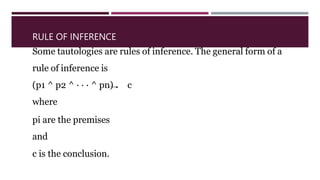
RULE OF INFERENCE
Some tautologies are rules of inference. The general form of a
rule of inference is
(p1 ^ p2 ^ · · · ^ pn) c
where
pi are the premises
and
c is the conclusion.
MODUS PONENS
p q
p
q
If a conditional statement and the hypothesis of the
conditional statement are both true, therefore the conclusion
must also be true. The basis of the modus ponens is the
tautology.
(p ^ (p q)) q
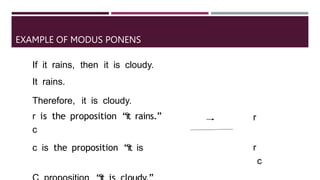
EXAMPLE OF MODUS PONENS
r
If it rains, then it is cloudy.
It rains.
Therefore, it is cloudy.
r is the proposition “it rains.”
c
c is the proposition “it is r
c
MODUS PONENS
P q P q p ^ (p q) (p ^ (p q)) q
T T T T T
T F F F T
F T T F T
F F T F T
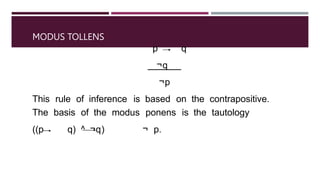
MODUS TOLLENS
p q
¬q
¬p
This rule of inference is based on the contrapositive.
The basis of the modus ponens is the tautology
((p q) ^ ¬q) ¬ p.
MODUS TOLLENS
p q P q ¬q ¬p (p q) ^ ¬q ((p q) ^ ¬q) ¬p
T T T F F F T
T F F T F F T
F T T F T F T
F F T T T T T
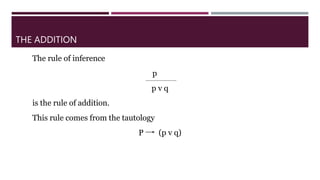
THE ADDITION
The rule of inference
p
p v q
is the rule of addition.
This rule comes from the tautology
P (p v q)
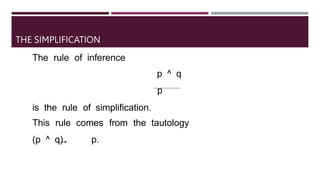
THE SIMPLIFICATION
The rule of inference
p ^ q
p
is the rule of simplification.
This rule comes from the tautology
(p ^ q) p.
THE FALLACY OF AFFIRMING THE CONCLUSION
The wrong “rule of inference”
p q
q
p
is denoted the fallacy of affirming the conclusion.
The basis of this fallacy is the contingency
(q ^ (p q)) p
that is a misuse of the modus ponens and is not a tautology.
FALLACY OF AFFIRMING THE CONCLUSION
p q P q q ^ (p q) (q ^ (p q)) p
T T T T T
T F F F T
F T T T T
F F T F F
THE FALLACY OF DENYING THE HYPOTHESIS
The wrong “rule of inference”
p q
¬p
¬q
is denoted the fallacy of denying the hypothesis.
The basis of this fallacy is the contingency
(¬p ^ (p q)) ¬q
that is a misuse of the modus tollens and is not a tautology.
FALLACY OF DENYING THE HYPOTHESIS
p q p q ¬p (p q) ^ ¬p ¬q ((p q) ^ ¬p)
¬q
T T T F F F T
T F F F F T T
F T T T T F F
F F T T T T T
THANK
YOU

discreatemathpresentationrss-171107192105.pptx

  • 1.
    WELCOME TO OURPRESENTATION Team Members 1. Abdi Khaliq roll 12 2. Abdallah roll 11 3. Abdalla roll 48 Submitted to: lecturer dept of CSE DIU Shifat jahan setu
  • 2.
    OUTLINE • Definitions • Rulesof Inference • Fallacies • Using Rules of Inference to Build Arguments • Rules of Inference and Quantifiers
  • 3.
    DEFINITIONS By an argument,we mean a sequence of statements that ends with a conclusion .The conclusion is the last statement of the argument. The premises are the statements of the argument preceding the conclusion .By a valid argument, we mean that the conclusion must follow from the truth of the premises.
  • 4.
    RULE OF INFERENCE Sometautologies are rules of inference. The general form of a rule of inference is (p1 ^ p2 ^ · · · ^ pn) c where pi are the premises and c is the conclusion.
  • 5.
    MODUS PONENS p q p q Ifa conditional statement and the hypothesis of the conditional statement are both true, therefore the conclusion must also be true. The basis of the modus ponens is the tautology. (p ^ (p q)) q
  • 6.
    EXAMPLE OF MODUSPONENS r If it rains, then it is cloudy. It rains. Therefore, it is cloudy. r is the proposition “it rains.” c c is the proposition “it is r c
  • 7.
    MODUS PONENS P qP q p ^ (p q) (p ^ (p q)) q T T T T T T F F F T F T T F T F F T F T
  • 8.
    MODUS TOLLENS p q ¬q ¬p Thisrule of inference is based on the contrapositive. The basis of the modus ponens is the tautology ((p q) ^ ¬q) ¬ p.
  • 9.
    MODUS TOLLENS p qP q ¬q ¬p (p q) ^ ¬q ((p q) ^ ¬q) ¬p T T T F F F T T F F T F F T F T T F T F T F F T T T T T
  • 10.
    THE ADDITION The ruleof inference p p v q is the rule of addition. This rule comes from the tautology P (p v q)
  • 11.
    THE SIMPLIFICATION The ruleof inference p ^ q p is the rule of simplification. This rule comes from the tautology (p ^ q) p.
  • 12.
    THE FALLACY OFAFFIRMING THE CONCLUSION The wrong “rule of inference” p q q p is denoted the fallacy of affirming the conclusion. The basis of this fallacy is the contingency (q ^ (p q)) p that is a misuse of the modus ponens and is not a tautology.
  • 13.
    FALLACY OF AFFIRMINGTHE CONCLUSION p q P q q ^ (p q) (q ^ (p q)) p T T T T T T F F F T F T T T T F F T F F
  • 14.
    THE FALLACY OFDENYING THE HYPOTHESIS The wrong “rule of inference” p q ¬p ¬q is denoted the fallacy of denying the hypothesis. The basis of this fallacy is the contingency (¬p ^ (p q)) ¬q that is a misuse of the modus tollens and is not a tautology.
  • 15.
    FALLACY OF DENYINGTHE HYPOTHESIS p q p q ¬p (p q) ^ ¬p ¬q ((p q) ^ ¬p) ¬q T T T F F F T T F F F F T T F T T T T F F F F T T T T T
  • 16.