SESSION STYLES
REGGAE MUSIC
CHRISTOPHER BAKER
MUSICSTUDENTINFO.COM
REGGAE ORIGINS - MENTO
 MENTO music is the grandfather of Reggae music. It is
referred to as being the country music of Jamaica. The
classic Mento sound is acoustic, Informal, and has a folksy
rural style. Mento music came to real prominence in the
1940’s and 1950’s, with the 1950’s being the real golden
age for Mento. Instruments that are usually found in
Mento include the banjo, acoustic guitar, a home-made
saxophone, clarinet or flute made out of bamboo, a variety
of hand percussion and a rumba box.
REGGAE WHAT
IS IT?
Reggae is a music genre that originated in Jamaica in the
late 1960’s. It incorporates stylistic elements such as
Calypso, R&B, African, Jazz, and Latin American music.
Reggae’s roots are found in the earlier genres Mento, Ska,
and Rocksteady.
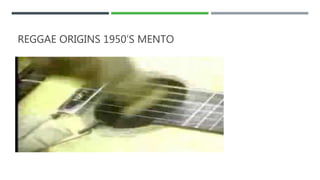
REGGAE ORIGINS 1950’S MENTO
SESSION
STYLES REGGAE
BACKGROUND
The idea of blasting music from the radio or a record
player-the best in American R and B or hot jazz-
through a configuration of open-air loudspeaker
cabinets became popular in the mid 1940s.
Firstly done to attract patrons the music eventually
became the event.
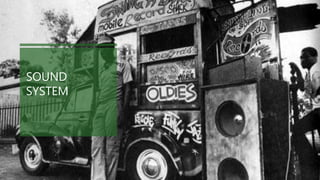
SOUND
SYSTEM
REGGAE MUSIC BACKGROUND SOUND SYSTEM
Apparatus used to amplify
recorded music.
Sound system parties became
very popular in inner city
Kingston areas as entertainment
source.
Early system operators: Tom the
Great Sebastian, V Rocket, Count
Smith the Blues Blaster, Sir Nick
the Champ, King Edwards or
Lord Koos.
REGGAE BACKGROUND EARLY SOUND SYSTEMS
CONTINUED
Music played was American R+B, Hot Jazz and even Be-Bop.
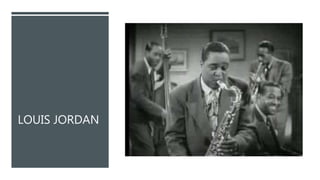
Louis Jordan was a favourite.
Competition was intense as exclusivity was the order of the day.
The more obscure the better.
Created micro-economy of importation and selling of records.
LOUIS JORDAN
SOUND
SYSTEM
INNOVATORS
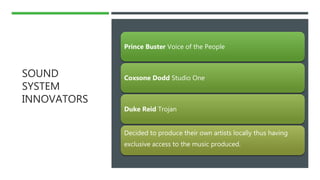
Prince Buster Voice of the People
Coxsone Dodd Studio One
Duke Reid Trojan
Decided to produce their own artists locally thus having
exclusive access to the music produced.
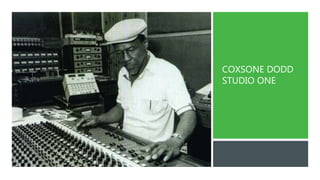
COXSONE DODD
STUDIO ONE
REGGAE MUSIC INNOVATION
introduction some Mento elements in to the R+B music by stretching off-beats.
This concept was adapted and developed by Coxsone where he wanted to take things further by putting greater distance between homegrown and
imported music. He called a meeting with Ernie Ranglin, and bass player Cluett Johnson.
(Coxsone) deliberately wanted to keep the R and B shuffle beat, but he moved the stress to the afterbeat –the second and fourth beats – to such a
degree that it turned the arrangement around. ….People used to call in to stress it even more, and this off-beat become the focus of all Jamaican
music that followed on after it.’
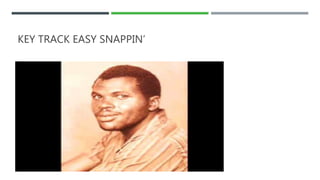
Track – Easy Snappin.
KEY TRACK EASY SNAPPIN’
REGGAE
MNUSIC
INNOVATION
CONT’D
Buster continued this theory with the accented ‘off’ beat.
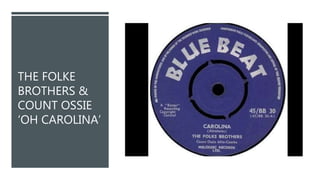
Introduced Rastafari to popular music through seminal ‘Oh
Carolina’
Featured Folke Brothers singing and Count Ossie drum
group.
Jamaican dialect and phrasing also introduced.
THE FOLKE
BROTHERS &
COUNT OSSIE
‘OH CAROLINA’
SKA MUSIC
A couple of years into the 1960s and the music had settled down into what was to become classic ska sound.
The new beat owed a lot to the seminal band the Skatalites who worked with the major studios especially Studio One.
Lloyd Knibbs, Tommy McCook,
Lloyd Brevette and Jackie Mittoo.
Don Drummond was leader of the group and important influence.
SKA POPULARITY
Ska became the first
unique and distinct
popular genre emerging
from Jamaica.
Gained national
recognition as radio
picked started to
broadcast it.
Gained international
appeal especially in urban
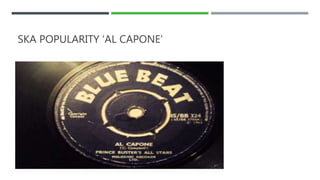
UK; ‘Al Capone’ Top 20
British hit in 1967.
SKA POPULARITY ‘AL CAPONE’
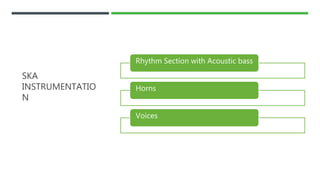
SKA
INSTRUMENTATIO
N
Rhythm Section with Acoustic bass
Horns
Voices
SKA ARTISTS
The Skatalites
Millie
Lord Tanamo
Prince Buster
Jimmy Cliff
ROCKSTEADY
TO REGGAE
Late 1960s saw the birth of a slower heavily bass oriented type of music known
as Rocksteady.
Key element the introduction of the electric bass and the now dominant, melodic
place it took within the ensemble.
Electric organ also introduced.
Horns were limited due to expense.
Rocksteady dominated by vocal groups.
ROCKSTEADY
ARTISTS
 The Paragons, The Wailers,
The Heptones, The Maytals
REGGAE
Rocksteady changed in name and form in
1968.
Slightly faster, with new organ pattern and
studio effects.
Rasta ideology prominent as well as Burru
and Kumina drumming styles.
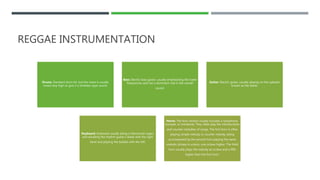
REGGAE INSTRUMENTATION
Drums: Standard drum kit, but the snare is usually
tuned very high to give it a timbales-type sound.
Bass: Electric bass guitar, usually emphasizing the lower
frequencies and has a dominant role in the overall
sound.
Guitar: Electric guitar, usually playing on the upbeats
known as the skank.
Keyboard: Keyboard usually being a Hammond organ,
and doubling the rhythm guitar’s skank with the right
hand and playing the bubble with the left.
Horns: The horn section usually includes a saxophone,
trumpet, or trombone. They often play the introductions
and counter-melodies of songs. The first horn is often
playing simple melody or counter melody, being
accompanied by the second horn playing the same
melodic phrase in unison, one octave higher. The third
horn usually plays the melody an octave and a fifth
higher than the first horn.
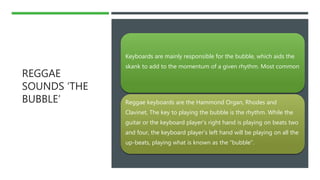
REGGAE
SOUNDS ‘THE
BUBBLE’
Keyboards are mainly responsible for the bubble, which aids the
skank to add to the momentum of a given rhythm. Most common
Reggae keyboards are the Hammond Organ, Rhodes and
Clavinet, The key to playing the bubble is the rhythm. While the
guitar or the keyboard player’s right hand is playing on beats two
and four, the keyboard player’s left hand will be playing on all the
up-beats, playing what is known as the “bubble”.
THE ‘SKANK’  The Skank- The skank is a rhythm
played usually by the guitar / piano on
beats two and our.
REGGAE ARTISTS The Israelites, The Royals, The Wailers,
Dennis Brown, The Ethiopians, Jimmy
Cliff, Peter Tosh, Gregory Issacs, Beres
Hammond, Barrington Levy….
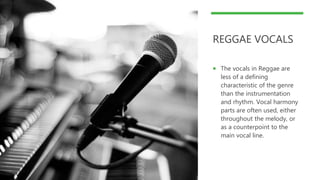
REGGAE VOCALS
 The vocals in Reggae are
less of a defining
characteristic of the genre
than the instrumentation
and rhythm. Vocal harmony
parts are often used, either
throughout the melody, or
as a counterpoint to the
main vocal line.
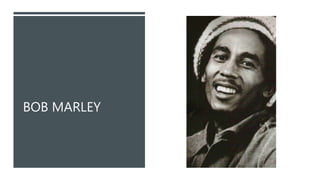
BOB MARLEY
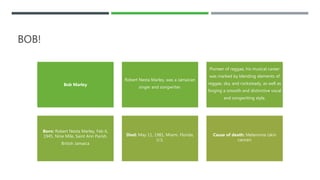
BOB!
Bob Marley
Robert Nesta Marley, was a Jamaican
singer and songwriter.
Pioneer of reggae, his musical career
was marked by blending elements of
reggae, ska, and rocksteady, as well as
forging a smooth and distinctive vocal
and songwriting style.
Born: Robert Nesta Marley, Feb 6,
1945, Nine Mile, Saint Ann Parish,
British Jamaica
Died: May 11, 1981, Miami, Florida,
U.S.
Cause of death: Melanoma (skin
cancer)
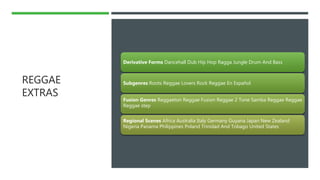
REGGAE
EXTRAS
Derivative Forms Dancehall Dub Hip Hop Ragga Jungle Drum And Bass
Subgenres Roots Reggae Lovers Rock Reggae En Español
Fusion Genres Reggaeton Reggae Fusion Reggae 2 Tone Samba Reggae Reggae
Reggae step
Regional Scenes Africa Australia Italy Germany Guyana Japan New Zealand
Nigeria Panama Philippines Poland Trinidad And Tobago United States
THE END

Introduction to Reggae Music

  • 1.
    SESSION STYLES REGGAE MUSIC CHRISTOPHERBAKER MUSICSTUDENTINFO.COM
  • 2.
    REGGAE ORIGINS -MENTO  MENTO music is the grandfather of Reggae music. It is referred to as being the country music of Jamaica. The classic Mento sound is acoustic, Informal, and has a folksy rural style. Mento music came to real prominence in the 1940’s and 1950’s, with the 1950’s being the real golden age for Mento. Instruments that are usually found in Mento include the banjo, acoustic guitar, a home-made saxophone, clarinet or flute made out of bamboo, a variety of hand percussion and a rumba box.
  • 3.
    REGGAE WHAT IS IT? Reggaeis a music genre that originated in Jamaica in the late 1960’s. It incorporates stylistic elements such as Calypso, R&B, African, Jazz, and Latin American music. Reggae’s roots are found in the earlier genres Mento, Ska, and Rocksteady.
  • 4.
  • 5.
    SESSION STYLES REGGAE BACKGROUND The ideaof blasting music from the radio or a record player-the best in American R and B or hot jazz- through a configuration of open-air loudspeaker cabinets became popular in the mid 1940s. Firstly done to attract patrons the music eventually became the event.
  • 6.
  • 7.
    REGGAE MUSIC BACKGROUNDSOUND SYSTEM Apparatus used to amplify recorded music. Sound system parties became very popular in inner city Kingston areas as entertainment source. Early system operators: Tom the Great Sebastian, V Rocket, Count Smith the Blues Blaster, Sir Nick the Champ, King Edwards or Lord Koos.
  • 8.
    REGGAE BACKGROUND EARLYSOUND SYSTEMS CONTINUED Music played was American R+B, Hot Jazz and even Be-Bop. Louis Jordan was a favourite. Competition was intense as exclusivity was the order of the day. The more obscure the better. Created micro-economy of importation and selling of records.
  • 9.
  • 10.
    SOUND SYSTEM INNOVATORS Prince Buster Voiceof the People Coxsone Dodd Studio One Duke Reid Trojan Decided to produce their own artists locally thus having exclusive access to the music produced.
  • 11.
  • 12.
    REGGAE MUSIC INNOVATION introductionsome Mento elements in to the R+B music by stretching off-beats. This concept was adapted and developed by Coxsone where he wanted to take things further by putting greater distance between homegrown and imported music. He called a meeting with Ernie Ranglin, and bass player Cluett Johnson. (Coxsone) deliberately wanted to keep the R and B shuffle beat, but he moved the stress to the afterbeat –the second and fourth beats – to such a degree that it turned the arrangement around. ….People used to call in to stress it even more, and this off-beat become the focus of all Jamaican music that followed on after it.’ Track – Easy Snappin.
  • 13.
    KEY TRACK EASYSNAPPIN’
  • 14.
    REGGAE MNUSIC INNOVATION CONT’D Buster continued thistheory with the accented ‘off’ beat. Introduced Rastafari to popular music through seminal ‘Oh Carolina’ Featured Folke Brothers singing and Count Ossie drum group. Jamaican dialect and phrasing also introduced.
  • 15.
    THE FOLKE BROTHERS & COUNTOSSIE ‘OH CAROLINA’
  • 16.
    SKA MUSIC A coupleof years into the 1960s and the music had settled down into what was to become classic ska sound. The new beat owed a lot to the seminal band the Skatalites who worked with the major studios especially Studio One. Lloyd Knibbs, Tommy McCook, Lloyd Brevette and Jackie Mittoo. Don Drummond was leader of the group and important influence.
  • 17.
    SKA POPULARITY Ska becamethe first unique and distinct popular genre emerging from Jamaica. Gained national recognition as radio picked started to broadcast it. Gained international appeal especially in urban UK; ‘Al Capone’ Top 20 British hit in 1967.
  • 18.
  • 19.
    SKA INSTRUMENTATIO N Rhythm Section withAcoustic bass Horns Voices
  • 20.
    SKA ARTISTS The Skatalites Millie LordTanamo Prince Buster Jimmy Cliff
  • 21.
    ROCKSTEADY TO REGGAE Late 1960ssaw the birth of a slower heavily bass oriented type of music known as Rocksteady. Key element the introduction of the electric bass and the now dominant, melodic place it took within the ensemble. Electric organ also introduced. Horns were limited due to expense. Rocksteady dominated by vocal groups.
  • 22.
    ROCKSTEADY ARTISTS  The Paragons,The Wailers, The Heptones, The Maytals
  • 23.
    REGGAE Rocksteady changed inname and form in 1968. Slightly faster, with new organ pattern and studio effects. Rasta ideology prominent as well as Burru and Kumina drumming styles.
  • 24.
    REGGAE INSTRUMENTATION Drums: Standarddrum kit, but the snare is usually tuned very high to give it a timbales-type sound. Bass: Electric bass guitar, usually emphasizing the lower frequencies and has a dominant role in the overall sound. Guitar: Electric guitar, usually playing on the upbeats known as the skank. Keyboard: Keyboard usually being a Hammond organ, and doubling the rhythm guitar’s skank with the right hand and playing the bubble with the left. Horns: The horn section usually includes a saxophone, trumpet, or trombone. They often play the introductions and counter-melodies of songs. The first horn is often playing simple melody or counter melody, being accompanied by the second horn playing the same melodic phrase in unison, one octave higher. The third horn usually plays the melody an octave and a fifth higher than the first horn.
  • 25.
    REGGAE SOUNDS ‘THE BUBBLE’ Keyboards aremainly responsible for the bubble, which aids the skank to add to the momentum of a given rhythm. Most common Reggae keyboards are the Hammond Organ, Rhodes and Clavinet, The key to playing the bubble is the rhythm. While the guitar or the keyboard player’s right hand is playing on beats two and four, the keyboard player’s left hand will be playing on all the up-beats, playing what is known as the “bubble”.
  • 26.
    THE ‘SKANK’ The Skank- The skank is a rhythm played usually by the guitar / piano on beats two and our.
  • 27.
    REGGAE ARTISTS TheIsraelites, The Royals, The Wailers, Dennis Brown, The Ethiopians, Jimmy Cliff, Peter Tosh, Gregory Issacs, Beres Hammond, Barrington Levy….
  • 28.
    REGGAE VOCALS  Thevocals in Reggae are less of a defining characteristic of the genre than the instrumentation and rhythm. Vocal harmony parts are often used, either throughout the melody, or as a counterpoint to the main vocal line.
  • 29.
  • 30.
    BOB! Bob Marley Robert NestaMarley, was a Jamaican singer and songwriter. Pioneer of reggae, his musical career was marked by blending elements of reggae, ska, and rocksteady, as well as forging a smooth and distinctive vocal and songwriting style. Born: Robert Nesta Marley, Feb 6, 1945, Nine Mile, Saint Ann Parish, British Jamaica Died: May 11, 1981, Miami, Florida, U.S. Cause of death: Melanoma (skin cancer)
  • 31.
    REGGAE EXTRAS Derivative Forms DancehallDub Hip Hop Ragga Jungle Drum And Bass Subgenres Roots Reggae Lovers Rock Reggae En Español Fusion Genres Reggaeton Reggae Fusion Reggae 2 Tone Samba Reggae Reggae Reggae step Regional Scenes Africa Australia Italy Germany Guyana Japan New Zealand Nigeria Panama Philippines Poland Trinidad And Tobago United States
  • 32.