FLOODS
*A flood is an overflow of water that submerges land which is usually
dry. Flooding may occur as an overflow of water from water bodies,
such as a river or lake, in which the water overtops, resulting in
some of that water escaping its usual occur in rivers when the flow
rate exceeds the capacity of the river channel.
*Floods can happen on flat or low-lying areas when the ground is
saturated and water cannot run off quickly enough to stop
accumulating.
*The primary effects of flooding include loss of life, damage to
buildings and other structures, damage to roads ,etc .
*Floods also frequently damage power transmission and
sometimes power generation, which then has knock-on
effects caused by the loss of power. This includes loss of
drinking water treatment and water supply, which may result in loss
of drinking water.
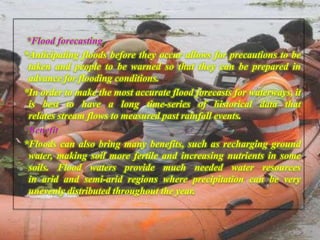
*Flood forecasting
*Anticipating floods before they occur allows for precautions to be
taken and people to be warned so that they can be prepared in
advance for flooding conditions.
*In order to make the most accurate flood forecasts for waterways, it
is best to have a long time-series of historical data that
relates stream flows to measured past rainfall events.
*Benefit
*Floods can also bring many benefits, such as recharging ground
water, making soil more fertile and increasing nutrients in some
soils. Flood waters provide much needed water resources
in arid and semi-arid regions where precipitation can be very
unevenly distributed throughout the year.
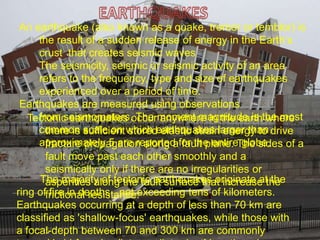
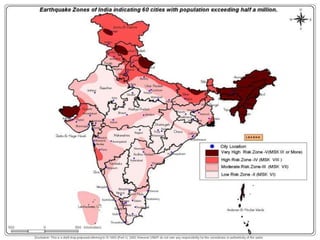
An earthquake (also known as a quake, tremor or temblor) is
the result of a sudden release of energy in the Earth‘s
crust that creates seismic waves
The seismicity, seismic or seismic activity of an area
refers to the frequency, type and size of earthquakes
experienced over a period of time.
Earthquakes are measured using observations
from seismometers. The moment magnitude is the most
common scale on which earthquakes larger than
approximately 5 are reported for the entire globe.
Tectonic earthquakes occur anywhere in the earth where
there is sufficient stored elastic strain energy to drive
fracture propagation along a fault plane. The sides of a
fault move past each other smoothly and a
seismically only if there are no irregularities or
asperities along the fault surface that increase the
frictional resistance.
The majority of tectonic earthquakes originate at the
ring of fire in depths not exceeding tens of kilometers.
Earthquakes occurring at a depth of less than 70 km are
classified as 'shallow-focus' earthquakes, while those with
a focal-depth between 70 and 300 km are commonly
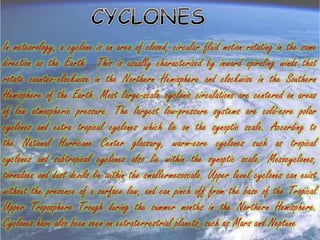
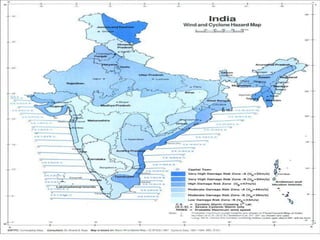
In meteorology, a cyclone is an area of closed, circular fluid motion rotating in the same
direction as the Earth. This is usually characterized by inward spiraling winds that
rotate counter-clockwise in the Northern Hemisphere and clockwise in the Southern
Hemisphere of the Earth. Most large-scale cyclonic circulations are centered on areas
of low atmospheric pressure. The largest low-pressure systems are cold-core polar
cyclones and extra tropical cyclones which lie on the synoptic scale. According to
the National Hurricane Center glossary, warm-core cyclones such as tropical
cyclones and subtropical cyclones also lie within the synoptic scale. Mesocyclones,
tornadoes and dust devils lie within the smallermesoscale. Upper level cyclones can exist
without the presence of a surface low, and can pinch off from the base of the Tropical
Upper Troposphere Trough during the summer months in the Northern Hemisphere.
Cyclones have also been seen on extraterrestrial planets, such as Mars and Neptune
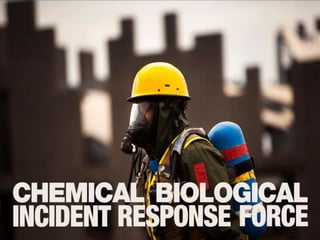
Biological and Chemical Accidents
Biological disasters
belong to the class of natural disasters and define the devastating effects that may
be caused by an enormous spread of a certain kind of living organism - that may
be the spread of a disease, a virus, an epidemics, but also just a sudden growth of
the population of a certain kind of plants or animals, e.g.. a locust plague.
Chemical Disasters
A chemical accident is the unintentional refuse of one or more hazardous
substances which could harm human health or the environment. Chemical
hazards are systems where chemical accidents could occur under certain
circumstances. Such events include fires, explosions, leakages or releases
of toxic or hazardous materials that can cause people illness, injury, disability or
death . While chemical accidents may occur whenever toxic materials are
stored, transported or used, the most severe accidents are industrial accidents,
involving major chemical manufacturing and storage facilities.
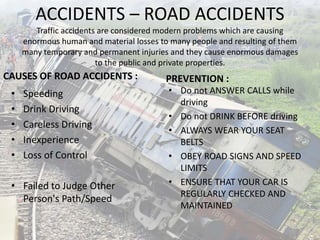
ACCIDENTS – ROAD ACCIDENTS
Traffic accidents are considered modern problems which are causing
enormous human and material losses to many people and resulting of them
many temporary and permanent injuries and they cause enormous damages
to the public and private properties.
CAUSES OF ROAD ACCIDENTS :
• Speeding
• Drink Driving
• Careless Driving
• Inexperience
• Loss of Control
• Failed to Judge Other
Person's Path/Speed
PREVENTION :
• Do not ANSWER CALLS while
driving
• Do not DRINK BEFORE driving
• ALWAYS WEAR YOUR SEAT
BELTS
• OBEY ROAD SIGNS AND SPEED
LIMITS
• ENSURE THAT YOUR CAR IS
REGULARLY CHECKED AND
MAINTAINED
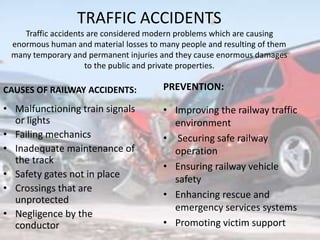
TRAFFIC ACCIDENTS
Traffic accidents are considered modern problems which are causing
enormous human and material losses to many people and resulting of them
many temporary and permanent injuries and they cause enormous damages
to the public and private properties.
CAUSES OF RAILWAY ACCIDENTS:
• Malfunctioning train signals
or lights
• Failing mechanics
• Inadequate maintenance of
the track
• Safety gates not in place
• Crossings that are
unprotected
• Negligence by the
conductor
PREVENTION:
• Improving the railway traffic
environment
• Securing safe railway
operation
• Ensuring railway vehicle
safety
• Enhancing rescue and
emergency services systems
• Promoting victim support
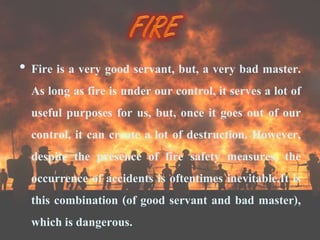
• Fire is a very good servant, but, a very bad master.
As long as fire is under our control, it serves a lot of
useful purposes for us, but, once it goes out of our
control, it can create a lot of destruction. However,
despite the presence of fire safety measures, the
occurrence of accidents is oftentimes inevitable.It is
this combination (of good servant and bad master),
which is dangerous.
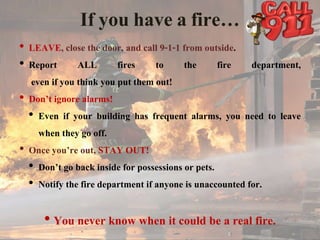
If you have a fire…
• LEAVE, close the door, and call 9-1-1 from outside.
• Report ALL fires to the fire department,
even if you think you put them out!
• Don’t ignore alarms!
• Even if your building has frequent alarms, you need to leave
when they go off.
• Once you’re out, STAY OUT!
• Don’t go back inside for possessions or pets.
• Notify the fire department if anyone is unaccounted for.
• You never know when it could be a real fire.
THANK YOU
Made By :
Ayush,Fozan,Palak,Aman &
Nalinaksha

Disaster management ppt

  • 2.
    FLOODS *A flood isan overflow of water that submerges land which is usually dry. Flooding may occur as an overflow of water from water bodies, such as a river or lake, in which the water overtops, resulting in some of that water escaping its usual occur in rivers when the flow rate exceeds the capacity of the river channel. *Floods can happen on flat or low-lying areas when the ground is saturated and water cannot run off quickly enough to stop accumulating. *The primary effects of flooding include loss of life, damage to buildings and other structures, damage to roads ,etc . *Floods also frequently damage power transmission and sometimes power generation, which then has knock-on effects caused by the loss of power. This includes loss of drinking water treatment and water supply, which may result in loss of drinking water.
  • 3.
    *Flood forecasting *Anticipating floodsbefore they occur allows for precautions to be taken and people to be warned so that they can be prepared in advance for flooding conditions. *In order to make the most accurate flood forecasts for waterways, it is best to have a long time-series of historical data that relates stream flows to measured past rainfall events. *Benefit *Floods can also bring many benefits, such as recharging ground water, making soil more fertile and increasing nutrients in some soils. Flood waters provide much needed water resources in arid and semi-arid regions where precipitation can be very unevenly distributed throughout the year.
  • 5.
    An earthquake (alsoknown as a quake, tremor or temblor) is the result of a sudden release of energy in the Earth‘s crust that creates seismic waves The seismicity, seismic or seismic activity of an area refers to the frequency, type and size of earthquakes experienced over a period of time. Earthquakes are measured using observations from seismometers. The moment magnitude is the most common scale on which earthquakes larger than approximately 5 are reported for the entire globe. Tectonic earthquakes occur anywhere in the earth where there is sufficient stored elastic strain energy to drive fracture propagation along a fault plane. The sides of a fault move past each other smoothly and a seismically only if there are no irregularities or asperities along the fault surface that increase the frictional resistance. The majority of tectonic earthquakes originate at the ring of fire in depths not exceeding tens of kilometers. Earthquakes occurring at a depth of less than 70 km are classified as 'shallow-focus' earthquakes, while those with a focal-depth between 70 and 300 km are commonly
  • 7.
    In meteorology, acyclone is an area of closed, circular fluid motion rotating in the same direction as the Earth. This is usually characterized by inward spiraling winds that rotate counter-clockwise in the Northern Hemisphere and clockwise in the Southern Hemisphere of the Earth. Most large-scale cyclonic circulations are centered on areas of low atmospheric pressure. The largest low-pressure systems are cold-core polar cyclones and extra tropical cyclones which lie on the synoptic scale. According to the National Hurricane Center glossary, warm-core cyclones such as tropical cyclones and subtropical cyclones also lie within the synoptic scale. Mesocyclones, tornadoes and dust devils lie within the smallermesoscale. Upper level cyclones can exist without the presence of a surface low, and can pinch off from the base of the Tropical Upper Troposphere Trough during the summer months in the Northern Hemisphere. Cyclones have also been seen on extraterrestrial planets, such as Mars and Neptune
  • 9.
    Biological and ChemicalAccidents Biological disasters belong to the class of natural disasters and define the devastating effects that may be caused by an enormous spread of a certain kind of living organism - that may be the spread of a disease, a virus, an epidemics, but also just a sudden growth of the population of a certain kind of plants or animals, e.g.. a locust plague. Chemical Disasters A chemical accident is the unintentional refuse of one or more hazardous substances which could harm human health or the environment. Chemical hazards are systems where chemical accidents could occur under certain circumstances. Such events include fires, explosions, leakages or releases of toxic or hazardous materials that can cause people illness, injury, disability or death . While chemical accidents may occur whenever toxic materials are stored, transported or used, the most severe accidents are industrial accidents, involving major chemical manufacturing and storage facilities.
  • 11.
    ACCIDENTS – ROADACCIDENTS Traffic accidents are considered modern problems which are causing enormous human and material losses to many people and resulting of them many temporary and permanent injuries and they cause enormous damages to the public and private properties. CAUSES OF ROAD ACCIDENTS : • Speeding • Drink Driving • Careless Driving • Inexperience • Loss of Control • Failed to Judge Other Person's Path/Speed PREVENTION : • Do not ANSWER CALLS while driving • Do not DRINK BEFORE driving • ALWAYS WEAR YOUR SEAT BELTS • OBEY ROAD SIGNS AND SPEED LIMITS • ENSURE THAT YOUR CAR IS REGULARLY CHECKED AND MAINTAINED
  • 12.
    TRAFFIC ACCIDENTS Traffic accidentsare considered modern problems which are causing enormous human and material losses to many people and resulting of them many temporary and permanent injuries and they cause enormous damages to the public and private properties. CAUSES OF RAILWAY ACCIDENTS: • Malfunctioning train signals or lights • Failing mechanics • Inadequate maintenance of the track • Safety gates not in place • Crossings that are unprotected • Negligence by the conductor PREVENTION: • Improving the railway traffic environment • Securing safe railway operation • Ensuring railway vehicle safety • Enhancing rescue and emergency services systems • Promoting victim support
  • 13.
    • Fire isa very good servant, but, a very bad master. As long as fire is under our control, it serves a lot of useful purposes for us, but, once it goes out of our control, it can create a lot of destruction. However, despite the presence of fire safety measures, the occurrence of accidents is oftentimes inevitable.It is this combination (of good servant and bad master), which is dangerous.
  • 14.
    If you havea fire… • LEAVE, close the door, and call 9-1-1 from outside. • Report ALL fires to the fire department, even if you think you put them out! • Don’t ignore alarms! • Even if your building has frequent alarms, you need to leave when they go off. • Once you’re out, STAY OUT! • Don’t go back inside for possessions or pets. • Notify the fire department if anyone is unaccounted for. • You never know when it could be a real fire.
  • 15.
    THANK YOU Made By: Ayush,Fozan,Palak,Aman & Nalinaksha