Dr. J.B. Kathiriya
Dept. of Veterinary Public Health & Epidemiology
College of Veterinary Science & A.H.,
Junagadh Agricultural University,
Junagadh-362001
INTRODUCTION
Natural Calamities like Cyclone, flood, earthquake, volcanoes
and Landslides are normal natural events in the formation of
earth, but they are disastrous when they strike human
settlements.
In India, natural disasters occur frequently. For example, about
260 million people are being affected by frequent floods which
occur in eight major river valleys in 40 million ha..
About ten million people are affected by cyclones in the entire
5700km long coastline of peninsular India in 9 states.
This impact of earthquake is much more than the other
disasters because about 400 million people in the seismic zones
IV and V (55% of total area of India) are being greatly affected.
About ten million people living along the entire sub Himalayan
region and Western Ghats suffer a lot due to landslides.
Since the disasters strike human settlements often in different
parts of the world, they have to learn to minimize the effects of
disasters.
CYCLONES
Cyclone is a large scale
air mass that rotates
around a strong center of
low atmospheric pressure.
Tropical cyclones in the
warm oceans are formed to
heat and moisture.
Sea surface temperature
should be above 260
C.
Cyclones move like a spin
(120-400 km/hr) with a
diameter of 100-1500 km.
Management
It is not possible to stop cyclones. But we can follow
certain measures to escape from their devastation.
The measures are as follows:
Planting of trees along coastal belts.
Construction of dams and wind breaks.
Installation of wide roads for the people to evacuate
quickly in emergencies.
Installation of better working system.
Construction of proper drainage.
Disaster prediction i.e., announcement of cyclone warning
to people would help in minimizing the impact.
FLOODS
Causes
It is caused by natural and human factors.
Natural Factors: Heavy and prolonged rainfall,
blocking of free flow of the rivers due to landsides and
overflowing of river banks.
Human Factors: Building activities, channel
manipulation through diversion of river course,
construction of bridges, deforestation,
changes in land use and blockage of water courses by
plastics.
Recently in Chennai, the intensity of flooding of roads
and residential colonies increased due to the
accumulation of plastics in water courses.
Control
The impact of flood can be minimized by the
following steps
The discharge of waste must be hastened.
The flow of water must be diverted.
The return runoff water from river must be delayed.
The flood situation must be announced to the people in
advance through media.
EARTHQUAKES
A sudden movement of Earth’s crust (or) a motion of the ground
surface is known as earthquake.
Earth’s crust has many tectonic plates of solid rock which slowly
move along their boundaries.
Hypocenter is a point of sudden energy release.
Epicenter is the place on the ground surface (fault lines or planes
of weakness) recording seismic waves (first movement) for the
first time.
The intensity of energy released by an earthquake is measured by
the Richter scale devised by Charles F. Richter.
Sesimometer is an instrument used to measure seismic waves.
Severity of an earthquake
S. No Richter Scale Severity of
Earth quake
1. Less than 4 Insignificant
2. 4-4.9 Minor
3. 5-5.9 Damaging
4. 6-6.9 Destructive
5. 7-7.9 Major
6. More than 8.9 Great
Causes
Natural factors: Friction due to moving of tectonic plates
creates stress which leads to fractures and causes
earthquakes.
Human factors:
Underground nuclear testing causes earth tremor.
Collection of huge amount of water behind a dam also causes
earthquake.
Pouring liquid wastes into deeper wells creates tremor.
Effects
Earthquake causes damage to buildings, roads, factories,
dams and bridges.
Water supply and electricity supply and
Telecommunication are completely disrupted.
In hilly areas, land slides occur damaging dams and
causing floods
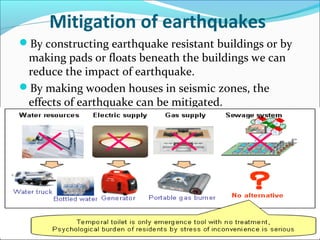
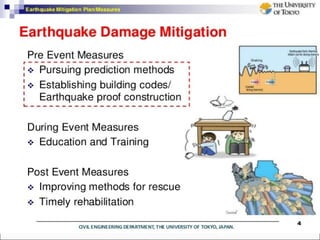
Mitigation of earthquakes
By constructing earthquake resistant buildings or by
making pads or floats beneath the buildings we can
reduce the impact of earthquake.
By making wooden houses in seismic zones, the
effects of earthquake can be mitigated.
Tusnamis-(High Sea waves) (Japanese word)
Severe earthquakes under sea water generate high sea
waves and these are referred to as tsunami in Japanese
language.
They travel at a speed up to 1000mk/hr or more.
They rise from 15 meters to 65 meters in height at sea
shore, causing vast devastation in coastal areas.
The first Tsunami hit India in 1945, when Indians were
engaged in the war of Independence.
At that time, people did not worry about Tsunami much.
Even now there is a danger of Tsunami in the Arabian
sea.
People are not aware of this danger. But the animals are
capable of learning the tsunami strike in advance with
the help of their ultrasonic radiation.
Thus, they often escape from the danger. Therefore, it
is better to train sea animals as done in China, in order
to caution the human beings about tsunami in advance.
A tsunami-warning instrument is to be fixed in the Bay
of Bengal to track tsunami in advance.
Generally tsunami strikes during the beginning or
towards the end of a month. For example, tsunamis
struck on 27th
August 1883, 25th
November 1945 and 26th
December 2004. In some countries, tsunami struck in
the beginning of the month.
LANDSLIDES
The moving down of coherent rock of soil mass due to
gravitation is called landslide. The sudden rockslides are more
Causes
Human activities like hydroelectric Projects, dams,
construction of roads, railway lines, mines and deforestation
cause landslides.
Mitigation
Landslides can be minimized by stabilizing the slopes by
adopting the following measures:
A forestation in vulnerable areas so that vegetation
consolidates the slope materials and provides cohesion with
the help of root and also retards water flow and erosion.
Providing slope supported by wired stone blocks.
Providing concrete support at the base of slope.
Draining the surface and subsurface water.
Disaster management
Disaster management
Disaster management

Disaster management

  • 1.
    Dr. J.B. Kathiriya Dept.of Veterinary Public Health & Epidemiology College of Veterinary Science & A.H., Junagadh Agricultural University, Junagadh-362001
  • 2.
    INTRODUCTION Natural Calamities likeCyclone, flood, earthquake, volcanoes and Landslides are normal natural events in the formation of earth, but they are disastrous when they strike human settlements. In India, natural disasters occur frequently. For example, about 260 million people are being affected by frequent floods which occur in eight major river valleys in 40 million ha.. About ten million people are affected by cyclones in the entire 5700km long coastline of peninsular India in 9 states. This impact of earthquake is much more than the other disasters because about 400 million people in the seismic zones IV and V (55% of total area of India) are being greatly affected. About ten million people living along the entire sub Himalayan region and Western Ghats suffer a lot due to landslides. Since the disasters strike human settlements often in different parts of the world, they have to learn to minimize the effects of disasters.
  • 3.
    CYCLONES Cyclone is alarge scale air mass that rotates around a strong center of low atmospheric pressure. Tropical cyclones in the warm oceans are formed to heat and moisture. Sea surface temperature should be above 260 C. Cyclones move like a spin (120-400 km/hr) with a diameter of 100-1500 km.
  • 5.
    Management It is notpossible to stop cyclones. But we can follow certain measures to escape from their devastation. The measures are as follows: Planting of trees along coastal belts. Construction of dams and wind breaks. Installation of wide roads for the people to evacuate quickly in emergencies. Installation of better working system. Construction of proper drainage. Disaster prediction i.e., announcement of cyclone warning to people would help in minimizing the impact.
  • 7.
    FLOODS Causes It is causedby natural and human factors. Natural Factors: Heavy and prolonged rainfall, blocking of free flow of the rivers due to landsides and overflowing of river banks. Human Factors: Building activities, channel manipulation through diversion of river course, construction of bridges, deforestation, changes in land use and blockage of water courses by plastics. Recently in Chennai, the intensity of flooding of roads and residential colonies increased due to the accumulation of plastics in water courses.
  • 8.
    Control The impact offlood can be minimized by the following steps The discharge of waste must be hastened. The flow of water must be diverted. The return runoff water from river must be delayed. The flood situation must be announced to the people in advance through media.
  • 9.
    EARTHQUAKES A sudden movementof Earth’s crust (or) a motion of the ground surface is known as earthquake. Earth’s crust has many tectonic plates of solid rock which slowly move along their boundaries. Hypocenter is a point of sudden energy release. Epicenter is the place on the ground surface (fault lines or planes of weakness) recording seismic waves (first movement) for the first time. The intensity of energy released by an earthquake is measured by the Richter scale devised by Charles F. Richter. Sesimometer is an instrument used to measure seismic waves.
  • 10.
    Severity of anearthquake S. No Richter Scale Severity of Earth quake 1. Less than 4 Insignificant 2. 4-4.9 Minor 3. 5-5.9 Damaging 4. 6-6.9 Destructive 5. 7-7.9 Major 6. More than 8.9 Great
  • 12.
    Causes Natural factors: Frictiondue to moving of tectonic plates creates stress which leads to fractures and causes earthquakes. Human factors: Underground nuclear testing causes earth tremor. Collection of huge amount of water behind a dam also causes earthquake. Pouring liquid wastes into deeper wells creates tremor. Effects Earthquake causes damage to buildings, roads, factories, dams and bridges. Water supply and electricity supply and Telecommunication are completely disrupted. In hilly areas, land slides occur damaging dams and causing floods
  • 13.
    Mitigation of earthquakes Byconstructing earthquake resistant buildings or by making pads or floats beneath the buildings we can reduce the impact of earthquake. By making wooden houses in seismic zones, the effects of earthquake can be mitigated.
  • 16.
    Tusnamis-(High Sea waves)(Japanese word) Severe earthquakes under sea water generate high sea waves and these are referred to as tsunami in Japanese language. They travel at a speed up to 1000mk/hr or more. They rise from 15 meters to 65 meters in height at sea shore, causing vast devastation in coastal areas. The first Tsunami hit India in 1945, when Indians were engaged in the war of Independence. At that time, people did not worry about Tsunami much. Even now there is a danger of Tsunami in the Arabian sea.
  • 17.
    People are notaware of this danger. But the animals are capable of learning the tsunami strike in advance with the help of their ultrasonic radiation. Thus, they often escape from the danger. Therefore, it is better to train sea animals as done in China, in order to caution the human beings about tsunami in advance. A tsunami-warning instrument is to be fixed in the Bay of Bengal to track tsunami in advance. Generally tsunami strikes during the beginning or towards the end of a month. For example, tsunamis struck on 27th August 1883, 25th November 1945 and 26th December 2004. In some countries, tsunami struck in the beginning of the month.
  • 19.
    LANDSLIDES The moving downof coherent rock of soil mass due to gravitation is called landslide. The sudden rockslides are more Causes Human activities like hydroelectric Projects, dams, construction of roads, railway lines, mines and deforestation cause landslides. Mitigation Landslides can be minimized by stabilizing the slopes by adopting the following measures: A forestation in vulnerable areas so that vegetation consolidates the slope materials and provides cohesion with the help of root and also retards water flow and erosion. Providing slope supported by wired stone blocks. Providing concrete support at the base of slope. Draining the surface and subsurface water.