Disability
Disclosure: A
Brief Overview
Key
Definitions
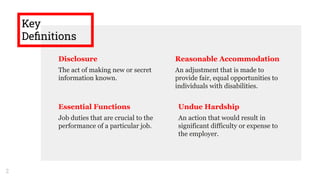
Disclosure
The act of making new or secret
information known.
2
Essential Functions
Job duties that are crucial to the
performance of a particular job.
Reasonable Accommodation
An adjustment that is made to
provide fair, equal opportunities to
individuals with disabilities.
Undue Hardship
An action that would result in
significant difficulty or expense to
the employer.
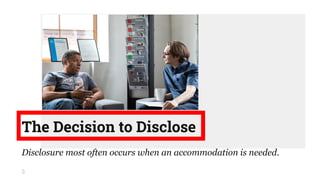
The Decision to Disclose
Disclosure most often occurs when an accommodation is needed.
3
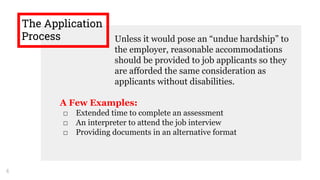
The Application
Process Unless it would pose an “undue hardship” to
the employer, reasonable accommodations
should be provided to job applicants so they
are afforded the same consideration as
applicants without disabilities.
4
A Few Examples:
□ Extended time to complete an assessment
□ An interpreter to attend the job interview
□ Providing documents in an alternative format
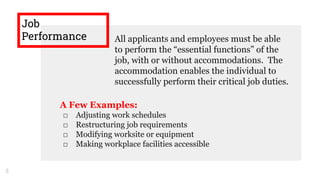
Job
Performance All applicants and employees must be able
to perform the “essential functions” of the
job, with or without accommodations. The
accommodation enables the individual to
successfully perform their critical job duties.
5
A Few Examples:
□ Adjusting work schedules
□ Restructuring job requirements
□ Modifying worksite or equipment
□ Making workplace facilities accessible
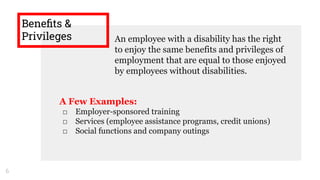
Benefits &
Privileges An employee with a disability has the right
to enjoy the same benefits and privileges of
employment that are equal to those enjoyed
by employees without disabilities.
6
A Few Examples:
□ Employer-sponsored training
□ Services (employee assistance programs, credit unions)
□ Social functions and company outings
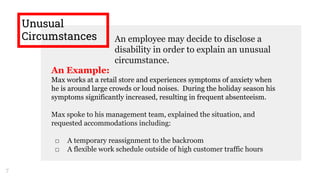
Unusual
Circumstances An employee may decide to disclose a
disability in order to explain an unusual
circumstance.
7
An Example:
Max works at a retail store and experiences symptoms of anxiety when
he is around large crowds or loud noises. During the holiday season his
symptoms significantly increased, resulting in frequent absenteeism.
Max spoke to his management team, explained the situation, and
requested accommodations including:
□ A temporary reassignment to the backroom
□ A flexible work schedule outside of high customer traffic hours
“ “I don’t need easy.
I just need possible.”
- Bethany Hamilton
8
When to Disclose
Disability disclosure can occur at any
time during the employment process.
9
It’s
Your
Choice!
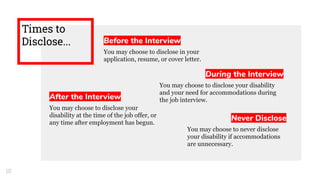
Times to
Disclose... Before the Interview
You may choose to disclose in your
application, resume, or cover letter.
During the Interview
You may choose to disclose your disability
and your need for accommodations during
the job interview.After the Interview
You may choose to disclose your
disability at the time of the job offer, or
any time after employment has begun.
Never Disclose
You may choose to never disclose
your disability if accommodations
are unnecessary.
10
Final
Thoughts
11
❏ Only you can decide whether disclosing a
disability is the right decision for you.
❏ Disclosure can occur at any time during
the employment process and an employer
may not retaliate against an applicant or
employee for disclosing their disability.
In
Summary...
Disability disclosure is never required unless a
request is made for a reasonable accommodation.
12
An accommodation is a change or modification that provides fair and
equal employment opportunities for individuals with disabilities.
Reasonable accommodations should be provided, unless the request
would pose an undue hardship such as a significant expense.
The CareerAbility Coach
Developing Career Rock Stars, Promoting Disability Inclusion
13
thanks!
Any questions?
You can find me at
www.CareerAbilityCoach.com
mary@careerabilitycoach.com
https://www.facebook.com/CareerAbilityCoach
?
14

Disability Disclosure

  • 1.
  • 2.
    Key Definitions Disclosure The act ofmaking new or secret information known. 2 Essential Functions Job duties that are crucial to the performance of a particular job. Reasonable Accommodation An adjustment that is made to provide fair, equal opportunities to individuals with disabilities. Undue Hardship An action that would result in significant difficulty or expense to the employer.
  • 3.
    The Decision toDisclose Disclosure most often occurs when an accommodation is needed. 3
  • 4.
    The Application Process Unlessit would pose an “undue hardship” to the employer, reasonable accommodations should be provided to job applicants so they are afforded the same consideration as applicants without disabilities. 4 A Few Examples: □ Extended time to complete an assessment □ An interpreter to attend the job interview □ Providing documents in an alternative format
  • 5.
    Job Performance All applicantsand employees must be able to perform the “essential functions” of the job, with or without accommodations. The accommodation enables the individual to successfully perform their critical job duties. 5 A Few Examples: □ Adjusting work schedules □ Restructuring job requirements □ Modifying worksite or equipment □ Making workplace facilities accessible
  • 6.
    Benefits & Privileges Anemployee with a disability has the right to enjoy the same benefits and privileges of employment that are equal to those enjoyed by employees without disabilities. 6 A Few Examples: □ Employer-sponsored training □ Services (employee assistance programs, credit unions) □ Social functions and company outings
  • 7.
    Unusual Circumstances An employeemay decide to disclose a disability in order to explain an unusual circumstance. 7 An Example: Max works at a retail store and experiences symptoms of anxiety when he is around large crowds or loud noises. During the holiday season his symptoms significantly increased, resulting in frequent absenteeism. Max spoke to his management team, explained the situation, and requested accommodations including: □ A temporary reassignment to the backroom □ A flexible work schedule outside of high customer traffic hours
  • 8.
    “ “I don’tneed easy. I just need possible.” - Bethany Hamilton 8
  • 9.
    When to Disclose Disabilitydisclosure can occur at any time during the employment process. 9 It’s Your Choice!
  • 10.
    Times to Disclose... Beforethe Interview You may choose to disclose in your application, resume, or cover letter. During the Interview You may choose to disclose your disability and your need for accommodations during the job interview.After the Interview You may choose to disclose your disability at the time of the job offer, or any time after employment has begun. Never Disclose You may choose to never disclose your disability if accommodations are unnecessary. 10
  • 11.
    Final Thoughts 11 ❏ Only youcan decide whether disclosing a disability is the right decision for you. ❏ Disclosure can occur at any time during the employment process and an employer may not retaliate against an applicant or employee for disclosing their disability.
  • 12.
    In Summary... Disability disclosure isnever required unless a request is made for a reasonable accommodation. 12 An accommodation is a change or modification that provides fair and equal employment opportunities for individuals with disabilities. Reasonable accommodations should be provided, unless the request would pose an undue hardship such as a significant expense.
  • 13.
    The CareerAbility Coach DevelopingCareer Rock Stars, Promoting Disability Inclusion 13
  • 14.
    thanks! Any questions? You canfind me at www.CareerAbilityCoach.com mary@careerabilitycoach.com https://www.facebook.com/CareerAbilityCoach ? 14