Office of Institutional Diversity and Equity
Toya Camacho
AVP for Institutional Diversity and Equity
Title IX & ADA Coordinator
2/27/2019
Non-Discrimination Policy
Williams College, in compliance with state and federal law,
does not discriminate in admission, employment, or
administration of its programs and activities on the basis of
race, color, sex, national origin, religion, age, disability,
marital status, sexual orientation, gender identity or
expression, ancestry, or military service.
2/27/2019
Session Objectives
At the end of the session, you will be able to:
 Identify the purpose of the ADA;
 Define “disability”;
 Make reasonable accommodations; and
 Avoid discrimination based on disability.
2/27/2019
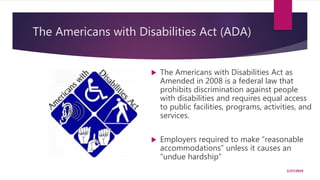
The Americans with Disabilities Act (ADA)
 The Americans with Disabilities Act as
Amended in 2008 is a federal law that
prohibits discrimination against people
with disabilities and requires equal access
to public facilities, programs, activities, and
services.
 Employers required to make “reasonable
accommodations” unless it causes an
“undue hardship”
2/27/2019
Defining Disability
 A physical or mental “impairment” that substantially
limits one or more major life activities;
 Having a record of such impairment; or
 Being regarded as having
such an impairment.
2/27/2019
Eligible employees include:
 A qualified person is someone who “satisfies the requisite skill,
experience, education, and other job-related requirements of the
position… and can perform the essential functions of the job, with or
without a reasonable accommodation and without posing a direct threat
to the health or safety of the individual or others”
 Part-time and full-time employees
2/27/2019
Major Life Activities
 Caring for oneself
 Performing manual tasks
 Seeing, hearing, eating, and sleeping
 Walking, standing, sitting, reaching, lifting, and bending
 Speaking, breathing, learning, and reading
 Concentrating, thinking, and communicating
 Interacting with others and working
2/27/2019
Major Life Activities (cont.)
Covered disability also applies to:
• The immune system, special sense organs, and skin
• Normal cell growth
• Digestive, neurological, and respiratory systems
• Circulatory and cardiovascular systems
• The operation of an individual organ within a body system (e.g., kidney, heart,
and liver).
2/27/2019
When to Start the Interactive Process
Initiate the interactive process when the employee’s disability is
known or apparent. For example, when:
 Employee requests an accommodation
 Employee presents doctor’s note with work restrictions
 Employer otherwise becomes aware of need for accommodation through third party or observation
2/27/2019
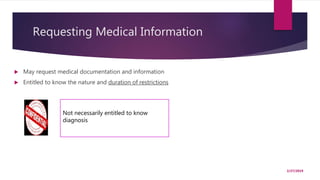
Requesting Medical Information
 May request medical documentation and information
 Entitled to know the nature and duration of restrictions
2/27/2019
Not necessarily entitled to know
diagnosis
Essential Functions
Essential job functions are important as these tasks are the focus of
the accommodation for an employee with a disability.
In all cases, the employee with a disability must be able to perform the
essential functions of the job, with or without an accommodation.
2/27/2019
Essential Functions (cont.)
When evaluating whether a task is essential, it is important to consider the following:
 Content of the written job description, including any physical skills
required to perform the job (i.e. must be able to move and transport
objects weighing up to 40 frequently; must climb ladders to inspect
work; etc.)
 The amount of time spent performing the job function
2/27/2019
“
I need a closer parking space because the employee lot is too
difficult with my leg problems” is an accommodation request
under the ADA.
True or False?
2/27/2019
2/27/2019
You should not transfer an employee to a different job to “ease” him back
into work after returning from a medical leave if the employee has been
released to work without restrictions.
True or False?
The Request for an Accommodation
 There is no specific language required when an employee is making a
request for an accommodation. That is, the employee does not have
to use the word “accommodation” and they do not have to make the
request in writing.
 The request for an accommodation may be expressed in a
conversation with the supervisor in talking about something that has
changed for the employee, or in talking about what they may need to
be able to do their job.
2/27/2019
The Request for an Accommodation
 Here are some examples of statements that can be a request for an
accommodation:
 “I’m on a new medication and having trouble getting to work on
time.”
 “I need time off for some treatment that my doctor is
recommending.”
 “I am making more errors because I am having trouble seeing the
data on the monitor.”
2/27/2019
Requests for Accommodations?
2/27/2019
Employee leaves mid-shift saying, “I
need to leave. I need to leave right
now,” without any reason.
“My feet hurt.”
“I need a shorter route through the
stockroom because the other way is
too long and difficult with my leg
problems.”
“I just cannot stand for 8 hours
anymore.”
ADA Scenario
A long-term employee starts having
performance problems. When her employer
talks to her about the problems, she responds
that she is very stressed and is having difficulty
handling her job duties. The employer doesn’t
know if this is an accommodation request and is
afraid to ask for clarification for fear of violating
the ADA’s rules about making medical inquiries.
2/27/2019
Reasonable Accommodation
 The College will provide a reasonable accommodation to a qualified employee
with a known disability unless the accommodation would impose an undue
hardship.
 The employee must be qualified. That is, they must have the skills,
education, and experience for the job.
 The employee must disclose they have a disability to the ADA Coordinator.
 The accommodation must be reasonable and not impose an undue
hardship.
2/27/2019
Examples of Accommodations
Modifying the job application process
Acquiring or modifying of
equipment/devices
Making facilities accessible
Other similar accommodations
2/27/2019
Providing Equipment as an
Accommodation
Jessica is an computer specialist. Her job requires that she work the majority of the
day, except for breaks and lunch, seated at
her desk using the computer and phone to complete her job tasks.
She has a chronic impairment and recently had back surgery. With her
return to work, it was recommended she have a more supportive chair
and an adjustable height desk as she was restricted from sitting for
hours at a time. The equipment provided her the opportunity to work
either sitting or standing while she completed her job tasks.
2/27/2019
What is Reasonable?
In determining whether an accommodation is reasonable we look at
whether providing the accommodation would be an “undue hardship.”
Considerations include:
The nature and cost of the accommodation*
The one that will fundamentally alter the nature of employment
The impact of the accommodation on the operation of the department
* Generally speaking, the cost of an accommodations on is not an undue
hardship for the college as most accommodations are administrative and/or not
of significant cost.
2/27/2019
The Interactive Process
These requests and the resulting conversations between the employee and the
supervisor starts the “interactive process,” an important component of the
accommodation procedure.
These interactions can also help identify barriers the employee is
experiencing. A barrier is some feature of the employee’s job (or the
job environment) that makes it difficult for the person with a disability
to perform their job tasks.
2/27/2019
Confidentiality
Any disclosure an employee makes regarding a disability, including any
medical documentation regarding the disability, must be kept
confidential.
2/27/2019
What would you do?
You are conducting job interviews for the
position of administrative assistant. One of
your applicants has a hand disability due to an
accident. You are not sure if she can handle
the computer work associated with the job.
2/27/2019
What would you do (cont.)
Do you:
 Ask how he/she is able to type with her disability?
 Tell her he/she is not right for the job?
 Explain the duties of the job and ask if he/she can accomplish them?
2/27/2019
What Not To Do
 “I wanted to speak to you about moving _____ out after the July Start. She is not
performing to expectations. She calls out sick frequently. She creates a negative
energy on the team…She does not hustle or work hard…she said she is unable to
work Saturdays due to her injury. She comes in late frequently-when I question
her about her tardiness-she blames her work injury for her frequent tardiness. She
is MILKING the system and everyone knows it. This is creating a distraction on the
team. She needs to go. Let’s discuss when you all get a chance. She called out
sick again today.”
2/27/2019
ADA Takeaways
 ADA protects qualified individuals with disabilities from employment
discrimination
 Accommodation requests can be verbal or written
 Do not ask the employee for medical information
 Consult with ADA Coordinator to start the interactive process
2/27/2019

ADA for Supervisors

  • 1.
    Office of InstitutionalDiversity and Equity Toya Camacho AVP for Institutional Diversity and Equity Title IX & ADA Coordinator 2/27/2019
  • 2.
    Non-Discrimination Policy Williams College,in compliance with state and federal law, does not discriminate in admission, employment, or administration of its programs and activities on the basis of race, color, sex, national origin, religion, age, disability, marital status, sexual orientation, gender identity or expression, ancestry, or military service. 2/27/2019
  • 3.
    Session Objectives At theend of the session, you will be able to:  Identify the purpose of the ADA;  Define “disability”;  Make reasonable accommodations; and  Avoid discrimination based on disability. 2/27/2019
  • 4.
    The Americans withDisabilities Act (ADA)  The Americans with Disabilities Act as Amended in 2008 is a federal law that prohibits discrimination against people with disabilities and requires equal access to public facilities, programs, activities, and services.  Employers required to make “reasonable accommodations” unless it causes an “undue hardship” 2/27/2019
  • 5.
    Defining Disability  Aphysical or mental “impairment” that substantially limits one or more major life activities;  Having a record of such impairment; or  Being regarded as having such an impairment. 2/27/2019
  • 6.
    Eligible employees include: A qualified person is someone who “satisfies the requisite skill, experience, education, and other job-related requirements of the position… and can perform the essential functions of the job, with or without a reasonable accommodation and without posing a direct threat to the health or safety of the individual or others”  Part-time and full-time employees 2/27/2019
  • 7.
    Major Life Activities Caring for oneself  Performing manual tasks  Seeing, hearing, eating, and sleeping  Walking, standing, sitting, reaching, lifting, and bending  Speaking, breathing, learning, and reading  Concentrating, thinking, and communicating  Interacting with others and working 2/27/2019
  • 8.
    Major Life Activities(cont.) Covered disability also applies to: • The immune system, special sense organs, and skin • Normal cell growth • Digestive, neurological, and respiratory systems • Circulatory and cardiovascular systems • The operation of an individual organ within a body system (e.g., kidney, heart, and liver). 2/27/2019
  • 9.
    When to Startthe Interactive Process Initiate the interactive process when the employee’s disability is known or apparent. For example, when:  Employee requests an accommodation  Employee presents doctor’s note with work restrictions  Employer otherwise becomes aware of need for accommodation through third party or observation 2/27/2019
  • 10.
    Requesting Medical Information May request medical documentation and information  Entitled to know the nature and duration of restrictions 2/27/2019 Not necessarily entitled to know diagnosis
  • 11.
    Essential Functions Essential jobfunctions are important as these tasks are the focus of the accommodation for an employee with a disability. In all cases, the employee with a disability must be able to perform the essential functions of the job, with or without an accommodation. 2/27/2019
  • 12.
    Essential Functions (cont.) Whenevaluating whether a task is essential, it is important to consider the following:  Content of the written job description, including any physical skills required to perform the job (i.e. must be able to move and transport objects weighing up to 40 frequently; must climb ladders to inspect work; etc.)  The amount of time spent performing the job function 2/27/2019
  • 13.
    “ I need acloser parking space because the employee lot is too difficult with my leg problems” is an accommodation request under the ADA. True or False? 2/27/2019
  • 14.
    2/27/2019 You should nottransfer an employee to a different job to “ease” him back into work after returning from a medical leave if the employee has been released to work without restrictions. True or False?
  • 15.
    The Request foran Accommodation  There is no specific language required when an employee is making a request for an accommodation. That is, the employee does not have to use the word “accommodation” and they do not have to make the request in writing.  The request for an accommodation may be expressed in a conversation with the supervisor in talking about something that has changed for the employee, or in talking about what they may need to be able to do their job. 2/27/2019
  • 16.
    The Request foran Accommodation  Here are some examples of statements that can be a request for an accommodation:  “I’m on a new medication and having trouble getting to work on time.”  “I need time off for some treatment that my doctor is recommending.”  “I am making more errors because I am having trouble seeing the data on the monitor.” 2/27/2019
  • 17.
    Requests for Accommodations? 2/27/2019 Employeeleaves mid-shift saying, “I need to leave. I need to leave right now,” without any reason. “My feet hurt.” “I need a shorter route through the stockroom because the other way is too long and difficult with my leg problems.” “I just cannot stand for 8 hours anymore.”
  • 18.
    ADA Scenario A long-termemployee starts having performance problems. When her employer talks to her about the problems, she responds that she is very stressed and is having difficulty handling her job duties. The employer doesn’t know if this is an accommodation request and is afraid to ask for clarification for fear of violating the ADA’s rules about making medical inquiries. 2/27/2019
  • 19.
    Reasonable Accommodation  TheCollege will provide a reasonable accommodation to a qualified employee with a known disability unless the accommodation would impose an undue hardship.  The employee must be qualified. That is, they must have the skills, education, and experience for the job.  The employee must disclose they have a disability to the ADA Coordinator.  The accommodation must be reasonable and not impose an undue hardship. 2/27/2019
  • 20.
    Examples of Accommodations Modifyingthe job application process Acquiring or modifying of equipment/devices Making facilities accessible Other similar accommodations 2/27/2019
  • 21.
    Providing Equipment asan Accommodation Jessica is an computer specialist. Her job requires that she work the majority of the day, except for breaks and lunch, seated at her desk using the computer and phone to complete her job tasks. She has a chronic impairment and recently had back surgery. With her return to work, it was recommended she have a more supportive chair and an adjustable height desk as she was restricted from sitting for hours at a time. The equipment provided her the opportunity to work either sitting or standing while she completed her job tasks. 2/27/2019
  • 22.
    What is Reasonable? Indetermining whether an accommodation is reasonable we look at whether providing the accommodation would be an “undue hardship.” Considerations include: The nature and cost of the accommodation* The one that will fundamentally alter the nature of employment The impact of the accommodation on the operation of the department * Generally speaking, the cost of an accommodations on is not an undue hardship for the college as most accommodations are administrative and/or not of significant cost. 2/27/2019
  • 23.
    The Interactive Process Theserequests and the resulting conversations between the employee and the supervisor starts the “interactive process,” an important component of the accommodation procedure. These interactions can also help identify barriers the employee is experiencing. A barrier is some feature of the employee’s job (or the job environment) that makes it difficult for the person with a disability to perform their job tasks. 2/27/2019
  • 24.
    Confidentiality Any disclosure anemployee makes regarding a disability, including any medical documentation regarding the disability, must be kept confidential. 2/27/2019
  • 25.
    What would youdo? You are conducting job interviews for the position of administrative assistant. One of your applicants has a hand disability due to an accident. You are not sure if she can handle the computer work associated with the job. 2/27/2019
  • 26.
    What would youdo (cont.) Do you:  Ask how he/she is able to type with her disability?  Tell her he/she is not right for the job?  Explain the duties of the job and ask if he/she can accomplish them? 2/27/2019
  • 27.
    What Not ToDo  “I wanted to speak to you about moving _____ out after the July Start. She is not performing to expectations. She calls out sick frequently. She creates a negative energy on the team…She does not hustle or work hard…she said she is unable to work Saturdays due to her injury. She comes in late frequently-when I question her about her tardiness-she blames her work injury for her frequent tardiness. She is MILKING the system and everyone knows it. This is creating a distraction on the team. She needs to go. Let’s discuss when you all get a chance. She called out sick again today.” 2/27/2019
  • 28.
    ADA Takeaways  ADAprotects qualified individuals with disabilities from employment discrimination  Accommodation requests can be verbal or written  Do not ask the employee for medical information  Consult with ADA Coordinator to start the interactive process 2/27/2019