YMCA EMPLOYMENT SERVICES
DISCLOSING YOUR
DISABILITY…
OR NOT
PowerPoint Created by: Carrie Alexander, Employment Placement Consultant
ACKNOWLEDGEMENT
Material in this workshop is based upon:
National Collaborative on Workforce and Disability
“The 411 on Disability Disclosure Workbook”
Washington, DC
Institute for Educational Leadership
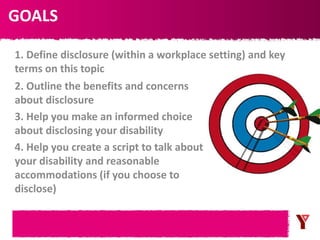
2. Outline the benefits and concerns
about disclosure
3. Help you make an informed choice
about disclosing your disability
4. Help you create a script to talk about
your disability and reasonable
accommodations (if you choose to
disclose)
GOALS
1. Define disclosure (within a workplace setting) and key
terms on this topic
TERMINOLOGY
• Disclosure
• Accommodation
• Informed choice
• Self-determination
DISCLOSURE
“to open up, to reveal or to tell”
• Very personal choice
• Should be an informed choice
• Usually done in order to receive
accommodations
• If you do not require accommodations,
it is generally not necessary to tell
people about your disability
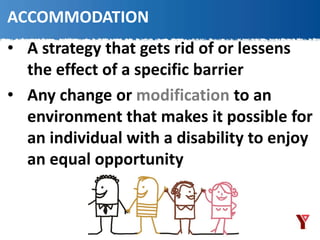
ACCOMMODATION
• A strategy that gets rid of or lessens
the effect of a specific barrier
• Any change or modification to an
environment that makes it possible for
an individual with a disability to enjoy
an equal opportunity
THREE BASIC TYPES OF ACCOMMODATIONS
1. Changes to facilities and
equipment (ramps, large print,
assistive technology)
2. Provision of special services (ASL
interpreters, job coach)
3. Creative thinking and problem
solving (flexible schedule, work
from home)
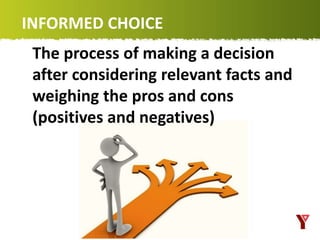
INFORMED CHOICE
The process of making a decision
after considering relevant facts and
weighing the pros and cons
(positives and negatives)
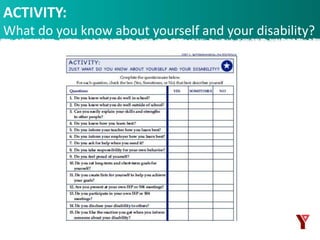
ACTIVITY:
What do you know about yourself and your disability?
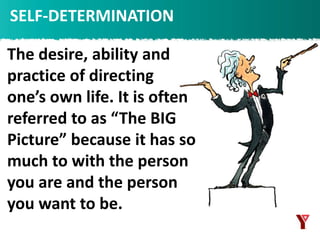
SELF-DETERMINATION
The desire, ability and
practice of directing
one’s own life. It is often
referred to as “The BIG
Picture” because it has so
much to with the person
you are and the person
you want to be.
SELF-DETERMINATION
A self-determined person can:
• See options
• Solve problems
• Speak for him or herself
• Understand required supports and
• Evaluate outcomes
SELF-DETERMINATION
Self-determined people:
• Respect themselves
• Accept themselves
• Value themselves for who
they are and what they have
to offer others
• More easily identify long and
short-term goals
A self-determined person:
• Understands their strengths
• Can describe their strengths to others
• Understands their disability and limitations
• Discloses (or doesn’t disclose) their disability
to others
• Knows which accommodations are effective
SELF-DETERMINATION
DISADVANTAGES TO DISCLOSING
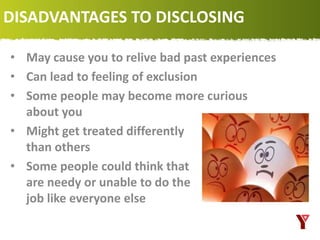
• May cause you to relive bad past experiences
• Can lead to feeling of exclusion
• Some people may become more curious
about you
• Might get treated differently
than others
• Some people could think that you
are needy or unable to do the
job like everyone else
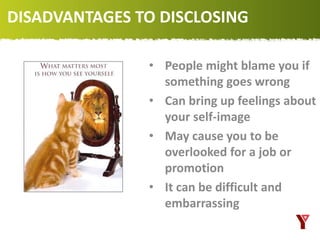
DISADVANTAGES TO DISCLOSING
• People might blame you if
something goes wrong
• Can bring up feelings about
your self-image
• May cause you to be
overlooked for a job or
promotion
• It can be difficult and
embarrassing
ADVANTAGES TO DISCLOSING
Allows you to:
• Receive reasonable
accommodations so that you
can work more effectively
• Reduce stress since you are
no longer protecting a
“secret”
• Be legally protected against
discrimination
• Increase your comfort level
ADVANTAGES TO DISCLOSING
• Have a clearer impression of what
kinds of expectations people may
have of you and your disability
• Ensures you are getting what you
need to be successful
• Greater freedom to communicate
should you face changes on the job
• Improves self-image though self-
advocacy (being able to stand up
for yourself)
ACTIVITY: Disclosure examples (page 7-10)
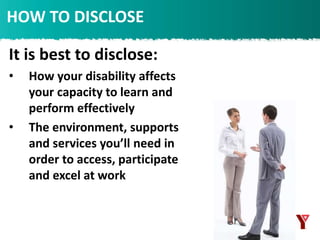
HOW TO DISCLOSE
It is best to disclose:
• How your disability affects
your capacity to learn and
perform effectively
• The environment, supports
and services you’ll need in
order to access, participate
and excel at work
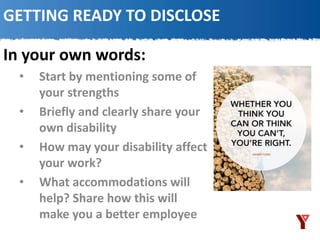
GETTING READY TO DISCLOSE
In your own words:
• Start by mentioning some of
your strengths
• Briefly and clearly share your
own disability
• How may your disability affect
your work?
• What accommodations will
help? Share how this will
make you a better employee
• Is the person in a supervisory
role and will he/she support
me?
• What experiences does this
person have with similar
disclosure situations
• Do I respect this person and
will they keep my disclosure
confidential?
WHO SHOULD YOU TALK TO
Questions to consider
• Does this person have the
power to determine how
reasonable the request is for
the accommodation?
• Can the person provide the
required accommodation(s)?
• Is the person responsible for
hiring, promoting or firing?
WHO SHOULD YOU TALK TO
Questions to consider, continued…
TIMING
• Select a private, confidential, comfortable place
to disclose
• Allow enough time to discuss the impact of
your disability
• The person(s) to whom you are disclosing may
have questions, suggestions or concerns that
require more time for discussion
Remember:
ACTIVITY: Practice Script (page 7-13)
PRACTICE SCRIPT
Having a disclosure “script” and practicing
it with friends, relatives and mentors will
be of great benefit to you when the time
actually comes to discuss your disability
at work
 Most people find it easier to talk about
the effect of their disability than using
clinical terms
REMEMBER…
Your decision to disclose your
disability may change based on:
• the particular person
• situation or setting
• need for accommodations
Trust your instincts!
FINAL THOUGHT

Disclosing Your Disability...OR NOT

  • 1.
    YMCA EMPLOYMENT SERVICES DISCLOSINGYOUR DISABILITY… OR NOT PowerPoint Created by: Carrie Alexander, Employment Placement Consultant
  • 2.
    ACKNOWLEDGEMENT Material in thisworkshop is based upon: National Collaborative on Workforce and Disability “The 411 on Disability Disclosure Workbook” Washington, DC Institute for Educational Leadership
  • 3.
    2. Outline thebenefits and concerns about disclosure 3. Help you make an informed choice about disclosing your disability 4. Help you create a script to talk about your disability and reasonable accommodations (if you choose to disclose) GOALS 1. Define disclosure (within a workplace setting) and key terms on this topic
  • 4.
    TERMINOLOGY • Disclosure • Accommodation •Informed choice • Self-determination
  • 5.
    DISCLOSURE “to open up,to reveal or to tell” • Very personal choice • Should be an informed choice • Usually done in order to receive accommodations • If you do not require accommodations, it is generally not necessary to tell people about your disability
  • 6.
    ACCOMMODATION • A strategythat gets rid of or lessens the effect of a specific barrier • Any change or modification to an environment that makes it possible for an individual with a disability to enjoy an equal opportunity
  • 7.
    THREE BASIC TYPESOF ACCOMMODATIONS 1. Changes to facilities and equipment (ramps, large print, assistive technology) 2. Provision of special services (ASL interpreters, job coach) 3. Creative thinking and problem solving (flexible schedule, work from home)
  • 8.
    INFORMED CHOICE The processof making a decision after considering relevant facts and weighing the pros and cons (positives and negatives)
  • 9.
    ACTIVITY: What do youknow about yourself and your disability?
  • 10.
    SELF-DETERMINATION The desire, abilityand practice of directing one’s own life. It is often referred to as “The BIG Picture” because it has so much to with the person you are and the person you want to be.
  • 11.
    SELF-DETERMINATION A self-determined personcan: • See options • Solve problems • Speak for him or herself • Understand required supports and • Evaluate outcomes
  • 12.
    SELF-DETERMINATION Self-determined people: • Respectthemselves • Accept themselves • Value themselves for who they are and what they have to offer others • More easily identify long and short-term goals
  • 13.
    A self-determined person: •Understands their strengths • Can describe their strengths to others • Understands their disability and limitations • Discloses (or doesn’t disclose) their disability to others • Knows which accommodations are effective SELF-DETERMINATION
  • 14.
    DISADVANTAGES TO DISCLOSING •May cause you to relive bad past experiences • Can lead to feeling of exclusion • Some people may become more curious about you • Might get treated differently than others • Some people could think that you are needy or unable to do the job like everyone else
  • 15.
    DISADVANTAGES TO DISCLOSING •People might blame you if something goes wrong • Can bring up feelings about your self-image • May cause you to be overlooked for a job or promotion • It can be difficult and embarrassing
  • 16.
    ADVANTAGES TO DISCLOSING Allowsyou to: • Receive reasonable accommodations so that you can work more effectively • Reduce stress since you are no longer protecting a “secret” • Be legally protected against discrimination • Increase your comfort level
  • 17.
    ADVANTAGES TO DISCLOSING •Have a clearer impression of what kinds of expectations people may have of you and your disability • Ensures you are getting what you need to be successful • Greater freedom to communicate should you face changes on the job • Improves self-image though self- advocacy (being able to stand up for yourself)
  • 18.
  • 19.
    HOW TO DISCLOSE Itis best to disclose: • How your disability affects your capacity to learn and perform effectively • The environment, supports and services you’ll need in order to access, participate and excel at work
  • 20.
    GETTING READY TODISCLOSE In your own words: • Start by mentioning some of your strengths • Briefly and clearly share your own disability • How may your disability affect your work? • What accommodations will help? Share how this will make you a better employee
  • 21.
    • Is theperson in a supervisory role and will he/she support me? • What experiences does this person have with similar disclosure situations • Do I respect this person and will they keep my disclosure confidential? WHO SHOULD YOU TALK TO Questions to consider
  • 22.
    • Does thisperson have the power to determine how reasonable the request is for the accommodation? • Can the person provide the required accommodation(s)? • Is the person responsible for hiring, promoting or firing? WHO SHOULD YOU TALK TO Questions to consider, continued…
  • 23.
    TIMING • Select aprivate, confidential, comfortable place to disclose • Allow enough time to discuss the impact of your disability • The person(s) to whom you are disclosing may have questions, suggestions or concerns that require more time for discussion Remember:
  • 24.
  • 25.
    PRACTICE SCRIPT Having adisclosure “script” and practicing it with friends, relatives and mentors will be of great benefit to you when the time actually comes to discuss your disability at work  Most people find it easier to talk about the effect of their disability than using clinical terms
  • 26.
    REMEMBER… Your decision todisclose your disability may change based on: • the particular person • situation or setting • need for accommodations Trust your instincts!
  • 27.

Editor's Notes

  • #10 This is a separate hand-out to the package. Discuss responses with client after activity.
  • #11 Every good project begins with a well crafted creative brief. We started out by articulating our objectives. We wanted a report that communicates what we achieved in 2010 from working together: locally, nationally, internationally demonstrates we are a leading charity in Canada showcases our refreshed Verbal and Visual Identity highlights our new brand positioning Nurturing the potential of children, youth and young adults Promoting healthy living Fostering a sense of social responsibility
  • #12 Every good project begins with a well crafted creative brief. We started out by articulating our objectives. We wanted a report that communicates what we achieved in 2010 from working together: locally, nationally, internationally demonstrates we are a leading charity in Canada showcases our refreshed Verbal and Visual Identity highlights our new brand positioning Nurturing the potential of children, youth and young adults Promoting healthy living Fostering a sense of social responsibility
  • #24 Every good project begins with a well crafted creative brief. We started out by articulating our objectives. We wanted a report that communicates what we achieved in 2010 from working together: locally, nationally, internationally demonstrates we are a leading charity in Canada showcases our refreshed Verbal and Visual Identity highlights our new brand positioning Nurturing the potential of children, youth and young adults Promoting healthy living Fostering a sense of social responsibility