The Interactive Process and
Reasonable Accommodation
of Disabled Workers
Jeffrey D. Polsky, Esq.
December 3, 2013

© 2013 Fox Rothschild
Basic Premise
• Title I of the ADA requires an employer to provide
reasonable accommodation to qualified
individuals with disabilities who are employees or
applicants for employment, except when such
accommodation would cause an undue hardship.
Disability defined
The term “disability” means, with respect to an
individual(A) a physical or mental impairment that
[substantially] limits one or more major life activities
of such individual;
(B) a record of such an impairment; or
(C) being regarded as having such an impairment.
Disability defined
ADA Regs: Impairment may still be substantially limiting
even if it is expected to last less than 6 mos.
DFEH regs: Exclude conditions that are mild, which have
little or no residual effects,
• The common cold; seasonal or common influenza; minor
cuts, sprains;
• Muscle aches, soreness, bruises, or abrasions; nonmigraine headaches; and
• Minor non-chronic gastrointestinal disorders.
Disability defined
Definition also excludes:
• Statutorily specified conditions, e.g. compulsive
gambling, kleptomania, pyromania, pedophilia, e
xhibitionism, and voyeurism
• Current abuse of alcohol or drugs
Qualified individual
A qualified individual with a disability is an
individual who, with or without reasonable
accommodation, can perform the essential
functions of the employment position that such
individual holds or desires.
Essential Functions
• The fundamental job duties of the employment
position the individual with a disability holds or
desires
• Look at:
–
–
–
–
–

Employer’s judgment/written job descriptions
Time spent performing
Consequences of not requiring the person to perform
CBA terms
Work experience
Reasonable accommodation/Undue
Hardship
“Reasonable accommodation” may include• (A) making existing facilities used by employees
readily accessible; and
• (B) job restructuring, part--time/ modified work
schedules; reassignment to a vacant position;
acquiring or modifying equipment; modifying
exams, training materials or policies; qualified
readers or interpreters; and other similar
accommodations
Reasonable accommodation/Undue
Hardship
“Undue hardship” means an action requiring
significant difficulty or expense, when considered in
light of:
• the nature and cost of the accommodation;
• the facility and the employer’s financial resources
and number of employees; and
• the effect on operations.
ADA Amendments Act of 2008
Expanded definition of disability by saying don’t
consider “mitigating measures” in determining
whether individual is “substantially limited in a
major life activity”
• Medications
• Medical supplies/equipment
• Prosthetics
• Hearing aids
• Mobility devices
ADA Amendments Act of 2008
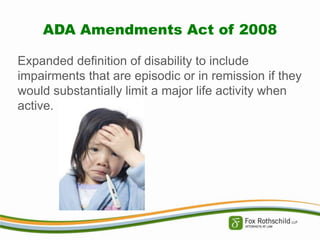
Expanded definition of disability to include
impairments that are episodic or in remission if they
would substantially limit a major life activity when
active.
Treating Everyone The Same Isn’t
Enough
• Equal opportunity ≠ Equal treatment
• Goal is to give disabled employees/applicants
opportunities to work
• Understanding the extent of that obligation is the
challenge
Significant Burden on Employers
• The number of impairments that qualify as
disabilities and the range of possible
accommodations are vast
• The ability to rely on a defense of “undue
hardship” is narrow
Significant Burden on Employers
• Employers must be prepared to assume
costs, inconvenience, inefficiencies, and
disruption
• The larger the employer, the greater the
obligation
• Even if no accommodation is
available, employers must engage the employee
in a timely, good faith interactive process
Misconduct attributed to a
disability
• EEOC Enforcement Guidance says an employer
is free to discipline a disabled employee for
violating a “workplace conduct standard” if it is
job-related and consistent with business
necessity, even if the misconduct resulted from a
disability.
• Case law not as clear – Wills v. Superior Court
(OK to enforce standards where disability-related
misconduct involves threats or violence)
Flexibility Is Key
What the interactive process
requires
• "Both the employer or other covered entity and
the applicant, employee or the individual’s
representative shall exchange essential
information identified below without delay or
obstruction of the process." (DFEH regs)
What the interactive process
requires
The employer must:
1. Grant the applicant or employee’s requested
accommodation.
2. Reject it "after due consideration" and initiate
discussion of other possible accommodations.
3. Ask for "reasonable medical documentation
confirming the existence of the disability and the
need for accommodation."
What the interactive process
requires
4. If information provided by the employee isn’t
clear, the employer can specify what further
information it needs.
5. When necessary to assess a requested
accommodation or to advance the interactive
process, the employer can consult with experts.
6. If reassignment is being considered, the
employer can ask about relevant education and
work experience.
What the interactive process
requires
Once the necessary information has been
exchanged, the employer must consult with the
individual to identify potential accommodations and
assess their effectiveness. It need not grant the
employee’s preferred accommodation.
What triggers the obligation to
engage in the interactive process?
• When the employee requests accommodation
• When an employer becomes aware of the need
for an accommodation through a third party or by
observation. (Don’t assume poor performance or
behavior is due to a disability.)
• If an employee with a disability exhausts the
leave provided under some other law (such as
FMLA) and remains unable to return to work.
Examples of accommodation (from
DFEH regs)
• “Providing accessible break
rooms, restrooms, training rooms, or reserved
parking places; acquiring or modifying
furniture, equipment or devices; or making other
similar adjustments.”
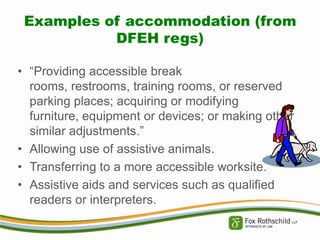
• Allowing use of assistive animals.
• Transferring to a more accessible worksite.
• Assistive aids and services such as qualified
readers or interpreters.
Examples of accommodation (from
DFEH regs)
• Job Restructuring (although the employer is not
required to reassign essential job functions).
• Part-time or modified work schedules.
• Changing when and/or how an essential function
is performed.
• Adjusting or modifying examinations, training
materials or policies.
• Modifying policies or supervisory methods.
Examples of accommodations (from
DFEH regs)
•
•
•
•

Providing additional training.
Letting the employee work from home.
Leaves of absence.
Reassignment to a vacant position
• An employee returning from a disability LOA is
entitled to “preferential consideration” over other
applicants or existing employees
• More than the ability to compete
• Absent a bona fide seniority
system, “reassignment means that the employee
gets the vacant position if s/he is qualified for it.”
(EEOC Enforcement Guidance)
How can employers reduce their
exposure?
• Policies should spell out the right to
accommodations and how to request
• Job descriptions should be current and
accurately identify essential functions
• Managers should know that there’s an obligation
to accommodate and whom to address disabilityrelated issues to
• Train employees who engage in the interactive
process.
How can employers reduce their
exposure?
• The obligation to accommodate is ongoing. If an
accommodation isn’t effective, start over.
• Protect employee privacy
• Document, Document, Document
• Get legal advice, if necessary
Sources for further information
• The Americans With Disabilities Act of 1990 – 42
USC §12101 et seq.
• EEOC Regs – 29 CFR Part 1630
• http://www.eeoc.gov/laws/types/disability.cfm EEOC
• http://www.ada.gov – US DOJ Civil Rights Div.
• http://www.eeoc.gov/policy/docs/accommodation.
html#N_90_ - EEOC Enforcement Guidance
(reasonable accommodation)
Sources for further information
(continued)
• http://www.eeoc.gov/policy/docs/psych.html EEOC Guidance (psychiatric disabilities)
• http://www.eeoc.gov/policy/docs/guidanceinquiries.html - EEOC Guidance (disabilityrelated inquiries)
• http://californiaemploymentlaw.foxrothschild.com
• http://employmentdiscrimination.foxrothschild.com
Jeffrey D. Polsky, Esq.
415.364.5563
jpolsky@foxrothschild.com

The Interactive Process and Reasonable Accommodation of Disabled Workers

  • 1.
    The Interactive Processand Reasonable Accommodation of Disabled Workers Jeffrey D. Polsky, Esq. December 3, 2013 © 2013 Fox Rothschild
  • 2.
    Basic Premise • TitleI of the ADA requires an employer to provide reasonable accommodation to qualified individuals with disabilities who are employees or applicants for employment, except when such accommodation would cause an undue hardship.
  • 3.
    Disability defined The term“disability” means, with respect to an individual(A) a physical or mental impairment that [substantially] limits one or more major life activities of such individual; (B) a record of such an impairment; or (C) being regarded as having such an impairment.
  • 4.
    Disability defined ADA Regs:Impairment may still be substantially limiting even if it is expected to last less than 6 mos. DFEH regs: Exclude conditions that are mild, which have little or no residual effects, • The common cold; seasonal or common influenza; minor cuts, sprains; • Muscle aches, soreness, bruises, or abrasions; nonmigraine headaches; and • Minor non-chronic gastrointestinal disorders.
  • 5.
    Disability defined Definition alsoexcludes: • Statutorily specified conditions, e.g. compulsive gambling, kleptomania, pyromania, pedophilia, e xhibitionism, and voyeurism • Current abuse of alcohol or drugs
  • 6.
    Qualified individual A qualifiedindividual with a disability is an individual who, with or without reasonable accommodation, can perform the essential functions of the employment position that such individual holds or desires.
  • 7.
    Essential Functions • Thefundamental job duties of the employment position the individual with a disability holds or desires • Look at: – – – – – Employer’s judgment/written job descriptions Time spent performing Consequences of not requiring the person to perform CBA terms Work experience
  • 8.
    Reasonable accommodation/Undue Hardship “Reasonable accommodation”may include• (A) making existing facilities used by employees readily accessible; and • (B) job restructuring, part--time/ modified work schedules; reassignment to a vacant position; acquiring or modifying equipment; modifying exams, training materials or policies; qualified readers or interpreters; and other similar accommodations
  • 9.
    Reasonable accommodation/Undue Hardship “Undue hardship”means an action requiring significant difficulty or expense, when considered in light of: • the nature and cost of the accommodation; • the facility and the employer’s financial resources and number of employees; and • the effect on operations.
  • 10.
    ADA Amendments Actof 2008 Expanded definition of disability by saying don’t consider “mitigating measures” in determining whether individual is “substantially limited in a major life activity” • Medications • Medical supplies/equipment • Prosthetics • Hearing aids • Mobility devices
  • 11.
    ADA Amendments Actof 2008 Expanded definition of disability to include impairments that are episodic or in remission if they would substantially limit a major life activity when active.
  • 12.
    Treating Everyone TheSame Isn’t Enough • Equal opportunity ≠ Equal treatment • Goal is to give disabled employees/applicants opportunities to work • Understanding the extent of that obligation is the challenge
  • 13.
    Significant Burden onEmployers • The number of impairments that qualify as disabilities and the range of possible accommodations are vast • The ability to rely on a defense of “undue hardship” is narrow
  • 14.
    Significant Burden onEmployers • Employers must be prepared to assume costs, inconvenience, inefficiencies, and disruption • The larger the employer, the greater the obligation • Even if no accommodation is available, employers must engage the employee in a timely, good faith interactive process
  • 15.
    Misconduct attributed toa disability • EEOC Enforcement Guidance says an employer is free to discipline a disabled employee for violating a “workplace conduct standard” if it is job-related and consistent with business necessity, even if the misconduct resulted from a disability. • Case law not as clear – Wills v. Superior Court (OK to enforce standards where disability-related misconduct involves threats or violence)
  • 16.
  • 17.
    What the interactiveprocess requires • "Both the employer or other covered entity and the applicant, employee or the individual’s representative shall exchange essential information identified below without delay or obstruction of the process." (DFEH regs)
  • 18.
    What the interactiveprocess requires The employer must: 1. Grant the applicant or employee’s requested accommodation. 2. Reject it "after due consideration" and initiate discussion of other possible accommodations. 3. Ask for "reasonable medical documentation confirming the existence of the disability and the need for accommodation."
  • 19.
    What the interactiveprocess requires 4. If information provided by the employee isn’t clear, the employer can specify what further information it needs. 5. When necessary to assess a requested accommodation or to advance the interactive process, the employer can consult with experts. 6. If reassignment is being considered, the employer can ask about relevant education and work experience.
  • 20.
    What the interactiveprocess requires Once the necessary information has been exchanged, the employer must consult with the individual to identify potential accommodations and assess their effectiveness. It need not grant the employee’s preferred accommodation.
  • 21.
    What triggers theobligation to engage in the interactive process? • When the employee requests accommodation • When an employer becomes aware of the need for an accommodation through a third party or by observation. (Don’t assume poor performance or behavior is due to a disability.) • If an employee with a disability exhausts the leave provided under some other law (such as FMLA) and remains unable to return to work.
  • 22.
    Examples of accommodation(from DFEH regs) • “Providing accessible break rooms, restrooms, training rooms, or reserved parking places; acquiring or modifying furniture, equipment or devices; or making other similar adjustments.” • Allowing use of assistive animals. • Transferring to a more accessible worksite. • Assistive aids and services such as qualified readers or interpreters.
  • 23.
    Examples of accommodation(from DFEH regs) • Job Restructuring (although the employer is not required to reassign essential job functions). • Part-time or modified work schedules. • Changing when and/or how an essential function is performed. • Adjusting or modifying examinations, training materials or policies. • Modifying policies or supervisory methods.
  • 24.
    Examples of accommodations(from DFEH regs) • • • • Providing additional training. Letting the employee work from home. Leaves of absence. Reassignment to a vacant position
  • 25.
    Reassignment to avacant position • An employee returning from a disability LOA is entitled to “preferential consideration” over other applicants or existing employees • More than the ability to compete • Absent a bona fide seniority system, “reassignment means that the employee gets the vacant position if s/he is qualified for it.” (EEOC Enforcement Guidance)
  • 26.
    How can employersreduce their exposure? • Policies should spell out the right to accommodations and how to request • Job descriptions should be current and accurately identify essential functions • Managers should know that there’s an obligation to accommodate and whom to address disabilityrelated issues to • Train employees who engage in the interactive process.
  • 27.
    How can employersreduce their exposure? • The obligation to accommodate is ongoing. If an accommodation isn’t effective, start over. • Protect employee privacy • Document, Document, Document • Get legal advice, if necessary
  • 28.
    Sources for furtherinformation • The Americans With Disabilities Act of 1990 – 42 USC §12101 et seq. • EEOC Regs – 29 CFR Part 1630 • http://www.eeoc.gov/laws/types/disability.cfm EEOC • http://www.ada.gov – US DOJ Civil Rights Div. • http://www.eeoc.gov/policy/docs/accommodation. html#N_90_ - EEOC Enforcement Guidance (reasonable accommodation)
  • 29.
    Sources for furtherinformation (continued) • http://www.eeoc.gov/policy/docs/psych.html EEOC Guidance (psychiatric disabilities) • http://www.eeoc.gov/policy/docs/guidanceinquiries.html - EEOC Guidance (disabilityrelated inquiries) • http://californiaemploymentlaw.foxrothschild.com • http://employmentdiscrimination.foxrothschild.com
  • 30.
    Jeffrey D. Polsky,Esq. 415.364.5563 jpolsky@foxrothschild.com