REAL NUMBER SYSTEM
No World without Water
No Mathematics without Numbers
1.1 Introduction
In the development of science, we should know about the properties and
operations on numbers which are very important in our daily life. In the earlier classes
we have studied about the whole numbers and the fundamental operations on them.
Now, we extend our study to the integers, rationals, decimals, fractions and powers in
this chapter.
Numbers
In real life, we use Hindu Arabic numerals - a system which consists of the
symbols 0 to 9. This system of reading and writing numerals is called, “Base ten
system” or “Decimal number system”.
1.2 Revision
In VI standard, we have studied about Natural numbers, Whole numbers,
Fractions and Decimals. We also studied two fundamental operations addition and
subtraction on them. We shall revise them here.
Natural Numbers
Counting numbers are called natural numbers. These numbers start with
smallest number 1 and go without end. The set of all natural numbers is denoted by
the symbol ‘N’.
N = , , , , ,...1 2 3 4 5" , is the set of all natural numbers.
Whole numbers
Natural numbers together with zero (0) are called whole numbers. These
numbers start with smallest number 0 and go without end. The set of all whole
numbers is denoted by the symbol ‘W’.
W = , , , , , ,...0 1 2 3 4 5" , is the set of all whole numbers.
1
2
Chapter 1
Integers
The whole numbers and negative numbers together
are called integers. The set of all integers is denoted by Z.
Z = ... , , , , ,...2 1 0 1 2- -" , is the set of all integers
(or) Z = 0, 1, 2,...! !" , is the set of all Integers.
1.3 Four Fundamental Operations on Integers
(i) Addition of Integers
Sum of two integers is again an integer.
For example,
	 i)	 10 4 10 4 6+ - = - =^ h
	 ii)	 48 12+ =
	 iii)	 6 60+ =
	 iv)	 6 + 5 = 11
	 v)	 4 + 0 = 4
(ii) Subtraction of integers
To subtract an integer from another integer, add the additive inverse of the
second number to the first number.
For example,
	 i)	 5 – 3 = 5 + addditive inverse of 3 = 5 + (– 3) = 2.
	 ii)	 6 – (– 2) = 6 + addditive inverse of (– 2) = 6 + 2 = 8.
	 iii)	 (– 8) – (5) = (– 8) + (– 5) = – 13.
	 iv)	 (– 20) – (– 6) = – 20 + 6 = – 14.
(iii) Multiplication of integers
In the previous class, we have learnt that multiplication is repeated addition in
the set of whole numbers. Let us learn about it now in the set of integers.
Rules :
	1.	 The product of two positive integers is a positive integer.
	2.	 The product of two negative integers is a positive integer.
	3.	 The product of a positive integer and a negative integer is a negative
integer.
Ramanujam, the greatest
Mathematician was born
at Erode in Tamil Nadu.
3
Real Number System
Example
	 i)	 5 8 40# =
	 ii)	 5 9#- -^ ^h h 45=
	 iii)	 15 3 15 3 45# #- =- =-^ ^h h
	 iv)	 12 4 12 4 48# #- =- =-^ ^h h
Activity
Draw a straight line on the ground. Mark the middle point of the line as ‘0’
(Zero). Stand on the zero. Now jump one step to the right on the line. Mark it as + 1.
From there jump one more step in the same direction and mark it as + 2. Continue
jumping one step at a time and mark each step (as + 3, + 4, + 5, ...). Now come back to
zero position on the line. Move one step to the left of ‘0’ and mark it as – 1. Continue
jumping one step at a time in the same direction and mark the steps as – 2, – 3, – 4,
and so on. The number line is ready. Play the game of numbers as indicated below.
	 i)	 Stand on the zero of the number line facing right side of 0. Jumping two
steps at a time. If you continue jumping like this 3 times, how far are you
from ‘0’ on number line?
	ii)	 Stand on the zero of number line facing left side of 0. Jump 3 steps at a
time. If you continue jumping like this 3 times, how far are you from ‘0’
on the number line?
Activity
× 4 – 6 – 3 2 7 8
– 6 – 24
– 5 15 – 40
3 21
Example 1.1
Multiply (– 11) and (– 10).
Solution
	 – 11 × (– 10)	 =	 (11 × 10) = 110
Example 1.2
Multiply (– 14) and 9.
Solution
	 (– 14) × 9	 =	 – (14 × 9) = – 126
1) 0 × (– 10) =
2) 9 × (– 7) =
3) – 5 × (– 10) =
4) – 11 × 6 =
4
Chapter 1
Example 1.3
Find the value of 15 × 18.
Solution
	 15 × 18	 =	 270
Example 1.4
The cost of a television set is `5200. Find the cost of 25 television sets.
Solution
	 The cost one television set	 = `5200
	 ` the cost of 25 television set	 =	5200 × 25
		 =	`130000
Exercise 1.1
	 1.	 Choose the best answer:
	 i)	 The value of multiplying a zero with any other integer is
	 (A) positive integer		 (B) negative integer			
	 (C) 1		 (D) 0
	 ii)	 – 152
is equal to
	 (A) 225	 (B) – 225	 (C) 325	 (D) 425
	 iii)	 – 15 × (– 9) × 0 is equal to
	 (A) – 15	 (B) – 9	 (C) 0	 (D) 7
	 iv)	 The product of any two negative integers is a
	 (A) negative integer		 (B) positive integer			
	 (C) natural number		 (D) whole number
	 2.	 Fill in the blanks:
		 i)	 The product of a negative integer and zero is _________.
		 ii)	 _________ × 7014- =^ h
		 iii)	 72 #-^ h _________ = 360-
		 iv)	 0 17# -^ h = _________.
	 3.	 Evaluate:
		 i)	 3 2# -^ h	 ii)	 1 25#-^ h 	 iii)	 21 31#- -^ ^h h
		 iv)	 316 1#-^ h 	 v)	 (– 16) × 0 × (– 18)	 vi)	 12 11 10# #- -^ ^h h
	 vii)		 5 5#- -^ ^h h	 viii)	 5 5# 	 ix)	 3 7 2 1# # #- - - -^ ^ ^ ^h h h h
		 x)	 1 2 3 4# # #- - -^ ^ ^h h h 	 xi)	 7 5 9 6# # #- -^ ^ ^h h h
		xii)	 7 9 6 5# # # -^ h 	 		 xiii)	 10 × 16 × (– 9)
		xiv)	 16 × (– 8) × (– 2)			 xv)	 (– 20) × (– 12) × 25
		xvi)		9 × 6 × (– 10) × (– 20)
5
Real Number System
	 4.	 Multiply
	 i)	 9-^ h and 15	
	 ii)	 4-^ h and 4-^ h
	 iii)	 13 and 14
	 iv)	 25-^ h with 32
	 v)	 1-^ h with 1-^ h
	 vi)	 100-^ h with 0
	 5.	 The cost of one pen is `15. What is the cost of 43 pens?
	 6.	 A question paper contains 20 questions and each question carries 5 marks. If a
student answered 15 questions correctly, find his mark?
	 7.	 Revathi earns ` 150 every day. How much money will she have in 10 days?
	 8.	 The cost of one apple is `20. Find the cost of 12 apples?
(iv) Division of integers
We know that division is the inverse operation of multiplication.
We can state the rules of division as follows:
	
Positive integer
Positive integer
= Positive number
	
Negative integer
Negative integer
= Positive number
	
Negative integer
Positive integer
= Negative number
	
Positive integer
Negative integer
= Negative number
Division by zero
Division of any number by zero (except 0) is meaningless because division by
zero is not defined.
Example 1.5
Divide 250 by 50.
Solution
Divide 250 by 50 is
50
250 = 5.
a)
10
0 =	 b)
3
9
-
=
c)
3
3
-
- =	 d) 2
10- =
6
Chapter 1
Example 1.6
Divide (– 144) by 12.
Solution
Divide (– 144) by 12 is
12
144- = – 12.
Example 1.7
Find the value
2 10
15 30 60
#
# #- -^ ^h h
.
Solution
	
2 10
15 30 60
#
# #- -^ ^h h
	 =	
20
27000 = 1350.
Example 1.8
A bus covers 200 km in 5 hours. What is the distance covered in 1 hour?
Solution
Distance covered in 5 hours = 200 km.
	` Distance covered in 1 hour =
5
200 = 40 km.
Exercise 1.2
	 1.	 Choose the best answer:
	 i)	 Division of integers is inverse operation of
	 (A) addition	 (B) subtraction	 (C) multiplication	 (D) division
	 ii)	 369 ÷ ............ = 369.
	 (A) 1	 (B) 2	 (C) 369	 (D) 769
	 iii)	 – 206 ÷ ............ = 1.
	 (A) 1	 (B) 206	 (C) – 206	 (D) 7
	 iv)	 – 75 ÷ ............ = – 1.
	 (A) 75	 (B) – 1	 (C) – 75	 (D) 10
	 2.	 Evaluate
	 i)	 30 6'-^ h 		 ii) 50 ' 5 		 iii ) 36 9'- -^ ^h h
	 iv)	 49 49'-^ h 		 v) 12 3 1' - +^ h6 @	 vi) 36 6 3'- -^ h6 @
	 vii)	 6 7 3 2'- + - +^ ^h h6 6@ @			 viii) 7 19 10 3'- + - - + -^ ^ ^ ^h h h h6 6@ @
	 ix)	 7 13 2 8'+ +6 6@ @	 x) [7 + 23] ÷ [2 + 3]
	 3.	 Evaluate
	 i)	
2 3
1 5 4 6
#
# # #- - - -^ ^ ^ ^h h h h
ii)
4 5 6 2
8 5 4 3 10
# # #
# # # # iii)
4 6
40 20 12
#
# #
-
- -
^
^ ^
h
h h
	 4.	 The product of two numbers is 105. One of the number is (– 21). What is the
other number?
7
Real Number System
1.5 Properties of Addition of integers
(i) Closure Property
Observe the following examples:
	 1.	 1 29 3 42+ = 			
	 2.	 10 4 6- + =- 				
	 3.	 18 ( 47) 29+ - =- 	
In general, for any two integers a and b, a + b is an integer.		
Therefore the set of integers is closed under addition.
(ii) Commutative Property
Two integers can be added in any order. In other words, addition is commutative
for integers.
We have	 8 3 5+ - =^ h and 3 8 5- + =^ h
So,	 8 3 3 8+ - = - +^ ^h h
In general, for any two integers a and b we can say, a b b a+ = +
Therefore addition of integers is commutative.
(iii) Associative Property
Observe the following example:
Consider the integers 5, – 4 and 7.
Look at	 5 + [(– 4) + 7]	 = 5 + 3 = 8 and
	 [5 + (– 4)] + 7	 =	1 + 7 = 8
Therefore,	 5 + [(– 4) + 7]	 =	[5 + (– 4)] + 7
In general, for any integers a, b and c, we can say, a b c a b c+ + = + +^ ^h h .
Therefore addition of integers is associative.
Are the following pairs of
expressions equal?	
i)  7 5 4+ +^ h, 7 5 4+ +^ h
ii)  5 2 4- + - + -^ ^ ^h h h6 @,
   5 2 4- + - + -^ ^ ^h h h6 @
Are the following equal?
	 i)	 5 12+ -^ ^h h and 12 5- +^ ^h h
	 ii)	 7220- +^ h and 72 20+ -^ h
8
Chapter 1
  (iv) Additive identity
When we add zero to any integer, we get the same integer.
Observe the example: 5 + 0 = 5.
In general, for any integer a, a + 0 = a.
Therefore, zero is the additive identity for integers.
Properties of subtraction of integers.
(i) Closure Property
Observe the following examples:
	 i) 5 12 7- =- 				
	 ii) 18 13 5- - - =-^ ^h h 	
From the above examples it is clear that subtraction of any two integers is again
an integer. In general, for any two integers a and b, a - b is an integer.
Therefore, the set of integers is closed under subtraction.
(ii) Commutative Property
Consider the integers 7 and 4. We see that
	 7 4 3- =
	 4 7 3- =-
` 7 4 4 7!- -
In general, for any two integers a and b
a b b a!- -
Therefore, we conclude that subtraction is not commutative for integers.
(iii) Associative Property
Consider the integers 7, 4 and 2
( )7 4 2 7 2 5- - = - =
( )7 4 2 3 2 1- - = - =
` ( ) ( )7 4 2 7 4 2]- - - -
In general, for any three integers a , b and c
( ) ( ) .a b c a b c!- - - -
Therefore, subtraction of integers is not associative.
i) 17 + ___ = 17
ii) 0 + ___ = 20
iii) – 53 + ___ = – 53
9
Real Number System
Properties of multiplication of integers
(i) Closure property
Observe the following:
	 – 10 × (– 5)	 =	 50
	 40 × (– 15)	 =	 – 600
In general, a × b is an integer, for all integers a and b.
Therefore, integers are closed under multiplication.
(ii) Commutative property
Observe the following:
	 5 × (– 6)	 =	 – 30 and (– 6) × 5 = – 30
	 5 × (– 6)	 =	 (– 6) × 5
Therefore, multiplication is commutative for integers.
In general, for any two integers a and b, a × b = b × a.
(iii) Multiplication by Zero
The product of any nonzero integer with zero is zero.
Observe the following:
	 5 × 0	 =	 0
	 – 8 × 0	 =	 0
In general, for any nonzero integer a
	 a × 0	 =	 0 × a = 0
(iv) Multiplicative identity
Observe the following:
	 15 # 	 =	 5
	 1 ( 7)# - 	 =	 7-
This shows that ‘1’ is the multiplicative identity for integers.
In general, for any integer a we have
a 1# = a1 # = a
Are the following
pairs equal?
i) 5 × (– 7), (– 7) × 5
ii) 9 × (– 10), (– 10) × 9
i)	 0 × 0	= _____
ii)	– 100 × 0	= _____
iii)	 0 × x	= _____
i) (– 10) × 1 = ___
ii) (– 7) × ___ = – 7
iii) ___ × 9 = 9
10
Chapter 1
  (v) Associative property for Multiplication
Consider the integers 2, – 5, 6.
Look at
2 5 6# #-^ h6 @ = 10 6#-
	 60=- and	
2 5 6# #-^ h6 @= 2 30# -^ h
	 = 60-
Thus 2 5 6 2 5 6# # # #- = -^ ^h h6 6@ @
So we can say that integers are associative under multiplication.
In general, for any integers a, b, c, (a × b) × c = a × (b × c).
(vi) Distributive property
Consider the integers 12, 9, 7.
Look at
12 9 7# +^ h = 12 16# = 192
12 9 12 7# #+^ ^h h = 108 84+ = 192
Thus 12 9 7# +^ h = 12 9 12 7# #+^ ^h h
In general, for any integers a, b, c.
		 a b c# +^ h = a b a c# #+^ ^h h.
Therefore, integers are distributive under multiplication.
Properties of division of integers
(i) Closure property
Observe the following examples:
	 (i)	 15 5 3' = 		
	 (ii)	 3 9
9
3
3
1'- = - = -^ h 	
	 (iii)	 7 4
4
7' = 		
From the above examples we observe that integers are not closed under
division.
Are the following equal?
1. 4 5 6# +^ h and 4 5 4 6# #+^ ^h h
2. 3 7 8# -^ h and 3 7 3 8# #+ -^ ^h h
3. 4 5# -^ h and 5 4#-^ h
11
Real Number System
(ii) Commutative Property
Observe the following example:
8 ÷ 4 = 2 and
4 ÷ 8 =
2
1
` 8 ÷ 4 ! 4 ÷ 8
We observe that integers are not commutative under division.
(iii) Associative Property
Observe the following example:
12 (6 ) 12
(12 6) 2 2 2 1
12 (6 2) (12 6) 2
2 3 4' ' '
' ' '
` ' ' ' '!
= =
= =
From the above example we observe that integers are not associative under
division.
1.6 Fractions
Introduction
In the early classes we have learnt about fractions which included proper,
improper and mixed fractions as well as their addition and subtraction. Now let us see
multiplication and division of fractions.
Recall :
Proper fraction: A fraction is called a proper fraction if its
Denominator > Numerator.
	 Example: , , ,
4
3
2
1
10
9
6
5
Improper fraction: A fraction is called an improper fraction if its
Numerator > Denominator.
	 Example : , , ,
4
5
5
6
30
41
25
51
Mixed fraction : A fraction consisting of a natural number and a proper fraction
is called a mixed fractions.	
Example: , ,2
4
3 1
5
4 5
7
1
Think it : Mixed fraction = Natural number+ Proper fraction
12
Chapter 1
All whole numbers are
fractional numbers with
1 as the denominator.
Discuss : How many numbers are there from 0 to 1.
Recall : Addition and subtraction of fractions.
Example (i)
Simplify:
5
2
5
3+
Solution
	
5
2
5
3+ = 1
5
2 3
5
5+ = =
Example (ii)
Simplify:
3
2
12
5
24
7+ +
Solution
		
3
2
12
5
24
7+ + =
24
2 8 5 2 7 1# # #+ +
				 =
24
16 10 7+ +
		 =
24
33 =1
8
3
Example (iii)
Simplify: 5
4
1 4
4
3 7
8
5+ +
Solution
	 5
4
1 4
4
3 7
8
5+ + 	 =	
4
21
4
19
8
61+ + 	
		 =	
8
42 38 61+ + =
8
141
		 =	 17
8
5
Example (iv)
Simplify:
7
5
7
2-
Solution
7
5
7
2- = .
7
5 2
7
3- =
Example (v)
Simplify: 2
3
2 3
6
1 6
4
3- +
Solution
	 2
3
2 3
6
1 6
4
3- + 	 =	
3
8
6
19
4
27- +
13
Real Number System
	 =	
12
32 8 813- +
	 =	
12
75 = 6
4
1
(i) Multiplication of a fractions by a whole number
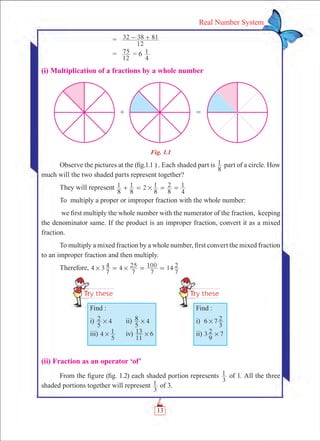
Fig. 1.1
Observe the pictures at the (fig.1.1 ) . Each shaded part is
8
1 part of a circle. How
much will the two shaded parts represent together?
They will represent 2
8
1
8
1
8
1
8
2
4
1#+ = = =
To multiply a proper or improper fraction with the whole number:
we first multiply the whole number with the numerator of the fraction, keeping
the denominator same. If the product is an improper fraction, convert it as a mixed
fraction.
To multiply a mixed fraction by a whole number, first convert the mixed fraction
to an improper fraction and then multiply.
Therefore, 4 3
7
4 4
7
25
7
100 14
7
2# #= = =
(ii) Fraction as an operator ‘of’
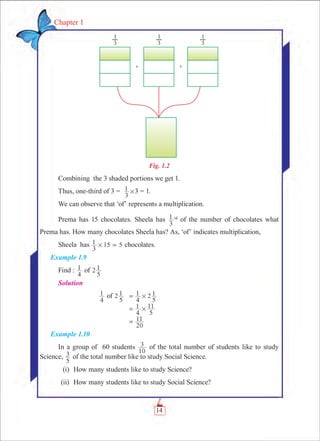
From the figure (fig. 1.2) each shaded portion represents
3
1 of 1. All the three
shaded portions together will represent
3
1 of 3.
Find :
i)
5
2 4# 	 ii)
5
8 4#
iii) 4
5
1# 	 iv)
11
13 6#
Find :
i) 6 7
3
2#
ii) 3
9
2 7#
14
Chapter 1
Fig. 1.2
Combining the 3 shaded portions we get 1.
Thus, one-third of 3 =
3
1 #3 = 1.
We can observe that ‘of’ represents a multiplication.
Prema has 15 chocolates. Sheela has
3
1 rd
of the number of chocolates what
Prema has. How many chocolates Sheela has? As, ‘of’ indicates multiplication,
Sheela has 5
3
1 15# = chocolates.
Example 1.9
Find :
4
1 of 2
5
1
Solution
	
4
1 of 2
5
1 	
4
1 2
5
1#=
		
4
1
5
11#=
		
20
11=
Example 1.10
In a group of 60 students
10
3 of the total number of students like to study
Science,
5
3 of the total number like to study Social Science.
	 (i)	 How many students like to study Science?
	(ii)	 How many students like to study Social Science?
15
Real Number System
Solution
Total number of students in the class 60=
(i)	 Out of 60 students,
10
3 of the students like to study Science.
	 Thus, the number of students who like to study Science =
10
3 of 60
		 = 60 18
10
3 # = .
(ii)	Out of 60 students,
5
3 of the students like to study Social Science.
	 Thus, the number of students who like to study Social Science
		 =
5
3 of 60
		 = 	 60
5
3 # = 36.
Exercise 1.3
	 1.	 Multiply :
i)	 6
5
4# 	 ii)	 3
7
3# 	 iii)	 4
8
4# 	 iv)	 51
10
2#
v)	
3
2 7# 	 vi)	 8
2
5 # 	 vii)	
4
11 7# 	 viii)	
6
5 12#
ix)	
7
4 14# 	 x)	 18
3
4#
	 2.	 Find :
i)	
2
1 of 28	 ii)	
3
7 of 27	 iii)	
4
1 of 64	 iv)	
5
1 of 125
v)	
6
8 of 216	 vi)	
8
4 of 32	 vii)	
9
3 of 27	 viii) 	
10
7 of 100
ix)	
7
5 of 35	 x)	
2
1 of 100
	 3.	 Multiply and express as a mixed fraction :
i)	 55
4
1# 	 ii)	 63
5
3# 	 iii)	 18
5
1# 	 iv)	 6 10
7
5#
v)	 7 7
2
1# 	 vi)	 9 9
2
1#
	 4.	 Vasu and Visu went for a picnic. Their mother gave them a baggage of 10 one
litre water bottles. Vasu consumed
5
2 of the water Visu consumed the remaining
water. How much water did Vasu drink?
16
Chapter 1
  (iii) Multiplication of a fraction by a fraction
Example 1.11
Find
5
1 of
8
3 .
Solution
	
5
1 of
8
3 	 =	
5
1 ×
8
3 =
40
3
Example 1.12
Find
9
2 ×
2
3 .
Solution
	
9
2 ×
2
3 	 =	
3
1
Example 1.13
Leela reads
4
1 th
of a book in 1 hour. How much of the book will she read in 3
2
1
hours?
Solution
The part of the book read by leela in 1 hour
4
1=
So, the part of the book read by her in 3
2
1 hour 3
2
1
4
1#=
						 =
2
7
4
1#
						
4 2
7 1
#
#=
						
8
7=
` Leela reads
8
7 part of a book in 3
2
1 hours.
Exercise 1.4
	 1.	 Find :
i)	
5
10 of
10
5 	 ii)	
3
2 of
8
7 	 iii)	
3
1 of
4
7 	 iv)	
8
4 of
9
7
v)	
9
4 of
4
9 	 vi)	
7
1 of
9
2
	 2.	 Multiply and reduce to lowest form :
i)	
9
2 3
3
2# 	 ii)	
9
2
10
9# 	 iii)	
8
3
9
6# 	 iv)	
8
7
14
9#
v)	
2
9
3
3# 	 vi)	
5
4
7
12#
Find
i)
3
1 ×
5
7
ii)
3
2
9
8#
17
Real Number System
	 3.		Simplify the following fractions :
i)	
5
2 5
3
2# 	 ii)	 6
4
3
10
7# 	 iii)	 7
2
1 1#
iv)	 5
4
3 3
2
1# 	 v)	 7
4
1 8
4
1#
	 4.	 A car runs 20 km. using 1 litre of petrol. How much distance will it cover using
2
4
3 litres of 	petrol.
	 5.	 Everyday Gopal read book for 1
4
3 hours. He reads the entire book in 7 days.
How many hours in all were required by him to read the book?
The reciprocal of a fraction
If the product of two non-zero numbers is equal to one then each number is
called the reciprocal of the other. So reciprocal of
5
3
3
5is , the reciprocal of .
3
5
5
3is
Note:	Reciprocal of 1 is 1 itself. 0 does not have a reciprocal.
(iv) Division of a whole number by a fraction
To divide a whole number by any fraction, multiply that whole number by the
reciprocal of that fraction.
Example 1.14
Find	 (i) 6
5
2' 		 (ii) 8
9
7' 	
Solution
(i)	6 ÷
5
2 = 6 ×
2
5 = 15
(ii) 8
9
7 8
7
9
7
72' #= =
While dividing a whole number by a mixed fraction, first convert the mixed
fraction into improper fraction and then solve it.
Example 1.15
Find 6 ÷ 3
5
4
Solution
6 ÷ 3
5
4 = 6 ÷
5
19 = 6 ×
19
5 =
19
30 = 1
19
11
(v) Division of a fraction by another fraction
To divide a fraction by another fraction, multiply the first fraction by the
reciprocal of the second fraction.	
Find:
i) 6 5
3
2' ii) 9 3
7
3'
18
Chapter 1
We can now find
5
1
7
3'
	
5
1
7
3
5
1' #= reciprocal of .
7
3
		
5
1
3
7
15
7#= = 		
Exercise 1.5
	 1.	 Find the reciprocal of each of the following fractions:
i)	
7
5 	 ii)
9
4 	 iii)
7
10 	 iv)
4
9
v)	
2
33 	 vi)
9
1 	 vii)
13
1 	 viii)
5
7
	 2.	 Find :
i)	
3
5 ÷ 25	 ii)
9
6 ÷ 36	 iii)
3
7 ÷ 14	 iv) 1
4
1 ÷ 15
	 3.	 Find :
	 (i)	
5
2
4
1' 	 (ii)	
6
5
7
6' 		 (iii) 2
4
3
5
3' 	 (iv) 3
2
3
3
8'
	 4.	 How many uniforms can be stitched from 47
4
1 metres of cloth if each scout
requires 2
4
1 metres for one uniform?
	 5.	 The distance between two places is 47
2
1 km. If it takes 1
16
3 hours to cover the
distance by a van, what is the speed of the van?
1.7 Introduction to Rational Numbers
A rational number is defined as a number that can be expressed in the form ,
q
p
where p and q are integers and .q 0^ Here p is the numerator and q is the denominator.
For example , , , ,
3
7
7
5
9
2
7
11
11
3-
-
- are the rational numbers
A rational number is said to be in standard form if its denominator is positive
and the numerator and denominator have no common factor other than 1.
If a rational number is not in the standard form, then it can be reduced to the
standard form.
Example 1.16
Reduce
54
72 to the standard form.
Find:
i)
7
3
5
4' , ii)
2
1
5
4' , iii) 2
4
3
2
7'
19
Real Number System
Solution
We have, 54
72
54 2
72 2
27
36
27 3
36 3
9
12
9 3
12 3
3
4
'
'
'
'
'
'
=
= =
= =
=
	
In this example, note that 18 is the highest common factor (H.C.F.) of 72 and 54.
To reduce the rational number to its standard form, we divide its numerator and
denominator by their H.C.F. ignoring the negative sign if any.
If there is negative sign in the denominator divide by " ".H.C.F.-
Example 1.17
Reduce to the standard form.
	 (i)	
12
18
-
	 (ii)	
16
4
-
-
Solution
(i) The H.C.F. of 18 and 12 is 6
Thus, its standard form would be obtained by dividing by – 6.
		
12
18
12 6
18 6
2
3
'
'
-
=
- -
-
= -
^
^
h
h
(ii) The H.C.F. of 4 and 16 is 4.
Thus, its standard form would be obtained by dividing by – 4
	
16
4
16 4
4 4
4
1
'
'
-
- =
- -
- -
=
^
^
h
h
1.8 Representation of Rational numbers on the Number line.
You know how to represent integers on the number line. Let us draw one such
number line.
The points to the right of 0 are positive integers. The points to left of 0 are
negative integers.
Let us see how the rational numbers can be represented on a number line.
Fig. 1.3
Aliter:
54
72
54 18
72 18
3
4
'
'= =
Write in standard form.
i)
51
18- , ii)
28
12- , iii)
35
7
20
Chapter 1
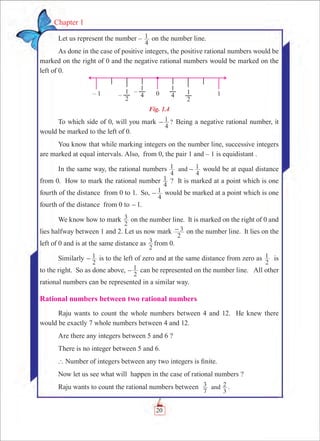
Let us represent the number –
4
1 on the number line.
As done in the case of positive integers, the positive rational numbers would be
marked on the right of 0 and the negative rational numbers would be marked on the
left of 0.
Fig. 1.4
To which side of 0, will you mark ?
4
1- Being a negative rational number, it
would be marked to the left of 0.
You know that while marking integers on the number line, successive integers
are marked at equal intervals. Also, from 0, the pair 1 and – 1 is equidistant .
In the same way, the rational numbers
4
1
4
1and - would be at equal distance
from 0. How to mark the rational number
4
1 ? It is marked at a point which is one
fourth of the distance from 0 to 1. So,
4
1- would be marked at a point which is one
fourth of the distance from 0 to -1.
We know how to mark
2
3 on the number line. It is marked on the right of 0 and
lies halfway between 1 and 2. Let us now mark
2
3- on the number line. It lies on the
left of 0 and is at the same distance as
2
3 from 0.
Similarly
2
1- is to the left of zero and at the same distance from zero as
2
1 is
to the right. So as done above,
2
1- can be represented on the number line. All other
rational numbers can be represented in a similar way.
Rational numbers between two rational numbers
Raju wants to count the whole numbers between 4 and 12. He knew there
would be exactly 7 whole numbers between 4 and 12.
Are there any integers between 5 and 6 ?
There is no integer between 5 and 6.
` Number of integers between any two integers is finite.
Now let us see what will happen in the case of rational numbers ?
Raju wants to count the rational numbers between
7
3
3
2and .
21
Real Number System
For that he converted them to rational numbers with same denominators.
So
7
3
21
9= and
3
2
21
14=
Now he has,
21
9
21
10
21
11
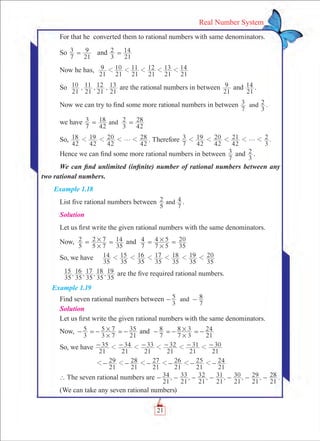
21
12
21
13
21
141 1 1 1 1
So , , ,
21
10
21
11
21
12
21
13 are the rational numbers in between
21
9 and
21
14 .
Now we can try to find some more rational numbers in between
7
3
3
2and .
we have
7
3
42
18
3
2
42
28and= =
So,
42
18
42
19
42
20
42
28g1 1 1 1 . Therefore .
7
3
42
19
42
20
42
21
3
2g1 1 1 1 1
Hence we can find some more rational numbers in between
7
3 and
3
2 .
We can find unlimited (infinite) number of rational numbers between any
two rational numbers.
Example 1.18
List five rational numbers between
5
2
7
4and .
Solution
Let us first write the given rational numbers with the same denominators.
Now,	
5
2
5 7
2 7
35
14
#
#= = and
7
4
7 5
4 5
35
20
#
#= =
So, we have
35
14
35
15
35
16
35
17
35
18
35
19
35
201 1 1 1 1 1
, , , ,
35
15
35
16
35
17
35
18
35
19 are the five required rational numbers.
Example 1.19
Find seven rational numbers between
3
5
7
8and- -
Solution
Let us first write the given rational numbers with the same denominators.
Now,	
3
5
3 7
5 7
21
35
#
#- =- =- and
7
8
7 3
8 3
21
24
#
#- =- =-
So, we have
21
35
21
34
21
33
21
32
21
31
21
301 1 1 1 1- - - - - -
		
21
29
21
28
21
27
21
26
21
25
21
241 1 1 1 1 1- - - - - -
` The seven rational numbers are , , , , , , .
21
34
21
33
21
32
21
31
21
30
21
29
21
28- - - - - - -
(We can take any seven rational numbers)
22
Chapter 1
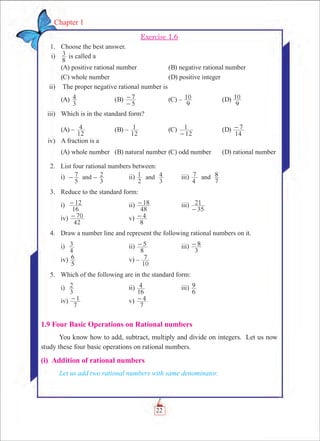
Exercise 1.6
	 1.	 Choose the best answer.
	 i)	
8
3 is called a
	 (A) positive rational number	 (B) negative rational number		
	 (C) whole number		 (D) positive integer
	 ii)	 The proper negative rational number is
	 (A)
3
4 	 (B)
5
7
-
- 	 (C) –
9
10 	 (D)
9
10
	 iii)	 Which is in the standard form?
	 (A) –
12
4 	 (B) –
12
1 	 (C)
12
1
-
	 (D)
14
7-
	 iv)	 A fraction is a
	 (A) whole number	 (B) natural number	(C) odd number	 (D) rational number
	 2.	 List four rational numbers between:
		 i)	
5
7
3
2and- - 	 ii)
2
1
3
4and 	 iii)
4
7
7
8and
	 3.	 Reduce to the standard form:
		 i)	
16
12- 	 ii)
48
18- 	 iii)
35
21
-
		 iv)
42
70- 	 v)
8
4-
	 4.	 Draw a number line and represent the following rational numbers on it.
		 i)	
4
3 	 ii)
8
5- 	 iii)
3
8-
		 iv)
5
6 	 v) –
10
7
	 5.	 Which of the following are in the standard form:
		 i)	
3
2 	 ii)
16
4 	 iii)
6
9
		 iv)
7
1- 	 v)
7
4-
1.9 Four Basic Operations on Rational numbers
You know how to add, subtract, multiply and divide on integers. Let us now
study these four basic operations on rational numbers.
(i) Addition of rational numbers
Let us add two rational numbers with same denominator.
23
Real Number System
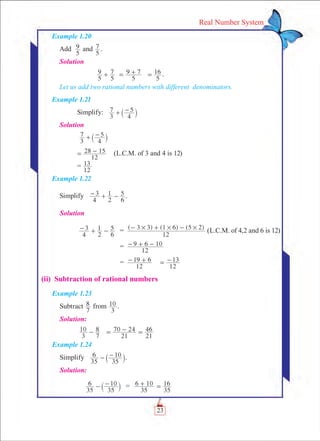
Example 1.20
Add
5
9 and
5
7 .
Solution
		
5
9
5
7+
5
9 7= +
5
16= .
Let us add two rational numbers with different denominators.
Example 1.21
	 Simplify:
3
7
4
5+ -` j
Solution
	 3
7
4
5+ -` j
12
28 15= - (L.C.M. of 3 and 4 is 12)
	 =
12
13
Example 1.22
Simplify
4
3
2
1
6
5- + - .
Solution
	
4
3
2
1
6
5- + - 	 =	 ( ) ( ) ( )
12
3 3 1 6 5 2# # #- + - (L.C.M. of 4,2 and 6 is 12)
		 =	
12
9 6 10- + -
		 =	
12
19 6- +
12
13= -
(ii) Subtraction of rational numbers
Example 1.23
Subtract
7
8 from
3
10 .
Solution:
	
3
10
7
8-
21
70 24
21
46= - =
Example 1.24
Simplify
35
6
35
10- -` j.
Solution:
	
35
6
35
10- -` j	 =	
35
6 10+
35
16=
24
Chapter 1
Example 1.25
Simplify 2
35
7 3
35
6- -` `j j.
Solution
	 2
35
7 3
35
6- -` `j j	 =	
35
77
35
111- -
		 =	
35
77 111- - =
35
188- 5
35
13=-
Example 1.26
The sum of two rational numbers is 1. If one of the numbers is
20
5 , find the
other.
Solution
	 Sum of two rational numbers	 =	 1
	 Given number + Required number	 =	 1
	
20
5 +Required number	 =	 1
	 Required number	 =	 1
20
5-
		 =	
20
20 5-
		 =	
20
15 =
4
3
` Required number is
4
3 .
Exercise1.7
	 1.	 Choose the best answer.
	 i)	
3
1 +
3
2 is equal to
	 (A) 2	 (B) 3	 (C) 1	 (D) 4
	 ii)	
5
4 –
5
9 is equal to
	 (A) 1	 (B) 3	 (C) – 1	 (D) 7
	 iii)	 5
11
1 + 1
11
10 is equal to
	 (A) 4	 (B) 3	 (C) – 5	 (D) 7
	 iv)	 The sum of two rational numbers is 1. If one of the numbers is
2
1 , the other
number is
	 (A)
3
4 	 (B)
4
3 	 (C)
4
3- 	 (D)
2
1
i)
35
7
35
5- , ii)
6
5
12
7- ,
iii)
3
7
4
3- , iv) 3
4
3 2
4
1-` `j j,
v) 4
7
5 6
4
1-` `j j
25
Real Number System
	 2.	 Add :
i)	
5
12
5
6and 	 ii)
13
7
13
17and 	 iii)
7
8
7
6and
iv)	
13
7
13
5and- - 	 v)
3
7
4
8and 	 vi)
7
5
6
7and-
vii)	
7
9
3
10and - 	 viii)
6
3
2
7and - 	 ix) ,
4
9
28
1
7
8 and
x)	 ,
5
4
15
8
10
7 and- -
	 3.	 Find the sum of the following :
i)	
4
3
4
7- + 	 ii)
6
9
6
15+ 	 iii)
4
3
11
6- +
iv)	
8
7
16
9- + 	 v)
5
4
20
7+ 	 vi)
13
6
26
14- + -` `j j
vii)	
13
11
2
7+ -` j	 viii)
5
2
12
5
10
7- + + -` `j j
ix)	
9
7
18
10
27
7+ - + -` `j j	 x)
3
6
6
7
12
9+ - + -` `j j
	 4.	 Simplify :
i)	
35
7
35
5- 	 ii)
6
5
12
7- 	 iii)
3
7
4
3-
iv)	 3
4
3 2
4
1-` `j j	 v) 4
7
5 6
4
1-` `j j
	 5.	 Simplify :
i)	 1
11
2 3
11
5+` `j j	 ii) 3
5
4 7
10
3-` `j j
iii)	 1
11
2 3
11
5 6
11
3- + - +` ` `j j j	 iv) 3
10
9 3
5
2 6
20
5- + +` ` `j j j
v)	 3
5
4 2
8
3- +` `j j	 vi) 1
12
5 2
11
7- + -` `j j
vii)	 9
7
6 11
3
2 5
42
7+ - + -` ` `j j j	 viii) 7
10
3 10
21
7+ -` `j j
	 6.	 The sum of two rational numbers is
4
17 . If one of the numbers is
2
5 , find the
other number.
	 7.	 What number should be added to
6
5 so as to get .
30
49
	 8.	 A shopkeeper sold 7
4
3 kg, 2
2
1 kg and 3
5
3 kg of sugar to three consumers in a
day. Find the total weight of sugar sold on that day.
	 9.	 Raja bought 25 kg of Rice and he used 1
4
3 kg on the first day, 4
2
1 kg on the
second day. Find the remaining quantity of rice left.
	 10.	 Ram bought 10 kg apples and he gave 3
5
4 kg to his sister and 2
10
3 kg to his
friend. How many kilograms of apples are left?
26
Chapter 1
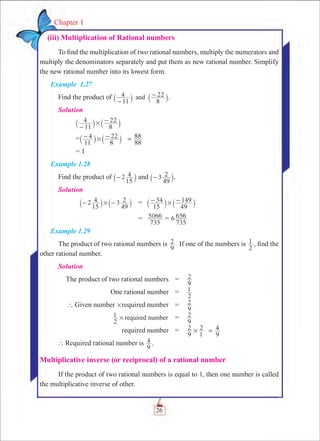
  (iii) Multiplication of Rational numbers
To find the multiplication of two rational numbers, multiply the numerators and
multiply the denominators separately and put them as new rational number. Simplify
the new rational number into its lowest form.
Example 1.27
Find the product of
11
4
8
22and
-
-
` `j j.
Solution
	
11
4
8
22#
-
-
` `j j
	 =
11
4
8
22#- -` `j j 88
88=
= 1
Example 1.28
Find the product of 2
15
4-` j and 3
49
2-` j.
Solution
	 2
15
4 3
49
2#- -` `j j	 =	
15
34
49
149#- -` `j j
		 =	
735
5066 = 6
735
656
Example 1.29
The product of two rational numbers is .
9
2 If one of the numbers is
2
1 , find the
other rational number.
Solution
	 The product of two rational numbers	 =	
9
2
	 One rational number	 =	
2
1
	 ` Given number #required number	 =	
9
2
	
2
1 required number# 	 =	
9
2
	 required number	 =	
9
2
1
2#
9
4=
` Required rational number is
9
4 .
Multiplicative inverse (or reciprocal) of a rational number
If the product of two rational numbers is equal to 1, then one number is called
the multiplicative inverse of other.
27
Real Number System
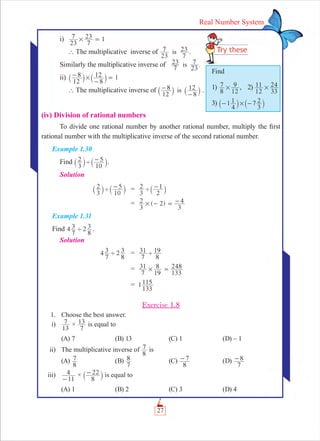
i)
23
7
7
23 1# =
` The multiplicative inverse of
23
7
7
23is .
Similarly the multiplicative inverse of .
7
23
23
7is
ii)
12
8
8
12 1#-
-
=` `j j
` The multiplicative inverse of
12
8
8
12is-
-
` `j j .
(iv) Division of rational numbers
To divide one rational number by another rational number, multiply the first
rational number with the multiplicative inverse of the second rational number.
Example 1.30
Find
3
2
10
5' -` `j j.
Solution
3
2
10
5' -` `j j =
3
2
2
1' -` j
= ( 2)
3
2 # -
3
4= -
Example 1.31
Find 4
7
3 2
8
3' .
Solution
4
7
3 2
8
3' =
7
31
8
19'
=
7
31
19
8#
133
248=
= 1
133
115
Exercise 1.8
1. Choose the best answer.
i)
13
7 ×
7
13 is equal to
(A) 7 (B) 13 (C) 1 (D) – 1
ii) The multiplicative inverse of
8
7 is
(A)
8
7 (B)
7
8 (C)
8
7- (D)
7
8-
iii)
11
4
-
×
8
22-` j is equal to
(A) 1 (B) 2 (C) 3 (D) 4
Find
1)
8
7
12
9# , 2)
12
11
33
24#
3) 1
4
1 7
3
2#- -` `j j
28
Chapter 1
	 iv)	 –
9
4 ÷
36
9 is equal to
	 (A)
9
16- 	 (B) 4	 (C) 5	 (D) 7
	 2.	 Multiply :
	 i)	
5
12
5
6and- 	 ii)
13
7
13
5and-
	 iii)	
9
3
8
7and- 	 iv)
11
6
22
44and-
	 v)	
7
50
10
28and- 	 vi)
6
5
15
4and- -
	 3.	 Find the value of the following :
	 i)	
5
9
4
10
18
15# #- 	 ii)
4
8
6
5
10
30# #- - -
	 iii)	 1 2
5
1
5
2 9
10
3# # 	 iv) 3 2
15
4
5
1 9
5
1# #- - 	 v)
6
3
7
9
4
10# #
	 4.	 Find the value of the following :
	 i)	
9
4
4
9'-
-
	 ii)
5
3
10
4' -` j
	 iii)	
35
8
35
7'-` j 	 iv) 9
4
3 1
40
3'-
	 5.	 The product of two rational numbers is 6. If one of the number is ,
3
14 find the
other number.
	 6.	 What number should be multiply
2
7 to get
4
21 ?
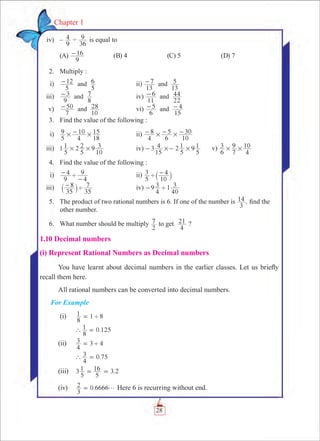
1.10 Decimal numbers
(i) Represent Rational Numbers as Decimal numbers
You have learnt about decimal numbers in the earlier classes. Let us briefly
recall them here.
All rational numbers can be converted into decimal numbers.
For Example
(i)	 1
8
1 8'=
	 0.125
8
1` =
(ii) 3
4
3 4'=
	 0.75
4
3` =
(iii)	 3
5
1
5
16= .23=
(iv)	 0.6666
3
2 g= Here 6 is recurring without end.
29
Real Number System
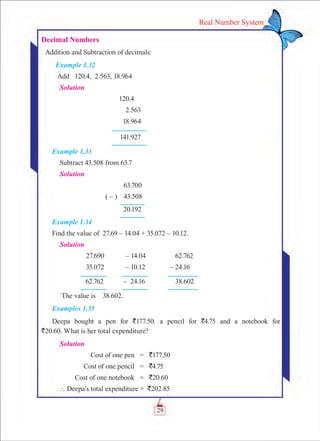
Decimal Numbers
Addition and Subtraction of decimals:
Example 1.32
Add 120.4, 2.563, 18.964
Solution
	 120.4
	 2.563
	 18.964
	 141.927
Example 1.33
Subtract 43.508 from 63.7
Solution	
	 63.700
( – )	 43.508
	 20.192
Example 1.34
Find the value of 27.69 – 14.04 + 35.072 – 10.12.
Solution	
	 27.690	 – 14.04	 62.762
	 35.072	 – 10.12	 – 24.16
	 62.762	 – 24.16	 38.602
The value is 38.602.
Examples 1.35
Deepa bought a pen for `177.50. a pencil for `4.75 and a notebook for
`20.60. What is her total expenditure?
Solution
	 Cost of one pen	 =	 `177.50
	 Cost of one pencil	 =	 `4.75
	 Cost of one notebook	 =	 `20.60
` Deepa’s total expenditure = `202.85
30
Chapter 1
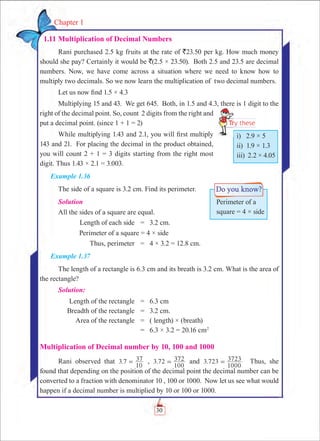
  1.11 Multiplication of Decimal Numbers
Rani purchased 2.5 kg fruits at the rate of `23.50 per kg. How much money
should she pay? Certainly it would be `(2.5 × 23.50). Both 2.5 and 23.5 are decimal
numbers. Now, we have come across a situation where we need to know how to
multiply two decimals. So we now learn the multiplication of two decimal numbers.
Let us now find 1.5 × 4.3
Multiplying 15 and 43. We get 645. Both, in 1.5 and 4.3, there is 1 digit to the
right of the decimal point. So, count 2 digits from the right and
put a decimal point. (since 1 + 1 = 2)
While multiplying 1.43 and 2.1, you will first multiply
143 and 21. For placing the decimal in the product obtained,
you will count 2 + 1 = 3 digits starting from the right most
digit. Thus 1.43 × 2.1 = 3.003.
Example 1.36
The side of a square is 3.2 cm. Find its perimeter.
Solution
All the sides of a square are equal.
	 Length of each side	 =	 3.2 cm.
Perimeter of a square = 4 × side
	 Thus, perimeter	 =	 4 × 3.2 = 12.8 cm.
Example 1.37
The length of a rectangle is 6.3 cm and its breath is 3.2 cm. What is the area of
the rectangle?
Solution:
	 Length of the rectangle	 =	 6.3 cm
	 Breadth of the rectangle	 =	 3.2 cm.
	 Area of the rectangle	 =	 ( length) × (breath)
		 =	 6.3 × 3.2 = 20.16 cm2
Multiplication of Decimal number by 10, 100 and 1000
Rani observed that .3 7
10
37= , .3 72
100
372= and 3.723
1000
3723= Thus, she
found that depending on the position of the decimal point the decimal number can be
converted to a fraction with denominator 10 , 100 or 1000. Now let us see what would
happen if a decimal number is multiplied by 10 or 100 or 1000.
i) 2.9 × 5
ii) 1.9 × 1.3
iii) 2.2 × 4.05
Perimeter of a
square = 4 × side
31
Real Number System
For example,
	 3.23 × 10	 =	
100
323 × 10 = 32.3
Decimal point shifted to the right by one place since
10 has one zero over one.
	 3.23 × 100	 =	
100
323 × 100 = 323
Decimal point shifted to the right by two places since
100 has two zeros over two.
	 3.23 × 1000	 =	
100
323 × 1000 = 3230
Exercise 1.9
	 1.	 Choose the best answer.
	 i)	 0.1 × 0.1 is equal to
	 (A) 0.1	 (B) 0.11	 (C) 0.01	 (D) 0.0001
	 ii)	 5 ÷ 100 is equal to
	 (A) 0.5	 (B) 0.005	 (C) 0.05	 (D) 0.0005
	 iii)	
10
1 ×
10
1 is equal to
	 (A) 0.01	 (B) 0.001	 (C) 0.0001	 (D) 0.1
	 iv)	 0.4 × 5 is equal to
	 (A) 1	 (B) 0.4	 (C) 2	 (D) 3
	 2.	 Find :
	 (i) 0.3 × 7	 (ii) 9 × 4.5	 (iii) 2.85 × 6	 (iv) 20.7 × 4
	 (v) 0.05 × 9	 (vi) 212.03 × 5	 (vii) 3 × 0.86	 (viii) 3.5 × 0.3
	 (ix) 0.2 × 51.7	 (x) 0.3 × 3.47 (xi) 1.4 × 3.2	 (xii) 0.5 × 0.0025
	 (xiii) 12.4 × 0.17	(xiv) 1.04 × 0.03
	 3.	 Find :
	 (i) 1.4 × 10	 (ii) 4.68 × 10	 (iii) 456.7 × 10 (iv) 269.08 × 10
	 (v) 32.3 × 100	 (vi) 171.4 × 100	 (vii) 4.78 × 100
	 4.	 Find the area of rectangle whose length is 10.3 cm and breath is 5 cm.
	 5.	 A two-wheeler covers a distance of 75.6 km in one litre of petrol. How much
distance will it cover in 10 litres of petrol?
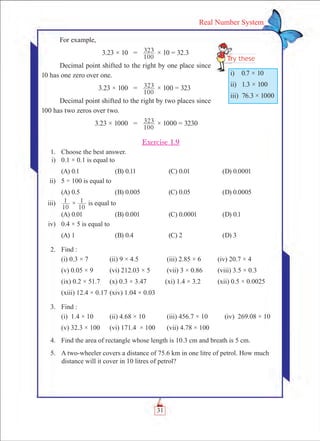
i)  0.7 × 10
ii)  1.3 × 100
iii)  76.3 × 1000
32
Chapter 1
  (ii) Division of Decimal Numbers
Jasmine was preparing a design to decorate her classroom. She needed a few
colourd strips of paper of length 1.8 cm each. She had a strip of coloured paper of
length 7.2 cm. How many pieces of the required length will she get out of this strip?
She thought it would be
.
.
1 8
7 2 cm. Is she correct?
Both 7.2 and 1.8 are decimal numbers. So we need to know the division of
decimal numbers .
For example,
	 141.5 ' 10	 =	 14.15
	 141.5 ' 100	 =	 1.415
	 141.5' 1000	 =	 0.1415
To get the quotient we shift the digits in the decimal
number to the left by as many places as there are zeros
over 1.
Example 1.38
Find 4.2 ÷ 3.
Solution
	 4.2 ÷ 3	 =	
10
42 3
10
42
3
1' #=
		 =	
10 3
42 1
10 3
1 42
#
#
#
#=
		 =	 14
10
1
3
42
10
1# #=
		 =	 1.4
10
14 =
Example 1.39
Find 18.5 ÷ 5.
Solution
First find 185 ÷ 5. We get 37.
There is one digit to the right of the decimal point in 18.5.
Place the decimal point in 37 such that there would be one digit
to its right. We will get 3.7.
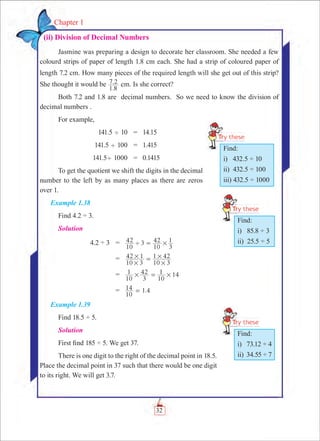
Find:
i) 432.5 ÷ 10
ii) 432.5 ÷ 100
iii) 432.5 ÷ 1000
Find:
i) 85.8 ÷ 3
ii) 25.5 ÷ 5
Find:
i) 73.12 ÷ 4
ii) 34.55 ÷ 7
33
Real Number System
Division of a Decimal Number by another Decimal number
Example 1.40
Find
.
.
0 4
17 6 .	
Solution
We have	 17.6 ÷ 0.4	 =	
10
176
10
4'
		 =	
10
176
4
10# = 44.
Example 1.41
A car covers a distance of 129.92 km in 3.2 hours. What is the distance covered
by it in 1 hour?
Solution
	 Distance covered by the car	 =	 129.92 km.
	Time required to cover this distance	 =	 3.2 hours.
	 So, distance covered by it in 1 hour	 =	
.
. .
3 2
129 92
32
1299 2= = 40.6km.
Exercise 1.10
	 1.	 Choose the best answer.
	 i)	 0.1 ÷ 0.1 is equal to
	 (A) 1	 (B) 0.1	 (C) 0.01	 (D) 2
	 ii)	
1000
1 is equal to
	 (A) 0.01	 (B) 0.001	 (C) 1.001	 (D) 1.01
	 iii)	 How many apples can be bought for `50 if the cost of one apple is `12.50?
	 (A) 2	 (B) 3	 (C) 4	 (D) 7
	 iv)	
.
.
2 5
12 5 is equal to
	 (A) 4	 (B) 5	 (C) 7	 (D) 10
	 2.	 Find :
	 (i) 0.6 ÷ 2	 (ii) 0.45 ÷ 5	 (iii) 3.48 ÷ 3
	 (iv) 64.8 ÷ 6	 (v) 785.2 ÷ 4	 (vi) 21.28 ÷ 7
	 3.	 Find :
	 (i) 6.8 ÷ 10	 (ii) 43.5 ÷ 10		(iii) 0.9 ÷ 10
	 (iv) 44.3 ÷ 10	 (v) 373.48 ÷ 10	 (vi) 0.79 ÷ 10
Find :
i)
.
.
0 5
9 25
ii)
.0 04
36
iii)
.
.
1 3
6 5
34
Chapter 1
	 4.	 Find :
	 (i) 5.6 ÷ 100	 (ii) 0.7 ÷ 100		(iii) 0.69 ÷ 100
	 (iv) 743.6 ÷ 100	 (v) 43.7 ÷ 100	 (vi) 78.73 ÷ 100
	 5.	 Find :
	 (i) 8.9 ÷ 1000	 (ii) 73.3 ÷ 1000	 (iii) 48.73 ÷ 1000
	 (iv) 178.9 ÷ 1000	 (v) 0.9 ÷ 1000	 (vi) 0.09 ÷ 1000
	 6.	 Find :
	 (i) 9 ÷ 4.5	 (ii) 48 ÷ 0.3		(iii) 6.25 ÷ 0.5
	 (iv) 40.95 ÷ 5	 (v) 0.7 ÷ 0.35		(vi) 8.75 ÷ 0.25
	 7.	 A vehicle covers a distance of 55.2 km in 2.4 litres of petrol. How much distance
will it cover in one litre of petrol?
	 8.	 If the total weight of 11 similar bags is 115.5 kg, what is the weight of 1 bag?
	 9.	 How many books can be bought for `362.25, if the cost of one book is `40.25?
	 10.	 A motorist covers a distance of 135.04 km in 3.2 hours. Find his speed?
	 11.	 The product of two numbers is 45.36. One of them is 3.15. Find the other
number?
1.12 Powers
Introduction
Teacher asked Ramu, “Can you read this number 2560000000000000?”
He replies, “It is very difficult to read sir”.
“The distance between sun and saturn is 1,433,500,000,000 m. Raja can you
able to read this number?” asked teacher.
He replies, “Sir, it is also very difficult to read”.
Now, we are going to see how to read the difficult numbers in the examples
given above.
Exponents
We can write the large numbers in a shortest form by using the following
methods.
	 10	 =	 101
	 100	 =	 101
× 101
= = 102
	 1000	 =	 101
×101
× 101
= 103
35
Real Number System
Similarly,
	 21
# 21
= 22
	 21
# 21
# 21
= 23
	 21
# 21
# 21
# 21
= 24
	
	 a # a	 =	 a2
	 [read as ‘a’ squared or ‘a’ raised to the power 2]	
	 a # a # a	 =	 a3
	 [read as ‘a’ cubed or ‘a’ raised to the power 3]
a # a # a # a	 =	 a4
	 [read as ‘a’ raised to the power 4 or the 4th
power of ‘a’]
gggggggg gggggggg
a # a #... m times = am
	 [read as ‘a’ raised to the power m or mth
power of ‘a’] 	
	 Here ‘a’ is called the base, ‘m’ is called the exponent (or) power.
Note: Only a2
and a3
have the special names “a squared’ and “a cubed”.
	 ` we can write large numbers in a shorter form using exponents.
Example 1.42
Express 512 as a power .
Solution
We have	 512	 =	 2 # 2 # 2 # 2 # 2 # 2 # 2 # 2 × 2
So we can say that	 512	 =	 29
Example: 1.43
Which one is greater 25
, 52
?
Solution
We have	 25
	 =	 2 # 2 # 2 × 2 × 2 = 32
and	 52	
=	 5 # 5 = 25
Since 32 > 25.
Therefore 25
is greater than 52
.
36
Chapter 1
Example: 1.44
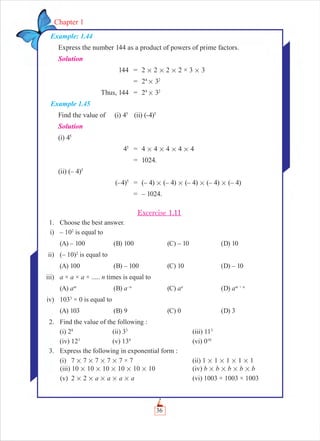
Express the number 144 as a product of powers of prime factors.
Solution
144 = 2 # 2 # 2 # 2 × 3 # 3
= 24
# 32
Thus, 144 = 24
# 32
Example 1.45
Find the value of (i) 45
(ii) (-4)5
Solution
(i) 45
45
= 4 # 4 # 4 # 4 # 4
= 1024.
(ii) (– 4)5
(–4)5
= (– 4) # (– 4) # (– 4) # (– 4) # (– 4)
= – 1024.
Excercise 1.11
1. Choose the best answer.
i) – 102
is equal to
(A) – 100 (B) 100 (C) – 10 (D) 10
ii) (– 10)2
is equal to
(A) 100 (B) – 100 (C) 10 (D) – 10
iii) a × a × a × ..... n times is equal to
(A) am
(B) a–n
(C) an
(D) am + n
iv) 1033
× 0 is equal to
(A) 103 (B) 9 (C) 0 (D) 3
2. Find the value of the following :
(i) 28
(ii) 33
(iii) 113
(iv) 123
(v) 134
(vi) 010
3. Express the following in exponential form :
(i) 7 # 7 # 7 # 7 # 7 × 7 (ii) 1 # 1 # 1 # 1 # 1
(iii) 10 # 10 # 10 # 10 # 10 # 10 (iv) b # b # b # b # b
(v) 2 # 2 # a # a # a # a (vi) 1003 × 1003 × 1003
37
Real Number System
	 4.	 Express each of the follwing numbers using exponential notation. (with smallest
base)
	 (i) 216	 (ii) 243	 (iii) 625
	 (iv) 1024	 (v) 3125	 (vi) 100000
	 5.	 Identify the greater number in each of the following :
	 (i) 45
, 54
	 (ii) 25
, 52
	 (iii) 32
, 23
	 (iv) 56
, 65
	 (v) 72
, 27
	 (vi) 47
, 74
	 6.	 Express each of the following as product of powers of their prime factors :
	 (i) 100	 (ii) 384	 (iii) 798
	 (iv) 678	 (v) 948	 (vi) 640
	 7.	 Simplify :
	 (i) 2 # 105
	 (ii) 0 # 104
	 (iii) 52
# 34
	 (iv) 24
# 34
	 (v) 32
# 109
	 (vi) 103
# 0
	 8.	 Simplify :
	 (i) (– 5)3	
(ii) (– 1)10
	 (iii) (– 3)2
# (– 2)3
	 (iv) (– 4)2
# (– 5)3
	 (v) (6)3
# (7)2
	 (vi) (– 2)7
# (– 2)10
Laws of exponents
Multiplying powers with same base
1)	 32
# 34
	 =	 (3 # 3) # (3 # 3 # 3 × 3)
		 =	 31
# 31
# 31
# 31
# 31
# 31
		 =	 36
2)	 (– 5)2
# (– 5)3
	 =	 [(– 5) # (– 5)] # [(– 5) # (– 5) # (– 5)]
		 =	 (– 5)1
# (– 5)1
# (– 5)1
# (– 5)1
# (– 5)1
		 =	 (– 5)5
3)	 a2
# a5
	 =	 (a # a) # (a # a # a # a # a)
		 =	 a1
# a1
# a1
# a1
# a1
# a1
# a1
		 =	 a7
From this we can generalise that for
any non-zero integer a, where m and n are
whole numbers a a am n m n
# = +
i) 25
# 27
	 ii) 43
# 44
iii) p3
# p5
	 iv) 4 4100 10
#- -^ ^h h
38
Chapter 1
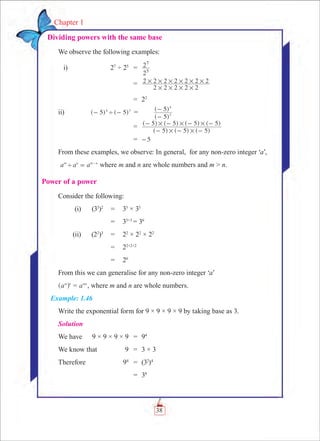
  Dividing powers with the same base
We observe the following examples:
i) 	 27
÷ 25	
=	
2
2
5
7
		 =	
2 2 2 2 2
2 2 2 2 2 2 2
# # # #
# # # # # #
		 =	 22
ii) ( ) ( )5 54 3
'- - 	=	
( )
( )
5
5
3
4
-
-
		 =	
( ) ( ) ( )
( ) ( ) ( ) ( )
5 5 5
5 5 5 5
# #
# # #
- - -
- - - -
		 =	 5-
From these examples, we observe: In general, for any non-zero integer ‘a’,
a a am n m n
' = -
where m and n are whole numbers and m > n.
Power of a power
Consider the following:
	 (i)	 (33
)2
	 =	 33
× 33
			
=	 33+3
= 36
	 (ii)	 (22
)3
	 =	 22
× 22
× 22
			
=	 22+2+2
			
=	 26
From this we can generalise for any non-zero integer ‘a’
am n
^ h = amn
, where m and n are whole numbers.
Example: 1.46
Write the exponential form for 9 × 9 × 9 × 9 by taking base as 3.
Solution
We have	 9 × 9 × 9 × 9	 =	 94
We know that	 9 	 =	 3 × 3
Therefore	 94
	 =	 (32
)4
		 =	 38
39
Real Number System
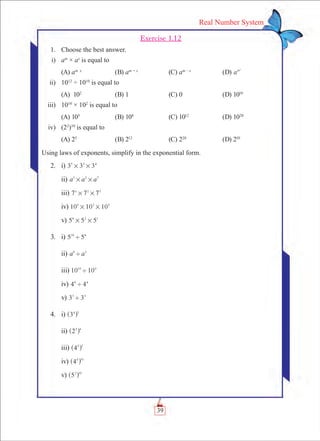
Exercise 1.12
	 1.	 Choose the best answer.
	 i)	 am
× ax
is equal to
	 (A) am x
	 (B) am + x
	 (C) am – x
	 (D) amx
	 ii)	 1012
÷ 1010
is equal to
	 (A) 102
	 (B) 1	 (C) 0	 (D) 1010
	 iii)	 1010
× 102
is equal to
	 (A) 105
	 (B) 108
	 (C) 1012
	 (D) 1020
	 iv)	 (22
)10
is equal to
	 (A) 25
	 (B) 212
	 (C) 220
	 (D) 210
Using laws of exponents, simplify in the exponential form.
	 2.	 i) 3 3 35 3 4
# #
		 ii) a a a3 2 7
# #
		 iii) 7 7 7x 2 3
# #
		 iv) 10 10 100 2 5
# #
		 v) 5 5 56 2 1
# #
	 3.	 i) 5 510 6
'
		 ii) a a6 2
'
		 iii) 10 1010 0
'
		 iv) 4 46 4
'
		 v) 3 33 3
'
	 4.	 i) 34 3
^ h
		 ii) 25 4
^ h
		 iii) 45 2
^ h
		 iv) 40 10
^ h
		 v) 52 10
^ h
40
Chapter 1
	 1.	 Natural numbrs N = {1, 2, 3, ...}
	 2.	 Whole numbers W = {0, 1, 2, ...}
	 3.	 Integers Z = {..., – 3, – 2, – 1, 0, 1, 2, 3, ...}
	 4.	 The product of two positive integers is a positive integer.
	 5.	 The product of two negative integers is a positive integer.
	 6.	 The product of a positive integer and a negative integer is a negative integer.
	 7.	 The division of two integers need not be an integer.
	 8.	 Fraction is a part of whole.
	 9.	 If the product of two non-zero numbers is 1 then the numbers are called the
reciprocal of each other.
	 10.	 a × a × a × ... m times = am
		 (read as ‘a’ raised to the power m (or) the mth
power of ‘a’)
	 11.	 For any two non-zero integers a and b and whole numbers m and n,
		 i)	 a am n
= am n+
		 ii)	
a
a
n
m
= am n-
, where m > n
		 iii)	 am n
^ h = amn
		 iv)	 (– 1)n
= 1, when n is an even number
				 (– 1)n
= – 1, when n is an odd number
41
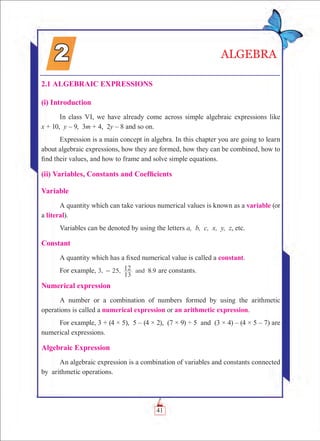
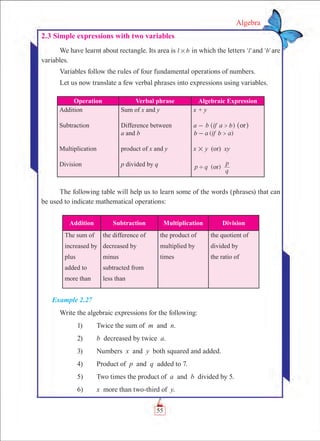
2.1 Algebraic Expressions
(i) Introduction
In class VI, we have already come across simple algebraic expressions like
x + 10, y – 9, 3m + 4, 2y – 8 and so on.
Expression is a main concept in algebra. In this chapter you are going to learn
about algebraic expressions, how they are formed, how they can be combined, how to
find their values, and how to frame and solve simple equations.
(ii) Variables, Constants and Coefficients
Variable
A quantity which can take various numerical values is known as a variable (or
a literal).
Variables can be denoted by using the letters a, b, c, x, y, z, etc.
Constant
A quantity which has a fixed numerical value is called a constant.
For example, 3, 25, 8.9and
13
12- are constants.
Numerical expression
A number or a combination of numbers formed by using the arithmetic
operations is called a numerical expression or an arithmetic expression.
For example, 3 + (4 × 5), 5 – (4 × 2), (7 × 9) ÷ 5 and (3 × 4) – (4 × 5 – 7) are
numerical expressions.
Algebraic Expression
An algebraic expression is a combination of variables and constants connected
by arithmetic operations.
ALGEBRA
42
Chapter 2
Example 2.1
Statement Expressions
(i) 5 added to y y + 5
(ii) 8 subtracted from n n – 8
(iii) 12 multiplied by x 12 x
(iv) p divided by 3
p
3
Term
A term is a constant or a variable or a product of a constant and one or more
variables.
3x2
, 6x and – 5 are called the terms of the expression 3 5x x62
+ - .
A term could be
(i) a constant
(ii) a variable
(iii) a product of constant and a variable (or variables)
(iv) a product of two or more variables
In the expression ,a a4 7 32
+ + the terms are 4 , 7a a2
and 3. The number of
terms is 3.
In the expression -6 18 7,p pq q92 2
+ + - the terms are 6 , 18 , 9p pq q2 2
- and
– 7. The number of terms is 4.
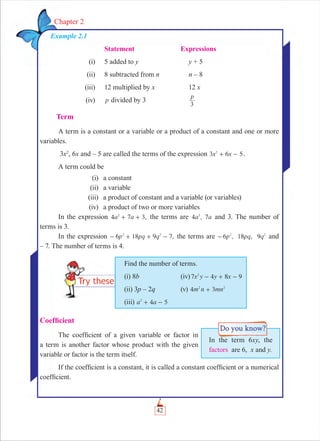
Find the number of terms.
(i) 8b (iv) x y y x7 4 8 92
- + -
(ii) 3p – 2q (v) m n mn4 32 2
+
(iii) 4 5a a2
+ -
Coefficient
The coefficient of a given variable or factor in
a term is another factor whose product with the given
variable or factor is the term itself.
If the coefficient is a constant, it is called a constant coefficient or a numerical
coefficient.
In the term 6xy, the
factors are 6, x and y.
43
Algebra
Example 2.3
In the term – mn2
,
	 coefficient of mn2
is – 1,
	 coefficient of – n is m2
,
	 coefficient of m is – n2
.
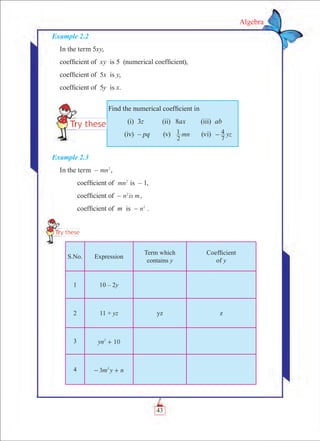
S.No. Expression
Term which
contains y
Coefficient
of y
1 10 – 2y
2 11 + yz yz z
3 yn 102
+
4 m y n3 2
- +
Example 2.2
In the term 5xy,
coefficient of xy is 5 (numerical coefficient),
coefficient of 5x is y,
coefficient of 5y is x.
Find the numerical coefficient in
	 (i)	 3z	 (ii)	 8ax 	 (iii)	 ab
	 (iv)	 – pq	 (v)	 mn
2
1 	 (vi)	 yz
7
4-
44
Chapter 2
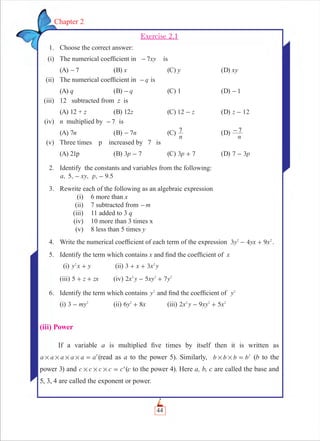
Exercise 2.1
1. Choose the correct answer:
(i) The numerical coefficient in xy7- is
(A) 7- (B) x (C) y (D) xy
(ii) The numerical coefficient in q- is
(A) q (B) q- (C) 1 (D) 1-
(iii) 12 subtracted from z is
(A) 12 + z (B) 12z (C) z12 - (D) z 12-
(iv) n multiplied by 7- is
(A) 7n (B) - n7 (C)
n
7 (D)
n
7-
(v) Three times p increased by 7 is
(A) 21p (B) p3 7- (C) p3 7+ (D) p7 3-
2. Identify the constants and variables from the following:
, 5, , , 9.5a xy p- -
3. Rewrite each of the following as an algebraic expression
(i) 6 more than x
(ii) 7 subtracted from m-
(iii) 11 added to 3 q
(iv) 10 more than 3 times x
(v) 8 less than 5 times y
4. Write the numerical coefficient of each term of the expression 3 4y yx x92 2
- + .
5. Identify the term which contains x and find the coefficient of x
(i) y x y2
+ (ii) x x y3 3 2
+ +
(iii) z zx5 + + (iv) x y xy y2 5 72 2 2
- +
6. Identify the term which contains y2
and find the coefficient of y2
(i) my3 2
- (ii) y x6 82
+ (iii) x y xy x2 9 52 2 2
- +
(iii) Power
If a variable a is multiplied five times by itself then it is written as
a a a a a a5
# # # # = (read as a to the power 5). Similarly, b b b b3
# # = (b to the
power 3) and c c c c c4
# # # = (c to the power 4). Here a, b, c are called the base and
5, 3, 4 are called the exponent or power.
45
Algebra
(v) Degree of an Algebraic expression
Consider the expression 8 6 7.x x2
- + It has 3 terms 8 , 6 7x x and2
- .
In the term 8 ,x2
the power of the variable x is 2.
In the term 6x- , the power of the variable x is 1.
The term 7 is called as a constant term or an independent term.
The term 7 is x7 1 7 0
# = in which the power of the variable x is 0.
In the above expression the term x8 2
has the highest power 2. So the degree of
	 the expression 8x2
– 6x + 7 is 2.
Consider the expression x y xy y6 2 3
2 2
+ + .
In the term x y6
2
, the power of variable is 3.
(Adding the powers of x and y we get 3 (i.e.) 2 + 1 = 3).
In term xy2 , the power of the variable is 2.
In term ,y3
2
the power of the variable is 2.
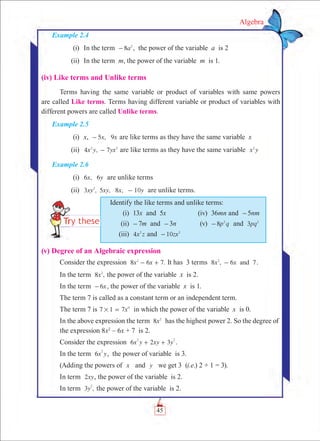
Identify the like terms and unlike terms:
	 (i)	 13x and 5x	 (iv)	 36mn and -5nm
	 (ii)	 -7m and -3n	 (v)	 p q8 2
- and 3pq2
	 (iii)	 4x z2
and zx10 2
-
Example 2.4
	 (i)	 In the term a8 2
- , the power of the variable a is 2
	 (ii)	 In the term m, the power of the variable m is 1.
(iv) Like terms and Unlike terms
Terms having the same variable or product of variables with same powers
are called Like terms. Terms having different variable or product of variables with
different powers are called Unlike terms.
Example 2.5
	 (i)	 x, ­ 5 , 9x x- are like terms as they have the same variable x
	 (ii)	 4 , 7x y yx2 2
- are like terms as they have the same variable x y2
Example 2.6
	 (i)	 6 , 6x y are unlike terms
	 (ii)	 3 , , 8 , 10xy xy x y52
- are unlike terms.
46
Chapter 2
So, in the expression x y xy y6 2 3
2 2
+ + , the term x y6
2
has the highest power 3.
So the degree of this expression is 3.
Hence, the degree of an expression of one variable is the highest value of the
exponent of the variable. The degree of an expression of more than one variable is the
highest value of the sum of the exponents of the variables in different terms.
Note: The degree of a constant is 0.
Example 2.7
The degree of the expression: (i) 5 6 10a a2
- + is 2
(ii) 3 7 6x xy2 2
+ + is 3
(iii) 3 8m n mn2 2
+ + is 4
(vi) Value of an Algebraic expression
We know that an algebraic expression has variables and a variable can take any
value. Thus, when each variable takes a value, the expression gives some value.
For example, if the cost of a book is ` x and if you are buying 5 books, you
should pay ` 5x. The value of this algebraic expression 5x depends upon the value of
x which can take any value.
If 4, 5 5 4 20x xthen #= = = .
If 30, 5 5 30 150.x xthen #= = =
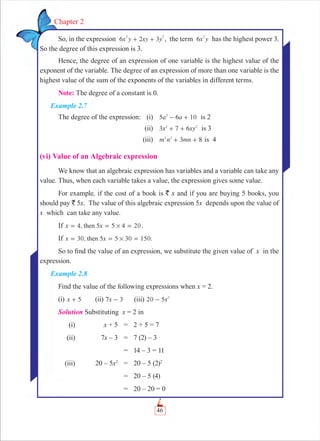
So to find the value of an expression, we substitute the given value of x in the
expression.
Example 2.8
Find the value of the following expressions when x = 2.
(i) x 5+ (ii) x7 3- (iii) x20 5 2
-
Solution Substituting x = 2 in
(i) x + 5 = 2 + 5 = 7
(ii) 7x – 3 = 7 (2) – 3
= 14 – 3 = 11
(iii) 20 – 5x2
= 20 – 5 (2)2
= 20 – 5 (4)
= 20 – 20 = 0
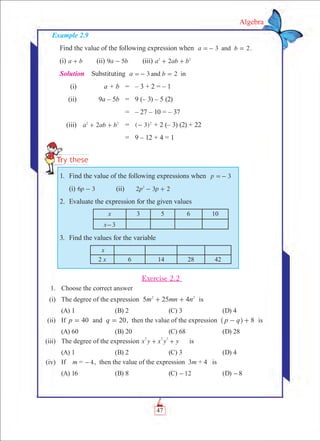
47
Algebra
Example 2.9
Find the value of the following expression when 3 2a band=- = .
(i) a b+ 	 (ii) a b9 5- 	 (iii) a ab b22 2
+ +
Solution  Substituting 3 2a band in=- =
	 (i)	 a + b	 =	 – 3 + 2 = – 1
	 (ii)	 9a – 5b	 =	 9 (– 3) – 5 (2)
			 =	 – 27 – 10 = – 37
	 (iii)	 a ab b22 2
+ + 	 =	 ( )3 2
- + 2 (– 3) (2) + 22
			 =	 9 – 12 + 4 = 1
1.	 Find the value of the following expressions when p 3=-
	 (i)	 p6 3- 		 (ii)	 p p2 3 22
- +
2.	 Evaluate the expression for the given values
x 3 5 6 10
x-3
3.	 Find the values for the variable
x
2 x 6 14 28 42
Exercise 2.2
	 1.	 Choose the correct answer
	 (i)	 The degree of the expression 5m mn n25 42 2
+ + is
	 (A) 1	 (B) 2	 (C) 3	 (D) 4
	 (ii)	 If p 40= and q 20= , then the value of the expression p q 8- +^ h is
	 (A) 60	 (B) 20	 (C) 68	 (D) 28
	 (iii)	 The degree of the expression x y x y y
2 2 2
+ + is
	 (A) 1	 (B) 2	 (C) 3	 (D) 4
	 (iv)	 If m = 4- , then the value of the expression 3m + 4 is
	 (A) 16	 (B) 8	 (C) 12- 	 (D) 8-
48
Chapter 2
(v) If p = 2 and q = 3, then the value of the expression ( )p q p q+ - -^ h is
(A) 6 (B) 5 (C) 4 (D) 3
2. Identify the like terms in each of the following:
(i) , ,x y x4 6 7
(ii) , ,a b b2 7 3-
(iii) ,3 , 3 , 8xy x y y yx2 2 2
- -
(iv) , , ,ab a b a b a b72 2 2 2
(v) 5 , 4 , 3 , , 10 , 4 , 25 , 70 , 14pq p q p q p p pq q p q2 2 2 2 2
- -
3. State the degree in each of the following expression:
(i) x yz2
+ (ii) 15 3y2
- (iii) x y xy6 2
+
(iv) a b ab72 2
- (v) 1 3 7t t2
- +
4. If ,x 1=- evaluate the following:
(i) x3 7- (ii) x 9- + (iii) x x3 72
- +
5. If a 5= and ,b 3=- evaluate the following:
(i) a b3 2- (ii) a b2 2
+ (iii) a b4 5 32
+ -
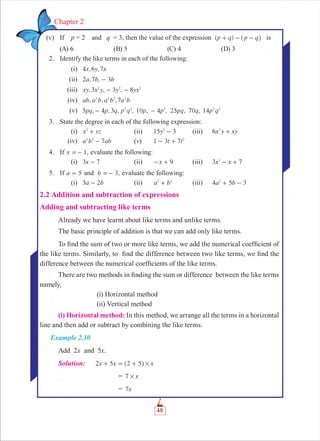
2.2 Addition and subtraction of expressions
Adding and subtracting like terms
Already we have learnt about like terms and unlike terms.
The basic principle of addition is that we can add only like terms.
To find the sum of two or more like terms, we add the numerical coefficient of
the like terms. Similarly, to find the difference between two like terms, we find the
difference between the numerical coefficients of the like terms.
There are two methods in finding the sum or difference between the like terms
namely,
(i) Horizontal method
(ii) Vertical method
(i) Horizontal method: In this method, we arrange all the terms in a horizontal
line and then add or subtract by combining the like terms.
Example 2.10
Add 2x and 5x.
Solution: x x x2 5 2 5 #+ = +^ h
= x7 #
= x7
49
Algebra
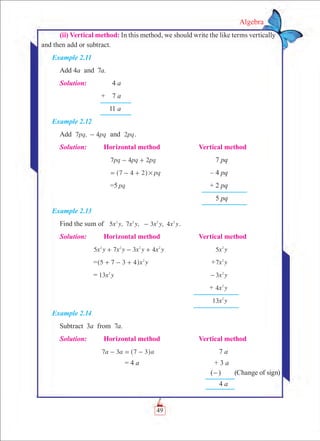
(ii) Vertical method: In this method, we should write the like terms vertically
and then add or subtract.
Example 2.11
Add 4a and 7a.
Solution:	 4 a
	 +  7 a
	 11 a
Example 2.12
Add 7 , 4pq pq- and pq2 .
Solution:	 Horizontal method	 Vertical method
	 pq pq pq7 4 2- + 	 7 pq
	 pq7 4 2 #= - +^ h 	 – 4 pq
	 =5 pq	 + 2 pq
		 5 pq
Example 2.13
Find the sum of 5 , 7 , 3 , 4x y x y x y x y2 2 2 2
- .
Solution:	 Horizontal method	 Vertical method
	 x y x y x y x y5 7 3 42 2 2 2
+ - + 	 x y5 2
	 = x y5 7 3 4 2
+ - +^ h 	 + x y7 2
	 = x y13 2
	 3x y2
-
		 + x y4 2
		 x y13 2
Example 2.14
Subtract 3a from 7a.
Solution:	 Horizontal method	 Vertical method
	 7 3a a a7 3- = -^ h 	 7 a
	 = 4 a	 + 3 a
		 (-)   (Change of sign)
		 4 a
50
Chapter 2
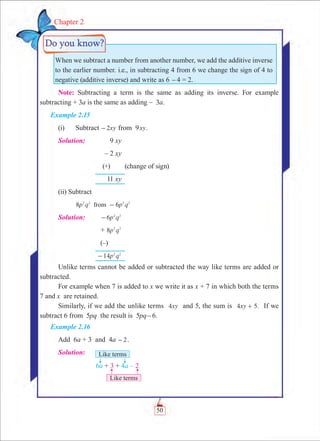
When we subtract a number from another number, we add the additive inverse
to the earlier number. i.e., in subtracting 4 from 6 we change the sign of 4 to
negative (additive inverse) and write as 6 -4 = 2.
Note: Subtracting a term is the same as adding its inverse. For example
subtracting + 3a is the same as adding – 3a.
Example 2.15
(i)	 Subtract xy2- from 9xy.
Solution:	 9 xy
	 – 2 xy
	 (+)	 (change of sign)
	 11 xy	
(ii) Subtract
	 8 6p q p qfrom2 2 2 2
-
Solution:	 p q6 2 2
-
	 + p q8 2 2
	 (–)	
	 p q14 2 2
-
Unlike terms cannot be added or subtracted the way like terms are added or
subtracted.
For example when 7 is added to x we write it as x + 7 in which both the terms
7 and x are retained.
Similarly, if we add the unlike terms xy4 and 5, the sum is .xy4 5+ If we
subtract 6 from 5pq the result is 5pq-6.
Example 2.16
Add 6a + 3 and 4a 2- .
Solution:
51
Algebra
		 = 6a + 4a + 3 – 2	 (grouping like terms)
		 = 10a + 1
Example 2.17
Simplify t t6 5 1+ + + .
Solution:	
		 = 6t + t + 5 + 1	 (grouping like terms)
		 = 7t + 6
Example 2.18
Add 5 8 3 4 5y z yand+ + -
Solution:
	 5 8 3 4y z y 5+ + + - 	
	 = 5 4 8 5 3y y z+ + - + 	 (grouping like terms)
	 = 9 3 3y z+ + 		 (The term 3z will remain as it is.)
Example 2.19
Simplify the expression 15 10 6 6 3 5n n n n n2 2
- + - - +
Solution:
Grouping like terms we have
15 6 10 6 3n n n n n 52 2
- - + - +
	 5n n15 6 10 6 32
= - + - + - +^ ^h h 	
	 = n n9 7 52
+ - +^ h
	 = 9 7 5n n2
- +
Example 2.20
Add 10 5 2 , 4 4 5 3 2 6x xy y x xy y x xy yand2 2 2 2 2 2
- + - + + - - .
Solution:	 x xy y10 5 22 2
- +
	 x xy y4 4 52 2
- + +
	 x xy y3 2 62 2
+ - -
	 x xy y9 32 2
- +
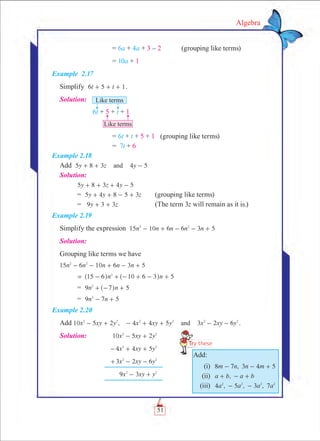
Add:
	 (i)	 8 7 , 3 4 5m n n m- - +
	 (ii)	 ,a b a b+ - +
	 (iii)	 4 , 5 , 3 , 7a a a a2 2 2 2
- -
52
Chapter 2
Example 2.21
Subtract a b6 3- from a b8 9- + .
Solution: 8 9a b- +
a b6 3+ -
(–) (+)
a b14 12- +
Example 2.22
Subtract 2 3p q p q5 3from- - +^ ^h h
Solution: 2p q p q3 5 3- + - -^ ^h h
= p q p q15 3 9 2 2- + - +
= p p q q15 2 3 2 9- - + +
= p q13 9- +
Example 2.23
Subtract 3a b ab2 2
+ - from 3a b ab2 2
- - .
Solution:
Horizontal method Vertical method
a b ab a b ab3 32 2 2 2
- - - + -^ ^h h a2
– b2
– 3ab
3 3a b ab a b ab2 2 2 2
= - - - - + a2
+ b2
– 3ab
= b b2 2
- - (–) (–) (+)
= 2b2
- – 2 b2
Example 2.24
If 5 7 8, 4 7 3, 2A Bx x x x find A B2 2
= + + = - + - .
Solution: 2A = 2 x x5 7 82
+ +^ h
= x x10 14 162
+ +
Now 2 A – B x x x x10 14 16 4 7 32 2
= + + - - +^ ^h h
x x x x10 14 16 4 7 32 2
= + + - + -
x x6 21 132
= + +
Just as
8 5,
m n m n
8 5
2 2 2
- - = - +
- - =- +
^
^
h
h
the signs of algebraic terms are
handled in the same way as signs
of numbers.
53
Algebra
Example 2.25
What should be subtracted from b14 2
to obtain b6 2
?
Solution:	 b14 2
	 b6 2
	 (–)	
	 b8 2
Example 2.26
What should be subtracted from a b ab3 4 52 2
- + to obtain a b ab62 2
- - + .
Solution:
	 3 4 5a b ab2 2
- +
6a b ab2 2
- - +
(+) (+) (–)
4 3a b ab2 2
- -
Exercise 2.3
	 1.	 Choose the correct answer:
	 (i)	 Sum of 4x, x8- and 7x is
	 (A) 5x	 (B) 4x	 (C) 3x	 (D) 19x
	 (ii)	 Sum of 2ab, 4ab, ab8- is
	 (A) 14ab	 (B) ab2- 	 (C) ab2 	 (D) ab14-
	 (iii)	 ab bc ab5 3+ - is
	 (A) ab bc2 + 	 (B) ab bc8 + 	 (C) ab9 	 (D) ab3
	 (iv)	 y y y y5 3 4
2 2
- - + is
	 (A) y y9 4
2
+ 	 (B) y y9 4
2
- 	 (C) y y2
2
+ 	 (D) y y2
2
-
	 (v)	 If 3 2xA and= + B = 6x 5- , then A - B is
	 (A) x3 7- + 	 (B) x3 7- 	 (C) x7 3- 	 (D) 9x 7+
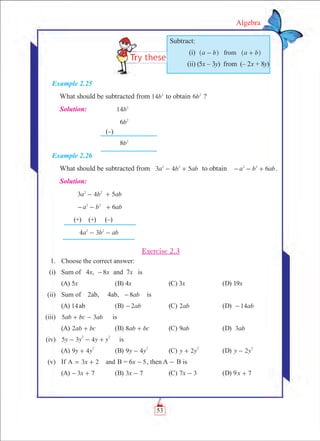
Subtract:
	 (i)	 a b a bfrom- +^ ^h h
	 (ii) (5x – 3y) from (– 2x + 8y)
54
Chapter 2
2. Simplify :
(i) a b a b6 3 7 5- + +
(ii) 8 5 3l l l l2 2
- - +
(iii) z z z z z10 2 7 142 2 2
- + - + -
(iv) p p q q q p- - - - -^ ^h h
(v) 3 3 4 5 2mn m nm n m n32 2 2 2
- + - - +
(vi) x xy y x xy y4 5 3 3 2 42 2 2 2
- + - - -^ ^h h
3. Add :
(i) 7 , 8 , 10 ,ab ab ab- ab3-
(ii) , 2 ,s t s t s t+ - - +
(iii) 3 2 , 2 3a b p q- +
(iv) 2 5 7, 8 3 3, 5 7 6a b a b a b+ + - + - - -
(v) , ,x y x y x y6 7 3 8 7 4 4 2+ + - - - - +
(vi) 6 3, 3 9, 4 10c c c c c2 2
- + - - + +
(vii) 6m2
n + 4mn – 2n2
+ 5, n2
– nm2
+ 3, mn – 3n2
– 2m2
n – 4
4. Subtract :
(i) a6 from a14
(ii) a b2
- from a b6 2
(iii) x y7 2 2
from x y4 2 2
-
(iv) xy3 4- from xy 12+
(v) m n 3-^ h from n m5 -^ h
(vi) p p9 52
- from 10 6p p2
- -
(vii) m m3 6 32
- + + from 5 9m2
-
(viii) 6s s122
- + - from 6 10s -
(ix) 5 3m mn n62 2
+ - from n mn m6 4 42 2
- -
5. (i) What should be added to x xy y3 32 2
+ + to obtain ?x xy4 62
+
(ii) What should be subtracted from p q4 6 14+ + to get ?p q5 8 20- + +
(iii) If 8 3 9, 9x y yA B= - + =- - and 4 9x yC = - - find A B C.+ -
6. Three sides of a triangle are 3 4 2, 7a b a+ - - and .a b2 4 3- + What is its
perimeter?
7. The sides of a rectangle are x3 2+ and x5 4+ . Find its perimeter.
8. Ram spends 4a+3 rupees for a shirt and a8 5- rupees for a book. How much
does he spend in all?
9. A wire is x10 3- metres long. A length of x3 5+ metres is cut out of it for use.
How much wire is left out?
10. If 3 5p pA 2
= + + and 2 5 7p pB 2
= - - , then find
(i) 2A + 3B (ii) A-B
11. Find the value 8of P Q +- if 8m mP 2
= + and 3 2m mQ 2
=- + - .
55
Algebra
2.3 Simple expressions with two variables
We have learnt about rectangle. Its area is l b# in which the letters ' 'l and ' 'b are
variables.
Variables follow the rules of four fundamental operations of numbers.
Let us now translate a few verbal phrases into expressions using variables.
Operation Verbal phrase Algebraic Expression
Addition
Subtraction
Multiplication
Division
Sum of x and y
Difference between
a and b
product of x and y
p divided by q
x + y
a - b if a b^ h or^ h
( )b a if b a- 
x # y (or) xy
( )p q
q
p
or'
The following table will help us to learn some of the words (phrases) that can
be used to indicate mathematical operations:
Addition Subtraction Multiplication Division
The sum of
increased by
plus
added to
more than
the difference of
decreased by
minus
subtracted from
less than
the product of
multiplied by
times
the quotient of
divided by
the ratio of
Example 2.27
Write the algebraic expressions for the following:
	 1)	 Twice the sum of m and n.
	 2)	 b decreased by twice a.
	 3)	 Numbers x and y both squared and added.
	 4)	 Product of p and q added to 7.
	 5)	 Two times the product of a and b divided by 5.
	 6)	 x more than two-third of y.
56
Chapter 2
7) Half a number x decreased by 3.
8) Sum of numbers m and n decreased by their product .
9) 4 times x less than sum of y and 6.
10) Double the sum of one third of a and m.
11) Quotient of y by 5 added to x.
Solution:
1) m n2 +^ h 2) b a2-
3) x y2 2
+ 4) pq7 +
5) ab
5
2 6) y x
3
2 +
7) x
2
3- 8) ( )m n mn+ -
9) y x6 4+ -^ h 10) a m2
3
1 +` j
11)
y
x
5
+
Express each of the following as an algebraic expression
(i) a times b.
(ii) 5 multiplied by the sum of a and b.
(iii) Twice m decreased by n .
(iv) Four times x divided by y .
(v) Five times p multiplied by 3 times q.
Exercise 2.4
1. Choose the correct answer:
(i) The sum of 5 times x, 3 times y and 7
(A) x y5 3 7+ +^ h (B) x y5 3 7+ +
(C) x y5 3 7+ +^ h (D) x y5 3 7+ ^ h
(ii) One half of the sum of numbers a and b
(A) a b
2
1 +^ h (B) a b
2
1 + (C) a b
2
1 -^ h (D) a b
2
1 + +
(iii) Three times the difference of x and y
(A) x y3 - (B) x y3 - - (C) xy 3- (D) y x3 -^ h
57
Algebra
	 (iv)	 2 less than the product of y and z
	 (A) yz2 - 	 (B) yz2 + 	 (C) yz 2- 	 (D) y z2 -
	 (v)	 Half of p added to the product of 6 and q
	 (A) 6
p
q
2
+ 	 (B) p
q
2
6
+ 	 (C) p q
2
1 6+^ h	 (D) p q
2
1 6 +^ h
	 2.	 Write the algebraic expressions for the following using variables, constants and
arithmetic operations:
	 (i)	 Sum of x and twice y.
	 (ii)	 Subtraction of z from y.
	 (iii)	 Product of x and y increased by 4
	 (iv)	 The difference between 3 times x and 4 times y.
	 (v)	 The sum of 10, x and y.
	 (vi)	 Product of p and q decreased by 5.
	 (vii)	 Product of numbers m and n subtracted from 12.
	 (viii)	 Sum of numbers a and b subtracted from their product.
	 (ix)	 Number 6 added to 3 times the product of numbers c and d.
	 (x)	 Four times the product of x and y divided by 3.
2.4 Simple Linear Equations
Malar’s uncle presented her a statue. She wants to
know the weight of that statue. She used a weighing balance
to measure its weight. She knows her weight is 40kg . She
finds that the statue and potatoes balance her weight.
i.e.,
Weight of
statue
Plus
Weight of
potatoes
Equal
Malar’s
weight
s + 15 = 40
           Table 2.1
Now we will think about a balance to find the value of s.
Chapter 2
Take away 15 from both sides.
Now the balance shows the weight of the statue.
	 s + 15	 =	 40 (from Table 2.1)
	 s + 15 – 15	 =	 40 – 15 (Taking away 15 from both the sides)
	 s	 =	 25
So the statue weighs 25 kg.
The statement s 15 40+ = is an equation. i.e., a statement in which two
mathematical expressions are equal is called an equation.
In a balance, if we take away some weight from one side, to balance it we must
take away the same weight from the other side also.
If we add some weight to one side of the balance, to balance it we must add the
same weight on the other side also.
Similarly, an equation is like a weighing balance having equal weights on
each side. In an equation there is always an equality sign. This equality sign shows
that value of the expression on the left hand side (LHS) is equal to the value of the
expression on the right hand side (RHS).
¬ Consider the equation x 7 15+ =
Here	 LHS is x 7+
	 RHS is 15
We shall subtract 7 from both sides of the equation
	 x 7 7 15 7+ - = - 	 (Subtracting 7 reduces the LHS to x)
	 x 8= 		 (variable x is separated)
58
59
Algebra
¬ Consider the equation 3 10n - =
	 LHS is 3n -
	 RHS is 10
Adding 3 to both sides, we get
	 n 3 3 10 3- + = +
	 n 13= 	 (variable n is separated)
¬ Consider the equation 4m = 28
Divide both sides by 4
	 m
4
4
4
28=
	 m = 7
¬ Consider the equation
y
2
6=
	 Multiply both sides by 2
	
y
2
2 6 2# #=
	 y 12=
So, if we add (or subtract) any number on one side of an equation, we have
to add (or subtract) the same number the other side of the equation also to keep
the equation balanced. Similarly, if we multiply (or divide) both sides by the same
non-zero number, the equation is balanced. Hence to solve an equation, one has to
perform the arithmetical operations according to the given equations to separate the
variable from the equation.
Example 2.28
Solve p3 4 25+ =
Solution:	 3 4 4 4p 25+ - = - 	 (Subtracting4frombothsidesoftheequation)
	 p3 21=
	
p
3
3
3
21= 	 (Dividing both sides by 3)
	 p 7=
Example 2.29
Solve m7 5 30- = 				
Solution:	 m7 5 5 30 5- + = + 	 (adding 5 on both sides)
60
Chapter 2
m7 35=
m
7
7
7
35= (Dividing both sides by 7)
m 5=
While solving equations, the commonly used operation is adding or subtracting
the same number on both sides of the equation. Instead of adding or subtracting a
number on both sides of the equation, we can transpose the number.
Transposing a number (i.e., changing the side of the number) is the same as
adding or subtracting the number from both sides. While transposing a number we
should change its sign. Let us see some examples of transposing.
Example 2.30
Solve a2 12 14- =
Solution:
Adding or subtracting
on both sides
Transposing
a2 12 14- =
a2 12 12 14 12- + = + (adding 12 on
both sides)
2 2a 6=
a
2
2
2
26= (dividing both sides by 2)
1a 3=
a2 12 14- =
Transpose (– 12) from LHS to RHS
a2 14 12= + (on transposing
12 12becomes- + )
2 2a 6=
a
2
2
2
26= (Dividing both sides by 2)
1a 3=
Example 2.31
Solve x5 3 18+ =
Solution: Transposing +3 from LHS to RHS
x5 18 3= - (on Transposing +3 becomes 3- )
x5 15=
x
x
5
5
5
15
3
=
=
(Dividing both sides by 5)
61
Algebra
Example 2.32
Solve x2 4 12+ =^ h
Solution: Divide both sides by 2 to remove the brackets in the LHS.
	
x
2
2 4
2
12+
=
^ h
	 x 4 6+ =
	 x 6 4= - 	 (transposing +4 to RHS)
	 x 2=
Example 2.33
Solve m3 2 18- - =^ h
Solution: Divide both sides by 3-^ h to remove the brackets in the LHS.
	
m
3
3 2
3
18
-
- -
=
-
^ h
	 m 2 6- =-
	 m 6 2=- + 	 (transposing 2- to RHS)
	 m 4=- 		
Example 2.34
Solve (3x + 1 ) – 7 = 12
Solution:
	 (3x + 1) – 7	 =	 12
	 3x + 1 – 7	 =	 12
	 3x – 6	 =	 12
	 3x	 =	 12 + 6
	 x
3
3 	 =	
3
18
	 x	 =	 6
Example 2.35
Solve x x5 3 17 2+ = -
Solution:
	 x x5 3 17 2+ = -
62
Chapter 2
5 2 17 3x x+ = - (transposing + 3 to RHS and x2- to LHS)
x7 14=
x
7
7
7
14=
x 2=
Example 2.36
Sum of three consecutive integers is 45. Find the integers.
Solution: Let the first integer be x.
 second integer x 1= +
Third integer 1 1 2x x= + + = +
Their sum x x x1 2 45= + + + + =^ ^h h
x3 3 45+ =
x
x
3 42
14
=
=
Hence, the integers are x 14=
1 15x + =
x 2 16+ =
Example 2.37
A number when added to 60 gives 75. What is the number?
Solution: Let the number be x.
The equation is x60 75+ =
x 75 60= -
x 15=
Example 2.38
20 less than a number is 80. What is the number?
Solution: Let the number be x.
The equation is x 20 80- =
x 80 20= +
x 100=
63
Algebra
Example 2.39
10
1 of a number is 63. What is the number?
Solution: Let the number be x.
The equation is	 x
10
1 63=^ h
	 ( ) 63 10x
10
1 10# #=
	 x 630=
Example 2.40
A number divided by 4 and increased by 6 gives 10. Find the number.
Solution: Let the number be x.
The equation is	 x
4
6 10+ =
	 10 6x
4
= -
	 x
4
4=
	 x
4
4 4 4# #=
 the number is 16.
Example 2.41
Thendral’s age is 3 less than that of Revathi. If Thendral’s age is 18, what is
Revathi’ s age?
Solution: Let Revathi’s age be x
 Thendral’s age = x 3-
Given, Thendral’s age is 18 years
	 	 x 3 18- =
	 x 18 3= +
	 x 21=
Hence Revathi’s age is 21 years.
64
Chapter 2
Exercise - 2.5
1. Choose the correct answer.
(i) If p 3 9+ = , then p is
(A) 12 (B) 6 (C) 3 (D) 27
(ii) If x12 8- = , then x is
(A) 4 (B) 20 (C) 4- (D) 20-
(iii) If
q
6
7= , then q is
(A) 13 (B)
42
1 (C) 42 (D)
6
7
(iv) If x7 9 35- =^ h , then x is
(A) 5 (B) 4- (C) 14 (D) 37
(v) Three times a number is 60. Then the number is
(A) 63 (B) 57 (C) 180 (D) 20
2. Solve :
(i) x 5 7- = (ii) a 3 10+ = (iii) y4 2+ =-
(iv) b 3 5- =- (v) x 5- = (vi) x 7- =-
(vii) x3 8- = (viii) n14 10- = (ix) m7 4- =-
(x) y20 7- =-
3. Solve :
(i) x2 100= (ii) l3 42= (iii) x36 9=
(iv) a51 17= (v) x5 45=- (vi) t5 20=-
(vii) x7 42- = (viii) m10 30- =- (ix) x2 1- =
(x) x3 18- =-
4. Solve :
(i) x
2
1 7= (ii) a
6
5= (iii) n
3
8=-
(iv)
p
7
8
-
= (v) x
5
2- = (vi) m
3
4- =-
5. Solve :
(i) x3 1 10+ = (ii) 11 2x 19+ =- (iii) z4 3 17- =
(iv) a4 5 41- =- (v) x3 2 15+ =^ h (vi) x4 2 12- - =^ h
(vii)
y
5
3
14
+
= (viii) x
3
5 7+ = (ix) y y6 21= -
(x) m m11 42 4= + (xi) x x3 5 22- =- + (xii) 6 2 1m m1- = +
(xiii) x x3 14 8- = - (xiv) x x x5 2 7 1- + = + (xv) t t5 3 3 5- = -
65
Algebra
Fun game
Ram asked his friends Arun, Saranya and Ravi to think of a number and told
them to add 50 to it. Then he asked them to double it. Next he asked them to add 48 to
the answer. Then he told them to divide it by 2 and subtract the number that they had
thought of. Ram said that the number could now be 74 for all of them. Check it out if
Arun had thought of 16, Saranya had thought of 20 and Ravi had thought of 7.
Arun Saranya Ravi
Think of a number x 16 20 7
Add 50 x+50
Double it x2 100+ 
Add 48 x2 148+ 
Divide by 2 x 74+ 
Take away the number
you thought of
74
Solve:
	 (i)	 y 18 70+ =- 	 (ii)	 x300 100- + =
	 (iii)	 t
3
5 6- =- 	 (iv)	 x2 9 19+ =
	 (v)	 x x3 4 2 11+ = +
	 6.	 The sum of two numbers is 33. If one number is 18, what is the other number?
	 7.	 A number increased by 12 gives 25. Find the number.
	 8.	 If 60 is subtracted from a number, the result is 48. Find the number.
	 9.	 5 times a number is 60. Find the number.
	 10.	 3 times a number decreased by 6 gives 18. Find the number.
	 11. 	 The sum of 2 consecutive integers is 75. Find the numbers.
	 12.	 Ram’s father gave him 70 rupees. Now he has 130 rupees. How much money did
Ram have in the beginning?
	 13.	 8 years ago, I was 27 years old. How old am I now?
66
Chapter 2
	 1.	 Algebra is a branch of Mathematics that involves alphabet, numbers and
mathematical operations.
	 2.	 A variable or a literal is a quantity which can take various numerical values.
	 3.	 A quantity which has a fixed numerical value is a constant.
	 4.	 An algebraic expression is a combination of variables and constants connected
by the arithmetic operations.
	 5.	 Expressions are made up of terms.
	 6.	 Terms having the same variable or product of variables with same powers are
called Like terms. Terms having different variable or product of variables with
different powers are called Unlike terms.
	 7.	 The degree of an expression of one variable is the highest value of the exponent
of the variable. The degree of an expression of more than one variable is the
highest value of the sum of the exponents of the variables in different terms
	 8.	 A statement in which two expressions are equal is called an equation.
	 9.	 An equation remains the same if the LHS and RHS are interchanged.
	 10.	 The value of the variable for which the equation is satisfied is called the
solution of the equation.
67
3.1 Introduction
In most of our daily activities like following a recipe or decorating our home
or calculating our daily expenses we are unknowingly using mathematical principles.
People have been using these principles for thousands of years, across countries and
continents. Whether you’re sailing a boat off the coast of Chennai or building a house
in Ooty, you are using mathematics to get things done.
How can mathematics be so universal? First human beings did not invent
mathematical concepts, we discovered them. Also the language of mathematics is
numbers, not English or German or Russian. If we are well versed in this language
of numbers, it can help us make important decisions and perform everyday tasks.
Mathematics can help us shop wisely, remodel a house within a budget, understand
population growth, invest properly and save happily.
Let us learn some basic mathematical concepts that are used in real life
situations.
3.2 Revision - Ratio and Proportion
Try and recollect the definitions and facts on Ratio and Proportion and complete the
following statements using the help box:
	 1.	 The comparison of two quantities of the same kind by means of division is
termed as __________.
	 2.	 The two quantities to be compared are called the ________ of the ratio.
	 3.	 The first term of the ratio is called the _________ and the second term is
called the _______.
	 4.	 In a ratio, only two quantities of the __________ unit can be compared.
	 5.	 If the terms of the ratio have common factors, we can reduce it to its lowest
terms by cancelling the _____.
	 6.	 When both the terms of a ratio are multiplied or divided by the same number
(other than zero) the ratio remains _________ .The obtained ratios are
called__________.
LIFE MATHEMATICS
68
Chapter 3
Aliter:
Factorizing 270,378 we get
378
270
2 3 3 3 7
2 3 3 3 5
# # # #
# # # #=
	 7
5=
	 7.	 In a ratio the order of the terms is very important. (Say True or False)
	 8.	 Ratios are mere numbers. Hence units are not needed. (Say True or False)
	 9.	 Equality of two ratios is called a __________. If , ; ,a b c d are in proportion,
then : :: :a b c d .
	 10.	 In a proportion, the product of extremes =___________
Help Box:
1) Ratio	 2) terms	 3) antecedent, consequent
4) same	 5) common terms	 6) unchanged, equivalent ratios
7) True	 8) True	 9) proportion
10) product of means
Example 3.1:
Find 5 equivalent ratios of 2:7
Solution: 2 : 7 can be written as
7
2 .
Multiplying the numerator and the denominator of
7
2 by 2, 3, 4, 5, 6
we get 	
7 2
2 2
#
# 	= ,
14
4
7 3
2 3
#
# 	 =
21
6 ,	
7 4
2 4
#
# =
28
8
		
7 5
2 5
#
# 	 =
35
10 ,	
7 6
2 6
#
# =
42
12
4 : 14, 6 : 21, 8 : 28, 10 : 35, 12 : 42 are equivalent ratios of 2 : 7.
Example 3.2:
Reduce 270 : 378 to its lowest term.
Solution:
	 270:378 =
378
270
	 Dividing both the numerator and
	 the denominator by 2, we get	
	
378 2
270 2
189
135
'
' =
69
Life Mathematics
by 3, we get	
	
189 3
135 3
63
45
'
' =
by 9, we get						
	
63 9
45 9
7
5
'
' =
	 270 : 378 is reduced to 5 : 7
Example 3.3
Find the ratio of 9 months to 1 year
Solution:	 1 year	 =	 12 months
Ratio of 9 months to 12 months = 9 : 12
	 9 : 12 can be written as
12
9
	
12 3
9 3
4
3
'
'= =
	 = 3 : 4
Example 3.4
If a class has 60 students and the ratio of boys to girls is 2:1, find the number
of boys and girls.
Solution:
	 Number of students	 =	 60
	 Ratio of boys to girls	 =	 2 : 1
	 Total parts	 =	 2 + 1 = 3
	 Number of boys	 =	
3
2 of 60
		 60
3
2 #= = 40
	 Number of boys	 =	 40
	 Number of girls	 =	 Total Number of students -Number of boys
		 =	 60 40-
		 = 	20
	 Number of girls	 =	 20
[OR] Number of girls
	 =
3
1 of 60 =
3
1 60#
	 = 20
Quantities of the same
units only can be
compared in the form of
a ratio. So convert year
to months.
70
Chapter 3
Example 3.5
A ribbon is cut into 3 pieces in the ratio 3: 2: 7. If the total length of the ribbon
is 24 m, find the length of each piece.			
Solution:
	 Length of the ribbon	 =	 24m
	 Ratio of the 3 pieces	 =	 3 : 2 : 7
	 Total parts	 =	 3 + 2 + 7 = 12
	 Length of the first piece of ribbon	 =	 24
12
3 of
		 =	
12
3 24# = 6 m
	 Length of the second piece of ribbon	 =	 24
12
2 of
		 =	
12
2 24# = 4 m
	 Length of the last piece of ribbon	 =	 24
12
7 of
		 =	
12
7 24# = 14 m
So, the length of the three pieces of ribbon are 6 m, 4 m, 14 m respectively.
Example 3.6
The ratio of boys to girls in a class is 4 : 5. If the number of boys is 20, find the
number of girls.
Solution:	 Ratio of boys to girls	 =	 4 : 5
	 Number of boys	 =	 20
Let the number of girls be x
The ratio of the number of boys to the number of girls is 20 : x
4 : 5 and 20 : x are in proportion, as both the ratios represent the number of boys
and girls.
(i.e.) 4 : 5 :: 20 : x
	 Product of extremes	 =	 4 # x
	 Product of means	 =	 5 # 20
In a proportion, product of extremes = product of means
71
Life Mathematics
	 4 # x	 =	 5 # 20
	 x	 =	
4
5 20# = 25
	 Number of girls	 =	 25
Example 3.7
If A : B = 4 : 6, B : C = 18 : 5, find the ratio of A : B : C.
Solution:
	 A	:	 B	 =	 4 : 6
			 B : C	 =	 18 : 5
L.C.M. of 6, 18 = 18
	 A	:	 B	 =	 12 : 18
			 B : C	 =	 18 : 5
	 A : B : C =12 : 18 : 5
           Do you Know?
Golden Ratio: Golden Ratio is a special number
approximately equal to 1.6180339887498948482g. We use the
Greek letter Phi (F) to refer to this ratio. Like Phi the digits of the
Golden Ratio go on forever without repeating.
Golden Rectangle: A Golden Rectangle is a rectangle in which the ratio of the
length to the width is the Golden Ratio. If width of the Golden Rectangle is 2 ft long,
the other side is approximately = 2 (1.62) = 3.24 ft
Golden segment: It is a line segment divided
into 2 parts. The ratio of the length of the 2 parts of this
segment is the Golden Ratio
		
BC
AB
AC
BC=
Applications of Golden Ratio:
Hint
To compare 3 ratios as
given in the example, the
consequent (2nd term) of the
1st ratio and the antecedent
(1st term) of the 2nd ratio
must be made equal.
72
Chapter 3
Think!
	 1.	 Use the digits 1 to 9 to write as many proportions as possible. Each
digit can be used only once in a proportion. The numbers that make
up the proportion should be a single digit number.
		 Eg:
2
1
6
3=
	 2.	 Suppose the ratio of zinc to copper in an alloy is 4 : 9, is there more
zinc or more copper in the alloy?
	 3.	 A bronze statue is made of copper, tin and lead metals. It has
,of of
10
1
4
1tin lead and the rest copper. Find the part of copper in
the bronze statue.
3.2 Variation
What do the above said statements indicate?
These are some changes.
What happens when......
73
Life Mathematics
In the above cases, a change in one factor brings about a change in the related
factor. These changes are also termed as variations.
Now, try and match the answers to the given questions:
What happens when............
The above examples are interdependent quantities that change numerically.
We observe that, an increase ( )- in one quantity brings about an increase ( )- in
the other quantity and similarly a decrease ( ). in one quantity brings about a decrease
( ). in the other quantity .
Now, look at the following tables:
Cost of 1 pen (`) Cost of 10 pens (`)
5 10 5 50# =
20 10 20 200# =
30 10 30 300# =
As the number of pens increases, the cost also increases correspondingly.
Cost of 5 shirts (`) Cost of 1 shirt (`)
3000
5
3000 600=
1000
5
1000 200=
74
Chapter 3
As the number of shirts decreases, the cost also decreases correspondingly.	
Thus we can say, if an increase ( ) [decrease ( ­)] in one quantity produces a
proportionate increase ( ) [decrease ( ­)] in another quantity, then the two quantities
are said to be in direct variation.
Now, let us look at some more examples:
i)	 When the speed of the car increases, do you think that the time taken to
reach the destination will increase or decrease?
	ii)	 When the number of students in a hostel decreases, will the provisions to
prepare food for the students last longer or not?
We know that as the speed of the car increases, the time taken to reach the given
destination definitely decreases.
Similarly, if the number of students decreases, the provisions last for some more
number of days.
Thus, we find that if an increase ( ) [decrease ( ­)] in one quantity produces a
proportionate decrease ( ­) [increase ( )] in another quantity, then we say that the two
quantities are in inverse variation.
Identify the direct and inverse variations from the given examples.
	 1.	 Number of pencils and their cost
	 2.	 The height of poles and the length of their shadows at a
given time
	 3.	 Speed and time taken to cover a distance
	 4.	 Radii of circles and their areas
	 5.	 Number of labourers and the number of days taken to
complete a job
	 6.	 Number of soldiers in a camp and weekly expenses
	 7.	 Principal and Interest
	 8.	 Number of lines per page and number of pages in a book
Look at the table given below:
Number of pens x 2 4 7 10 20
Cost of pens (`) y 100 200 350 500 1000
We see that as ‘x’ increases ( ) ‘y’ also increases ( ).
75
Life Mathematics
We shall find the ratio of number of pens to cost of pens
	 , , , , ,
y
x
100
2
200
4
350
7
500
10
1000
20
Cost of pens
Number of pens
to be=
and we see that each ratio =
50
1 = Constant.
Ratio of number of pens to cost of pens is a constant.
	 `
y
x constant=
It can be said that when two quantities vary directly the ratio of the two
given quantities is always a constant.
Now, look at the example given below:
Time taken (Hrs) x 21 = x 102 =
Distance travelled (km) y 101 = 50y2 =
We see that as time taken increases ( ), distance travelled also increases ( ).
	 X	 =	
x
x
10
2
5
1
2
1
= =
	 Y
y
y
50
10
5
1
2
1
= = =
	 X	 =	 Y =
5
1
From the above example, it is clear that in direct variation, when a given
quantity is changed in some ratio then the other quantity is also changed in the
same ratio.
Now, study the relation between the given variables and find a and b.
Time taken (hrs) x 2 5 6 8 10 12
Distance travelled (Km) y 120 300 a 480 600 b
Here again, we find that the ratio of the time taken to the distance travelled is a
constant.
120
2
300
5
600
10
480
8
60
1
Distance travelled
Time taken Constant= = = = = =
(i.e.)	
y
x
60
1= . Now, we try to find the unknown
	
a60
1 6=
	 1	 ×	6	 =	 6
	 60	×	6	 =	 360
			 a	 =	 360
76
Chapter 3
       
b60
1 12=
	 1	×	12	 =	 12
	 60	×	12	 =	 720
			 b	 =	 720
Look at the table given below:
Speed (Km / hr) x 40 48 60 80 120
Time taken (hrs) y 12 10 8 6 4
Here, we find that as x increases ( ). y decreases ( )-
	 xy	 =	 40 # 12 = 480
		 =	 48 # 10 = 60 # 8 = 80# 6 = 120# 4 = 480
	  xy	 =	 constant
It can be stated that if two quantities vary inversely, their product is a
constant.
Look at the example below:
Speed (Km/hr) x 1201 = x 602 =
Time taken (hrs) y 41 = y 82 =
As speed increases ( ), time taken decreases ( ­).
	 X
x
x
60
120 2
2
1
= = =
	 Y
y
y
8
4
2
1
2
1
= = = 1/Y =2
	 X
Y
1=
Thus, it is clear that in inverse variation, when a given quantity is changed in
some ratio the other quantity is changed in inverse ratio.
Now, study the relation between the variables and find a and b.
No of men x 15 5 6 b 60
No of days y 4 12 a 20 1
We see that, xy 15 4 5 12 60# #= = = = constant
	 xy	 =	 60
	 6 × a	 =	 60
	 6 × 10	 =	 60
	 a	 =	 10
77
Life Mathematics
	 xy	 =	 60
	 b × 20	 =	 60
	 3 × 20	 =	 60
	 b	 =	 3
1. If x varies directly as y, complete the given tables:
x 1 3 9 15
y 2 10 16
x 2 4 5
y 6 18 21
2. If x varies inversely as y, complete the given tables:
x 20 10 40 50
y 50 250
x 200 8 4 16
y 10 50
Example 3.8
If the cost of 16 pencils is `48, find the cost of 4 pencils.
Solution:
Let the cost of four pencils be represented as ‘a’.
	 Number of pencils	 Cost (`)
	 x	 y
	 16	 48
	 4	 a
As the number of pencils decreases ( ­), the cost also decreases ( ­). Hence the
two quantities are in direct variation.
We know that, in direct variation,
y
x = constant
	
a48
16 4=
	 16 48 4a# #=
	 a
16
48 4#= = 12
Cost of four pencils = `12
(i)
(i)
(ii)
(ii)
78
Chapter 3
Aliter:
Let the cost of four pencils be represented as ‘a’ .
	 Number of pencils	 Cost (`)
	 x	 y
	 16	 48
	 4	 a
As number of pencils decreases ( ­), cost also decreases ( ­), direct variation
(Same ratio).
	
a4
16 48=
	 a16 4 48# #=
	 a
16
4 48#= = 12
Cost of four pencils = `12.
Example 3.9
A car travels 360 km in 4 hrs. Find the distance it covers in 6 hours 30 mins at
the same speed.
Solution:
Let the distance travelled in 6
2
1 hrs be a
	Time taken (hrs)	 Distance travelled (km)
	 x	 y
	 4	 360
	 6
2
1 	 a
As time taken increases ( ), distance travelled also increases ( ), direct
variation.
In direct variation,
y
x = constant
	
a360
4 61
2
=
	 4 360a 6
2
1# #=
	 4 a 360
2
13# #=
	 a
4 2
360 13
#
#= = 585
Distance travelled in 6
2
1 hrs = 585 km
	30 mins	 =	
60
30 hrs
		 =	
2
1 of an hr
6 hrs 30 mins = 6 2
1
hrs
79
Life Mathematics
Aliter: Let the distance travelled in 6
2
1 hrs be a
	 Time taken (hrs)	 Distance travelled (km)
	 4	 360
	 6
2
1 	 a
As time taken increases ( ), distance travelled also increases ( ), direct
variation (same ratio).
	
a6
4 360
1
2
=
	 6a4 360 1
2# #=
	 4 360a
2
13# #=
	 a
4
360
2
13#= = 585
Distance travelled in 6 2
1
hrs = 585 km.
Example 3.10
7 men can complete a work in 52 days. In how many days will 13 men finish
the same work?
Solution: Let the number of unknown days be a.
	 Number of men	Number of days
	 x	 y
	 7	 52
	 13	 a
As the number of men increases ( ), number of days decreases ( ­), inverse
variation
In inverse variation, xy = constant
	 7 52 13 a# #=
	 13 7 52a# #=
	 a
13
7 52#= = 28
13 men can complete the work in 28 days.
Aliter:
Let the number of unknown days be a.
	 Number of men	Number of days
	 7	 52
	 13	 a
80
Chapter 3
As number of men increases ( ), number of days decreases ( ­), inverse
variation (inverse ratio).
	 a
13
7
52
=
	 7 52 13 a# #=
	 13 7 52a# #=
	 a
13
7 52#= = 28
13 men can complete the work in 28 days			
Example 3.11
A book contains 120 pages. Each page has 35 lines . How many pages will the
book contain if every page has 24 lines per page?	
Solution: Let the number of pages be a.
	 Number of lines per page	Number of pages
	 35	 120
	 24	 a
As the number of lines per page decreases ( ­) number of pages increases ( ) it
is in inverse variation (inverse ratio).
	 a
24
35
120
=
	 120 24a35 # #=
	 24 120a 35# #=
	 a
24
35 120#=
	 5 5a 3 #= = 175
If there are 24 lines in one page, then the number of pages in the book = 175
Exercise 3.1
	 1.	 Choose the correct answer
	 i)	 If the cost of 8 kgs of rice is `160, then the cost of 18 kgs of rice is
	 (A) `480	 (B) `180	 (C) `360	 (D) `1280
	 ii)	 If the cost of 7 mangoes is `35, then the cost of 15 mangoes is
	 (A) `75 	 (B) `25	 (C) `35 	 (D) `50
81
Life Mathematics
	 iii)	 A train covers a distance of 195 km in 3 hrs. At the same speed, the distance
travelled in 5 hours is 	
	 (A) 195 km.	 (B) 325 km.	 (C) 390 km. 	 (D) 975 km.
	 iv)	 If 8 workers can complete a work in 24 days, then 24 workers can complete the
same work in
	 (A) 8 days	 (B) 16 days 	 (C) 12 days	 (D) 24 days
	 v)	 If 18 men can do a work in 20 days, then 24 men can do this work in
(A) 20 days	 (B) 22 days	 (C) 21 days	 (D) 15 days
	 2.	 A marriage party of 300 people require 60 kg of vegetables. What is the
requirement if 500 people turn up for the marriage?
	 3.	 90 teachers are required for a school with a strength 1500 students. How many
teachers are required for a school of 2000 students?
	 4.	 A car travels 60 km in 45 minutes. At the same rate, how many kilo metres will it
travel in one hour?
	 5.	 A man whitewashes 96 sq.m of a compound wall in 8 days. How many sq.m will
be white washed in 18 days?
	 6.	 7 boxes weigh 36.4 kg. How much will 5 such boxes weigh?
	 7.	 A car takes 5 hours to cover a particular distance at a uniform speed of
60 km / hr. How long will it take to cover the same distance at a uniform speed
of 40 km / hr?
	 8.	 150 men can finish a piece of work in 12 days. How many days will 120 men take
to finish the same work?
	 9.	 A troop has provisions for 276 soldiers for 20 days. How many soldiers leave the
troop so that the provisions may last for 46 days?
	 10.	 A book has 70 pages with 30 lines of printed matter on each page. If each page is
to have only 20 lines of printed matter, how many pages will the book have?
	 11. 	 There are 800 soldiers in an army camp. There is enough provisions for them
for 6o days. If 400 more soldiers join the camp, for how many days will the
provisions last?
If an owl builds a nest in 1 second , then what time will it take if
there were 200 owls?
Owls don’t build their own nests. They simply move into an old
hawk’s nest or rest in ready made cavities.
Read the questions. Recollect the different methods that you have
learnt earlier. Try all the different methods possible and solve them.
1.	 A wheel makes 48 revolutions in 3 seconds. How many revolutions
does it make in 30 seconds?
2.	A film processor can develop 100 negatives in 5 minutes. How many minutes
will it take to develop 1200 negatives?
3.	There are 36 players in 2 teams. How many players are there in 5 teams?
82
Chapter 3
	 3.3 Percent
In the banners put up in the shops what do you understand by 25%, 20% ?
Ramu’s mother refers to his report card to analyze his performance in
Mathematics in standard VI.
His marks in Maths as given in his report card are
17 / 25 , 36 / 50 , 75 /100 ,80 /100 , 22 / 25, 45 / 50
She is unable to find his best mark and his least mark by just looking at the marks.
So, she converts all the given marks for a maximum of 100 (equivalent fractions
with denominator 100) as given below:
Unit Test
1
Monthly
Test 1
Quarterly
Exam
Half - yearly
Exam
Unit Test
2
Monthly
Test
2
100
68
100
72
100
75
100
80
100
88
100
90
83
Life Mathematics
Now, all his marks are out of 100. So, she is able to compare his marks easily
and is happy that Ramu has improved consistently in Mathematics in standard vi.
Now let us learn about these special fractions.
Try and help the duck to trace the path through the maze from ‘Start’ to ‘End’.
Is there more than one path?
No, there is only one path that can be traced from ‘Start’ to ‘End’.
	 Total number of the smallest squares	 =	 100
	 Number of shaded squares	 =	 41
	 Number of unshaded squares	 =	 59
	 Number of squares traced by the path	 =	 ____
Now, look at the table below and fill in the blanks:
Ratio Fraction Percent
Shaded Portion
41 out of
100
41 : 100
100
41 41%
Unshaded
Portion
59 out of
100
59 : 100
100
59 59%
Portion traced
by the path
_____ out
of 100 ____ : 100
100
_____ %
The fraction with its denominator 100 is called a Percent.
•	 The word ‘Percent’ is derived from the Latin word ‘Percentum’, which means
‘per hundred’ or ‘hundredth’ or ‘out of 100’.
•	 Percentage also means ‘percent’.
•	 Symbol used for percent is %
•	 Any ratio x : y, where y = 100 is called ‘Percent’.
84
Chapter 3
To Express Percent in Different Forms:
Shaded portion represented in the form of :
	 Ratio	 5 : 100	 17 : 100	 43 : 100
	 Fraction	
100
5 	
100
17 	
100
43
	 Percent 	 5%	 17%	 43%
Exercise 3.2
	 1)	 Write the following as a percent:
		 (i) :20 100	 (ii)
100
93 	 (iii) 11 100divided by 	 (iv)
100
1 	 (v)
100
100
	 2)	 Write the following percent as a ratio:
		 (i) 43%	 (ii) 75%	 (iii) 5%	 (iv) %171
2 	 (v) 33 %1
3 	
	 3)	 Write the following percent as a fraction:
		 (i) 25%	 (ii) %121
2 	 (iii) 33%	 (iv) 70%	 (v) 82%
Pictorial
Representation
Think!
Find the selling price in percentage when 25% discount is given, in the first shop.
What is the reduction in percent given in the second shop?
Which shop offers better price?
85
Life Mathematics
I. To Express a Fraction and a Decimal as a Percent
We know that
100
5 = 5%, .
100
1 2 = 1.2%,
100
175 = 175%.
To convert
10
5 to a percent
10
5 represented pictorially can be converted to a percent as shown below:
Multiply the numerator and denominator by 10 to make the denominator 100
	 0%
10 10
5 10
100
50 5
#
# = =
This can also be done by multiplying
10
5 by 100%
	 % 0%
10
5 100 5# =` j
Do you know?
Less than 1 and more than 100 can also be represented as a percent.
2
1 % 120%
10
5
100
50
50% of the circle is shaded. 25% of the circle is shaded.
Try drawing circles with (i) 50%, (ii) 25% portion shaded in
different ways.
86
Chapter 3
(i) Fractions with denominators that can be converted to 100
Example 3.12
Express
5
3 as a percent 					
Solution:
5 multiplied by 20 gives 100	
	
5
%
20
3 20
100
60 60
#
# = =
	 %
5
3 60=
Example 3.13
Express 6
4
1 as a percent
Solution:
	 6
4
1
4
25=
4 multiplied by 25 gives 100
	
4
25 %
25
25
100
625 625
#
# = =
(ii) Fractions with denominators that cannot be converted to 100
Example 3.14
Express
7
4 as a percent
Solution: Multiply by 100%
	 % %
7
4 100
7
400# =` j
	 57 % 57.14%
7
1= =
Example 3.15
Express
3
1 as a percent
Solution: Multiply by 100%
	 % %
3
1 100
3
100# =` `j j
	 33 %( )33.33%or1
3=
Example 3.16
There are 250 students in a school. 55 students like basketball, 75 students like
football, 63 students like throw ball, while the remaining like cricket. What percent of
students like (a) basket ball? (b) throw ball?
1) 2 × ____ = 100
2) 5 × 20 = _____
3) 4 × 25 = _____
4) 10 × _____ = 100
5) 1 × _____ = 100
87
Life Mathematics
Solution:
Total number of students = 250
(a)	 Number of students who like basket ball = 55
	 55 out of 250 like basket ball which can be represented as
250
55
	 Percentage of students who like basket ball = %
250
55 100#` j
	 22%=
(b)	 Number of students who like throw ball = 63
	 63 out of 250 like throw ball and that can be represented as
250
63
	 Percentage of students who like throw ball	 = %
250
63 100#` j
		 %
5
126= = 25.2%
22% like basket ball, 25.2% like throw ball.
(iii) To convert decimals to percents
Example 3.17
Express 0.07 as a percent
Solution:
	 Multiply by 100%
	 (0.07 )% %100 7# =
Aliter:
	 . %0 07
100
7 7= =
Example 3.18
Express 0.567 as a percent
Solution:
	 Multiply by 100%							
	 (0.567 100)% 56.7%# = 					
Aliter:	 0.567	 =	
1000
567 =
10 100
567
#
		 =	 . . %
100
56 7 56 7=
Note: To convert a fraction or a
decimal to a percent, multiply by 100%.
88
Chapter 3
Exercise 3.3
	 1.	 Choose the correct answer:
	 (i)	 6.25 =
	 (A) 62.5%	 (B) 6250%	 (C) 625%	 (D) 6.25%
	 (ii)	 0.0003 =
	 (A) 3%	 (B) 0.3%	 (C) 0.03%	 (D) 0.0003%
	 (iii)	
20
5 =
	 (A) 25%	 (B)
4
1 %	 (C) 0.25%	 (D) 5%
	 (iv)	 The percent of 20 minutes to 1 hour is
	 (A) 331
3 	 (B) 33	 (C) 332
3 	 (D) none of these
	 (v)	 The percent of 50 paise to Re. 1 is
	 (A) 500	 (B)
2
1 	 (C) 50	 (D) 20
	 2.	 Convert the given fractions to percents
			i)
20
20 		 ii)
50
9 		 iii) 5 1
4
	 iv)
3
2 		 v)
11
5
	 3.	 Convert the given decimals to percents
		 i) 0.36	 ii) 0.03	 iii) 0.071	 iv) 3.05	 v) 0.75
	 4.	 In a class of 35 students, 7 students were absent on a particular day.What percentage
of the students were absent?
	 5.		Ram bought 36 mangoes. 5 mangoes were rotten. What percentage of the mangoes
were rotten?
	 6.	 In a class of 50, 23 were girls and the rest were boys. What is the percentage of
girls and the percentage of boys?
	 7.	 Ravi got 66 marks out of 75 in Mathematics and 72 out of 80 in Science. In which
subject did he score more?
	 8.	 Shyam’s monthly income is `12,000. He saves `1,200 Find the percent of his
savings and his expenditure.
Think!
	 1.	
10
9 of your blood is water. What % of your blood is not water.
	 2.	
5
2 of your body weight is muscle. What % of body is muscle?
		 About
3
2 of your body weight is water. Is muscle weight plus water weight
more or less than 100 %? What does that tell about your muscles?
89
Life Mathematics
II. To Express a Percent as a Fraction (or) a Decimal
i) A percent is a fraction with its denominator 100. While expressing it as a
fraction, reduce the fraction to its lowest term.
Example 3.19
Express 12% as a fraction.
Solution:
	 12%	 =	
100
12 (reduce the fraction to its lowest terms)
		 =	
25
3
Example 3.20
Express %2331
3 as a fraction.
Solution:
	 % %233
3
7001
3 =
		 =	
3 100
700
3
7
#
=
		 =	 2 3
1
Example 3.21
Express
4
1 % as a fraction
Solution:
		 %
4
1
4 100
1
400
1
#
= =
(ii) A percent is a fraction with its denominator 100. To convert this fraction to
a decimal, take the numerator and move the decimal point to its left by 2 digits.
Example 3.22
Express 15% as a decimal.
Solution:
	 15%	 =	 .
100
15 0 15=
Example 3.23
Express 25.7% as a decimal.
Solution:
	 25.7%	 =	 .
100
25 7
		 =	 0.257
Percents that have easy
fractions
	 50%	 =	
2
1
	 25%	 =	
4
1
	 33
3
1 %	 =	
3
1
Find more of this kind
90
Chapter 3
Make a deck of 48 cards (16 such sets of cards) - 3 cards to represent one
particular value - in the form of %, ratio and decimal.
Shuffle the cards and deal the entire deck to all the players.
Players have to pick out the three cards that represent the same value of percent,
ratio and decimal and place them face up on the table.
The remaining cards are held by the players and the game begins.
One player chooses a single unknown card from the player on his left. If this
card completes a triple (3 matching cards) the 3 cards are placed face up on the table. If
triplet cannot be made, the card is added to the player’s hand. Play proceeds to the left.
Players take turns to choose the cards until all triplets have been made.
The player with the most number of triplets is the winner.
To find the values of percents
Colour 50% of the circle green and 25% of the circle red.
50% =
100
50
2
1= of the circle is to be coloured green.
Similarly, 25% =
100
25
100
25
4
1= =
4
1 of the circle is to be coloured red.
Math game - To make a triplet (3 Matching cards)
This game can be played by 2 or 3 people.
Write an equivalent ratio and decimal for each of the given percent in different
cards as shown.
5%
33
3
1 %
1 : 20
1 : 3
0.05
0.33
91
Life Mathematics
Now, try colouring
2
1 of the square, green and
4
1 of the
square, red.
Do you think that the green coloured regions are equal in
both the figures?
No, 50% of the circle is not equal to 50% of the square.
Similarly the red coloured regions, 25% of the circle is not equal to 25% of the
square.
Now, let’s find the value of 50% of `100 and 50% of `10.
What is 50% of `100? 	 What is 50% of `10?
	 50%	 =
100
50
2
1= 	 50%
100
50
2
1= =
So,
2
1 of 100 =
2
1 100 50# = 	 10 10 5
2
1
2
1of #= =
	50% of `100 = `50	 50% of `10 = `5
Example 3.24
Find the value of 20% of 1000 kg.
Solution:
	 20% of 1000	 =	 1000of
100
20
		 =	
100
20 1000#
	 20% of 1000 kg	 =	 200 kg.
Example 3.25
Find the value of %
2
1 of 200.
Solution:
	 =	
100
2
1
of 200
	 =	
2 100
1 200
#
#
	 200 1
200
1 # =
	 % 200 1of
2
1 =
92
Chapter 3
Example 3.26
Find the value of 0.75% of 40 kg.
Solution:
0.75% = .
100
0 75
0.75% of 40 = .
100
0 75 40#
= .
10
3 0 3=
0.75% of 40kg = 0.3kg.
Example 3.27
In a class of 70, 60% are boys. Find the number of boys and girls.
Solution:
Total number of students = 70
Number of boys = 60% of 70
=
100
60 70#
= 42
Number of boys = 42
Number of girls = Total students – Number of boys
= 70 – 42
= 28
Number of girls = 28
Example 3.28
In 2010, the population of a town is 1,50,000. If it is increased by 10% in the
next year, find the population in 2011.
Solution:
Population in 2010 = 1,50,000
Increase in population = , ,
100
10 1 50 000#
= 15,000
Population in 2011 = 150000 + 15000
= 1,65,000
93
Life Mathematics
Exercise 3.4
	 1.	 Choose the correct answer:
	 (i)	 The common fraction of 30 % is
	 (A)
10
1 	 (B)
10
7 	 (C)
100
3 	 (D)
10
3
	 (ii)	 The common fraction of %
2
1 is
	 (A)
2
1 	 (B)
200
1 	 (C)
100
200 	 (D) 100
	 (iii)	 The decimal equivalent of 25% is
	 (A) 0.25	 (B) 25	 (C) 0.0025	 (D) 2.5
	 (iv)	 10% of `300 is
	 (A) `10	 (B) `20	 (C) `30	 (D) `300
	 (v)	 5% of `150 is
	 (A) `7	 (B) `7.50	 (C) `5	 (D) `100
	 2.	 Convert the given percents to fractions:
		 i) 9% 	 ii) 75%	 iii) %
4
1 	 iv) 2.5%	 v) %662
3
	 3.	 Convert the given percents to decimals:
		 i) 7%		 ii) 64%	 iii) 375%	 iv) 0.03%	 v) . %0 5
	 4.	 Find the value of:
		 i) 75% of 24		 ii) 33 3
1
% of `72	 iii) 45% of 80m
		 iv) 72% of 150	 v) 7.5% of 50kg
	 5.	 Ram spent 25% of his income on rent. Find the amount spent on rent, if his
income is `25,000.
	 6.	 A team played 25 matches in a season and won 36% of them. Find the number of
matches won by the team.
	 7.	 The population of a village is 32,000. 40% of them are men. 25% of them are
women and the rest are children. Find the number of men and children.
	 8.	 The value of an old car is `45,000. If the price decreases by 15%, find its new
price.
	 9.	 The percentage of literacy in a village is 47%. Find the number of illiterates in the
village, if the population is 7,500.
94
Chapter 3
Think!
	 1)	 Is it true?
		 20% of 25 is same as 25% of 20.
	 2)	 The tax in a restaurant is 1.5% of your total bill.
		 a) Write the tax % as a decimal.
		 b) A family of 6 members paid a bill of ` 750. What is the tax for
		 their bill amount?
		 c) What is the total amount that they should pay at the restaurant?
3.4 Profit and Loss
Ram  Co. makes a profit of `1,50,000 in 2008.
Ram  Co. makes a loss of `25,000 in 2009.
Is it possible for Ram  Co. to make a profit in the first year and a loss in the
subsequent year?
Different stages of a leather product - bag are shown below:
	
	 Factory	 Wholesale Dealer	 Retailer
Where are the bags produced?
Do the manufactures sell the products directly?
Whom does the products reach finally?
Raja, the fruit stall owner buys fruits from the wholesale market and sells it in
his shop.
On a particular day, he buys apples, mangoes and bananas.
Wholesale Market Fruit Stall
95
Life Mathematics
Each fruit has two prices, one at each shop, as shown in the price list.
The price at which Raja buys the fruit at the market is called the Cost Price
(C.P.). The price at which he sells the fruit in his stall is called the Selling Price (S.P.).
From the price list we can say that the selling price of the apples and the mangoes
in the shop are greater than their respective cost price in the whole sale market. (i.e.)
the shopkeeper gets some amount in addition to the cost price. This additional amount
is called the profit.
	 Selling Price of mango 	 =	 Cost Price of mango + Profit
	 Selling price – Cost price	 =	 Profit
	 Profit	 =	 Selling Price – Cost Price
		 =	 15 – 10
	 Profit	 =	 `5
	 i.e., Profit	 =	 Selling Price – Cost Price
In case of the apples,
Selling price of apple  Cost price of apple, there is a profit.
	 Profit	 =	 S.P. – C.P.
		 =	 8 – 6
	 Profit	 =	 `2
As we know, bananas get rotten fast, the shop keeper wanted to sell them without
wasting them. So, he sells the bananas at a lower price (less than the cost price). The
amount by which the cost is reduced from the cost price is called Loss.
In case of bananas,
Cost price of banana  selling price of banana, there is a loss.
	S.P. of the banana	 =	 C.P. of the banana – Reduced amount
	 S.P.	 =	 C.P. – Loss
	 Loss	 =	 C.P. – S.P.
	 Loss	 =	 3 – 2
	 Loss	 =	 `1
96
Chapter 3
So, we can say that
•	 When the selling price of an article is greater than its cost price, then
there is a profit.
	 Profit = Selling Price - Cost Price
•	 When the cost price of an article is greater than its selling price, then
there is a loss.
	 Loss = Cost Price – Selling Price
•	 S.P = C.P + Profit
•	 S.P = C.P - Loss.
To find Profit / Loss %
Rakesh buys articles for `10,000
and sells them for `11,000 and makes
a profit of `1,000, while Ramesh buys
articles for `1,00,000 and sells them
for `1,01,000 and makes a profit of
`1,000.
Both of them have made the
same amount of profit. Can you say
both of them are benefited equally? No.
To find who has gained more, we
need to compare their profit based on
their investment.
We know that comparison becomes easier when numbers are expressed in
percent. So, let us find the profit %
Rakesh makes a profit of `1,000, when he invests `10,000.
Profit of `1,000 out of `10,000
For each 1 rupee, he makes a profit of
10000
1000
Therefore for `100, profit =
,10 000
1000 100#
	 Profit %	 =	 10
1)	 Any fraction with its denominator
100 is called __________
2)	
2
1 = _________%
3)	 35% = _________ ( in fraction)
4)	 0.05 = _________%
5)	
4
1 = __ %
97
Life Mathematics
Ramesh makes a profit of `1000, when he invests `1,00,000.
	 Profit of 1000 out of 1,00,000	 =	
100000
1000
	 Profit %	 =	
100000
1000 100# = 1
So, from the above we can say that Rakesh is benefited more than Ramesh.
	 So, Profit%	 =	 100
C.P
Profit #
	 Loss % is also calculated in the same way.
	 Loss%	 =	 100
C.P.
Loss #
	 Profit % or Loss % is always calculated on the cost price of the article.
Example 3.29
A dealer bought a television set for `10,000 and sold it for `12,000. Find the
profit / loss made by him for 1 television set. If he had sold 5 television sets, find the
total profit/loss
Solution:
	 Selling Price of the television set	 =	 `12,000
	 Cost Price of the television set	 =	 `10,000
	 S.P.	 	 C.P, there is a profit
	 Profit	 =	 S.P. – C. P.
		 =	 12000 – 10000
	 Profit	 =	 `2,000
	 Profit on 1 television set	 =	 `2,000
	 Profit on 5 television sets	 =	 2000 × 5
	 Profit on 5 television sets	 =	 `10,000
Example 3.30
Sanjay bought a bicycle for `5,000. He sold it for `600 less after two years.
Find the selling price and the loss percent.
Solution:
	 Cost Price of the bicycle	 = 	 `5000
98
Chapter 3
	 Loss	 =	 `600
	 Selling Price	 =	 Cost Price – Loss
		 =	 5000 – 600
	 Selling Price of the bicycle	 =	 `4400
	 Loss %	 =	 100
C.P.
Loss #
		 =	 100
5000
600 # 
		 =	 12
	 Loss %	 =	 12
Example 3.31
A man bought an old bicycle for `1,250. He spent `250 on its repairs. He then
sold it for `1400. Find his gain or loss %
Solution:
	 Cost Price of the bicycle	 = 	 `1,250
	 Repair Charges	 =	 `250
	 Total Cost Price	 =	 1250 + 250 = `1,500
	 Selling Price	 =	 `1,400
	 C.P.	 	 S.P., there is a Loss
	 Loss	 =	 Cost Price – Selling Price
		 =	 1500 – 1400
		 =	 100
	 Loss	 =	 `100
	 Loss %	 =	 100
C.P.
Loss #
		 =	
1500
100 100#
		 =	
3
20
		 =	 6
3
2 (or) 6.67
	 Loss %	 =	 6.67
99
Life Mathematics
Example 3.32
A fruit seller bought 8 boxes of grapes at `150 each. One box was damaged.
He sold the remaining boxes at `190 each. Find the profit / loss percent.
Solution:
	 Cost Price of 1 box of grapes	 =	 `150
	 Cost Price of 8 boxes of grapes	 =	 150 8#
		 =	 `1200
	 Number of boxes damaged	 =	 1
	 Number of boxes sold	 =	 8 – 1
		 =	 7
	 Selling Price of 1 box of grapes	 =	 `190
	Selling Price of 7 boxes of grapes	=	 190 × 7
		 =	 `1330
	 S.P.	 	 C.P, there is a Profit.
	 Profit	 =	 Selling Price – Cost Price
		 =	 1330 – 1200
		 =	 130
	 Profit	 =	 `130
	 Profit %	 =	 100
C.P
Profit #
		 =	
1200
130 100#
		 =	 10.83
	 Profit %	 =	 10.83
Example 3.33
Ram, the shopkeeper bought a pen for `50 and then sold it at a loss of `5. Find
his selling price.
Solution:
	 Cost price of the pen	 =	 `50
	 Loss	 =	 `5
100
Chapter 3
	 S.P.	 =	 C.P. – Loss
		 =	 50 – 5
		 =	 45
	 Selling price of the pen	 =	 `45.
Example 3.34
Sara baked cakes for the school festival. The cost of one cake was `55. She sold
25 cakes and made a profit of `11 on each cake. Find the selling price of the cakes and
the profit percent.
Solution:
	 Cost price of 1 cake	 =	 `55
	 Number of cakes sold	 =	 25
	 Cost price of 25 cakes	 =	 55 × 25 = `1375
	 Profit on 1 cake	 =	 `11
	 Profit on 25 cakes	 =	 11 × 25 = `275
	 S.P.	 =	 C.P. + Profit
		 =	 1375 + 275
		 =	 1,650
		 =	 `1,650
	 Profit %	 =	 100
C. P
Profit #
		 =	
1375
275 100#
		 =	 20
	 Profit %	 =	 20
Exercise 3.5
	 1.	 Choose the correct answer:
	 i)	 If the cost price of a bag is `575 and the selling price is `625, then 		
there is a profit of `
	 (A) 50	 (B) 575	 (C) 625	 (D) none of these
	 ii)	 If the cost price of the box is `155 and the selling price is `140, then there is a loss
of `
	 (A) 155	 (B) 140	 (C) 15	 (D) none of these
101
Life Mathematics
	 iii)	 If the selling price of a bag is `235 and the cost price is `200, then 		
there is a
	 (A) profit of `235		 (B) loss of `3
	 (C) profit of `35		 (D) loss of `200
	 iv)	 Gain or loss percent is always calculated on
	 (A) cost price	 (B) selling price	 (C) gain	 (D) loss
	 v)	 If a man makes a profit of `25 on a purchase of `250, then profit% is
	 (A) 25	 (B) 10	 (C) 250	 (D) 225
	 2.	 Complete the table by filling in the appropriate column:
C.P.
`
S.P.
`
Profit
`
Loss
`
144 168
59 38
600 635.45
26599 23237
107.50 100
	 3.	 Find the selling price when cost price and profit / loss are given.
		 i)	 Cost Price = `450	 Profit = `80
		 ii)	 Cost Price = `760	 Loss = `140
		 iii)	Cost Price = `980	 Profit = `47.50
		 iv)	Cost Price = `430	 Loss = `93.25
		 v)	 Cost Price = `999.75	 Loss = `56.25
	 4.	 Vinoth purchased a house for `27, 50,000. He spent `2,50,000 on repairs and
painting. If he sells the house for `33,00,000 what is his profit or loss % ?
	 5.	 A shop keeper bought 10 bananas for `100. 2 bananas were rotten. He sold the
remaining bananas at the rate of `11 per banana. Find his gain or loss %
	 6.	 A shop keeper purchased 100 ball pens for `250. He sold each pen for
`4. Find the profit percent.
	 7.	 A vegetable vendor bought 40 kg of onions for `360. He sold 36 kg at `11 per
kg. The rest were sold at `4.50 per kg as they were not very good. Find his
profit / loss percent.
Choose one product and find out the different stages it
crosses from the time it is produced in the factory to
the time it reaches the customer.
102
Chapter 3
Think!
Do you think direct selling by the manufacturer himself is more beneficial for
the costumers? Discuss.
Do it yourself
	 1.	 A trader mixes two kinds of oil, one costing `100 per Kg. and the other costing
`80 per Kg. in the ratio 3: 2 and sells the mixture at `101.20 per Kg. Find his
profit or loss percent.
	 2.	 Sathish sold a camera to Rajesh at a profit of 10 %. Rajesh sold it to John at a
loss of 12 %. If John paid `4,840, at what price did Sathish buy the camera?
	 3.		The profit earned by a book seller by selling a book at a profit of 5% is `15
more than when he sells it at a loss of 5%. Find the Cost Price of the book.
4.5 Simple Interest
Deposit `10,000 now. Get `20,000 at the end of 7 years.
Deposit `10,000 now. Get `20,000 at the end of 6 years.
Is it possible? What is the reason for these differences?
Lokesh received a prize amount of `5,000 which he deposited in a bank in June
2008. After one year he got back `5,400.
Why does he get more money? How much more does he get?
If `5,000 is left with him in his purse, will he gain `400?
Lokesh deposited `5,000 for 1 year and received `5,400 at the end of the first
year.
When we borrow (or lend) money we pay (or receive) some additional amount
in addition to the original amount. This additional amount that we receive is termed
as Interest (I).
103
Life Mathematics
As we have seen in the above case, money can be borrowed deposited in
banks to get Interest.
In the above case, Lokesh received an interest of `400.
The amount borrowed / lent is called the Principal (P). In this case, the amount
deposited - `5,000 is termed as Principal (P).
The Principal added to the Interest is called the Amount (A).
In the above case,	 Amount	 =	 Principal +Interest
		 =	 `5000 + `400 = `5,400.
Will this Interest remain the same always?
Definitely not. Now, look at the following cases
	 (i)	 If the Principal deposited is increased from `5,000 to `10,000, then
will the interest increase?
	 (ii)	 Similarly, if `5,000 is deposited for more number of years, then will
the interest increase?
Yes in both the above said cases, interest will definitely increase.
From the above, we can say that interest depends on principal and duration of
time. But it also depends on one more factor called the rate of interest.
Rate of interest is the amount calculated annually for `100
(i.e.) if rate of interest is 10% per annum, then interest is `10 for `100 for 1 year.
So, Interest depends on:
	 Amount deposited or borrowed – Principal (P)
	 Period of time - mostly expressed in years (n)
	 Rate of Interest (r)
This Interest is termed as Simple Interest because it is always calculated on the
initial amount (ie) Principal.
Calculation of Interest
If ‘r’ is the rate of interest, principal is `100, then Interest
	 for 1 year	 100 1 r
100
# #=
	 for 2 years	 r100 2
100
# #=
	 for 3 years	 r100 3
100
# #=
	 for n years	 n r100
100
# #=
104
Chapter 3
So,	 I	 =	 Pnr
100
	 A	 =	 P I+
	 A	 =	 P Pnr
100
+
	 A	 =	 P nr1
100
+` j
	 Interest	 =	 Amount – Principal
	 I	 =	 A – P
The other formulae derived from
	 I	 =	 Pnr
100
are
	 r	 =	 100
P
I
n
	 n	 =	 100
P
I
r
	 P	 =	
rn
I100
Note: ‘n’ is always calculated in years. When ‘n’ is given in months  days,
convert it into years.
Fill in the blanks
Principal
`
Interest
`
Amount
`
5,000 500
12,500 17,500
6,000 25,000
8,450 750
12,000 15,600
Example 3.35
Kamal invested `3,000 for 1 year at 7 % per annum. Find the simple interest
and the amount received by him at the end of one year.
Solution:
	 Principal (P)	 =	 `3,000
	 Number of years (n)	 =	 1
	 Rate of interest (r)	 =	 7 %
105
Life Mathematics
	 Interest (I)	 =	 Pnr
100
		 =	
100
3000 1 7# #
	 I	 =	 `210
	 A	 =	 P + I
		 =	 3000 + 210
	 A	 =	 `3,210
Example 3.36
Radhika invested `5,000 for 2 years at 11 % per annum. Find the simple interest
and the amount received by him at the end of 2 years.
Solution:
	 Principal (P)	 =	 `5,000
	 Number of years (n)	 =	 2 years
	 Rate of interest (r)	 =	 11 %
	 I	 =	 Pnr
100
		 =	
100
5000 11 2# #
		 =	 1100
	 I	 = 	 `1,100
	 Amount (A)	 =	 P + I
		 =	 5000 + 1100
	 A	 =	 `6,100
Example 3.37
Find the simple interest and the amount due on `7,500 at 8 % per annum for
1 year 6 months.
Solution:
	 P	 = 	 `7,500
	 n	 =	 1 yr 6 months
		 =	 yrs1
12
6
		 =	 yrs1
2
1
2
3=
	 r	 =	 8 %
Know this
	 12 months = 1 years
	 6 months
12
6 year=
		
2
1= year
3 months
12
3 year=
		
4
1= year
106
Chapter 3
	 I	 =	 Pnr
100
		 =	
100
7500
2
3 8# #
		 =	
2 100
7500 3 8
#
# #
		 =	 900
	 I	 =	 `900
	 A	 =	 P + I
		 =	 7500 + 900
		 =	 `8,400
	 Interest	 =	 `900, Amount = `8,400
Aliter:
	 P	 = 	 `7,500
	 n	 =	
2
3 years
	 r	 = 	 8 %
	 A	 =	 P nr1
100
+` j
		 =	 7500 1
100
2
3 8#
+e o
		 =	 7500 1
2 100
3 8
#
#+c m
		 =	 7500
25
28
` j
		 =	 300 28#
		 =	 8400
	 A	 =	 `8400
	 I	 =	 A – P
		 =	 8400 – 7500
		 =	 900
	 I	 =	 `900
	 Interest	 =	 `900
	 Amount	 =	 `8,400
107
Life Mathematics
Example 3.38
Find the simple interest and the amount due on `6,750 for 219 days at 10 % per
annum.
Solution:
	 P	 =	 `6,750
	 n	 =	 219 days
		 =	
365
219 year =
5
3 year
	 r	 =	 10 %
	 I	 =	 Pnr
100
	 I	 =	
5
6750 3
100
10
#
# #
		 =	 405
	 I	 =	 `405
	 A	 = 	 P + I
		 =	 6750 + 405
		 =	 7,155
	 A	 =	 `7,155
	 Interest	 =	 `405, Amount = `7,155
Example 3.39
Rahul borrowed `4,000 on 7th of June 2006 and returned it on 19th August2006.
Find the amount he paid, if the interest is calculated at 5 % per annum.
Solution:
	 P	 =	 `4,000
	 r	 =	 5 %
Number of days,	 June	 =	 24 (30 – 6)
	 July	 =	 31
	 August	 =	 18
	 Total number of days	 =	 73
	 n	 =	 73 days
Know this
	 365 days	 =	 1 year
	 219 days	 =	
365
219 year
		 =	
5
3 year
	 73 days	 =	
365
73 year
		 =	
5
1 year
Know this
Thirty days hath
September, April, June
and November. All the
rest have thirty - one
except February.
108
Chapter 3
		 =	
365
73 year
		 =	
5
1 year
	 A	 =	 P nr1
100
+` j
		 =	
5
14000 1
100
5
#
#+c m
		 =	 4000 1
100
1+` j
		 =	 4000
100
101
` j
		 =	 4,040
	 Amount	 =	 `4,040
Example 3.40
Find the rate percent per annum when a principal of `7,000 earns a S.I. of
`1,680 in 16 months.
Solution:
	 P	 =	 `7,000
	 n	 = 	 16 months
		 =	 yr yr
12
16
3
4=
	 I	 =	 `1,680
	 r	 =	 ?
	 r	 =	 100
P
I
n
		 =	
7000
3
4
100 1680
#
#
		 =	
7000 4
100 1680 3
#
# #
		 =	 18
	 r	 =	 18 %
Example 3.41
Vijay invested `10,000 at the rate of 5 % simple interest per annum. He received
`11,000 after some years. Find the number of years.
Solution:
	 A	 =	 `11,000
	 P	 =	 `10,000
109
Life Mathematics
	 r	 =	 5 %
	 n	 =	 ?
	 I	 =	 A – P
		 =	 11,000 – 10,000
		 =	 1,000
	 I	 =	 `1000
	 n	 =	 100
rP
I
		 =	
10000 5
100 1000
#
#
	 n	 =	 2 years.
Aliter:
	 A	 =	 P nr1
100
+` j
	 11000	 =	 10000 n1
100
5#+` j
	
10000
11000 	 =	 1 n
20
+
	
10
11 	 =	 n
20
20 +
	 20
10
11 # 	 =	 0 n2 +
	 22	 =	 20 + n
	 22 – 20	 =	 n
	 n	 = 	 2 years
Example 3.42
A sum of money triples itself at 8 % per annum over a certain time. Find the
number of years.
Solution:
Let Principal be `P.
	 Amount	 =	 triple the principal
		 =	 `3 P
	 r	 =	 8 %
	 n	 =	 ?
110
Chapter 3
	 I	 =	 A – P
		 =	 3P – P
		 =	 2P
	 I	 =	 `2 P
	 n	 =	
Pr
100I
		 =	
8
100 2
P
P
#
#
	 n	 = 	 25 years
	 Number of years	 =	 25
Aliter:
Let Principal be `100
	 Amount	 =	 3 100#
		 =	 `300
	 I	 =	 A – P
		 =	 300 - 100
	 I	 =	 `200.
	 n	 = 	 100
P
I
r 100 8
100 200
#
#=
	 n	 =	
8
200 = 25
	 Number of years	 = 	 25.
Example 3.43
A certain sum of money amounts to `10,080 in 5 years at 8 % . Find the principal.
Solution:
	 A	 =	 `10,080
	 n	 = 	 5 years
	 r	 =	 8 %
	 P	 = 	 ?
	 A	 =	 P nr1
100
+` j
	 10080	 =	 P 1
100
5 8#+` j
111
Life Mathematics
	 10080	 =	
5
7P` j
	 10080
7
5# 	 =	 P
	 7,200	 =	 P
	 Principal	 = 	 `7,200
Example 3.44
A certain sum of money amounts to `8,880 in 6 years and `7,920 in 4 years
respectively. Find the principal and rate percent.
Solution:
	 Amount at the end of 6 years	 =	 Principal + interest for 6 years
		 =	 8880P I6+ =
	 Amount at the end of 4 years	 =	 Principal + Interest for 4 years
		 =	 7920P I4+ =
	 I2
	 =	 8880 – 7920
		 =	 960
	 Interest at the end of 2 years	 =	 `960
	 Interest at the end of 1st year	 =	 960
2
		 =	 480
	 Interest at the end of 4 years	 =	 480 4#
		 =	 1,920
	 P I4+ 	 =	 7920
	 P 1920+ 	 =	 7920
	 P	 =	 7920 1920-
	 P	 =	 6,000
	 Principal	 =	 `6,000
	 r	 =	
pn
I100
		 =	
6000 4
100 1920
#
#
	 r	 =	 8 %
112
Chapter 3
Exercise 3.6
	 1.	 Choose the correct answer:
	 i)	 Simple Interest on `1000 at 10 % per annum for 2 years is
	 (A) `1000 	 (B) `200	 (C) `100	 (D) `2000
	 ii)	 If Amount = `11,500,	 Principal = `11,000,	 Interest is
	 (A) `500	 (B) `22,500	 (C) `11,000	 (D) `11,000
	 iii)	 6 months =
	 (A)
2
1 yr	 (B)
4
1 yr	 (C)
4
3 yr	 (D) 1 yr
	 iv)	 292 days =
	 (A)
5
1 yr	 (B)
5
3 yr	 (C)
5
4 yr	 (D)
5
2 yr
	 v)	 If P = `14000 I = `1000, A is
	 (A) `15000	 (B) `13000 	 (C) `14000	 (D) `1000 	
	 2.	 Find the S.I. and the amount on `5,000 at 10 % per annum for 5 years.
	 3.	 Find the S.I and the amount on `1,200 at %121
2 per annum for 3 years.
	 4.	 Lokesh invested `10,000 in a bank that pays an interest of 10 % per annum. He
withdraws the amount after 2 years and 3 months. Find the interest, he receives.
	 5.	 Find the amount when `2,500 is invested for 146 days at 13 % per annum.
	 6.	 Find the S.I and amount on `12,000 from May 21
st
1999 to August 2 1999
nd
at
9 % per annum.
	 7.	 Sathya deposited `6,000 in a bank and received `7500 at the end of 5 years.
Find the rate of interest.
	 8.	 Find the principal that earns `250 as S.I. in 2
2
1 years at 10 % per annum.
	 9.	 In how many years will a sum of `5,000 amount to `5,800 at the rate of
8 % per annum.
	 10.	 A sum of money doubles itself in 10 years. Find the rate of interest.
	 11.	 A sum of money doubles itself at %12
2
1 per annum over a certain period of
time. Find the number of years.
	 12.	 A certain sum of money amounts to `6,372 in 3 years at 6 % Find the principal.
	 13.	 A certain sum of money amounts to `6,500 in 3 years and `5,750 in 1
2
1 years
respectively . Find the principal and the rate percent?
113
Life Mathematics
Think!
	 1)	 Find the rate per cent at which, a sum of money becomes
4
9 times in 2
years.
	 2)	 If Ram needs `6,00,000 after 10 years, how much should he invest now
in a bank if the bank pays 20 % interest p.a.
	
	 1.	 Two quantities are said to be in direct variation if the increase (decrease)
in one quantity results in a proportionate increase (decrease) in the other
quantity.
	 2.	 Two quantities are said to be in inverse variation if the increase (decrease)
in one quantity results in a proportionate decrease (increase) in the other
quantity.
	 3.	 In direct proportion, the ratio of one quantity is equal to the ratio of the
second quantity.
	 4.	 In indirect proportion, the ratio of one quantity is equal to the inverse ratio of
the second quantity.
	 5.	 A fraction whose denominator is 100 or a ratio whose second term is 100 is
termed as a percent.
	 6.	 Percent means per hundred, denoted by %
	 7.	 To convert a fraction or a decimal to a percent, multiply by 100.
	 8. 	The price at which an article is bought is called the cost price of an article.
	 9.	 The price at which an article is sold is called the selling price of an article.
	 10. 	If the selling price of  an article is more than the cost price, there is a profit.
114
Chapter 3
	 11. 	If the cost price of an article is more than the selling price, there is a loss.
	 12.	 Total cost price = Cost Price + Repair Charges / Transportation charges.
	 13.	 Profit or loss is always calculated for the same number of articles or same
units.
	 14. 	Profit = Selling Price – Cost Price
	 15.	 Loss = Cost Price – Selling Price
	 16.	 Profit% = 100
C.P.
Profit #
	 17.	 Loss% = 100
C.P.
Loss #
	 18.	 Selling Price = Cost Price + Profit	
	 19.	 Selling Price = Cost Price - Loss
	 20.	 The formula to calculate interest is I
100
Pnr=
	 21.		 A	 =	 P + I
				 =	 P Pnr
100
+
				 =	 P nr1
100
+` j
	 22.	 	 I	 =	 A – P
	 23.		 P	 =	
nr
I100
	 24.		 r	 =	 100
P
I
n
	 25.		 n	 =	
Pr
I100
115
MEASUREMENTS
In class VI, we have learnt about the concepts and formulae for finding the
perimeter and area of simple closed figures like rectangle , square and right triangle. In
this chapter, we will learn about the area of some more closed figures such as triangle,
quadrilateral, parallelogram, rhombus, trapezium and circle.
4.1 Revision
Let us recall what we have learnt about the area and perimeter of rectangle,
square and right triangle.
Perimeter
When we go around the boundary of the closed figure, the distance covered by
us is called the perimeter.
Fig. 4.1
	Perimeter of the rectangle	 =	 2 × (length) + 2 × (breadth)
		 =	 2 [length + breadth]
	Perimeter of the rectangle	 =	 2 (l + b) units where l = length, b = breadth
	 Perimeter of the square	 =	 4 × length of its side
		 =	 4 × side
	 Perimeter of the square	 =	 4 a units where a = side
	 Perimeter of the triangle	 =	 Sum of the sides of the triangle
	 Perimeter of the triangle	 =	 (a + b + c) units
			 where a, b, c are the sides of the triangle
Chapter 4
Area
The surface enclosed by a closed figure is called its area.
Fig. 4.2
	 Area of the rectangle	 =	length × breadth
	 Area of the rectangle	 =	l × b sq. units
	 Area of the square	 =	side × side
	 Area of the square	 =	a × a sq. units
	Area of the right triangle	 =	
2
1 × product of the sides containing 90°
	Area of the right triangle	 =	 b h
2
1 # #^ h sq. units
			 where b and h are adjacent sides of the right angle.
	 )	 Find the area and perimeter of your class room
blackboard, table and windows.
	 )	 Take a sheet of paper, cut the sheet into different
measures of rectangles, squares and right triangles.
Place them on a table and find the perimeter and area
of each figure.
Example 4.1
Find the area and the perimeter of a rectangular field of length 15 m and
breadth 10 m.
Solution
Given: length = 15 m and breadth = 10 m
	 Area of the rectangle	 =	 length × breadth
		 =	 15 m × 10 m
		 =	 150 m2
Fig.4.3
116
117
Measurements
	 Perimeter of the rectangle	 =	 2 [length + breadth]
		 =	 2 [15 +10] = 50 m
	  Area of the rectangle	 =	 150 m2
	 Perimeter of the rectangle	 =	 50 m
Example 4.2
The area of a rectangular garden 80m long is 3200sq.m. Find the width of the
garden.
Solution
Given: length = 80 m, Area = 3200 sq.m
	 Area of the rectangle	 =	 length breadth#
	 breadth	 =	
length
area
		 =	
80
3200 = 40 m
	 ` Width of the garden	 =	 40 m
Example 4.3
Find the area and perimeter of a square plot of length 40 m.
Solution
Given the side of the square plot = 40 m
	 Area of the square	 =	 side × side
		 =	 40 m × 40 m
		 =	 1600 sq.m
	 Perimeter of the square	 =	 4 × side
		 =	 4 × 40 = 160 m
	  Area of the square	 =	 1600 sq.m
	 Perimeter of the square	 =	 160 m
Example 4.4
Find the cost of fencing a square flower garden of side 50 m at the rate of `10	
per metre.
Solution
Given the side of the flower garden = 50 m
For finding the cost of fencing, we need to find the total length of the boundary
(perimeter) and then multiply it by the rate of fencing.
Fig. 4.4
Chapter 4
	Perimeter of the square flower garden	 =	 4 × side
		 =	 4 × 50
		 =	 200 m
	 cost of fencing 1m	 =	 `10   (given)
	 ` cost of fencing 200m	 =	 `10 × 200
		 =	 `2000
Example 4.5
Find the cost of levelling a square park of side 60 m at `2 per sq.m.
Solution
Given the side of the square park = 60 m
For finding the cost of levelling, we need to find the area and then multiply it by
the rate for levelling.
	 Area of the square park	 =	 side × side
		 =	 60 × 60
		 =	 3600 sq.m
	 cost of levelling 1 sq.m	 =	 `2
	 ` cost of levelling 3600 sq.m	 =	 `2 × 3600
		 =	 `7200
Example 4.6
In a right triangular ground, the sides adjacent to the right angle are 50 m and
80 m. Find the cost of cementing the ground at `5 per sq.m
Solution
For finding the cost of cementing, we need to find the area
and then multiply it by the rate for cementing.
Area of right triangular ground =
2
1 × b × h
where b and h are adjacent sides of the right anlges.
		 =	 (50 80 )m m
2
1 # # 	
		 =	 2000 m2
	 cost of cementing one sq.m	 =	 `5
	 ` cost of cementing 2000 sq.m	 = 	`5 × 2000
		 =	 `10000
Fig. 4.5
	 1 are	 =	 100 m2
	 1 hectare	 =	 100 are (or)
		 =	 10000 m2
118
119
Measurements
Fig. 4.6
Fig. 4.7
Fig. 4.8
Fig. 4.9
Fig. 4.10
4.2 Area of Combined Plane Figures
In this section we will learn about the area of combined plane figures such as
rectangle, square and right triangle taken two at a time.
A villager owns two pieces of
land adjacent to each other as shown in
the Fig.4.6. He did not know the area of
land he owns. One land is in the form
of rectangle of dimension 50 m × 20 m
and the other land is in the form of a
square of side 30m. Can you guide the
villager to find the total area he owns?
Now, Valarmathi and Malarkodi are the leaders
of Mathematics club in the school. They decorated the
walls with pictures. First, Valarmathi made a rectangular
picture of length 2m and width 1.5m. While Malarkodi
made a picture in the shape of a right triangle as in Fig.
4.7. The adjacent sides that make the right angle are 1.5m
and 2m. Can we find the total decorated area?
Now, let us see some examples for combined figures
Example 4.7
Find the area of the adjacent figure:
Solution
	 Area of square (1)	 =	 3 3cm cm# = 9 cm2
	 Area of rectangle (2)	 =	 10 cm × 4 cm = 40 cm2
	` Total area of the figure (Fig. 4.9) = ( 9 + 40 ) cm2
		 =	 49 cm2
Aliter:
	 Area of rectangle (1)	 =	 7 cm × 3 cm = 21 cm2
	 Area of rectangle (2)	 =	 7 cm × 4 cm = 28 cm2
	` Total area of the figure (Fig. 4.10) = ( 21 + 28 ) cm2
		 = 49 cm2
Chapter 4
Example 4.8
Find the area of the following figure:
Fig. 4.11
Solution
The figure contains a rectangle and a right triangle
Fig. 4.12
	 Area of the rectangle (1)	 =	 5 cm × 10 cm
		 =	 50 cm2
	 Area of the right triangle (2)	 =	 (7 5 )
2
1 cm cm# #
		 =	
2
35 cm2 = 17.5 cm2
	 `Total area of the figure	 =	 ( 50 + .17 5) cm2
		 =	 67.5 cm2
	 Total area	 =	 67.5 cm2
Example 4.9
Arivu bought a square plot of side 60 m. Adjacent to this Anbu bought a
rectangular plot of dimension 70 m # 50 m. Both paid the same amount. Who is
benefited ?
Solution
Fi.g 4.13
120
121
Measurements
	 Area of the square plot of Arivu (1)	 =	 60 360060 m m m2
# =
	 Area of the rectangular plot of Anbu (2)	 =	 50 350070 m m m2
# =
The area of the square plot is more than the rectangular plot.
So, Arivu is benefited.
Exercise 4.1
	 1.	 Find the area of the following figures:
	 2.	 Sibi wants to cover the floor of a room 5 m long and width 4 m by square
tiles. If area of each square tiles is
2
1 m2
, then find the number of tiles
required to cover the floor of a room.
	 3.	 The cost of a right triangular land and the cost of a rectangular land are
equal. Both the lands are adjacent to each other. In a right triangular land the
adjacent sides of the right angles are 30 m and 40 m. The dimensions of the
rectangular land are 20 m and 15 m. Which is best to purchase?
	 4.	 Mani bought a square plot of side 50 m. Adjacent to this Ravi bought a
rectangular plot of length 60 m and breadth 40 m for the same price. Find out
who is benefited and how many sq. m. are more for him?
	 5.	 Which has larger area? A right triangle with the length of the sides containing
the right angle being 80 cm and 60 cm or a square of length 50 cm.
Take two square sheets of same area. Cut one square sheet along
the diagonal. How many right triangles do you have? What can
you say about their area? Place them on the other square sheet.
Observe and discuss.
Now, take two rectangular sheets of same dimensions. Cut one
rectangular sheet along the diagonal. How many right triangles
do you have? What can you say about their area? Place them on
the other sheet. What is the relationship between the right triangle
and the rectangle?
Chapter 4
4.3 Area of Triangle
The area of a right triangle is half the area of the
rectangle that contains it.
The area of the right triangle
	 =	 (
2
1 Product of the sides containing 90 )0
(or)	 =	
2
1 b h sq.units
		 where b and h are adjacent sides of right angle
In this section we will learn to find the area of triangles.
To find the area of a triangle
Take a rectangular piece of paper. Name the vertices as A, B, C and D. Mark
any point E on DC. Join AE and BE. We get a triangle ABE inscribed in the rectangle
ABCD as shown in the Fig. 4.15 (i)
Fig. 4.15
Now mark a point F on AB such that DE = AF. join EF. We observe that		
EF = BC. We call EF as h and AB as b.
Now cut along the lines AE and BE and superpose two triangles (2) and (3) on
ABE as shown in the Fig. 4.15 (iii).
	 ` Area of DABE	 =	 Area of DADE + Area of DBCE	 ..... (1)
	Area of Rectangle ABCD	 =	 Area of DABE + (Area of DADE +
							 Area of DBCE)
		 =	 Area of DABE + Area of D ABE (By using (1))
		 =	 2 Area of DABE
	 (i.e.) 2 Area of DABE	 =	 Area of the rectangle ABCD
Fig. 4.14
122
123
Measurements
` Area of the triangle ABE
	 =	
2
1 (area of rectangle ABCD)
	 =	
2
1 (length × breadth)
	 =	
2
1 bh sq.units
	` Area of any triangle =
2
1 bh sq.units
Where b is the base and h is the height of the triangle.
      Paper folding method
Take a triangular piece of paper. Name the vertices as A, B and C. Consider the
base AB as b and altitude by h.
Find the midpoint of AC and BC, say D and E respectively. Join D and E and
draw a perpendicular line from C to AB. It meets at F on DE and G on AB. We
observe that CF = FG.
Fig. 4.18
Cut along DE and again cut it along CF to get two right triangles. Now, place
the two right triangles beside the quarilateral ABED as shown in the Fig. 4.18 (iii).
	 Area of figure (i)	 =	 Area of figure (iii)
	(i.e.) Area of the triangle	 =	 Area of the rectangle
		 =	 b ( h
2
1 )# sq. units   [CF + FG = h]
		 =	 b h
2
1 sq. units.
Fig. 4.16
Consider an obtuse angled triangle
ABC. The perpendicular drawn from C
meets the base BA produced at D.
What is the area of the triangle?
Fig. 4.17
Chapter 4
Example 4.10
Find the area of the following figures:
Fig. 4.19
Solution
(i) Given:	 Base	 =	 5 cm, Height = 4 cm
	 Area of the triangle PQR	 =	 b h
2
1
		 =	 5 4
2
1 cm cm# #
		 =	 10 sq.cm (or) cm2
(ii) Given:	 Base	 =	 7cm, Height = 6cm
	 Area of the triangle ABC	 =	 b h
2
1
		 =	 7
2
1 6cm cm# #
		 =	 21 sq.cm (or) cm2
Example 4.11
Area of a triangular garden is 800 sq.m. The height of the garden is 40 m. Find
the base length of the garden.
Solution
	 Area of the triangular garden	 =	 800 sq.m. (given)
	 b h
2
1 	 =	 800
	 b
2
1 40# # 	 =	 800   (since h = 40)
	 20 b	 =	 800
	 b	 =	 40 m
` Base of the garden is 40 m.
124
125
Measurements
Exercise 4.2
	 1.	 Find the area of the following triangles:
	 2.	 Find the area of the triangle for the following measurements:
		 (i) base = 6 cm,	 height = 8 cm
		 (ii) base = 3 m,	 height = 2 m
		 (iii) base = 4.2 m ,	 height = 5 m
	 3.	 Find the base of the triangle whose area and height are given below:
		 (i) area = 40 m2 ,	 height = 8 m
		 (ii) area = 210 cm2 ,	height = 21 cm
		 (iii) area = 82.5 m2 ,	height = 10 m
	 4.	 Find the height of the triangle whose area and the base are given below:
		 (i) area = 180 m2 ,	 base = 20 m
		 (ii) area = 62.5 m2 ,	base = 25 m
		 (iii) area = 20 cm2 ,	base = 5 cm
	 5.	 A garden is in the form of a triangle. Its base is 26 m and height is 28 m. Find the
cost of levelling the garden at `5 per m2.
4.4 Area of the Quadrilateral
A quadrilateral is a closed figure bounded by four line segments such that no
two line segments cross each other.
Fig. 4.20
In the above figure
fig (i), (ii), (iii) are quadrilaterals.
fig (iv) is not a quadrilateral.
(i) (ii) (iii) (iv)
Chapter 4
Types of quadrilateral
The figure given below shows the different types of quadrilateral.
Fig. 4.21
Area of the quadrilateral
In a quadrilateral ABCD, draw the diagonal AC.
It divides the quadrilateral into two triangles ABC and
ADC. Draw altitudes BE and DF to the common base AC.
Area of the quadrilateral ABCD
		 =	 Area of 3ABC + Area of 3ADC
		 =	 [ h
2
1 AC 1# # ] + [ h
2
1 AC 2# # ]
		 =	 ( )AC h h
2
1 1 2# # +
		 =	 ( )d h h
2
1 1 2# # + sq. units
where d is the length of the diagonal AC and h hand1 2 are perpendiculars drawn
to the diagonal from the opposite vertices.
` Area of the quadrilateral = ( )d h h
2
1 1 2# # + sq.units.
Fig. 4.22
126
127
Measurements
Example 4.12
Calculate the area of a quadrilateral PQRS
shown in the figure
Solution
Given: d = 20cm , 7 10h hcm, cm1 2= = .
Area of a quadrilateral PQRS
	 =	 d h h
2
1 1 2# # +^ h
	 =	
2
1 20 7 10# # +^ h
	 =	 10 17#
	 =	 170 cm2
` Area of the quadrilateral PQRS = 170 cm2.
Example 4.13
A plot of land is in the form of a quadrilateral, where one of its diagonals is 200
m long. The two vertices on either side of this diagonals are 60 m and 50 m away from
the diagonal. What is the area of the plot of land ?
Solution
Given: d = 200 m, h1 = 50 m, h2 = 60 m
	 Area of the quadrilateral ABCD	 =	 d h h
2
1 1 2# # +^ h
		 =	
2
1 200 50 60# # +^ h
		 =	 100 # 110
	  Area of the quadrilateral	 =	 11000 m2
Example 4.14
The area of a quadrilateral is 525 sq. m. The perpendiculars from two vertices
to the diagonal are 15 m and 20 m. What is the length of this diagonal ?
Solution
Given: Area = 525 sq. m,  h1 = 15 m,  h2 = 20 m.
Now, we have
	 Area of the quadrilateral	 =	 525 sq.m.
	 d h h
2
1 1 2# # +^ h	 =	 525
Fig. 4.23
Fig. 4.24
Chapter 4
	 d
2
1 15 20# # +^ h	 =	 525
	 d
2
1 35# # 	 =	 525
	 d	 =	
35
525 2# =
35
1050 = 30 m
` The length of the diagonal = 30 m.
Example 4.15
The area of a quadrilateral PQRS is 400 cm2. Find the length of the perpendicular
drawn from S to PR, if PR = 25 cm and the length of the perpendicular from Q to PR
is 15 cm.
Solution
Given: d = 25 cm, h1 = 15 cm, Area = 400 cm2
	Area of a quadrilateral PQRS	= 400 cm2
	
2
1 × d × (SL + QM)	 =	 400 where SL = h1, QM = h2
(i.e.)	 d h h
2
1 1 2# # +^ h	 =	 400
	 h
2
1 25 15 2# # +^ h	 =	 400
	 15 + h2 	 =	
25
400 2# = 16 # 2 = 32
	 h2 	 =	 32 – 15 = 17
` The length of the perpendicular from S to PR is 17 cm.
Excercise 4.3
	 1.	 From the figure,
		 find the area of the quadrilateral ABCD.
	 2.	 Find the area of the quadrilateral whose diagonal and heights are:
		 (i) d = 15 cm, h1 = 5 cm, h2 = 4 cm
		 (ii) d = 10 cm, h1 = 8.4 cm, h2 = 6.2 cm
		 (iii) d = 7.2 cm, h1 = 6 cm, h2 = 8 cm
	 3.	 A diagonal of a quadrilateral is 25 cm, and perpendicular on it from the
opposite vertices are 5 cm and 7 cm. Find the area of the quadrilateral.
	 4.	 The area of a quadrilateral is 54 cm2. The perpendicualrs from two opposite
vertices to the diagonal are 4 cm and 5 cm. What is the length of this diagonal?
	 5.	 A plot of land is in the form of a quadrilateral, where one of its diagonals is
250 m long. The two vertices on either side of the diagonal are 70 m and 80 m
away. What is the area of the plot of the land?
Fig. 4.25
128
129
Measurements
4.5 Area of a Parallelogram
In our daily life, we have seen many plane figures other than square, rectangle
and triangle. Do you know the other plane figures?
Parallelogram is one of the other plane figures.
In this section we will discuss about the parallelogram and further we are going
to discuss the following:
How to find the area of a land which is a parallelogram in shape ?
Can a parallelogram be converted into rectangle of equal area ?
Can a parallelogram be converted into two triangles of equal area ?
Definition of Parallelogram
Take four broom sticks. Using cycle valve tube rubber, join them and form a
rectangle ( see Fig. 4.26 (i))
Fig. 4.26
Keeping the base AB fixed and slightly push the corner D to its right, you will
get the shape as shown in Fig. 4.26 (ii).
Now answer the following:
Do the shape has parallel sides ? Which are the sides parallel to each other?
Here the sides AB and DC are parallel and AD and
BC are parallel. We use the symbol ‘||’ which denotes “is
parallel to” i.e., AB || DC and AD || BC. ( Read it as AB
is parallel to DC and AD is parallel to BC ).
So, in a quadrilateral, if both the pair of opposite
sides are parallel then it is called a parallelogram. Fig.4.27.
Fig. 4.27
Chapter 4
Area of the parallelogram
Draw a parallelogram on a graph paper as shown in Fig. 4.28 (i)
Fig. 4.28
Draw a perpendicular line from the vertex D to meet the base AB at E.
Now, cut out the triangle AED. Place the triangle AED to the other side as
shown in Fig. 4.28 (iii)
What shape do you get? Is it a rectangle?
Is the area of the parallelogram equal to the area of the rectangle formed?
Yes, Area of the parallelogram = Area of the rectangle formed
Fig. 4.29
Wefindthatthelengthofrectangleformedisequaltothebaseoftheparallelogram
and breadth of rectangle is equal to the height of the parallelogram. (see Fig. 4.29)
`	 Area of parallelogram	 =	Area of rectangle
		 =	(length × breadth) sq. Units
		 =	(base × height) sq. Units
	 Area of parallelogram	 =	bh sq. Units
Where b is the base and h is the height of the parallelogram.
` area of the parallelogram
is the product of the base (b) and its
corresponding height (h).
Note: Any side of a parallelogram can
be chosen as base of the parallelogram.
The perpendicular dropped on that side
from the opposite vertex is known as
height (altitude).
In a parallelogram
•	 the opposite sides are parallel.
•	 the opposite angles are equal.
•	 the opposite sides are equal.
•	 the diagonals are not equal.
•	 the diagonals bisect each other.
130
131
Measurements
Example 4.16
Using the data given in the figure,
	 (i)	 find the area of the parallelogram with base AB.
	(ii)	 find the area of the parallelogram with base AD.
Solution
The area of the parallelogram = base × height
	(i)	 Area of parallelogram with base AB	 =	 base AB × height DE
			 =	 6 cm × 4 cm
			 =	 24 cm2
	(ii)	 Area of parallelogram with base AD	 = base AD × height FB
			 =	 5 cm × 4.8 cm
			 =	 24 cm2
Note: Here, area of parallelogram
with base AB is equal to the area of
parallelogram with base AD.
` we conclude that the area of
a parallelogram can be found choosing
any of the side as its base with its
corresponding height.
Example 4.17
Find the area of a parallelogram
whose base is 9 cm and the altitude
(height) is 5 cm.
Solution
Given: b = 9 cm, h = 5 cm
	 Area of the parallelogram	 =	 b × h
		 =	 9 cm × 5 cm
	  Area of the parallelogram	 =	 45 cm2
Find the relationship between
the area of the parallelogram and
the triangles using Fig. 4.31.
Fig. 4.30
Fig. 4.31
132
Chapter 4
Example 4.18
Find the height of a parallelogram whose area is 480 cm2 and base is 24 cm.
Solution
Given: Area = 480 cm2, base b = 24 cm
Area of the parallelogram = 480
b × h = 480
24 × h = 480
h =
24
480 = 20 cm
` height of a parallelogram = 20 cm.
Example 4.19
The area of the parallelogram is 56 cm2. Find the base if its height is 7 cm.
Solution
Given: Area = 56 cm2, height h = 7 cm
Area of the parallelogram = 56
b × h = 56
b × 7 = 56
b =
7
56 = 8 cm.
` base of a parallelogram = 8 cm.
Example 4.20
Two sides of the parallelogram PQRS are
9 cm and 5 cm. The height corresponding
to the base PQ is 4 cm (see figure). Find
(i) area of the parallelogram
(ii) the height corresponding to the base PS
Solution
(i) Area of the parallelogram = b × h
= 9 cm × 4 cm
= 36 cm2
(ii) If the base PS ( b ) = 5 cm, then
Fig. 4.32
133
Measurements
Area = 36
	 b × h	 =	 36
	 5 × h	 =	 36
	 h	 =	
5
36 	= 7.2 cm.
	 ` height corresponding to the base PS is 7.2 cm.
Think and Discuss:
•	 Draw different parallelograms with equal perimeters.
•	 Can you say that they have same area?
Excercise 4.4
	 1.	 Choose the correct answer.
	 i)	 The height of a parallelogram whose area is 300 cm2 and base 15 cm is
	 (A) 10 cm	 (B) 15 cm	 (C) 20 cm	 (D) 30 cm
	 ii)	 The base of a parallelogram whose area is 800 cm2 and the height 20 cm is
	 (A) 20 cm	 (B) 30 cm	 (C) 40 cm	 (D) 50 cm
	 iii)	 The area of a parallelogram whose base is 20 cm and height is 30 cm is
	 (A) 300 cm2	 (B) 400 cm2	 (C) 500 cm2	 (D) 600 cm2
	 2.	 Find the area of each of the following parallelograms:
	 3.	 Find the area of the parallelogram whose base and height are :
		 (i) b = 14 cm, h = 18 cm
		 (ii) b = 15 cm, h = 12 cm
		 (iii) b = 23 cm, h = 10.5 cm
		 (iv) b = 8.3 cm, h = 7 cm
	 4.	 One of the sides and the corresponding height of a parallelogram are 14 cm and
8 cm respectively. Find the area of the parallelogram.
	 5.	 A ground is in the form of a parallelogram. Its base is 324 m and its height is
75 m. Find the area of the ground.
	 6.	 Find the height of the parallelogram which has an area of 324 sq. cm. and a base
of 27 cm.
134
Chapter 4
4.6 Rhombus
In a parallelogram if all the sides are equal then it is
called rhombus.
Let the base of the rhombus be b units and its
corresponding height be h units.
Since a rhombus is also a parallelogram we can use
the same formula to find the area of the rhombus.
` The area of the rhombus = b × h sq. units.
In a rhombus,
(i) all the sides are equal
(ii) opposite sides are parallel
(iii) diagonal divides the rhombus into two triangles of equal area.
(iv) the diagonal bisect each other at right angles.
Area of the rhombus in terms of its diagonals
In a rhombus ABCD , AB || DC and BC || AD
Also, AB = BC = CD = DA
Let the diagonals be d1 ( AC ) and d2 ( BD )
Since, the diagonals bisect each other at right angles
AC = BD and BD = AC
Area of the rhombus ABCD
= Area of D ABC + Area of DADC
=
2
1 AC OB# #8 B +
2
1 AC OD# #8 B
=
2
1 AC OB OD# # +^ h
=
2
1 AC BD# #
= d d
2
1 1 2# # sq. units
` Area of the rhombus = d d
2
1 1 2#6 @ sq. units
=
2
1 × ( product of diagonals) sq. units
Think and Discuss
Square is a rhombus but a rhombus is not a square.
Fig. 4.33
Fig. 4.34
135
Measurements
Example 4.21
Find the area of a rhombus whose side is 15 cm and the altitude (height) is 10cm.
Solution
Given: base = 15 cm, height = 10 cm
	 Area of the rhombus	 =	 base # height
		 =	 15 cm # 10 cm
	  Area of the rhombus	 =	 150 cm2
Example 4.22
A flower garden is in the shape of a rhombus. The length of its diagonals are 18
m and 25 m. Find the area of the flower garden.
Solution
Given: d1 = 18 m,	 d2 = 25 m
	 Area of the rhombus	 = d d
2
1 1 2# #
		 =	
2
1 18 25# #
	 ` Area of the flower garden	 =	 225 m2
Example 4.23
Area of a rhombus is 150 sq. cm. One of its diagonal is 20 cm. Find the length
of the other diagonal.
Solution
Given: Area = 150 sq. cm, diagonal d1 = 20 cm
	 Area of the rhombus 	 =	 150
	 d d
2
1 1 2# # 	 =	 150
	 d
2
1 20 2# # 	 =	 150
	 d10 2# 	 =	 150
	 d2 	 =	 15 cm
` The length of the other diagonal = 15 cm.
Example 4.24
A field is in the form of a rhombus. The diagonals of the fields are 50 m and
60 m. Find the cost of levelling it at the rate of `2 per sq. m.
Solution
Given: d1 = 50 m, d2 = 60 m
136
Chapter 4
Area = d d
2
1 1 2# #
=
2
1 50 60# # sq. m
= 1500 sq. m
Cost of levelling 1 sq. m = `2
` cost of levelling 1500 sq. m = `2 × 1500
= `3000
Take a rectangular sheet. Mark the midpoints of the sides and join them as
shown in the Fig. 4.35.
Fig. 4.35
The shaded figure EFGH is a rhombus. Cut the light shaded triangles and join
them to form a rhombus. The new rhombus is identical to the original rhombus EFGH
see Fig.4.36.
Fig. 4.36
` The area of rectangle = Twice the area of rhombus
Area of a rhombus =
2
1 [area of rectangle]
=
2
1 AB BC#6 @
=
2
1 HF EG#6 @ [ see Fig. 4.35 ]
Area of a rhombus = d d
2
1 1 2#^ h sq. units.
TTake a re
137
Measurements
Exercise 4.5
	 1.	 Choose the correct answer.
	 i)	 The area of a rhombus
	 (A) d d1 2# 	 (B) ( )d d
4
3 1 2# 	 (C) ( )d d
2
1 1 2# 	 (D) ( )d d
4
1 1 2#
	 ii)	 The diagonals of a rhombus bisect each other at
	 (A) 30°	 (B) 45°	 (C) 60°	 (D) 90°
	 iii)	 The area of a rhombus whose diagonals are 10 cm and 12 cm is
	 (A) 30 cm2	 (B) 60 cm2	 (C) 120 cm2	 (D) 240 cm2
	 2.	 Find the area of rhombus whose diagonals are
		 i) 15 cm, 12 cm		 ii) 13 cm, 18.2 cm						
iii) 74 cm, 14.5 cm		 iv) 20 cm, 12 cm
	 3.	 One side of a rhombus is 8 cm and the altitude ( height ) is 12 cm. Find the area
of the rhombus.
	 4.	 Area of a rhombus is 4000 sq. m. The length of one diagonal is100 m. Find the
other diagonal.
	 5.	 A field is in the form of a rhombus. The diagonals of the field are 70 m and 80 m.
Find the cost of levelling it at the rate of `3 per sq. m.
4.7 Trapezium
A trapezium is a quadrilateral with one pair of
opposite sides are parallel.
The distance between the parallel sides is the
height of the trapezium. Here the sides AD and BC
are not parallel, but AB || DC.
If the non - parallel sides of a trapezium are equal
( AD = BC ), then it is known as an isosceles trapezium.
Here	 +A	 =	 +B ; +C = +D
	 AC	 =	 BD
	 +A + +D	 =	 180° ; +B + +C = 180°
Area of a trapezium
ABCD is a trapezium with parallel sides AB and DC measuring ‘a’ and ‘b’.
Let the distance between the two parallel sides be ‘h’. The diagonal BD divides the
trapezium into two triangles ABD and BCD.
Fig. 4.37
Fig. 4.38
138
Chapter 4
Area of the trapezium
= area of DABD + area of DBCD
= h h
2
1
2
1AB DC# # # #+
= h
2
1 AB DC# +6 @
= h a b
2
1 # +6 @ sq. units
` Area of a trapezium =
2
1 # height # (sum of the parallel sides) sq. units
Example 4.25
Find the area of the trapezium whose height is 10 cm and the parallel sides are
12 cm and 8 cm of length.
Solution
Given: h = 10 cm, a = 12 cm, b = 8 cm
Area of a trapezium = h a b
2
1 # +^ h
=
2
1 10 12 8# # +^ h = 5 20#^ h
∴ Area of the trapezium = 100 sq. cm2
Example 4.26
The length of the two parallel sides of a trapezium are 15 cm and 10 cm. If its
area is 100 sq. cm. Find the distance between the parallel sides.
Solution
Given: a = 15 cm, b = 10 cm, Area = 100 sq. cm.
Area of the trapezium = 100
h a b
2
1 +^ h = 100
h
2
1 15 10# # +^ h = 100
h 25# = 200
h =
25
200 = 8
` the distance between the parallel sides = 8 cm.
Example 4.27
The area of a trapezium is 102 sq. cm and its height is 12 cm. If one of its
parallel sides is 8 cm. Find the length of the other side.
Solution
Given: Area = 102 cm2, h = 12 cm, a = 8 cm.
Fig. 4.39
139
Measurements
	 Area of a trapezium	 =	 102
	 h a b
2
1 +^ h	 =	 102
	 b
2
1 12 8# # +^ h	 =	 102
	 6 (8 + b)	 =	 102
	 8 + b	 =	 17      b = 17 – 8 = 9
	` length of the other side	 =	 9 cm
By paper folding method:
In a chart paper draw a trapezium ABCD of any measure. Cut and take the
trapezium separately. Fold the trapezium in such a way that DC lies on AB and crease
it on the middle to get EF.
Fig. 4.40
EF divides the trapezium in to two parts as shown in the Fig. 4.40 (ii)
From D draw DG = EF. Cut the three parts separately.
Arrange three parts as shown in the Fig. 4.40 (iii)
The figure obtained is a rectangle whose length is AB + CD = a b+
and breadth is 	
2
1 ( height of trapezium ) = h
2
1
	 ` Area of trapezium	 =	 area of rectangle as shown in Fig. 4.40 (iii)
		 =	 length # breadth
		 =	 a b h
2
1+^ `h j
		 =	 h a b
2
1 +^ h sq. units
140
Chapter 4
Excercise 4.6
1. Choose the correct answer.
i) The area of trapezium is ____________ sq. units
(A) h a b+^ h (B)
2
1 h (a + b) (C) h a b-^ h (D)
2
1 h (a – b)
ii) In an isosceles trapezium
(A) non parallel sides are equal (B) parallel sides are equal
(C) height = base (D) parallel side = non parallel side
iii) The sum of parallel sides of a trapezium is 18 cm and height is 15 cm. Then its
area is
(A) 105 cm2 (B) 115 cm2 (C) 125 cm2 (D) 135 cm2
iv) The height of a trapezium whose sum of parallel sides is 20 cm and the area
80 cm2 is
(A) 2 cm (B) 4 cm (C) 6 cm (D) 8 cm
2. Find the area of a trapezium whose altitudes and parallel sides are given below:
i) altitude = 10 cm, parallel sides = 4 cm and 6 cm
ii) altitude = 11 cm, parallel sides = 7.5 cm and 4.5 cm
iii) altitude = 14 cm, parallel sides = 8 cm and 3.5 cm
3. The area of a trapezium is 88 cm2 and its height is 8 cm. If one of its parallel side
is 10 cm. Find the length of the other side.
4. A garden is in the form of a trapezium. The parallel sides are 40 m and 30 m.
The perpendicular distance between the parallel side is 25 m. Find the area of the
garden.
5. Area of a trapezium is 960 cm2. The parallel sides are 40 cm and 60 cm. Find the
distance between the parallel sides.
4.8 Circle
In our daily life, we come across a number of objects like wheels, coins, rings,
bangles,giant wheel, compact disc (C.D.)
What is the shape of the above said objects?
‘round’, ‘round’, ‘round’
Yes, it is round. In Mathematics it is called a circle. Now, let us try to draw a
circle.
Take a thread of any length and fix one end tightly
at a point O as shown in the figure. Tie a pencil (or a
chalk) to the other end and stretch the thread completely
to a point A.
Holding the thread stretched tightly, move the
pencil. Stop it when the pencil again reaches the point A.
Now see the path traced by the pencil.
Fig. 4.41
141
Measurements
Is the path traced by the pencil a circle or a straight line?
‘Circle’
Yes, the path traced by the point, which moves at a constant distance from a
fixed point on a given plane surface is called a circle.
Parts of a Circle
The fixed point is called the centre of the circle.
The constant distance between the fixed point and
the moving point is called the radius of the circle.
i.e. The radius is a line segment with one end point
at the centre and the other end on the circle. It is denoted
by ‘r’.
A line segment joining any two points on the circle
is called a chord.
Diameter is a chord passing through the centre of the circle. It is denoted by ‘d’.
The diameter is the longest chord. It is twice the radius.(i.e. 2d r= )
The diameter divides the circle into two equal parts. Each equal part is a
semicircle.
Circumference of a circle:
Can you find the distance covered by an
athlete if he takes two rounds on a circular track.
Since it is a circular track, we cannot use
the ruler to find out the distance.
So, what can we do ?
Take a one rupee coin.Place it on a paper
and draw its outline. Remove the coin. Mark a
point A on the outline as shown in the Fig. 4.44
Take a thread and fix one end at A. Now place the
thread in such a way that the thread coincides exactly with
the outline. Cut the other end of the thread when it reaches
the point A.
Length of the thread is nothing but the circumference
of the coin.
The plural of radius is “radii”.
All the radii of a circle are equal.
Think it:
How many diameters can
a circle have ?
Fig. 4.43
Fig. 4.42
Fig. 4.44
142
Chapter 4
So,
the distance around a circle is called the circumference of the circle, which is
denoted by ‘C’. i.e., The perimeter of a circle is known as its circumference.
Relation between diameter and circumference of the circle
Draw four circles with radii 3.5 cm, 7 cm, 5 cm, 10.5 cm in your note book.
Measure their circumferences using a thread and the diameter using a ruler as shown
in the Fig. 4.45 given below.
Fig. 4.45
Fill up the missing values in table 4.1 and find the ratio of the circumference to
the diameter.
Circle Radius
Diameter
(d )
Circumference
(C) Ratio C
d` j
1 3.5 cm 7 cm 22 cm
7
22 = 3.14
2 7 cm 14 cm 44 cm
14
44
7
22= = 3.14
3 5 cm 10 cm ---- ----
4 10.5 cm 21 cm ---- ----
Table 4.1
Take a bottle cap or a bangle or any other circular objects and
find the circumference. If possible find the relation between
the circumference and the diameter of the circular objects.
143
Measurements
What do you infer from the above table?. Is this ratio C
d` j approximately	
the same?
Yes !
C
d
	 = 3.14  C = . d3 14^ h
So, can you say that the circumference of a circle is always more than 3 times
its diameter ?
Yes !
In all the cases, the radio C
d
is a constant and is denoted by the Greek letter r
(read as ‘pi’ ). Its approximate value is
7
22 or 3.14.
so,	 C
d
= r  C = dr units	 where d is the diameter of a circle.
We know that the diameter of a circle is twice the radius r. i.e., d = r2 .
from the above formula, C = dr = r2r^ h   C = r2r units.
The value of r is calculated by many mathematicians.
Babylonians	:	 r = 3	 Greeks		 :	 r =
7
22 or 3.14
Archemides	 :	 3
7
1  r  3
71
10 	 Aryabhata	:	
2000
62838r = (or) 3.1416
Now, we use
7
22r = or 3.14
Example 4.28
Find the circumference of a circle whose diameter is 21 cm.
Solution
	Circumference of a circle	 =	 dr
		 =	
7
22 21# 	 Here
7
22r =
		 =	 66 cm.
Example 4.29
Find the circumference of a circle whose radius is 3.5 m.
Solution
	Circumference of a circle	 =	 r2r
		 =	 2 .5
7
22 3# #
		 =	 2 × 22 × 0.5
		 =	 22 m
144
Chapter 4
Example 4.30
A wire of length 88 cm is bent as a circle. What is the radius of the circle.
Solution
Length of the wire = 88 cm
Circumference of the circle = Length of the wire
r2r = 88
r2
7
22# # = 88
r =
2 22
88 7
#
# = 14 cm
` radius of a circle is 14 cm.
Example 4.31
The diameter of a bicycle wheel is 63 cm. How much distance will it cover in
20 revolutions?
Solution
When a wheel makes one complete revolutions,
Distance covered in one rotation = Circumference of wheel
` circumference of the wheel = dr units
=
7
22 63# cm
= 198 cm
For one revolution, the distance covered = 198 cm
` for 20 revolutions, the distance covered = 20 × 198 cm
= 3960 cm
= 39 m 60 cm [100 cm = 1 m]
Example 4.32
A scooter wheel makes 50 revolutions to cover a distance of 8800 cm. Find the
radius of the wheel.
Solution
Distance travelled = Number of revolutions # Circumference
Circumference =
Number of revolutions
Distance travelled
r2r =
50
8800
i.e., r2r = 176
145
Measurements
	 r2
7
22# # 	 =	 176
	 r	 =	
2 22
176 7
#
#
	 r	 =	 28 cm
` radius of the wheel = 28 cm.
Example 4.33
The radius of a cart wheel is 70 cm. How many revolution does it make in
travelling a distance of 132 m.
Solution
Given: r = 70 cm, Distance travelled = 132 m.
	` Circumference of a cart wheel = r2r
		 =	 2
7
22 70# #
		 =	 440 cm
	 Distance travelled	 =	 Number of revolutions # Circumference
	` Number of revolutions	 =
Circumference
Distance travelled
		 =	
440
132
cm
m
		 =	
440
13200
cm
cm 	(1 m = 100 cm, 132 m = 13200 cm)
		 =	 30
	 ` Number of revolutions = 30.
Example 4.34
The circumference of a circular field is 44 m. A cow is tethered to a peg at the
centre of the field. If the cow can graze the entire field, find the length of the rope used
to tie the cow.
Solution
	 Length of the rope	 =	 Radius of the circle
	 Circumference	 =	 44 m (given)
	 i.e., r2r 	 =	 44
	 r2
7
22# # 	 =	 44
	 ` r	 =	
2 22
44 7
#
# = 7 m
` The length of the rope used to tie the cow is 7 m.
Fig. 4.46
146
Chapter 4
Example 4.35
The radius of a circular flower garden is 56 m. What is the cost of fencing it at
`10 a metre ?
Solution
Length to be fenced = Circumference of the circular flower garden
Circumference of the flower garden = r2r
= 2
7
22 56# # = 352 m
` Length of the fence = 352 m
Cost of fencing per metre = `10
` cost of fencing 352 m = `10 # 352
= `3520
` Total cost of fencing is `3520.
Example 4.36
The cost of fencing a circular park at the rate of `5 per metre is `1100. What is
the radius of the park.
Solution
Cost of fencing = Circumference # Rate
` Circumference =
Rate
Cost of fencing
i.e., r2r =
5
1100
r2r = 220
r2
7
22` # # = 220
r =
2 22
220 7
#
#
= 35 m
` Radius of the park = 35 m.
Activity - Circular Geoboard
Take a square Board and draw a circle.
Fix nails on the circumference of the circle. ( See fig )
Using rubber band, form various diameters, chords, radii and
compare.
147
Measurements
Excercise 4.7
	 1.	 Choose the correct answer:
	 i)	 The line segment that joins the centre of a circle to any point on the circle is
called
	 (A) Diameter	 (B) Radius	 (C) Chord	 (D) None
	 ii)	 A line segment joining any two points on the circle is called
	 (A) Diameter	 (B) Radius	 (C) Chord	 (D) None
	 iii)	 A chord passing through the centre is called
	 (A) Diameter	 (B) Radius	 (C) Chord	 (D) None
	 iv)	 The diameter of a circle is 1 m then its radius is
	 (A) 100 cm	 (B) 50 cm	 (C) 20 cm	 (D) 10 cm
	 v)	 The circumference of a circle whose radius is 14 cm is
	 (A) 22 cm	 (B) 44 cm	 (C) 66 cm	 (D) 88 cm
	 2.	 Fill up the unknown in the following table:
radius (r) diameter (d) circumference (c)
(i) 35 cm ----- -----
(ii) ----- 56 cm -----
(iii) ----- ----- 30.8 cm
	 3.	 Find the circumference of a circle whose diametre is given below:
		 (i) 35 cm		 (ii) 84 cm		 (iii) 119 cm		 (iv) 147 cm
	 4.	 Find the circumference of a circle whose radius is given below:
		 (i) 12.6 cm		 (ii) 63 cm		 (iii) 1.4 m 	 (iv) 4.2 m
	 5.	 Find the radius of a circle whose circumference is given below:
		 (i) 110 cm		 (ii) 132 cm		 (iii) 4.4 m		 (iv) 11 m
	 6.	 The diameter of a cart wheel is 2.1 m. Find the distance travelled when it
complets 100 revolutions.
	 7.	 The diameter of a circular park is 98 m. Find the cost of fencing it at `4 per 	
metre.
	 8.	 A wheel makes 20 revolutions to cover a distance of 66 m. Find the diameter of
the wheel.
	 9.	 The radius of a cycle wheel is 35 cm. How many revolutions does it make to
cover a distance of 81.40 m?
148
Chapter 4
Area of a circle
Consider the following
A farmer levels a circular field of radius 70 m. What will be the cost of levelling?
What will be the cost of polishing a circular table-top of radius 1.5 m ?
How will you find the cost ?
To find the cost what do you need to find actually?
Area or perimeter ?
Area, area, area
Yes. In such cases we need to find the area of the circular region.
So far, you have learnt to find the area of triangles and quadrilaterals that made
up of straight lines. But, a cirlce is a plane figure made up of curved line different from
other plane figures.
So, we have to find a new approach which will make the circle turn into a figure
with straight lines.
Take a chart paper and draw a circle. Cut the circle and take it separately. Shade
one half of the circular region. Now fold the entire circle into eight parts and cut along
the folds (see Fig. 4.48).
Fig. 4.48
Arrange the pieces as shown below.
Fig. 4.49
What is the figure obtained?
These eight pieces roughly form a parallelogram.
Similarly, if we divide the circle into 64 equal parts and arrange these, it gives
nearly a rectangle. (see Fig. 4.50)
The region enclosed by
the circumference of a
circle is a circular region.
149
Measurements
Fig. 4.50
What is the breadth of this rectangle?
The breadth of the rectangle is the radius of the circle.
i.e.,	 breadth b = r			 ..... (1)
What is the length of this rectangle ?
As the whole circle is divided into 64 equal parts and on each side we have 32
equal parts. Therefore, the length of the rectangle is the length of 32 equal parts, which
is half of the circumference of a circle.
	 ` length l 	 =	
2
1 [circumference of the circle]
		 =	 r
2
1 2r6 @ = rr
	 l` 	 =	 rr 				 ..... (2)
	 Area of the circle	 =	 Area of the rectangle (from the Fig. 4.50)
		 =	 l b#
		 =	 ( )r r#r 		 (from (1) and (2))
		 =	 r2
r sq. units.
	 `Area of the circle	 =	 r2
r sq. units.
Example 4.37
Find the area of a circle whose diameter is 14 cm
Solution
	 Diameter d	 =	 14 cm
So,	 radius r	 =	 d
2
=
2
14 = 7 cm
	 Area of circle	 =	 r2
r
		 =	
7
22 7 7# #
		 =	 154 sq. cm
	 ` Area of circle	 =	 154 sq. cm
150
Chapter 4
Example 4.38
A goat is tethered by a rope 3.5 m long. Find the maximum area that the goat
can graze.
Solution
Radius of the circle = Length of the rope
` radius r = 3.5 m =
2
7 m
maximum area grazed by the goat = r2
r sq. units.
= 7
7
22
2
7
2
# #
=
2
77 = 38.5 sq. m
` maximum area grazed by the goat is 38.5 sq. m.
Example 4.39
The circumference of a circular park is 176 m. Find the area of the park.
Solution
Circumference = 176 m (given)
r2r = 176
r2
7
22# # = 176
r =
44
176 7#
` r = 28 m
Area of the park = r2
r
= 2 2
7
22 8 8# #
= 22 24 8# #
= 2464 sq. m.
Example 4.40
A silver wire when bent in the form of a square encloses an area of 121 sq. cm.
If the same wire is bent in the form of a circle. Find the area of the circle.
Solution
Let a be the side of the square
Area of the square = 121 sq. cm. (given)
a2 = 121  a = 11 cm (11#11 = 121)
Fig. 4.51
151
Measurements
	 Perimeter of the square	 =	 a4 units
		 =	 4 11# cm
		 =	 44 cm
	 Length of the wire	 =	 Perimeter of the square
		 =	 44 cm
The wire is bent in the form of a circle
The circumference of the circle = Length of the wire
	` circumference of a circle = 44 cm
	 r2r 	 =	 44
	 r2
7
22` # # 	 =	 44
	 r	 =	
44
44 7#
	 r	 =	 7 cm
	 ` Area of the circle	 =	 r2
r
		 =	
7
22 × 7 cm × 7 cm
	 Area of the circle	 =	 154 cm2.
Example 4.41
When a man runs around circular plot of land 10 times, the distance covered by
him is 352 m. Find the area of the plot.
Solution
	 Distance covered in 10 times	 =	352 m
	 Distance covered in one time	 =	
10
352 m = 35.2 m
		 The circumference of the circular plot	 =	Distance covered in one time
	 ` circumference	 =	35.2 m
	 r2r 	 =	 35.2
	 r2
7
22# # 	 =	 35.2
	 r	 =	 .
44
35 2 7#
		 =	 .0 8 7#
		 =	 5.6 m
	 Area of the circular plot	 =	 r2
r
		 =	 . .
7
22 5 6 5 6# #
		 =	 22#0.8#5.6
		 =	 98.56 m2
	 ` Area of circular plot	 =	 98.56 m2
152
Chapter 4
Example 4.42
A wire in the shape of a rectangle of length 37 cm and width 29 cm is reshaped
in the form of a circle. Find the radius and area of the circle.
Solution
Length of the wire = perimeter of the rectangle
= 2 [ length + breadth ]
= 2 [37 cm + 29 cm] = 2 # 66 cm
= 132 cm.
Since wire is bent in the form of a circle,
The circumference of the circle = The length of the wire
` Circumference of a circle = 132
r2r = 132
r2
7
22# # = 132
r =
44
132 7# = 21
` radius of the circle = 21 cm
Area of the circle = r2
r
=
7
22 21 21# # = 22 3 21# #
` Area of the circle = 1386 sq. cm.
Exercise 4.8
1. Find the area of the circles whose diameters are given below:
(i) 7 cm (ii) 10.5 cm (iii) 4.9 m (iv) 6.3 m (take
7
22r = )
2. Find the area of the circles whose radii are given below:
(i) 1.2 cm (ii) 14 cm (iii) 4.2 m (iv) 5.6 m (take
7
22r = )
3. The diameter of a circular plot of ground is 28 m. Find the cost of levelling the
ground at the rate of `3 per sq. m.
4. A goat is tied to a peg on a grass land with a rope 7 m long. Find the maximum
area of the land it can graze.
5. A circle and a square each have a perimeter of 88 cm. Which has a larger area?
6. A wheel goes a distance of 2200 m in 100 revolutions. Find the area of the wheel.
7. A wire is in the form of a circle of radius 28 cm. Find the area that will
enclose, if it is bent in the form of a square having its perimeter equal to the
circumference of the cirlce.
8. The area of circular plot is 3850 m2. Find the radius of the plot. Find the cost of
fencing the plot at `10 per metre.
153
Measurements
4.9 Area of the path way
In our day - to - day life we go for a walk in a park, or in a play ground or even
around a swimming pool.
Can you represent the path way of a park diagrammatically ?
Have you ever wondered if it is possible to find the area of such paths ?
Can the path around the rectangular pool be related to the mount around the
photo in a photo frame ?
Can you think of some more examples?
In this section we will learn to find
		 • Area of rectangular pathway
		 • Area of circular pathway
Area of rectangular pathway
(a) Area of uniform pathway outside the rectangle
Consider a rectangular building. A uniform flower garden is to be laid outside
the building. How do we find the area of the flower
garden?
The uniform flower garden including the
building is also a rectangle in shape. Let us call
it as outer rectangle. We call the building as inner
rectangle.
Let l and b be the length and breadth of the
building.
` Area of the inner rectangle = l b sq. units.
Let w be the width of the flower garden.
What is the length and breadth of the outer
rectangle ?
	 The length of the outer rectangle (L)	 =	 w l w+ + = l w2+^ h units
	 The breadth of the outer rectangle (B)	 =	 w b w+ + = b w2+^ h units
	 ` area of the outer rectangle	 =	 L # B
		 =	 l w b w2 2+ +^ ^h h sq. units
Now, what is the area of the flower garden ?
Fig. 4.52
Fig. 4.53
154
Chapter 4
Actually, the area of the flower garden is the pathway bounded between two
rectangles.
` Area of the flower garden = (Area of building and flower garden) –
(Area of building)
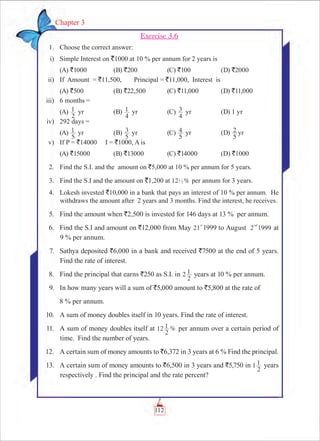
Generally,
Area of the pathway = (Area of outer rectangle) – (Area of inner rectangle)
i.e. Area of the pathway = (l + 2w) (b + 2w) – lb.
Example 4.43
The area of outer rectangle is 360 m2. The area of inner rectangle is 280 m2. The
two rectangles have uniform pathway between them. What is the area of the pathway?
Solution
Area of the pathway = (Area of outer rectangle) – (Area of inner rectangle)
= (360 – 280) m2
= 80 m2
` Area of the pathway = 80 m2
Example 4.44
The length of a building is 20 m and its breadth is 10 m. A path of width 1 m is
made all around the building outside. Find the area of the path.
Solution
Inner rectangle (given) Outer rectangle
l = 20 m
b = 10 m
Area = l × b
Area = 20 m × 10 m
= 200 m2
width, w = 1 m
L = l + 2w
= 20 + 2 = 22 m
B = b + 2w
= 10 + 2 = 12 m
Area = (l + 2w) (b + 2w)
Area = 22 m # 12 m
= 264 m2
Area of the path = (Area of outer rectangle) – (Area of inner rectangle)
= ( 264 – 200 ) m2 = 64 m2
` Area of the path = 64 m2
155
Measurements
Example 4.45
A school auditorium is 45 m long and
27 m wide. This auditorium is surrounded by a
varandha of width 3 m on its outside. Find the area
of the varandha. Also, find the cost of laying the
tiles in the varandha at the rate of `100 per sq. m.
Solution
Inner (given) rectangle Outer rectangle
l	 = 45 m
b	 = 27 m
Area	= 45m # 27 m
	 = 1215 m2
Width, w	 = 3 m
	 L	 = l w2+
	 	 = 45 + 6 = 51 m
	 B	 = b w2+
		 = 27 + 6 = 33 m
	 Area	 = 51m # 33 m
		 = 1683 m2
(i)	 Area of the verandha	 =	 (Area of outer rectangle) – (Area of inner rectangle)
		 =	 (1683 – 1215) m2
		 =	 468 m2
	 ` Area of the verandha	 =	 468 m2 (or) 468 sq. m.
(ii)	 Cost of laying tiles for 1 sq. m	 =	`100
	 Cost of laying tiles for 468 sq. m	 =	`100 # 468
		 =	`46,800
	 `Cost of laying tiles in the verandha	 =	`46,800
(b) Area of uniform pathway inside a rectangle
A swimming pool is built in the middle
of a rectangular ground leaving an uniform
width all around it to maintain the lawn.
If the pathway outside the pool is to be
grassed, how can you find its cost ?
If the area of the pathway and cost of
grassing per sq. unit is known, then the cost
of grassing the pathway can be found.
Fig. 4.54
Fig. 4.55
156
Chapter 4
Here, the rectangular ground is the outer rectangle where l and b are length and
breadth.
` Area of the ground (outer rectangle) = l b sq. units
If w be the width of the pathway (lawn), what will be the length and breath of
the swimming pool ?
The length of the swimming pool = l w w- -
= l w2-
The breadth of the swimming pool = b w w- -
= b w2-
` Area of the swimming pool (inner rectangle) = l w b w2 2- -^ ^h h Sq. units
Area of the lawn = Area of the ground – Area of the swimming pool.
Generally,
Area of the pathway = (Area of outer rectangle) – (Area of inner rectangle)
= lb – (l – 2w) (b – 2w)
Example 4.46
The length and breadth of a room are 8 m and
5 m respectively. A red colour border of uniform
width of 0.5 m has been painted all around on its
inside. Find the area of the border.
Solution
Outer (given)rectangle Inner rectangle
l = 8 m
b = 5 m
Area= 8m # 5 m
= 40 m2
width, w = 0.5 m
L = l w2-
= (8 – 1) m = 7 m
B = b w2-
= (5 – 1) m = 4 m
Area = 7m × 4 m
= 28 m2
Area of the path = (Area of outer rectangle) – (Area of inner rectangle)
= (40 – 28) m2
= 12 m2
` Area of the border painted with red colour = 12 m2
Fig. 4.56
157
Measurements
Example 4.47
A carpet measures 3 m # 2 m. A strip of 0.25 m wide is cut off from it on all
sides. Find the area of the remaining carpet and also find the area of strip cut out.
Solution
Outer rectangle
carpet before cutting the strip
Inner rectangle
carpet after cutting the strip
l	 = 3 m
b	 = 2 m
Area 	 = 3m # 2m
	 = 6 m2
width, w	 = 0.25 m
L	 = l w2- = (3 – 0.5) m
		 = 2.5 m
	 B	 = b w2- = (2 – 0.5) m
		 = 1.5 m
Area	 = 2.5m # 1.5m
		 = 3.75 m2
The area of the carpet after cutting the strip = 3.75 m2
	 Area of the strip cut out	 =	 (Area of the carpet) – 		
             (Area of the remaining part)
		 =	 (6 – 3.75) m2
		 =	 2.25 m2
	` Area of the strip cut out = 2.25 m2
Note: If the length and breadth of the inner rectangle
is given, then the length and breadth of the outer rectangle
is 2l w+ , 2b w+ respectively where w is the width of the
path way.
Suppose the length and breadth of the outer rectangle
is given, then the length and breadth of the inner rectangle
is 2l w- , 2b w- respectively.
Exercise 4.9
	 1.	 A play ground 60 m # 40 m is extended on all sides by 3 m. What is the
extended area.
	 2.	 A school play ground is rectangular in shape with length 80 m and breadth 60
m. A cemented pathway running all around it on its outside of width 2 m is
built. Find the cost of cementing if the rate of cementing 1 sq. m is `20.
	 3.	 A garden is in the form of a rectangle of dimension 30 m # 20 m. A path of
width 1.5 m is laid all around the garden on the outside at the rate of `10 per
sq. m. What is the total expense.
Fig. 4.57
158
Chapter 4
4. A picture is painted on a card board 50 cm long and 30 cm wide such that there is
a margin of 2.5 cm along each of its sides. Find the total area of the margin.
5. A rectangular hall has 10 m long and 7 m broad. A carpet is spread in the centre
leaving a margin of 1 m near the walls. Find the area of the carpet. Also find the
area of the un covered floor.
6. The outer length and breadth of a photo frame is 80 cm , 50 cm. If the width of
the frame is 3 cm all around the photo. What is the area of the picture that will be
visible?
Circular pathway
Concentric circles
Circles drawn in a plane with a common centre and different
radii are called concentric circles.
Circular pathway
A track of uniform width is laid around a circular park for
walking purpose.
Can you find the area of this track ?
Yes. Area of the track is the area bounded between two
concentric circles. In Fig. 4.59, O is the common centre of the two
circles.Let the radius of the outer circle be R and inner circle be r.
The shaded portion is known as the circular ring or the
circular pathway. i.e. a circular pathway is the portion bounded
between two concentric circles.
width of the pathway, w = R – r units
i.e., w = R – r R = w r+ units
r = R – w units.
The area of the circular path = (area of the outer circle) – (area of the inner circle)
= rR2 2
r r-
= R r2 2
r -^ h sq. units
` The area of the circular path = R r2 2
r -^ h sq. units
= R r R rr + -^ ^h h sq. units
Example 4.48
The adjoining figure shows two concentric circles. The radius
of the larger circle is 14 cm and the smaller circle is 7 cm. Find
(i) The area of the larger circle.
(ii) The area of the smaller circle.
(iii) The area of the shaded region between two circles.
Fig. 4.58
Fig. 4.59
Fig. 4.60
159
Measurements
Solution
i) Larger circle	 ii) Smaller circle
	 R	 =	 14	 r	 =	 7
	 area	 =	 R2
r 	 area	 =	 r2
r
		 =	
7
22 14 14# # 		 =	
7
22 7 7# #
		 =	 22 # 28		 =	 22 # 7
		 =	 616 cm2	 	 =	 154 cm2
iii) The area of the shaded region
		 =	 (Area of larger circle) – (Area of smaller circle)
		 =	 (616 – 154) cm2
		 =	 462 cm2
Example 4.49
From a circular sheet of radius 5 cm, a concentric circle of radius 3 cm is
removed. Find the area of the remaining sheet ? (Take .3 14r = )
Solution
Given: R = 5 cm, r = 3 cm
	 Area of the remaining sheet	 =	 R r2 2
r -^ h
		 =	 3.14 (52 – 32)
		 =	 3.14 (25 – 9)
		 =	 3.14 × 16
		 =	 50.24 cm2
Aliter:
Outer circle Inner circle
R	 = 5 cm
Area	 = R2
r sq. units
	 = .3 14 5 5# #
	 = 3.14 # 25
	 = 78.5 cm2
r	 = 3 cm
Area	= r2
r sq. units
	 = .3 14 3 3# #
	 = 3.14 # 9
	 = 28.26 cm2
	 Area of the remaining sheet	 =	(Area of outer circle) – (Area of inner circle)
		 =	(78.5 – 28.26) cm2
		 =	50.24 cm2
	` Area of the remaining sheet	=	50.24 cm2
160
Chapter 4
Example 4.50
A circular flower garden has an area 500 m2. A sprinkler at the centre of the
garden can cover an area that has a radius of 12 m. will the sprinkler water the entire
garden (Take r = 3.14)
Solution
Given, area of the garden = 500 m2
Area covered by a sprinkler = r2
r
= .3 14 12 12# #
= 3.14 # 144
= 452 .16 m2
Since, the area covered by a sprinkler is less than the area of the circular flower
garden, the sprinkler cannot water the entire garden.
Example 4.51
A uniform circular path of width 2 m is laid out side a circular park of radius
50 m. Find the cost of levelling the path at the rate of `5 per m2 (Take r = 3.14)
Solution
Given: r = 50 m, w = 2 m, R = r w+ = 50 + 2 = 52 m
Area of the circular path = R r R rr + -^ ^h h
= .3 14 52 50 52 50# + -^ ^h h
= .3 14 102 2# #
= 3.14 204#
= 640.56 m2
The cost of levelling the path of area 1 sq m = `5
The cost of levelling the path of 640.56 m2 = `5 # 640.56
= `3202.80
` the cost of levelling the path = `3202.80
Fig. 4.60
Fig. 4.61
161
Measurements
Exercise 4.10
	 1.	 A circus tent has a base radius of 50 m. The ring at the centre for the
performance by an artists is 20 m in radius. Find the area left for the audience.	
(Take r = 3.14)
	 2.	 A circular field of radius 30 m has a circular path of width 3 m inside its
boundary. Find the area of the path (Take r = 3.14)
	 3.	 A ring shape metal plate has an internal radius of 7 cm and an external radius of
10.5 cm. If the cost of material is `5 per sq. cm, find the cost of 25 rings.
	 4.	 A circular well has radius 3 m. If a platform of uniform width of 1.5 m is laid
around it, find the area of the platform . (Take r = 3.14)
	 5.	 A uniform circular path of width 2.5 m is laid outside a circular park of radius
56m. Find the cost of levelling the path at the rate of `5 per m2 (Take r = 3.14)
Figure Area Forumula
2
1 × base × height
2
1 × b × h sq. units.
2
1 × diagonal × (sum
of the perpendicular
distances drawn to
the diagonal from the
opposite vertices)
2
1 × d × (h1 + h2) sq.
units
base × corresponding
altitude
bh sq. units
162
Chapter 4
2
1 × product of diagonals
2
1 × d1 × d2 sq. units
2
1 × height × sum of
parallel sides
2
1 × h × (a + b) sq.
units
Perimeter of the circle =
2 × r × radius
2rr units
Area of the circle =
r × radius × radius
rr2 sq. units
Area of the pathway
i) area of the rectangular
pathway
Area of outer
rectangle – Area of
inner rectangle
ii) area of the circular
pathway
Area of outer circle –
Area of inner circle
= r (R2 – r2) sq. units
= r (R + r) (R – r)
sq. units
Rhombus
Trapezium
Circular Pathway
GEOMETRY
Geometry is a branch of Mathematics that deals with the properties of various
geometrical shapes and figures. In Greek the word “Geometry” means “Earth
Measurement”. Geometry deals with the shape, size, position and other geometrical
properties of various objects. Geometry is useful in studying space, architecture,
design and engineering.
5.1. Revision
Basic Geometrical concepts:
In earlier classes you have studied about some geometrical concepts. Let us
recall them.
Point
A fine dot made with a sharp pencil may be
taken as roughly representing a point. A point has a
position but it has no length, breadth or thickness. It
is denoted by a capital letters. In the figure A, B, C, D
are points.
Line
A line is traced out by a moving point.
If the point of a pencil is moved over a sheet
of paper, the trace left represents a line. A line
has length, but it has no breadth. A line has no
end points. A line AB is written as AB. A line
may be named with small letters l, m, n, etc. we read them as line l, line m, line n etc.
A line has no end points as it goes on endlessly in both directions.
Ray
A ray has a starting point but has no end point. The starting
point is called the initial point.
Here OA is called the ray and it is written as OA. That is
the ray starts from O and passes through A.
Fig. 5.1
Fig. 5.2
Fig. 5.3
163
Chapter 5
Line Segment
Let AB be a straight line.
Two points C and D are taken on it. CD is a part
of AB. CD is called a line segment, and is written as CD.
A line segment has two end points.
Plane
A plane is a flat surface which extends indefinitely in all directions. The upper
surface of a table, the blackboard, the walls are some examples of planes.
5.2. Symmetry
Symmetry is an important geometrical concept commonly seen in nature and is
used in every field of our life. Artists, manufacturers, designers, architects and others
make use of the idea of symmetry. The beehives, flowers, tree leaves, hand kerchief,
utensils have symmetrical design.
Fig. 5.5
Symmetry refers to the exact match in shape and
size between two halves of an object. If we fold a picture
in half and both the halves-left half and right half - match
exactly then we say that the picture is symmetrical.
For example, if we cut an apple into two equal
halves, we observe that two parts are in symmetry.
Fig. 5.6
Fig. 5.4
Tajmahal in Agra is a
symmetrical monument.
164
Geometry
A butterfly is also an example of a symmetrical form. If a line is drawn down
the centre of the butterfly’s body, each half of the butterfly looks the same.
Fig. 5.7
Symmetry is of different types. Here we discuss about
	 1.	 Line of symmetry or axis of symmetry
	 2.	 Mirror symmetry
	 3.	 Rotational symmetry
1. Line of symmetry
In the Fig 5.8 the dotted lines divide the figure into two identical parts. If figure
is folded along the line, one half of the figure will coincide exactly with the other half.
This dotted line is known as line of symmetry.
When a line divides a given figure into two
equal halves such that the left and right halves matches
exactly then we say that the figure is symmetrical
about the line. This line is called the line of symmetry
or axis of symmetry.
Activity 1:
Take a rectangular sheet of
paper. Fold it once lengthwise, so
that one half fits exactly over the
other half and crease the edges.
Now open it, and again fold it once
along its width.
Fig. 5.9
Fig. 5.8
165
Chapter 5
In this paper folding,
You observe that a rectangle has two lines of symmetry.
Discuss: Does a parallelogram have a line of symmetry?
Activity 2:
One of the two set squares in your geometry box has angle of
measure , , .30 60 90
0 0 0
Take two such identical set squares. Place them
side by side to form a ‘kite’ as shown in the Fig. 5.10.
How many lines of symmetry does the shape have?
You observe that this kite shape figure has one line of symmetry
about its vertical diagonal.
Activity 3:
For the given regular polygons find the lines of symmetry by using paper folding
method and also draw the lines of symmetry by dotted lines.
Fig. 5.11
In the above paper folding, you observe that
	 (i)	 An equilateral triangle has three lines of
symmetry.
	(ii)	 A square has four lines of symmetry
	(iii)	 A regular pentagon has five lines of
symmetry.
	(iv)	 A regular hexagon has six lines of symmetry.
Each regular polygon has as many lines of symmetry as it has sides.
Fig. 5.10
A polygon is said to be
regular if all its sides are
of equal length and all
its angles are of equal
measure.
166
Geometry
Some objects and figures have no line of symmetry.
Fig. 5.12
The above figures have no line of symmetry; because these figures are not
symmetrical. We can say that these figures are asymmetrical.
Mirror line symmetry
When we look into a mirror we see our image is behind the
mirror. This image is due to reflection in the mirror. We know that
the image is formed as far behind the mirror as the object is in front
of it.
In the above figure if a mirror is placed along the line at the
middle, the half part of the figure reflects through the mirror creating the remaining
identical half. In other words, the line were the mirror is placed divides the figure into
two identical parts in Fig. 5.13. They are of the same size and one side of the line will
have its reflection exactly at the same distance on the other side. Thus it is also known
as mirror line symmetry.
While dealing with mirror reflection, we notice that the left-right changes as
seen in the figure.
Example 5.1
The figure shows the reflection of the
mirror lines.
A circle has many lines of
symmetry.
Identify the regular polygon
Fig. 5.13
Make a list of English
alphabets which have
no line of symmetry
To reflect an object means to produce its mirror image.
167
Chapter 5
Exercise 5.1
	 1.	 Choose the correct answer.
	 i)	 An isosceles triangle has
	 (A) no lines of symmetry	 (B) one line of symmetry
	 (C) three lines of symmetry 	 (D) many lines of symmetry
	 ii)	 A parallelogram has
	 (A) two lines of symmetry	 (B) four lines of symmetry
	 (C) no lines of symmetry 	 (D) many lines of symmetry
	 iii)	 A rectangle has
	 (A) two lines of symmetry 	 (B) no lines of symmetry
	 (C) four lines of symmetry 	 (D) many lines of symmetry
	 iv)	 A rhombus has
	 (A) no lines os symmetry	 (B) four lines of symmetry
	 (C) two lines of symmetry 	 (D) six lines of symmetry
	 v)	 A scalene triangle has
	 (A) no lines of symmetry 	 (B) three lines of symmetry
	 (C) one line of symmetry	 (D) many lines of symmetry
	 2.	 Which of the following have lines of symmetry?
		 How many lines of symmetry does each have?
	 3.	 In the following figures, the mirror line (i.e. the line of symmetry) is given as
dotted line. Complete each figure performing reflection in the dotted (mirror) line.
168
169
Geometry
	 4.	 Complete the following table:
Shape Rough figure Number of lines of symmetry
Equilateral triangle
Square
Rectangle
Isosceles triangle
Rhombus
	 5.	 Name a triangle which has
	 (i) exactly one line of symmetry.
	 (ii) exactly three lines of symmetry.
	 (iii) no lines of symmetry.
	 6.	 Make a list of the capital letters of English alphabets which
	 (i) have only one line of symmetry about a vertical line.
	 (ii) have only one line of symmetry about a horizontal line.
	 (iii) have two lines of symmetry about both horizontal and vertical line
	 of symmetry.
5.3 Rotational Symmetry
Look at the following figures showing the shapes that we get, when we rotate
about its centre ‘O’ by an angle of 90 180or
0 0
Fig. 5.14
Fig. 5.15
Chapter 5
Fig. 5.16
In the case of a square, we get exactly the same shape after it is rotated by 90
0
while in the case of a rectangle, we get exactly the same shape after it is rotated by
180° such figures which can be rotated through an angle less than 360° to get the same
shape are said to have rotational symmetry.
Angle of Rotation
The minimum angle through which the figure has to be rotated to get the original
figure is called the angle of rotation and the point about which the figure is rotation is
known as centre of rotation.
Activity 4:
Take two card board sheets and cut off
one equilateral triangle in each sheet such that
both the triangles are identical. Prepare a circle
on a card board and mark the degrees from 0 to
360 degree in the anticlockwise direction. Now
palce one triangle exactly over the other and put
a pin through the centres of the figures. Rotate
the top figure until it matches with the lower
figure.
You observe that the triangle has been
rotated through an angle 120°.
Again rotate the top figure until it matches with the lower figure for the second
time. Now you observe that the top of figure has been rotated through an angle 240°
from the original position.
Rotate the top figure for the third time to match with the lower figure. Now the
top triangle has reached its original position after a complete rotation of 360° From
the above activity you observe that an equilateral triangle has angle of rotation 120°.
170
171
Geometry
Fig. 5.17
Angle of rotation of a hexagon
Fig. 5.18
In the above Fig. 5.15 to 5.18.
We get exactly the same shape of square, rectangle, equilateral triangle and
hexagon after it is rotated by , , ,90 180 120 60
0 0 0 0
respectively.
Thus the angle of rotation of
	 (i)	 a square is 90
0
	 (ii)	 a rectangle is 180
0
	 (iii)	 an equilateral triangle is 120
0
	 (iv)	 a hexagon is 60
0
Order of rotational symmetry
The order of rotational symmetry is the number that tell us how many times a
figure looks exactly the same while it takes one complete rotation about the centre.
Thus if the angle of rotation of an object is x
0
It’s order of rotational symmetry symmetry
x
360
0=
In Fig. 5.15 to 5.18.
Chapter 5
The order of rotational symmetry of
	 (i)	 a square is	
90
360 40
0
=
	 (ii)	 a rectangle is	
180
360 20
0
=
	 (iii)	 an equilateral triangle is	
120
360 3
0
=
	 (iv)	 a hexagon is	 .
60
360 60
0
=
Example 5.2
The objects having no line of symmetry can have
rotational symmetry.
Have you ever made a paper wind mill? The paper wind
mill in the picture looks symmetrical. But you do not find any
line of symmetry. No folding can help you to have coincident
halves. However if you rotate it by 90° about the the centre,
the windmill will look exactly the same. We say the wind mill
has a rotational symmetry.
In a full turn, there are four positions (on rotation through the angles
90 ,180 270 360and
0 0 0 0
) in which the wind mill looks exactly the same. Because of
this, we say it has a rotational symmetry of order 4.
AcActivity 5:tivity: 5
As shown in figure cut out a card board or paper triangle. Place
it on a board and fix it with a drawing pin at one of its vertices. Now
rotate the triangle about this vertex, by 90
0
at a time till it comes to
its original position.
172
173
Geometry
The triangle comes back to its original position at position (v) after rotating
through 360
0
Thus the angle of rotation of this triangle is 360
0
and the order of
rotational symmetry of this triangle is
360
360 10
0
= .
Exercise 5.2
	 1.	 Choose the correct answer:
	 i)	 The angle of rotation of an equilateral triangle is
(A)	 60
0
	 (B) 90
0
	 (C) 120
0
	 (D) 180
0
	 ii)	 The order of rotational symmetry of square is
(A)	 2	 (B) 4		 (C) 6		 (D) 1.
	 iii)	 The angle of rotation of an object is 72
0
then its order of rotational symmetry is
(A)	 1	 (B) 3		 (C) 4		 (D) 5
	 iv) 	 The angle of rotation of the letter ‘S’ is
(A)	 90
0
	 (B) 180
0
	 (C) 270
0
	 (D) 360
0
	 v)	 the order of rotational symmetry of the letter ‘V’ is one then its angle of rotation
is
(A)	 60
0
	 (B) 90
0
	 (C) 180
0
	 (D) 360
0
You observe that, for every 90
0
you have the following figures (ii to v).
(i)
(iv) (v)
(ii) (iii)
Chapter 5
	 2.	 The following figures make a rotation to come to the new position about a given
centre of rotation. Examine the angle through which the figure is rotated.
	 3.	 Find the angle of rotation and the order of rotational symmetry for the
following figures given that the centre of rotation is ‘0’.
	 4.	 A circular wheel has eight spokes.
		 What is the angle of rotation and the order of rotation?
5.3 Angle
Two rays starting from a common point form an angle.
In +AOB, O is the vertex, OA and OB are the two arms.
Types of angles
	 (i) Acute angle:
An angle whose measure is greater than 0° but less than
90
0
is called an acute angle.
Example: , , ,15 30 60 75
0 0 0 0
, In Fig. 5.20 +AOB = 30
0
is an acute angle.
Fig. 5.19
Fig. 5.20
(i) (ii) (iii) (iv)
(i) (ii) (iii) (iv)
174
Geometry
	 (ii) Right angle
An angle whose measure is 90
0
is called a right angle.
In Fig. 5.21 +AOB = 90
0
is a right angle.
	 (iii) Obtuse angle
An angle whose measure is greater than 90
0
and less
than 180
0
is called an obtuse angle.
Example: , , ,100 110 120 140
0 0 0 0
In Fig. 5.22 + AOB = 110
0
is an obtuse angle.
	 (iv) Straight angle
When the arms of an angle, are opposite rays forming
a straight line. The angle thus formed is a straight angle and
whose measure is 180
0
In Fig. (5.23) + AOB = 180
0
is a straight
angle.
	 (v) Reflex angle
An angle whose measure is more than 180
0
but less
than 360
0
is called a reflex angle. In Fig. 5.24 +AOB = 220°
is a reflex angle.
	 (vi) Complete angle
In Fig. 5.25
The angle formed by OP and OQ is one complete
circle, that is 360
0
.Such an angle is called a complete angle
Related Angles
	 (i) Complementary angles
If the sum of the measures of two angle is 90
0
, then the
two angles are called complementary angles. Here each angle
is the complement of the other.
The complement of 30
0
is 60
0
and the complement of
is60 30
0 0
Fig. 5.21
Fig. 5.22
Fig. 5.23
Fig. 5.24
Fig. 5.25
Fig. 5.26
175
Chapter 5
Intersecting lines
Fig. 5.28
Look at the Fig. 5.28. Two lines l1
and l2
are shown. Both the lines pass through
a point P. We say l land1 2
intersect at P. If two lines have one common point, they are
called intersecting lines. The common point ‘P’ is their point of intersection.
Fig. 5.27
	 (ii) Supplementary angles
If the sum of the measures of two angle is
180
0
,thenthetwoanglesarecalledsupplementary
angles. Here each angle is the supplement of the
other.
The supplement of 120 60is
0 0
and 60° is the supplement of 120
0
Identify the following pairs
ofanglesarecomplementary
or supplementary
(a) 80 10 _____and
0 0
(b) 70 110 _____and
0 0
(c) 40 50 ______and
0 0
(d) 95 85 _______and
0 0
(e) 65 115 ______and
0 0
Fill in the blanks.
(a) Complement of ____is85
0
(b) Complement of 30° is ___
(c) Supplement of 60
0
is ____
(d) Supplement of _____is90
0
176
177
Geometry
Angles in intersecting lines
When two lines intersect at a point
angles are formed.
In Fig. 5.29 the two lines AB
and CD intersect at a point ‘O’, +COA,
+AOD, +DOB, +BOC are formed.
Among the four angles two angles are
acute and the other two angles are obtuse.
But in figure 5.30 if the two intersecting lines are perpendicular to each other then the
four angles are at right angles.
Adjacent angles
If two angles have the same vertex and a common arm,
then the angles are called adjacent angles.
In Fig. 5.31 +BAC and +CAD are adjacent angles (i.e .
+x and +y) as they have a common arm AC,a common vertex
A and both the angle +BAC and +CAD are on either side of
the common arm AC.
Fig. 5.29 Fig. 5.30
Fig. 5.31
(i) Adjacent angles on a line.
When a ray stands on a straight line two angles are
formed. They are called linear adjacent angles on the line.
+ ROP and +QOP
are not adjacent angle.
Why?
Look at the following figure
Open a book looks like the above
figure. Is the pair of angles are
adjacent angles?
Fig. 5.32
Chapter 5
In Fig. 5.32 the ray OC stands on the line AB. +BOC and +COA are the two
adjacent angles formed on the line AB. Here ‘O’ is called the common vertex, OC is
called the common arm. The arms OA and OB lie on the opposite sides of the common
arm OC.
Two angles are said to be linear adjacent angles on a line if they have a
common vertex, a common arm and the other two arms are on the opposite sides
of the common arm.
(ii) The sum of the adjacent angles on a line is 180°
	 Fig. 5.33	 Fig.5.34
In Fig. 5.33 +AOB = 180
0
is a straight angle.
In Fig. 5.34 The ray OC stands on the line AB. +AOC and +COB are adjacent
angles. Since + AOB is a straight angle whose measure is 180
0
+AOC + + COB = 180
0
From this we conclude that the sum of the adjacent angles on a line is 180
0
Note 1: A pair of adjacent angles whose non common arms are opposite rays.
Note 2: Two adjacent supplementary angles form a straight angle.
Are the angles marked 1 and 2 adjacent?
If they are not adjacent, Justify your answer.
178
179
Geometry
Discuss:
	 (i)	 Can two adjacent acute angles form a liner pair?
	 (ii)	 Can two adjacent obtuse angles form a linear pair?
	 (iii)	 Can two adjacent right angles form a linear pair?
	 (iv)	 Can an acute and obtuse adjacent angles form a linear pair?
(iii) Angle at a point
In Fig. 5.35, four angles are formed at the point ‘O’. The
sum of the four angles formed is 360
0
.
(i.e) +1 + +2 + +3 + +4 = 360
0
(iv) Vertically opposite angles
If two straight lines AB and CD intersect at a point
‘O’. Then +AOC and +BOD form one pair of vertically
opposite angles and + DOA and +COB form another pair
of vertically opposite angles.
	 A vegetable chopping board	 A pen stand
The chopping blade makes a linear pair of angles with the board.
The pen makes a linear pair of angles with the stand.
Fig. 5.36
The following are some real life
example for vertically
Opposite angles
Fig. 5.35
O
Chapter 5
Activity 6: Draw two lines ‘l’ and ‘m’, intersecting at a point ‘P’ mark +1,
+2, +3 and +4 as in the Fig. 5.37.
Take a trace copy of the figure on a transparent sheet. Place the copy on the
original such that + 1 matches with its copy, +2, matches with its copy.. etc...
Fix a pin at the point of intersection of two lines ‘l’ and ‘m’ at P. Rotate the copy
by 180
0
. Do the lines coincide again?
Fig. 5.37
You find that +1 and +3 have interchanged their positions and so have +2
and +4. (This has been done without disturbing the position of the lines).
Thus +1 = +3 and +2 = +4.
From this we conclude that when two lines intersect, the vertically opposite
angles are equal.
Now let us try to prove this using Geometrical idea.
Let the lines AB and CD intersect at ‘O’ making angles +1,
+2, +3 and +4.
Now +1 = 180
0
- +2  (i)
( Since sum of the adjacent angle on a line 180
0
)
	 +3 = 180
0
- +2  (ii)
( Since sum of the adjacent angle on a line 180
0
).
From (i) and (ii)
	 +1 = + 3 and similarly we prove that + 2 = + 4.
Example 5.3
In the given figure identify
	 (a) Two pairs of adjacent angles.
	 (b) Two pairs of vertically opposite angles.
Fig. 5.38
180
181
Geometry
Solution:
(a) Two pairs of adjacent angles are
	 (i) +EOA, +COE	 since	 OE is common to + EOA and +COE
	 (ii) +COA, +BOC since	OC is common to +COA and +BOC
(b) Two pairs of vertically opposite angles are 	 i) +BOC, +AOD
							 ii) +COA, +DOB.	
Example 5.4
Find the value of x in the given figure.
Solution:
+BCD + +DCA = 180
0
			 (Since +BCA = 180
0
is a straight angle)
	 45° + x	 =	 180°
	 x	 =	 180° – 45°
		 =	 135°
` The value of x is 135
0
.
Example 5.5
Find the value of x in the given figure.
Solution:
	 +AOD + +DOB	 =	 180
0
			 (Since +AOB = 180
0
is a straight angle)
	 x100 180
0 0
+ =
			 x 180 100
0 0
= -
			 = 80
0
	 ` The value of x is 80
0
.
Example 5.6
Find the value of x in the given figure.
Solution:
	 +POR + +ROQ = 180
0
			 ( Since +POQ = 180
0
is a straight angle)
Chapter 5
		 x x2 180
0
+ =
		 x3 180
0
=
		 x
3
180
0
=
		 60
0
=
	 ` The value of x is 60
0
Example 5.7
Find the value of x in the given figure.
Solution:
+BCD + +DCA = 180
0
			 (Since +BCA = 180
0
is a straights angle)
	 x x3 180
0
+ =
	 x4 180
0
=
	 x
4
180
0
=
	 = 45
0
	 ` The value of x is 45
0
Example 5.8
Find the value of x in the given figure.
Solution:
	 +BCD + +DCE + +ECA = 180
0
					 (Since +BCA = 180
0
is a straight angle)
		 x40 30 180
0 0 0
+ + =
			 x 70 180
0 0
+ =
				 x 180 70
0 0
= -
				 110
0
=
	 ` The value of x is 110
0
Example 5.9
Find the value of x in the given figure.
Solution:
	 +BCD + +DCE + +ECA = 180
0
	 (Since +BCA = 180
0
straight angle).
182
183
Geometry
	 x x x20 40 180
0 0 0
+ + + + =
		 x3 60 180
0 0
+ =
			 x3 180 60
0 0
= -
			 x3 120
0
=
		 x
3
120 40
0
= =
		 ` The value of x is 40
0
Example 5.10
Find the value of x in the given figure.
Solution:
	 +BOC + +COA + +AOD + +DOE + +EOB = 360
0
					 (Since angle at a point is 360
0
)
	 2 4 3 2 360x x x x x
0
+ + + + =
			 x12 360
0
=
			 x
12
360
0
=
			 30
0
=
	 ` The value of x is 30
0
Example 5.11
Find the value of x the given figure.
Solution:
	 +BOD + +DOE + +EOA = 180
0
	 (Since + AOB = 180
0
is straight angles)
	 		 x x x2 180
0
+ + =
				 x4 180
0
=
				 x
4
180
0
=
				 = 45
0
		 ` The value of x is 45
0
Chapter 5
Exercise: 5.3
	 1.	 Choose the correct answer:
	 i) 	 The number of points common to two intersecting line is
	 (A) one 	 (B) Two	 (C) three	 (D) four
	 ii)	 The sum of the adjacent angles on a line is
	 (A) 90
0
		 (B) 180
0
	 (C) 270
0
	 (D) 360
0
	 iii)	 In the figure +COA will be
	 (A) 80
0
		 (B) 90
0
	 (C) 100
0
		 (D) 95
0
	 iv)	 In the figure +BOC will be
	 (A) 80
0
		 (B) 90
0
	 (C) 100
0
		 (D) 120
0
	 v)	 In the figure CD is perpendicular to AB.
		 Then the value of +BCE will be
	 (A) 45
0
		 (B) 35
0
	 (C) 40
0
		 (D) 50
0
	 2.	 Name the adjacent angles in the following figures
	 3. 	 Identity the vertically opposite angles in the figure.
	 4. 	 Find +B if +A measures?
		 (i) 30
0
		 (ii) 80
0
		 (iii) 70°
		 (iv) 60°
		 (v) 45
0
	
184
185
Geometry
	 5.	 In figure AB and CD be the intersecting lines if
		 +DOB = 35
0
find the measure of the other angles.
	 6.	 Find the value of x in the following figures.
	 7.	 In the following figure two lines AB and CD intersect at
		 the point O. Find the value of x and y.
	 8.	 Two linear adjacent angles on a line are 4x x3 5and +^ h .
Find the value of x.
Parallel Lines
Look at the table.
The top of the table ABCD is a
flat surface. Are you able to see some
points and line segment on the top?
Yes.
The line segment AB and BC
intersects at B. which line segment
intersects at A, C and D? Do the line
segment AD and CD intersect? Do the line segment AD and BC intersect?
The line segment AB and CD will not meet however they are extended such
lines are called parallel lines. AD and BC form one such pair. AB and CD form another
pair.
If the two lines AB and CD are parallel. We write AB || CD.
Fig. 5.39
(i) (ii) (iii)
(iv) (v) (vi)
186
Chapter 5
Two straight lines are said to be parallel to each other
if they do not intersect at any point.
Inthegivenfigure,theperpendiculardistancebetween
the two parallel lines is the same everwhere.
Transversal
A straight line intersects two or more given lines
at distinct points is called a transversal to the given lines.
The given lines may or may not be parallel.
Names of angles formed by a transversal.
InFig.5.41(i),apairoflinesABandCD,arecutbyatransversalXY, intersecting
the two lines at points M and N respectively. The points M and N are called points of
intersection.
Fig. 5.41 (ii) when a transversal intersects two lines the eight angles marked 1
to 8 have their special names. Let us see what those angles are
1. Interior angles
All the angles which have the line segment MN as one arm in Fig. 5.41 (ii) are
known as interior angles as they lie between the two lines AB and CD. In Fig. 5.41
(ii), + 3, + 4, + 5, + 6 are interior angles.
Fig. 5.40
The following are the examples
of parallel lines
The opposite edges of ruler
The cross bars of
this window l3
is parallel to l3
The above figure give
an idea of a transversal.
You have seen a railway
line crossing several
lines.
Fig. 5.41
(i) (ii)
187
Geometry
2. Interior alternate angles
When a transversal intersects two lines four interior angles are formed. Of
the interior angles, the angles that are on opposite sides of the transversal and lie in
separate linear pairs are known as interior alternate angles. +3 and +5, +4 and +6
are interior alternate angles in Fig. 5.41 (ii).
3. Exterior angles
All the angles which do not have the line segment MN as one arm, are known
as exterior angles. +1, +2, +7, +8 are exterior angles in Fig. 5.41 (ii).
4. Exterior alternate angles
When a transversal intersects two lines four exterior angles are formed. Of
the exterior angles, the angles that are on opposite sides of the transversal and lie in
separate linear pairs are known as exterior alternate angles.
In Fig. 5.41 (ii), +1 and +7, +2 and +8 are exterior alternate angles.
5. Corresponding angles
The pair of angles on one side of the transversal, one of which is an exterior
angle while the other is an interior angle but together do not form a linear pair, are
known as corresponding angles.
The pairs of corresponding angles in Fig. 5.41 (ii) are +1 and + 5, + 2 and
+ 6, + 3 and + 7, + 4 and + 8.
Notice that although both + 6 and + 7 lie on the same side of the transversal
and + 6 is an interior angle while +7 is an exterior angle but + 6 and + 7 are not
corresponding angles as together they form a linear pair. Now we tabulate the angles.
a Interior angles + 3, + 4,+ 5,+ 6
b Exterior angles + 1,+ 2,+ 7,+ 8
c Pairs of corresponding angles
+ 1 and + 5; + 2 and + 6
+3 and +7; + 4 and +8
d Pairs of alternate interior angles +3 and +5 ; +4 and +6
e Pairs of alternate exterior angles +1 and +7 ; +2 and +8
f
Pairs of interior angles on the
same side of the transversal.
+3 and +6 ; +4 and +5
Chapter 5
Properties of parallel lines cut by a transversal
Activity 7:
Take a sheet of white paper. Draw (in thick colour) two parallel lines ‘l’ and ‘m’.
Draw a transversal ‘t’ to the lines ‘l’ and ‘m’ . Label +1 and +2 as shown in Fig 5.42.
Fig. 5.42
Place a trace paper over the figure drawn. Trace the lines ‘l’, ‘m’ and ‘t’. Slide
the trace paper along ‘t’ until ‘l’ coincides with ‘m’.
You find that +1 on the traced figure coincides with +2 of the original figure.
In fact, you can see all the following results by similar tracing and sliding activity.
(i) +1 = +2		 (ii) +3 = +4		 (iii) +5 = +6		 (iv) +7 = +8
From this you observe that.
When two parallel lines are cut by a transversal,
	 (a)	 each pair of corresponding angles are equal
	 (b)	 each pair of alternate angles are equal
	 (c)	 each pair of interior angles on the same side of the transversal are
supplementary (i.e 180
0
)
Name the following angles:
	 a)	 Any two interior
angles ____ and
_____
	 b)	 Any two exterior
angles ____ and
_____
	 c)	 A pair of interior angles
_____and _____
	 d)	 A pair of corresponding
_____and _____ angles.
In Fig. (i) p is a transversal
to the lines l and m. In
Fig. (ii) the line p is not a
transversal, although it cuts
two lines l and ‘m’ can you
say why?
188
189
Geometry
	 The F - shape stands for corresponding angles.
The Z - shape stands for alternate angles.
Draw parallel lines cut by a transversal. Verify the above
three statements by actually measuring the angles.
Lines l || m, t is a
transversal, +x = ?
Lines l || m, t is a
transversal, +z = ?
Lines l || m, t is a
transversal, +x = ?
Lines a || b, c is a
transversal, +y = ?
l1
, l2
be two lines and t is
a transversal.
Is +1 = +2?
190
Chapter 5
Example 5.12
In the figure, find CGH+ and BFE+ .
Solution
In the figure, AB || CD and EH is a transversal.
FGC+ = 60° (given)
y = +CGH = 180° – +FGC (Since CGH+ and FGC+
are adjacent angles on a line )
= 180° – 60°
= 120°
+EFA = 60° ( Since EFA+ and FGC+ are corresponding angles )
+EFA + +BFE = 180° (Since sum of the adjacent angles on a line is 180°)
60° + x = 180°
x = 180° – 60°
= 120°
` x = +BFE = 120°
y = +CGH = 120°
Checking for
Parallel Lines:
Look at the
letter z.
The horizontal segments
are parallel, because the
alternate angles are equal.
Fold a sheet of paper so as to get a pair of
parallel lines. Again fold the paper across such
that a transversal is obtained. Press the edges
of folded paper and open it. You will see a pair
of parallel lines with the transversal. Measure
the angles and verify the properties of parallel
lines when cut by a transversal.
191
Geometry
Example 5.13
In the given figure, find CGF+ and DGF+ .
Solution
In the figure AB || CD and EH is a transversal.
	 +GFB	 =	 70°	 (given)
	 +FGC	 =	 a = 70°	(Since alternate interior angles GFB+ and
				 CGF+ are equal)
	 +CGF + +DGF	 =	 180°	 (Since sum of the adjacent angle on a line is 180°)
	 a + b	 =	 180°
	 70 + b	 =	 180°
	 b	 =	 180° – 70°
		 =	 110°
	 +CGF	 =	 a = 70°
	 +DGF	 =	 b = 110°
Example 5.14
In the given figure, +BFE = 100°
and +CGF = 80°.
Find i) +EFA, ii) +DGF,
iii) +GFB, iv) +AFG, v) +HGD.
Solution
	 +BFE	 =	 100° and +CGF = 80° (given)
i)	 + EFA	 =	 +80°	 (Corresponding angles)
ii)	 +DGF	 =	 100°	 (Since corresponding angles are equal)
iii)	 +GFB	 =	 80°	 (Since alternate interior angles are equal)
iv)	 +AFG	 =	 100°	 (Since corresponding angles +CGH and
				 +AFG are equal)
v)	 +HGD	 =	 80°	 (Since corresponding angles are equal)
192
Chapter 5
Example 5.15
In the figure, AB || CD, +AFG = 120° Find
(i) +DGF
(ii) +GFB
(iii) +CGF
Solution
In the figure, AB || CD and EH is a transversal
(i) +AFG = 120° (Given)
+AFG = +DGF = 120° (Since alternate interior angles
` +DGF = 120° are equal)
(ii) +AFG + +GFB = 180° (Since sum of the adjacent angle
120° + +GFB = 180° on a line is 180°)
+GFB = 180° – 120°
= 60°
(iii) +AFG + +CGF = 180°
120° + +CGF = 180° (Since sum of the adjacent
angles on a line is 180°)
+CGF = 180° – 120°
= 60°
Example 5.16
Find the measure of x in the figure, given l || m.
Solution
In the figure, l || m
+3 = x (Since alternate interior angles are equal)
3x + x = 180° (Since sum of the adjacent angles on a line is 180°)
4x = 180°
x =
4
180
0
= 45°
193
Geometry
Exercise 5.4
	 1.	 Choose the correct answer
	 i)	 If a transversal intersect two lines, the number of angles formed are
	 (A) 4	 (B) 6	 (C) 8	 (D) 12
	 ii)	 If a transversal intersect any two lines the two lines
		 (A) are parallel 			 (B) are not parallel
		 (C) may or may not be parallel 	 (D) are perpendicular
	 iii)	 When two parallel lines are cut by a transversal, the sum of the interior angles on
the same side of the transversal is
	 (A) 90°	 (B) 180°	 (C) 270°	 (D) 360°
	 iv)	 In the given figure
		 +BQR and +QRC are a pair of
		 (A) vertically apposite angles
(B) exterior angles
(C) alternate interior angles
(D) corresponding angles
	 v)	 In the given figure +SRD = 110°
		 then the value of +BQP will be
	 (A) 110°	 (B) 100°
	 (C) 80°	 (D) 70°
	 2.	 In the given figure, state the property that is used in each of
the following statement.
		 (i) If l || m then +1=+5.
		 (ii) If +4 = +6 then l || m.
		 (iii) If +4 + +5 = 180° then l || m.
	 3.	 Name the required angles in the figure.
		 (i) The angle vertically opposite to +AMN
		 (ii) The angle alternate to +CNQ
		 (iii) The angle corresponding to + BMP
		 (iv) The angle corresponding to + BMN
	 4.	 In the given figure identify
		 (i) Pairs of corresponding angles
		 (ii) Pairs of alternate interior angles.
		 (iii) Pairs of interior angles on the same side of the transversal
		 (iv) Vertically opposite angles.
194
Chapter 5
6. Given l || m and 1+ = 70°, find the measure of
, , , , ,2 3 4 5 6 7+ + + + + + and 8+ .
7. In the given figures below, decide whether l || m? Give reasons.
8. Given l || m, find the measure of +1 and +2 in
the figure shown.
Triangle: Revision
A triangle is a closed plane figure made of three line
segments.
In Fig. 5.43 the line segments AB, BC and CA
form a closed figure. This is a triangle and is denoted by
DABC. This triangle may be named as DABC or DBCA or
DCAB.
The line segments forming a triangle are the three sides of the triangle. In
Fig.5.43 AB, BC and CA are the three sides of the triangle.
5. Given l || m, find the measure of x in the following figures
Fig. 5.43
195
Geometry
The point where any two of the three line segments of a triangle intersect is
called the vertex of the triangle. In Fig. 5.43 A,B and C are the three vertices of the
DABC.
When two line segments intersect, they form an angle at that point. In the
triangle in Fig. 5.43 AB and BC intersect at B and form an angle at that vertex. This
angle at B is read as angle B or +B or +ABC. Thus a triangle has three angles +A,
+B and +C.
In Fig. 5.43 DABC has
Sides	 :	 AB,BC,CA
Angles	 :	 +CAB, +ABC,+BCA
Vertices	 :	 A, B, C
The side opposite to the vertices A, B, C are BC, AC and AB respectively. The
angle opposite to the side BC, CA and AB is +A, +B and +C respectively.
A triangle is a closed figure made of three line segments. It has three vertices,
three sides and three angles.
Types of Triangles
Based on sides
A triangle is said to be
Equilateral, when all its sides are equal.
Isosceles, when two of its sides are equal.
Scalene, when its sides are all unequal.
Based on angles
A triangle is said to be
Right angled, when one of its angle is a right angle and the other two angles are
acute.
Obtuse - angled, when one of its angle is obtuse and the other two angles are
acute.
Acute - angled, when all the three of its angles are acute.
The sum of the lengths of any two sides of a triangle is always greater than the
length of the third side.
196
Chapter 5
Angle sum property of a triangle:
Activity 8
Draw any triangle ABC on a sheet of paper and
mark the angles 1, 2 and 3 on both sides of the paper
as shown in Fig. 5.44 (i).
Fig. 5.44
Cut the triangle ABC. Fold the vertex A to touch the side BC as shown in the
Fig. 5.44 (ii) Fold the vertices B and C to get a rectangle as shown in the Fig. 5.44 (iii)
Now you see that +1, +2 and +3 make a straight line.
From this you observe that
+1 + +2 + +3 = 180°
+A + +B + + C = 180°
The sum of the three angles of a triangle is 180°
Activity 9
Draw a triangle. Cut on the three angles.
Re arrange them as shown in Fig. 5.45 (ii). You
observe that the three angles now constitute
one angle. This angle is a straight angle and so
has measure 180°
The sum of the three angles of a triangle is 180°
Think it.
1. Can you have a triangle with the three angles less than 60°?
2. Can you have a triangle with two right angles?
Is it possible to form a
triangle whose sides are
7cm, 5cm and 13cm?
Fig. 5.45
197
Geometry
Exterior angle of a triangle and its property
Activity 10
Fig. 5.46
Draw a triangle ABC and produce one of its sides, say BC as shown in
Fig. 5.46 (i) observe the angles ACD formed at the point C. This angle lies in the
exterior of TABC formed at vertex C.
+BCA is an adjacent angle to +ACD. The remaining two angles of the triangle
namely +A nd + B are called the two interior opposite angles.
Now cut out (or make trace copies of) +A and +B and place them adjacent to
each other as shown in Fig. 5.46 (ii)
You observe that these two pieces together entirely cover + ACD.
From this we conclude that the exterior angle of a triangle is equal to the sum of
the two interior opposite angles.
The relation between an exterior angle and its two interior angles is referred to
as the exterior angle property of a triangle.
Draw a triangle ABC and produce one of its sides BC as shown in
Fig. 5.46 (i) +ACD formed at the point C. Now take a protractor
and measure + ACD, +A and +B.
Find the sum + A + + B. and compare it with the measure of
+ACD. Do you observe that +ACD = +A + B?
Example 5.17
In the given figure find the value of x.
Solution
	+CAB + +ABC ++ BCA	 =	180° 	
	 40° + x + x	 =	180°	
	 40° + 2x	 =	180°
	 2x	 =	180° – 40°
	 2x	 =	140°
	 x	 =	 °
2
140 = 70°
	 The value of x	 =	70°.
(Since sum of the three
angles of a triangle is 180°)
198
Chapter 5
Example 5.18
Two angles of a triangle are 40° and 60°. Find the third
angle.
Solution
+RPQ + +PQR ++QRP = 180° (Since sum of the three angles of a
x + 40° + 60° = 180° triangle is 180°)
x + 100° = 180°
x = 180° – 100°
= 80°
` The third angle x = 80°
Example 5.19
In the given figure, find the measure of +A.
Solution
+CAB + +ABC + +BCA = 180° (Since sum of the three angles of a
2x + 120° + x = 180° triangle is 180°)
3x + 120° = 180°
3x = 180° – 120°
3x = 60°
x = °
3
60
= 20°
` +A = 2x = 2 × 20° = 40°
Example 5.20
In the given figure. Find the value of x.
Solution
In the figure exterior angle = +ABD = 110°.
Sum of the two interior opposite angle = +BCA + + CAB
= x + 50°
x + 50° = 110° (Since the sum of the two interior opposite
x = 110° – 50° angle is equal to the exterior angle)
= 60°
` The value of x is 60°.
199
Geometry
Example 5.21
In the given figure find the values of x and y.
Solution
In the give figure,
	 Exterior angle	 =	 + DCA = 130°
	 50° + x	 =	 130°	 (Since sum of the two interior opposite
	 x	 =	 130° – 50°	angle is equal to the exterior angle)
		 =	 80°
In DABC,
	 +A + +B + +C	 =	 180° (Since sum of three angles of a triangle is 180°)
	 50° + x + y	 =	 180°
	 50° + 80° + y	 =	 180°
	 130° + y	 =	 180°
	 y	 =	 180° – 130°
		 =	 50°
` The values of x = 80° and y = 50°.
Aliter:
	+ACB + + DCA	 =	 180°	 (Since sum of the adjacent angles on a line is 180°)
	 y + 130°	 =	 180°
	 y	 =	 180° – 130°
		 =	 50°
In D ABC,
	+A + +B + + C	 =	 180°	 (Since sum of the three angles of a triangle is 180°)
	 50° + x + y	 =	 180°
	 50° + x + 50°	 =	 180°
	 100° + x	 =	 180°
	 x	 =	 180° – 100°
		 =	 80°
200
Chapter 5
Example 5.22
Three angles of a triangle are 3x + 5°, x + 20°, x + 25°. Find the measure of each
angle.
Solution
Sum of the three angles of a triangle = 180°
3x + 5° + x + 20° + x + 25° = 180°
5x + 50° = 180°
5x = 180° – 50°
5x = 130°
x = °
5
130
= 26°
3x + 5° = (3 × 26°) + 5° = 78° + 5° = 83°
x + 20° = 26° + 20° = 46°
x + 25° = 26° + 25° = 51°
` The three angles of a triangle are 83°, 46° and 51°.
Exercise 5.5
1. Choose the correct answer.
i) The sum of the three angles of a triangle is
(A) 90° (B) 180° (C) 270° (D) 360°
ii) In a triangle, all the three angles are equal, then the measure of each angle is
(A) 30
0
(B) 45
0
(C) 60
0
(D) 90
0
iii) Which of the following can be angles of a triangle?
(A) , ,50 30 105
0 0 0
(B) , ,36 44 90
0 0 0
(C) , ,70 30 80
0 0 0
(D) ,45 45 80
0 0 0
iv) Two angles of a triangle are 40° and 60°, then the third angle is
(A) 20
0
(B) 40
0
(C) 60
0
(D) 80
0
v) In TABC, BC is produced to D and +ABC = 50
0
,
+ACD = 105
0
, then + BAC will be equal to
(A) 75° (B) 15°
(C) 40° (D) 55°
201
Geometry
	 2.	 State which of the following are triangles.
		 (i) +A = 25
0
	 +B = 35
0
	 +C = 120
0
		 (ii) +P = 90
0
	 +Q = 30
0
	 + R = 50
0
		 (iii) +X = 40
0
	 +Y = 70
0
	 + Z = 80
0
	 3.	 Two angles of a triangle is given, find the third angle.
		 (i) ,75 45
0 0
	 (ii) ,80 30
0 0
	 (iii) ,40 90
0 0
	 (iv) ,45 85
0 0
	 4.	 Find the value of the unknown x in the following diagrams:
	 5.	 Find the values of the unknown x and y in the following diagrams:
	 6.	 Three angles of a triangle are x + 5°, x + 10° and x + 15° find x.
202
Chapter 5
	 1.	 Symmetry refers to the exact match in shape and size between two halves of
an object.
	 2.	 When a line divides a given figure into two equal halves such that the left and
right halves matches exactly then we say that the figure is symmetrical about
the line. This line is called the line of symmetry or axis of symmetry.
	 3.	 Each regular polygon has as many lines of symmetry as it has sides.
	 4.	 Some objects and figures have no lines of symmetry.
	 5.	 Figures which can be rotated through an angle less than 360° to get the same
shape are said to have rotational symmetry.
	 6.	 The order of rotational symmetry is the number that tell us how many times
a figure looks exactly the same while it takes one complete rotation about the
centre.
	 7.	 The objects having no line of symmetry can have rotational symmetry.
	 8.	 If two angles have the same vertex and a common arm, then the angles are
called adjacent angles.
	 9.	 The sum of the adjacent angles on a line is 180°.
	 10.	 When two lines interset, the vertically opposite angles are equal.
	 11.	 Angle at a point is 360°.
	 12.	 Two straight lines are said to be parallel to each other if they do not intersect
at any point.
	 13.	 A straight line intersects two or more lines at distinct points is called a
transversal to the given line.
	 14.	 When two parallel lines are cut by a transversal,
	 	 (a) each pair of corresponding angles are equal.
	 	 (b) each pair of alternate angles are equal.
		 (c) each pair of interior angles on the same side of the transversal are
supplementary.
	 15.	 The sum of the three angles of a triangle is 180°.
	 16.	 In a triangle an exterior angle is equal to the sum of the two interior opposite
angles.
203
Practical Geometry
6.1 Introduction
This chapter helps the students to understand and confirm the concepts they
have learnt already in theoretical geometry. This also helps them to acquire some
basic knowledge in geometry which they are going to prove in their later classes. No
doubt, all the students will do the constructions actively and learn the concepts easily.
In the previous class we have learnt to draw a line segment, the parallel lines,
the perpendicular lines and also how to construct an angle.
Here we are going to learn about the construction of perpendicular bisector of a
line segment, angle bisector, some angles using scale and compass and the construction
of triangles.
Review
To recall the concept of angles, parallel lines and perpendicular lines
from the given figure.
We shall identify the points, the line segments, the angles, the parallel
lines and the perpendicular lines from the figures given below in the table.
Figures
Points
identi-
fied
Lines
identi-
fied
Angles identified
Parallel
lines
Perpendic-
ular lines
1
A, B,
C and
D
AB,
BC,
CD,
AD,
and
BD
1 - +BAD (+A)
2 - +DCB (+C)
3 - +DBA
4 - +CBD
AB || DC
BC || AD
AB = AD
AB = BC
BC = CD
CD = AD
Chapter 6
No. Figures
Points
iden-
tified
Lines
iden-
tified
Angles
identified
Parallel
lines
Perpen-
dicular
lines
2
3
6.2 Perpendicular bisector of the given line segment
(i) Activity : Paper folding
•	 Draw a line segment AB on a sheet of paper.
•	 Fold the paper so that the end point B lies on A.
Make a crease XY on the paper.
•	 Unfold the paper. Mark the point O where the line
of crease XY intersects the line AB.
X
Y
X
Y
O
204
205
Practical Geometry
•	 By actual measurement we can see that OA = OB and the line of crease XY
is perpendicular to the line AB.
The line of crease XY is the perpendicular bisector of the line AB.
The perpendicular bisector of a line segment is a
perpendicular line drawn at its midpoint.
(ii) To construct a perpendicular bisector to a given line segment.
Step 1	 :	 Draw a line segment
AB of the given
measurement.
Step 2	 :	 With ‘A’ as centre draw
arcs of radius more than
half of AB, above and
below the line AB.
Step 3	 :	 With ‘B’ as centre and
with the same radius
draw two arcs. These
arcs cut the previous
arcs at P and Q.
Chapter 6
Step 4	 :	 Join PQ. Let PQ intersect
AB at ‘O’.
		 PQ is a perpendicular
bisector of AB.
Example 6.1
Draw a perpendicular bisector to the 	
	 line segment AB = 8 cm.
Solution
Step 1	 :	 Draw the line segment
AB = 8cm.
Step 2	 :	 With ‘A’ as centre draw
arcs of radius more than
half of AB above and
below the line AB.
Step 3	 :	 With ‘B’ as centre draw
the arcs of same radius to
cut the previous arcs at X
and Y.
The perpendicular bisector of a line
segment is the axis of symmetry for the
line segment.
Can there be more than one
perpendicular bisector for the
given line segment?
Mark any point on the perpendicular bisector PQ. Verify that it
is equidistant from both A and B.
206
207
Practical Geometry
6.3 Angle Bisector
(ii) Activity : Paper folding
•	 Take a sheet of paper and mark a point O on it.
With O as initial point draw two rays OA and
OB to make +AOB.
•	 Fold the sheet through ‘O’ such that the rays
OA and OB coincide with each other and make
a crease on the paper.
Step 4	 :	 Join XY to intersect the line AB at O.
		 XY is the perpendicular bisector of AB.
1.	 With PQ = 6.5 cm as diameter draw a circle.
2.	 Draw a line segment of length 12 cm. Using compass divide
it into four equal parts. Verify it by actual measurement.
3.	 Draw a perpendicular bisector to a given line segment
AC. Let the bisector intersect the line at ‘O’. Mark the
points B and D on the bisector at equal distances from O.
Join the points A, B, C and D in order. Verify whether all
lines joined are of equal length.
Think!
In the above construction mark the points B and D on the
bisector, such that OA = OB = OC = OD. Join the points A, B,
C and D in order. Then
	 1. Do the lines joined are of equal length?
	 2. Do the angles at the vertices are right angles?
	 3. Can you identify the figure?
C
Chapter 6
•	 Let OC be the line of crease on the paper after
unfold. By actual measurement, +AOC and
+BOC are equal.
•	 So the line of crease OC divides the given angle
into two equal parts.
•	 This line of crease is the line of symmetry for +AOB.
•	 This line of symmetry for +AOB is called the angle bisector.
The angle bisector of a given angle is the line of symmetry
which divides the angle into two equal parts.
(ii) To construct an angle bisector of the given angle using scale and compass
Step 1	 :	 Construct an angle of given
		 measure at O.
Step 2	 :	 With ‘O ’ as centre draw an
arc of any radius to cut the
rays of the angle at A and B.
Step 3	 :	 With ‘A’ as centre draw an
arc of radius more than half
of AB, in the interior of the
given angle.
208
209
Practical Geometry
Step 4	 :	 With ‘B’ as centre draw an
arc of same radius to cut the
previous arc at ‘C’.
Step 5	 :	 Join OC.
		 OC is the angle bisector of the
given angle.
Example 6.2
Construct +AOB = 80° and draw its angle bisector.
Solution
Step 1	 :	 Construct +AOB = 80° angle at
the point ‘O’ using protractor.
Step 2	 :	 With ‘O’ as centre draw an arc
of any radius to cut the rays OA
and OB at the points X and Y
respectively.
Step 3	 :	 With ‘X’ as centre draw an arc
of radius more than half of XY
in the interior of the angle.
C
Mark any point on the angle bisector OC. Verify that
it is equidistant from the rays OA and OB.
Chapter 6
Step 4	 :	 With ‘Y’ as centre draw an arc of the same radius to cut the previous
arc at C. Join OC.
		 OC is the angle bisector of the given angle 80°.
Exercise 6.1
	 1.	 Draw the line segment AB = 7cm and construct its perpendicular bisector.
	 2.	 Draw a line segment XY = 8.5 cm and find its axis of symmetry.
	 3.	 Draw a perpendicular bisector of the line segment AB = 10 cm.
	 4.	 Draw an angle measuring 70° and construct its bisector.
	 5.	 Draw an angle measuring 110° and construct its bisector.
	 6.	 Construct a right angle and bisect it using scale and compass.
Draw an angle of measure 120° and divide
into four equal parts.
	 1.	 Draw a circle with centre ‘C’ and radius 4 cm. Draw any chord AB.
Construct perpendicular bisector to AB and examine whether it passes
through the centre of the circle.
	 2.	 Draw perpendicular bisectors to any two chords of equal length in a circle.
(i) Where do they meet? (ii) Verify whether the chords are at a same
distance from the centre.
	 3.	 Plot three points not on a straight line. Find a point equidistant from them.
Hint: Join all the points in order. You get a triangle. Draw perpendicular
bisectors to each side. They meet at a point which is equidistant from the
points you have plotted. This point is called circumcentre.
6.4 To construct angles 60°, 30°, 120°, 90° using scale and compass.
(i) Construction of 60° angle
Step 1	 :	 Draw a line ‘l’ and mark a
point ‘O’ on it.
210
211
Practical Geometry
Step 2	 :	 With ‘O’ as centre draw an
arc of any radius to cut the
line at A.
Step 3	 :	 With the same radius and
A as centre draw an arc to
cut the previous arc at B.
Step 4	 :	 Join OB.
		 +AOB = 60°.
(ii) Construction of 30° angle
First you construct 60° angle and then bisect it to get 30° angle.
Step 1	 :	 Construct 60° (as shown in
the above construction (i))
Step 2	 :	 With ‘A’ as centre, draw
an arc of radius more than
half of AB in the interior of
+AOB.
Draw a circle of any radius with centre
‘O’. Take any point ‘A’ on the circumference.
With ‘A’ as centre and OA as radius draw an
arc to cut the circle at ‘B’. Again with ‘B’ as
centre draw the arc of same radius to cut the
circle at ‘C’. Proceed so on. The final arc will
pass through the point ‘A’. Join all such points A,
B, C, D, E and F in order. ABCDEF is a regular
Hexagon.
From the above figure we came to know
	 (i)	 The circumference of the circle is divided into six equal arc length
subtending 60° each at the centre. In any circle a chord of length equal
to its radius subtends 60° angle at the centre.
	 (ii)	 Total angle measuring around a point is 360°.
	 (iii)	 It consists of six equilateral triangles.
Chapter 6
Step 3	 :	 With the same radius
and with B as centre
draw an arc to cut the
previous one at C.
Join OC.
		 +AOC is 30°.
(iii) Construction of 120° angle
Step 1	 :	 Mark a point ‘O’ on a
line ‘l’.
Step 2	 :	 With ‘O’ as centre draw
an arc of any radius to
cut the line l at A.
Step 3	 :	 With same radius and
with ‘A’ as centre draw
another arc to cut the
previous arc at ‘B’.
Step 4	 :	 With ‘B’ as centre draw
another arc of same
radius to cut the first arc
at ‘C’.
Step 5	 :	 Join OC.
		 +AOC is 120°.
How will you construct 15° angle.
212
213
Practical Geometry
(iv) Construction of 90° angle
To construct 90° angle, we are going to bisect the straight angle 180°.
Step 1	 : 	 Mark a point ‘O’ on a
straight line ‘l’.
Step 2	 : 	 With ‘O’ as centre draw
arcs of any radius to cut
the line l at A and B.
Now +AOB = 180°.
Step 3	 :	 With A and B as centres
and with the radius
more than half of AB
draw arcs above AB to
instersect each other at
‘C’.
Step 4	 :	 Join OC.
		 +AOC = 90°.
Exercise 6.2
	 1.	 Construct the angles of following measures with ruler and compass.
		 (i) 60°	 (ii) 30°		 (iii) 120°	 (iv) 90°
To construct a perpendicular
for a given line at any point
on it, you can adopt this
method for the set-square
method, as an alternate.
1.	Construct an angle of measure 60° and
find the angle bisector of its
complementary angle.
2.	Trisect the right angle.
3.	Construct the angles of following
measures: 22½°, 75°, 105°, 135°, 150°
Chapter 6
6.5 Construction of triangles
In the previous class, we have learnt the various types of triangles on the
basis of using their sides and angles. Now let us recall the different types of
triangles and some properties of triangle.
Classification of triangles
CLASSIFICATIONOFTRIANGLES
onthebasisSIDES
No. Name of Triangle Figure Note
1 Equilateral triangle Three sides are equal
2
Isosceles triangle
Any two sides are equal
3 Scalene triangle Sides are unequal
onthebasisANGLES
4 Acute angled triangle
All the three angles are
acute (less than 90°)
5 Obtuse angled triangle
Any one of the angles is
obtuse (more than 90°)
6 Right angled triangle
Any one of the angles is
right angle (90°)
Some properties of triangle
	 1.	 The sum of the lengths of any two sides of a triangle is greater
than the third side.
	 2.	 The sum of all the three angles of a triangle is 180°.
214
215
Practical Geometry
To construct a triangle we need three measurements in which at least the
length of one side must be given. Let us construct the following types of triangles
with the given measurements.
	 (i)	 Three sides (SSS).
	 (ii)	 Two sides and included angle between them (SAS).
	 (iii)	 Two angles and included side between them (ASA).
(i) To construct a triangle when three sides are given (SSS Criterion)
Example 6.3
Construct a triangle ABC given that AB = 4cm, BC = 6 cm and AC = 5 cm.
Solution
Given measurements
	 AB = 4cm
	 BC = 6 cm
	 AC = 5 cm.
Rough Diagram
Steps for construction
Step 1	 :	 Draw a line segment BC = 6cm
Step 2	 : 	 With ‘B’ as centre, draw an arc of radius 4 cm above the line BC.
Step 3	 :	 With ‘C’ as centre, draw an arc of 5 cm to intersect the previous arc at ‘A’
Step 4	 :	 Join AB and AC.
		 Now ABC is the required triangle.
Chapter 6
By using protector measure all the angles of a triangle. Find
the sum of all the three angles of a triangle.
	 1.	 A student attempted to draw a triangle with given
measurements PQ = 2cm, QR = 6cm, PR = 3 cm. (as
in the rough figure). First he drew QR = 6cm. Then he
drew an arc of 2cm with P as centre and he drew an arc
of radius 3 cm with R as centre. They could not intersect
each to get P.
				 (i) What is the reason?
				 (ii) What is the triangle property in connection with this?
The sum of any two sides of a triangle is always greater than the third side.
(ii)  To construct a triangle when Two sides and an angle included between
   them are given. (SAS Criterion)
Example 6.4
Construct a triangle PQR given that PQ = 4 cm, QR = 6.5 cm and +PQR = 60°.
Solution
Given measurements
	 PQ	 =	 4 cm
	 QR	 =	 6.5 cm
	 +PQR	 =	 60°
Draw the bisectors of the three angles of
a triangle. Check whether all of them pass
through a same point. This point is incentre.
216
217
Practical Geometry
Steps for construction
Step 1	 :	 Draw the line segment QR = 6.5 cm.
Step 2	 :	 At Q, draw a line QX making an angle of 600
with QR.
Step 3	 :	 With Q as centre, draw an arc of radius 4 cm to cut the line (QX)
at P.
Step 4	 :	 Join PR.
		 PQR is the required triangle.
Construct a triangle with the given measurements
XY = 6cm, YZ = 6cm and +XYZ = 70°. Measure the angles
of the triangle opposite to the equal sides. What do you
observe?
(iii) To construct a triangle when two of its angles and a side
     included between them are given. (ASA criterion)
Example 6.5
Construct a triangle XYZ given that XY = 6 cm, +ZXY = 30° and
+XYZ = 100°. Examine whether the third angle
measures 50°.
Solution
Given measurements
	 XY = 6 cm
	 +ZXY = 30°
	 +XYZ = 100°
Chapter 6
Step 1	 :	 Draw the line segment XY = 6cm.
Step 2	 :	 At X, draw a ray XP making an angle of 30° with XY.
Step 3	 :	 At Y, draw another ray YQ making an angle of 100° with XY. The
rays XP and YQ intersect at Z.
Step 4	 :	 The third angle measures 50° i.e +Z = 50°.
Exercise : 6.3
	 I.	 Construct the triangles for the following given measurements.
	 1.	 Construct 3PQR, given that PQ = 6cm, QR = 7cm, PR = 5cm.
	 2.	 Construct an equilateral triangle with the side 7cm. Using protector measure each
angle of the triangle. Are they equal?
	 3.	 Draw a triangle DEF such that DE = 4.5cm, EF = 5.5cm and DF = 4.5cm. Can
you indentify the type of the triangle? Write the name of it.
	 II.	 Construct the triangles for the following given measurements.
	 4.	 Construct 3XYZ, given that YZ = 7cm, ZX = 5cm, +Z = 50°.
	 5.	 Construct 3PQR when PQ = 6cm, PR = 9cm and +P = 100°.
	 6.	 Construct 3ABC given that AB = 6 cm, BC = 8 cm and +B = 90° measure
length of AC.
	 III.	 Construct the triangles for the following given measurements.
	 7.	 Construct 3XYZ, when X = 50°, Y = 70° and XY = 5cm.
	 8.	 Construct 3ABC when A = 120°, B = 30° and AB = 7cm.
	 9.	 Construct 3LMN, given that +L = 40°, +M = 40° and LM = 6cm. Measure and
write the length of sides opposite to the +L and +M. Are they equal? What type
of Triangle is this?
Construct a triangle PQR given that PQ = 7 cm,
+Q = 70°, +R = 40°.
Hint: Use the Angle Sum Property of a triangle.
218
219
DATA HANDLING
Introduction
Data Handling is a part of statistics. The word statistics is derived from the
Latin word “ Status”. Like Mathematics, Statistics is also a science of numbers. The
numbers referred to here are data expressed in numerical form like,
(i)	 Marks of students in a class
(ii)	 Weight of children of particular age in a village
(iii)	 The amount of rainfall in a region over a period of years.
Statistics deals with the methods of collection, classification, analysis and
interpretation of such data.
Any collection of information in the form of numerical figures giving the
required information is called data.
Raw data
The marks obtained in Mathematics test by the students of a class is a collection
of observations gathered initially. The information which is collected initially and
presented randomly is called a raw data.
The raw data is an unprocessed and unclassified data.
Grouped data
Some times the collected raw data may be huge in number and it gives us no
information as such. Whenever the data is large, we have to group them meaningfully
and then analyse.
The data which is arranged in groups or classes is called a grouped data.
Collection of data
The initial step of investigation is the collection of data. The collected data
must be relevant to the need.
Chapter 7
220
Primary data
For example, Mr. Vinoth, the class teacher of standard
VII plans to take his students for an excursion. He asks the
students to give their choice for
(i)	 particular location they would like to go
(ii)	 the game they would like to play
(iii)	 the food they would like to have on their trip
For all these, he is getting the information directly from the students. This type
of collection of data is known as primary data.
7.1 Collection and Organizing of Continues Data
Secondary data
Mr. Vinoth, the class teacher of standard VII is collecting the information about
weather for their trip. He may collects the information from the internet, news papers,
magazines, television and other sources. These external sources are called secondary
data.
Variable
As for as statistics is concerned the word variable means by measurable quantity
which takes any numerical values within certain limits.
Few etxamples are (i) age, (ii) income, (iii) height and (iv) weight.
Frequency
Suppose we measure the height of students in a school. It is possible that a
particular value of height say 140 cm gets repeated. We then count the number of times
the value occurs. This number is called the frequency of 140 cm.
The number of times a particular value repeats itself is called its frequency.
Range
The difference between the highest value and the lowest value of a particular
data is called the range.
Example 7.1
Let the heights (in cm) of 20 students in a class be as follows.
	 120, 122, 127, 112, 129, 118, 130, 132, 120, 115
	 124, 128, 120, 134, 126, 110, 132, 121, 127, 118.
Here the least value is 110 cm and the highest value is 134 cm.
Range = Highest value - Lowest value
= 134 – 110 = 24
Find the relevant data
for the students from
tribal villages are
good visual learners.
221
Data Handling
Class and Class Interval
The above example we take 5 classes say 110 - 115, 115, -120, 120 - 125,
125 - 130, 130 - 135 and each class is known as class interval. The class interval
must be of equal size. The number of classes is neither too big nor too small. i.e The
optimum number of classes is between 5 and 10.
Class limits
In class 110 - 115, 110 is called the lower limit of the class and 115 is the upper
limit.
Width (or size) of the class interval:
The difference between the upper and lower limit is called the width of the
class interval. In the above example the width of the class interval is 115 - 110 = 5. By
increasing the class interval, we can reduce the number of classes.
There are two types of class intervals. They are (i) inclusive form and
(ii) Exclusive form.
(i) Inclusive form
In this form, the lower limit as well as upper limit will be included in that class
interval. For example in the first class interval 110 - 114 the heights 110 as well as 114
are included. In the second class interval 115 - 119 both the heights 115 and 119 are
included and so on.
(ii) Exclusive form:
In the above example 7.1, in the first class interval 110 - 115, 110 cm is included
and 115 cm is excluded. In the second class interval 115 is included and 120 is excluded
and so on. Since the two class intervals contain 115 cm. It is customary to include 115
cm in the class interval 115 cm - 120 cm, which is the lower limit of the class interval.
Tally marks
Intheaboveexample7.1,theheight110cm,112cmbelongstointheclassinterval
110 - 115. We enter | | tally marks. Count the tally marks and enter 2 as the frequency
in the frequency column.
If five tally marks are to be made we mark four tally marks first and the fifth one
one is marked across, so that | | | | represents a cluster of five tally marks.
To represent seven, we use a cluster of five tally marks and then add two more
tally marks as shown |||| ||.
Chapter 7
Frequency Table
A table which represents the data in the form of three columns, first column
showing the variable (Number) and the second column showing the values of the
variable (Tally mark) and the third column showing their frequencies is called a
frequency table (Refer table 7.3).
If the values of the variable are given using different classes and the frequencies
are marked against the respective classes, we get a frequency distribution. All the
frequencies are added and the number is written as the total frequency for the entire
intervals. This must match the total number of data given. The above process of
forming a frequency table is called tabulation of data.
Now we have the following table for the above data. (Example 7.1)
Inclusive form
Class Interval Tally Marks Frequency
110 - 114 || 2
115 - 119 ||| 3
120 - 124 |||| | 6
125 - 129 |||| 5
130 - 134 |||| 4
Total 20
Table 7.1
Exclusive form
Class Interval Tally Marks Frequency
110 - 115 || 2
115 - 120 ||| 3
120 - 125 |||| | 6
125 - 130 |||| 5
130 - 135 |||| 4
Total 20
Table 7.2
222
223
Data Handling
Frequency table for an ungrouped data
Example 7.2
Construct a frequency table for the following data.
	 5, 1, 3, 4, 2, 1, 3, 5, 4, 2
	 1, 5, 1, 3, 2, 1, 5, 3, 3, 2.
Solution:
From the data, we observe the numbers 1, 2, 3, 4 and 5 are repeated. Hence
under the number column, write the five numbers 1, 2, 3, 4, and 5 one below the other.
Now read the number and put the tally mark in the tally mark column against
the number. In the same way put the tally mark till the last number. Add the tally
marks against the numbers 1, 2, 3, 4 and 5 and write the total in the corresponding
frequency column. Now, add all the numbers under the frequency column and write
it against the total.
Number Tally Marks Frequency
1 |||| 5
2 |||| 4
3 |||| 5
4 || 2
5 |||| 4
Total 20
Table 7.3
In the formation of Frequency distribution for the given data values, we should
(i)	 select a suitable number of classes, not very small and also not very large.
(ii)	 take a suitable class - interval (or class width) and
(iii)	 present the classes with increasing values without any gaps between classes.
Frequency table for a grouped data
Example 7.3
The following data relate to mathematics marks obtained by 30 students in
standard VII. Prepare a frequency table for the data.
25, 67, 78, 43, 21, 17, 49, 54, 76, 92, 20, 45, 86, 37, 35
60, 71, 49, 75, 49, 32, 67, 15, 82, 95, 76, 41, 36, 71, 62
Solution:
The minimum marks obtained is 15.
The maximum marks obtained is 95.
Chapter 7
	 Range	 = 	Maximum value – Minimum value
		 =	 95 – 15
		 =	 80
Choose 9 classes with a class interval of 10. as 10 - 20, 20 - 30,g,90 - 100. The
following is the frequency table.
Class Interval (Marks) Tally Marks Frequency
10 - 20 || 2
20 - 30 ||| 3
30 - 40 |||| 4
40 - 50 |||| 5
50 - 60 || 2
60 - 70 |||| 4
70 - 80 |||| | 6
80 - 90 || 2
90 - 100 || 2
Total 30
Table 7.4
7.2 Continuous grouped Frequency distribution Table
To find the class limits in continuous grouped frequency distribution.
Steps to do
	 (i)	 Find the difference between the upper limit of the first class and lower
limit of the second class.
	 (ii)	 Divide the difference by 2. Let the answer be x.
	 (iii)	 Subtract ‘x’ from lower limits of all the class intervals.
	 (iv)	 Add ‘x’ to all the upper limits of all the class intervals. Now the new
limits will be true class limits.
Example 7.4
Form the frequency distribution table for the following data which gives the
ages of persons who watched a particular channel on T.V.
Class Interval
(Age)
10 -19 20 -29 30 - 39 40 - 49 50 - 59 60 - 69
Number of
persons
45 60 87 52 25 12
224
225
Data Handling
Solution:
In this table, the classes given here have gaps. Hence we rewrite the classes
using the exclusive method.
Difference between upper limits of first class and lower limits of second class
		 =	 20 – 19 = 1
Divide the difference by 2 then,
	 .x
2
1 0 5= =
Now subtract 0.5 from lower limits and add 0.5 to the upper limits. Now we
get continuous frequency distribution table with true class limits.
Class Interval
(Age)
Frequency
(Number of persons)
9.5 - 19.5
19.5 - 29.5
29.5 - 39.5
39.5 - 49.5
49.5 - 59.5
59.5 - 69.5
45
60
87
52
25
12
Table 7.5
Exercise 7.1
1. Choose the correct answer.
	 i)	 The difference between the highest and lowest value of the variable in the given
data. is called.
	 (A) Frequency	 (B) Class limit	 (C) Class interval	 (D) Range
	 ii)	 The marks scored by a set of students in a test are 65, 97, 78, 49, 23, 48, 59, 98.
The range for this data is
	 (A) 90	 (B) 74	 (C) 73	 (D) 75
	 iii)	 The range of the first 20 natural numbers is
	 (A) 18	 (B) 19	 (C) 20	 (D) 21
	 iv)	 The lower limit of the class interval 20 - 30 is
	 (A) 30	 (B) 20	 (C) 25	 (D) 10
	 v)	 The upper of the class interval 50 - 60 is
	 (A) 50	 (B) 60	 (C) 10	 (D) 55
Chapter 7
	 2.	 Construct a frequency table for each of the following data:
			 10, 15, 13, 12, 14, 11, 11, 12, 13, 15
			 11, 13, 12, 15, 13, 12, 14, 14, 15, 11
	 3.	 In the town there were 26 patients in a hospital.
		 The number of tablets given to them is given below. Draw a frequency table for
the data.
			 2, 4, 3, 1, 2, 2, 2, 4, 3, 5, 2, 1, 1, 2
			 4, 5, 1, 2, 5, 4, 3, 3, 2, 1, 5, 4.
	 4.	 The number of savings book accounts opened in a bank during 25 weeks are
given as below. Find a frequency distribution for the data:
			 15, 25, 22, 20, 18, 15, 23, 17, 19, 12, 21, 26, 30
			 19, 17, 14, 20, 21, 24, 21, 16, 22, 20, 17, 14
	 5.	 The weight (in kg) 20 persons are given below.
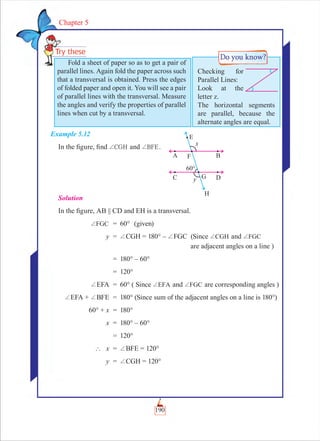
			 42, 45, 51, 55, 49, 62, 41, 52, 48, 64
			 52, 42, 49, 50, 47, 53, 59, 60, 46, 54
		 Form the frequency table by taking class intervals 40 - 45, 45 - 50, 50 - 55,
55 - 60 and 60 - 65.
	 6.	 The marks obtained by 30 students of a class in a mathematics test are given
below.
			 45, 35, 60, 41, 8, 28, 31, 39, 55, 72, 22, 75, 57, 33, 51
			 76, 30, 49, 19, 13, 40, 88, 95, 62, 17, 67, 50, 66, 73, 70
		 Form the grouped frequency table:
	 7.	 Form a continuous frequency distribution table from the given data.
Class Interval
(weight in kg.)
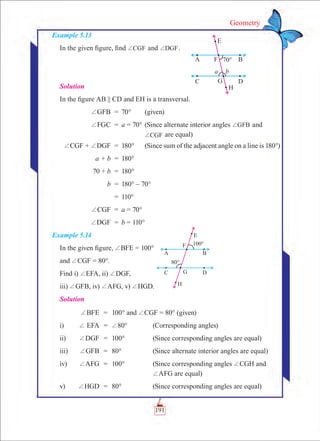
21 - 23 24 - 26 27 - 29 30 - 32 33 - 35 36 - 38
Frequency
(Number of children)
2 6 10 14 7 3
	 8.	 The following data gives the heights of trees in a grove. Form a continuous
frequency distribution table.
Class Interval
(Height in metres)
2 - 4 5 - 7 8 - 10 11 - 13 14 - 16
Frequency
(Number of trees)
29 41 36 27 12
226
227
Data Handling
7.3 Mean Median, Mode of ungrouped data
Arithmetic mean
We use the word ‘average’ in our day to day life.
Poovini spends on an average of about 5 hours daily for her studies.
In the month of May the average temperature at Chennai is 40 degree celsius.
What do the above statement tell us?
Poovini usually studies for 5 hours. On some days, she may study for less
number of hours and on the other day she may study longer.
The average temperature of 40 degree celsius, means that, the temperature at
the month of May in chennai is 40 degree celsius. Some times it may be less than 40
degree celsius and at other time it may be more than 40 degree celsius.
Average lies between the highest and the lowest value of the given data.
Rohit gets the following marks in different subjects in an examination.
	 62, 84, 92, 98, 74
In order to get the average marks scored by him in the examination, we first add
up all the marks obtained by him in different subjects.
	 62 + 84 + 92 + 98 + 74 = 410.
and then divide the sum by the total number of subjects. (i.e. 5)
The average marks scored by Rohit = .
5
410 82=
Thisnumberhelpsustounderstandthegenerallevelofhisacademicachievement
and is referred to as mean.
` The average or arithmetic mean or mean is defined as follows.
	 Mean =
Total number of observations
Sum of all observations
Example 7.5
Gayathri studies for 4 hours, 5 hours and 3 hours respectively on 3 consecutive
days. How many hours did she study daily on an average?
Solution:
Average study time =
Number of days for which she studied.
Total number of study hours
Chapter 7
		 =	 4 5 3
3
+ + hours
		 =	
3
12
		 =	 4 hours per day.
Thus we can say that Gayathri studies for 4 hours daily on an average.
Example 7.6
The monthly income of 6 families are ` 3500, ` 2700, ` 3000, ` 2800, ` 3900
and ` 2100. Find the mean income.
Solution:
	Average monthly income	 =	
Number of families
Total income of 6 familes
		 =	 3500 2700 3000 2800 3900 2100`
6
+ + + + +
		 =	 `
6
18000
		 =	 ` 3,000.
Example 7.7
The mean price of 5 pens is ` 75. What is the total cost of 5 pens?
Solution:
	 Mean	 =	
Number of pens
Total cost of 5 pens
	 Total cost of 5 pens	 =	 Mean # Number of pens
		 =	 ` 75 5#
		 =	 ` 375
Median
Consider a group of 11 students with the following height (in cm)
	 106, 110, 123, 125, 115, 120, 112, 115, 110, 120, 115.
The Physical EducationTeacher Mr. Gowtham wants to divide the students into
two groups so that each group has equal number of students. One group has height
lesser than a particular height and the other group has student with height greater than
the particular height.
Now, Mr. Gowtham arranged the students according to their height in ascending
order.
	 106, 110, 110, 112, 115, 115,115, 120, 120, 123, 125
228
229
Data Handling
The middle value in the data is 115 because this value divides the students into
two equal groups of 5 students each. This values is called as median. Median refers
to the value 115 which lies in the middle of the data.Mr. Gowtham decides to keep
the middle student as a referee in the game.
Median is defined as the middle value of the data when the data is arranged
in ascending or descending order.
Find the median of the following:
	 40, 50, 30, 60, 80, 70
Arrange the given data in ascending order.
	 30, 40, 50, 60, 70, 80.
Here the number of terms is 6 which is even. So the third and fourth terms are
middle terms. The average value of the two terms is the median.
(i.e)	 Median = 50 60 .
2 2
110 55+ = =
	 (i)	 When the number of observations is odd, the middle number is the
median.
	 (ii)	 When the number of observations is even, the median is the average of
the two middle numbers.
Example 7.8
Find the median of the following data.
		 3, 4, 5, 3, 6, 7, 2.
Solution:
Arrange the data in ascending order.
		 2, 3, 3, 4, 5, 6, 7
The number of observation is 7 which is odd.
`The middle value 4 the median.
Example 7.9
Find the median of the data
	 12, 14, 25, 23, 18, 17, 24, 20.
Solution:
Arrange the data in ascending order
	 12, 14, 17, 18, 20, 23, 24, 25.
Find the actual
distance between
your school and
house. Find the
median of the place.
In highways, the yellow
line represents the median.
Chapter 7
The number of observation is 8 which is even.
` Median is the average of the two middle terms 18 and 20.
Median =
2
18 20
2
38 19+ = =
Example 7.10
Find the median of the first 5 prime numbers.
Solution:
The first five prime numbers are 2, 3, 5, 7, 11.
The number of observation is 5 which is odd.
` The middle value 5 is the median.
Mode
Look at the following example,
Mr. Raghavan, the owner of a ready made dress shop says that the most popular
size of shirts he sells is of size 40 cm.
Observe that here also, the owner is concerned about the number of shirts of
different sizes sold. He is looking at the shirt size that is sold, the most. The highest
occurring event is the sale of size 40 cm. This value is called the mode of the data.
Mode is the variable which occurs most frequently in the given data.
Mode of Large data
Putting the same observation together and counting them is not easy if the
number of observation is large. In such cases we tabulate the data.
Example 7.11
Following are the margin of victory in the foot ball matches of a league.
1, 3, 2, 5, 1, 4, 6, 2, 5, 2, 2, 2, 4, 1, 2, 3, 2, 3, 2,
1, 1, 2, 3, 2, 6, 4, 3, 2, 1, 1, 4, 2, 1, 5, 3, 4, 2, 1, 2. Find the mode of this data.
Solution:
Margin of victory Tally Marks Number of Matches
1 |||| |||| 9
2 |||| |||| |||| 14
3 |||| || 7
4 |||| 5
5 || 3
6 || 2
Total 40
Table 7.6
230
231
Data Handling
Now we quickly say that ‘2’ is the mode. Since 2 has occurred the more number
of times, then the most of the matches have been won with a victory margin of 2 goals.
Example 7.12
Find the mode of the following data.
	 3, 4, 5, 3, 6, 7
Solution:
	 3 occurs the most number of times.
	 ` Mode of the data is 3.
Example 7.13
Find the mode of the following data.
	 2, 2, 2, 3, 3, 4, 5,5, 5, 6,6, 8
Solution:
	 2 and 5 occur 3 times.
	 ` Mode of the data is 2 and 5.
Example 7.14
Find the mode of the following data
90, 40, 68, 94, 50, 60.
Solution:
Here there are no frequently occurring values. Hence this data has no mode.
Example 7.15
The number of children in 20 families are 1, 2, 2, 1, 2, 1, 3, 1, 1, 3
	 1, 3, 1, 1, 1, 2, 1, 1, 2, 1. Find the mode.
Solution:
Number of
Children
Tally Marks
Number of
Families
1 |||| |||| || 12
2 |||| 5
3 ||| 3
Total 20
Table 7.7
12 families have 1 child only, so the mode of the data is 1.
Find the mode of
the transport in your
place.
Find the mode
of the flower.
Chapter 7
Exercise: 7.2
	 1.	 Choose the correct answer:
	 i)	 The arithmetic mean of 1, 3, 5, 7 and 9 is
	 (A) 5	 (B) 7	 (C) 3	 (D) 9
	 ii)	 The average marks of 5 children is 40 then their total mark is
	 (A) 20	 (B) 200	 (C) 8	 (D) 4	
	 iii)	 The median of 30,50, 40, 10, 20 is
	 (A) 40	 (B) 20	 (C) 30	 (D) 10
	 iv)	 The median of 2, 4, 6, 8, 10, 12 is
	 (A) 6	 (B) 8	 (C) 7	 (D) 14
	 v)	 The mode of 3, 4, 7, 4, 3, 2, 4 is
	 (A) 3	 (B) 4	 (C) 7	 (D) 2
	 2.	 The marks in mathematics of 10 students are
			 56, 48, 58, 60, 54, 76, 84, 92, 82, 98.
		 Find the range and arithmetic mean
	 3.	 The weights of 5 people are
		 72 kg, 48 kg, 51 kg, 69 kg, 67 kg.
		 Find the mean of their weights.
	 4.	 Two vessels contain 30 litres and 50 litres of milk separately. What is the
capacity of the vessels if both share the milk equally?
	 5.	 The maximum temperature in a city on 7 days of a certain week was 34.8°C,
38.5°C, 33.4°C, 34.7°C, 35.8°C, 32.8°C, 34.3°C. Find the mean temperature for
the week.
	 6.	 The mean weight of 10 boys in a cricket team is 65.5 kg. What is the total weight
of 10 boys.
	 7.	 Find the median of the following data.
			 6, 14, 5, 13, 11, 7, 8
	 8.	 The weight of 7 chocolate bars in grams are
		 131, 132, 125, 127, 130, 129, 133. Find the median.
	 9.	 The runs scored by a batsman in 5 innings are
			 60, 100, 78, 54, 49. Find the median.
	 10.	 Find the median of the first seven natural numbers.
	 11.	 Pocket money received by 7 students is given below.
		 ` 42, ` 22, ` 40, ` 28, ` 23, ` 26, ` 43. Find the median.
	 12.	 Find the mode of the given data.
			 3, 4, 3, 5, 3, 6, 3, 8, 4.
232
233
Data Handling
	 13.	 Twelve eggs collected in a farm have the following weights.
			 32 gm,40 gm, 27 gm, 32 gm, 38 gm, 45 gm,
			 40 gm, 32 gm, 39 gm, 40 gm, 30 gm, 31 gm,
		 Find the mode of the above data.
	 14.	 Find the mode of the following data.
			 4, 6, 8, 10, 12, 14
	 15.	 Find the mode of the following data.
			 12, 14, 12, 16, 15, 13, 14, 18, 19, 12, 14, 15, 16, 15, 16, 16,
			 15, 17, 13, 16, 16, 15, 13, 15, 17, 15, 14, 15, 13, 15, 14.
	 1.	 Any collection of information in the form of numerical figures giving the
required information is called  data.
	 2.	 The raw data is an unprocessed and unclassified data.
	 3.	 The data which is arranged in groups (or classes) is called a grouped data.
	 4.	 The number of times a particular value repeats itself is called its frequency.
	 5.	 Range = Highest value – Lowest value.
	 6.	 The difference between the upper and the lower limit is called the width of the
class interval.
	 7.	 Average lies between the highest and the lowest value of the given data.
	 8.	 Mean =
total number of observations
sum of all the observations
	 9.	 Median is defined as the middle value of the data, when the data is arranged
in ascending or descending order.
	 10.	 Mode is the variable which occurs most frequently in the given data.
234
5
24
7
9
3
14
4
77
4
1
5
4
5
3
7
2
2
1
2
1
12
7
12
7
18
7
63
2
27
22
5
1
4
1
16
9
2
9
35
48
15
4
40
29
2
1
8
1
16
13
12
4
1
235
5
7
4
9
10
7
9
4
33
2
7
5
15
1
54
1
6
1
12
1
5
8
36
35
12
7
16
11
15
20-
15
19-
15
18-
15
17-
6
7
6
6
6
5
6
4
28
48
28
47
28
46
28
45
4
3-
8
3-
5
3-
3
5-
2
1-
5
18
13
24
13
12-
3
13
42
19
21
43-
7
24
30
13-
44
9-
16
5-
20
23
26
69-
60
41- 1
27
-
12
1
35
2
4
1
12
19
2
3
28
43-
11
7
2
1
11
7
4
3
40
17
132
7
42
41
210
7
4
7
5
4
20
17
4
3
10
9
236
25
72-
169
35-
24
7-
11
12-
9
2
4
15- 26
125
98 66
375
44
28
45
81
16
2
3-
7
8-
43
3
7
9
2
3
106
237
238
xy
3
4
2
1-
2
1
239
100
25
200
25
100
33
100
70
100
82
3
1
10
3
200
1
100
9
4
3
400
1
40
1
3
2
240
5
4
241
242
+ + + +
+ + + + + + + +
243
+ + + +
+ + +
+ + + +
+ + + + + + + + + + + +
+ + + + + + + + + + + +
+ + + +
+ + + +
+ +
244
+ + +

math m1

  • 5.
    REAL NUMBER SYSTEM NoWorld without Water No Mathematics without Numbers 1.1 Introduction In the development of science, we should know about the properties and operations on numbers which are very important in our daily life. In the earlier classes we have studied about the whole numbers and the fundamental operations on them. Now, we extend our study to the integers, rationals, decimals, fractions and powers in this chapter. Numbers In real life, we use Hindu Arabic numerals - a system which consists of the symbols 0 to 9. This system of reading and writing numerals is called, “Base ten system” or “Decimal number system”. 1.2 Revision In VI standard, we have studied about Natural numbers, Whole numbers, Fractions and Decimals. We also studied two fundamental operations addition and subtraction on them. We shall revise them here. Natural Numbers Counting numbers are called natural numbers. These numbers start with smallest number 1 and go without end. The set of all natural numbers is denoted by the symbol ‘N’. N = , , , , ,...1 2 3 4 5" , is the set of all natural numbers. Whole numbers Natural numbers together with zero (0) are called whole numbers. These numbers start with smallest number 0 and go without end. The set of all whole numbers is denoted by the symbol ‘W’. W = , , , , , ,...0 1 2 3 4 5" , is the set of all whole numbers. 1
  • 6.
    2 Chapter 1 Integers The wholenumbers and negative numbers together are called integers. The set of all integers is denoted by Z. Z = ... , , , , ,...2 1 0 1 2- -" , is the set of all integers (or) Z = 0, 1, 2,...! !" , is the set of all Integers. 1.3 Four Fundamental Operations on Integers (i) Addition of Integers Sum of two integers is again an integer. For example, i) 10 4 10 4 6+ - = - =^ h ii) 48 12+ = iii) 6 60+ = iv) 6 + 5 = 11 v) 4 + 0 = 4 (ii) Subtraction of integers To subtract an integer from another integer, add the additive inverse of the second number to the first number. For example, i) 5 – 3 = 5 + addditive inverse of 3 = 5 + (– 3) = 2. ii) 6 – (– 2) = 6 + addditive inverse of (– 2) = 6 + 2 = 8. iii) (– 8) – (5) = (– 8) + (– 5) = – 13. iv) (– 20) – (– 6) = – 20 + 6 = – 14. (iii) Multiplication of integers In the previous class, we have learnt that multiplication is repeated addition in the set of whole numbers. Let us learn about it now in the set of integers. Rules : 1. The product of two positive integers is a positive integer. 2. The product of two negative integers is a positive integer. 3. The product of a positive integer and a negative integer is a negative integer. Ramanujam, the greatest Mathematician was born at Erode in Tamil Nadu.
  • 7.
    3 Real Number System Example i) 5 8 40# = ii) 5 9#- -^ ^h h 45= iii) 15 3 15 3 45# #- =- =-^ ^h h iv) 12 4 12 4 48# #- =- =-^ ^h h Activity Draw a straight line on the ground. Mark the middle point of the line as ‘0’ (Zero). Stand on the zero. Now jump one step to the right on the line. Mark it as + 1. From there jump one more step in the same direction and mark it as + 2. Continue jumping one step at a time and mark each step (as + 3, + 4, + 5, ...). Now come back to zero position on the line. Move one step to the left of ‘0’ and mark it as – 1. Continue jumping one step at a time in the same direction and mark the steps as – 2, – 3, – 4, and so on. The number line is ready. Play the game of numbers as indicated below. i) Stand on the zero of the number line facing right side of 0. Jumping two steps at a time. If you continue jumping like this 3 times, how far are you from ‘0’ on number line? ii) Stand on the zero of number line facing left side of 0. Jump 3 steps at a time. If you continue jumping like this 3 times, how far are you from ‘0’ on the number line? Activity × 4 – 6 – 3 2 7 8 – 6 – 24 – 5 15 – 40 3 21 Example 1.1 Multiply (– 11) and (– 10). Solution – 11 × (– 10) = (11 × 10) = 110 Example 1.2 Multiply (– 14) and 9. Solution (– 14) × 9 = – (14 × 9) = – 126 1) 0 × (– 10) = 2) 9 × (– 7) = 3) – 5 × (– 10) = 4) – 11 × 6 =
  • 8.
    4 Chapter 1 Example 1.3 Findthe value of 15 × 18. Solution 15 × 18 = 270 Example 1.4 The cost of a television set is `5200. Find the cost of 25 television sets. Solution The cost one television set = `5200 ` the cost of 25 television set = 5200 × 25 = `130000 Exercise 1.1 1. Choose the best answer: i) The value of multiplying a zero with any other integer is (A) positive integer (B) negative integer (C) 1 (D) 0 ii) – 152 is equal to (A) 225 (B) – 225 (C) 325 (D) 425 iii) – 15 × (– 9) × 0 is equal to (A) – 15 (B) – 9 (C) 0 (D) 7 iv) The product of any two negative integers is a (A) negative integer (B) positive integer (C) natural number (D) whole number 2. Fill in the blanks: i) The product of a negative integer and zero is _________. ii) _________ × 7014- =^ h iii) 72 #-^ h _________ = 360- iv) 0 17# -^ h = _________. 3. Evaluate: i) 3 2# -^ h ii) 1 25#-^ h iii) 21 31#- -^ ^h h iv) 316 1#-^ h v) (– 16) × 0 × (– 18) vi) 12 11 10# #- -^ ^h h vii) 5 5#- -^ ^h h viii) 5 5# ix) 3 7 2 1# # #- - - -^ ^ ^ ^h h h h x) 1 2 3 4# # #- - -^ ^ ^h h h xi) 7 5 9 6# # #- -^ ^ ^h h h xii) 7 9 6 5# # # -^ h xiii) 10 × 16 × (– 9) xiv) 16 × (– 8) × (– 2) xv) (– 20) × (– 12) × 25 xvi) 9 × 6 × (– 10) × (– 20)
  • 9.
    5 Real Number System 4. Multiply i) 9-^ h and 15 ii) 4-^ h and 4-^ h iii) 13 and 14 iv) 25-^ h with 32 v) 1-^ h with 1-^ h vi) 100-^ h with 0 5. The cost of one pen is `15. What is the cost of 43 pens? 6. A question paper contains 20 questions and each question carries 5 marks. If a student answered 15 questions correctly, find his mark? 7. Revathi earns ` 150 every day. How much money will she have in 10 days? 8. The cost of one apple is `20. Find the cost of 12 apples? (iv) Division of integers We know that division is the inverse operation of multiplication. We can state the rules of division as follows: Positive integer Positive integer = Positive number Negative integer Negative integer = Positive number Negative integer Positive integer = Negative number Positive integer Negative integer = Negative number Division by zero Division of any number by zero (except 0) is meaningless because division by zero is not defined. Example 1.5 Divide 250 by 50. Solution Divide 250 by 50 is 50 250 = 5. a) 10 0 = b) 3 9 - = c) 3 3 - - = d) 2 10- =
  • 10.
    6 Chapter 1 Example 1.6 Divide(– 144) by 12. Solution Divide (– 144) by 12 is 12 144- = – 12. Example 1.7 Find the value 2 10 15 30 60 # # #- -^ ^h h . Solution 2 10 15 30 60 # # #- -^ ^h h = 20 27000 = 1350. Example 1.8 A bus covers 200 km in 5 hours. What is the distance covered in 1 hour? Solution Distance covered in 5 hours = 200 km. ` Distance covered in 1 hour = 5 200 = 40 km. Exercise 1.2 1. Choose the best answer: i) Division of integers is inverse operation of (A) addition (B) subtraction (C) multiplication (D) division ii) 369 ÷ ............ = 369. (A) 1 (B) 2 (C) 369 (D) 769 iii) – 206 ÷ ............ = 1. (A) 1 (B) 206 (C) – 206 (D) 7 iv) – 75 ÷ ............ = – 1. (A) 75 (B) – 1 (C) – 75 (D) 10 2. Evaluate i) 30 6'-^ h ii) 50 ' 5 iii ) 36 9'- -^ ^h h iv) 49 49'-^ h v) 12 3 1' - +^ h6 @ vi) 36 6 3'- -^ h6 @ vii) 6 7 3 2'- + - +^ ^h h6 6@ @ viii) 7 19 10 3'- + - - + -^ ^ ^ ^h h h h6 6@ @ ix) 7 13 2 8'+ +6 6@ @ x) [7 + 23] ÷ [2 + 3] 3. Evaluate i) 2 3 1 5 4 6 # # # #- - - -^ ^ ^ ^h h h h ii) 4 5 6 2 8 5 4 3 10 # # # # # # # iii) 4 6 40 20 12 # # # - - - ^ ^ ^ h h h 4. The product of two numbers is 105. One of the number is (– 21). What is the other number?
  • 11.
    7 Real Number System 1.5Properties of Addition of integers (i) Closure Property Observe the following examples: 1. 1 29 3 42+ = 2. 10 4 6- + =- 3. 18 ( 47) 29+ - =- In general, for any two integers a and b, a + b is an integer. Therefore the set of integers is closed under addition. (ii) Commutative Property Two integers can be added in any order. In other words, addition is commutative for integers. We have 8 3 5+ - =^ h and 3 8 5- + =^ h So, 8 3 3 8+ - = - +^ ^h h In general, for any two integers a and b we can say, a b b a+ = + Therefore addition of integers is commutative. (iii) Associative Property Observe the following example: Consider the integers 5, – 4 and 7. Look at 5 + [(– 4) + 7] = 5 + 3 = 8 and [5 + (– 4)] + 7 = 1 + 7 = 8 Therefore, 5 + [(– 4) + 7] = [5 + (– 4)] + 7 In general, for any integers a, b and c, we can say, a b c a b c+ + = + +^ ^h h . Therefore addition of integers is associative. Are the following pairs of expressions equal? i)  7 5 4+ +^ h, 7 5 4+ +^ h ii)  5 2 4- + - + -^ ^ ^h h h6 @,    5 2 4- + - + -^ ^ ^h h h6 @ Are the following equal? i) 5 12+ -^ ^h h and 12 5- +^ ^h h ii) 7220- +^ h and 72 20+ -^ h
  • 12.
    8 Chapter 1   (iv)Additive identity When we add zero to any integer, we get the same integer. Observe the example: 5 + 0 = 5. In general, for any integer a, a + 0 = a. Therefore, zero is the additive identity for integers. Properties of subtraction of integers. (i) Closure Property Observe the following examples: i) 5 12 7- =- ii) 18 13 5- - - =-^ ^h h From the above examples it is clear that subtraction of any two integers is again an integer. In general, for any two integers a and b, a - b is an integer. Therefore, the set of integers is closed under subtraction. (ii) Commutative Property Consider the integers 7 and 4. We see that 7 4 3- = 4 7 3- =- ` 7 4 4 7!- - In general, for any two integers a and b a b b a!- - Therefore, we conclude that subtraction is not commutative for integers. (iii) Associative Property Consider the integers 7, 4 and 2 ( )7 4 2 7 2 5- - = - = ( )7 4 2 3 2 1- - = - = ` ( ) ( )7 4 2 7 4 2]- - - - In general, for any three integers a , b and c ( ) ( ) .a b c a b c!- - - - Therefore, subtraction of integers is not associative. i) 17 + ___ = 17 ii) 0 + ___ = 20 iii) – 53 + ___ = – 53
  • 13.
    9 Real Number System Propertiesof multiplication of integers (i) Closure property Observe the following: – 10 × (– 5) = 50 40 × (– 15) = – 600 In general, a × b is an integer, for all integers a and b. Therefore, integers are closed under multiplication. (ii) Commutative property Observe the following: 5 × (– 6) = – 30 and (– 6) × 5 = – 30 5 × (– 6) = (– 6) × 5 Therefore, multiplication is commutative for integers. In general, for any two integers a and b, a × b = b × a. (iii) Multiplication by Zero The product of any nonzero integer with zero is zero. Observe the following: 5 × 0 = 0 – 8 × 0 = 0 In general, for any nonzero integer a a × 0 = 0 × a = 0 (iv) Multiplicative identity Observe the following: 15 # = 5 1 ( 7)# - = 7- This shows that ‘1’ is the multiplicative identity for integers. In general, for any integer a we have a 1# = a1 # = a Are the following pairs equal? i) 5 × (– 7), (– 7) × 5 ii) 9 × (– 10), (– 10) × 9 i) 0 × 0 = _____ ii) – 100 × 0 = _____ iii) 0 × x = _____ i) (– 10) × 1 = ___ ii) (– 7) × ___ = – 7 iii) ___ × 9 = 9
  • 14.
    10 Chapter 1   (v)Associative property for Multiplication Consider the integers 2, – 5, 6. Look at 2 5 6# #-^ h6 @ = 10 6#- 60=- and 2 5 6# #-^ h6 @= 2 30# -^ h = 60- Thus 2 5 6 2 5 6# # # #- = -^ ^h h6 6@ @ So we can say that integers are associative under multiplication. In general, for any integers a, b, c, (a × b) × c = a × (b × c). (vi) Distributive property Consider the integers 12, 9, 7. Look at 12 9 7# +^ h = 12 16# = 192 12 9 12 7# #+^ ^h h = 108 84+ = 192 Thus 12 9 7# +^ h = 12 9 12 7# #+^ ^h h In general, for any integers a, b, c. a b c# +^ h = a b a c# #+^ ^h h. Therefore, integers are distributive under multiplication. Properties of division of integers (i) Closure property Observe the following examples: (i) 15 5 3' = (ii) 3 9 9 3 3 1'- = - = -^ h (iii) 7 4 4 7' = From the above examples we observe that integers are not closed under division. Are the following equal? 1. 4 5 6# +^ h and 4 5 4 6# #+^ ^h h 2. 3 7 8# -^ h and 3 7 3 8# #+ -^ ^h h 3. 4 5# -^ h and 5 4#-^ h
  • 15.
    11 Real Number System (ii)Commutative Property Observe the following example: 8 ÷ 4 = 2 and 4 ÷ 8 = 2 1 ` 8 ÷ 4 ! 4 ÷ 8 We observe that integers are not commutative under division. (iii) Associative Property Observe the following example: 12 (6 ) 12 (12 6) 2 2 2 1 12 (6 2) (12 6) 2 2 3 4' ' ' ' ' ' ` ' ' ' '! = = = = From the above example we observe that integers are not associative under division. 1.6 Fractions Introduction In the early classes we have learnt about fractions which included proper, improper and mixed fractions as well as their addition and subtraction. Now let us see multiplication and division of fractions. Recall : Proper fraction: A fraction is called a proper fraction if its Denominator > Numerator. Example: , , , 4 3 2 1 10 9 6 5 Improper fraction: A fraction is called an improper fraction if its Numerator > Denominator. Example : , , , 4 5 5 6 30 41 25 51 Mixed fraction : A fraction consisting of a natural number and a proper fraction is called a mixed fractions. Example: , ,2 4 3 1 5 4 5 7 1 Think it : Mixed fraction = Natural number+ Proper fraction
  • 16.
    12 Chapter 1 All wholenumbers are fractional numbers with 1 as the denominator. Discuss : How many numbers are there from 0 to 1. Recall : Addition and subtraction of fractions. Example (i) Simplify: 5 2 5 3+ Solution 5 2 5 3+ = 1 5 2 3 5 5+ = = Example (ii) Simplify: 3 2 12 5 24 7+ + Solution 3 2 12 5 24 7+ + = 24 2 8 5 2 7 1# # #+ + = 24 16 10 7+ + = 24 33 =1 8 3 Example (iii) Simplify: 5 4 1 4 4 3 7 8 5+ + Solution 5 4 1 4 4 3 7 8 5+ + = 4 21 4 19 8 61+ + = 8 42 38 61+ + = 8 141 = 17 8 5 Example (iv) Simplify: 7 5 7 2- Solution 7 5 7 2- = . 7 5 2 7 3- = Example (v) Simplify: 2 3 2 3 6 1 6 4 3- + Solution 2 3 2 3 6 1 6 4 3- + = 3 8 6 19 4 27- +
  • 17.
    13 Real Number System = 12 32 8 813- + = 12 75 = 6 4 1 (i) Multiplication of a fractions by a whole number Fig. 1.1 Observe the pictures at the (fig.1.1 ) . Each shaded part is 8 1 part of a circle. How much will the two shaded parts represent together? They will represent 2 8 1 8 1 8 1 8 2 4 1#+ = = = To multiply a proper or improper fraction with the whole number: we first multiply the whole number with the numerator of the fraction, keeping the denominator same. If the product is an improper fraction, convert it as a mixed fraction. To multiply a mixed fraction by a whole number, first convert the mixed fraction to an improper fraction and then multiply. Therefore, 4 3 7 4 4 7 25 7 100 14 7 2# #= = = (ii) Fraction as an operator ‘of’ From the figure (fig. 1.2) each shaded portion represents 3 1 of 1. All the three shaded portions together will represent 3 1 of 3. Find : i) 5 2 4# ii) 5 8 4# iii) 4 5 1# iv) 11 13 6# Find : i) 6 7 3 2# ii) 3 9 2 7#
  • 18.
    14 Chapter 1 Fig. 1.2 Combiningthe 3 shaded portions we get 1. Thus, one-third of 3 = 3 1 #3 = 1. We can observe that ‘of’ represents a multiplication. Prema has 15 chocolates. Sheela has 3 1 rd of the number of chocolates what Prema has. How many chocolates Sheela has? As, ‘of’ indicates multiplication, Sheela has 5 3 1 15# = chocolates. Example 1.9 Find : 4 1 of 2 5 1 Solution 4 1 of 2 5 1 4 1 2 5 1#= 4 1 5 11#= 20 11= Example 1.10 In a group of 60 students 10 3 of the total number of students like to study Science, 5 3 of the total number like to study Social Science. (i) How many students like to study Science? (ii) How many students like to study Social Science?
  • 19.
    15 Real Number System Solution Totalnumber of students in the class 60= (i) Out of 60 students, 10 3 of the students like to study Science. Thus, the number of students who like to study Science = 10 3 of 60 = 60 18 10 3 # = . (ii) Out of 60 students, 5 3 of the students like to study Social Science. Thus, the number of students who like to study Social Science = 5 3 of 60 = 60 5 3 # = 36. Exercise 1.3 1. Multiply : i) 6 5 4# ii) 3 7 3# iii) 4 8 4# iv) 51 10 2# v) 3 2 7# vi) 8 2 5 # vii) 4 11 7# viii) 6 5 12# ix) 7 4 14# x) 18 3 4# 2. Find : i) 2 1 of 28 ii) 3 7 of 27 iii) 4 1 of 64 iv) 5 1 of 125 v) 6 8 of 216 vi) 8 4 of 32 vii) 9 3 of 27 viii) 10 7 of 100 ix) 7 5 of 35 x) 2 1 of 100 3. Multiply and express as a mixed fraction : i) 55 4 1# ii) 63 5 3# iii) 18 5 1# iv) 6 10 7 5# v) 7 7 2 1# vi) 9 9 2 1# 4. Vasu and Visu went for a picnic. Their mother gave them a baggage of 10 one litre water bottles. Vasu consumed 5 2 of the water Visu consumed the remaining water. How much water did Vasu drink?
  • 20.
    16 Chapter 1   (iii)Multiplication of a fraction by a fraction Example 1.11 Find 5 1 of 8 3 . Solution 5 1 of 8 3 = 5 1 × 8 3 = 40 3 Example 1.12 Find 9 2 × 2 3 . Solution 9 2 × 2 3 = 3 1 Example 1.13 Leela reads 4 1 th of a book in 1 hour. How much of the book will she read in 3 2 1 hours? Solution The part of the book read by leela in 1 hour 4 1= So, the part of the book read by her in 3 2 1 hour 3 2 1 4 1#= = 2 7 4 1# 4 2 7 1 # #= 8 7= ` Leela reads 8 7 part of a book in 3 2 1 hours. Exercise 1.4 1. Find : i) 5 10 of 10 5 ii) 3 2 of 8 7 iii) 3 1 of 4 7 iv) 8 4 of 9 7 v) 9 4 of 4 9 vi) 7 1 of 9 2 2. Multiply and reduce to lowest form : i) 9 2 3 3 2# ii) 9 2 10 9# iii) 8 3 9 6# iv) 8 7 14 9# v) 2 9 3 3# vi) 5 4 7 12# Find i) 3 1 × 5 7 ii) 3 2 9 8#
  • 21.
    17 Real Number System 3. Simplify the following fractions : i) 5 2 5 3 2# ii) 6 4 3 10 7# iii) 7 2 1 1# iv) 5 4 3 3 2 1# v) 7 4 1 8 4 1# 4. A car runs 20 km. using 1 litre of petrol. How much distance will it cover using 2 4 3 litres of petrol. 5. Everyday Gopal read book for 1 4 3 hours. He reads the entire book in 7 days. How many hours in all were required by him to read the book? The reciprocal of a fraction If the product of two non-zero numbers is equal to one then each number is called the reciprocal of the other. So reciprocal of 5 3 3 5is , the reciprocal of . 3 5 5 3is Note: Reciprocal of 1 is 1 itself. 0 does not have a reciprocal. (iv) Division of a whole number by a fraction To divide a whole number by any fraction, multiply that whole number by the reciprocal of that fraction. Example 1.14 Find (i) 6 5 2' (ii) 8 9 7' Solution (i) 6 ÷ 5 2 = 6 × 2 5 = 15 (ii) 8 9 7 8 7 9 7 72' #= = While dividing a whole number by a mixed fraction, first convert the mixed fraction into improper fraction and then solve it. Example 1.15 Find 6 ÷ 3 5 4 Solution 6 ÷ 3 5 4 = 6 ÷ 5 19 = 6 × 19 5 = 19 30 = 1 19 11 (v) Division of a fraction by another fraction To divide a fraction by another fraction, multiply the first fraction by the reciprocal of the second fraction. Find: i) 6 5 3 2' ii) 9 3 7 3'
  • 22.
    18 Chapter 1 We cannow find 5 1 7 3' 5 1 7 3 5 1' #= reciprocal of . 7 3 5 1 3 7 15 7#= = Exercise 1.5 1. Find the reciprocal of each of the following fractions: i) 7 5 ii) 9 4 iii) 7 10 iv) 4 9 v) 2 33 vi) 9 1 vii) 13 1 viii) 5 7 2. Find : i) 3 5 ÷ 25 ii) 9 6 ÷ 36 iii) 3 7 ÷ 14 iv) 1 4 1 ÷ 15 3. Find : (i) 5 2 4 1' (ii) 6 5 7 6' (iii) 2 4 3 5 3' (iv) 3 2 3 3 8' 4. How many uniforms can be stitched from 47 4 1 metres of cloth if each scout requires 2 4 1 metres for one uniform? 5. The distance between two places is 47 2 1 km. If it takes 1 16 3 hours to cover the distance by a van, what is the speed of the van? 1.7 Introduction to Rational Numbers A rational number is defined as a number that can be expressed in the form , q p where p and q are integers and .q 0^ Here p is the numerator and q is the denominator. For example , , , , 3 7 7 5 9 2 7 11 11 3- - - are the rational numbers A rational number is said to be in standard form if its denominator is positive and the numerator and denominator have no common factor other than 1. If a rational number is not in the standard form, then it can be reduced to the standard form. Example 1.16 Reduce 54 72 to the standard form. Find: i) 7 3 5 4' , ii) 2 1 5 4' , iii) 2 4 3 2 7'
  • 23.
    19 Real Number System Solution Wehave, 54 72 54 2 72 2 27 36 27 3 36 3 9 12 9 3 12 3 3 4 ' ' ' ' ' ' = = = = = = In this example, note that 18 is the highest common factor (H.C.F.) of 72 and 54. To reduce the rational number to its standard form, we divide its numerator and denominator by their H.C.F. ignoring the negative sign if any. If there is negative sign in the denominator divide by " ".H.C.F.- Example 1.17 Reduce to the standard form. (i) 12 18 - (ii) 16 4 - - Solution (i) The H.C.F. of 18 and 12 is 6 Thus, its standard form would be obtained by dividing by – 6. 12 18 12 6 18 6 2 3 ' ' - = - - - = - ^ ^ h h (ii) The H.C.F. of 4 and 16 is 4. Thus, its standard form would be obtained by dividing by – 4 16 4 16 4 4 4 4 1 ' ' - - = - - - - = ^ ^ h h 1.8 Representation of Rational numbers on the Number line. You know how to represent integers on the number line. Let us draw one such number line. The points to the right of 0 are positive integers. The points to left of 0 are negative integers. Let us see how the rational numbers can be represented on a number line. Fig. 1.3 Aliter: 54 72 54 18 72 18 3 4 ' '= = Write in standard form. i) 51 18- , ii) 28 12- , iii) 35 7
  • 24.
    20 Chapter 1 Let usrepresent the number – 4 1 on the number line. As done in the case of positive integers, the positive rational numbers would be marked on the right of 0 and the negative rational numbers would be marked on the left of 0. Fig. 1.4 To which side of 0, will you mark ? 4 1- Being a negative rational number, it would be marked to the left of 0. You know that while marking integers on the number line, successive integers are marked at equal intervals. Also, from 0, the pair 1 and – 1 is equidistant . In the same way, the rational numbers 4 1 4 1and - would be at equal distance from 0. How to mark the rational number 4 1 ? It is marked at a point which is one fourth of the distance from 0 to 1. So, 4 1- would be marked at a point which is one fourth of the distance from 0 to -1. We know how to mark 2 3 on the number line. It is marked on the right of 0 and lies halfway between 1 and 2. Let us now mark 2 3- on the number line. It lies on the left of 0 and is at the same distance as 2 3 from 0. Similarly 2 1- is to the left of zero and at the same distance from zero as 2 1 is to the right. So as done above, 2 1- can be represented on the number line. All other rational numbers can be represented in a similar way. Rational numbers between two rational numbers Raju wants to count the whole numbers between 4 and 12. He knew there would be exactly 7 whole numbers between 4 and 12. Are there any integers between 5 and 6 ? There is no integer between 5 and 6. ` Number of integers between any two integers is finite. Now let us see what will happen in the case of rational numbers ? Raju wants to count the rational numbers between 7 3 3 2and .
  • 25.
    21 Real Number System Forthat he converted them to rational numbers with same denominators. So 7 3 21 9= and 3 2 21 14= Now he has, 21 9 21 10 21 11 21 12 21 13 21 141 1 1 1 1 So , , , 21 10 21 11 21 12 21 13 are the rational numbers in between 21 9 and 21 14 . Now we can try to find some more rational numbers in between 7 3 3 2and . we have 7 3 42 18 3 2 42 28and= = So, 42 18 42 19 42 20 42 28g1 1 1 1 . Therefore . 7 3 42 19 42 20 42 21 3 2g1 1 1 1 1 Hence we can find some more rational numbers in between 7 3 and 3 2 . We can find unlimited (infinite) number of rational numbers between any two rational numbers. Example 1.18 List five rational numbers between 5 2 7 4and . Solution Let us first write the given rational numbers with the same denominators. Now, 5 2 5 7 2 7 35 14 # #= = and 7 4 7 5 4 5 35 20 # #= = So, we have 35 14 35 15 35 16 35 17 35 18 35 19 35 201 1 1 1 1 1 , , , , 35 15 35 16 35 17 35 18 35 19 are the five required rational numbers. Example 1.19 Find seven rational numbers between 3 5 7 8and- - Solution Let us first write the given rational numbers with the same denominators. Now, 3 5 3 7 5 7 21 35 # #- =- =- and 7 8 7 3 8 3 21 24 # #- =- =- So, we have 21 35 21 34 21 33 21 32 21 31 21 301 1 1 1 1- - - - - - 21 29 21 28 21 27 21 26 21 25 21 241 1 1 1 1 1- - - - - - ` The seven rational numbers are , , , , , , . 21 34 21 33 21 32 21 31 21 30 21 29 21 28- - - - - - - (We can take any seven rational numbers)
  • 26.
    22 Chapter 1 Exercise 1.6 1. Choose the best answer. i) 8 3 is called a (A) positive rational number (B) negative rational number (C) whole number (D) positive integer ii) The proper negative rational number is (A) 3 4 (B) 5 7 - - (C) – 9 10 (D) 9 10 iii) Which is in the standard form? (A) – 12 4 (B) – 12 1 (C) 12 1 - (D) 14 7- iv) A fraction is a (A) whole number (B) natural number (C) odd number (D) rational number 2. List four rational numbers between: i) 5 7 3 2and- - ii) 2 1 3 4and iii) 4 7 7 8and 3. Reduce to the standard form: i) 16 12- ii) 48 18- iii) 35 21 - iv) 42 70- v) 8 4- 4. Draw a number line and represent the following rational numbers on it. i) 4 3 ii) 8 5- iii) 3 8- iv) 5 6 v) – 10 7 5. Which of the following are in the standard form: i) 3 2 ii) 16 4 iii) 6 9 iv) 7 1- v) 7 4- 1.9 Four Basic Operations on Rational numbers You know how to add, subtract, multiply and divide on integers. Let us now study these four basic operations on rational numbers. (i) Addition of rational numbers Let us add two rational numbers with same denominator.
  • 27.
    23 Real Number System Example1.20 Add 5 9 and 5 7 . Solution 5 9 5 7+ 5 9 7= + 5 16= . Let us add two rational numbers with different denominators. Example 1.21 Simplify: 3 7 4 5+ -` j Solution 3 7 4 5+ -` j 12 28 15= - (L.C.M. of 3 and 4 is 12) = 12 13 Example 1.22 Simplify 4 3 2 1 6 5- + - . Solution 4 3 2 1 6 5- + - = ( ) ( ) ( ) 12 3 3 1 6 5 2# # #- + - (L.C.M. of 4,2 and 6 is 12) = 12 9 6 10- + - = 12 19 6- + 12 13= - (ii) Subtraction of rational numbers Example 1.23 Subtract 7 8 from 3 10 . Solution: 3 10 7 8- 21 70 24 21 46= - = Example 1.24 Simplify 35 6 35 10- -` j. Solution: 35 6 35 10- -` j = 35 6 10+ 35 16=
  • 28.
    24 Chapter 1 Example 1.25 Simplify2 35 7 3 35 6- -` `j j. Solution 2 35 7 3 35 6- -` `j j = 35 77 35 111- - = 35 77 111- - = 35 188- 5 35 13=- Example 1.26 The sum of two rational numbers is 1. If one of the numbers is 20 5 , find the other. Solution Sum of two rational numbers = 1 Given number + Required number = 1 20 5 +Required number = 1 Required number = 1 20 5- = 20 20 5- = 20 15 = 4 3 ` Required number is 4 3 . Exercise1.7 1. Choose the best answer. i) 3 1 + 3 2 is equal to (A) 2 (B) 3 (C) 1 (D) 4 ii) 5 4 – 5 9 is equal to (A) 1 (B) 3 (C) – 1 (D) 7 iii) 5 11 1 + 1 11 10 is equal to (A) 4 (B) 3 (C) – 5 (D) 7 iv) The sum of two rational numbers is 1. If one of the numbers is 2 1 , the other number is (A) 3 4 (B) 4 3 (C) 4 3- (D) 2 1 i) 35 7 35 5- , ii) 6 5 12 7- , iii) 3 7 4 3- , iv) 3 4 3 2 4 1-` `j j, v) 4 7 5 6 4 1-` `j j
  • 29.
    25 Real Number System 2. Add : i) 5 12 5 6and ii) 13 7 13 17and iii) 7 8 7 6and iv) 13 7 13 5and- - v) 3 7 4 8and vi) 7 5 6 7and- vii) 7 9 3 10and - viii) 6 3 2 7and - ix) , 4 9 28 1 7 8 and x) , 5 4 15 8 10 7 and- - 3. Find the sum of the following : i) 4 3 4 7- + ii) 6 9 6 15+ iii) 4 3 11 6- + iv) 8 7 16 9- + v) 5 4 20 7+ vi) 13 6 26 14- + -` `j j vii) 13 11 2 7+ -` j viii) 5 2 12 5 10 7- + + -` `j j ix) 9 7 18 10 27 7+ - + -` `j j x) 3 6 6 7 12 9+ - + -` `j j 4. Simplify : i) 35 7 35 5- ii) 6 5 12 7- iii) 3 7 4 3- iv) 3 4 3 2 4 1-` `j j v) 4 7 5 6 4 1-` `j j 5. Simplify : i) 1 11 2 3 11 5+` `j j ii) 3 5 4 7 10 3-` `j j iii) 1 11 2 3 11 5 6 11 3- + - +` ` `j j j iv) 3 10 9 3 5 2 6 20 5- + +` ` `j j j v) 3 5 4 2 8 3- +` `j j vi) 1 12 5 2 11 7- + -` `j j vii) 9 7 6 11 3 2 5 42 7+ - + -` ` `j j j viii) 7 10 3 10 21 7+ -` `j j 6. The sum of two rational numbers is 4 17 . If one of the numbers is 2 5 , find the other number. 7. What number should be added to 6 5 so as to get . 30 49 8. A shopkeeper sold 7 4 3 kg, 2 2 1 kg and 3 5 3 kg of sugar to three consumers in a day. Find the total weight of sugar sold on that day. 9. Raja bought 25 kg of Rice and he used 1 4 3 kg on the first day, 4 2 1 kg on the second day. Find the remaining quantity of rice left. 10. Ram bought 10 kg apples and he gave 3 5 4 kg to his sister and 2 10 3 kg to his friend. How many kilograms of apples are left?
  • 30.
    26 Chapter 1   (iii)Multiplication of Rational numbers To find the multiplication of two rational numbers, multiply the numerators and multiply the denominators separately and put them as new rational number. Simplify the new rational number into its lowest form. Example 1.27 Find the product of 11 4 8 22and - - ` `j j. Solution 11 4 8 22# - - ` `j j = 11 4 8 22#- -` `j j 88 88= = 1 Example 1.28 Find the product of 2 15 4-` j and 3 49 2-` j. Solution 2 15 4 3 49 2#- -` `j j = 15 34 49 149#- -` `j j = 735 5066 = 6 735 656 Example 1.29 The product of two rational numbers is . 9 2 If one of the numbers is 2 1 , find the other rational number. Solution The product of two rational numbers = 9 2 One rational number = 2 1 ` Given number #required number = 9 2 2 1 required number# = 9 2 required number = 9 2 1 2# 9 4= ` Required rational number is 9 4 . Multiplicative inverse (or reciprocal) of a rational number If the product of two rational numbers is equal to 1, then one number is called the multiplicative inverse of other.
  • 31.
    27 Real Number System i) 23 7 7 231# = ` The multiplicative inverse of 23 7 7 23is . Similarly the multiplicative inverse of . 7 23 23 7is ii) 12 8 8 12 1#- - =` `j j ` The multiplicative inverse of 12 8 8 12is- - ` `j j . (iv) Division of rational numbers To divide one rational number by another rational number, multiply the first rational number with the multiplicative inverse of the second rational number. Example 1.30 Find 3 2 10 5' -` `j j. Solution 3 2 10 5' -` `j j = 3 2 2 1' -` j = ( 2) 3 2 # - 3 4= - Example 1.31 Find 4 7 3 2 8 3' . Solution 4 7 3 2 8 3' = 7 31 8 19' = 7 31 19 8# 133 248= = 1 133 115 Exercise 1.8 1. Choose the best answer. i) 13 7 × 7 13 is equal to (A) 7 (B) 13 (C) 1 (D) – 1 ii) The multiplicative inverse of 8 7 is (A) 8 7 (B) 7 8 (C) 8 7- (D) 7 8- iii) 11 4 - × 8 22-` j is equal to (A) 1 (B) 2 (C) 3 (D) 4 Find 1) 8 7 12 9# , 2) 12 11 33 24# 3) 1 4 1 7 3 2#- -` `j j
  • 32.
    28 Chapter 1 iv) – 9 4 ÷ 36 9 is equal to (A) 9 16- (B) 4 (C) 5 (D) 7 2. Multiply : i) 5 12 5 6and- ii) 13 7 13 5and- iii) 9 3 8 7and- iv) 11 6 22 44and- v) 7 50 10 28and- vi) 6 5 15 4and- - 3. Find the value of the following : i) 5 9 4 10 18 15# #- ii) 4 8 6 5 10 30# #- - - iii) 1 2 5 1 5 2 9 10 3# # iv) 3 2 15 4 5 1 9 5 1# #- - v) 6 3 7 9 4 10# # 4. Find the value of the following : i) 9 4 4 9'- - ii) 5 3 10 4' -` j iii) 35 8 35 7'-` j iv) 9 4 3 1 40 3'- 5. The product of two rational numbers is 6. If one of the number is , 3 14 find the other number. 6. What number should be multiply 2 7 to get 4 21 ? 1.10 Decimal numbers (i) Represent Rational Numbers as Decimal numbers You have learnt about decimal numbers in the earlier classes. Let us briefly recall them here. All rational numbers can be converted into decimal numbers. For Example (i) 1 8 1 8'= 0.125 8 1` = (ii) 3 4 3 4'= 0.75 4 3` = (iii) 3 5 1 5 16= .23= (iv) 0.6666 3 2 g= Here 6 is recurring without end.
  • 33.
    29 Real Number System DecimalNumbers Addition and Subtraction of decimals: Example 1.32 Add 120.4, 2.563, 18.964 Solution 120.4 2.563 18.964 141.927 Example 1.33 Subtract 43.508 from 63.7 Solution 63.700 ( – ) 43.508 20.192 Example 1.34 Find the value of 27.69 – 14.04 + 35.072 – 10.12. Solution 27.690 – 14.04 62.762 35.072 – 10.12 – 24.16 62.762 – 24.16 38.602 The value is 38.602. Examples 1.35 Deepa bought a pen for `177.50. a pencil for `4.75 and a notebook for `20.60. What is her total expenditure? Solution Cost of one pen = `177.50 Cost of one pencil = `4.75 Cost of one notebook = `20.60 ` Deepa’s total expenditure = `202.85
  • 34.
    30 Chapter 1   1.11Multiplication of Decimal Numbers Rani purchased 2.5 kg fruits at the rate of `23.50 per kg. How much money should she pay? Certainly it would be `(2.5 × 23.50). Both 2.5 and 23.5 are decimal numbers. Now, we have come across a situation where we need to know how to multiply two decimals. So we now learn the multiplication of two decimal numbers. Let us now find 1.5 × 4.3 Multiplying 15 and 43. We get 645. Both, in 1.5 and 4.3, there is 1 digit to the right of the decimal point. So, count 2 digits from the right and put a decimal point. (since 1 + 1 = 2) While multiplying 1.43 and 2.1, you will first multiply 143 and 21. For placing the decimal in the product obtained, you will count 2 + 1 = 3 digits starting from the right most digit. Thus 1.43 × 2.1 = 3.003. Example 1.36 The side of a square is 3.2 cm. Find its perimeter. Solution All the sides of a square are equal. Length of each side = 3.2 cm. Perimeter of a square = 4 × side Thus, perimeter = 4 × 3.2 = 12.8 cm. Example 1.37 The length of a rectangle is 6.3 cm and its breath is 3.2 cm. What is the area of the rectangle? Solution: Length of the rectangle = 6.3 cm Breadth of the rectangle = 3.2 cm. Area of the rectangle = ( length) × (breath) = 6.3 × 3.2 = 20.16 cm2 Multiplication of Decimal number by 10, 100 and 1000 Rani observed that .3 7 10 37= , .3 72 100 372= and 3.723 1000 3723= Thus, she found that depending on the position of the decimal point the decimal number can be converted to a fraction with denominator 10 , 100 or 1000. Now let us see what would happen if a decimal number is multiplied by 10 or 100 or 1000. i) 2.9 × 5 ii) 1.9 × 1.3 iii) 2.2 × 4.05 Perimeter of a square = 4 × side
  • 35.
    31 Real Number System Forexample, 3.23 × 10 = 100 323 × 10 = 32.3 Decimal point shifted to the right by one place since 10 has one zero over one. 3.23 × 100 = 100 323 × 100 = 323 Decimal point shifted to the right by two places since 100 has two zeros over two. 3.23 × 1000 = 100 323 × 1000 = 3230 Exercise 1.9 1. Choose the best answer. i) 0.1 × 0.1 is equal to (A) 0.1 (B) 0.11 (C) 0.01 (D) 0.0001 ii) 5 ÷ 100 is equal to (A) 0.5 (B) 0.005 (C) 0.05 (D) 0.0005 iii) 10 1 × 10 1 is equal to (A) 0.01 (B) 0.001 (C) 0.0001 (D) 0.1 iv) 0.4 × 5 is equal to (A) 1 (B) 0.4 (C) 2 (D) 3 2. Find : (i) 0.3 × 7 (ii) 9 × 4.5 (iii) 2.85 × 6 (iv) 20.7 × 4 (v) 0.05 × 9 (vi) 212.03 × 5 (vii) 3 × 0.86 (viii) 3.5 × 0.3 (ix) 0.2 × 51.7 (x) 0.3 × 3.47 (xi) 1.4 × 3.2 (xii) 0.5 × 0.0025 (xiii) 12.4 × 0.17 (xiv) 1.04 × 0.03 3. Find : (i) 1.4 × 10 (ii) 4.68 × 10 (iii) 456.7 × 10 (iv) 269.08 × 10 (v) 32.3 × 100 (vi) 171.4 × 100 (vii) 4.78 × 100 4. Find the area of rectangle whose length is 10.3 cm and breath is 5 cm. 5. A two-wheeler covers a distance of 75.6 km in one litre of petrol. How much distance will it cover in 10 litres of petrol? i)  0.7 × 10 ii)  1.3 × 100 iii)  76.3 × 1000
  • 36.
    32 Chapter 1   (ii)Division of Decimal Numbers Jasmine was preparing a design to decorate her classroom. She needed a few colourd strips of paper of length 1.8 cm each. She had a strip of coloured paper of length 7.2 cm. How many pieces of the required length will she get out of this strip? She thought it would be . . 1 8 7 2 cm. Is she correct? Both 7.2 and 1.8 are decimal numbers. So we need to know the division of decimal numbers . For example, 141.5 ' 10 = 14.15 141.5 ' 100 = 1.415 141.5' 1000 = 0.1415 To get the quotient we shift the digits in the decimal number to the left by as many places as there are zeros over 1. Example 1.38 Find 4.2 ÷ 3. Solution 4.2 ÷ 3 = 10 42 3 10 42 3 1' #= = 10 3 42 1 10 3 1 42 # # # #= = 14 10 1 3 42 10 1# #= = 1.4 10 14 = Example 1.39 Find 18.5 ÷ 5. Solution First find 185 ÷ 5. We get 37. There is one digit to the right of the decimal point in 18.5. Place the decimal point in 37 such that there would be one digit to its right. We will get 3.7. Find: i) 432.5 ÷ 10 ii) 432.5 ÷ 100 iii) 432.5 ÷ 1000 Find: i) 85.8 ÷ 3 ii) 25.5 ÷ 5 Find: i) 73.12 ÷ 4 ii) 34.55 ÷ 7
  • 37.
    33 Real Number System Divisionof a Decimal Number by another Decimal number Example 1.40 Find . . 0 4 17 6 . Solution We have 17.6 ÷ 0.4 = 10 176 10 4' = 10 176 4 10# = 44. Example 1.41 A car covers a distance of 129.92 km in 3.2 hours. What is the distance covered by it in 1 hour? Solution Distance covered by the car = 129.92 km. Time required to cover this distance = 3.2 hours. So, distance covered by it in 1 hour = . . . 3 2 129 92 32 1299 2= = 40.6km. Exercise 1.10 1. Choose the best answer. i) 0.1 ÷ 0.1 is equal to (A) 1 (B) 0.1 (C) 0.01 (D) 2 ii) 1000 1 is equal to (A) 0.01 (B) 0.001 (C) 1.001 (D) 1.01 iii) How many apples can be bought for `50 if the cost of one apple is `12.50? (A) 2 (B) 3 (C) 4 (D) 7 iv) . . 2 5 12 5 is equal to (A) 4 (B) 5 (C) 7 (D) 10 2. Find : (i) 0.6 ÷ 2 (ii) 0.45 ÷ 5 (iii) 3.48 ÷ 3 (iv) 64.8 ÷ 6 (v) 785.2 ÷ 4 (vi) 21.28 ÷ 7 3. Find : (i) 6.8 ÷ 10 (ii) 43.5 ÷ 10 (iii) 0.9 ÷ 10 (iv) 44.3 ÷ 10 (v) 373.48 ÷ 10 (vi) 0.79 ÷ 10 Find : i) . . 0 5 9 25 ii) .0 04 36 iii) . . 1 3 6 5
  • 38.
    34 Chapter 1 4. Find : (i) 5.6 ÷ 100 (ii) 0.7 ÷ 100 (iii) 0.69 ÷ 100 (iv) 743.6 ÷ 100 (v) 43.7 ÷ 100 (vi) 78.73 ÷ 100 5. Find : (i) 8.9 ÷ 1000 (ii) 73.3 ÷ 1000 (iii) 48.73 ÷ 1000 (iv) 178.9 ÷ 1000 (v) 0.9 ÷ 1000 (vi) 0.09 ÷ 1000 6. Find : (i) 9 ÷ 4.5 (ii) 48 ÷ 0.3 (iii) 6.25 ÷ 0.5 (iv) 40.95 ÷ 5 (v) 0.7 ÷ 0.35 (vi) 8.75 ÷ 0.25 7. A vehicle covers a distance of 55.2 km in 2.4 litres of petrol. How much distance will it cover in one litre of petrol? 8. If the total weight of 11 similar bags is 115.5 kg, what is the weight of 1 bag? 9. How many books can be bought for `362.25, if the cost of one book is `40.25? 10. A motorist covers a distance of 135.04 km in 3.2 hours. Find his speed? 11. The product of two numbers is 45.36. One of them is 3.15. Find the other number? 1.12 Powers Introduction Teacher asked Ramu, “Can you read this number 2560000000000000?” He replies, “It is very difficult to read sir”. “The distance between sun and saturn is 1,433,500,000,000 m. Raja can you able to read this number?” asked teacher. He replies, “Sir, it is also very difficult to read”. Now, we are going to see how to read the difficult numbers in the examples given above. Exponents We can write the large numbers in a shortest form by using the following methods. 10 = 101 100 = 101 × 101 = = 102 1000 = 101 ×101 × 101 = 103
  • 39.
    35 Real Number System Similarly, 21 # 21 = 22 21 # 21 # 21 = 23 21 # 21 # 21 # 21 = 24 a # a = a2 [read as ‘a’ squared or ‘a’ raised to the power 2] a # a # a = a3 [read as ‘a’ cubed or ‘a’ raised to the power 3] a # a # a # a = a4 [read as ‘a’ raised to the power 4 or the 4th power of ‘a’] gggggggg gggggggg a # a #... m times = am [read as ‘a’ raised to the power m or mth power of ‘a’] Here ‘a’ is called the base, ‘m’ is called the exponent (or) power. Note: Only a2 and a3 have the special names “a squared’ and “a cubed”. ` we can write large numbers in a shorter form using exponents. Example 1.42 Express 512 as a power . Solution We have 512 = 2 # 2 # 2 # 2 # 2 # 2 # 2 # 2 × 2 So we can say that 512 = 29 Example: 1.43 Which one is greater 25 , 52 ? Solution We have 25 = 2 # 2 # 2 × 2 × 2 = 32 and 52 = 5 # 5 = 25 Since 32 > 25. Therefore 25 is greater than 52 .
  • 40.
    36 Chapter 1 Example: 1.44 Expressthe number 144 as a product of powers of prime factors. Solution 144 = 2 # 2 # 2 # 2 × 3 # 3 = 24 # 32 Thus, 144 = 24 # 32 Example 1.45 Find the value of (i) 45 (ii) (-4)5 Solution (i) 45 45 = 4 # 4 # 4 # 4 # 4 = 1024. (ii) (– 4)5 (–4)5 = (– 4) # (– 4) # (– 4) # (– 4) # (– 4) = – 1024. Excercise 1.11 1. Choose the best answer. i) – 102 is equal to (A) – 100 (B) 100 (C) – 10 (D) 10 ii) (– 10)2 is equal to (A) 100 (B) – 100 (C) 10 (D) – 10 iii) a × a × a × ..... n times is equal to (A) am (B) a–n (C) an (D) am + n iv) 1033 × 0 is equal to (A) 103 (B) 9 (C) 0 (D) 3 2. Find the value of the following : (i) 28 (ii) 33 (iii) 113 (iv) 123 (v) 134 (vi) 010 3. Express the following in exponential form : (i) 7 # 7 # 7 # 7 # 7 × 7 (ii) 1 # 1 # 1 # 1 # 1 (iii) 10 # 10 # 10 # 10 # 10 # 10 (iv) b # b # b # b # b (v) 2 # 2 # a # a # a # a (vi) 1003 × 1003 × 1003
  • 41.
    37 Real Number System 4. Express each of the follwing numbers using exponential notation. (with smallest base) (i) 216 (ii) 243 (iii) 625 (iv) 1024 (v) 3125 (vi) 100000 5. Identify the greater number in each of the following : (i) 45 , 54 (ii) 25 , 52 (iii) 32 , 23 (iv) 56 , 65 (v) 72 , 27 (vi) 47 , 74 6. Express each of the following as product of powers of their prime factors : (i) 100 (ii) 384 (iii) 798 (iv) 678 (v) 948 (vi) 640 7. Simplify : (i) 2 # 105 (ii) 0 # 104 (iii) 52 # 34 (iv) 24 # 34 (v) 32 # 109 (vi) 103 # 0 8. Simplify : (i) (– 5)3 (ii) (– 1)10 (iii) (– 3)2 # (– 2)3 (iv) (– 4)2 # (– 5)3 (v) (6)3 # (7)2 (vi) (– 2)7 # (– 2)10 Laws of exponents Multiplying powers with same base 1) 32 # 34 = (3 # 3) # (3 # 3 # 3 × 3) = 31 # 31 # 31 # 31 # 31 # 31 = 36 2) (– 5)2 # (– 5)3 = [(– 5) # (– 5)] # [(– 5) # (– 5) # (– 5)] = (– 5)1 # (– 5)1 # (– 5)1 # (– 5)1 # (– 5)1 = (– 5)5 3) a2 # a5 = (a # a) # (a # a # a # a # a) = a1 # a1 # a1 # a1 # a1 # a1 # a1 = a7 From this we can generalise that for any non-zero integer a, where m and n are whole numbers a a am n m n # = + i) 25 # 27 ii) 43 # 44 iii) p3 # p5 iv) 4 4100 10 #- -^ ^h h
  • 42.
    38 Chapter 1   Dividingpowers with the same base We observe the following examples: i) 27 ÷ 25 = 2 2 5 7 = 2 2 2 2 2 2 2 2 2 2 2 2 # # # # # # # # # # = 22 ii) ( ) ( )5 54 3 '- - = ( ) ( ) 5 5 3 4 - - = ( ) ( ) ( ) ( ) ( ) ( ) ( ) 5 5 5 5 5 5 5 # # # # # - - - - - - - = 5- From these examples, we observe: In general, for any non-zero integer ‘a’, a a am n m n ' = - where m and n are whole numbers and m > n. Power of a power Consider the following: (i) (33 )2 = 33 × 33 = 33+3 = 36 (ii) (22 )3 = 22 × 22 × 22 = 22+2+2 = 26 From this we can generalise for any non-zero integer ‘a’ am n ^ h = amn , where m and n are whole numbers. Example: 1.46 Write the exponential form for 9 × 9 × 9 × 9 by taking base as 3. Solution We have 9 × 9 × 9 × 9 = 94 We know that 9 = 3 × 3 Therefore 94 = (32 )4 = 38
  • 43.
    39 Real Number System Exercise1.12 1. Choose the best answer. i) am × ax is equal to (A) am x (B) am + x (C) am – x (D) amx ii) 1012 ÷ 1010 is equal to (A) 102 (B) 1 (C) 0 (D) 1010 iii) 1010 × 102 is equal to (A) 105 (B) 108 (C) 1012 (D) 1020 iv) (22 )10 is equal to (A) 25 (B) 212 (C) 220 (D) 210 Using laws of exponents, simplify in the exponential form. 2. i) 3 3 35 3 4 # # ii) a a a3 2 7 # # iii) 7 7 7x 2 3 # # iv) 10 10 100 2 5 # # v) 5 5 56 2 1 # # 3. i) 5 510 6 ' ii) a a6 2 ' iii) 10 1010 0 ' iv) 4 46 4 ' v) 3 33 3 ' 4. i) 34 3 ^ h ii) 25 4 ^ h iii) 45 2 ^ h iv) 40 10 ^ h v) 52 10 ^ h
  • 44.
    40 Chapter 1 1. Natural numbrs N = {1, 2, 3, ...} 2. Whole numbers W = {0, 1, 2, ...} 3. Integers Z = {..., – 3, – 2, – 1, 0, 1, 2, 3, ...} 4. The product of two positive integers is a positive integer. 5. The product of two negative integers is a positive integer. 6. The product of a positive integer and a negative integer is a negative integer. 7. The division of two integers need not be an integer. 8. Fraction is a part of whole. 9. If the product of two non-zero numbers is 1 then the numbers are called the reciprocal of each other. 10. a × a × a × ... m times = am (read as ‘a’ raised to the power m (or) the mth power of ‘a’) 11. For any two non-zero integers a and b and whole numbers m and n, i) a am n = am n+ ii) a a n m = am n- , where m > n iii) am n ^ h = amn iv) (– 1)n = 1, when n is an even number (– 1)n = – 1, when n is an odd number
  • 45.
    41 2.1 Algebraic Expressions (i)Introduction In class VI, we have already come across simple algebraic expressions like x + 10, y – 9, 3m + 4, 2y – 8 and so on. Expression is a main concept in algebra. In this chapter you are going to learn about algebraic expressions, how they are formed, how they can be combined, how to find their values, and how to frame and solve simple equations. (ii) Variables, Constants and Coefficients Variable A quantity which can take various numerical values is known as a variable (or a literal). Variables can be denoted by using the letters a, b, c, x, y, z, etc. Constant A quantity which has a fixed numerical value is called a constant. For example, 3, 25, 8.9and 13 12- are constants. Numerical expression A number or a combination of numbers formed by using the arithmetic operations is called a numerical expression or an arithmetic expression. For example, 3 + (4 × 5), 5 – (4 × 2), (7 × 9) ÷ 5 and (3 × 4) – (4 × 5 – 7) are numerical expressions. Algebraic Expression An algebraic expression is a combination of variables and constants connected by arithmetic operations. ALGEBRA
  • 46.
    42 Chapter 2 Example 2.1 StatementExpressions (i) 5 added to y y + 5 (ii) 8 subtracted from n n – 8 (iii) 12 multiplied by x 12 x (iv) p divided by 3 p 3 Term A term is a constant or a variable or a product of a constant and one or more variables. 3x2 , 6x and – 5 are called the terms of the expression 3 5x x62 + - . A term could be (i) a constant (ii) a variable (iii) a product of constant and a variable (or variables) (iv) a product of two or more variables In the expression ,a a4 7 32 + + the terms are 4 , 7a a2 and 3. The number of terms is 3. In the expression -6 18 7,p pq q92 2 + + - the terms are 6 , 18 , 9p pq q2 2 - and – 7. The number of terms is 4. Find the number of terms. (i) 8b (iv) x y y x7 4 8 92 - + - (ii) 3p – 2q (v) m n mn4 32 2 + (iii) 4 5a a2 + - Coefficient The coefficient of a given variable or factor in a term is another factor whose product with the given variable or factor is the term itself. If the coefficient is a constant, it is called a constant coefficient or a numerical coefficient. In the term 6xy, the factors are 6, x and y.
  • 47.
    43 Algebra Example 2.3 In theterm – mn2 , coefficient of mn2 is – 1, coefficient of – n is m2 , coefficient of m is – n2 . S.No. Expression Term which contains y Coefficient of y 1 10 – 2y 2 11 + yz yz z 3 yn 102 + 4 m y n3 2 - + Example 2.2 In the term 5xy, coefficient of xy is 5 (numerical coefficient), coefficient of 5x is y, coefficient of 5y is x. Find the numerical coefficient in (i) 3z (ii) 8ax (iii) ab (iv) – pq (v) mn 2 1 (vi) yz 7 4-
  • 48.
    44 Chapter 2 Exercise 2.1 1.Choose the correct answer: (i) The numerical coefficient in xy7- is (A) 7- (B) x (C) y (D) xy (ii) The numerical coefficient in q- is (A) q (B) q- (C) 1 (D) 1- (iii) 12 subtracted from z is (A) 12 + z (B) 12z (C) z12 - (D) z 12- (iv) n multiplied by 7- is (A) 7n (B) - n7 (C) n 7 (D) n 7- (v) Three times p increased by 7 is (A) 21p (B) p3 7- (C) p3 7+ (D) p7 3- 2. Identify the constants and variables from the following: , 5, , , 9.5a xy p- - 3. Rewrite each of the following as an algebraic expression (i) 6 more than x (ii) 7 subtracted from m- (iii) 11 added to 3 q (iv) 10 more than 3 times x (v) 8 less than 5 times y 4. Write the numerical coefficient of each term of the expression 3 4y yx x92 2 - + . 5. Identify the term which contains x and find the coefficient of x (i) y x y2 + (ii) x x y3 3 2 + + (iii) z zx5 + + (iv) x y xy y2 5 72 2 2 - + 6. Identify the term which contains y2 and find the coefficient of y2 (i) my3 2 - (ii) y x6 82 + (iii) x y xy x2 9 52 2 2 - + (iii) Power If a variable a is multiplied five times by itself then it is written as a a a a a a5 # # # # = (read as a to the power 5). Similarly, b b b b3 # # = (b to the power 3) and c c c c c4 # # # = (c to the power 4). Here a, b, c are called the base and 5, 3, 4 are called the exponent or power.
  • 49.
    45 Algebra (v) Degree ofan Algebraic expression Consider the expression 8 6 7.x x2 - + It has 3 terms 8 , 6 7x x and2 - . In the term 8 ,x2 the power of the variable x is 2. In the term 6x- , the power of the variable x is 1. The term 7 is called as a constant term or an independent term. The term 7 is x7 1 7 0 # = in which the power of the variable x is 0. In the above expression the term x8 2 has the highest power 2. So the degree of the expression 8x2 – 6x + 7 is 2. Consider the expression x y xy y6 2 3 2 2 + + . In the term x y6 2 , the power of variable is 3. (Adding the powers of x and y we get 3 (i.e.) 2 + 1 = 3). In term xy2 , the power of the variable is 2. In term ,y3 2 the power of the variable is 2. Identify the like terms and unlike terms: (i) 13x and 5x (iv) 36mn and -5nm (ii) -7m and -3n (v) p q8 2 - and 3pq2 (iii) 4x z2 and zx10 2 - Example 2.4 (i) In the term a8 2 - , the power of the variable a is 2 (ii) In the term m, the power of the variable m is 1. (iv) Like terms and Unlike terms Terms having the same variable or product of variables with same powers are called Like terms. Terms having different variable or product of variables with different powers are called Unlike terms. Example 2.5 (i) x, ­ 5 , 9x x- are like terms as they have the same variable x (ii) 4 , 7x y yx2 2 - are like terms as they have the same variable x y2 Example 2.6 (i) 6 , 6x y are unlike terms (ii) 3 , , 8 , 10xy xy x y52 - are unlike terms.
  • 50.
    46 Chapter 2 So, inthe expression x y xy y6 2 3 2 2 + + , the term x y6 2 has the highest power 3. So the degree of this expression is 3. Hence, the degree of an expression of one variable is the highest value of the exponent of the variable. The degree of an expression of more than one variable is the highest value of the sum of the exponents of the variables in different terms. Note: The degree of a constant is 0. Example 2.7 The degree of the expression: (i) 5 6 10a a2 - + is 2 (ii) 3 7 6x xy2 2 + + is 3 (iii) 3 8m n mn2 2 + + is 4 (vi) Value of an Algebraic expression We know that an algebraic expression has variables and a variable can take any value. Thus, when each variable takes a value, the expression gives some value. For example, if the cost of a book is ` x and if you are buying 5 books, you should pay ` 5x. The value of this algebraic expression 5x depends upon the value of x which can take any value. If 4, 5 5 4 20x xthen #= = = . If 30, 5 5 30 150.x xthen #= = = So to find the value of an expression, we substitute the given value of x in the expression. Example 2.8 Find the value of the following expressions when x = 2. (i) x 5+ (ii) x7 3- (iii) x20 5 2 - Solution Substituting x = 2 in (i) x + 5 = 2 + 5 = 7 (ii) 7x – 3 = 7 (2) – 3 = 14 – 3 = 11 (iii) 20 – 5x2 = 20 – 5 (2)2 = 20 – 5 (4) = 20 – 20 = 0
  • 51.
    47 Algebra Example 2.9 Find thevalue of the following expression when 3 2a band=- = . (i) a b+ (ii) a b9 5- (iii) a ab b22 2 + + Solution  Substituting 3 2a band in=- = (i) a + b = – 3 + 2 = – 1 (ii) 9a – 5b = 9 (– 3) – 5 (2) = – 27 – 10 = – 37 (iii) a ab b22 2 + + = ( )3 2 - + 2 (– 3) (2) + 22 = 9 – 12 + 4 = 1 1. Find the value of the following expressions when p 3=- (i) p6 3- (ii) p p2 3 22 - + 2. Evaluate the expression for the given values x 3 5 6 10 x-3 3. Find the values for the variable x 2 x 6 14 28 42 Exercise 2.2 1. Choose the correct answer (i) The degree of the expression 5m mn n25 42 2 + + is (A) 1 (B) 2 (C) 3 (D) 4 (ii) If p 40= and q 20= , then the value of the expression p q 8- +^ h is (A) 60 (B) 20 (C) 68 (D) 28 (iii) The degree of the expression x y x y y 2 2 2 + + is (A) 1 (B) 2 (C) 3 (D) 4 (iv) If m = 4- , then the value of the expression 3m + 4 is (A) 16 (B) 8 (C) 12- (D) 8-
  • 52.
    48 Chapter 2 (v) Ifp = 2 and q = 3, then the value of the expression ( )p q p q+ - -^ h is (A) 6 (B) 5 (C) 4 (D) 3 2. Identify the like terms in each of the following: (i) , ,x y x4 6 7 (ii) , ,a b b2 7 3- (iii) ,3 , 3 , 8xy x y y yx2 2 2 - - (iv) , , ,ab a b a b a b72 2 2 2 (v) 5 , 4 , 3 , , 10 , 4 , 25 , 70 , 14pq p q p q p p pq q p q2 2 2 2 2 - - 3. State the degree in each of the following expression: (i) x yz2 + (ii) 15 3y2 - (iii) x y xy6 2 + (iv) a b ab72 2 - (v) 1 3 7t t2 - + 4. If ,x 1=- evaluate the following: (i) x3 7- (ii) x 9- + (iii) x x3 72 - + 5. If a 5= and ,b 3=- evaluate the following: (i) a b3 2- (ii) a b2 2 + (iii) a b4 5 32 + - 2.2 Addition and subtraction of expressions Adding and subtracting like terms Already we have learnt about like terms and unlike terms. The basic principle of addition is that we can add only like terms. To find the sum of two or more like terms, we add the numerical coefficient of the like terms. Similarly, to find the difference between two like terms, we find the difference between the numerical coefficients of the like terms. There are two methods in finding the sum or difference between the like terms namely, (i) Horizontal method (ii) Vertical method (i) Horizontal method: In this method, we arrange all the terms in a horizontal line and then add or subtract by combining the like terms. Example 2.10 Add 2x and 5x. Solution: x x x2 5 2 5 #+ = +^ h = x7 # = x7
  • 53.
    49 Algebra (ii) Vertical method:In this method, we should write the like terms vertically and then add or subtract. Example 2.11 Add 4a and 7a. Solution: 4 a +  7 a 11 a Example 2.12 Add 7 , 4pq pq- and pq2 . Solution: Horizontal method Vertical method pq pq pq7 4 2- + 7 pq pq7 4 2 #= - +^ h – 4 pq =5 pq + 2 pq 5 pq Example 2.13 Find the sum of 5 , 7 , 3 , 4x y x y x y x y2 2 2 2 - . Solution: Horizontal method Vertical method x y x y x y x y5 7 3 42 2 2 2 + - + x y5 2 = x y5 7 3 4 2 + - +^ h + x y7 2 = x y13 2 3x y2 - + x y4 2 x y13 2 Example 2.14 Subtract 3a from 7a. Solution: Horizontal method Vertical method 7 3a a a7 3- = -^ h 7 a = 4 a + 3 a (-)   (Change of sign) 4 a
  • 54.
    50 Chapter 2 When wesubtract a number from another number, we add the additive inverse to the earlier number. i.e., in subtracting 4 from 6 we change the sign of 4 to negative (additive inverse) and write as 6 -4 = 2. Note: Subtracting a term is the same as adding its inverse. For example subtracting + 3a is the same as adding – 3a. Example 2.15 (i) Subtract xy2- from 9xy. Solution: 9 xy – 2 xy (+) (change of sign) 11 xy (ii) Subtract 8 6p q p qfrom2 2 2 2 - Solution: p q6 2 2 - + p q8 2 2 (–) p q14 2 2 - Unlike terms cannot be added or subtracted the way like terms are added or subtracted. For example when 7 is added to x we write it as x + 7 in which both the terms 7 and x are retained. Similarly, if we add the unlike terms xy4 and 5, the sum is .xy4 5+ If we subtract 6 from 5pq the result is 5pq-6. Example 2.16 Add 6a + 3 and 4a 2- . Solution:
  • 55.
    51 Algebra = 6a+ 4a + 3 – 2 (grouping like terms) = 10a + 1 Example 2.17 Simplify t t6 5 1+ + + . Solution: = 6t + t + 5 + 1 (grouping like terms) = 7t + 6 Example 2.18 Add 5 8 3 4 5y z yand+ + - Solution: 5 8 3 4y z y 5+ + + - = 5 4 8 5 3y y z+ + - + (grouping like terms) = 9 3 3y z+ + (The term 3z will remain as it is.) Example 2.19 Simplify the expression 15 10 6 6 3 5n n n n n2 2 - + - - + Solution: Grouping like terms we have 15 6 10 6 3n n n n n 52 2 - - + - + 5n n15 6 10 6 32 = - + - + - +^ ^h h = n n9 7 52 + - +^ h = 9 7 5n n2 - + Example 2.20 Add 10 5 2 , 4 4 5 3 2 6x xy y x xy y x xy yand2 2 2 2 2 2 - + - + + - - . Solution: x xy y10 5 22 2 - + x xy y4 4 52 2 - + + x xy y3 2 62 2 + - - x xy y9 32 2 - + Add: (i) 8 7 , 3 4 5m n n m- - + (ii) ,a b a b+ - + (iii) 4 , 5 , 3 , 7a a a a2 2 2 2 - -
  • 56.
    52 Chapter 2 Example 2.21 Subtracta b6 3- from a b8 9- + . Solution: 8 9a b- + a b6 3+ - (–) (+) a b14 12- + Example 2.22 Subtract 2 3p q p q5 3from- - +^ ^h h Solution: 2p q p q3 5 3- + - -^ ^h h = p q p q15 3 9 2 2- + - + = p p q q15 2 3 2 9- - + + = p q13 9- + Example 2.23 Subtract 3a b ab2 2 + - from 3a b ab2 2 - - . Solution: Horizontal method Vertical method a b ab a b ab3 32 2 2 2 - - - + -^ ^h h a2 – b2 – 3ab 3 3a b ab a b ab2 2 2 2 = - - - - + a2 + b2 – 3ab = b b2 2 - - (–) (–) (+) = 2b2 - – 2 b2 Example 2.24 If 5 7 8, 4 7 3, 2A Bx x x x find A B2 2 = + + = - + - . Solution: 2A = 2 x x5 7 82 + +^ h = x x10 14 162 + + Now 2 A – B x x x x10 14 16 4 7 32 2 = + + - - +^ ^h h x x x x10 14 16 4 7 32 2 = + + - + - x x6 21 132 = + + Just as 8 5, m n m n 8 5 2 2 2 - - = - + - - =- + ^ ^ h h the signs of algebraic terms are handled in the same way as signs of numbers.
  • 57.
    53 Algebra Example 2.25 What shouldbe subtracted from b14 2 to obtain b6 2 ? Solution: b14 2 b6 2 (–) b8 2 Example 2.26 What should be subtracted from a b ab3 4 52 2 - + to obtain a b ab62 2 - - + . Solution: 3 4 5a b ab2 2 - + 6a b ab2 2 - - + (+) (+) (–) 4 3a b ab2 2 - - Exercise 2.3 1. Choose the correct answer: (i) Sum of 4x, x8- and 7x is (A) 5x (B) 4x (C) 3x (D) 19x (ii) Sum of 2ab, 4ab, ab8- is (A) 14ab (B) ab2- (C) ab2 (D) ab14- (iii) ab bc ab5 3+ - is (A) ab bc2 + (B) ab bc8 + (C) ab9 (D) ab3 (iv) y y y y5 3 4 2 2 - - + is (A) y y9 4 2 + (B) y y9 4 2 - (C) y y2 2 + (D) y y2 2 - (v) If 3 2xA and= + B = 6x 5- , then A - B is (A) x3 7- + (B) x3 7- (C) x7 3- (D) 9x 7+ Subtract: (i) a b a bfrom- +^ ^h h (ii) (5x – 3y) from (– 2x + 8y)
  • 58.
    54 Chapter 2 2. Simplify: (i) a b a b6 3 7 5- + + (ii) 8 5 3l l l l2 2 - - + (iii) z z z z z10 2 7 142 2 2 - + - + - (iv) p p q q q p- - - - -^ ^h h (v) 3 3 4 5 2mn m nm n m n32 2 2 2 - + - - + (vi) x xy y x xy y4 5 3 3 2 42 2 2 2 - + - - -^ ^h h 3. Add : (i) 7 , 8 , 10 ,ab ab ab- ab3- (ii) , 2 ,s t s t s t+ - - + (iii) 3 2 , 2 3a b p q- + (iv) 2 5 7, 8 3 3, 5 7 6a b a b a b+ + - + - - - (v) , ,x y x y x y6 7 3 8 7 4 4 2+ + - - - - + (vi) 6 3, 3 9, 4 10c c c c c2 2 - + - - + + (vii) 6m2 n + 4mn – 2n2 + 5, n2 – nm2 + 3, mn – 3n2 – 2m2 n – 4 4. Subtract : (i) a6 from a14 (ii) a b2 - from a b6 2 (iii) x y7 2 2 from x y4 2 2 - (iv) xy3 4- from xy 12+ (v) m n 3-^ h from n m5 -^ h (vi) p p9 52 - from 10 6p p2 - - (vii) m m3 6 32 - + + from 5 9m2 - (viii) 6s s122 - + - from 6 10s - (ix) 5 3m mn n62 2 + - from n mn m6 4 42 2 - - 5. (i) What should be added to x xy y3 32 2 + + to obtain ?x xy4 62 + (ii) What should be subtracted from p q4 6 14+ + to get ?p q5 8 20- + + (iii) If 8 3 9, 9x y yA B= - + =- - and 4 9x yC = - - find A B C.+ - 6. Three sides of a triangle are 3 4 2, 7a b a+ - - and .a b2 4 3- + What is its perimeter? 7. The sides of a rectangle are x3 2+ and x5 4+ . Find its perimeter. 8. Ram spends 4a+3 rupees for a shirt and a8 5- rupees for a book. How much does he spend in all? 9. A wire is x10 3- metres long. A length of x3 5+ metres is cut out of it for use. How much wire is left out? 10. If 3 5p pA 2 = + + and 2 5 7p pB 2 = - - , then find (i) 2A + 3B (ii) A-B 11. Find the value 8of P Q +- if 8m mP 2 = + and 3 2m mQ 2 =- + - .
  • 59.
    55 Algebra 2.3 Simple expressionswith two variables We have learnt about rectangle. Its area is l b# in which the letters ' 'l and ' 'b are variables. Variables follow the rules of four fundamental operations of numbers. Let us now translate a few verbal phrases into expressions using variables. Operation Verbal phrase Algebraic Expression Addition Subtraction Multiplication Division Sum of x and y Difference between a and b product of x and y p divided by q x + y a - b if a b^ h or^ h ( )b a if b a-  x # y (or) xy ( )p q q p or' The following table will help us to learn some of the words (phrases) that can be used to indicate mathematical operations: Addition Subtraction Multiplication Division The sum of increased by plus added to more than the difference of decreased by minus subtracted from less than the product of multiplied by times the quotient of divided by the ratio of Example 2.27 Write the algebraic expressions for the following: 1) Twice the sum of m and n. 2) b decreased by twice a. 3) Numbers x and y both squared and added. 4) Product of p and q added to 7. 5) Two times the product of a and b divided by 5. 6) x more than two-third of y.
  • 60.
    56 Chapter 2 7) Halfa number x decreased by 3. 8) Sum of numbers m and n decreased by their product . 9) 4 times x less than sum of y and 6. 10) Double the sum of one third of a and m. 11) Quotient of y by 5 added to x. Solution: 1) m n2 +^ h 2) b a2- 3) x y2 2 + 4) pq7 + 5) ab 5 2 6) y x 3 2 + 7) x 2 3- 8) ( )m n mn+ - 9) y x6 4+ -^ h 10) a m2 3 1 +` j 11) y x 5 + Express each of the following as an algebraic expression (i) a times b. (ii) 5 multiplied by the sum of a and b. (iii) Twice m decreased by n . (iv) Four times x divided by y . (v) Five times p multiplied by 3 times q. Exercise 2.4 1. Choose the correct answer: (i) The sum of 5 times x, 3 times y and 7 (A) x y5 3 7+ +^ h (B) x y5 3 7+ + (C) x y5 3 7+ +^ h (D) x y5 3 7+ ^ h (ii) One half of the sum of numbers a and b (A) a b 2 1 +^ h (B) a b 2 1 + (C) a b 2 1 -^ h (D) a b 2 1 + + (iii) Three times the difference of x and y (A) x y3 - (B) x y3 - - (C) xy 3- (D) y x3 -^ h
  • 61.
    57 Algebra (iv) 2less than the product of y and z (A) yz2 - (B) yz2 + (C) yz 2- (D) y z2 - (v) Half of p added to the product of 6 and q (A) 6 p q 2 + (B) p q 2 6 + (C) p q 2 1 6+^ h (D) p q 2 1 6 +^ h 2. Write the algebraic expressions for the following using variables, constants and arithmetic operations: (i) Sum of x and twice y. (ii) Subtraction of z from y. (iii) Product of x and y increased by 4 (iv) The difference between 3 times x and 4 times y. (v) The sum of 10, x and y. (vi) Product of p and q decreased by 5. (vii) Product of numbers m and n subtracted from 12. (viii) Sum of numbers a and b subtracted from their product. (ix) Number 6 added to 3 times the product of numbers c and d. (x) Four times the product of x and y divided by 3. 2.4 Simple Linear Equations Malar’s uncle presented her a statue. She wants to know the weight of that statue. She used a weighing balance to measure its weight. She knows her weight is 40kg . She finds that the statue and potatoes balance her weight. i.e., Weight of statue Plus Weight of potatoes Equal Malar’s weight s + 15 = 40            Table 2.1 Now we will think about a balance to find the value of s.
  • 62.
    Chapter 2 Take away15 from both sides. Now the balance shows the weight of the statue. s + 15 = 40 (from Table 2.1) s + 15 – 15 = 40 – 15 (Taking away 15 from both the sides) s = 25 So the statue weighs 25 kg. The statement s 15 40+ = is an equation. i.e., a statement in which two mathematical expressions are equal is called an equation. In a balance, if we take away some weight from one side, to balance it we must take away the same weight from the other side also. If we add some weight to one side of the balance, to balance it we must add the same weight on the other side also. Similarly, an equation is like a weighing balance having equal weights on each side. In an equation there is always an equality sign. This equality sign shows that value of the expression on the left hand side (LHS) is equal to the value of the expression on the right hand side (RHS). ¬ Consider the equation x 7 15+ = Here LHS is x 7+ RHS is 15 We shall subtract 7 from both sides of the equation x 7 7 15 7+ - = - (Subtracting 7 reduces the LHS to x) x 8= (variable x is separated) 58
  • 63.
    59 Algebra ¬ Consider theequation 3 10n - = LHS is 3n - RHS is 10 Adding 3 to both sides, we get n 3 3 10 3- + = + n 13= (variable n is separated) ¬ Consider the equation 4m = 28 Divide both sides by 4 m 4 4 4 28= m = 7 ¬ Consider the equation y 2 6= Multiply both sides by 2 y 2 2 6 2# #= y 12= So, if we add (or subtract) any number on one side of an equation, we have to add (or subtract) the same number the other side of the equation also to keep the equation balanced. Similarly, if we multiply (or divide) both sides by the same non-zero number, the equation is balanced. Hence to solve an equation, one has to perform the arithmetical operations according to the given equations to separate the variable from the equation. Example 2.28 Solve p3 4 25+ = Solution: 3 4 4 4p 25+ - = - (Subtracting4frombothsidesoftheequation) p3 21= p 3 3 3 21= (Dividing both sides by 3) p 7= Example 2.29 Solve m7 5 30- = Solution: m7 5 5 30 5- + = + (adding 5 on both sides)
  • 64.
    60 Chapter 2 m7 35= m 7 7 7 35=(Dividing both sides by 7) m 5= While solving equations, the commonly used operation is adding or subtracting the same number on both sides of the equation. Instead of adding or subtracting a number on both sides of the equation, we can transpose the number. Transposing a number (i.e., changing the side of the number) is the same as adding or subtracting the number from both sides. While transposing a number we should change its sign. Let us see some examples of transposing. Example 2.30 Solve a2 12 14- = Solution: Adding or subtracting on both sides Transposing a2 12 14- = a2 12 12 14 12- + = + (adding 12 on both sides) 2 2a 6= a 2 2 2 26= (dividing both sides by 2) 1a 3= a2 12 14- = Transpose (– 12) from LHS to RHS a2 14 12= + (on transposing 12 12becomes- + ) 2 2a 6= a 2 2 2 26= (Dividing both sides by 2) 1a 3= Example 2.31 Solve x5 3 18+ = Solution: Transposing +3 from LHS to RHS x5 18 3= - (on Transposing +3 becomes 3- ) x5 15= x x 5 5 5 15 3 = = (Dividing both sides by 5)
  • 65.
    61 Algebra Example 2.32 Solve x24 12+ =^ h Solution: Divide both sides by 2 to remove the brackets in the LHS. x 2 2 4 2 12+ = ^ h x 4 6+ = x 6 4= - (transposing +4 to RHS) x 2= Example 2.33 Solve m3 2 18- - =^ h Solution: Divide both sides by 3-^ h to remove the brackets in the LHS. m 3 3 2 3 18 - - - = - ^ h m 2 6- =- m 6 2=- + (transposing 2- to RHS) m 4=- Example 2.34 Solve (3x + 1 ) – 7 = 12 Solution: (3x + 1) – 7 = 12 3x + 1 – 7 = 12 3x – 6 = 12 3x = 12 + 6 x 3 3 = 3 18 x = 6 Example 2.35 Solve x x5 3 17 2+ = - Solution: x x5 3 17 2+ = -
  • 66.
    62 Chapter 2 5 217 3x x+ = - (transposing + 3 to RHS and x2- to LHS) x7 14= x 7 7 7 14= x 2= Example 2.36 Sum of three consecutive integers is 45. Find the integers. Solution: Let the first integer be x. second integer x 1= + Third integer 1 1 2x x= + + = + Their sum x x x1 2 45= + + + + =^ ^h h x3 3 45+ = x x 3 42 14 = = Hence, the integers are x 14= 1 15x + = x 2 16+ = Example 2.37 A number when added to 60 gives 75. What is the number? Solution: Let the number be x. The equation is x60 75+ = x 75 60= - x 15= Example 2.38 20 less than a number is 80. What is the number? Solution: Let the number be x. The equation is x 20 80- = x 80 20= + x 100=
  • 67.
    63 Algebra Example 2.39 10 1 ofa number is 63. What is the number? Solution: Let the number be x. The equation is x 10 1 63=^ h ( ) 63 10x 10 1 10# #= x 630= Example 2.40 A number divided by 4 and increased by 6 gives 10. Find the number. Solution: Let the number be x. The equation is x 4 6 10+ = 10 6x 4 = - x 4 4= x 4 4 4 4# #= the number is 16. Example 2.41 Thendral’s age is 3 less than that of Revathi. If Thendral’s age is 18, what is Revathi’ s age? Solution: Let Revathi’s age be x Thendral’s age = x 3- Given, Thendral’s age is 18 years x 3 18- = x 18 3= + x 21= Hence Revathi’s age is 21 years.
  • 68.
    64 Chapter 2 Exercise -2.5 1. Choose the correct answer. (i) If p 3 9+ = , then p is (A) 12 (B) 6 (C) 3 (D) 27 (ii) If x12 8- = , then x is (A) 4 (B) 20 (C) 4- (D) 20- (iii) If q 6 7= , then q is (A) 13 (B) 42 1 (C) 42 (D) 6 7 (iv) If x7 9 35- =^ h , then x is (A) 5 (B) 4- (C) 14 (D) 37 (v) Three times a number is 60. Then the number is (A) 63 (B) 57 (C) 180 (D) 20 2. Solve : (i) x 5 7- = (ii) a 3 10+ = (iii) y4 2+ =- (iv) b 3 5- =- (v) x 5- = (vi) x 7- =- (vii) x3 8- = (viii) n14 10- = (ix) m7 4- =- (x) y20 7- =- 3. Solve : (i) x2 100= (ii) l3 42= (iii) x36 9= (iv) a51 17= (v) x5 45=- (vi) t5 20=- (vii) x7 42- = (viii) m10 30- =- (ix) x2 1- = (x) x3 18- =- 4. Solve : (i) x 2 1 7= (ii) a 6 5= (iii) n 3 8=- (iv) p 7 8 - = (v) x 5 2- = (vi) m 3 4- =- 5. Solve : (i) x3 1 10+ = (ii) 11 2x 19+ =- (iii) z4 3 17- = (iv) a4 5 41- =- (v) x3 2 15+ =^ h (vi) x4 2 12- - =^ h (vii) y 5 3 14 + = (viii) x 3 5 7+ = (ix) y y6 21= - (x) m m11 42 4= + (xi) x x3 5 22- =- + (xii) 6 2 1m m1- = + (xiii) x x3 14 8- = - (xiv) x x x5 2 7 1- + = + (xv) t t5 3 3 5- = -
  • 69.
    65 Algebra Fun game Ram askedhis friends Arun, Saranya and Ravi to think of a number and told them to add 50 to it. Then he asked them to double it. Next he asked them to add 48 to the answer. Then he told them to divide it by 2 and subtract the number that they had thought of. Ram said that the number could now be 74 for all of them. Check it out if Arun had thought of 16, Saranya had thought of 20 and Ravi had thought of 7. Arun Saranya Ravi Think of a number x 16 20 7 Add 50 x+50 Double it x2 100+  Add 48 x2 148+  Divide by 2 x 74+  Take away the number you thought of 74 Solve: (i) y 18 70+ =- (ii) x300 100- + = (iii) t 3 5 6- =- (iv) x2 9 19+ = (v) x x3 4 2 11+ = + 6. The sum of two numbers is 33. If one number is 18, what is the other number? 7. A number increased by 12 gives 25. Find the number. 8. If 60 is subtracted from a number, the result is 48. Find the number. 9. 5 times a number is 60. Find the number. 10. 3 times a number decreased by 6 gives 18. Find the number. 11. The sum of 2 consecutive integers is 75. Find the numbers. 12. Ram’s father gave him 70 rupees. Now he has 130 rupees. How much money did Ram have in the beginning? 13. 8 years ago, I was 27 years old. How old am I now?
  • 70.
    66 Chapter 2 1. Algebra is a branch of Mathematics that involves alphabet, numbers and mathematical operations. 2. A variable or a literal is a quantity which can take various numerical values. 3. A quantity which has a fixed numerical value is a constant. 4. An algebraic expression is a combination of variables and constants connected by the arithmetic operations. 5. Expressions are made up of terms. 6. Terms having the same variable or product of variables with same powers are called Like terms. Terms having different variable or product of variables with different powers are called Unlike terms. 7. The degree of an expression of one variable is the highest value of the exponent of the variable. The degree of an expression of more than one variable is the highest value of the sum of the exponents of the variables in different terms 8. A statement in which two expressions are equal is called an equation. 9. An equation remains the same if the LHS and RHS are interchanged. 10. The value of the variable for which the equation is satisfied is called the solution of the equation.
  • 71.
    67 3.1 Introduction In mostof our daily activities like following a recipe or decorating our home or calculating our daily expenses we are unknowingly using mathematical principles. People have been using these principles for thousands of years, across countries and continents. Whether you’re sailing a boat off the coast of Chennai or building a house in Ooty, you are using mathematics to get things done. How can mathematics be so universal? First human beings did not invent mathematical concepts, we discovered them. Also the language of mathematics is numbers, not English or German or Russian. If we are well versed in this language of numbers, it can help us make important decisions and perform everyday tasks. Mathematics can help us shop wisely, remodel a house within a budget, understand population growth, invest properly and save happily. Let us learn some basic mathematical concepts that are used in real life situations. 3.2 Revision - Ratio and Proportion Try and recollect the definitions and facts on Ratio and Proportion and complete the following statements using the help box: 1. The comparison of two quantities of the same kind by means of division is termed as __________. 2. The two quantities to be compared are called the ________ of the ratio. 3. The first term of the ratio is called the _________ and the second term is called the _______. 4. In a ratio, only two quantities of the __________ unit can be compared. 5. If the terms of the ratio have common factors, we can reduce it to its lowest terms by cancelling the _____. 6. When both the terms of a ratio are multiplied or divided by the same number (other than zero) the ratio remains _________ .The obtained ratios are called__________. LIFE MATHEMATICS
  • 72.
    68 Chapter 3 Aliter: Factorizing 270,378we get 378 270 2 3 3 3 7 2 3 3 3 5 # # # # # # # #= 7 5= 7. In a ratio the order of the terms is very important. (Say True or False) 8. Ratios are mere numbers. Hence units are not needed. (Say True or False) 9. Equality of two ratios is called a __________. If , ; ,a b c d are in proportion, then : :: :a b c d . 10. In a proportion, the product of extremes =___________ Help Box: 1) Ratio 2) terms 3) antecedent, consequent 4) same 5) common terms 6) unchanged, equivalent ratios 7) True 8) True 9) proportion 10) product of means Example 3.1: Find 5 equivalent ratios of 2:7 Solution: 2 : 7 can be written as 7 2 . Multiplying the numerator and the denominator of 7 2 by 2, 3, 4, 5, 6 we get 7 2 2 2 # # = , 14 4 7 3 2 3 # # = 21 6 , 7 4 2 4 # # = 28 8 7 5 2 5 # # = 35 10 , 7 6 2 6 # # = 42 12 4 : 14, 6 : 21, 8 : 28, 10 : 35, 12 : 42 are equivalent ratios of 2 : 7. Example 3.2: Reduce 270 : 378 to its lowest term. Solution: 270:378 = 378 270 Dividing both the numerator and the denominator by 2, we get 378 2 270 2 189 135 ' ' =
  • 73.
    69 Life Mathematics by 3,we get 189 3 135 3 63 45 ' ' = by 9, we get 63 9 45 9 7 5 ' ' = 270 : 378 is reduced to 5 : 7 Example 3.3 Find the ratio of 9 months to 1 year Solution: 1 year = 12 months Ratio of 9 months to 12 months = 9 : 12 9 : 12 can be written as 12 9 12 3 9 3 4 3 ' '= = = 3 : 4 Example 3.4 If a class has 60 students and the ratio of boys to girls is 2:1, find the number of boys and girls. Solution: Number of students = 60 Ratio of boys to girls = 2 : 1 Total parts = 2 + 1 = 3 Number of boys = 3 2 of 60 60 3 2 #= = 40 Number of boys = 40 Number of girls = Total Number of students -Number of boys = 60 40- = 20 Number of girls = 20 [OR] Number of girls = 3 1 of 60 = 3 1 60# = 20 Quantities of the same units only can be compared in the form of a ratio. So convert year to months.
  • 74.
    70 Chapter 3 Example 3.5 Aribbon is cut into 3 pieces in the ratio 3: 2: 7. If the total length of the ribbon is 24 m, find the length of each piece. Solution: Length of the ribbon = 24m Ratio of the 3 pieces = 3 : 2 : 7 Total parts = 3 + 2 + 7 = 12 Length of the first piece of ribbon = 24 12 3 of = 12 3 24# = 6 m Length of the second piece of ribbon = 24 12 2 of = 12 2 24# = 4 m Length of the last piece of ribbon = 24 12 7 of = 12 7 24# = 14 m So, the length of the three pieces of ribbon are 6 m, 4 m, 14 m respectively. Example 3.6 The ratio of boys to girls in a class is 4 : 5. If the number of boys is 20, find the number of girls. Solution: Ratio of boys to girls = 4 : 5 Number of boys = 20 Let the number of girls be x The ratio of the number of boys to the number of girls is 20 : x 4 : 5 and 20 : x are in proportion, as both the ratios represent the number of boys and girls. (i.e.) 4 : 5 :: 20 : x Product of extremes = 4 # x Product of means = 5 # 20 In a proportion, product of extremes = product of means
  • 75.
    71 Life Mathematics 4# x = 5 # 20 x = 4 5 20# = 25 Number of girls = 25 Example 3.7 If A : B = 4 : 6, B : C = 18 : 5, find the ratio of A : B : C. Solution: A : B = 4 : 6 B : C = 18 : 5 L.C.M. of 6, 18 = 18 A : B = 12 : 18 B : C = 18 : 5 A : B : C =12 : 18 : 5            Do you Know? Golden Ratio: Golden Ratio is a special number approximately equal to 1.6180339887498948482g. We use the Greek letter Phi (F) to refer to this ratio. Like Phi the digits of the Golden Ratio go on forever without repeating. Golden Rectangle: A Golden Rectangle is a rectangle in which the ratio of the length to the width is the Golden Ratio. If width of the Golden Rectangle is 2 ft long, the other side is approximately = 2 (1.62) = 3.24 ft Golden segment: It is a line segment divided into 2 parts. The ratio of the length of the 2 parts of this segment is the Golden Ratio BC AB AC BC= Applications of Golden Ratio: Hint To compare 3 ratios as given in the example, the consequent (2nd term) of the 1st ratio and the antecedent (1st term) of the 2nd ratio must be made equal.
  • 76.
    72 Chapter 3 Think! 1. Use the digits 1 to 9 to write as many proportions as possible. Each digit can be used only once in a proportion. The numbers that make up the proportion should be a single digit number. Eg: 2 1 6 3= 2. Suppose the ratio of zinc to copper in an alloy is 4 : 9, is there more zinc or more copper in the alloy? 3. A bronze statue is made of copper, tin and lead metals. It has ,of of 10 1 4 1tin lead and the rest copper. Find the part of copper in the bronze statue. 3.2 Variation What do the above said statements indicate? These are some changes. What happens when......
  • 77.
    73 Life Mathematics In theabove cases, a change in one factor brings about a change in the related factor. These changes are also termed as variations. Now, try and match the answers to the given questions: What happens when............ The above examples are interdependent quantities that change numerically. We observe that, an increase ( )- in one quantity brings about an increase ( )- in the other quantity and similarly a decrease ( ). in one quantity brings about a decrease ( ). in the other quantity . Now, look at the following tables: Cost of 1 pen (`) Cost of 10 pens (`) 5 10 5 50# = 20 10 20 200# = 30 10 30 300# = As the number of pens increases, the cost also increases correspondingly. Cost of 5 shirts (`) Cost of 1 shirt (`) 3000 5 3000 600= 1000 5 1000 200=
  • 78.
    74 Chapter 3 As thenumber of shirts decreases, the cost also decreases correspondingly. Thus we can say, if an increase ( ) [decrease ( ­)] in one quantity produces a proportionate increase ( ) [decrease ( ­)] in another quantity, then the two quantities are said to be in direct variation. Now, let us look at some more examples: i) When the speed of the car increases, do you think that the time taken to reach the destination will increase or decrease? ii) When the number of students in a hostel decreases, will the provisions to prepare food for the students last longer or not? We know that as the speed of the car increases, the time taken to reach the given destination definitely decreases. Similarly, if the number of students decreases, the provisions last for some more number of days. Thus, we find that if an increase ( ) [decrease ( ­)] in one quantity produces a proportionate decrease ( ­) [increase ( )] in another quantity, then we say that the two quantities are in inverse variation. Identify the direct and inverse variations from the given examples. 1. Number of pencils and their cost 2. The height of poles and the length of their shadows at a given time 3. Speed and time taken to cover a distance 4. Radii of circles and their areas 5. Number of labourers and the number of days taken to complete a job 6. Number of soldiers in a camp and weekly expenses 7. Principal and Interest 8. Number of lines per page and number of pages in a book Look at the table given below: Number of pens x 2 4 7 10 20 Cost of pens (`) y 100 200 350 500 1000 We see that as ‘x’ increases ( ) ‘y’ also increases ( ).
  • 79.
    75 Life Mathematics We shallfind the ratio of number of pens to cost of pens , , , , , y x 100 2 200 4 350 7 500 10 1000 20 Cost of pens Number of pens to be= and we see that each ratio = 50 1 = Constant. Ratio of number of pens to cost of pens is a constant. ` y x constant= It can be said that when two quantities vary directly the ratio of the two given quantities is always a constant. Now, look at the example given below: Time taken (Hrs) x 21 = x 102 = Distance travelled (km) y 101 = 50y2 = We see that as time taken increases ( ), distance travelled also increases ( ). X = x x 10 2 5 1 2 1 = = Y y y 50 10 5 1 2 1 = = = X = Y = 5 1 From the above example, it is clear that in direct variation, when a given quantity is changed in some ratio then the other quantity is also changed in the same ratio. Now, study the relation between the given variables and find a and b. Time taken (hrs) x 2 5 6 8 10 12 Distance travelled (Km) y 120 300 a 480 600 b Here again, we find that the ratio of the time taken to the distance travelled is a constant. 120 2 300 5 600 10 480 8 60 1 Distance travelled Time taken Constant= = = = = = (i.e.) y x 60 1= . Now, we try to find the unknown a60 1 6= 1 × 6 = 6 60 × 6 = 360 a = 360
  • 80.
    76 Chapter 3         b60 1 12= 1 × 12 = 12 60 × 12 = 720 b = 720 Look at the table given below: Speed (Km / hr) x 40 48 60 80 120 Time taken (hrs) y 12 10 8 6 4 Here, we find that as x increases ( ). y decreases ( )- xy = 40 # 12 = 480 = 48 # 10 = 60 # 8 = 80# 6 = 120# 4 = 480 xy = constant It can be stated that if two quantities vary inversely, their product is a constant. Look at the example below: Speed (Km/hr) x 1201 = x 602 = Time taken (hrs) y 41 = y 82 = As speed increases ( ), time taken decreases ( ­). X x x 60 120 2 2 1 = = = Y y y 8 4 2 1 2 1 = = = 1/Y =2 X Y 1= Thus, it is clear that in inverse variation, when a given quantity is changed in some ratio the other quantity is changed in inverse ratio. Now, study the relation between the variables and find a and b. No of men x 15 5 6 b 60 No of days y 4 12 a 20 1 We see that, xy 15 4 5 12 60# #= = = = constant xy = 60 6 × a = 60 6 × 10 = 60 a = 10
  • 81.
    77 Life Mathematics xy = 60 b × 20 = 60 3 × 20 = 60 b = 3 1. If x varies directly as y, complete the given tables: x 1 3 9 15 y 2 10 16 x 2 4 5 y 6 18 21 2. If x varies inversely as y, complete the given tables: x 20 10 40 50 y 50 250 x 200 8 4 16 y 10 50 Example 3.8 If the cost of 16 pencils is `48, find the cost of 4 pencils. Solution: Let the cost of four pencils be represented as ‘a’. Number of pencils Cost (`) x y 16 48 4 a As the number of pencils decreases ( ­), the cost also decreases ( ­). Hence the two quantities are in direct variation. We know that, in direct variation, y x = constant a48 16 4= 16 48 4a# #= a 16 48 4#= = 12 Cost of four pencils = `12 (i) (i) (ii) (ii)
  • 82.
    78 Chapter 3 Aliter: Let thecost of four pencils be represented as ‘a’ . Number of pencils Cost (`) x y 16 48 4 a As number of pencils decreases ( ­), cost also decreases ( ­), direct variation (Same ratio). a4 16 48= a16 4 48# #= a 16 4 48#= = 12 Cost of four pencils = `12. Example 3.9 A car travels 360 km in 4 hrs. Find the distance it covers in 6 hours 30 mins at the same speed. Solution: Let the distance travelled in 6 2 1 hrs be a Time taken (hrs) Distance travelled (km) x y 4 360 6 2 1 a As time taken increases ( ), distance travelled also increases ( ), direct variation. In direct variation, y x = constant a360 4 61 2 = 4 360a 6 2 1# #= 4 a 360 2 13# #= a 4 2 360 13 # #= = 585 Distance travelled in 6 2 1 hrs = 585 km 30 mins = 60 30 hrs = 2 1 of an hr 6 hrs 30 mins = 6 2 1 hrs
  • 83.
    79 Life Mathematics Aliter: Letthe distance travelled in 6 2 1 hrs be a Time taken (hrs) Distance travelled (km) 4 360 6 2 1 a As time taken increases ( ), distance travelled also increases ( ), direct variation (same ratio). a6 4 360 1 2 = 6a4 360 1 2# #= 4 360a 2 13# #= a 4 360 2 13#= = 585 Distance travelled in 6 2 1 hrs = 585 km. Example 3.10 7 men can complete a work in 52 days. In how many days will 13 men finish the same work? Solution: Let the number of unknown days be a. Number of men Number of days x y 7 52 13 a As the number of men increases ( ), number of days decreases ( ­), inverse variation In inverse variation, xy = constant 7 52 13 a# #= 13 7 52a# #= a 13 7 52#= = 28 13 men can complete the work in 28 days. Aliter: Let the number of unknown days be a. Number of men Number of days 7 52 13 a
  • 84.
    80 Chapter 3 As numberof men increases ( ), number of days decreases ( ­), inverse variation (inverse ratio). a 13 7 52 = 7 52 13 a# #= 13 7 52a# #= a 13 7 52#= = 28 13 men can complete the work in 28 days Example 3.11 A book contains 120 pages. Each page has 35 lines . How many pages will the book contain if every page has 24 lines per page? Solution: Let the number of pages be a. Number of lines per page Number of pages 35 120 24 a As the number of lines per page decreases ( ­) number of pages increases ( ) it is in inverse variation (inverse ratio). a 24 35 120 = 120 24a35 # #= 24 120a 35# #= a 24 35 120#= 5 5a 3 #= = 175 If there are 24 lines in one page, then the number of pages in the book = 175 Exercise 3.1 1. Choose the correct answer i) If the cost of 8 kgs of rice is `160, then the cost of 18 kgs of rice is (A) `480 (B) `180 (C) `360 (D) `1280 ii) If the cost of 7 mangoes is `35, then the cost of 15 mangoes is (A) `75 (B) `25 (C) `35 (D) `50
  • 85.
    81 Life Mathematics iii) A train covers a distance of 195 km in 3 hrs. At the same speed, the distance travelled in 5 hours is (A) 195 km. (B) 325 km. (C) 390 km. (D) 975 km. iv) If 8 workers can complete a work in 24 days, then 24 workers can complete the same work in (A) 8 days (B) 16 days (C) 12 days (D) 24 days v) If 18 men can do a work in 20 days, then 24 men can do this work in (A) 20 days (B) 22 days (C) 21 days (D) 15 days 2. A marriage party of 300 people require 60 kg of vegetables. What is the requirement if 500 people turn up for the marriage? 3. 90 teachers are required for a school with a strength 1500 students. How many teachers are required for a school of 2000 students? 4. A car travels 60 km in 45 minutes. At the same rate, how many kilo metres will it travel in one hour? 5. A man whitewashes 96 sq.m of a compound wall in 8 days. How many sq.m will be white washed in 18 days? 6. 7 boxes weigh 36.4 kg. How much will 5 such boxes weigh? 7. A car takes 5 hours to cover a particular distance at a uniform speed of 60 km / hr. How long will it take to cover the same distance at a uniform speed of 40 km / hr? 8. 150 men can finish a piece of work in 12 days. How many days will 120 men take to finish the same work? 9. A troop has provisions for 276 soldiers for 20 days. How many soldiers leave the troop so that the provisions may last for 46 days? 10. A book has 70 pages with 30 lines of printed matter on each page. If each page is to have only 20 lines of printed matter, how many pages will the book have? 11. There are 800 soldiers in an army camp. There is enough provisions for them for 6o days. If 400 more soldiers join the camp, for how many days will the provisions last? If an owl builds a nest in 1 second , then what time will it take if there were 200 owls? Owls don’t build their own nests. They simply move into an old hawk’s nest or rest in ready made cavities. Read the questions. Recollect the different methods that you have learnt earlier. Try all the different methods possible and solve them. 1. A wheel makes 48 revolutions in 3 seconds. How many revolutions does it make in 30 seconds? 2. A film processor can develop 100 negatives in 5 minutes. How many minutes will it take to develop 1200 negatives? 3. There are 36 players in 2 teams. How many players are there in 5 teams?
  • 86.
    82 Chapter 3 3.3Percent In the banners put up in the shops what do you understand by 25%, 20% ? Ramu’s mother refers to his report card to analyze his performance in Mathematics in standard VI. His marks in Maths as given in his report card are 17 / 25 , 36 / 50 , 75 /100 ,80 /100 , 22 / 25, 45 / 50 She is unable to find his best mark and his least mark by just looking at the marks. So, she converts all the given marks for a maximum of 100 (equivalent fractions with denominator 100) as given below: Unit Test 1 Monthly Test 1 Quarterly Exam Half - yearly Exam Unit Test 2 Monthly Test 2 100 68 100 72 100 75 100 80 100 88 100 90
  • 87.
    83 Life Mathematics Now, allhis marks are out of 100. So, she is able to compare his marks easily and is happy that Ramu has improved consistently in Mathematics in standard vi. Now let us learn about these special fractions. Try and help the duck to trace the path through the maze from ‘Start’ to ‘End’. Is there more than one path? No, there is only one path that can be traced from ‘Start’ to ‘End’. Total number of the smallest squares = 100 Number of shaded squares = 41 Number of unshaded squares = 59 Number of squares traced by the path = ____ Now, look at the table below and fill in the blanks: Ratio Fraction Percent Shaded Portion 41 out of 100 41 : 100 100 41 41% Unshaded Portion 59 out of 100 59 : 100 100 59 59% Portion traced by the path _____ out of 100 ____ : 100 100 _____ % The fraction with its denominator 100 is called a Percent. • The word ‘Percent’ is derived from the Latin word ‘Percentum’, which means ‘per hundred’ or ‘hundredth’ or ‘out of 100’. • Percentage also means ‘percent’. • Symbol used for percent is % • Any ratio x : y, where y = 100 is called ‘Percent’.
  • 88.
    84 Chapter 3 To ExpressPercent in Different Forms: Shaded portion represented in the form of : Ratio 5 : 100 17 : 100 43 : 100 Fraction 100 5 100 17 100 43 Percent 5% 17% 43% Exercise 3.2 1) Write the following as a percent: (i) :20 100 (ii) 100 93 (iii) 11 100divided by (iv) 100 1 (v) 100 100 2) Write the following percent as a ratio: (i) 43% (ii) 75% (iii) 5% (iv) %171 2 (v) 33 %1 3 3) Write the following percent as a fraction: (i) 25% (ii) %121 2 (iii) 33% (iv) 70% (v) 82% Pictorial Representation Think! Find the selling price in percentage when 25% discount is given, in the first shop. What is the reduction in percent given in the second shop? Which shop offers better price?
  • 89.
    85 Life Mathematics I. ToExpress a Fraction and a Decimal as a Percent We know that 100 5 = 5%, . 100 1 2 = 1.2%, 100 175 = 175%. To convert 10 5 to a percent 10 5 represented pictorially can be converted to a percent as shown below: Multiply the numerator and denominator by 10 to make the denominator 100 0% 10 10 5 10 100 50 5 # # = = This can also be done by multiplying 10 5 by 100% % 0% 10 5 100 5# =` j Do you know? Less than 1 and more than 100 can also be represented as a percent. 2 1 % 120% 10 5 100 50 50% of the circle is shaded. 25% of the circle is shaded. Try drawing circles with (i) 50%, (ii) 25% portion shaded in different ways.
  • 90.
    86 Chapter 3 (i) Fractionswith denominators that can be converted to 100 Example 3.12 Express 5 3 as a percent Solution: 5 multiplied by 20 gives 100 5 % 20 3 20 100 60 60 # # = = % 5 3 60= Example 3.13 Express 6 4 1 as a percent Solution: 6 4 1 4 25= 4 multiplied by 25 gives 100 4 25 % 25 25 100 625 625 # # = = (ii) Fractions with denominators that cannot be converted to 100 Example 3.14 Express 7 4 as a percent Solution: Multiply by 100% % % 7 4 100 7 400# =` j 57 % 57.14% 7 1= = Example 3.15 Express 3 1 as a percent Solution: Multiply by 100% % % 3 1 100 3 100# =` `j j 33 %( )33.33%or1 3= Example 3.16 There are 250 students in a school. 55 students like basketball, 75 students like football, 63 students like throw ball, while the remaining like cricket. What percent of students like (a) basket ball? (b) throw ball? 1) 2 × ____ = 100 2) 5 × 20 = _____ 3) 4 × 25 = _____ 4) 10 × _____ = 100 5) 1 × _____ = 100
  • 91.
    87 Life Mathematics Solution: Total numberof students = 250 (a) Number of students who like basket ball = 55 55 out of 250 like basket ball which can be represented as 250 55 Percentage of students who like basket ball = % 250 55 100#` j 22%= (b) Number of students who like throw ball = 63 63 out of 250 like throw ball and that can be represented as 250 63 Percentage of students who like throw ball = % 250 63 100#` j % 5 126= = 25.2% 22% like basket ball, 25.2% like throw ball. (iii) To convert decimals to percents Example 3.17 Express 0.07 as a percent Solution: Multiply by 100% (0.07 )% %100 7# = Aliter: . %0 07 100 7 7= = Example 3.18 Express 0.567 as a percent Solution: Multiply by 100% (0.567 100)% 56.7%# = Aliter: 0.567 = 1000 567 = 10 100 567 # = . . % 100 56 7 56 7= Note: To convert a fraction or a decimal to a percent, multiply by 100%.
  • 92.
    88 Chapter 3 Exercise 3.3 1. Choose the correct answer: (i) 6.25 = (A) 62.5% (B) 6250% (C) 625% (D) 6.25% (ii) 0.0003 = (A) 3% (B) 0.3% (C) 0.03% (D) 0.0003% (iii) 20 5 = (A) 25% (B) 4 1 % (C) 0.25% (D) 5% (iv) The percent of 20 minutes to 1 hour is (A) 331 3 (B) 33 (C) 332 3 (D) none of these (v) The percent of 50 paise to Re. 1 is (A) 500 (B) 2 1 (C) 50 (D) 20 2. Convert the given fractions to percents i) 20 20 ii) 50 9 iii) 5 1 4 iv) 3 2 v) 11 5 3. Convert the given decimals to percents i) 0.36 ii) 0.03 iii) 0.071 iv) 3.05 v) 0.75 4. In a class of 35 students, 7 students were absent on a particular day.What percentage of the students were absent? 5. Ram bought 36 mangoes. 5 mangoes were rotten. What percentage of the mangoes were rotten? 6. In a class of 50, 23 were girls and the rest were boys. What is the percentage of girls and the percentage of boys? 7. Ravi got 66 marks out of 75 in Mathematics and 72 out of 80 in Science. In which subject did he score more? 8. Shyam’s monthly income is `12,000. He saves `1,200 Find the percent of his savings and his expenditure. Think! 1. 10 9 of your blood is water. What % of your blood is not water. 2. 5 2 of your body weight is muscle. What % of body is muscle? About 3 2 of your body weight is water. Is muscle weight plus water weight more or less than 100 %? What does that tell about your muscles?
  • 93.
    89 Life Mathematics II. ToExpress a Percent as a Fraction (or) a Decimal i) A percent is a fraction with its denominator 100. While expressing it as a fraction, reduce the fraction to its lowest term. Example 3.19 Express 12% as a fraction. Solution: 12% = 100 12 (reduce the fraction to its lowest terms) = 25 3 Example 3.20 Express %2331 3 as a fraction. Solution: % %233 3 7001 3 = = 3 100 700 3 7 # = = 2 3 1 Example 3.21 Express 4 1 % as a fraction Solution: % 4 1 4 100 1 400 1 # = = (ii) A percent is a fraction with its denominator 100. To convert this fraction to a decimal, take the numerator and move the decimal point to its left by 2 digits. Example 3.22 Express 15% as a decimal. Solution: 15% = . 100 15 0 15= Example 3.23 Express 25.7% as a decimal. Solution: 25.7% = . 100 25 7 = 0.257 Percents that have easy fractions 50% = 2 1 25% = 4 1 33 3 1 % = 3 1 Find more of this kind
  • 94.
    90 Chapter 3 Make adeck of 48 cards (16 such sets of cards) - 3 cards to represent one particular value - in the form of %, ratio and decimal. Shuffle the cards and deal the entire deck to all the players. Players have to pick out the three cards that represent the same value of percent, ratio and decimal and place them face up on the table. The remaining cards are held by the players and the game begins. One player chooses a single unknown card from the player on his left. If this card completes a triple (3 matching cards) the 3 cards are placed face up on the table. If triplet cannot be made, the card is added to the player’s hand. Play proceeds to the left. Players take turns to choose the cards until all triplets have been made. The player with the most number of triplets is the winner. To find the values of percents Colour 50% of the circle green and 25% of the circle red. 50% = 100 50 2 1= of the circle is to be coloured green. Similarly, 25% = 100 25 100 25 4 1= = 4 1 of the circle is to be coloured red. Math game - To make a triplet (3 Matching cards) This game can be played by 2 or 3 people. Write an equivalent ratio and decimal for each of the given percent in different cards as shown. 5% 33 3 1 % 1 : 20 1 : 3 0.05 0.33
  • 95.
    91 Life Mathematics Now, trycolouring 2 1 of the square, green and 4 1 of the square, red. Do you think that the green coloured regions are equal in both the figures? No, 50% of the circle is not equal to 50% of the square. Similarly the red coloured regions, 25% of the circle is not equal to 25% of the square. Now, let’s find the value of 50% of `100 and 50% of `10. What is 50% of `100? What is 50% of `10? 50% = 100 50 2 1= 50% 100 50 2 1= = So, 2 1 of 100 = 2 1 100 50# = 10 10 5 2 1 2 1of #= = 50% of `100 = `50 50% of `10 = `5 Example 3.24 Find the value of 20% of 1000 kg. Solution: 20% of 1000 = 1000of 100 20 = 100 20 1000# 20% of 1000 kg = 200 kg. Example 3.25 Find the value of % 2 1 of 200. Solution: = 100 2 1 of 200 = 2 100 1 200 # # 200 1 200 1 # = % 200 1of 2 1 =
  • 96.
    92 Chapter 3 Example 3.26 Findthe value of 0.75% of 40 kg. Solution: 0.75% = . 100 0 75 0.75% of 40 = . 100 0 75 40# = . 10 3 0 3= 0.75% of 40kg = 0.3kg. Example 3.27 In a class of 70, 60% are boys. Find the number of boys and girls. Solution: Total number of students = 70 Number of boys = 60% of 70 = 100 60 70# = 42 Number of boys = 42 Number of girls = Total students – Number of boys = 70 – 42 = 28 Number of girls = 28 Example 3.28 In 2010, the population of a town is 1,50,000. If it is increased by 10% in the next year, find the population in 2011. Solution: Population in 2010 = 1,50,000 Increase in population = , , 100 10 1 50 000# = 15,000 Population in 2011 = 150000 + 15000 = 1,65,000
  • 97.
    93 Life Mathematics Exercise 3.4 1. Choose the correct answer: (i) The common fraction of 30 % is (A) 10 1 (B) 10 7 (C) 100 3 (D) 10 3 (ii) The common fraction of % 2 1 is (A) 2 1 (B) 200 1 (C) 100 200 (D) 100 (iii) The decimal equivalent of 25% is (A) 0.25 (B) 25 (C) 0.0025 (D) 2.5 (iv) 10% of `300 is (A) `10 (B) `20 (C) `30 (D) `300 (v) 5% of `150 is (A) `7 (B) `7.50 (C) `5 (D) `100 2. Convert the given percents to fractions: i) 9% ii) 75% iii) % 4 1 iv) 2.5% v) %662 3 3. Convert the given percents to decimals: i) 7% ii) 64% iii) 375% iv) 0.03% v) . %0 5 4. Find the value of: i) 75% of 24 ii) 33 3 1 % of `72 iii) 45% of 80m iv) 72% of 150 v) 7.5% of 50kg 5. Ram spent 25% of his income on rent. Find the amount spent on rent, if his income is `25,000. 6. A team played 25 matches in a season and won 36% of them. Find the number of matches won by the team. 7. The population of a village is 32,000. 40% of them are men. 25% of them are women and the rest are children. Find the number of men and children. 8. The value of an old car is `45,000. If the price decreases by 15%, find its new price. 9. The percentage of literacy in a village is 47%. Find the number of illiterates in the village, if the population is 7,500.
  • 98.
    94 Chapter 3 Think! 1) Is it true? 20% of 25 is same as 25% of 20. 2) The tax in a restaurant is 1.5% of your total bill. a) Write the tax % as a decimal. b) A family of 6 members paid a bill of ` 750. What is the tax for their bill amount? c) What is the total amount that they should pay at the restaurant? 3.4 Profit and Loss Ram Co. makes a profit of `1,50,000 in 2008. Ram Co. makes a loss of `25,000 in 2009. Is it possible for Ram Co. to make a profit in the first year and a loss in the subsequent year? Different stages of a leather product - bag are shown below: Factory Wholesale Dealer Retailer Where are the bags produced? Do the manufactures sell the products directly? Whom does the products reach finally? Raja, the fruit stall owner buys fruits from the wholesale market and sells it in his shop. On a particular day, he buys apples, mangoes and bananas. Wholesale Market Fruit Stall
  • 99.
    95 Life Mathematics Each fruithas two prices, one at each shop, as shown in the price list. The price at which Raja buys the fruit at the market is called the Cost Price (C.P.). The price at which he sells the fruit in his stall is called the Selling Price (S.P.). From the price list we can say that the selling price of the apples and the mangoes in the shop are greater than their respective cost price in the whole sale market. (i.e.) the shopkeeper gets some amount in addition to the cost price. This additional amount is called the profit. Selling Price of mango = Cost Price of mango + Profit Selling price – Cost price = Profit Profit = Selling Price – Cost Price = 15 – 10 Profit = `5 i.e., Profit = Selling Price – Cost Price In case of the apples, Selling price of apple Cost price of apple, there is a profit. Profit = S.P. – C.P. = 8 – 6 Profit = `2 As we know, bananas get rotten fast, the shop keeper wanted to sell them without wasting them. So, he sells the bananas at a lower price (less than the cost price). The amount by which the cost is reduced from the cost price is called Loss. In case of bananas, Cost price of banana selling price of banana, there is a loss. S.P. of the banana = C.P. of the banana – Reduced amount S.P. = C.P. – Loss Loss = C.P. – S.P. Loss = 3 – 2 Loss = `1
  • 100.
    96 Chapter 3 So, wecan say that • When the selling price of an article is greater than its cost price, then there is a profit. Profit = Selling Price - Cost Price • When the cost price of an article is greater than its selling price, then there is a loss. Loss = Cost Price – Selling Price • S.P = C.P + Profit • S.P = C.P - Loss. To find Profit / Loss % Rakesh buys articles for `10,000 and sells them for `11,000 and makes a profit of `1,000, while Ramesh buys articles for `1,00,000 and sells them for `1,01,000 and makes a profit of `1,000. Both of them have made the same amount of profit. Can you say both of them are benefited equally? No. To find who has gained more, we need to compare their profit based on their investment. We know that comparison becomes easier when numbers are expressed in percent. So, let us find the profit % Rakesh makes a profit of `1,000, when he invests `10,000. Profit of `1,000 out of `10,000 For each 1 rupee, he makes a profit of 10000 1000 Therefore for `100, profit = ,10 000 1000 100# Profit % = 10 1) Any fraction with its denominator 100 is called __________ 2) 2 1 = _________% 3) 35% = _________ ( in fraction) 4) 0.05 = _________% 5) 4 1 = __ %
  • 101.
    97 Life Mathematics Ramesh makesa profit of `1000, when he invests `1,00,000. Profit of 1000 out of 1,00,000 = 100000 1000 Profit % = 100000 1000 100# = 1 So, from the above we can say that Rakesh is benefited more than Ramesh. So, Profit% = 100 C.P Profit # Loss % is also calculated in the same way. Loss% = 100 C.P. Loss # Profit % or Loss % is always calculated on the cost price of the article. Example 3.29 A dealer bought a television set for `10,000 and sold it for `12,000. Find the profit / loss made by him for 1 television set. If he had sold 5 television sets, find the total profit/loss Solution: Selling Price of the television set = `12,000 Cost Price of the television set = `10,000 S.P. C.P, there is a profit Profit = S.P. – C. P. = 12000 – 10000 Profit = `2,000 Profit on 1 television set = `2,000 Profit on 5 television sets = 2000 × 5 Profit on 5 television sets = `10,000 Example 3.30 Sanjay bought a bicycle for `5,000. He sold it for `600 less after two years. Find the selling price and the loss percent. Solution: Cost Price of the bicycle = `5000
  • 102.
    98 Chapter 3 Loss = `600 Selling Price = Cost Price – Loss = 5000 – 600 Selling Price of the bicycle = `4400 Loss % = 100 C.P. Loss # = 100 5000 600 #  = 12 Loss % = 12 Example 3.31 A man bought an old bicycle for `1,250. He spent `250 on its repairs. He then sold it for `1400. Find his gain or loss % Solution: Cost Price of the bicycle = `1,250 Repair Charges = `250 Total Cost Price = 1250 + 250 = `1,500 Selling Price = `1,400 C.P. S.P., there is a Loss Loss = Cost Price – Selling Price = 1500 – 1400 = 100 Loss = `100 Loss % = 100 C.P. Loss # = 1500 100 100# = 3 20 = 6 3 2 (or) 6.67 Loss % = 6.67
  • 103.
    99 Life Mathematics Example 3.32 Afruit seller bought 8 boxes of grapes at `150 each. One box was damaged. He sold the remaining boxes at `190 each. Find the profit / loss percent. Solution: Cost Price of 1 box of grapes = `150 Cost Price of 8 boxes of grapes = 150 8# = `1200 Number of boxes damaged = 1 Number of boxes sold = 8 – 1 = 7 Selling Price of 1 box of grapes = `190 Selling Price of 7 boxes of grapes = 190 × 7 = `1330 S.P. C.P, there is a Profit. Profit = Selling Price – Cost Price = 1330 – 1200 = 130 Profit = `130 Profit % = 100 C.P Profit # = 1200 130 100# = 10.83 Profit % = 10.83 Example 3.33 Ram, the shopkeeper bought a pen for `50 and then sold it at a loss of `5. Find his selling price. Solution: Cost price of the pen = `50 Loss = `5
  • 104.
    100 Chapter 3 S.P. = C.P. – Loss = 50 – 5 = 45 Selling price of the pen = `45. Example 3.34 Sara baked cakes for the school festival. The cost of one cake was `55. She sold 25 cakes and made a profit of `11 on each cake. Find the selling price of the cakes and the profit percent. Solution: Cost price of 1 cake = `55 Number of cakes sold = 25 Cost price of 25 cakes = 55 × 25 = `1375 Profit on 1 cake = `11 Profit on 25 cakes = 11 × 25 = `275 S.P. = C.P. + Profit = 1375 + 275 = 1,650 = `1,650 Profit % = 100 C. P Profit # = 1375 275 100# = 20 Profit % = 20 Exercise 3.5 1. Choose the correct answer: i) If the cost price of a bag is `575 and the selling price is `625, then there is a profit of ` (A) 50 (B) 575 (C) 625 (D) none of these ii) If the cost price of the box is `155 and the selling price is `140, then there is a loss of ` (A) 155 (B) 140 (C) 15 (D) none of these
  • 105.
    101 Life Mathematics iii) If the selling price of a bag is `235 and the cost price is `200, then there is a (A) profit of `235 (B) loss of `3 (C) profit of `35 (D) loss of `200 iv) Gain or loss percent is always calculated on (A) cost price (B) selling price (C) gain (D) loss v) If a man makes a profit of `25 on a purchase of `250, then profit% is (A) 25 (B) 10 (C) 250 (D) 225 2. Complete the table by filling in the appropriate column: C.P. ` S.P. ` Profit ` Loss ` 144 168 59 38 600 635.45 26599 23237 107.50 100 3. Find the selling price when cost price and profit / loss are given. i) Cost Price = `450 Profit = `80 ii) Cost Price = `760 Loss = `140 iii) Cost Price = `980 Profit = `47.50 iv) Cost Price = `430 Loss = `93.25 v) Cost Price = `999.75 Loss = `56.25 4. Vinoth purchased a house for `27, 50,000. He spent `2,50,000 on repairs and painting. If he sells the house for `33,00,000 what is his profit or loss % ? 5. A shop keeper bought 10 bananas for `100. 2 bananas were rotten. He sold the remaining bananas at the rate of `11 per banana. Find his gain or loss % 6. A shop keeper purchased 100 ball pens for `250. He sold each pen for `4. Find the profit percent. 7. A vegetable vendor bought 40 kg of onions for `360. He sold 36 kg at `11 per kg. The rest were sold at `4.50 per kg as they were not very good. Find his profit / loss percent. Choose one product and find out the different stages it crosses from the time it is produced in the factory to the time it reaches the customer.
  • 106.
    102 Chapter 3 Think! Do youthink direct selling by the manufacturer himself is more beneficial for the costumers? Discuss. Do it yourself 1. A trader mixes two kinds of oil, one costing `100 per Kg. and the other costing `80 per Kg. in the ratio 3: 2 and sells the mixture at `101.20 per Kg. Find his profit or loss percent. 2. Sathish sold a camera to Rajesh at a profit of 10 %. Rajesh sold it to John at a loss of 12 %. If John paid `4,840, at what price did Sathish buy the camera? 3. The profit earned by a book seller by selling a book at a profit of 5% is `15 more than when he sells it at a loss of 5%. Find the Cost Price of the book. 4.5 Simple Interest Deposit `10,000 now. Get `20,000 at the end of 7 years. Deposit `10,000 now. Get `20,000 at the end of 6 years. Is it possible? What is the reason for these differences? Lokesh received a prize amount of `5,000 which he deposited in a bank in June 2008. After one year he got back `5,400. Why does he get more money? How much more does he get? If `5,000 is left with him in his purse, will he gain `400? Lokesh deposited `5,000 for 1 year and received `5,400 at the end of the first year. When we borrow (or lend) money we pay (or receive) some additional amount in addition to the original amount. This additional amount that we receive is termed as Interest (I).
  • 107.
    103 Life Mathematics As wehave seen in the above case, money can be borrowed deposited in banks to get Interest. In the above case, Lokesh received an interest of `400. The amount borrowed / lent is called the Principal (P). In this case, the amount deposited - `5,000 is termed as Principal (P). The Principal added to the Interest is called the Amount (A). In the above case, Amount = Principal +Interest = `5000 + `400 = `5,400. Will this Interest remain the same always? Definitely not. Now, look at the following cases (i) If the Principal deposited is increased from `5,000 to `10,000, then will the interest increase? (ii) Similarly, if `5,000 is deposited for more number of years, then will the interest increase? Yes in both the above said cases, interest will definitely increase. From the above, we can say that interest depends on principal and duration of time. But it also depends on one more factor called the rate of interest. Rate of interest is the amount calculated annually for `100 (i.e.) if rate of interest is 10% per annum, then interest is `10 for `100 for 1 year. So, Interest depends on: Amount deposited or borrowed – Principal (P) Period of time - mostly expressed in years (n) Rate of Interest (r) This Interest is termed as Simple Interest because it is always calculated on the initial amount (ie) Principal. Calculation of Interest If ‘r’ is the rate of interest, principal is `100, then Interest for 1 year 100 1 r 100 # #= for 2 years r100 2 100 # #= for 3 years r100 3 100 # #= for n years n r100 100 # #=
  • 108.
    104 Chapter 3 So, I = Pnr 100 A = P I+ A = P Pnr 100 + A = P nr1 100 +` j Interest = Amount – Principal I = A – P The other formulae derived from I = Pnr 100 are r = 100 P I n n = 100 P I r P = rn I100 Note: ‘n’ is always calculated in years. When ‘n’ is given in months days, convert it into years. Fill in the blanks Principal ` Interest ` Amount ` 5,000 500 12,500 17,500 6,000 25,000 8,450 750 12,000 15,600 Example 3.35 Kamal invested `3,000 for 1 year at 7 % per annum. Find the simple interest and the amount received by him at the end of one year. Solution: Principal (P) = `3,000 Number of years (n) = 1 Rate of interest (r) = 7 %
  • 109.
    105 Life Mathematics Interest(I) = Pnr 100 = 100 3000 1 7# # I = `210 A = P + I = 3000 + 210 A = `3,210 Example 3.36 Radhika invested `5,000 for 2 years at 11 % per annum. Find the simple interest and the amount received by him at the end of 2 years. Solution: Principal (P) = `5,000 Number of years (n) = 2 years Rate of interest (r) = 11 % I = Pnr 100 = 100 5000 11 2# # = 1100 I = `1,100 Amount (A) = P + I = 5000 + 1100 A = `6,100 Example 3.37 Find the simple interest and the amount due on `7,500 at 8 % per annum for 1 year 6 months. Solution: P = `7,500 n = 1 yr 6 months = yrs1 12 6 = yrs1 2 1 2 3= r = 8 % Know this 12 months = 1 years 6 months 12 6 year= 2 1= year 3 months 12 3 year= 4 1= year
  • 110.
    106 Chapter 3 I = Pnr 100 = 100 7500 2 3 8# # = 2 100 7500 3 8 # # # = 900 I = `900 A = P + I = 7500 + 900 = `8,400 Interest = `900, Amount = `8,400 Aliter: P = `7,500 n = 2 3 years r = 8 % A = P nr1 100 +` j = 7500 1 100 2 3 8# +e o = 7500 1 2 100 3 8 # #+c m = 7500 25 28 ` j = 300 28# = 8400 A = `8400 I = A – P = 8400 – 7500 = 900 I = `900 Interest = `900 Amount = `8,400
  • 111.
    107 Life Mathematics Example 3.38 Findthe simple interest and the amount due on `6,750 for 219 days at 10 % per annum. Solution: P = `6,750 n = 219 days = 365 219 year = 5 3 year r = 10 % I = Pnr 100 I = 5 6750 3 100 10 # # # = 405 I = `405 A = P + I = 6750 + 405 = 7,155 A = `7,155 Interest = `405, Amount = `7,155 Example 3.39 Rahul borrowed `4,000 on 7th of June 2006 and returned it on 19th August2006. Find the amount he paid, if the interest is calculated at 5 % per annum. Solution: P = `4,000 r = 5 % Number of days, June = 24 (30 – 6) July = 31 August = 18 Total number of days = 73 n = 73 days Know this 365 days = 1 year 219 days = 365 219 year = 5 3 year 73 days = 365 73 year = 5 1 year Know this Thirty days hath September, April, June and November. All the rest have thirty - one except February.
  • 112.
    108 Chapter 3 = 365 73year = 5 1 year A = P nr1 100 +` j = 5 14000 1 100 5 # #+c m = 4000 1 100 1+` j = 4000 100 101 ` j = 4,040 Amount = `4,040 Example 3.40 Find the rate percent per annum when a principal of `7,000 earns a S.I. of `1,680 in 16 months. Solution: P = `7,000 n = 16 months = yr yr 12 16 3 4= I = `1,680 r = ? r = 100 P I n = 7000 3 4 100 1680 # # = 7000 4 100 1680 3 # # # = 18 r = 18 % Example 3.41 Vijay invested `10,000 at the rate of 5 % simple interest per annum. He received `11,000 after some years. Find the number of years. Solution: A = `11,000 P = `10,000
  • 113.
    109 Life Mathematics r = 5 % n = ? I = A – P = 11,000 – 10,000 = 1,000 I = `1000 n = 100 rP I = 10000 5 100 1000 # # n = 2 years. Aliter: A = P nr1 100 +` j 11000 = 10000 n1 100 5#+` j 10000 11000 = 1 n 20 + 10 11 = n 20 20 + 20 10 11 # = 0 n2 + 22 = 20 + n 22 – 20 = n n = 2 years Example 3.42 A sum of money triples itself at 8 % per annum over a certain time. Find the number of years. Solution: Let Principal be `P. Amount = triple the principal = `3 P r = 8 % n = ?
  • 114.
    110 Chapter 3 I = A – P = 3P – P = 2P I = `2 P n = Pr 100I = 8 100 2 P P # # n = 25 years Number of years = 25 Aliter: Let Principal be `100 Amount = 3 100# = `300 I = A – P = 300 - 100 I = `200. n = 100 P I r 100 8 100 200 # #= n = 8 200 = 25 Number of years = 25. Example 3.43 A certain sum of money amounts to `10,080 in 5 years at 8 % . Find the principal. Solution: A = `10,080 n = 5 years r = 8 % P = ? A = P nr1 100 +` j 10080 = P 1 100 5 8#+` j
  • 115.
    111 Life Mathematics 10080 = 5 7P` j 10080 7 5# = P 7,200 = P Principal = `7,200 Example 3.44 A certain sum of money amounts to `8,880 in 6 years and `7,920 in 4 years respectively. Find the principal and rate percent. Solution: Amount at the end of 6 years = Principal + interest for 6 years = 8880P I6+ = Amount at the end of 4 years = Principal + Interest for 4 years = 7920P I4+ = I2 = 8880 – 7920 = 960 Interest at the end of 2 years = `960 Interest at the end of 1st year = 960 2 = 480 Interest at the end of 4 years = 480 4# = 1,920 P I4+ = 7920 P 1920+ = 7920 P = 7920 1920- P = 6,000 Principal = `6,000 r = pn I100 = 6000 4 100 1920 # # r = 8 %
  • 116.
    112 Chapter 3 Exercise 3.6 1. Choose the correct answer: i) Simple Interest on `1000 at 10 % per annum for 2 years is (A) `1000 (B) `200 (C) `100 (D) `2000 ii) If Amount = `11,500, Principal = `11,000, Interest is (A) `500 (B) `22,500 (C) `11,000 (D) `11,000 iii) 6 months = (A) 2 1 yr (B) 4 1 yr (C) 4 3 yr (D) 1 yr iv) 292 days = (A) 5 1 yr (B) 5 3 yr (C) 5 4 yr (D) 5 2 yr v) If P = `14000 I = `1000, A is (A) `15000 (B) `13000 (C) `14000 (D) `1000 2. Find the S.I. and the amount on `5,000 at 10 % per annum for 5 years. 3. Find the S.I and the amount on `1,200 at %121 2 per annum for 3 years. 4. Lokesh invested `10,000 in a bank that pays an interest of 10 % per annum. He withdraws the amount after 2 years and 3 months. Find the interest, he receives. 5. Find the amount when `2,500 is invested for 146 days at 13 % per annum. 6. Find the S.I and amount on `12,000 from May 21 st 1999 to August 2 1999 nd at 9 % per annum. 7. Sathya deposited `6,000 in a bank and received `7500 at the end of 5 years. Find the rate of interest. 8. Find the principal that earns `250 as S.I. in 2 2 1 years at 10 % per annum. 9. In how many years will a sum of `5,000 amount to `5,800 at the rate of 8 % per annum. 10. A sum of money doubles itself in 10 years. Find the rate of interest. 11. A sum of money doubles itself at %12 2 1 per annum over a certain period of time. Find the number of years. 12. A certain sum of money amounts to `6,372 in 3 years at 6 % Find the principal. 13. A certain sum of money amounts to `6,500 in 3 years and `5,750 in 1 2 1 years respectively . Find the principal and the rate percent?
  • 117.
    113 Life Mathematics Think! 1) Find the rate per cent at which, a sum of money becomes 4 9 times in 2 years. 2) If Ram needs `6,00,000 after 10 years, how much should he invest now in a bank if the bank pays 20 % interest p.a. 1. Two quantities are said to be in direct variation if the increase (decrease) in one quantity results in a proportionate increase (decrease) in the other quantity. 2. Two quantities are said to be in inverse variation if the increase (decrease) in one quantity results in a proportionate decrease (increase) in the other quantity. 3. In direct proportion, the ratio of one quantity is equal to the ratio of the second quantity. 4. In indirect proportion, the ratio of one quantity is equal to the inverse ratio of the second quantity. 5. A fraction whose denominator is 100 or a ratio whose second term is 100 is termed as a percent. 6. Percent means per hundred, denoted by % 7. To convert a fraction or a decimal to a percent, multiply by 100. 8. The price at which an article is bought is called the cost price of an article. 9. The price at which an article is sold is called the selling price of an article. 10. If the selling price of an article is more than the cost price, there is a profit.
  • 118.
    114 Chapter 3 11. If the cost price of an article is more than the selling price, there is a loss. 12. Total cost price = Cost Price + Repair Charges / Transportation charges. 13. Profit or loss is always calculated for the same number of articles or same units. 14. Profit = Selling Price – Cost Price 15. Loss = Cost Price – Selling Price 16. Profit% = 100 C.P. Profit # 17. Loss% = 100 C.P. Loss # 18. Selling Price = Cost Price + Profit 19. Selling Price = Cost Price - Loss 20. The formula to calculate interest is I 100 Pnr= 21. A = P + I = P Pnr 100 + = P nr1 100 +` j 22. I = A – P 23. P = nr I100 24. r = 100 P I n 25. n = Pr I100
  • 119.
    115 MEASUREMENTS In class VI,we have learnt about the concepts and formulae for finding the perimeter and area of simple closed figures like rectangle , square and right triangle. In this chapter, we will learn about the area of some more closed figures such as triangle, quadrilateral, parallelogram, rhombus, trapezium and circle. 4.1 Revision Let us recall what we have learnt about the area and perimeter of rectangle, square and right triangle. Perimeter When we go around the boundary of the closed figure, the distance covered by us is called the perimeter. Fig. 4.1 Perimeter of the rectangle = 2 × (length) + 2 × (breadth) = 2 [length + breadth] Perimeter of the rectangle = 2 (l + b) units where l = length, b = breadth Perimeter of the square = 4 × length of its side = 4 × side Perimeter of the square = 4 a units where a = side Perimeter of the triangle = Sum of the sides of the triangle Perimeter of the triangle = (a + b + c) units where a, b, c are the sides of the triangle
  • 120.
    Chapter 4 Area The surfaceenclosed by a closed figure is called its area. Fig. 4.2 Area of the rectangle = length × breadth Area of the rectangle = l × b sq. units Area of the square = side × side Area of the square = a × a sq. units Area of the right triangle = 2 1 × product of the sides containing 90° Area of the right triangle = b h 2 1 # #^ h sq. units where b and h are adjacent sides of the right angle. ) Find the area and perimeter of your class room blackboard, table and windows. ) Take a sheet of paper, cut the sheet into different measures of rectangles, squares and right triangles. Place them on a table and find the perimeter and area of each figure. Example 4.1 Find the area and the perimeter of a rectangular field of length 15 m and breadth 10 m. Solution Given: length = 15 m and breadth = 10 m Area of the rectangle = length × breadth = 15 m × 10 m = 150 m2 Fig.4.3 116
  • 121.
    117 Measurements Perimeter ofthe rectangle = 2 [length + breadth] = 2 [15 +10] = 50 m Area of the rectangle = 150 m2 Perimeter of the rectangle = 50 m Example 4.2 The area of a rectangular garden 80m long is 3200sq.m. Find the width of the garden. Solution Given: length = 80 m, Area = 3200 sq.m Area of the rectangle = length breadth# breadth = length area = 80 3200 = 40 m ` Width of the garden = 40 m Example 4.3 Find the area and perimeter of a square plot of length 40 m. Solution Given the side of the square plot = 40 m Area of the square = side × side = 40 m × 40 m = 1600 sq.m Perimeter of the square = 4 × side = 4 × 40 = 160 m Area of the square = 1600 sq.m Perimeter of the square = 160 m Example 4.4 Find the cost of fencing a square flower garden of side 50 m at the rate of `10 per metre. Solution Given the side of the flower garden = 50 m For finding the cost of fencing, we need to find the total length of the boundary (perimeter) and then multiply it by the rate of fencing. Fig. 4.4
  • 122.
    Chapter 4 Perimeter ofthe square flower garden = 4 × side = 4 × 50 = 200 m cost of fencing 1m = `10   (given) ` cost of fencing 200m = `10 × 200 = `2000 Example 4.5 Find the cost of levelling a square park of side 60 m at `2 per sq.m. Solution Given the side of the square park = 60 m For finding the cost of levelling, we need to find the area and then multiply it by the rate for levelling. Area of the square park = side × side = 60 × 60 = 3600 sq.m cost of levelling 1 sq.m = `2 ` cost of levelling 3600 sq.m = `2 × 3600 = `7200 Example 4.6 In a right triangular ground, the sides adjacent to the right angle are 50 m and 80 m. Find the cost of cementing the ground at `5 per sq.m Solution For finding the cost of cementing, we need to find the area and then multiply it by the rate for cementing. Area of right triangular ground = 2 1 × b × h where b and h are adjacent sides of the right anlges. = (50 80 )m m 2 1 # # = 2000 m2 cost of cementing one sq.m = `5 ` cost of cementing 2000 sq.m = `5 × 2000 = `10000 Fig. 4.5 1 are = 100 m2 1 hectare = 100 are (or) = 10000 m2 118
  • 123.
    119 Measurements Fig. 4.6 Fig. 4.7 Fig.4.8 Fig. 4.9 Fig. 4.10 4.2 Area of Combined Plane Figures In this section we will learn about the area of combined plane figures such as rectangle, square and right triangle taken two at a time. A villager owns two pieces of land adjacent to each other as shown in the Fig.4.6. He did not know the area of land he owns. One land is in the form of rectangle of dimension 50 m × 20 m and the other land is in the form of a square of side 30m. Can you guide the villager to find the total area he owns? Now, Valarmathi and Malarkodi are the leaders of Mathematics club in the school. They decorated the walls with pictures. First, Valarmathi made a rectangular picture of length 2m and width 1.5m. While Malarkodi made a picture in the shape of a right triangle as in Fig. 4.7. The adjacent sides that make the right angle are 1.5m and 2m. Can we find the total decorated area? Now, let us see some examples for combined figures Example 4.7 Find the area of the adjacent figure: Solution Area of square (1) = 3 3cm cm# = 9 cm2 Area of rectangle (2) = 10 cm × 4 cm = 40 cm2 ` Total area of the figure (Fig. 4.9) = ( 9 + 40 ) cm2 = 49 cm2 Aliter: Area of rectangle (1) = 7 cm × 3 cm = 21 cm2 Area of rectangle (2) = 7 cm × 4 cm = 28 cm2 ` Total area of the figure (Fig. 4.10) = ( 21 + 28 ) cm2 = 49 cm2
  • 124.
    Chapter 4 Example 4.8 Findthe area of the following figure: Fig. 4.11 Solution The figure contains a rectangle and a right triangle Fig. 4.12 Area of the rectangle (1) = 5 cm × 10 cm = 50 cm2 Area of the right triangle (2) = (7 5 ) 2 1 cm cm# # = 2 35 cm2 = 17.5 cm2 `Total area of the figure = ( 50 + .17 5) cm2 = 67.5 cm2 Total area = 67.5 cm2 Example 4.9 Arivu bought a square plot of side 60 m. Adjacent to this Anbu bought a rectangular plot of dimension 70 m # 50 m. Both paid the same amount. Who is benefited ? Solution Fi.g 4.13 120
  • 125.
    121 Measurements Area ofthe square plot of Arivu (1) = 60 360060 m m m2 # = Area of the rectangular plot of Anbu (2) = 50 350070 m m m2 # = The area of the square plot is more than the rectangular plot. So, Arivu is benefited. Exercise 4.1 1. Find the area of the following figures: 2. Sibi wants to cover the floor of a room 5 m long and width 4 m by square tiles. If area of each square tiles is 2 1 m2 , then find the number of tiles required to cover the floor of a room. 3. The cost of a right triangular land and the cost of a rectangular land are equal. Both the lands are adjacent to each other. In a right triangular land the adjacent sides of the right angles are 30 m and 40 m. The dimensions of the rectangular land are 20 m and 15 m. Which is best to purchase? 4. Mani bought a square plot of side 50 m. Adjacent to this Ravi bought a rectangular plot of length 60 m and breadth 40 m for the same price. Find out who is benefited and how many sq. m. are more for him? 5. Which has larger area? A right triangle with the length of the sides containing the right angle being 80 cm and 60 cm or a square of length 50 cm. Take two square sheets of same area. Cut one square sheet along the diagonal. How many right triangles do you have? What can you say about their area? Place them on the other square sheet. Observe and discuss. Now, take two rectangular sheets of same dimensions. Cut one rectangular sheet along the diagonal. How many right triangles do you have? What can you say about their area? Place them on the other sheet. What is the relationship between the right triangle and the rectangle?
  • 126.
    Chapter 4 4.3 Areaof Triangle The area of a right triangle is half the area of the rectangle that contains it. The area of the right triangle = ( 2 1 Product of the sides containing 90 )0 (or) = 2 1 b h sq.units where b and h are adjacent sides of right angle In this section we will learn to find the area of triangles. To find the area of a triangle Take a rectangular piece of paper. Name the vertices as A, B, C and D. Mark any point E on DC. Join AE and BE. We get a triangle ABE inscribed in the rectangle ABCD as shown in the Fig. 4.15 (i) Fig. 4.15 Now mark a point F on AB such that DE = AF. join EF. We observe that EF = BC. We call EF as h and AB as b. Now cut along the lines AE and BE and superpose two triangles (2) and (3) on ABE as shown in the Fig. 4.15 (iii). ` Area of DABE = Area of DADE + Area of DBCE ..... (1) Area of Rectangle ABCD = Area of DABE + (Area of DADE + Area of DBCE) = Area of DABE + Area of D ABE (By using (1)) = 2 Area of DABE (i.e.) 2 Area of DABE = Area of the rectangle ABCD Fig. 4.14 122
  • 127.
    123 Measurements ` Area ofthe triangle ABE = 2 1 (area of rectangle ABCD) = 2 1 (length × breadth) = 2 1 bh sq.units ` Area of any triangle = 2 1 bh sq.units Where b is the base and h is the height of the triangle.       Paper folding method Take a triangular piece of paper. Name the vertices as A, B and C. Consider the base AB as b and altitude by h. Find the midpoint of AC and BC, say D and E respectively. Join D and E and draw a perpendicular line from C to AB. It meets at F on DE and G on AB. We observe that CF = FG. Fig. 4.18 Cut along DE and again cut it along CF to get two right triangles. Now, place the two right triangles beside the quarilateral ABED as shown in the Fig. 4.18 (iii). Area of figure (i) = Area of figure (iii) (i.e.) Area of the triangle = Area of the rectangle = b ( h 2 1 )# sq. units   [CF + FG = h] = b h 2 1 sq. units. Fig. 4.16 Consider an obtuse angled triangle ABC. The perpendicular drawn from C meets the base BA produced at D. What is the area of the triangle? Fig. 4.17
  • 128.
    Chapter 4 Example 4.10 Findthe area of the following figures: Fig. 4.19 Solution (i) Given: Base = 5 cm, Height = 4 cm Area of the triangle PQR = b h 2 1 = 5 4 2 1 cm cm# # = 10 sq.cm (or) cm2 (ii) Given: Base = 7cm, Height = 6cm Area of the triangle ABC = b h 2 1 = 7 2 1 6cm cm# # = 21 sq.cm (or) cm2 Example 4.11 Area of a triangular garden is 800 sq.m. The height of the garden is 40 m. Find the base length of the garden. Solution Area of the triangular garden = 800 sq.m. (given) b h 2 1 = 800 b 2 1 40# # = 800   (since h = 40) 20 b = 800 b = 40 m ` Base of the garden is 40 m. 124
  • 129.
    125 Measurements Exercise 4.2 1. Find the area of the following triangles: 2. Find the area of the triangle for the following measurements: (i) base = 6 cm, height = 8 cm (ii) base = 3 m, height = 2 m (iii) base = 4.2 m , height = 5 m 3. Find the base of the triangle whose area and height are given below: (i) area = 40 m2 , height = 8 m (ii) area = 210 cm2 , height = 21 cm (iii) area = 82.5 m2 , height = 10 m 4. Find the height of the triangle whose area and the base are given below: (i) area = 180 m2 , base = 20 m (ii) area = 62.5 m2 , base = 25 m (iii) area = 20 cm2 , base = 5 cm 5. A garden is in the form of a triangle. Its base is 26 m and height is 28 m. Find the cost of levelling the garden at `5 per m2. 4.4 Area of the Quadrilateral A quadrilateral is a closed figure bounded by four line segments such that no two line segments cross each other. Fig. 4.20 In the above figure fig (i), (ii), (iii) are quadrilaterals. fig (iv) is not a quadrilateral. (i) (ii) (iii) (iv)
  • 130.
    Chapter 4 Types ofquadrilateral The figure given below shows the different types of quadrilateral. Fig. 4.21 Area of the quadrilateral In a quadrilateral ABCD, draw the diagonal AC. It divides the quadrilateral into two triangles ABC and ADC. Draw altitudes BE and DF to the common base AC. Area of the quadrilateral ABCD = Area of 3ABC + Area of 3ADC = [ h 2 1 AC 1# # ] + [ h 2 1 AC 2# # ] = ( )AC h h 2 1 1 2# # + = ( )d h h 2 1 1 2# # + sq. units where d is the length of the diagonal AC and h hand1 2 are perpendiculars drawn to the diagonal from the opposite vertices. ` Area of the quadrilateral = ( )d h h 2 1 1 2# # + sq.units. Fig. 4.22 126
  • 131.
    127 Measurements Example 4.12 Calculate thearea of a quadrilateral PQRS shown in the figure Solution Given: d = 20cm , 7 10h hcm, cm1 2= = . Area of a quadrilateral PQRS = d h h 2 1 1 2# # +^ h = 2 1 20 7 10# # +^ h = 10 17# = 170 cm2 ` Area of the quadrilateral PQRS = 170 cm2. Example 4.13 A plot of land is in the form of a quadrilateral, where one of its diagonals is 200 m long. The two vertices on either side of this diagonals are 60 m and 50 m away from the diagonal. What is the area of the plot of land ? Solution Given: d = 200 m, h1 = 50 m, h2 = 60 m Area of the quadrilateral ABCD = d h h 2 1 1 2# # +^ h = 2 1 200 50 60# # +^ h = 100 # 110 Area of the quadrilateral = 11000 m2 Example 4.14 The area of a quadrilateral is 525 sq. m. The perpendiculars from two vertices to the diagonal are 15 m and 20 m. What is the length of this diagonal ? Solution Given: Area = 525 sq. m,  h1 = 15 m,  h2 = 20 m. Now, we have Area of the quadrilateral = 525 sq.m. d h h 2 1 1 2# # +^ h = 525 Fig. 4.23 Fig. 4.24
  • 132.
    Chapter 4 d 2 115 20# # +^ h = 525 d 2 1 35# # = 525 d = 35 525 2# = 35 1050 = 30 m ` The length of the diagonal = 30 m. Example 4.15 The area of a quadrilateral PQRS is 400 cm2. Find the length of the perpendicular drawn from S to PR, if PR = 25 cm and the length of the perpendicular from Q to PR is 15 cm. Solution Given: d = 25 cm, h1 = 15 cm, Area = 400 cm2 Area of a quadrilateral PQRS = 400 cm2 2 1 × d × (SL + QM) = 400 where SL = h1, QM = h2 (i.e.) d h h 2 1 1 2# # +^ h = 400 h 2 1 25 15 2# # +^ h = 400 15 + h2 = 25 400 2# = 16 # 2 = 32 h2 = 32 – 15 = 17 ` The length of the perpendicular from S to PR is 17 cm. Excercise 4.3 1. From the figure, find the area of the quadrilateral ABCD. 2. Find the area of the quadrilateral whose diagonal and heights are: (i) d = 15 cm, h1 = 5 cm, h2 = 4 cm (ii) d = 10 cm, h1 = 8.4 cm, h2 = 6.2 cm (iii) d = 7.2 cm, h1 = 6 cm, h2 = 8 cm 3. A diagonal of a quadrilateral is 25 cm, and perpendicular on it from the opposite vertices are 5 cm and 7 cm. Find the area of the quadrilateral. 4. The area of a quadrilateral is 54 cm2. The perpendicualrs from two opposite vertices to the diagonal are 4 cm and 5 cm. What is the length of this diagonal? 5. A plot of land is in the form of a quadrilateral, where one of its diagonals is 250 m long. The two vertices on either side of the diagonal are 70 m and 80 m away. What is the area of the plot of the land? Fig. 4.25 128
  • 133.
    129 Measurements 4.5 Area ofa Parallelogram In our daily life, we have seen many plane figures other than square, rectangle and triangle. Do you know the other plane figures? Parallelogram is one of the other plane figures. In this section we will discuss about the parallelogram and further we are going to discuss the following: How to find the area of a land which is a parallelogram in shape ? Can a parallelogram be converted into rectangle of equal area ? Can a parallelogram be converted into two triangles of equal area ? Definition of Parallelogram Take four broom sticks. Using cycle valve tube rubber, join them and form a rectangle ( see Fig. 4.26 (i)) Fig. 4.26 Keeping the base AB fixed and slightly push the corner D to its right, you will get the shape as shown in Fig. 4.26 (ii). Now answer the following: Do the shape has parallel sides ? Which are the sides parallel to each other? Here the sides AB and DC are parallel and AD and BC are parallel. We use the symbol ‘||’ which denotes “is parallel to” i.e., AB || DC and AD || BC. ( Read it as AB is parallel to DC and AD is parallel to BC ). So, in a quadrilateral, if both the pair of opposite sides are parallel then it is called a parallelogram. Fig.4.27. Fig. 4.27
  • 134.
    Chapter 4 Area ofthe parallelogram Draw a parallelogram on a graph paper as shown in Fig. 4.28 (i) Fig. 4.28 Draw a perpendicular line from the vertex D to meet the base AB at E. Now, cut out the triangle AED. Place the triangle AED to the other side as shown in Fig. 4.28 (iii) What shape do you get? Is it a rectangle? Is the area of the parallelogram equal to the area of the rectangle formed? Yes, Area of the parallelogram = Area of the rectangle formed Fig. 4.29 Wefindthatthelengthofrectangleformedisequaltothebaseoftheparallelogram and breadth of rectangle is equal to the height of the parallelogram. (see Fig. 4.29) ` Area of parallelogram = Area of rectangle = (length × breadth) sq. Units = (base × height) sq. Units Area of parallelogram = bh sq. Units Where b is the base and h is the height of the parallelogram. ` area of the parallelogram is the product of the base (b) and its corresponding height (h). Note: Any side of a parallelogram can be chosen as base of the parallelogram. The perpendicular dropped on that side from the opposite vertex is known as height (altitude). In a parallelogram • the opposite sides are parallel. • the opposite angles are equal. • the opposite sides are equal. • the diagonals are not equal. • the diagonals bisect each other. 130
  • 135.
    131 Measurements Example 4.16 Using thedata given in the figure, (i) find the area of the parallelogram with base AB. (ii) find the area of the parallelogram with base AD. Solution The area of the parallelogram = base × height (i) Area of parallelogram with base AB = base AB × height DE = 6 cm × 4 cm = 24 cm2 (ii) Area of parallelogram with base AD = base AD × height FB = 5 cm × 4.8 cm = 24 cm2 Note: Here, area of parallelogram with base AB is equal to the area of parallelogram with base AD. ` we conclude that the area of a parallelogram can be found choosing any of the side as its base with its corresponding height. Example 4.17 Find the area of a parallelogram whose base is 9 cm and the altitude (height) is 5 cm. Solution Given: b = 9 cm, h = 5 cm Area of the parallelogram = b × h = 9 cm × 5 cm Area of the parallelogram = 45 cm2 Find the relationship between the area of the parallelogram and the triangles using Fig. 4.31. Fig. 4.30 Fig. 4.31
  • 136.
    132 Chapter 4 Example 4.18 Findthe height of a parallelogram whose area is 480 cm2 and base is 24 cm. Solution Given: Area = 480 cm2, base b = 24 cm Area of the parallelogram = 480 b × h = 480 24 × h = 480 h = 24 480 = 20 cm ` height of a parallelogram = 20 cm. Example 4.19 The area of the parallelogram is 56 cm2. Find the base if its height is 7 cm. Solution Given: Area = 56 cm2, height h = 7 cm Area of the parallelogram = 56 b × h = 56 b × 7 = 56 b = 7 56 = 8 cm. ` base of a parallelogram = 8 cm. Example 4.20 Two sides of the parallelogram PQRS are 9 cm and 5 cm. The height corresponding to the base PQ is 4 cm (see figure). Find (i) area of the parallelogram (ii) the height corresponding to the base PS Solution (i) Area of the parallelogram = b × h = 9 cm × 4 cm = 36 cm2 (ii) If the base PS ( b ) = 5 cm, then Fig. 4.32
  • 137.
    133 Measurements Area = 36 b × h = 36 5 × h = 36 h = 5 36 = 7.2 cm. ` height corresponding to the base PS is 7.2 cm. Think and Discuss: • Draw different parallelograms with equal perimeters. • Can you say that they have same area? Excercise 4.4 1. Choose the correct answer. i) The height of a parallelogram whose area is 300 cm2 and base 15 cm is (A) 10 cm (B) 15 cm (C) 20 cm (D) 30 cm ii) The base of a parallelogram whose area is 800 cm2 and the height 20 cm is (A) 20 cm (B) 30 cm (C) 40 cm (D) 50 cm iii) The area of a parallelogram whose base is 20 cm and height is 30 cm is (A) 300 cm2 (B) 400 cm2 (C) 500 cm2 (D) 600 cm2 2. Find the area of each of the following parallelograms: 3. Find the area of the parallelogram whose base and height are : (i) b = 14 cm, h = 18 cm (ii) b = 15 cm, h = 12 cm (iii) b = 23 cm, h = 10.5 cm (iv) b = 8.3 cm, h = 7 cm 4. One of the sides and the corresponding height of a parallelogram are 14 cm and 8 cm respectively. Find the area of the parallelogram. 5. A ground is in the form of a parallelogram. Its base is 324 m and its height is 75 m. Find the area of the ground. 6. Find the height of the parallelogram which has an area of 324 sq. cm. and a base of 27 cm.
  • 138.
    134 Chapter 4 4.6 Rhombus Ina parallelogram if all the sides are equal then it is called rhombus. Let the base of the rhombus be b units and its corresponding height be h units. Since a rhombus is also a parallelogram we can use the same formula to find the area of the rhombus. ` The area of the rhombus = b × h sq. units. In a rhombus, (i) all the sides are equal (ii) opposite sides are parallel (iii) diagonal divides the rhombus into two triangles of equal area. (iv) the diagonal bisect each other at right angles. Area of the rhombus in terms of its diagonals In a rhombus ABCD , AB || DC and BC || AD Also, AB = BC = CD = DA Let the diagonals be d1 ( AC ) and d2 ( BD ) Since, the diagonals bisect each other at right angles AC = BD and BD = AC Area of the rhombus ABCD = Area of D ABC + Area of DADC = 2 1 AC OB# #8 B + 2 1 AC OD# #8 B = 2 1 AC OB OD# # +^ h = 2 1 AC BD# # = d d 2 1 1 2# # sq. units ` Area of the rhombus = d d 2 1 1 2#6 @ sq. units = 2 1 × ( product of diagonals) sq. units Think and Discuss Square is a rhombus but a rhombus is not a square. Fig. 4.33 Fig. 4.34
  • 139.
    135 Measurements Example 4.21 Find thearea of a rhombus whose side is 15 cm and the altitude (height) is 10cm. Solution Given: base = 15 cm, height = 10 cm Area of the rhombus = base # height = 15 cm # 10 cm Area of the rhombus = 150 cm2 Example 4.22 A flower garden is in the shape of a rhombus. The length of its diagonals are 18 m and 25 m. Find the area of the flower garden. Solution Given: d1 = 18 m, d2 = 25 m Area of the rhombus = d d 2 1 1 2# # = 2 1 18 25# # ` Area of the flower garden = 225 m2 Example 4.23 Area of a rhombus is 150 sq. cm. One of its diagonal is 20 cm. Find the length of the other diagonal. Solution Given: Area = 150 sq. cm, diagonal d1 = 20 cm Area of the rhombus = 150 d d 2 1 1 2# # = 150 d 2 1 20 2# # = 150 d10 2# = 150 d2 = 15 cm ` The length of the other diagonal = 15 cm. Example 4.24 A field is in the form of a rhombus. The diagonals of the fields are 50 m and 60 m. Find the cost of levelling it at the rate of `2 per sq. m. Solution Given: d1 = 50 m, d2 = 60 m
  • 140.
    136 Chapter 4 Area =d d 2 1 1 2# # = 2 1 50 60# # sq. m = 1500 sq. m Cost of levelling 1 sq. m = `2 ` cost of levelling 1500 sq. m = `2 × 1500 = `3000 Take a rectangular sheet. Mark the midpoints of the sides and join them as shown in the Fig. 4.35. Fig. 4.35 The shaded figure EFGH is a rhombus. Cut the light shaded triangles and join them to form a rhombus. The new rhombus is identical to the original rhombus EFGH see Fig.4.36. Fig. 4.36 ` The area of rectangle = Twice the area of rhombus Area of a rhombus = 2 1 [area of rectangle] = 2 1 AB BC#6 @ = 2 1 HF EG#6 @ [ see Fig. 4.35 ] Area of a rhombus = d d 2 1 1 2#^ h sq. units. TTake a re
  • 141.
    137 Measurements Exercise 4.5 1. Choose the correct answer. i) The area of a rhombus (A) d d1 2# (B) ( )d d 4 3 1 2# (C) ( )d d 2 1 1 2# (D) ( )d d 4 1 1 2# ii) The diagonals of a rhombus bisect each other at (A) 30° (B) 45° (C) 60° (D) 90° iii) The area of a rhombus whose diagonals are 10 cm and 12 cm is (A) 30 cm2 (B) 60 cm2 (C) 120 cm2 (D) 240 cm2 2. Find the area of rhombus whose diagonals are i) 15 cm, 12 cm ii) 13 cm, 18.2 cm iii) 74 cm, 14.5 cm iv) 20 cm, 12 cm 3. One side of a rhombus is 8 cm and the altitude ( height ) is 12 cm. Find the area of the rhombus. 4. Area of a rhombus is 4000 sq. m. The length of one diagonal is100 m. Find the other diagonal. 5. A field is in the form of a rhombus. The diagonals of the field are 70 m and 80 m. Find the cost of levelling it at the rate of `3 per sq. m. 4.7 Trapezium A trapezium is a quadrilateral with one pair of opposite sides are parallel. The distance between the parallel sides is the height of the trapezium. Here the sides AD and BC are not parallel, but AB || DC. If the non - parallel sides of a trapezium are equal ( AD = BC ), then it is known as an isosceles trapezium. Here +A = +B ; +C = +D AC = BD +A + +D = 180° ; +B + +C = 180° Area of a trapezium ABCD is a trapezium with parallel sides AB and DC measuring ‘a’ and ‘b’. Let the distance between the two parallel sides be ‘h’. The diagonal BD divides the trapezium into two triangles ABD and BCD. Fig. 4.37 Fig. 4.38
  • 142.
    138 Chapter 4 Area ofthe trapezium = area of DABD + area of DBCD = h h 2 1 2 1AB DC# # # #+ = h 2 1 AB DC# +6 @ = h a b 2 1 # +6 @ sq. units ` Area of a trapezium = 2 1 # height # (sum of the parallel sides) sq. units Example 4.25 Find the area of the trapezium whose height is 10 cm and the parallel sides are 12 cm and 8 cm of length. Solution Given: h = 10 cm, a = 12 cm, b = 8 cm Area of a trapezium = h a b 2 1 # +^ h = 2 1 10 12 8# # +^ h = 5 20#^ h ∴ Area of the trapezium = 100 sq. cm2 Example 4.26 The length of the two parallel sides of a trapezium are 15 cm and 10 cm. If its area is 100 sq. cm. Find the distance between the parallel sides. Solution Given: a = 15 cm, b = 10 cm, Area = 100 sq. cm. Area of the trapezium = 100 h a b 2 1 +^ h = 100 h 2 1 15 10# # +^ h = 100 h 25# = 200 h = 25 200 = 8 ` the distance between the parallel sides = 8 cm. Example 4.27 The area of a trapezium is 102 sq. cm and its height is 12 cm. If one of its parallel sides is 8 cm. Find the length of the other side. Solution Given: Area = 102 cm2, h = 12 cm, a = 8 cm. Fig. 4.39
  • 143.
    139 Measurements Area ofa trapezium = 102 h a b 2 1 +^ h = 102 b 2 1 12 8# # +^ h = 102 6 (8 + b) = 102 8 + b = 17      b = 17 – 8 = 9 ` length of the other side = 9 cm By paper folding method: In a chart paper draw a trapezium ABCD of any measure. Cut and take the trapezium separately. Fold the trapezium in such a way that DC lies on AB and crease it on the middle to get EF. Fig. 4.40 EF divides the trapezium in to two parts as shown in the Fig. 4.40 (ii) From D draw DG = EF. Cut the three parts separately. Arrange three parts as shown in the Fig. 4.40 (iii) The figure obtained is a rectangle whose length is AB + CD = a b+ and breadth is 2 1 ( height of trapezium ) = h 2 1 ` Area of trapezium = area of rectangle as shown in Fig. 4.40 (iii) = length # breadth = a b h 2 1+^ `h j = h a b 2 1 +^ h sq. units
  • 144.
    140 Chapter 4 Excercise 4.6 1.Choose the correct answer. i) The area of trapezium is ____________ sq. units (A) h a b+^ h (B) 2 1 h (a + b) (C) h a b-^ h (D) 2 1 h (a – b) ii) In an isosceles trapezium (A) non parallel sides are equal (B) parallel sides are equal (C) height = base (D) parallel side = non parallel side iii) The sum of parallel sides of a trapezium is 18 cm and height is 15 cm. Then its area is (A) 105 cm2 (B) 115 cm2 (C) 125 cm2 (D) 135 cm2 iv) The height of a trapezium whose sum of parallel sides is 20 cm and the area 80 cm2 is (A) 2 cm (B) 4 cm (C) 6 cm (D) 8 cm 2. Find the area of a trapezium whose altitudes and parallel sides are given below: i) altitude = 10 cm, parallel sides = 4 cm and 6 cm ii) altitude = 11 cm, parallel sides = 7.5 cm and 4.5 cm iii) altitude = 14 cm, parallel sides = 8 cm and 3.5 cm 3. The area of a trapezium is 88 cm2 and its height is 8 cm. If one of its parallel side is 10 cm. Find the length of the other side. 4. A garden is in the form of a trapezium. The parallel sides are 40 m and 30 m. The perpendicular distance between the parallel side is 25 m. Find the area of the garden. 5. Area of a trapezium is 960 cm2. The parallel sides are 40 cm and 60 cm. Find the distance between the parallel sides. 4.8 Circle In our daily life, we come across a number of objects like wheels, coins, rings, bangles,giant wheel, compact disc (C.D.) What is the shape of the above said objects? ‘round’, ‘round’, ‘round’ Yes, it is round. In Mathematics it is called a circle. Now, let us try to draw a circle. Take a thread of any length and fix one end tightly at a point O as shown in the figure. Tie a pencil (or a chalk) to the other end and stretch the thread completely to a point A. Holding the thread stretched tightly, move the pencil. Stop it when the pencil again reaches the point A. Now see the path traced by the pencil. Fig. 4.41
  • 145.
    141 Measurements Is the pathtraced by the pencil a circle or a straight line? ‘Circle’ Yes, the path traced by the point, which moves at a constant distance from a fixed point on a given plane surface is called a circle. Parts of a Circle The fixed point is called the centre of the circle. The constant distance between the fixed point and the moving point is called the radius of the circle. i.e. The radius is a line segment with one end point at the centre and the other end on the circle. It is denoted by ‘r’. A line segment joining any two points on the circle is called a chord. Diameter is a chord passing through the centre of the circle. It is denoted by ‘d’. The diameter is the longest chord. It is twice the radius.(i.e. 2d r= ) The diameter divides the circle into two equal parts. Each equal part is a semicircle. Circumference of a circle: Can you find the distance covered by an athlete if he takes two rounds on a circular track. Since it is a circular track, we cannot use the ruler to find out the distance. So, what can we do ? Take a one rupee coin.Place it on a paper and draw its outline. Remove the coin. Mark a point A on the outline as shown in the Fig. 4.44 Take a thread and fix one end at A. Now place the thread in such a way that the thread coincides exactly with the outline. Cut the other end of the thread when it reaches the point A. Length of the thread is nothing but the circumference of the coin. The plural of radius is “radii”. All the radii of a circle are equal. Think it: How many diameters can a circle have ? Fig. 4.43 Fig. 4.42 Fig. 4.44
  • 146.
    142 Chapter 4 So, the distancearound a circle is called the circumference of the circle, which is denoted by ‘C’. i.e., The perimeter of a circle is known as its circumference. Relation between diameter and circumference of the circle Draw four circles with radii 3.5 cm, 7 cm, 5 cm, 10.5 cm in your note book. Measure their circumferences using a thread and the diameter using a ruler as shown in the Fig. 4.45 given below. Fig. 4.45 Fill up the missing values in table 4.1 and find the ratio of the circumference to the diameter. Circle Radius Diameter (d ) Circumference (C) Ratio C d` j 1 3.5 cm 7 cm 22 cm 7 22 = 3.14 2 7 cm 14 cm 44 cm 14 44 7 22= = 3.14 3 5 cm 10 cm ---- ---- 4 10.5 cm 21 cm ---- ---- Table 4.1 Take a bottle cap or a bangle or any other circular objects and find the circumference. If possible find the relation between the circumference and the diameter of the circular objects.
  • 147.
    143 Measurements What do youinfer from the above table?. Is this ratio C d` j approximately the same? Yes ! C d = 3.14 C = . d3 14^ h So, can you say that the circumference of a circle is always more than 3 times its diameter ? Yes ! In all the cases, the radio C d is a constant and is denoted by the Greek letter r (read as ‘pi’ ). Its approximate value is 7 22 or 3.14. so, C d = r C = dr units where d is the diameter of a circle. We know that the diameter of a circle is twice the radius r. i.e., d = r2 . from the above formula, C = dr = r2r^ h   C = r2r units. The value of r is calculated by many mathematicians. Babylonians : r = 3 Greeks : r = 7 22 or 3.14 Archemides : 3 7 1 r 3 71 10 Aryabhata : 2000 62838r = (or) 3.1416 Now, we use 7 22r = or 3.14 Example 4.28 Find the circumference of a circle whose diameter is 21 cm. Solution Circumference of a circle = dr = 7 22 21# Here 7 22r = = 66 cm. Example 4.29 Find the circumference of a circle whose radius is 3.5 m. Solution Circumference of a circle = r2r = 2 .5 7 22 3# # = 2 × 22 × 0.5 = 22 m
  • 148.
    144 Chapter 4 Example 4.30 Awire of length 88 cm is bent as a circle. What is the radius of the circle. Solution Length of the wire = 88 cm Circumference of the circle = Length of the wire r2r = 88 r2 7 22# # = 88 r = 2 22 88 7 # # = 14 cm ` radius of a circle is 14 cm. Example 4.31 The diameter of a bicycle wheel is 63 cm. How much distance will it cover in 20 revolutions? Solution When a wheel makes one complete revolutions, Distance covered in one rotation = Circumference of wheel ` circumference of the wheel = dr units = 7 22 63# cm = 198 cm For one revolution, the distance covered = 198 cm ` for 20 revolutions, the distance covered = 20 × 198 cm = 3960 cm = 39 m 60 cm [100 cm = 1 m] Example 4.32 A scooter wheel makes 50 revolutions to cover a distance of 8800 cm. Find the radius of the wheel. Solution Distance travelled = Number of revolutions # Circumference Circumference = Number of revolutions Distance travelled r2r = 50 8800 i.e., r2r = 176
  • 149.
    145 Measurements r2 7 22# # = 176 r = 2 22 176 7 # # r = 28 cm ` radius of the wheel = 28 cm. Example 4.33 The radius of a cart wheel is 70 cm. How many revolution does it make in travelling a distance of 132 m. Solution Given: r = 70 cm, Distance travelled = 132 m. ` Circumference of a cart wheel = r2r = 2 7 22 70# # = 440 cm Distance travelled = Number of revolutions # Circumference ` Number of revolutions = Circumference Distance travelled = 440 132 cm m = 440 13200 cm cm (1 m = 100 cm, 132 m = 13200 cm) = 30 ` Number of revolutions = 30. Example 4.34 The circumference of a circular field is 44 m. A cow is tethered to a peg at the centre of the field. If the cow can graze the entire field, find the length of the rope used to tie the cow. Solution Length of the rope = Radius of the circle Circumference = 44 m (given) i.e., r2r = 44 r2 7 22# # = 44 ` r = 2 22 44 7 # # = 7 m ` The length of the rope used to tie the cow is 7 m. Fig. 4.46
  • 150.
    146 Chapter 4 Example 4.35 Theradius of a circular flower garden is 56 m. What is the cost of fencing it at `10 a metre ? Solution Length to be fenced = Circumference of the circular flower garden Circumference of the flower garden = r2r = 2 7 22 56# # = 352 m ` Length of the fence = 352 m Cost of fencing per metre = `10 ` cost of fencing 352 m = `10 # 352 = `3520 ` Total cost of fencing is `3520. Example 4.36 The cost of fencing a circular park at the rate of `5 per metre is `1100. What is the radius of the park. Solution Cost of fencing = Circumference # Rate ` Circumference = Rate Cost of fencing i.e., r2r = 5 1100 r2r = 220 r2 7 22` # # = 220 r = 2 22 220 7 # # = 35 m ` Radius of the park = 35 m. Activity - Circular Geoboard Take a square Board and draw a circle. Fix nails on the circumference of the circle. ( See fig ) Using rubber band, form various diameters, chords, radii and compare.
  • 151.
    147 Measurements Excercise 4.7 1. Choose the correct answer: i) The line segment that joins the centre of a circle to any point on the circle is called (A) Diameter (B) Radius (C) Chord (D) None ii) A line segment joining any two points on the circle is called (A) Diameter (B) Radius (C) Chord (D) None iii) A chord passing through the centre is called (A) Diameter (B) Radius (C) Chord (D) None iv) The diameter of a circle is 1 m then its radius is (A) 100 cm (B) 50 cm (C) 20 cm (D) 10 cm v) The circumference of a circle whose radius is 14 cm is (A) 22 cm (B) 44 cm (C) 66 cm (D) 88 cm 2. Fill up the unknown in the following table: radius (r) diameter (d) circumference (c) (i) 35 cm ----- ----- (ii) ----- 56 cm ----- (iii) ----- ----- 30.8 cm 3. Find the circumference of a circle whose diametre is given below: (i) 35 cm (ii) 84 cm (iii) 119 cm (iv) 147 cm 4. Find the circumference of a circle whose radius is given below: (i) 12.6 cm (ii) 63 cm (iii) 1.4 m (iv) 4.2 m 5. Find the radius of a circle whose circumference is given below: (i) 110 cm (ii) 132 cm (iii) 4.4 m (iv) 11 m 6. The diameter of a cart wheel is 2.1 m. Find the distance travelled when it complets 100 revolutions. 7. The diameter of a circular park is 98 m. Find the cost of fencing it at `4 per metre. 8. A wheel makes 20 revolutions to cover a distance of 66 m. Find the diameter of the wheel. 9. The radius of a cycle wheel is 35 cm. How many revolutions does it make to cover a distance of 81.40 m?
  • 152.
    148 Chapter 4 Area ofa circle Consider the following A farmer levels a circular field of radius 70 m. What will be the cost of levelling? What will be the cost of polishing a circular table-top of radius 1.5 m ? How will you find the cost ? To find the cost what do you need to find actually? Area or perimeter ? Area, area, area Yes. In such cases we need to find the area of the circular region. So far, you have learnt to find the area of triangles and quadrilaterals that made up of straight lines. But, a cirlce is a plane figure made up of curved line different from other plane figures. So, we have to find a new approach which will make the circle turn into a figure with straight lines. Take a chart paper and draw a circle. Cut the circle and take it separately. Shade one half of the circular region. Now fold the entire circle into eight parts and cut along the folds (see Fig. 4.48). Fig. 4.48 Arrange the pieces as shown below. Fig. 4.49 What is the figure obtained? These eight pieces roughly form a parallelogram. Similarly, if we divide the circle into 64 equal parts and arrange these, it gives nearly a rectangle. (see Fig. 4.50) The region enclosed by the circumference of a circle is a circular region.
  • 153.
    149 Measurements Fig. 4.50 What isthe breadth of this rectangle? The breadth of the rectangle is the radius of the circle. i.e., breadth b = r ..... (1) What is the length of this rectangle ? As the whole circle is divided into 64 equal parts and on each side we have 32 equal parts. Therefore, the length of the rectangle is the length of 32 equal parts, which is half of the circumference of a circle. ` length l = 2 1 [circumference of the circle] = r 2 1 2r6 @ = rr l` = rr ..... (2) Area of the circle = Area of the rectangle (from the Fig. 4.50) = l b# = ( )r r#r (from (1) and (2)) = r2 r sq. units. `Area of the circle = r2 r sq. units. Example 4.37 Find the area of a circle whose diameter is 14 cm Solution Diameter d = 14 cm So, radius r = d 2 = 2 14 = 7 cm Area of circle = r2 r = 7 22 7 7# # = 154 sq. cm ` Area of circle = 154 sq. cm
  • 154.
    150 Chapter 4 Example 4.38 Agoat is tethered by a rope 3.5 m long. Find the maximum area that the goat can graze. Solution Radius of the circle = Length of the rope ` radius r = 3.5 m = 2 7 m maximum area grazed by the goat = r2 r sq. units. = 7 7 22 2 7 2 # # = 2 77 = 38.5 sq. m ` maximum area grazed by the goat is 38.5 sq. m. Example 4.39 The circumference of a circular park is 176 m. Find the area of the park. Solution Circumference = 176 m (given) r2r = 176 r2 7 22# # = 176 r = 44 176 7# ` r = 28 m Area of the park = r2 r = 2 2 7 22 8 8# # = 22 24 8# # = 2464 sq. m. Example 4.40 A silver wire when bent in the form of a square encloses an area of 121 sq. cm. If the same wire is bent in the form of a circle. Find the area of the circle. Solution Let a be the side of the square Area of the square = 121 sq. cm. (given) a2 = 121 a = 11 cm (11#11 = 121) Fig. 4.51
  • 155.
    151 Measurements Perimeter ofthe square = a4 units = 4 11# cm = 44 cm Length of the wire = Perimeter of the square = 44 cm The wire is bent in the form of a circle The circumference of the circle = Length of the wire ` circumference of a circle = 44 cm r2r = 44 r2 7 22` # # = 44 r = 44 44 7# r = 7 cm ` Area of the circle = r2 r = 7 22 × 7 cm × 7 cm Area of the circle = 154 cm2. Example 4.41 When a man runs around circular plot of land 10 times, the distance covered by him is 352 m. Find the area of the plot. Solution Distance covered in 10 times = 352 m Distance covered in one time = 10 352 m = 35.2 m The circumference of the circular plot = Distance covered in one time ` circumference = 35.2 m r2r = 35.2 r2 7 22# # = 35.2 r = . 44 35 2 7# = .0 8 7# = 5.6 m Area of the circular plot = r2 r = . . 7 22 5 6 5 6# # = 22#0.8#5.6 = 98.56 m2 ` Area of circular plot = 98.56 m2
  • 156.
    152 Chapter 4 Example 4.42 Awire in the shape of a rectangle of length 37 cm and width 29 cm is reshaped in the form of a circle. Find the radius and area of the circle. Solution Length of the wire = perimeter of the rectangle = 2 [ length + breadth ] = 2 [37 cm + 29 cm] = 2 # 66 cm = 132 cm. Since wire is bent in the form of a circle, The circumference of the circle = The length of the wire ` Circumference of a circle = 132 r2r = 132 r2 7 22# # = 132 r = 44 132 7# = 21 ` radius of the circle = 21 cm Area of the circle = r2 r = 7 22 21 21# # = 22 3 21# # ` Area of the circle = 1386 sq. cm. Exercise 4.8 1. Find the area of the circles whose diameters are given below: (i) 7 cm (ii) 10.5 cm (iii) 4.9 m (iv) 6.3 m (take 7 22r = ) 2. Find the area of the circles whose radii are given below: (i) 1.2 cm (ii) 14 cm (iii) 4.2 m (iv) 5.6 m (take 7 22r = ) 3. The diameter of a circular plot of ground is 28 m. Find the cost of levelling the ground at the rate of `3 per sq. m. 4. A goat is tied to a peg on a grass land with a rope 7 m long. Find the maximum area of the land it can graze. 5. A circle and a square each have a perimeter of 88 cm. Which has a larger area? 6. A wheel goes a distance of 2200 m in 100 revolutions. Find the area of the wheel. 7. A wire is in the form of a circle of radius 28 cm. Find the area that will enclose, if it is bent in the form of a square having its perimeter equal to the circumference of the cirlce. 8. The area of circular plot is 3850 m2. Find the radius of the plot. Find the cost of fencing the plot at `10 per metre.
  • 157.
    153 Measurements 4.9 Area ofthe path way In our day - to - day life we go for a walk in a park, or in a play ground or even around a swimming pool. Can you represent the path way of a park diagrammatically ? Have you ever wondered if it is possible to find the area of such paths ? Can the path around the rectangular pool be related to the mount around the photo in a photo frame ? Can you think of some more examples? In this section we will learn to find • Area of rectangular pathway • Area of circular pathway Area of rectangular pathway (a) Area of uniform pathway outside the rectangle Consider a rectangular building. A uniform flower garden is to be laid outside the building. How do we find the area of the flower garden? The uniform flower garden including the building is also a rectangle in shape. Let us call it as outer rectangle. We call the building as inner rectangle. Let l and b be the length and breadth of the building. ` Area of the inner rectangle = l b sq. units. Let w be the width of the flower garden. What is the length and breadth of the outer rectangle ? The length of the outer rectangle (L) = w l w+ + = l w2+^ h units The breadth of the outer rectangle (B) = w b w+ + = b w2+^ h units ` area of the outer rectangle = L # B = l w b w2 2+ +^ ^h h sq. units Now, what is the area of the flower garden ? Fig. 4.52 Fig. 4.53
  • 158.
    154 Chapter 4 Actually, thearea of the flower garden is the pathway bounded between two rectangles. ` Area of the flower garden = (Area of building and flower garden) – (Area of building) Generally, Area of the pathway = (Area of outer rectangle) – (Area of inner rectangle) i.e. Area of the pathway = (l + 2w) (b + 2w) – lb. Example 4.43 The area of outer rectangle is 360 m2. The area of inner rectangle is 280 m2. The two rectangles have uniform pathway between them. What is the area of the pathway? Solution Area of the pathway = (Area of outer rectangle) – (Area of inner rectangle) = (360 – 280) m2 = 80 m2 ` Area of the pathway = 80 m2 Example 4.44 The length of a building is 20 m and its breadth is 10 m. A path of width 1 m is made all around the building outside. Find the area of the path. Solution Inner rectangle (given) Outer rectangle l = 20 m b = 10 m Area = l × b Area = 20 m × 10 m = 200 m2 width, w = 1 m L = l + 2w = 20 + 2 = 22 m B = b + 2w = 10 + 2 = 12 m Area = (l + 2w) (b + 2w) Area = 22 m # 12 m = 264 m2 Area of the path = (Area of outer rectangle) – (Area of inner rectangle) = ( 264 – 200 ) m2 = 64 m2 ` Area of the path = 64 m2
  • 159.
    155 Measurements Example 4.45 A schoolauditorium is 45 m long and 27 m wide. This auditorium is surrounded by a varandha of width 3 m on its outside. Find the area of the varandha. Also, find the cost of laying the tiles in the varandha at the rate of `100 per sq. m. Solution Inner (given) rectangle Outer rectangle l = 45 m b = 27 m Area = 45m # 27 m = 1215 m2 Width, w = 3 m L = l w2+ = 45 + 6 = 51 m B = b w2+ = 27 + 6 = 33 m Area = 51m # 33 m = 1683 m2 (i) Area of the verandha = (Area of outer rectangle) – (Area of inner rectangle) = (1683 – 1215) m2 = 468 m2 ` Area of the verandha = 468 m2 (or) 468 sq. m. (ii) Cost of laying tiles for 1 sq. m = `100 Cost of laying tiles for 468 sq. m = `100 # 468 = `46,800 `Cost of laying tiles in the verandha = `46,800 (b) Area of uniform pathway inside a rectangle A swimming pool is built in the middle of a rectangular ground leaving an uniform width all around it to maintain the lawn. If the pathway outside the pool is to be grassed, how can you find its cost ? If the area of the pathway and cost of grassing per sq. unit is known, then the cost of grassing the pathway can be found. Fig. 4.54 Fig. 4.55
  • 160.
    156 Chapter 4 Here, therectangular ground is the outer rectangle where l and b are length and breadth. ` Area of the ground (outer rectangle) = l b sq. units If w be the width of the pathway (lawn), what will be the length and breath of the swimming pool ? The length of the swimming pool = l w w- - = l w2- The breadth of the swimming pool = b w w- - = b w2- ` Area of the swimming pool (inner rectangle) = l w b w2 2- -^ ^h h Sq. units Area of the lawn = Area of the ground – Area of the swimming pool. Generally, Area of the pathway = (Area of outer rectangle) – (Area of inner rectangle) = lb – (l – 2w) (b – 2w) Example 4.46 The length and breadth of a room are 8 m and 5 m respectively. A red colour border of uniform width of 0.5 m has been painted all around on its inside. Find the area of the border. Solution Outer (given)rectangle Inner rectangle l = 8 m b = 5 m Area= 8m # 5 m = 40 m2 width, w = 0.5 m L = l w2- = (8 – 1) m = 7 m B = b w2- = (5 – 1) m = 4 m Area = 7m × 4 m = 28 m2 Area of the path = (Area of outer rectangle) – (Area of inner rectangle) = (40 – 28) m2 = 12 m2 ` Area of the border painted with red colour = 12 m2 Fig. 4.56
  • 161.
    157 Measurements Example 4.47 A carpetmeasures 3 m # 2 m. A strip of 0.25 m wide is cut off from it on all sides. Find the area of the remaining carpet and also find the area of strip cut out. Solution Outer rectangle carpet before cutting the strip Inner rectangle carpet after cutting the strip l = 3 m b = 2 m Area = 3m # 2m = 6 m2 width, w = 0.25 m L = l w2- = (3 – 0.5) m = 2.5 m B = b w2- = (2 – 0.5) m = 1.5 m Area = 2.5m # 1.5m = 3.75 m2 The area of the carpet after cutting the strip = 3.75 m2 Area of the strip cut out = (Area of the carpet) –              (Area of the remaining part) = (6 – 3.75) m2 = 2.25 m2 ` Area of the strip cut out = 2.25 m2 Note: If the length and breadth of the inner rectangle is given, then the length and breadth of the outer rectangle is 2l w+ , 2b w+ respectively where w is the width of the path way. Suppose the length and breadth of the outer rectangle is given, then the length and breadth of the inner rectangle is 2l w- , 2b w- respectively. Exercise 4.9 1. A play ground 60 m # 40 m is extended on all sides by 3 m. What is the extended area. 2. A school play ground is rectangular in shape with length 80 m and breadth 60 m. A cemented pathway running all around it on its outside of width 2 m is built. Find the cost of cementing if the rate of cementing 1 sq. m is `20. 3. A garden is in the form of a rectangle of dimension 30 m # 20 m. A path of width 1.5 m is laid all around the garden on the outside at the rate of `10 per sq. m. What is the total expense. Fig. 4.57
  • 162.
    158 Chapter 4 4. Apicture is painted on a card board 50 cm long and 30 cm wide such that there is a margin of 2.5 cm along each of its sides. Find the total area of the margin. 5. A rectangular hall has 10 m long and 7 m broad. A carpet is spread in the centre leaving a margin of 1 m near the walls. Find the area of the carpet. Also find the area of the un covered floor. 6. The outer length and breadth of a photo frame is 80 cm , 50 cm. If the width of the frame is 3 cm all around the photo. What is the area of the picture that will be visible? Circular pathway Concentric circles Circles drawn in a plane with a common centre and different radii are called concentric circles. Circular pathway A track of uniform width is laid around a circular park for walking purpose. Can you find the area of this track ? Yes. Area of the track is the area bounded between two concentric circles. In Fig. 4.59, O is the common centre of the two circles.Let the radius of the outer circle be R and inner circle be r. The shaded portion is known as the circular ring or the circular pathway. i.e. a circular pathway is the portion bounded between two concentric circles. width of the pathway, w = R – r units i.e., w = R – r R = w r+ units r = R – w units. The area of the circular path = (area of the outer circle) – (area of the inner circle) = rR2 2 r r- = R r2 2 r -^ h sq. units ` The area of the circular path = R r2 2 r -^ h sq. units = R r R rr + -^ ^h h sq. units Example 4.48 The adjoining figure shows two concentric circles. The radius of the larger circle is 14 cm and the smaller circle is 7 cm. Find (i) The area of the larger circle. (ii) The area of the smaller circle. (iii) The area of the shaded region between two circles. Fig. 4.58 Fig. 4.59 Fig. 4.60
  • 163.
    159 Measurements Solution i) Larger circle ii) Smaller circle R = 14 r = 7 area = R2 r area = r2 r = 7 22 14 14# # = 7 22 7 7# # = 22 # 28 = 22 # 7 = 616 cm2 = 154 cm2 iii) The area of the shaded region = (Area of larger circle) – (Area of smaller circle) = (616 – 154) cm2 = 462 cm2 Example 4.49 From a circular sheet of radius 5 cm, a concentric circle of radius 3 cm is removed. Find the area of the remaining sheet ? (Take .3 14r = ) Solution Given: R = 5 cm, r = 3 cm Area of the remaining sheet = R r2 2 r -^ h = 3.14 (52 – 32) = 3.14 (25 – 9) = 3.14 × 16 = 50.24 cm2 Aliter: Outer circle Inner circle R = 5 cm Area = R2 r sq. units = .3 14 5 5# # = 3.14 # 25 = 78.5 cm2 r = 3 cm Area = r2 r sq. units = .3 14 3 3# # = 3.14 # 9 = 28.26 cm2 Area of the remaining sheet = (Area of outer circle) – (Area of inner circle) = (78.5 – 28.26) cm2 = 50.24 cm2 ` Area of the remaining sheet = 50.24 cm2
  • 164.
    160 Chapter 4 Example 4.50 Acircular flower garden has an area 500 m2. A sprinkler at the centre of the garden can cover an area that has a radius of 12 m. will the sprinkler water the entire garden (Take r = 3.14) Solution Given, area of the garden = 500 m2 Area covered by a sprinkler = r2 r = .3 14 12 12# # = 3.14 # 144 = 452 .16 m2 Since, the area covered by a sprinkler is less than the area of the circular flower garden, the sprinkler cannot water the entire garden. Example 4.51 A uniform circular path of width 2 m is laid out side a circular park of radius 50 m. Find the cost of levelling the path at the rate of `5 per m2 (Take r = 3.14) Solution Given: r = 50 m, w = 2 m, R = r w+ = 50 + 2 = 52 m Area of the circular path = R r R rr + -^ ^h h = .3 14 52 50 52 50# + -^ ^h h = .3 14 102 2# # = 3.14 204# = 640.56 m2 The cost of levelling the path of area 1 sq m = `5 The cost of levelling the path of 640.56 m2 = `5 # 640.56 = `3202.80 ` the cost of levelling the path = `3202.80 Fig. 4.60 Fig. 4.61
  • 165.
    161 Measurements Exercise 4.10 1. A circus tent has a base radius of 50 m. The ring at the centre for the performance by an artists is 20 m in radius. Find the area left for the audience. (Take r = 3.14) 2. A circular field of radius 30 m has a circular path of width 3 m inside its boundary. Find the area of the path (Take r = 3.14) 3. A ring shape metal plate has an internal radius of 7 cm and an external radius of 10.5 cm. If the cost of material is `5 per sq. cm, find the cost of 25 rings. 4. A circular well has radius 3 m. If a platform of uniform width of 1.5 m is laid around it, find the area of the platform . (Take r = 3.14) 5. A uniform circular path of width 2.5 m is laid outside a circular park of radius 56m. Find the cost of levelling the path at the rate of `5 per m2 (Take r = 3.14) Figure Area Forumula 2 1 × base × height 2 1 × b × h sq. units. 2 1 × diagonal × (sum of the perpendicular distances drawn to the diagonal from the opposite vertices) 2 1 × d × (h1 + h2) sq. units base × corresponding altitude bh sq. units
  • 166.
    162 Chapter 4 2 1 ×product of diagonals 2 1 × d1 × d2 sq. units 2 1 × height × sum of parallel sides 2 1 × h × (a + b) sq. units Perimeter of the circle = 2 × r × radius 2rr units Area of the circle = r × radius × radius rr2 sq. units Area of the pathway i) area of the rectangular pathway Area of outer rectangle – Area of inner rectangle ii) area of the circular pathway Area of outer circle – Area of inner circle = r (R2 – r2) sq. units = r (R + r) (R – r) sq. units Rhombus Trapezium Circular Pathway
  • 167.
    GEOMETRY Geometry is abranch of Mathematics that deals with the properties of various geometrical shapes and figures. In Greek the word “Geometry” means “Earth Measurement”. Geometry deals with the shape, size, position and other geometrical properties of various objects. Geometry is useful in studying space, architecture, design and engineering. 5.1. Revision Basic Geometrical concepts: In earlier classes you have studied about some geometrical concepts. Let us recall them. Point A fine dot made with a sharp pencil may be taken as roughly representing a point. A point has a position but it has no length, breadth or thickness. It is denoted by a capital letters. In the figure A, B, C, D are points. Line A line is traced out by a moving point. If the point of a pencil is moved over a sheet of paper, the trace left represents a line. A line has length, but it has no breadth. A line has no end points. A line AB is written as AB. A line may be named with small letters l, m, n, etc. we read them as line l, line m, line n etc. A line has no end points as it goes on endlessly in both directions. Ray A ray has a starting point but has no end point. The starting point is called the initial point. Here OA is called the ray and it is written as OA. That is the ray starts from O and passes through A. Fig. 5.1 Fig. 5.2 Fig. 5.3 163
  • 168.
    Chapter 5 Line Segment LetAB be a straight line. Two points C and D are taken on it. CD is a part of AB. CD is called a line segment, and is written as CD. A line segment has two end points. Plane A plane is a flat surface which extends indefinitely in all directions. The upper surface of a table, the blackboard, the walls are some examples of planes. 5.2. Symmetry Symmetry is an important geometrical concept commonly seen in nature and is used in every field of our life. Artists, manufacturers, designers, architects and others make use of the idea of symmetry. The beehives, flowers, tree leaves, hand kerchief, utensils have symmetrical design. Fig. 5.5 Symmetry refers to the exact match in shape and size between two halves of an object. If we fold a picture in half and both the halves-left half and right half - match exactly then we say that the picture is symmetrical. For example, if we cut an apple into two equal halves, we observe that two parts are in symmetry. Fig. 5.6 Fig. 5.4 Tajmahal in Agra is a symmetrical monument. 164
  • 169.
    Geometry A butterfly isalso an example of a symmetrical form. If a line is drawn down the centre of the butterfly’s body, each half of the butterfly looks the same. Fig. 5.7 Symmetry is of different types. Here we discuss about 1. Line of symmetry or axis of symmetry 2. Mirror symmetry 3. Rotational symmetry 1. Line of symmetry In the Fig 5.8 the dotted lines divide the figure into two identical parts. If figure is folded along the line, one half of the figure will coincide exactly with the other half. This dotted line is known as line of symmetry. When a line divides a given figure into two equal halves such that the left and right halves matches exactly then we say that the figure is symmetrical about the line. This line is called the line of symmetry or axis of symmetry. Activity 1: Take a rectangular sheet of paper. Fold it once lengthwise, so that one half fits exactly over the other half and crease the edges. Now open it, and again fold it once along its width. Fig. 5.9 Fig. 5.8 165
  • 170.
    Chapter 5 In thispaper folding, You observe that a rectangle has two lines of symmetry. Discuss: Does a parallelogram have a line of symmetry? Activity 2: One of the two set squares in your geometry box has angle of measure , , .30 60 90 0 0 0 Take two such identical set squares. Place them side by side to form a ‘kite’ as shown in the Fig. 5.10. How many lines of symmetry does the shape have? You observe that this kite shape figure has one line of symmetry about its vertical diagonal. Activity 3: For the given regular polygons find the lines of symmetry by using paper folding method and also draw the lines of symmetry by dotted lines. Fig. 5.11 In the above paper folding, you observe that (i) An equilateral triangle has three lines of symmetry. (ii) A square has four lines of symmetry (iii) A regular pentagon has five lines of symmetry. (iv) A regular hexagon has six lines of symmetry. Each regular polygon has as many lines of symmetry as it has sides. Fig. 5.10 A polygon is said to be regular if all its sides are of equal length and all its angles are of equal measure. 166
  • 171.
    Geometry Some objects andfigures have no line of symmetry. Fig. 5.12 The above figures have no line of symmetry; because these figures are not symmetrical. We can say that these figures are asymmetrical. Mirror line symmetry When we look into a mirror we see our image is behind the mirror. This image is due to reflection in the mirror. We know that the image is formed as far behind the mirror as the object is in front of it. In the above figure if a mirror is placed along the line at the middle, the half part of the figure reflects through the mirror creating the remaining identical half. In other words, the line were the mirror is placed divides the figure into two identical parts in Fig. 5.13. They are of the same size and one side of the line will have its reflection exactly at the same distance on the other side. Thus it is also known as mirror line symmetry. While dealing with mirror reflection, we notice that the left-right changes as seen in the figure. Example 5.1 The figure shows the reflection of the mirror lines. A circle has many lines of symmetry. Identify the regular polygon Fig. 5.13 Make a list of English alphabets which have no line of symmetry To reflect an object means to produce its mirror image. 167
  • 172.
    Chapter 5 Exercise 5.1 1. Choose the correct answer. i) An isosceles triangle has (A) no lines of symmetry (B) one line of symmetry (C) three lines of symmetry (D) many lines of symmetry ii) A parallelogram has (A) two lines of symmetry (B) four lines of symmetry (C) no lines of symmetry (D) many lines of symmetry iii) A rectangle has (A) two lines of symmetry (B) no lines of symmetry (C) four lines of symmetry (D) many lines of symmetry iv) A rhombus has (A) no lines os symmetry (B) four lines of symmetry (C) two lines of symmetry (D) six lines of symmetry v) A scalene triangle has (A) no lines of symmetry (B) three lines of symmetry (C) one line of symmetry (D) many lines of symmetry 2. Which of the following have lines of symmetry? How many lines of symmetry does each have? 3. In the following figures, the mirror line (i.e. the line of symmetry) is given as dotted line. Complete each figure performing reflection in the dotted (mirror) line. 168
  • 173.
    169 Geometry 4. Completethe following table: Shape Rough figure Number of lines of symmetry Equilateral triangle Square Rectangle Isosceles triangle Rhombus 5. Name a triangle which has (i) exactly one line of symmetry. (ii) exactly three lines of symmetry. (iii) no lines of symmetry. 6. Make a list of the capital letters of English alphabets which (i) have only one line of symmetry about a vertical line. (ii) have only one line of symmetry about a horizontal line. (iii) have two lines of symmetry about both horizontal and vertical line of symmetry. 5.3 Rotational Symmetry Look at the following figures showing the shapes that we get, when we rotate about its centre ‘O’ by an angle of 90 180or 0 0 Fig. 5.14 Fig. 5.15
  • 174.
    Chapter 5 Fig. 5.16 Inthe case of a square, we get exactly the same shape after it is rotated by 90 0 while in the case of a rectangle, we get exactly the same shape after it is rotated by 180° such figures which can be rotated through an angle less than 360° to get the same shape are said to have rotational symmetry. Angle of Rotation The minimum angle through which the figure has to be rotated to get the original figure is called the angle of rotation and the point about which the figure is rotation is known as centre of rotation. Activity 4: Take two card board sheets and cut off one equilateral triangle in each sheet such that both the triangles are identical. Prepare a circle on a card board and mark the degrees from 0 to 360 degree in the anticlockwise direction. Now palce one triangle exactly over the other and put a pin through the centres of the figures. Rotate the top figure until it matches with the lower figure. You observe that the triangle has been rotated through an angle 120°. Again rotate the top figure until it matches with the lower figure for the second time. Now you observe that the top of figure has been rotated through an angle 240° from the original position. Rotate the top figure for the third time to match with the lower figure. Now the top triangle has reached its original position after a complete rotation of 360° From the above activity you observe that an equilateral triangle has angle of rotation 120°. 170
  • 175.
    171 Geometry Fig. 5.17 Angle ofrotation of a hexagon Fig. 5.18 In the above Fig. 5.15 to 5.18. We get exactly the same shape of square, rectangle, equilateral triangle and hexagon after it is rotated by , , ,90 180 120 60 0 0 0 0 respectively. Thus the angle of rotation of (i) a square is 90 0 (ii) a rectangle is 180 0 (iii) an equilateral triangle is 120 0 (iv) a hexagon is 60 0 Order of rotational symmetry The order of rotational symmetry is the number that tell us how many times a figure looks exactly the same while it takes one complete rotation about the centre. Thus if the angle of rotation of an object is x 0 It’s order of rotational symmetry symmetry x 360 0= In Fig. 5.15 to 5.18.
  • 176.
    Chapter 5 The orderof rotational symmetry of (i) a square is 90 360 40 0 = (ii) a rectangle is 180 360 20 0 = (iii) an equilateral triangle is 120 360 3 0 = (iv) a hexagon is . 60 360 60 0 = Example 5.2 The objects having no line of symmetry can have rotational symmetry. Have you ever made a paper wind mill? The paper wind mill in the picture looks symmetrical. But you do not find any line of symmetry. No folding can help you to have coincident halves. However if you rotate it by 90° about the the centre, the windmill will look exactly the same. We say the wind mill has a rotational symmetry. In a full turn, there are four positions (on rotation through the angles 90 ,180 270 360and 0 0 0 0 ) in which the wind mill looks exactly the same. Because of this, we say it has a rotational symmetry of order 4. AcActivity 5:tivity: 5 As shown in figure cut out a card board or paper triangle. Place it on a board and fix it with a drawing pin at one of its vertices. Now rotate the triangle about this vertex, by 90 0 at a time till it comes to its original position. 172
  • 177.
    173 Geometry The triangle comesback to its original position at position (v) after rotating through 360 0 Thus the angle of rotation of this triangle is 360 0 and the order of rotational symmetry of this triangle is 360 360 10 0 = . Exercise 5.2 1. Choose the correct answer: i) The angle of rotation of an equilateral triangle is (A) 60 0 (B) 90 0 (C) 120 0 (D) 180 0 ii) The order of rotational symmetry of square is (A) 2 (B) 4 (C) 6 (D) 1. iii) The angle of rotation of an object is 72 0 then its order of rotational symmetry is (A) 1 (B) 3 (C) 4 (D) 5 iv) The angle of rotation of the letter ‘S’ is (A) 90 0 (B) 180 0 (C) 270 0 (D) 360 0 v) the order of rotational symmetry of the letter ‘V’ is one then its angle of rotation is (A) 60 0 (B) 90 0 (C) 180 0 (D) 360 0 You observe that, for every 90 0 you have the following figures (ii to v). (i) (iv) (v) (ii) (iii)
  • 178.
    Chapter 5 2. The following figures make a rotation to come to the new position about a given centre of rotation. Examine the angle through which the figure is rotated. 3. Find the angle of rotation and the order of rotational symmetry for the following figures given that the centre of rotation is ‘0’. 4. A circular wheel has eight spokes. What is the angle of rotation and the order of rotation? 5.3 Angle Two rays starting from a common point form an angle. In +AOB, O is the vertex, OA and OB are the two arms. Types of angles (i) Acute angle: An angle whose measure is greater than 0° but less than 90 0 is called an acute angle. Example: , , ,15 30 60 75 0 0 0 0 , In Fig. 5.20 +AOB = 30 0 is an acute angle. Fig. 5.19 Fig. 5.20 (i) (ii) (iii) (iv) (i) (ii) (iii) (iv) 174
  • 179.
    Geometry (ii) Rightangle An angle whose measure is 90 0 is called a right angle. In Fig. 5.21 +AOB = 90 0 is a right angle. (iii) Obtuse angle An angle whose measure is greater than 90 0 and less than 180 0 is called an obtuse angle. Example: , , ,100 110 120 140 0 0 0 0 In Fig. 5.22 + AOB = 110 0 is an obtuse angle. (iv) Straight angle When the arms of an angle, are opposite rays forming a straight line. The angle thus formed is a straight angle and whose measure is 180 0 In Fig. (5.23) + AOB = 180 0 is a straight angle. (v) Reflex angle An angle whose measure is more than 180 0 but less than 360 0 is called a reflex angle. In Fig. 5.24 +AOB = 220° is a reflex angle. (vi) Complete angle In Fig. 5.25 The angle formed by OP and OQ is one complete circle, that is 360 0 .Such an angle is called a complete angle Related Angles (i) Complementary angles If the sum of the measures of two angle is 90 0 , then the two angles are called complementary angles. Here each angle is the complement of the other. The complement of 30 0 is 60 0 and the complement of is60 30 0 0 Fig. 5.21 Fig. 5.22 Fig. 5.23 Fig. 5.24 Fig. 5.25 Fig. 5.26 175
  • 180.
    Chapter 5 Intersecting lines Fig.5.28 Look at the Fig. 5.28. Two lines l1 and l2 are shown. Both the lines pass through a point P. We say l land1 2 intersect at P. If two lines have one common point, they are called intersecting lines. The common point ‘P’ is their point of intersection. Fig. 5.27 (ii) Supplementary angles If the sum of the measures of two angle is 180 0 ,thenthetwoanglesarecalledsupplementary angles. Here each angle is the supplement of the other. The supplement of 120 60is 0 0 and 60° is the supplement of 120 0 Identify the following pairs ofanglesarecomplementary or supplementary (a) 80 10 _____and 0 0 (b) 70 110 _____and 0 0 (c) 40 50 ______and 0 0 (d) 95 85 _______and 0 0 (e) 65 115 ______and 0 0 Fill in the blanks. (a) Complement of ____is85 0 (b) Complement of 30° is ___ (c) Supplement of 60 0 is ____ (d) Supplement of _____is90 0 176
  • 181.
    177 Geometry Angles in intersectinglines When two lines intersect at a point angles are formed. In Fig. 5.29 the two lines AB and CD intersect at a point ‘O’, +COA, +AOD, +DOB, +BOC are formed. Among the four angles two angles are acute and the other two angles are obtuse. But in figure 5.30 if the two intersecting lines are perpendicular to each other then the four angles are at right angles. Adjacent angles If two angles have the same vertex and a common arm, then the angles are called adjacent angles. In Fig. 5.31 +BAC and +CAD are adjacent angles (i.e . +x and +y) as they have a common arm AC,a common vertex A and both the angle +BAC and +CAD are on either side of the common arm AC. Fig. 5.29 Fig. 5.30 Fig. 5.31 (i) Adjacent angles on a line. When a ray stands on a straight line two angles are formed. They are called linear adjacent angles on the line. + ROP and +QOP are not adjacent angle. Why? Look at the following figure Open a book looks like the above figure. Is the pair of angles are adjacent angles? Fig. 5.32
  • 182.
    Chapter 5 In Fig.5.32 the ray OC stands on the line AB. +BOC and +COA are the two adjacent angles formed on the line AB. Here ‘O’ is called the common vertex, OC is called the common arm. The arms OA and OB lie on the opposite sides of the common arm OC. Two angles are said to be linear adjacent angles on a line if they have a common vertex, a common arm and the other two arms are on the opposite sides of the common arm. (ii) The sum of the adjacent angles on a line is 180° Fig. 5.33 Fig.5.34 In Fig. 5.33 +AOB = 180 0 is a straight angle. In Fig. 5.34 The ray OC stands on the line AB. +AOC and +COB are adjacent angles. Since + AOB is a straight angle whose measure is 180 0 +AOC + + COB = 180 0 From this we conclude that the sum of the adjacent angles on a line is 180 0 Note 1: A pair of adjacent angles whose non common arms are opposite rays. Note 2: Two adjacent supplementary angles form a straight angle. Are the angles marked 1 and 2 adjacent? If they are not adjacent, Justify your answer. 178
  • 183.
    179 Geometry Discuss: (i) Cantwo adjacent acute angles form a liner pair? (ii) Can two adjacent obtuse angles form a linear pair? (iii) Can two adjacent right angles form a linear pair? (iv) Can an acute and obtuse adjacent angles form a linear pair? (iii) Angle at a point In Fig. 5.35, four angles are formed at the point ‘O’. The sum of the four angles formed is 360 0 . (i.e) +1 + +2 + +3 + +4 = 360 0 (iv) Vertically opposite angles If two straight lines AB and CD intersect at a point ‘O’. Then +AOC and +BOD form one pair of vertically opposite angles and + DOA and +COB form another pair of vertically opposite angles. A vegetable chopping board A pen stand The chopping blade makes a linear pair of angles with the board. The pen makes a linear pair of angles with the stand. Fig. 5.36 The following are some real life example for vertically Opposite angles Fig. 5.35 O
  • 184.
    Chapter 5 Activity 6:Draw two lines ‘l’ and ‘m’, intersecting at a point ‘P’ mark +1, +2, +3 and +4 as in the Fig. 5.37. Take a trace copy of the figure on a transparent sheet. Place the copy on the original such that + 1 matches with its copy, +2, matches with its copy.. etc... Fix a pin at the point of intersection of two lines ‘l’ and ‘m’ at P. Rotate the copy by 180 0 . Do the lines coincide again? Fig. 5.37 You find that +1 and +3 have interchanged their positions and so have +2 and +4. (This has been done without disturbing the position of the lines). Thus +1 = +3 and +2 = +4. From this we conclude that when two lines intersect, the vertically opposite angles are equal. Now let us try to prove this using Geometrical idea. Let the lines AB and CD intersect at ‘O’ making angles +1, +2, +3 and +4. Now +1 = 180 0 - +2 (i) ( Since sum of the adjacent angle on a line 180 0 ) +3 = 180 0 - +2 (ii) ( Since sum of the adjacent angle on a line 180 0 ). From (i) and (ii) +1 = + 3 and similarly we prove that + 2 = + 4. Example 5.3 In the given figure identify (a) Two pairs of adjacent angles. (b) Two pairs of vertically opposite angles. Fig. 5.38 180
  • 185.
    181 Geometry Solution: (a) Two pairsof adjacent angles are (i) +EOA, +COE since OE is common to + EOA and +COE (ii) +COA, +BOC since OC is common to +COA and +BOC (b) Two pairs of vertically opposite angles are i) +BOC, +AOD ii) +COA, +DOB. Example 5.4 Find the value of x in the given figure. Solution: +BCD + +DCA = 180 0 (Since +BCA = 180 0 is a straight angle) 45° + x = 180° x = 180° – 45° = 135° ` The value of x is 135 0 . Example 5.5 Find the value of x in the given figure. Solution: +AOD + +DOB = 180 0 (Since +AOB = 180 0 is a straight angle) x100 180 0 0 + = x 180 100 0 0 = - = 80 0 ` The value of x is 80 0 . Example 5.6 Find the value of x in the given figure. Solution: +POR + +ROQ = 180 0 ( Since +POQ = 180 0 is a straight angle)
  • 186.
    Chapter 5 xx2 180 0 + = x3 180 0 = x 3 180 0 = 60 0 = ` The value of x is 60 0 Example 5.7 Find the value of x in the given figure. Solution: +BCD + +DCA = 180 0 (Since +BCA = 180 0 is a straights angle) x x3 180 0 + = x4 180 0 = x 4 180 0 = = 45 0 ` The value of x is 45 0 Example 5.8 Find the value of x in the given figure. Solution: +BCD + +DCE + +ECA = 180 0 (Since +BCA = 180 0 is a straight angle) x40 30 180 0 0 0 + + = x 70 180 0 0 + = x 180 70 0 0 = - 110 0 = ` The value of x is 110 0 Example 5.9 Find the value of x in the given figure. Solution: +BCD + +DCE + +ECA = 180 0 (Since +BCA = 180 0 straight angle). 182
  • 187.
    183 Geometry x xx20 40 180 0 0 0 + + + + = x3 60 180 0 0 + = x3 180 60 0 0 = - x3 120 0 = x 3 120 40 0 = = ` The value of x is 40 0 Example 5.10 Find the value of x in the given figure. Solution: +BOC + +COA + +AOD + +DOE + +EOB = 360 0 (Since angle at a point is 360 0 ) 2 4 3 2 360x x x x x 0 + + + + = x12 360 0 = x 12 360 0 = 30 0 = ` The value of x is 30 0 Example 5.11 Find the value of x the given figure. Solution: +BOD + +DOE + +EOA = 180 0 (Since + AOB = 180 0 is straight angles) x x x2 180 0 + + = x4 180 0 = x 4 180 0 = = 45 0 ` The value of x is 45 0
  • 188.
    Chapter 5 Exercise: 5.3 1. Choose the correct answer: i) The number of points common to two intersecting line is (A) one (B) Two (C) three (D) four ii) The sum of the adjacent angles on a line is (A) 90 0 (B) 180 0 (C) 270 0 (D) 360 0 iii) In the figure +COA will be (A) 80 0 (B) 90 0 (C) 100 0 (D) 95 0 iv) In the figure +BOC will be (A) 80 0 (B) 90 0 (C) 100 0 (D) 120 0 v) In the figure CD is perpendicular to AB. Then the value of +BCE will be (A) 45 0 (B) 35 0 (C) 40 0 (D) 50 0 2. Name the adjacent angles in the following figures 3. Identity the vertically opposite angles in the figure. 4. Find +B if +A measures? (i) 30 0 (ii) 80 0 (iii) 70° (iv) 60° (v) 45 0 184
  • 189.
    185 Geometry 5. Infigure AB and CD be the intersecting lines if +DOB = 35 0 find the measure of the other angles. 6. Find the value of x in the following figures. 7. In the following figure two lines AB and CD intersect at the point O. Find the value of x and y. 8. Two linear adjacent angles on a line are 4x x3 5and +^ h . Find the value of x. Parallel Lines Look at the table. The top of the table ABCD is a flat surface. Are you able to see some points and line segment on the top? Yes. The line segment AB and BC intersects at B. which line segment intersects at A, C and D? Do the line segment AD and CD intersect? Do the line segment AD and BC intersect? The line segment AB and CD will not meet however they are extended such lines are called parallel lines. AD and BC form one such pair. AB and CD form another pair. If the two lines AB and CD are parallel. We write AB || CD. Fig. 5.39 (i) (ii) (iii) (iv) (v) (vi)
  • 190.
    186 Chapter 5 Two straightlines are said to be parallel to each other if they do not intersect at any point. Inthegivenfigure,theperpendiculardistancebetween the two parallel lines is the same everwhere. Transversal A straight line intersects two or more given lines at distinct points is called a transversal to the given lines. The given lines may or may not be parallel. Names of angles formed by a transversal. InFig.5.41(i),apairoflinesABandCD,arecutbyatransversalXY, intersecting the two lines at points M and N respectively. The points M and N are called points of intersection. Fig. 5.41 (ii) when a transversal intersects two lines the eight angles marked 1 to 8 have their special names. Let us see what those angles are 1. Interior angles All the angles which have the line segment MN as one arm in Fig. 5.41 (ii) are known as interior angles as they lie between the two lines AB and CD. In Fig. 5.41 (ii), + 3, + 4, + 5, + 6 are interior angles. Fig. 5.40 The following are the examples of parallel lines The opposite edges of ruler The cross bars of this window l3 is parallel to l3 The above figure give an idea of a transversal. You have seen a railway line crossing several lines. Fig. 5.41 (i) (ii)
  • 191.
    187 Geometry 2. Interior alternateangles When a transversal intersects two lines four interior angles are formed. Of the interior angles, the angles that are on opposite sides of the transversal and lie in separate linear pairs are known as interior alternate angles. +3 and +5, +4 and +6 are interior alternate angles in Fig. 5.41 (ii). 3. Exterior angles All the angles which do not have the line segment MN as one arm, are known as exterior angles. +1, +2, +7, +8 are exterior angles in Fig. 5.41 (ii). 4. Exterior alternate angles When a transversal intersects two lines four exterior angles are formed. Of the exterior angles, the angles that are on opposite sides of the transversal and lie in separate linear pairs are known as exterior alternate angles. In Fig. 5.41 (ii), +1 and +7, +2 and +8 are exterior alternate angles. 5. Corresponding angles The pair of angles on one side of the transversal, one of which is an exterior angle while the other is an interior angle but together do not form a linear pair, are known as corresponding angles. The pairs of corresponding angles in Fig. 5.41 (ii) are +1 and + 5, + 2 and + 6, + 3 and + 7, + 4 and + 8. Notice that although both + 6 and + 7 lie on the same side of the transversal and + 6 is an interior angle while +7 is an exterior angle but + 6 and + 7 are not corresponding angles as together they form a linear pair. Now we tabulate the angles. a Interior angles + 3, + 4,+ 5,+ 6 b Exterior angles + 1,+ 2,+ 7,+ 8 c Pairs of corresponding angles + 1 and + 5; + 2 and + 6 +3 and +7; + 4 and +8 d Pairs of alternate interior angles +3 and +5 ; +4 and +6 e Pairs of alternate exterior angles +1 and +7 ; +2 and +8 f Pairs of interior angles on the same side of the transversal. +3 and +6 ; +4 and +5
  • 192.
    Chapter 5 Properties ofparallel lines cut by a transversal Activity 7: Take a sheet of white paper. Draw (in thick colour) two parallel lines ‘l’ and ‘m’. Draw a transversal ‘t’ to the lines ‘l’ and ‘m’ . Label +1 and +2 as shown in Fig 5.42. Fig. 5.42 Place a trace paper over the figure drawn. Trace the lines ‘l’, ‘m’ and ‘t’. Slide the trace paper along ‘t’ until ‘l’ coincides with ‘m’. You find that +1 on the traced figure coincides with +2 of the original figure. In fact, you can see all the following results by similar tracing and sliding activity. (i) +1 = +2 (ii) +3 = +4 (iii) +5 = +6 (iv) +7 = +8 From this you observe that. When two parallel lines are cut by a transversal, (a) each pair of corresponding angles are equal (b) each pair of alternate angles are equal (c) each pair of interior angles on the same side of the transversal are supplementary (i.e 180 0 ) Name the following angles: a) Any two interior angles ____ and _____ b) Any two exterior angles ____ and _____ c) A pair of interior angles _____and _____ d) A pair of corresponding _____and _____ angles. In Fig. (i) p is a transversal to the lines l and m. In Fig. (ii) the line p is not a transversal, although it cuts two lines l and ‘m’ can you say why? 188
  • 193.
    189 Geometry The F- shape stands for corresponding angles. The Z - shape stands for alternate angles. Draw parallel lines cut by a transversal. Verify the above three statements by actually measuring the angles. Lines l || m, t is a transversal, +x = ? Lines l || m, t is a transversal, +z = ? Lines l || m, t is a transversal, +x = ? Lines a || b, c is a transversal, +y = ? l1 , l2 be two lines and t is a transversal. Is +1 = +2?
  • 194.
    190 Chapter 5 Example 5.12 Inthe figure, find CGH+ and BFE+ . Solution In the figure, AB || CD and EH is a transversal. FGC+ = 60° (given) y = +CGH = 180° – +FGC (Since CGH+ and FGC+ are adjacent angles on a line ) = 180° – 60° = 120° +EFA = 60° ( Since EFA+ and FGC+ are corresponding angles ) +EFA + +BFE = 180° (Since sum of the adjacent angles on a line is 180°) 60° + x = 180° x = 180° – 60° = 120° ` x = +BFE = 120° y = +CGH = 120° Checking for Parallel Lines: Look at the letter z. The horizontal segments are parallel, because the alternate angles are equal. Fold a sheet of paper so as to get a pair of parallel lines. Again fold the paper across such that a transversal is obtained. Press the edges of folded paper and open it. You will see a pair of parallel lines with the transversal. Measure the angles and verify the properties of parallel lines when cut by a transversal.
  • 195.
    191 Geometry Example 5.13 In thegiven figure, find CGF+ and DGF+ . Solution In the figure AB || CD and EH is a transversal. +GFB = 70° (given) +FGC = a = 70° (Since alternate interior angles GFB+ and CGF+ are equal) +CGF + +DGF = 180° (Since sum of the adjacent angle on a line is 180°) a + b = 180° 70 + b = 180° b = 180° – 70° = 110° +CGF = a = 70° +DGF = b = 110° Example 5.14 In the given figure, +BFE = 100° and +CGF = 80°. Find i) +EFA, ii) +DGF, iii) +GFB, iv) +AFG, v) +HGD. Solution +BFE = 100° and +CGF = 80° (given) i) + EFA = +80° (Corresponding angles) ii) +DGF = 100° (Since corresponding angles are equal) iii) +GFB = 80° (Since alternate interior angles are equal) iv) +AFG = 100° (Since corresponding angles +CGH and +AFG are equal) v) +HGD = 80° (Since corresponding angles are equal)
  • 196.
    192 Chapter 5 Example 5.15 Inthe figure, AB || CD, +AFG = 120° Find (i) +DGF (ii) +GFB (iii) +CGF Solution In the figure, AB || CD and EH is a transversal (i) +AFG = 120° (Given) +AFG = +DGF = 120° (Since alternate interior angles ` +DGF = 120° are equal) (ii) +AFG + +GFB = 180° (Since sum of the adjacent angle 120° + +GFB = 180° on a line is 180°) +GFB = 180° – 120° = 60° (iii) +AFG + +CGF = 180° 120° + +CGF = 180° (Since sum of the adjacent angles on a line is 180°) +CGF = 180° – 120° = 60° Example 5.16 Find the measure of x in the figure, given l || m. Solution In the figure, l || m +3 = x (Since alternate interior angles are equal) 3x + x = 180° (Since sum of the adjacent angles on a line is 180°) 4x = 180° x = 4 180 0 = 45°
  • 197.
    193 Geometry Exercise 5.4 1. Choose the correct answer i) If a transversal intersect two lines, the number of angles formed are (A) 4 (B) 6 (C) 8 (D) 12 ii) If a transversal intersect any two lines the two lines (A) are parallel (B) are not parallel (C) may or may not be parallel (D) are perpendicular iii) When two parallel lines are cut by a transversal, the sum of the interior angles on the same side of the transversal is (A) 90° (B) 180° (C) 270° (D) 360° iv) In the given figure +BQR and +QRC are a pair of (A) vertically apposite angles (B) exterior angles (C) alternate interior angles (D) corresponding angles v) In the given figure +SRD = 110° then the value of +BQP will be (A) 110° (B) 100° (C) 80° (D) 70° 2. In the given figure, state the property that is used in each of the following statement. (i) If l || m then +1=+5. (ii) If +4 = +6 then l || m. (iii) If +4 + +5 = 180° then l || m. 3. Name the required angles in the figure. (i) The angle vertically opposite to +AMN (ii) The angle alternate to +CNQ (iii) The angle corresponding to + BMP (iv) The angle corresponding to + BMN 4. In the given figure identify (i) Pairs of corresponding angles (ii) Pairs of alternate interior angles. (iii) Pairs of interior angles on the same side of the transversal (iv) Vertically opposite angles.
  • 198.
    194 Chapter 5 6. Givenl || m and 1+ = 70°, find the measure of , , , , ,2 3 4 5 6 7+ + + + + + and 8+ . 7. In the given figures below, decide whether l || m? Give reasons. 8. Given l || m, find the measure of +1 and +2 in the figure shown. Triangle: Revision A triangle is a closed plane figure made of three line segments. In Fig. 5.43 the line segments AB, BC and CA form a closed figure. This is a triangle and is denoted by DABC. This triangle may be named as DABC or DBCA or DCAB. The line segments forming a triangle are the three sides of the triangle. In Fig.5.43 AB, BC and CA are the three sides of the triangle. 5. Given l || m, find the measure of x in the following figures Fig. 5.43
  • 199.
    195 Geometry The point whereany two of the three line segments of a triangle intersect is called the vertex of the triangle. In Fig. 5.43 A,B and C are the three vertices of the DABC. When two line segments intersect, they form an angle at that point. In the triangle in Fig. 5.43 AB and BC intersect at B and form an angle at that vertex. This angle at B is read as angle B or +B or +ABC. Thus a triangle has three angles +A, +B and +C. In Fig. 5.43 DABC has Sides : AB,BC,CA Angles : +CAB, +ABC,+BCA Vertices : A, B, C The side opposite to the vertices A, B, C are BC, AC and AB respectively. The angle opposite to the side BC, CA and AB is +A, +B and +C respectively. A triangle is a closed figure made of three line segments. It has three vertices, three sides and three angles. Types of Triangles Based on sides A triangle is said to be Equilateral, when all its sides are equal. Isosceles, when two of its sides are equal. Scalene, when its sides are all unequal. Based on angles A triangle is said to be Right angled, when one of its angle is a right angle and the other two angles are acute. Obtuse - angled, when one of its angle is obtuse and the other two angles are acute. Acute - angled, when all the three of its angles are acute. The sum of the lengths of any two sides of a triangle is always greater than the length of the third side.
  • 200.
    196 Chapter 5 Angle sumproperty of a triangle: Activity 8 Draw any triangle ABC on a sheet of paper and mark the angles 1, 2 and 3 on both sides of the paper as shown in Fig. 5.44 (i). Fig. 5.44 Cut the triangle ABC. Fold the vertex A to touch the side BC as shown in the Fig. 5.44 (ii) Fold the vertices B and C to get a rectangle as shown in the Fig. 5.44 (iii) Now you see that +1, +2 and +3 make a straight line. From this you observe that +1 + +2 + +3 = 180° +A + +B + + C = 180° The sum of the three angles of a triangle is 180° Activity 9 Draw a triangle. Cut on the three angles. Re arrange them as shown in Fig. 5.45 (ii). You observe that the three angles now constitute one angle. This angle is a straight angle and so has measure 180° The sum of the three angles of a triangle is 180° Think it. 1. Can you have a triangle with the three angles less than 60°? 2. Can you have a triangle with two right angles? Is it possible to form a triangle whose sides are 7cm, 5cm and 13cm? Fig. 5.45
  • 201.
    197 Geometry Exterior angle ofa triangle and its property Activity 10 Fig. 5.46 Draw a triangle ABC and produce one of its sides, say BC as shown in Fig. 5.46 (i) observe the angles ACD formed at the point C. This angle lies in the exterior of TABC formed at vertex C. +BCA is an adjacent angle to +ACD. The remaining two angles of the triangle namely +A nd + B are called the two interior opposite angles. Now cut out (or make trace copies of) +A and +B and place them adjacent to each other as shown in Fig. 5.46 (ii) You observe that these two pieces together entirely cover + ACD. From this we conclude that the exterior angle of a triangle is equal to the sum of the two interior opposite angles. The relation between an exterior angle and its two interior angles is referred to as the exterior angle property of a triangle. Draw a triangle ABC and produce one of its sides BC as shown in Fig. 5.46 (i) +ACD formed at the point C. Now take a protractor and measure + ACD, +A and +B. Find the sum + A + + B. and compare it with the measure of +ACD. Do you observe that +ACD = +A + B? Example 5.17 In the given figure find the value of x. Solution +CAB + +ABC ++ BCA = 180° 40° + x + x = 180° 40° + 2x = 180° 2x = 180° – 40° 2x = 140° x = ° 2 140 = 70° The value of x = 70°. (Since sum of the three angles of a triangle is 180°)
  • 202.
    198 Chapter 5 Example 5.18 Twoangles of a triangle are 40° and 60°. Find the third angle. Solution +RPQ + +PQR ++QRP = 180° (Since sum of the three angles of a x + 40° + 60° = 180° triangle is 180°) x + 100° = 180° x = 180° – 100° = 80° ` The third angle x = 80° Example 5.19 In the given figure, find the measure of +A. Solution +CAB + +ABC + +BCA = 180° (Since sum of the three angles of a 2x + 120° + x = 180° triangle is 180°) 3x + 120° = 180° 3x = 180° – 120° 3x = 60° x = ° 3 60 = 20° ` +A = 2x = 2 × 20° = 40° Example 5.20 In the given figure. Find the value of x. Solution In the figure exterior angle = +ABD = 110°. Sum of the two interior opposite angle = +BCA + + CAB = x + 50° x + 50° = 110° (Since the sum of the two interior opposite x = 110° – 50° angle is equal to the exterior angle) = 60° ` The value of x is 60°.
  • 203.
    199 Geometry Example 5.21 In thegiven figure find the values of x and y. Solution In the give figure, Exterior angle = + DCA = 130° 50° + x = 130° (Since sum of the two interior opposite x = 130° – 50° angle is equal to the exterior angle) = 80° In DABC, +A + +B + +C = 180° (Since sum of three angles of a triangle is 180°) 50° + x + y = 180° 50° + 80° + y = 180° 130° + y = 180° y = 180° – 130° = 50° ` The values of x = 80° and y = 50°. Aliter: +ACB + + DCA = 180° (Since sum of the adjacent angles on a line is 180°) y + 130° = 180° y = 180° – 130° = 50° In D ABC, +A + +B + + C = 180° (Since sum of the three angles of a triangle is 180°) 50° + x + y = 180° 50° + x + 50° = 180° 100° + x = 180° x = 180° – 100° = 80°
  • 204.
    200 Chapter 5 Example 5.22 Threeangles of a triangle are 3x + 5°, x + 20°, x + 25°. Find the measure of each angle. Solution Sum of the three angles of a triangle = 180° 3x + 5° + x + 20° + x + 25° = 180° 5x + 50° = 180° 5x = 180° – 50° 5x = 130° x = ° 5 130 = 26° 3x + 5° = (3 × 26°) + 5° = 78° + 5° = 83° x + 20° = 26° + 20° = 46° x + 25° = 26° + 25° = 51° ` The three angles of a triangle are 83°, 46° and 51°. Exercise 5.5 1. Choose the correct answer. i) The sum of the three angles of a triangle is (A) 90° (B) 180° (C) 270° (D) 360° ii) In a triangle, all the three angles are equal, then the measure of each angle is (A) 30 0 (B) 45 0 (C) 60 0 (D) 90 0 iii) Which of the following can be angles of a triangle? (A) , ,50 30 105 0 0 0 (B) , ,36 44 90 0 0 0 (C) , ,70 30 80 0 0 0 (D) ,45 45 80 0 0 0 iv) Two angles of a triangle are 40° and 60°, then the third angle is (A) 20 0 (B) 40 0 (C) 60 0 (D) 80 0 v) In TABC, BC is produced to D and +ABC = 50 0 , +ACD = 105 0 , then + BAC will be equal to (A) 75° (B) 15° (C) 40° (D) 55°
  • 205.
    201 Geometry 2. Statewhich of the following are triangles. (i) +A = 25 0 +B = 35 0 +C = 120 0 (ii) +P = 90 0 +Q = 30 0 + R = 50 0 (iii) +X = 40 0 +Y = 70 0 + Z = 80 0 3. Two angles of a triangle is given, find the third angle. (i) ,75 45 0 0 (ii) ,80 30 0 0 (iii) ,40 90 0 0 (iv) ,45 85 0 0 4. Find the value of the unknown x in the following diagrams: 5. Find the values of the unknown x and y in the following diagrams: 6. Three angles of a triangle are x + 5°, x + 10° and x + 15° find x.
  • 206.
    202 Chapter 5 1. Symmetry refers to the exact match in shape and size between two halves of an object. 2. When a line divides a given figure into two equal halves such that the left and right halves matches exactly then we say that the figure is symmetrical about the line. This line is called the line of symmetry or axis of symmetry. 3. Each regular polygon has as many lines of symmetry as it has sides. 4. Some objects and figures have no lines of symmetry. 5. Figures which can be rotated through an angle less than 360° to get the same shape are said to have rotational symmetry. 6. The order of rotational symmetry is the number that tell us how many times a figure looks exactly the same while it takes one complete rotation about the centre. 7. The objects having no line of symmetry can have rotational symmetry. 8. If two angles have the same vertex and a common arm, then the angles are called adjacent angles. 9. The sum of the adjacent angles on a line is 180°. 10. When two lines interset, the vertically opposite angles are equal. 11. Angle at a point is 360°. 12. Two straight lines are said to be parallel to each other if they do not intersect at any point. 13. A straight line intersects two or more lines at distinct points is called a transversal to the given line. 14. When two parallel lines are cut by a transversal, (a) each pair of corresponding angles are equal. (b) each pair of alternate angles are equal. (c) each pair of interior angles on the same side of the transversal are supplementary. 15. The sum of the three angles of a triangle is 180°. 16. In a triangle an exterior angle is equal to the sum of the two interior opposite angles.
  • 207.
    203 Practical Geometry 6.1 Introduction Thischapter helps the students to understand and confirm the concepts they have learnt already in theoretical geometry. This also helps them to acquire some basic knowledge in geometry which they are going to prove in their later classes. No doubt, all the students will do the constructions actively and learn the concepts easily. In the previous class we have learnt to draw a line segment, the parallel lines, the perpendicular lines and also how to construct an angle. Here we are going to learn about the construction of perpendicular bisector of a line segment, angle bisector, some angles using scale and compass and the construction of triangles. Review To recall the concept of angles, parallel lines and perpendicular lines from the given figure. We shall identify the points, the line segments, the angles, the parallel lines and the perpendicular lines from the figures given below in the table. Figures Points identi- fied Lines identi- fied Angles identified Parallel lines Perpendic- ular lines 1 A, B, C and D AB, BC, CD, AD, and BD 1 - +BAD (+A) 2 - +DCB (+C) 3 - +DBA 4 - +CBD AB || DC BC || AD AB = AD AB = BC BC = CD CD = AD
  • 208.
    Chapter 6 No. Figures Points iden- tified Lines iden- tified Angles identified Parallel lines Perpen- dicular lines 2 3 6.2Perpendicular bisector of the given line segment (i) Activity : Paper folding • Draw a line segment AB on a sheet of paper. • Fold the paper so that the end point B lies on A. Make a crease XY on the paper. • Unfold the paper. Mark the point O where the line of crease XY intersects the line AB. X Y X Y O 204
  • 209.
    205 Practical Geometry • Byactual measurement we can see that OA = OB and the line of crease XY is perpendicular to the line AB. The line of crease XY is the perpendicular bisector of the line AB. The perpendicular bisector of a line segment is a perpendicular line drawn at its midpoint. (ii) To construct a perpendicular bisector to a given line segment. Step 1 : Draw a line segment AB of the given measurement. Step 2 : With ‘A’ as centre draw arcs of radius more than half of AB, above and below the line AB. Step 3 : With ‘B’ as centre and with the same radius draw two arcs. These arcs cut the previous arcs at P and Q.
  • 210.
    Chapter 6 Step 4 : Join PQ. Let PQ intersect AB at ‘O’. PQ is a perpendicular bisector of AB. Example 6.1 Draw a perpendicular bisector to the line segment AB = 8 cm. Solution Step 1 : Draw the line segment AB = 8cm. Step 2 : With ‘A’ as centre draw arcs of radius more than half of AB above and below the line AB. Step 3 : With ‘B’ as centre draw the arcs of same radius to cut the previous arcs at X and Y. The perpendicular bisector of a line segment is the axis of symmetry for the line segment. Can there be more than one perpendicular bisector for the given line segment? Mark any point on the perpendicular bisector PQ. Verify that it is equidistant from both A and B. 206
  • 211.
    207 Practical Geometry 6.3 AngleBisector (ii) Activity : Paper folding • Take a sheet of paper and mark a point O on it. With O as initial point draw two rays OA and OB to make +AOB. • Fold the sheet through ‘O’ such that the rays OA and OB coincide with each other and make a crease on the paper. Step 4 : Join XY to intersect the line AB at O. XY is the perpendicular bisector of AB. 1. With PQ = 6.5 cm as diameter draw a circle. 2. Draw a line segment of length 12 cm. Using compass divide it into four equal parts. Verify it by actual measurement. 3. Draw a perpendicular bisector to a given line segment AC. Let the bisector intersect the line at ‘O’. Mark the points B and D on the bisector at equal distances from O. Join the points A, B, C and D in order. Verify whether all lines joined are of equal length. Think! In the above construction mark the points B and D on the bisector, such that OA = OB = OC = OD. Join the points A, B, C and D in order. Then 1. Do the lines joined are of equal length? 2. Do the angles at the vertices are right angles? 3. Can you identify the figure? C
  • 212.
    Chapter 6 • LetOC be the line of crease on the paper after unfold. By actual measurement, +AOC and +BOC are equal. • So the line of crease OC divides the given angle into two equal parts. • This line of crease is the line of symmetry for +AOB. • This line of symmetry for +AOB is called the angle bisector. The angle bisector of a given angle is the line of symmetry which divides the angle into two equal parts. (ii) To construct an angle bisector of the given angle using scale and compass Step 1 : Construct an angle of given measure at O. Step 2 : With ‘O ’ as centre draw an arc of any radius to cut the rays of the angle at A and B. Step 3 : With ‘A’ as centre draw an arc of radius more than half of AB, in the interior of the given angle. 208
  • 213.
    209 Practical Geometry Step 4 : With ‘B’ as centre draw an arc of same radius to cut the previous arc at ‘C’. Step 5 : Join OC. OC is the angle bisector of the given angle. Example 6.2 Construct +AOB = 80° and draw its angle bisector. Solution Step 1 : Construct +AOB = 80° angle at the point ‘O’ using protractor. Step 2 : With ‘O’ as centre draw an arc of any radius to cut the rays OA and OB at the points X and Y respectively. Step 3 : With ‘X’ as centre draw an arc of radius more than half of XY in the interior of the angle. C Mark any point on the angle bisector OC. Verify that it is equidistant from the rays OA and OB.
  • 214.
    Chapter 6 Step 4 : With ‘Y’ as centre draw an arc of the same radius to cut the previous arc at C. Join OC. OC is the angle bisector of the given angle 80°. Exercise 6.1 1. Draw the line segment AB = 7cm and construct its perpendicular bisector. 2. Draw a line segment XY = 8.5 cm and find its axis of symmetry. 3. Draw a perpendicular bisector of the line segment AB = 10 cm. 4. Draw an angle measuring 70° and construct its bisector. 5. Draw an angle measuring 110° and construct its bisector. 6. Construct a right angle and bisect it using scale and compass. Draw an angle of measure 120° and divide into four equal parts. 1. Draw a circle with centre ‘C’ and radius 4 cm. Draw any chord AB. Construct perpendicular bisector to AB and examine whether it passes through the centre of the circle. 2. Draw perpendicular bisectors to any two chords of equal length in a circle. (i) Where do they meet? (ii) Verify whether the chords are at a same distance from the centre. 3. Plot three points not on a straight line. Find a point equidistant from them. Hint: Join all the points in order. You get a triangle. Draw perpendicular bisectors to each side. They meet at a point which is equidistant from the points you have plotted. This point is called circumcentre. 6.4 To construct angles 60°, 30°, 120°, 90° using scale and compass. (i) Construction of 60° angle Step 1 : Draw a line ‘l’ and mark a point ‘O’ on it. 210
  • 215.
    211 Practical Geometry Step 2 : With ‘O’ as centre draw an arc of any radius to cut the line at A. Step 3 : With the same radius and A as centre draw an arc to cut the previous arc at B. Step 4 : Join OB. +AOB = 60°. (ii) Construction of 30° angle First you construct 60° angle and then bisect it to get 30° angle. Step 1 : Construct 60° (as shown in the above construction (i)) Step 2 : With ‘A’ as centre, draw an arc of radius more than half of AB in the interior of +AOB. Draw a circle of any radius with centre ‘O’. Take any point ‘A’ on the circumference. With ‘A’ as centre and OA as radius draw an arc to cut the circle at ‘B’. Again with ‘B’ as centre draw the arc of same radius to cut the circle at ‘C’. Proceed so on. The final arc will pass through the point ‘A’. Join all such points A, B, C, D, E and F in order. ABCDEF is a regular Hexagon. From the above figure we came to know (i) The circumference of the circle is divided into six equal arc length subtending 60° each at the centre. In any circle a chord of length equal to its radius subtends 60° angle at the centre. (ii) Total angle measuring around a point is 360°. (iii) It consists of six equilateral triangles.
  • 216.
    Chapter 6 Step 3 : With the same radius and with B as centre draw an arc to cut the previous one at C. Join OC. +AOC is 30°. (iii) Construction of 120° angle Step 1 : Mark a point ‘O’ on a line ‘l’. Step 2 : With ‘O’ as centre draw an arc of any radius to cut the line l at A. Step 3 : With same radius and with ‘A’ as centre draw another arc to cut the previous arc at ‘B’. Step 4 : With ‘B’ as centre draw another arc of same radius to cut the first arc at ‘C’. Step 5 : Join OC. +AOC is 120°. How will you construct 15° angle. 212
  • 217.
    213 Practical Geometry (iv) Constructionof 90° angle To construct 90° angle, we are going to bisect the straight angle 180°. Step 1 : Mark a point ‘O’ on a straight line ‘l’. Step 2 : With ‘O’ as centre draw arcs of any radius to cut the line l at A and B. Now +AOB = 180°. Step 3 : With A and B as centres and with the radius more than half of AB draw arcs above AB to instersect each other at ‘C’. Step 4 : Join OC. +AOC = 90°. Exercise 6.2 1. Construct the angles of following measures with ruler and compass. (i) 60° (ii) 30° (iii) 120° (iv) 90° To construct a perpendicular for a given line at any point on it, you can adopt this method for the set-square method, as an alternate. 1. Construct an angle of measure 60° and find the angle bisector of its complementary angle. 2. Trisect the right angle. 3. Construct the angles of following measures: 22½°, 75°, 105°, 135°, 150°
  • 218.
    Chapter 6 6.5 Constructionof triangles In the previous class, we have learnt the various types of triangles on the basis of using their sides and angles. Now let us recall the different types of triangles and some properties of triangle. Classification of triangles CLASSIFICATIONOFTRIANGLES onthebasisSIDES No. Name of Triangle Figure Note 1 Equilateral triangle Three sides are equal 2 Isosceles triangle Any two sides are equal 3 Scalene triangle Sides are unequal onthebasisANGLES 4 Acute angled triangle All the three angles are acute (less than 90°) 5 Obtuse angled triangle Any one of the angles is obtuse (more than 90°) 6 Right angled triangle Any one of the angles is right angle (90°) Some properties of triangle 1. The sum of the lengths of any two sides of a triangle is greater than the third side. 2. The sum of all the three angles of a triangle is 180°. 214
  • 219.
    215 Practical Geometry To constructa triangle we need three measurements in which at least the length of one side must be given. Let us construct the following types of triangles with the given measurements. (i) Three sides (SSS). (ii) Two sides and included angle between them (SAS). (iii) Two angles and included side between them (ASA). (i) To construct a triangle when three sides are given (SSS Criterion) Example 6.3 Construct a triangle ABC given that AB = 4cm, BC = 6 cm and AC = 5 cm. Solution Given measurements AB = 4cm BC = 6 cm AC = 5 cm. Rough Diagram Steps for construction Step 1 : Draw a line segment BC = 6cm Step 2 : With ‘B’ as centre, draw an arc of radius 4 cm above the line BC. Step 3 : With ‘C’ as centre, draw an arc of 5 cm to intersect the previous arc at ‘A’ Step 4 : Join AB and AC. Now ABC is the required triangle.
  • 220.
    Chapter 6 By usingprotector measure all the angles of a triangle. Find the sum of all the three angles of a triangle. 1. A student attempted to draw a triangle with given measurements PQ = 2cm, QR = 6cm, PR = 3 cm. (as in the rough figure). First he drew QR = 6cm. Then he drew an arc of 2cm with P as centre and he drew an arc of radius 3 cm with R as centre. They could not intersect each to get P. (i) What is the reason? (ii) What is the triangle property in connection with this? The sum of any two sides of a triangle is always greater than the third side. (ii)  To construct a triangle when Two sides and an angle included between    them are given. (SAS Criterion) Example 6.4 Construct a triangle PQR given that PQ = 4 cm, QR = 6.5 cm and +PQR = 60°. Solution Given measurements PQ = 4 cm QR = 6.5 cm +PQR = 60° Draw the bisectors of the three angles of a triangle. Check whether all of them pass through a same point. This point is incentre. 216
  • 221.
    217 Practical Geometry Steps forconstruction Step 1 : Draw the line segment QR = 6.5 cm. Step 2 : At Q, draw a line QX making an angle of 600 with QR. Step 3 : With Q as centre, draw an arc of radius 4 cm to cut the line (QX) at P. Step 4 : Join PR. PQR is the required triangle. Construct a triangle with the given measurements XY = 6cm, YZ = 6cm and +XYZ = 70°. Measure the angles of the triangle opposite to the equal sides. What do you observe? (iii) To construct a triangle when two of its angles and a side      included between them are given. (ASA criterion) Example 6.5 Construct a triangle XYZ given that XY = 6 cm, +ZXY = 30° and +XYZ = 100°. Examine whether the third angle measures 50°. Solution Given measurements XY = 6 cm +ZXY = 30° +XYZ = 100°
  • 222.
    Chapter 6 Step 1 : Draw the line segment XY = 6cm. Step 2 : At X, draw a ray XP making an angle of 30° with XY. Step 3 : At Y, draw another ray YQ making an angle of 100° with XY. The rays XP and YQ intersect at Z. Step 4 : The third angle measures 50° i.e +Z = 50°. Exercise : 6.3 I. Construct the triangles for the following given measurements. 1. Construct 3PQR, given that PQ = 6cm, QR = 7cm, PR = 5cm. 2. Construct an equilateral triangle with the side 7cm. Using protector measure each angle of the triangle. Are they equal? 3. Draw a triangle DEF such that DE = 4.5cm, EF = 5.5cm and DF = 4.5cm. Can you indentify the type of the triangle? Write the name of it. II. Construct the triangles for the following given measurements. 4. Construct 3XYZ, given that YZ = 7cm, ZX = 5cm, +Z = 50°. 5. Construct 3PQR when PQ = 6cm, PR = 9cm and +P = 100°. 6. Construct 3ABC given that AB = 6 cm, BC = 8 cm and +B = 90° measure length of AC. III. Construct the triangles for the following given measurements. 7. Construct 3XYZ, when X = 50°, Y = 70° and XY = 5cm. 8. Construct 3ABC when A = 120°, B = 30° and AB = 7cm. 9. Construct 3LMN, given that +L = 40°, +M = 40° and LM = 6cm. Measure and write the length of sides opposite to the +L and +M. Are they equal? What type of Triangle is this? Construct a triangle PQR given that PQ = 7 cm, +Q = 70°, +R = 40°. Hint: Use the Angle Sum Property of a triangle. 218
  • 223.
    219 DATA HANDLING Introduction Data Handlingis a part of statistics. The word statistics is derived from the Latin word “ Status”. Like Mathematics, Statistics is also a science of numbers. The numbers referred to here are data expressed in numerical form like, (i) Marks of students in a class (ii) Weight of children of particular age in a village (iii) The amount of rainfall in a region over a period of years. Statistics deals with the methods of collection, classification, analysis and interpretation of such data. Any collection of information in the form of numerical figures giving the required information is called data. Raw data The marks obtained in Mathematics test by the students of a class is a collection of observations gathered initially. The information which is collected initially and presented randomly is called a raw data. The raw data is an unprocessed and unclassified data. Grouped data Some times the collected raw data may be huge in number and it gives us no information as such. Whenever the data is large, we have to group them meaningfully and then analyse. The data which is arranged in groups or classes is called a grouped data. Collection of data The initial step of investigation is the collection of data. The collected data must be relevant to the need.
  • 224.
    Chapter 7 220 Primary data Forexample, Mr. Vinoth, the class teacher of standard VII plans to take his students for an excursion. He asks the students to give their choice for (i) particular location they would like to go (ii) the game they would like to play (iii) the food they would like to have on their trip For all these, he is getting the information directly from the students. This type of collection of data is known as primary data. 7.1 Collection and Organizing of Continues Data Secondary data Mr. Vinoth, the class teacher of standard VII is collecting the information about weather for their trip. He may collects the information from the internet, news papers, magazines, television and other sources. These external sources are called secondary data. Variable As for as statistics is concerned the word variable means by measurable quantity which takes any numerical values within certain limits. Few etxamples are (i) age, (ii) income, (iii) height and (iv) weight. Frequency Suppose we measure the height of students in a school. It is possible that a particular value of height say 140 cm gets repeated. We then count the number of times the value occurs. This number is called the frequency of 140 cm. The number of times a particular value repeats itself is called its frequency. Range The difference between the highest value and the lowest value of a particular data is called the range. Example 7.1 Let the heights (in cm) of 20 students in a class be as follows. 120, 122, 127, 112, 129, 118, 130, 132, 120, 115 124, 128, 120, 134, 126, 110, 132, 121, 127, 118. Here the least value is 110 cm and the highest value is 134 cm. Range = Highest value - Lowest value = 134 – 110 = 24 Find the relevant data for the students from tribal villages are good visual learners.
  • 225.
    221 Data Handling Class andClass Interval The above example we take 5 classes say 110 - 115, 115, -120, 120 - 125, 125 - 130, 130 - 135 and each class is known as class interval. The class interval must be of equal size. The number of classes is neither too big nor too small. i.e The optimum number of classes is between 5 and 10. Class limits In class 110 - 115, 110 is called the lower limit of the class and 115 is the upper limit. Width (or size) of the class interval: The difference between the upper and lower limit is called the width of the class interval. In the above example the width of the class interval is 115 - 110 = 5. By increasing the class interval, we can reduce the number of classes. There are two types of class intervals. They are (i) inclusive form and (ii) Exclusive form. (i) Inclusive form In this form, the lower limit as well as upper limit will be included in that class interval. For example in the first class interval 110 - 114 the heights 110 as well as 114 are included. In the second class interval 115 - 119 both the heights 115 and 119 are included and so on. (ii) Exclusive form: In the above example 7.1, in the first class interval 110 - 115, 110 cm is included and 115 cm is excluded. In the second class interval 115 is included and 120 is excluded and so on. Since the two class intervals contain 115 cm. It is customary to include 115 cm in the class interval 115 cm - 120 cm, which is the lower limit of the class interval. Tally marks Intheaboveexample7.1,theheight110cm,112cmbelongstointheclassinterval 110 - 115. We enter | | tally marks. Count the tally marks and enter 2 as the frequency in the frequency column. If five tally marks are to be made we mark four tally marks first and the fifth one one is marked across, so that | | | | represents a cluster of five tally marks. To represent seven, we use a cluster of five tally marks and then add two more tally marks as shown |||| ||.
  • 226.
    Chapter 7 Frequency Table Atable which represents the data in the form of three columns, first column showing the variable (Number) and the second column showing the values of the variable (Tally mark) and the third column showing their frequencies is called a frequency table (Refer table 7.3). If the values of the variable are given using different classes and the frequencies are marked against the respective classes, we get a frequency distribution. All the frequencies are added and the number is written as the total frequency for the entire intervals. This must match the total number of data given. The above process of forming a frequency table is called tabulation of data. Now we have the following table for the above data. (Example 7.1) Inclusive form Class Interval Tally Marks Frequency 110 - 114 || 2 115 - 119 ||| 3 120 - 124 |||| | 6 125 - 129 |||| 5 130 - 134 |||| 4 Total 20 Table 7.1 Exclusive form Class Interval Tally Marks Frequency 110 - 115 || 2 115 - 120 ||| 3 120 - 125 |||| | 6 125 - 130 |||| 5 130 - 135 |||| 4 Total 20 Table 7.2 222
  • 227.
    223 Data Handling Frequency tablefor an ungrouped data Example 7.2 Construct a frequency table for the following data. 5, 1, 3, 4, 2, 1, 3, 5, 4, 2 1, 5, 1, 3, 2, 1, 5, 3, 3, 2. Solution: From the data, we observe the numbers 1, 2, 3, 4 and 5 are repeated. Hence under the number column, write the five numbers 1, 2, 3, 4, and 5 one below the other. Now read the number and put the tally mark in the tally mark column against the number. In the same way put the tally mark till the last number. Add the tally marks against the numbers 1, 2, 3, 4 and 5 and write the total in the corresponding frequency column. Now, add all the numbers under the frequency column and write it against the total. Number Tally Marks Frequency 1 |||| 5 2 |||| 4 3 |||| 5 4 || 2 5 |||| 4 Total 20 Table 7.3 In the formation of Frequency distribution for the given data values, we should (i) select a suitable number of classes, not very small and also not very large. (ii) take a suitable class - interval (or class width) and (iii) present the classes with increasing values without any gaps between classes. Frequency table for a grouped data Example 7.3 The following data relate to mathematics marks obtained by 30 students in standard VII. Prepare a frequency table for the data. 25, 67, 78, 43, 21, 17, 49, 54, 76, 92, 20, 45, 86, 37, 35 60, 71, 49, 75, 49, 32, 67, 15, 82, 95, 76, 41, 36, 71, 62 Solution: The minimum marks obtained is 15. The maximum marks obtained is 95.
  • 228.
    Chapter 7 Range = Maximum value – Minimum value = 95 – 15 = 80 Choose 9 classes with a class interval of 10. as 10 - 20, 20 - 30,g,90 - 100. The following is the frequency table. Class Interval (Marks) Tally Marks Frequency 10 - 20 || 2 20 - 30 ||| 3 30 - 40 |||| 4 40 - 50 |||| 5 50 - 60 || 2 60 - 70 |||| 4 70 - 80 |||| | 6 80 - 90 || 2 90 - 100 || 2 Total 30 Table 7.4 7.2 Continuous grouped Frequency distribution Table To find the class limits in continuous grouped frequency distribution. Steps to do (i) Find the difference between the upper limit of the first class and lower limit of the second class. (ii) Divide the difference by 2. Let the answer be x. (iii) Subtract ‘x’ from lower limits of all the class intervals. (iv) Add ‘x’ to all the upper limits of all the class intervals. Now the new limits will be true class limits. Example 7.4 Form the frequency distribution table for the following data which gives the ages of persons who watched a particular channel on T.V. Class Interval (Age) 10 -19 20 -29 30 - 39 40 - 49 50 - 59 60 - 69 Number of persons 45 60 87 52 25 12 224
  • 229.
    225 Data Handling Solution: In thistable, the classes given here have gaps. Hence we rewrite the classes using the exclusive method. Difference between upper limits of first class and lower limits of second class = 20 – 19 = 1 Divide the difference by 2 then, .x 2 1 0 5= = Now subtract 0.5 from lower limits and add 0.5 to the upper limits. Now we get continuous frequency distribution table with true class limits. Class Interval (Age) Frequency (Number of persons) 9.5 - 19.5 19.5 - 29.5 29.5 - 39.5 39.5 - 49.5 49.5 - 59.5 59.5 - 69.5 45 60 87 52 25 12 Table 7.5 Exercise 7.1 1. Choose the correct answer. i) The difference between the highest and lowest value of the variable in the given data. is called. (A) Frequency (B) Class limit (C) Class interval (D) Range ii) The marks scored by a set of students in a test are 65, 97, 78, 49, 23, 48, 59, 98. The range for this data is (A) 90 (B) 74 (C) 73 (D) 75 iii) The range of the first 20 natural numbers is (A) 18 (B) 19 (C) 20 (D) 21 iv) The lower limit of the class interval 20 - 30 is (A) 30 (B) 20 (C) 25 (D) 10 v) The upper of the class interval 50 - 60 is (A) 50 (B) 60 (C) 10 (D) 55
  • 230.
    Chapter 7 2. Construct a frequency table for each of the following data: 10, 15, 13, 12, 14, 11, 11, 12, 13, 15 11, 13, 12, 15, 13, 12, 14, 14, 15, 11 3. In the town there were 26 patients in a hospital. The number of tablets given to them is given below. Draw a frequency table for the data. 2, 4, 3, 1, 2, 2, 2, 4, 3, 5, 2, 1, 1, 2 4, 5, 1, 2, 5, 4, 3, 3, 2, 1, 5, 4. 4. The number of savings book accounts opened in a bank during 25 weeks are given as below. Find a frequency distribution for the data: 15, 25, 22, 20, 18, 15, 23, 17, 19, 12, 21, 26, 30 19, 17, 14, 20, 21, 24, 21, 16, 22, 20, 17, 14 5. The weight (in kg) 20 persons are given below. 42, 45, 51, 55, 49, 62, 41, 52, 48, 64 52, 42, 49, 50, 47, 53, 59, 60, 46, 54 Form the frequency table by taking class intervals 40 - 45, 45 - 50, 50 - 55, 55 - 60 and 60 - 65. 6. The marks obtained by 30 students of a class in a mathematics test are given below. 45, 35, 60, 41, 8, 28, 31, 39, 55, 72, 22, 75, 57, 33, 51 76, 30, 49, 19, 13, 40, 88, 95, 62, 17, 67, 50, 66, 73, 70 Form the grouped frequency table: 7. Form a continuous frequency distribution table from the given data. Class Interval (weight in kg.) 21 - 23 24 - 26 27 - 29 30 - 32 33 - 35 36 - 38 Frequency (Number of children) 2 6 10 14 7 3 8. The following data gives the heights of trees in a grove. Form a continuous frequency distribution table. Class Interval (Height in metres) 2 - 4 5 - 7 8 - 10 11 - 13 14 - 16 Frequency (Number of trees) 29 41 36 27 12 226
  • 231.
    227 Data Handling 7.3 MeanMedian, Mode of ungrouped data Arithmetic mean We use the word ‘average’ in our day to day life. Poovini spends on an average of about 5 hours daily for her studies. In the month of May the average temperature at Chennai is 40 degree celsius. What do the above statement tell us? Poovini usually studies for 5 hours. On some days, she may study for less number of hours and on the other day she may study longer. The average temperature of 40 degree celsius, means that, the temperature at the month of May in chennai is 40 degree celsius. Some times it may be less than 40 degree celsius and at other time it may be more than 40 degree celsius. Average lies between the highest and the lowest value of the given data. Rohit gets the following marks in different subjects in an examination. 62, 84, 92, 98, 74 In order to get the average marks scored by him in the examination, we first add up all the marks obtained by him in different subjects. 62 + 84 + 92 + 98 + 74 = 410. and then divide the sum by the total number of subjects. (i.e. 5) The average marks scored by Rohit = . 5 410 82= Thisnumberhelpsustounderstandthegenerallevelofhisacademicachievement and is referred to as mean. ` The average or arithmetic mean or mean is defined as follows. Mean = Total number of observations Sum of all observations Example 7.5 Gayathri studies for 4 hours, 5 hours and 3 hours respectively on 3 consecutive days. How many hours did she study daily on an average? Solution: Average study time = Number of days for which she studied. Total number of study hours
  • 232.
    Chapter 7 = 4 5 3 3 + + hours = 3 12 = 4 hours per day. Thus we can say that Gayathri studies for 4 hours daily on an average. Example 7.6 The monthly income of 6 families are ` 3500, ` 2700, ` 3000, ` 2800, ` 3900 and ` 2100. Find the mean income. Solution: Average monthly income = Number of families Total income of 6 familes = 3500 2700 3000 2800 3900 2100` 6 + + + + + = ` 6 18000 = ` 3,000. Example 7.7 The mean price of 5 pens is ` 75. What is the total cost of 5 pens? Solution: Mean = Number of pens Total cost of 5 pens Total cost of 5 pens = Mean # Number of pens = ` 75 5# = ` 375 Median Consider a group of 11 students with the following height (in cm) 106, 110, 123, 125, 115, 120, 112, 115, 110, 120, 115. The Physical EducationTeacher Mr. Gowtham wants to divide the students into two groups so that each group has equal number of students. One group has height lesser than a particular height and the other group has student with height greater than the particular height. Now, Mr. Gowtham arranged the students according to their height in ascending order. 106, 110, 110, 112, 115, 115,115, 120, 120, 123, 125 228
  • 233.
    229 Data Handling The middlevalue in the data is 115 because this value divides the students into two equal groups of 5 students each. This values is called as median. Median refers to the value 115 which lies in the middle of the data.Mr. Gowtham decides to keep the middle student as a referee in the game. Median is defined as the middle value of the data when the data is arranged in ascending or descending order. Find the median of the following: 40, 50, 30, 60, 80, 70 Arrange the given data in ascending order. 30, 40, 50, 60, 70, 80. Here the number of terms is 6 which is even. So the third and fourth terms are middle terms. The average value of the two terms is the median. (i.e) Median = 50 60 . 2 2 110 55+ = = (i) When the number of observations is odd, the middle number is the median. (ii) When the number of observations is even, the median is the average of the two middle numbers. Example 7.8 Find the median of the following data. 3, 4, 5, 3, 6, 7, 2. Solution: Arrange the data in ascending order. 2, 3, 3, 4, 5, 6, 7 The number of observation is 7 which is odd. `The middle value 4 the median. Example 7.9 Find the median of the data 12, 14, 25, 23, 18, 17, 24, 20. Solution: Arrange the data in ascending order 12, 14, 17, 18, 20, 23, 24, 25. Find the actual distance between your school and house. Find the median of the place. In highways, the yellow line represents the median.
  • 234.
    Chapter 7 The numberof observation is 8 which is even. ` Median is the average of the two middle terms 18 and 20. Median = 2 18 20 2 38 19+ = = Example 7.10 Find the median of the first 5 prime numbers. Solution: The first five prime numbers are 2, 3, 5, 7, 11. The number of observation is 5 which is odd. ` The middle value 5 is the median. Mode Look at the following example, Mr. Raghavan, the owner of a ready made dress shop says that the most popular size of shirts he sells is of size 40 cm. Observe that here also, the owner is concerned about the number of shirts of different sizes sold. He is looking at the shirt size that is sold, the most. The highest occurring event is the sale of size 40 cm. This value is called the mode of the data. Mode is the variable which occurs most frequently in the given data. Mode of Large data Putting the same observation together and counting them is not easy if the number of observation is large. In such cases we tabulate the data. Example 7.11 Following are the margin of victory in the foot ball matches of a league. 1, 3, 2, 5, 1, 4, 6, 2, 5, 2, 2, 2, 4, 1, 2, 3, 2, 3, 2, 1, 1, 2, 3, 2, 6, 4, 3, 2, 1, 1, 4, 2, 1, 5, 3, 4, 2, 1, 2. Find the mode of this data. Solution: Margin of victory Tally Marks Number of Matches 1 |||| |||| 9 2 |||| |||| |||| 14 3 |||| || 7 4 |||| 5 5 || 3 6 || 2 Total 40 Table 7.6 230
  • 235.
    231 Data Handling Now wequickly say that ‘2’ is the mode. Since 2 has occurred the more number of times, then the most of the matches have been won with a victory margin of 2 goals. Example 7.12 Find the mode of the following data. 3, 4, 5, 3, 6, 7 Solution: 3 occurs the most number of times. ` Mode of the data is 3. Example 7.13 Find the mode of the following data. 2, 2, 2, 3, 3, 4, 5,5, 5, 6,6, 8 Solution: 2 and 5 occur 3 times. ` Mode of the data is 2 and 5. Example 7.14 Find the mode of the following data 90, 40, 68, 94, 50, 60. Solution: Here there are no frequently occurring values. Hence this data has no mode. Example 7.15 The number of children in 20 families are 1, 2, 2, 1, 2, 1, 3, 1, 1, 3 1, 3, 1, 1, 1, 2, 1, 1, 2, 1. Find the mode. Solution: Number of Children Tally Marks Number of Families 1 |||| |||| || 12 2 |||| 5 3 ||| 3 Total 20 Table 7.7 12 families have 1 child only, so the mode of the data is 1. Find the mode of the transport in your place. Find the mode of the flower.
  • 236.
    Chapter 7 Exercise: 7.2 1. Choose the correct answer: i) The arithmetic mean of 1, 3, 5, 7 and 9 is (A) 5 (B) 7 (C) 3 (D) 9 ii) The average marks of 5 children is 40 then their total mark is (A) 20 (B) 200 (C) 8 (D) 4 iii) The median of 30,50, 40, 10, 20 is (A) 40 (B) 20 (C) 30 (D) 10 iv) The median of 2, 4, 6, 8, 10, 12 is (A) 6 (B) 8 (C) 7 (D) 14 v) The mode of 3, 4, 7, 4, 3, 2, 4 is (A) 3 (B) 4 (C) 7 (D) 2 2. The marks in mathematics of 10 students are 56, 48, 58, 60, 54, 76, 84, 92, 82, 98. Find the range and arithmetic mean 3. The weights of 5 people are 72 kg, 48 kg, 51 kg, 69 kg, 67 kg. Find the mean of their weights. 4. Two vessels contain 30 litres and 50 litres of milk separately. What is the capacity of the vessels if both share the milk equally? 5. The maximum temperature in a city on 7 days of a certain week was 34.8°C, 38.5°C, 33.4°C, 34.7°C, 35.8°C, 32.8°C, 34.3°C. Find the mean temperature for the week. 6. The mean weight of 10 boys in a cricket team is 65.5 kg. What is the total weight of 10 boys. 7. Find the median of the following data. 6, 14, 5, 13, 11, 7, 8 8. The weight of 7 chocolate bars in grams are 131, 132, 125, 127, 130, 129, 133. Find the median. 9. The runs scored by a batsman in 5 innings are 60, 100, 78, 54, 49. Find the median. 10. Find the median of the first seven natural numbers. 11. Pocket money received by 7 students is given below. ` 42, ` 22, ` 40, ` 28, ` 23, ` 26, ` 43. Find the median. 12. Find the mode of the given data. 3, 4, 3, 5, 3, 6, 3, 8, 4. 232
  • 237.
    233 Data Handling 13. Twelve eggs collected in a farm have the following weights. 32 gm,40 gm, 27 gm, 32 gm, 38 gm, 45 gm, 40 gm, 32 gm, 39 gm, 40 gm, 30 gm, 31 gm, Find the mode of the above data. 14. Find the mode of the following data. 4, 6, 8, 10, 12, 14 15. Find the mode of the following data. 12, 14, 12, 16, 15, 13, 14, 18, 19, 12, 14, 15, 16, 15, 16, 16, 15, 17, 13, 16, 16, 15, 13, 15, 17, 15, 14, 15, 13, 15, 14. 1. Any collection of information in the form of numerical figures giving the required information is called data. 2. The raw data is an unprocessed and unclassified data. 3. The data which is arranged in groups (or classes) is called a grouped data. 4. The number of times a particular value repeats itself is called its frequency. 5. Range = Highest value – Lowest value. 6. The difference between the upper and the lower limit is called the width of the class interval. 7. Average lies between the highest and the lowest value of the given data. 8. Mean = total number of observations sum of all the observations 9. Median is defined as the middle value of the data, when the data is arranged in ascending or descending order. 10. Mode is the variable which occurs most frequently in the given data.
  • 238.
  • 239.
  • 240.
  • 241.
  • 242.
  • 243.
  • 244.
  • 245.
  • 246.
    242 + + ++ + + + + + + + +
  • 247.
    243 + + ++ + + + + + + + + + + + + + + + + + + + + + + + + + + + + + + + + + + + + + + + + +
  • 248.