MEN SYNDROMES
AND GENETIC BASIS
BY DR SRUTHI MEENAXSHI
INTRODUCTION
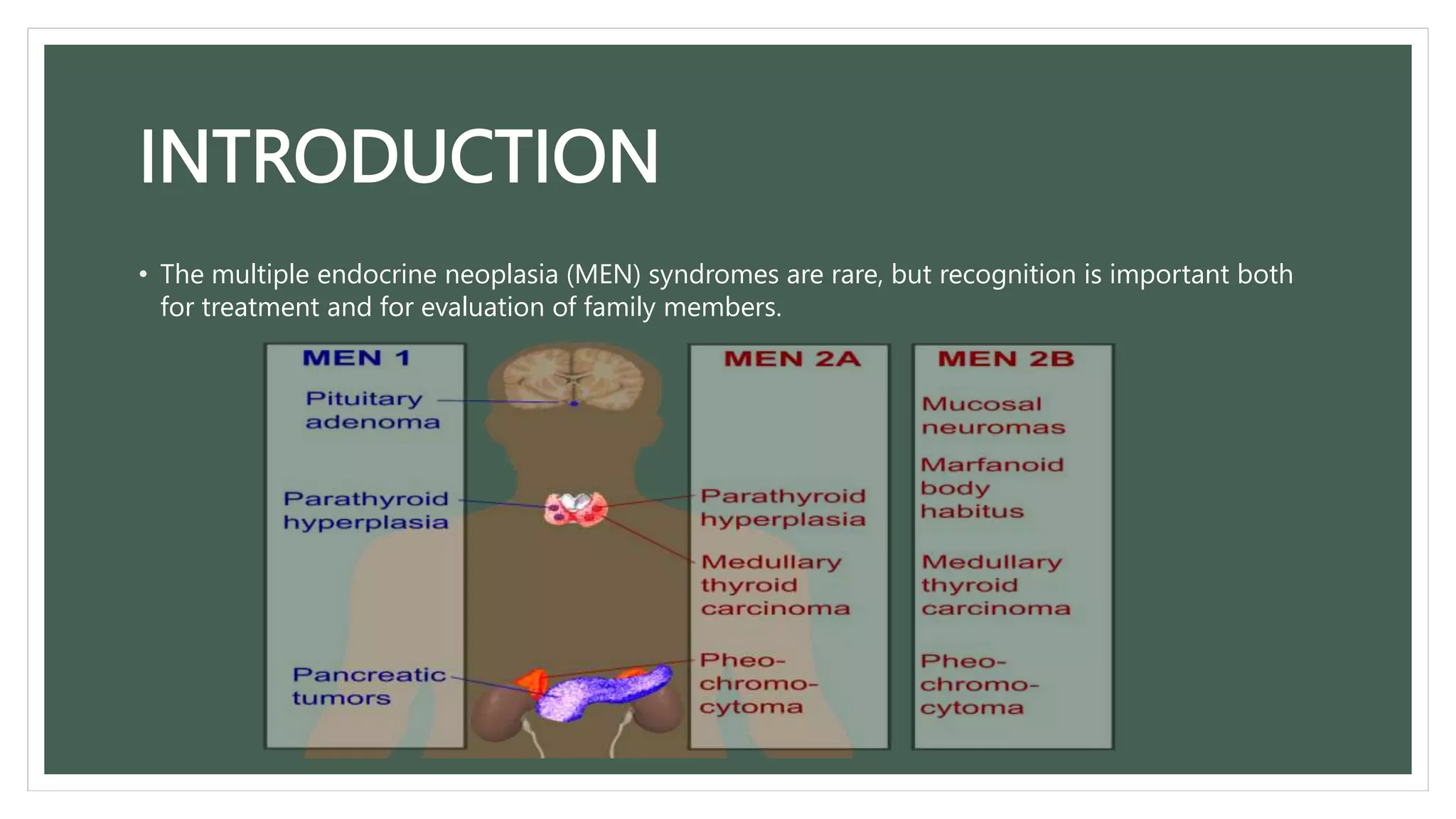
• The multiple endocrine neoplasia (MEN) syndromes are rare, but recognition is important both
for treatment and for evaluation of family members.
A CASE OF MEN1
• A 46-year-old female presented to us with multiple episodes of increased hunger, diaphoresis,
palpitations, tremors, anxiety, and dizziness for the last eight months. These episodes usually
occurred in the fasting state. During one such episode, her blood glucose recorded by
glucometer was 35 mg/dl.
• Her symptoms were reversed by intake of carbohydrate diet. Though Whipple’s triad was not
established as plasma glucose was not measured, the symptomatology did merit for further
evaluation . She had no history of diabetes, chronic liver disease, chronic kidney disease, or
history of intake of any drug known to cause hypoglycemia.
• On further probing, she revealed history of recurrent renal stones for the past 16 years. In
addition, she had history of galactorrhea and oligomenorrhea for the past two years. Apart from
this, there was no other significant history. She was the index case in her family.
• However, her family history did reveal that she was part of a large kindred. She had five siblings
and 22 step siblings from the five marriages of her father. Patient’s father who had similar
episodes of neuroglycopenic symptoms [suspected (?) insulinoma] and history of renal stones
had expired before evaluation.
• There was history suggestive of at least one MEN1-associated endocrine tumor among eight of
her siblings.
• After admission in our ward, the patient had an episode of spontaneous hypoglycemia, and
critical sample was analyzed that revealed non-ketotic hyperinsulinemic hypoglycemia (blood
glucose of 40 mg/dl with corresponding serum insulin 19.4 µU/ml and C peptide of 4.9 ng/ml,
blood ketones of 0.1 mmol/L) [3].
• Serum insulin and C peptide were measured by electrochemiluminescence while blood ketones
were measured on a finger prick test using a point of care device (normal range 0.4-0.5 mmol/L).
• Patient also had parathyroid hormone (PTH)-dependent hypercalcemia with hypercalciuria
[serum total calcium 12.3 mg/dl (normal range: 8.5-10.5 mg/dl), serum intact PTH of 210 pg/ml
(normal range 15-65 pg/ml), 24-hour urinary calcium of 450 mg/day (normal range < 250
mg/day)].
• Her serum prolactin level, measured by ECLIA, was also elevated, 92.6 ng/ml (normal range, 10-
29 ng/ml). Other pituitary hormones were within normal limits.
• A suspicion of MEN1 syndrome was made, which was later confirmed by positive screening test
for MEN1 gene mutation (Deletion: c.824-832delGGTACCCCA in exon 5 of MEN1 gene on whole
gene sequencing).
• For evaluation of PTH-dependent hypercalcemia, she underwent technetium-99m SESTAMIBI
scan that revealed involvement of three parathyroid glands (left superior, left inferior, and right
paratracheal) (Figures 2A, 2B). However, the four-dimensional computed tomography (4D CT)
(Figure 2C) and four-dimensional magnetic resonance imaging (4D MRI) (Figure 2D) showed
involvement of all the four glands.
•
Technetium-99m SESTAMIBI (A, B), 4D CT (C), and 4D MRI (D) scans of the patient showing parathyroid
adenomas
Early (A) and delayed (B) phase images of SESTAMIBI scan showing elongated areas of early increased tracer
uptake in right inferior, left superior, and left inferior parathyroid gland, persisting in delayed phase.
Coronal venous phase image of 4D CT (C) and coronal T2-weighted 4D MRI image (D) showing involvement of
all four parathyroid glands.
• For evaluation of hyperinsulinemic hypoglycemia, she underwent multiphase contrast-enhanced
computed tomography (CT) of abdomen that revealed two mass lesions in the pancreatic head
and tail, respectively
CT images showing pancreatic NET
Axial pancreatic phase images of multiphase contrast-enhanced CT images show hyper-
enhancing nodule in the pancreatic head (A) and another heterogeneous exophytic
lesion with eccentric nodular hyperenhancement in the pancreatic tail region (B) s/o
pancreatic neuroendocrine tumor (NET).
• Patient also underwent Ga-68-DOTANOC positron emission tomography (PET)/computed
tomography (CT) that revealed somatostatin receptor (SSTR) expressing lesions in the head of
the pancreas (1.6 cm x 1.5 cm) and tail of the pancreas (3.2 cm x 2.2 cm) (Figures 4A-4C).
• She also underwent endoscopic ultrasonography (EUS) that revealed multiple hypoechoic round
lesions in the pancreas (max: 3.5 cm x 2.1 cm x 0.8 cm) with vascularity in the lesions, two lesions
of diameter 2.1 cm and 1.1 cm in the body of pancreas, and four small lesions in the tail of
pancreas (~8 mm each).
Ga-68-DOTANOC scan images of the patient
Maximum intensity projection (MIP) image (A) and axial fused positron
emission tomography/computed tomography (PET/CT) images (B and C)
show two somatostatin receptor expressing lesions in the pancreatic
head (1.6 cm x 1.5 cm) (B) and tail region (3.2 cm x 2.2 cm) (C),
respectively.
• For evaluation of pituitary disease, she underwent an MRI sella that revealed a 9-mm pituitary
adenoma
MRI images showing pituitary adenoma
Coronal T2-weighted image (A) and early dynamic contrast-enhanced T1-weighted image (B)
show heterogenous lesion in the right half of the pituitary gland (~9 mm), showing central non-
enhancing T2 hyperintense area and eccentric nodular enhancement (hypoenhancement relative
to the rest of the pituitary gland), likely pituitary microadenoma.
• She underwent removal of all parathyroid glands, cervical thymectomy, and auto-
transplantation of normal parathyroid tissue into left forearm. Postoperatively, she was managed
with calcium supplements and calcitriol. She also underwent total pancreatico-duodenectomy
along with splenectomy. Post-surgery, glycemic control was achieved with insulin. Exocrine
functions were managed with pancreatic enzyme supplements. For prolactinoma, she was
started on tablet cabergoline 0.5 mg twice a week.
• Her brother, who was a 42-year-old male, also had symptoms suggestive of spontaneous
hypoglycemia corrected by intake of carbohydrate diet and acromegaloid habitus. He too was
admitted for evaluation and was found to have acromegaly with pituitary macroadenoma,
primary hyperparathyroidism with adenomas in all the four parathyroid glands, and
hyperinsulinemic hypoglycemia with multiple insulinomas
• He too underwent total parathyroidectomy along with auto-transplantation of normal
parathyroid tissue in non-dominant forearm, with cervical thymectomy. For pituitary
macroadenoma, he underwent trans-nasal trans-sphenoidal surgery (TNTS) with uneventful
recovery. However, he refused to undergo pancreatic surgery and instead resorted to medical
therapy with frequent, low carbohydrate meals.
• Multiple endocrine neoplasia type 1 (MEN1) is a rare heritable disorder classically characterized
by a predisposition
• to tumors of the parathyroid glands
• anterior pituitary
• pancreatic islet cells.
Copyrights apply
Primary hyperparathyroidism
• Multiple parathyroid tumors causing primary hyperparathyroidism are the initial manifestation
of MEN1,
• age 50 years
• asymptomatic or minimally symptomatic, and hypercalcemia is detected by routine (or
surveillance-based) biochemical screening.
• The biochemical diagnosis is upon the demonstration of hypercalcemia with inappropriately
high serum parathyroid hormone (PTH) concentrations
Pituitary adenomas
• The most common type of pituitary adenoma in MEN1 is a lactotroph adenoma, but
somatotroph, corticotroph, gonadotroph, and clinically nonfunctioning adenomas can also
occur
Pancreatic islet cell/gastrointestinal
endocrine tumors –
• Functioning pancreatic islet cell or gastrointestinal endocrine tumors become clinically apparent
in approximately one-third of patients with MEN1
• The most common cause of symptomatic disease is the Zollinger-Ellison (gastrinoma) syndrome
(ZES)
Copyrights apply
Screening of family members
• DNA testing for MEN1 gene mutations is available commercially and can provide valuable
information in specific situations
• The results generally do not dictate use of a major intervention established to improve
morbidity or mortality.
• We make determinations regarding MEN1 DNA testing on a case-by-case basis
• Biochemical screening (ie, serum calcium) of family members can be considered as a less costly
alternative to genetic screening, given the high penetrance of primary hyperparathyroidism in
MEN1, although its negative predictive value at younger ages is limited.
Monitoring for MEN-1 associated
tumors
• We carefully monitor all patients with MEN1, known MEN1 mutation carriers, and at-risk family
members with unknown carrier status for symptoms or signs of MEN1-associated tumors,
• such as nephrolithiasis,
• amenorrhea (women),
• galactorrhea,
• erectile dysfunction (men),
• peptic ulcer disease, diarrhea, and
• neuroglycopenic or sympathoadrenal symptoms from hypoglycemia.
• We typically measure serum calcium, PTH, and prolactin annually to detect asymptomatic
hyperparathyroidism and prolactinoma, respectively.
• Often, we perform additional surveillance using biochemical and imaging modalities.
• Others routinely use more aggressive screening protocols for MEN1-associated risks, beginning at
very early ages.
• The presence of MEN1 is defined clinically as the occurrence of two or more primary MEN1
tumor types, or in family members of a patient with a clinical diagnosis of MEN1, the occurrence
of one of the MEN1-associated tumors.
• Multiple parathyroid tumors causing primary hyperparathyroidism are the most common
component of MEN1,
• majority of patients are 50 years
• the initial manifestation of the disorder
OTHER TUMOURS
• Patients with MEN1 may have tumors other than those in the parathyroid and pituitary, and
pancreatic islet cells.
• The duodenum is a common site of tumors (gastrinomas) in these patients, and thymic or
bronchial carcinoid tumors, enterochromaffin cell-like gastric tumors, adrenocortical adenomas,
and lipomas are more frequent than in the general population.
• Other associated tumors include angiofibromas, angiomyolipomas, spinal cord ependymomas
and an increased risk of breast cancer has been reported
GENETICS
• MEN1 gene — The inheritance of classical multiple endocrine neoplasia type 1 (MEN1) follows
an autosomal dominant pattern, indicating that Mendelian inheritance of a single mutant gene
is responsible for transmitting the tumor predisposition within a given family.
• In 1988, genetic linkage analysis implicated a region on the long arm of chromosome 11
(11q13) as the site of the "MEN1 gene"
• A decade later, the critical gene in this region was identified, given the gene symbol
designation MEN1, and its protein product termed "menin" .
• MEN1 gene – The MEN1 tumor suppressor gene is located on the long arm of chromosome 11
(11q13). Its protein product is termed "menin."
• Over 1000 MEN1 gene mutations have been detected that inactivate or disrupt menin function.
• Inactivation of menin results in loss of tumor suppression.
• Families with the same types of mutations do not necessarily have the same clinical phenotype.
• Somatic mosaicism of pathogenic MEN1 mutations in tumor-prone tissues could be occurring in
some cases as well.
• Furthermore, rare phenocopies have been reported, ie, individuals within MEN1 kindreds who
were initially classified as having the syndrome when they developed a typical tumor (eg,
prolactinoma) but were then proven by DNA testing to have not inherited the pathologic
mutation.
Other genes
• Syndromes clinically related to but genetically distinct from MEN1 do exist.
• Germline AIP mutation, in the absence of MEN1 gene mutation, has been reported in the setting
of pituitary plus parathyroid neoplasia .
• Furthermore, mutations in the MEN1 gene are infrequent in kindreds with familial isolated
hyperparathyroidism and were not found in three kindreds with familial pituitary adenoma and
one with isolated familial acromegaly
Cyclin-dependent kinase inhibitor genes
• An inherited mutation of the p27 cyclin-dependent kinase (CDK) inhibitor gene, CDKN1B, was
reported in one kindred whose proband had hyperparathyroidism and acromegaly due to a
growth hormone-producing pituitary tumor; the proband's father had acromegaly, and the sister
had a renal angiomyolipoma.
• Germline CDKN1B mutation was also reported in a few other cases of MEN1 that collectively
exhibited features including hyperparathyroidism, Cushing's disease, cervical carcinoid tumor,
bilateral nonfunctioning adrenal masses, and Zollinger-Ellison syndrome with duodenal and
pancreatic masses .
• Rare germline mutations in three other CDK inhibitor genes, CDKN2B, CDKN2C, and CDKN1A,
encoding the p15, p18, and p21 proteins, respectively, have also been identified in this setting
and may collectively account for another 1 to 2 percent of MEN1-like cases without
detectable MEN1 mutations
• DNA testing — Direct DNA testing for MEN1 mutation is available for clinical use, has a useful
role in certain settings, and should be considered on an individual basis .
• However, in contrast to testing for RET gene mutations in MEN2, presymptomatic DNA
diagnosis has not been shown to yield equally clear benefit in preventing morbidity and
mortality in individuals at risk for MEN1.
PATHOGENESIS
• Patients with classical multiple endocrine neoplasia type 1 (MEN1) have often inherited one
inactivated copy of the MEN1 gene from an affected parent .
• The actual outgrowth of a tumor is thought to require the subsequent somatic inactivation,
often by gross deletion, of the remaining normal copy of the gene in one cell (so-called "two-
hit" effect described by Knudson).
• Such a parathyroid cell, as an example, would then be devoid of the MEN1 gene's normal tumor
suppressor function, and could gain a selective advantage over its neighbors, resulting in a
clonal proliferation .
Copyrights apply
MEN 2
• Multiple endocrine neoplasia type 2 (MEN2) is an autosomal dominant disorder with an
estimated prevalence of 1 per 30,000 in the general population.
• MEN2 is characterized by medullary thyroid carcinoma (MTC), pheochromocytoma, and primary
parathyroid hyperplasia.
• The genetic defect in MEN2 involves the RET proto-oncogene on chromosome 10.
• Autosomal Dominant Inheritance
• Affects Men and Women equally
• MEN2 is often first suspected when a patient is found to have one or more of the tumors, but
molecular DNA testing is now available for detecting asymptomatic patients with MEN2.
CLASSIFICATION
• Multiple endocrine neoplasia type 2 (MEN2) is subclassified into two distinct syndromes: types
2A (MEN2A) and 2B (MEN2B). Within MEN2A, there are four variants
●Classical MEN2A
●MEN2A with cutaneous lichen amyloidosis (CLA)
●MEN2A with Hirschsprung disease (HD)
●Familial medullary thyroid cancer (FMTC)
Copyrights apply
• In both MEN2A and MEN2B, there is an occurrence of multicentric tumor formation in all organs
where the RET proto-oncogene is expressed.
• The thyroid, parathyroid and adrenal glands, and accessory adrenals are at risk for developing
tumors that may reduce life expectancy and quality of life.
• Multiple endocrine neoplasia type 2A — Within MEN2A, there are four variants: classical
MEN2A, MEN2A with CLA, MEN2A with HD, and FMTC
• Classical MEN2A — Classical multiple endocrine neoplasia 2A (MEN2A) is the most common
MEN2A variant.
• It is a heritable predisposition to medullary thyroid cancer (MTC) (90%), pheochromocytoma(10-
50%), and primary parathyroid hyperplasia(10-20%).
• The frequency of the development of MTC, pheochromocytoma, and parathyroid hyperplasia
depends upon the specific RET mutation
MEN2A with cutaneous lichen
amyloidosis
• CLA (also known as lichen planus amyloidosis [LPA]) has been described in some families with
multiple endocrine neoplasia 2A (MEN2A), predominantly those with the RET codon 634
mutation, although it has also been reported in a patient with a codon 804 mutation .
• The diagnosis of CLA may precede the onset of clinically evident MTC.
• Patients with this variant develop pheochromocytomas and parathyroid hyperplasia with a
similar frequency as those with classical MEN2A.
Copyrights apply
MEN2A with Hirschsprung disease
HD is a motor disorder of the gut that is caused by the failure of neural crest cells (precursors of
enteric ganglion cells) to migrate completely during intestinal development.
The resulting aganglionic segment of the colon fails to relax, causing a functional obstruction.
At least eight genetic mutations have been identified in patients with HD.
The predominant gene affected is the RET proto-oncogene.
RET malfunction accounts for at least 50 percent of familial and 20 percent of sporadic cases of
HD.
• In one study, the prevalence of HD in MEN2 was 7.5 percent .
• The frequency of HD in MEN2A depends upon the specific RET mutation.
• The co-occurrence of HD and MEN2A is predominantly associated with RET mutations involving
codons 609, 611, 618, and 620 .
• In such patients, HD may be the first presentation of MEN2A .
Familial medullary thyroid cancer
• FMTC is a variant of MEN2A in which there is a strong predisposition to MTC but not the other
clinical manifestations of MEN2A (or 2B).
• The clinical distinction of FMTC from MEN2A may be difficult on statistical grounds in small
families; even in some large kindreds, the clinical designation of FMTC has been changed to
MEN2A after the diagnosis of pheochromocytoma or hyperparathyroidism in a family member.
• Because FMTC is the most limited variant of MEN2, making the wrong diagnosis of FMTC could
result in missing a pheochromocytoma in a patient with MEN2.
• Therefore, an FMTC kindred should be defined using the following rigorous criteria
• More than 10 carriers in the kindred
●Multiple carriers or affected members over the age of 50 years
●An adequate medical history, particularly in older family members
• Why pheochromocytomas and hyperparathyroidism infrequently develop in these families is still
unknown since many FMTC and MEN2A families carry identical RET mutations
• In rare families, both HD and FMTC appear to segregate .
• This may be related to the introduction of RET screening in the work-up of apparently sporadic
MTC and the more extensive search for RET mutations in non-hot spot regions of the gene.
Multiple endocrine neoplasia type 2B
• The frequency of MEN2B has been estimated at roughly 6 percent of all MEN2 patients .
• MEN2B shares the inherited predisposition to MTC and pheochromocytoma that occurs in
MEN2A.
• On the other hand, parathyroid hyperplasia is not a feature of this disorder.
• There are additional important clinical differences. Patients with MEN2B tend to have mucosal
neuromas, typically involving the lips and tongue, and intestinal ganglioneuromas.
• Disturbances of colonic function are common, including chronic constipation and megacolon.
• Many of these patients have development abnormalities, a Marfanoid habitus, and myelinated
corneal nerves.
• MTC is the most common component of the MEN2B syndrome.
• The tumor is often more aggressive
• and of earlier onset
• early diagnosis and prevention are particularly critical.
MOLECULAR GENETICS
• Multiple endocrine neoplasia types 2A (MEN2A) and 2B (MEN2B) are inherited in an autosomal
dominant pattern with very high penetrance.
• The genetic defect in these disorders involves the RET proto-oncogene on chromosome 10
Structure and function of the normal RET
proto-oncogene and its product
• The RET protein is a receptor tyrosine kinase that appears to transduce growth and
differentiation signals in several developing tissues, including those derived from the neural
crest.
• The protein consists of an extracellular part with a ligand-binding domain, a cadherin (calcium-
dependent cell adhesion)-like domain, and a cysteine-rich domain close to the cell membrane.
• It has a single transmembrane domain and an intracellular part with two tyrosine kinase
subdomains, TK1 and TK2.
Copyrights apply
• Activation of RET occurs by the binding of one of its four ligands,
• glial cell line-derived neurotrophic factor (GDNF),
• neurturin (TNT),
• artemin, or
• persephin,
• which require their specific co-receptors GDNF-receptor-family-a-1 (GFR-a-1), GFR-a-2, GFR-a-
3, and GFR-a-4, respectively.
• Interaction of these molecules results in dimerization of RET, cross-autophosphorylation, and
subsequent phosphorylation of intracellular substrates
• RET is expressed in the C-cells of the thyroid gland, adrenal medulla, neurons, and in other
tissues.
Structure and function of the mutated
RET proto-oncogene and its product
• There are differences but much overlap in the specific RET gene mutations underlying the
MEN2A variants and MEN2B.
• Several studies, including one from the International RET Mutation Consortium [25], have
described the relationships between the site of mutation and the type of disease.
• Germline mutations — The germline RET mutations in MEN2 result in a gain of function
• This is different from many other inherited predispositions to neoplasia which are due to
heritable "loss-of-function" mutations that inactivate tumor suppressor proteins.
Copyrights apply
• Germline mutations in the extracellular domain — The majority of mutations in MEN2A kindreds
involve one of five cysteine residues in the cysteine-rich region of the RET protein's extracellular
domain encoded in RET exons 10 (codons 609, 611, 618, and 620) or 11 (codon 634) .
• These extracellular MEN2A/familial medullary thyroid cancer (FMTC) cysteine mutations lead to
a ligand-independent dimerization of receptor molecules and constitutive activation of
intracellular signaling pathways .
• A mutation in codon 634 in exon 11 is associated with hyperparathyroidism and
pheochromocytoma in MEN2A and is the most common genetic defect in this disorder
• The penetrance of hyperparathyroidism in those with mutations at this site is approximately 20%
• Germline mutations in the intracellular tyrosine kinase domains — Germline mutations in
codons 768 (exon 13), 804 (exon 14), and 891 (exon 15) are predominantly associated with
FMTC, but they account for only a minority of cases of this disorder.
• These sites are part of the intracellular tyrosine kinase domain
• Less common mutations in MEN2A/FMTC occur in exon 13 (codons 790 and 791)
• Codon 804 mutations have been identified as gatekeeper mutations. Alterations at this site
influence access to the RET ATP-binding domain and can result in reduced sensitivity to some
RET-targeting multikinase inhibitors
• MEN2B-associated tumors are caused by mutations in the intracellular TK2 domain.
• A single 918 Met to Thr mutation in exon 16 is responsible for over 95 percent of cases of
MEN2B and is found only in this disorder
• Met 918 is a critical component of the substrate recognition pocket in the tyrosine kinase
catalytic core of the RET protein.
• In more than 50 percent of cases of MEN2B with codon 918 affected, mutations occur as new
(de novo) germline mutations .
• Another mutation, alanine to phenylalanine at codon 883 in exon 15, has been found in some
unrelated MEN2B kindreds .
• Atypical MEN2B may occur by dual (tandem) mutations in codons 804 and 806 or 804 and 904
Copyrights apply
Genetic screening
• Advances in the molecular genetics underlying the MEN2 syndromes have resulted in DNA
testing becoming the optimal test for their detection.
• In contrast to MEN1, in which the long-term benefit of early diagnosis by genetic screening is
not well established, early diagnosis by screening of "at-risk" family members in MEN2 kindreds
is essential because MTC is a life-threatening disease that can be cured or prevented by early
thyroidectomy
When RET mutation is unknown
• Biochemical testing — For closely related MEN2 family members who refuse DNA analysis for
themselves or their children, or for families who meet the clinical criteria for MEN2 but have
negative sequencing of the entire RET coding region, biochemical testing can be performed to
detect MEN2-related tumors.
• If biochemical testing is used, yearly testing starting at age five and continuing until at least age
35 years (or until a positive test occurs) is necessary
• Either a pentagastrin or a calcium stimulation test can be used to screen for C-cell
hyperplasia/MTC.
• Where available (not in the United States), pentagastrin is the preferred stimulation test.
• Testing should also include plasma fractionated metanephrines or 24-hour urinary
metanephrines and normetanephrines (to screen for pheochromocytoma) and serum calcium
(to screen for hyperparathyroidism)
Pentagastrin stimulation test
• The pentagastrin stimulation test uses a slow intravenous injection of pentagastrin (0.5 mcg/kg body
weight) over three minutes.
• Blood samples for calcitonin are obtained at baseline and two and five minutes after pentagastrin
infusion
• If stimulated calcitonin values are ≥200 pg/mL, MTC is likely and thyroidectomy and
lymphadenectomy are required.
• If values are <100 pg/mL, the risk of MTC is low and periodic monitoring of basal and stimulated
serum calcitonin levels is recommended.
• If the stimulated calcitonin values are between 100 and 200 pg/mL, the risk is uncertain. Such values
could be indicative of C-cell hyperplasia or micro MTC. Some advise surgery , while others
observation (following calcitonin levels) .
• Side effects of pentagastrin include abdominal cramping, extremity paresthesia, and feeling of
warmth, lasting up to one to two minutes
• . Pentagastrin is not available in many countries, including the United States.
Calcium stimulation test
• The calcium stimulation test uses an infusion of calcium gluconate (2.5 mg elemental
calcium/kg body weight over 30 seconds) administered in a fasting state (no food after
midnight) .
• Blood samples for calcitonin are obtained at baseline and two and five minutes after the
stimulus.
• The most common side effects are temporary flushing and feeling of warmth (98 percent) .
• Facial paresthesias are less common (20 percent).
Medical management
• Calcimimetic agents (eg, cinacalcet) activate the calcium-sensing receptor in the parathyroid
gland, thereby inhibiting PTH secretion.
• Cinacalcet also appears to decrease the serum calcium concentration in patients with primary
hyperparathyroidism due to MEN1
• Cinacalcet may be beneficial for patients with MEN1 and recurrent symptomatic primary
hyperparathyroidism who are not candidates for or refuse repeated surgical procedures.
• However, there are no long-term data evaluating the effect of cinacalcet on clinically important
outcomes (eg, bone density, fracture, nephrolithiasis, mortality) in patients with MEN1.
Established disease
• Among patients with multiple endocrine neoplasia type 2 (MEN2), virtually all develop clinically
apparent medullary thyroid cancer (MTC), often early in life .
• Patients with MTC can be cured only by complete resection of the thyroid tumor and any local
and regional metastases.
• ATA (American Thyroid Association) recommend total thyroidectomy for patients with hereditary
forms of MTC (MEN types 2A [MEN2A] and 2B [MEN2B]).
• For patients with bilateral pheochromocytomas, bilateral adrenalectomy is necessary.
• It should also be considered in a patient with unilateral disease when other family members
have had unusually aggressive bilateral adrenal medullary disease.
• For most other patients with a unilateral pheochromocytoma, unilateral adrenalectomy is the
treatment of choice.
Thankyou

MEN SYNDROMESAND GENETIC BASIS.pptx

  • 1.
    MEN SYNDROMES AND GENETICBASIS BY DR SRUTHI MEENAXSHI
  • 2.
    INTRODUCTION • The multipleendocrine neoplasia (MEN) syndromes are rare, but recognition is important both for treatment and for evaluation of family members.
  • 4.
    A CASE OFMEN1 • A 46-year-old female presented to us with multiple episodes of increased hunger, diaphoresis, palpitations, tremors, anxiety, and dizziness for the last eight months. These episodes usually occurred in the fasting state. During one such episode, her blood glucose recorded by glucometer was 35 mg/dl. • Her symptoms were reversed by intake of carbohydrate diet. Though Whipple’s triad was not established as plasma glucose was not measured, the symptomatology did merit for further evaluation . She had no history of diabetes, chronic liver disease, chronic kidney disease, or history of intake of any drug known to cause hypoglycemia.
  • 5.
    • On furtherprobing, she revealed history of recurrent renal stones for the past 16 years. In addition, she had history of galactorrhea and oligomenorrhea for the past two years. Apart from this, there was no other significant history. She was the index case in her family. • However, her family history did reveal that she was part of a large kindred. She had five siblings and 22 step siblings from the five marriages of her father. Patient’s father who had similar episodes of neuroglycopenic symptoms [suspected (?) insulinoma] and history of renal stones had expired before evaluation. • There was history suggestive of at least one MEN1-associated endocrine tumor among eight of her siblings.
  • 6.
    • After admissionin our ward, the patient had an episode of spontaneous hypoglycemia, and critical sample was analyzed that revealed non-ketotic hyperinsulinemic hypoglycemia (blood glucose of 40 mg/dl with corresponding serum insulin 19.4 µU/ml and C peptide of 4.9 ng/ml, blood ketones of 0.1 mmol/L) [3]. • Serum insulin and C peptide were measured by electrochemiluminescence while blood ketones were measured on a finger prick test using a point of care device (normal range 0.4-0.5 mmol/L). • Patient also had parathyroid hormone (PTH)-dependent hypercalcemia with hypercalciuria [serum total calcium 12.3 mg/dl (normal range: 8.5-10.5 mg/dl), serum intact PTH of 210 pg/ml (normal range 15-65 pg/ml), 24-hour urinary calcium of 450 mg/day (normal range < 250 mg/day)]. • Her serum prolactin level, measured by ECLIA, was also elevated, 92.6 ng/ml (normal range, 10- 29 ng/ml). Other pituitary hormones were within normal limits.
  • 7.
    • A suspicionof MEN1 syndrome was made, which was later confirmed by positive screening test for MEN1 gene mutation (Deletion: c.824-832delGGTACCCCA in exon 5 of MEN1 gene on whole gene sequencing). • For evaluation of PTH-dependent hypercalcemia, she underwent technetium-99m SESTAMIBI scan that revealed involvement of three parathyroid glands (left superior, left inferior, and right paratracheal) (Figures 2A, 2B). However, the four-dimensional computed tomography (4D CT) (Figure 2C) and four-dimensional magnetic resonance imaging (4D MRI) (Figure 2D) showed involvement of all the four glands. •
  • 8.
    Technetium-99m SESTAMIBI (A,B), 4D CT (C), and 4D MRI (D) scans of the patient showing parathyroid adenomas Early (A) and delayed (B) phase images of SESTAMIBI scan showing elongated areas of early increased tracer uptake in right inferior, left superior, and left inferior parathyroid gland, persisting in delayed phase. Coronal venous phase image of 4D CT (C) and coronal T2-weighted 4D MRI image (D) showing involvement of all four parathyroid glands.
  • 9.
    • For evaluationof hyperinsulinemic hypoglycemia, she underwent multiphase contrast-enhanced computed tomography (CT) of abdomen that revealed two mass lesions in the pancreatic head and tail, respectively
  • 10.
    CT images showingpancreatic NET Axial pancreatic phase images of multiphase contrast-enhanced CT images show hyper- enhancing nodule in the pancreatic head (A) and another heterogeneous exophytic lesion with eccentric nodular hyperenhancement in the pancreatic tail region (B) s/o pancreatic neuroendocrine tumor (NET).
  • 11.
    • Patient alsounderwent Ga-68-DOTANOC positron emission tomography (PET)/computed tomography (CT) that revealed somatostatin receptor (SSTR) expressing lesions in the head of the pancreas (1.6 cm x 1.5 cm) and tail of the pancreas (3.2 cm x 2.2 cm) (Figures 4A-4C). • She also underwent endoscopic ultrasonography (EUS) that revealed multiple hypoechoic round lesions in the pancreas (max: 3.5 cm x 2.1 cm x 0.8 cm) with vascularity in the lesions, two lesions of diameter 2.1 cm and 1.1 cm in the body of pancreas, and four small lesions in the tail of pancreas (~8 mm each).
  • 12.
    Ga-68-DOTANOC scan imagesof the patient Maximum intensity projection (MIP) image (A) and axial fused positron emission tomography/computed tomography (PET/CT) images (B and C) show two somatostatin receptor expressing lesions in the pancreatic head (1.6 cm x 1.5 cm) (B) and tail region (3.2 cm x 2.2 cm) (C), respectively.
  • 13.
    • For evaluationof pituitary disease, she underwent an MRI sella that revealed a 9-mm pituitary adenoma
  • 14.
    MRI images showingpituitary adenoma Coronal T2-weighted image (A) and early dynamic contrast-enhanced T1-weighted image (B) show heterogenous lesion in the right half of the pituitary gland (~9 mm), showing central non- enhancing T2 hyperintense area and eccentric nodular enhancement (hypoenhancement relative to the rest of the pituitary gland), likely pituitary microadenoma.
  • 15.
    • She underwentremoval of all parathyroid glands, cervical thymectomy, and auto- transplantation of normal parathyroid tissue into left forearm. Postoperatively, she was managed with calcium supplements and calcitriol. She also underwent total pancreatico-duodenectomy along with splenectomy. Post-surgery, glycemic control was achieved with insulin. Exocrine functions were managed with pancreatic enzyme supplements. For prolactinoma, she was started on tablet cabergoline 0.5 mg twice a week.
  • 16.
    • Her brother,who was a 42-year-old male, also had symptoms suggestive of spontaneous hypoglycemia corrected by intake of carbohydrate diet and acromegaloid habitus. He too was admitted for evaluation and was found to have acromegaly with pituitary macroadenoma, primary hyperparathyroidism with adenomas in all the four parathyroid glands, and hyperinsulinemic hypoglycemia with multiple insulinomas • He too underwent total parathyroidectomy along with auto-transplantation of normal parathyroid tissue in non-dominant forearm, with cervical thymectomy. For pituitary macroadenoma, he underwent trans-nasal trans-sphenoidal surgery (TNTS) with uneventful recovery. However, he refused to undergo pancreatic surgery and instead resorted to medical therapy with frequent, low carbohydrate meals.
  • 17.
    • Multiple endocrineneoplasia type 1 (MEN1) is a rare heritable disorder classically characterized by a predisposition • to tumors of the parathyroid glands • anterior pituitary • pancreatic islet cells.
  • 18.
  • 19.
    Primary hyperparathyroidism • Multipleparathyroid tumors causing primary hyperparathyroidism are the initial manifestation of MEN1, • age 50 years • asymptomatic or minimally symptomatic, and hypercalcemia is detected by routine (or surveillance-based) biochemical screening. • The biochemical diagnosis is upon the demonstration of hypercalcemia with inappropriately high serum parathyroid hormone (PTH) concentrations
  • 20.
    Pituitary adenomas • Themost common type of pituitary adenoma in MEN1 is a lactotroph adenoma, but somatotroph, corticotroph, gonadotroph, and clinically nonfunctioning adenomas can also occur
  • 21.
    Pancreatic islet cell/gastrointestinal endocrinetumors – • Functioning pancreatic islet cell or gastrointestinal endocrine tumors become clinically apparent in approximately one-third of patients with MEN1 • The most common cause of symptomatic disease is the Zollinger-Ellison (gastrinoma) syndrome (ZES)
  • 22.
  • 23.
    Screening of familymembers • DNA testing for MEN1 gene mutations is available commercially and can provide valuable information in specific situations • The results generally do not dictate use of a major intervention established to improve morbidity or mortality. • We make determinations regarding MEN1 DNA testing on a case-by-case basis • Biochemical screening (ie, serum calcium) of family members can be considered as a less costly alternative to genetic screening, given the high penetrance of primary hyperparathyroidism in MEN1, although its negative predictive value at younger ages is limited.
  • 24.
    Monitoring for MEN-1associated tumors • We carefully monitor all patients with MEN1, known MEN1 mutation carriers, and at-risk family members with unknown carrier status for symptoms or signs of MEN1-associated tumors, • such as nephrolithiasis, • amenorrhea (women), • galactorrhea, • erectile dysfunction (men), • peptic ulcer disease, diarrhea, and • neuroglycopenic or sympathoadrenal symptoms from hypoglycemia. • We typically measure serum calcium, PTH, and prolactin annually to detect asymptomatic hyperparathyroidism and prolactinoma, respectively. • Often, we perform additional surveillance using biochemical and imaging modalities. • Others routinely use more aggressive screening protocols for MEN1-associated risks, beginning at very early ages.
  • 25.
    • The presenceof MEN1 is defined clinically as the occurrence of two or more primary MEN1 tumor types, or in family members of a patient with a clinical diagnosis of MEN1, the occurrence of one of the MEN1-associated tumors. • Multiple parathyroid tumors causing primary hyperparathyroidism are the most common component of MEN1, • majority of patients are 50 years • the initial manifestation of the disorder
  • 26.
    OTHER TUMOURS • Patientswith MEN1 may have tumors other than those in the parathyroid and pituitary, and pancreatic islet cells. • The duodenum is a common site of tumors (gastrinomas) in these patients, and thymic or bronchial carcinoid tumors, enterochromaffin cell-like gastric tumors, adrenocortical adenomas, and lipomas are more frequent than in the general population. • Other associated tumors include angiofibromas, angiomyolipomas, spinal cord ependymomas and an increased risk of breast cancer has been reported
  • 28.
    GENETICS • MEN1 gene— The inheritance of classical multiple endocrine neoplasia type 1 (MEN1) follows an autosomal dominant pattern, indicating that Mendelian inheritance of a single mutant gene is responsible for transmitting the tumor predisposition within a given family. • In 1988, genetic linkage analysis implicated a region on the long arm of chromosome 11 (11q13) as the site of the "MEN1 gene" • A decade later, the critical gene in this region was identified, given the gene symbol designation MEN1, and its protein product termed "menin" .
  • 29.
    • MEN1 gene– The MEN1 tumor suppressor gene is located on the long arm of chromosome 11 (11q13). Its protein product is termed "menin." • Over 1000 MEN1 gene mutations have been detected that inactivate or disrupt menin function. • Inactivation of menin results in loss of tumor suppression. • Families with the same types of mutations do not necessarily have the same clinical phenotype.
  • 30.
    • Somatic mosaicismof pathogenic MEN1 mutations in tumor-prone tissues could be occurring in some cases as well. • Furthermore, rare phenocopies have been reported, ie, individuals within MEN1 kindreds who were initially classified as having the syndrome when they developed a typical tumor (eg, prolactinoma) but were then proven by DNA testing to have not inherited the pathologic mutation.
  • 31.
    Other genes • Syndromesclinically related to but genetically distinct from MEN1 do exist. • Germline AIP mutation, in the absence of MEN1 gene mutation, has been reported in the setting of pituitary plus parathyroid neoplasia . • Furthermore, mutations in the MEN1 gene are infrequent in kindreds with familial isolated hyperparathyroidism and were not found in three kindreds with familial pituitary adenoma and one with isolated familial acromegaly
  • 32.
    Cyclin-dependent kinase inhibitorgenes • An inherited mutation of the p27 cyclin-dependent kinase (CDK) inhibitor gene, CDKN1B, was reported in one kindred whose proband had hyperparathyroidism and acromegaly due to a growth hormone-producing pituitary tumor; the proband's father had acromegaly, and the sister had a renal angiomyolipoma. • Germline CDKN1B mutation was also reported in a few other cases of MEN1 that collectively exhibited features including hyperparathyroidism, Cushing's disease, cervical carcinoid tumor, bilateral nonfunctioning adrenal masses, and Zollinger-Ellison syndrome with duodenal and pancreatic masses .
  • 33.
    • Rare germlinemutations in three other CDK inhibitor genes, CDKN2B, CDKN2C, and CDKN1A, encoding the p15, p18, and p21 proteins, respectively, have also been identified in this setting and may collectively account for another 1 to 2 percent of MEN1-like cases without detectable MEN1 mutations
  • 34.
    • DNA testing— Direct DNA testing for MEN1 mutation is available for clinical use, has a useful role in certain settings, and should be considered on an individual basis . • However, in contrast to testing for RET gene mutations in MEN2, presymptomatic DNA diagnosis has not been shown to yield equally clear benefit in preventing morbidity and mortality in individuals at risk for MEN1.
  • 35.
    PATHOGENESIS • Patients withclassical multiple endocrine neoplasia type 1 (MEN1) have often inherited one inactivated copy of the MEN1 gene from an affected parent . • The actual outgrowth of a tumor is thought to require the subsequent somatic inactivation, often by gross deletion, of the remaining normal copy of the gene in one cell (so-called "two- hit" effect described by Knudson). • Such a parathyroid cell, as an example, would then be devoid of the MEN1 gene's normal tumor suppressor function, and could gain a selective advantage over its neighbors, resulting in a clonal proliferation .
  • 36.
  • 37.
    MEN 2 • Multipleendocrine neoplasia type 2 (MEN2) is an autosomal dominant disorder with an estimated prevalence of 1 per 30,000 in the general population. • MEN2 is characterized by medullary thyroid carcinoma (MTC), pheochromocytoma, and primary parathyroid hyperplasia. • The genetic defect in MEN2 involves the RET proto-oncogene on chromosome 10. • Autosomal Dominant Inheritance • Affects Men and Women equally
  • 38.
    • MEN2 isoften first suspected when a patient is found to have one or more of the tumors, but molecular DNA testing is now available for detecting asymptomatic patients with MEN2.
  • 39.
    CLASSIFICATION • Multiple endocrineneoplasia type 2 (MEN2) is subclassified into two distinct syndromes: types 2A (MEN2A) and 2B (MEN2B). Within MEN2A, there are four variants ●Classical MEN2A ●MEN2A with cutaneous lichen amyloidosis (CLA) ●MEN2A with Hirschsprung disease (HD) ●Familial medullary thyroid cancer (FMTC)
  • 40.
  • 41.
    • In bothMEN2A and MEN2B, there is an occurrence of multicentric tumor formation in all organs where the RET proto-oncogene is expressed. • The thyroid, parathyroid and adrenal glands, and accessory adrenals are at risk for developing tumors that may reduce life expectancy and quality of life.
  • 42.
    • Multiple endocrineneoplasia type 2A — Within MEN2A, there are four variants: classical MEN2A, MEN2A with CLA, MEN2A with HD, and FMTC • Classical MEN2A — Classical multiple endocrine neoplasia 2A (MEN2A) is the most common MEN2A variant. • It is a heritable predisposition to medullary thyroid cancer (MTC) (90%), pheochromocytoma(10- 50%), and primary parathyroid hyperplasia(10-20%). • The frequency of the development of MTC, pheochromocytoma, and parathyroid hyperplasia depends upon the specific RET mutation
  • 43.
    MEN2A with cutaneouslichen amyloidosis • CLA (also known as lichen planus amyloidosis [LPA]) has been described in some families with multiple endocrine neoplasia 2A (MEN2A), predominantly those with the RET codon 634 mutation, although it has also been reported in a patient with a codon 804 mutation . • The diagnosis of CLA may precede the onset of clinically evident MTC. • Patients with this variant develop pheochromocytomas and parathyroid hyperplasia with a similar frequency as those with classical MEN2A.
  • 44.
  • 45.
    MEN2A with Hirschsprungdisease HD is a motor disorder of the gut that is caused by the failure of neural crest cells (precursors of enteric ganglion cells) to migrate completely during intestinal development. The resulting aganglionic segment of the colon fails to relax, causing a functional obstruction. At least eight genetic mutations have been identified in patients with HD. The predominant gene affected is the RET proto-oncogene. RET malfunction accounts for at least 50 percent of familial and 20 percent of sporadic cases of HD.
  • 46.
    • In onestudy, the prevalence of HD in MEN2 was 7.5 percent . • The frequency of HD in MEN2A depends upon the specific RET mutation. • The co-occurrence of HD and MEN2A is predominantly associated with RET mutations involving codons 609, 611, 618, and 620 . • In such patients, HD may be the first presentation of MEN2A .
  • 47.
    Familial medullary thyroidcancer • FMTC is a variant of MEN2A in which there is a strong predisposition to MTC but not the other clinical manifestations of MEN2A (or 2B). • The clinical distinction of FMTC from MEN2A may be difficult on statistical grounds in small families; even in some large kindreds, the clinical designation of FMTC has been changed to MEN2A after the diagnosis of pheochromocytoma or hyperparathyroidism in a family member. • Because FMTC is the most limited variant of MEN2, making the wrong diagnosis of FMTC could result in missing a pheochromocytoma in a patient with MEN2.
  • 48.
    • Therefore, anFMTC kindred should be defined using the following rigorous criteria • More than 10 carriers in the kindred ●Multiple carriers or affected members over the age of 50 years ●An adequate medical history, particularly in older family members
  • 49.
    • Why pheochromocytomasand hyperparathyroidism infrequently develop in these families is still unknown since many FMTC and MEN2A families carry identical RET mutations • In rare families, both HD and FMTC appear to segregate . • This may be related to the introduction of RET screening in the work-up of apparently sporadic MTC and the more extensive search for RET mutations in non-hot spot regions of the gene.
  • 50.
    Multiple endocrine neoplasiatype 2B • The frequency of MEN2B has been estimated at roughly 6 percent of all MEN2 patients . • MEN2B shares the inherited predisposition to MTC and pheochromocytoma that occurs in MEN2A. • On the other hand, parathyroid hyperplasia is not a feature of this disorder.
  • 51.
    • There areadditional important clinical differences. Patients with MEN2B tend to have mucosal neuromas, typically involving the lips and tongue, and intestinal ganglioneuromas. • Disturbances of colonic function are common, including chronic constipation and megacolon. • Many of these patients have development abnormalities, a Marfanoid habitus, and myelinated corneal nerves.
  • 52.
    • MTC isthe most common component of the MEN2B syndrome. • The tumor is often more aggressive • and of earlier onset • early diagnosis and prevention are particularly critical.
  • 53.
    MOLECULAR GENETICS • Multipleendocrine neoplasia types 2A (MEN2A) and 2B (MEN2B) are inherited in an autosomal dominant pattern with very high penetrance. • The genetic defect in these disorders involves the RET proto-oncogene on chromosome 10
  • 54.
    Structure and functionof the normal RET proto-oncogene and its product • The RET protein is a receptor tyrosine kinase that appears to transduce growth and differentiation signals in several developing tissues, including those derived from the neural crest. • The protein consists of an extracellular part with a ligand-binding domain, a cadherin (calcium- dependent cell adhesion)-like domain, and a cysteine-rich domain close to the cell membrane. • It has a single transmembrane domain and an intracellular part with two tyrosine kinase subdomains, TK1 and TK2.
  • 55.
  • 56.
    • Activation ofRET occurs by the binding of one of its four ligands, • glial cell line-derived neurotrophic factor (GDNF), • neurturin (TNT), • artemin, or • persephin, • which require their specific co-receptors GDNF-receptor-family-a-1 (GFR-a-1), GFR-a-2, GFR-a- 3, and GFR-a-4, respectively. • Interaction of these molecules results in dimerization of RET, cross-autophosphorylation, and subsequent phosphorylation of intracellular substrates • RET is expressed in the C-cells of the thyroid gland, adrenal medulla, neurons, and in other tissues.
  • 57.
    Structure and functionof the mutated RET proto-oncogene and its product • There are differences but much overlap in the specific RET gene mutations underlying the MEN2A variants and MEN2B. • Several studies, including one from the International RET Mutation Consortium [25], have described the relationships between the site of mutation and the type of disease.
  • 58.
    • Germline mutations— The germline RET mutations in MEN2 result in a gain of function • This is different from many other inherited predispositions to neoplasia which are due to heritable "loss-of-function" mutations that inactivate tumor suppressor proteins.
  • 59.
  • 60.
    • Germline mutationsin the extracellular domain — The majority of mutations in MEN2A kindreds involve one of five cysteine residues in the cysteine-rich region of the RET protein's extracellular domain encoded in RET exons 10 (codons 609, 611, 618, and 620) or 11 (codon 634) . • These extracellular MEN2A/familial medullary thyroid cancer (FMTC) cysteine mutations lead to a ligand-independent dimerization of receptor molecules and constitutive activation of intracellular signaling pathways . • A mutation in codon 634 in exon 11 is associated with hyperparathyroidism and pheochromocytoma in MEN2A and is the most common genetic defect in this disorder • The penetrance of hyperparathyroidism in those with mutations at this site is approximately 20%
  • 61.
    • Germline mutationsin the intracellular tyrosine kinase domains — Germline mutations in codons 768 (exon 13), 804 (exon 14), and 891 (exon 15) are predominantly associated with FMTC, but they account for only a minority of cases of this disorder. • These sites are part of the intracellular tyrosine kinase domain • Less common mutations in MEN2A/FMTC occur in exon 13 (codons 790 and 791) • Codon 804 mutations have been identified as gatekeeper mutations. Alterations at this site influence access to the RET ATP-binding domain and can result in reduced sensitivity to some RET-targeting multikinase inhibitors
  • 62.
    • MEN2B-associated tumorsare caused by mutations in the intracellular TK2 domain. • A single 918 Met to Thr mutation in exon 16 is responsible for over 95 percent of cases of MEN2B and is found only in this disorder • Met 918 is a critical component of the substrate recognition pocket in the tyrosine kinase catalytic core of the RET protein. • In more than 50 percent of cases of MEN2B with codon 918 affected, mutations occur as new (de novo) germline mutations . • Another mutation, alanine to phenylalanine at codon 883 in exon 15, has been found in some unrelated MEN2B kindreds . • Atypical MEN2B may occur by dual (tandem) mutations in codons 804 and 806 or 804 and 904
  • 63.
  • 64.
    Genetic screening • Advancesin the molecular genetics underlying the MEN2 syndromes have resulted in DNA testing becoming the optimal test for their detection. • In contrast to MEN1, in which the long-term benefit of early diagnosis by genetic screening is not well established, early diagnosis by screening of "at-risk" family members in MEN2 kindreds is essential because MTC is a life-threatening disease that can be cured or prevented by early thyroidectomy
  • 65.
    When RET mutationis unknown • Biochemical testing — For closely related MEN2 family members who refuse DNA analysis for themselves or their children, or for families who meet the clinical criteria for MEN2 but have negative sequencing of the entire RET coding region, biochemical testing can be performed to detect MEN2-related tumors. • If biochemical testing is used, yearly testing starting at age five and continuing until at least age 35 years (or until a positive test occurs) is necessary
  • 66.
    • Either apentagastrin or a calcium stimulation test can be used to screen for C-cell hyperplasia/MTC. • Where available (not in the United States), pentagastrin is the preferred stimulation test. • Testing should also include plasma fractionated metanephrines or 24-hour urinary metanephrines and normetanephrines (to screen for pheochromocytoma) and serum calcium (to screen for hyperparathyroidism)
  • 67.
    Pentagastrin stimulation test •The pentagastrin stimulation test uses a slow intravenous injection of pentagastrin (0.5 mcg/kg body weight) over three minutes. • Blood samples for calcitonin are obtained at baseline and two and five minutes after pentagastrin infusion • If stimulated calcitonin values are ≥200 pg/mL, MTC is likely and thyroidectomy and lymphadenectomy are required. • If values are <100 pg/mL, the risk of MTC is low and periodic monitoring of basal and stimulated serum calcitonin levels is recommended. • If the stimulated calcitonin values are between 100 and 200 pg/mL, the risk is uncertain. Such values could be indicative of C-cell hyperplasia or micro MTC. Some advise surgery , while others observation (following calcitonin levels) . • Side effects of pentagastrin include abdominal cramping, extremity paresthesia, and feeling of warmth, lasting up to one to two minutes • . Pentagastrin is not available in many countries, including the United States.
  • 68.
    Calcium stimulation test •The calcium stimulation test uses an infusion of calcium gluconate (2.5 mg elemental calcium/kg body weight over 30 seconds) administered in a fasting state (no food after midnight) . • Blood samples for calcitonin are obtained at baseline and two and five minutes after the stimulus. • The most common side effects are temporary flushing and feeling of warmth (98 percent) . • Facial paresthesias are less common (20 percent).
  • 69.
    Medical management • Calcimimeticagents (eg, cinacalcet) activate the calcium-sensing receptor in the parathyroid gland, thereby inhibiting PTH secretion. • Cinacalcet also appears to decrease the serum calcium concentration in patients with primary hyperparathyroidism due to MEN1 • Cinacalcet may be beneficial for patients with MEN1 and recurrent symptomatic primary hyperparathyroidism who are not candidates for or refuse repeated surgical procedures. • However, there are no long-term data evaluating the effect of cinacalcet on clinically important outcomes (eg, bone density, fracture, nephrolithiasis, mortality) in patients with MEN1.
  • 70.
    Established disease • Amongpatients with multiple endocrine neoplasia type 2 (MEN2), virtually all develop clinically apparent medullary thyroid cancer (MTC), often early in life . • Patients with MTC can be cured only by complete resection of the thyroid tumor and any local and regional metastases. • ATA (American Thyroid Association) recommend total thyroidectomy for patients with hereditary forms of MTC (MEN types 2A [MEN2A] and 2B [MEN2B]).
  • 71.
    • For patientswith bilateral pheochromocytomas, bilateral adrenalectomy is necessary. • It should also be considered in a patient with unilateral disease when other family members have had unusually aggressive bilateral adrenal medullary disease. • For most other patients with a unilateral pheochromocytoma, unilateral adrenalectomy is the treatment of choice.
  • 72.