




ON THE CUTTING EDGE:January 3, 2011
Getting The Lay Of The LandSocial media and mobile technology have gained a solid foothold in the past few years. They’re now growing and merging together in important ways:
Convergence of online and offline, often through multiple screens
Location-based content, tools and “games”
In this land, context is king.
For brands, this is the possibility of reaching the right consumer with the right message and in the right way.
If you’re thinking about Millennials, note the majority prefer personal one-on-one communication with brands, according to a recent BFG study.2
Consider Your Audience:Social Media and Mobile Around the World
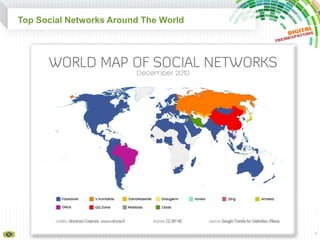
Top Social Networks Around The World4
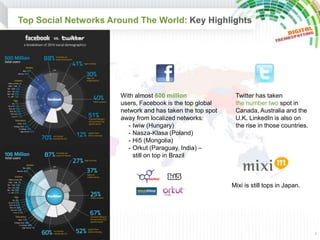
Top Social Networks Around The World: Key HighlightsWith almost 600 million users, Facebook is the top global network and has taken the top spot away from localized networks:Iwiw (Hungary)
Nasza-Klasa (Poland)
Hi5 (Mongolia)
Orkut (Paraguay, India) – still on top in BrazilTwitter has takenthe number two spot in Canada, Australia and the U.K. LinkedIn is also on the rise in those countries.Mixi is still tops in Japan.5
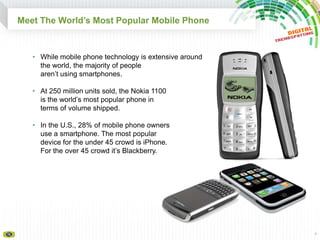
Meet The World’s Most Popular Mobile PhoneWhile mobile phone technology is extensive around the world, the majority of people aren’t using smartphones.
At 250 million units sold, the Nokia 1100 is the world’s most popular phone in terms of volume shipped.
In the U.S., 28% of mobile phone owners use a smartphone. The most popular device for the under 45 crowd is iPhone. For the over 45 crowd it’s Blackberry.6
Cash & Credit Are So 20th CenturyE-commerce and m-commerce are on the rise worldwide – no smartphone required.
By 2015, an estimated $119 billion will be spent via mobile phones.
M-payments account for 12% of Kenya’s GDP.
This is the equivalent of a bank account or credit card in many of the world’s poorest countries.
Earthquake survivors in Haiti are turning to cell phone payment systems to buy necessities like rice, flour and cooking oil.7
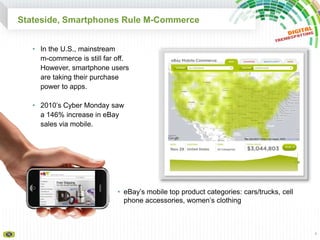
Stateside, Smartphones Rule M-CommerceIn the U.S., mainstream m-commerce is still far off. However, smartphone users are taking their purchase power to apps.
2010’s Cyber Monday saw a 146% increase in eBay sales via mobile.
eBay’s mobile top product categories: cars/trucks, cell phone accessories, women’s clothing8
Cutting Through Clutter:Reaching Consumers In Ways That Matter
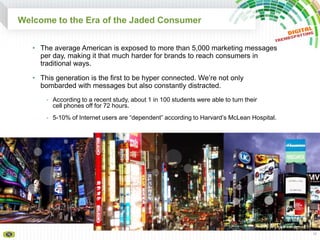
Welcome to the Era of the Jaded ConsumerThe average American is exposed to more than 5,000 marketing messages per day, making it that much harder for brands to reach consumers in traditional ways.
This generation is the first to be hyper connected. We’re not only bombarded with messages but also constantly distracted.
According to a recent study, about 1 in 100 students were able to turn their cell phones off for 72 hours.
5-10% of Internet users are “dependent” according to Harvard’s McLean Hospital.10
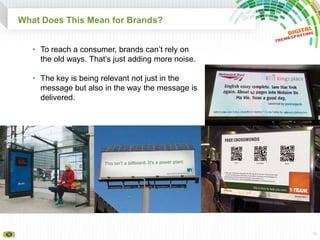
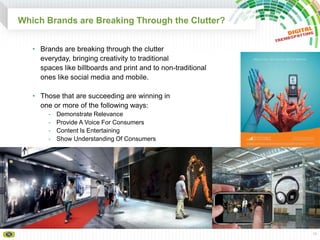
What Does This Mean for Brands?To reach a consumer, brands can’t rely on the old ways. That’s just adding more noise.
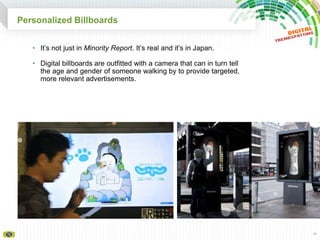
The key is being relevant not just in the message but also in the way the message is delivered.11
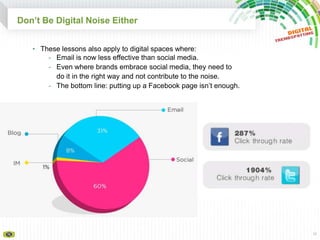
Don’t Be Digital Noise EitherThese lessons also apply to digital spaces where:
Email is now less effective than social media.
Even where brands embrace social media, they need to do it in the right way and not contribute to the noise.
The bottom line: putting up a Facebook page isn’t enough.12

Digital Trends To Watch In 2011

  • 1.
    ON THE CUTTINGEDGE:January 3, 2011
  • 2.
    Getting The LayOf The LandSocial media and mobile technology have gained a solid foothold in the past few years. They’re now growing and merging together in important ways:
  • 3.
    Convergence of onlineand offline, often through multiple screens
  • 4.
  • 5.
    In this land,context is king.
  • 6.
    For brands, thisis the possibility of reaching the right consumer with the right message and in the right way.
  • 7.
    If you’re thinkingabout Millennials, note the majority prefer personal one-on-one communication with brands, according to a recent BFG study.2
  • 8.
    Consider Your Audience:SocialMedia and Mobile Around the World
  • 9.
    Top Social NetworksAround The World4
  • 10.
    Top Social NetworksAround The World: Key HighlightsWith almost 600 million users, Facebook is the top global network and has taken the top spot away from localized networks:Iwiw (Hungary)
  • 11.
  • 12.
  • 13.
    Orkut (Paraguay, India)– still on top in BrazilTwitter has takenthe number two spot in Canada, Australia and the U.K. LinkedIn is also on the rise in those countries.Mixi is still tops in Japan.5
  • 14.
    Meet The World’sMost Popular Mobile PhoneWhile mobile phone technology is extensive around the world, the majority of people aren’t using smartphones.
  • 15.
    At 250 millionunits sold, the Nokia 1100 is the world’s most popular phone in terms of volume shipped.
  • 16.
    In the U.S.,28% of mobile phone owners use a smartphone. The most popular device for the under 45 crowd is iPhone. For the over 45 crowd it’s Blackberry.6
  • 17.
    Cash & CreditAre So 20th CenturyE-commerce and m-commerce are on the rise worldwide – no smartphone required.
  • 18.
    By 2015, anestimated $119 billion will be spent via mobile phones.
  • 19.
    M-payments account for12% of Kenya’s GDP.
  • 20.
    This is theequivalent of a bank account or credit card in many of the world’s poorest countries.
  • 21.
    Earthquake survivors inHaiti are turning to cell phone payment systems to buy necessities like rice, flour and cooking oil.7
  • 22.
    Stateside, Smartphones RuleM-CommerceIn the U.S., mainstream m-commerce is still far off. However, smartphone users are taking their purchase power to apps.
  • 23.
    2010’s Cyber Mondaysaw a 146% increase in eBay sales via mobile.
  • 24.
    eBay’s mobile topproduct categories: cars/trucks, cell phone accessories, women’s clothing8
  • 25.
    Cutting Through Clutter:ReachingConsumers In Ways That Matter
  • 26.
    Welcome to theEra of the Jaded ConsumerThe average American is exposed to more than 5,000 marketing messages per day, making it that much harder for brands to reach consumers in traditional ways.
  • 27.
    This generation isthe first to be hyper connected. We’re not only bombarded with messages but also constantly distracted.
  • 28.
    According to arecent study, about 1 in 100 students were able to turn their cell phones off for 72 hours.
  • 29.
    5-10% of Internetusers are “dependent” according to Harvard’s McLean Hospital.10
  • 30.
    What Does ThisMean for Brands?To reach a consumer, brands can’t rely on the old ways. That’s just adding more noise.
  • 31.
    The key isbeing relevant not just in the message but also in the way the message is delivered.11
  • 32.
    Don’t Be DigitalNoise EitherThese lessons also apply to digital spaces where:
  • 33.
    Email is nowless effective than social media.
  • 34.
    Even where brandsembrace social media, they need to do it in the right way and not contribute to the noise.
  • 35.
    The bottom line:putting up a Facebook page isn’t enough.12