Digital Tools Session I 0
Abstract “ Just in time” sessions focusing on a blend of tools needed to complete the courses* and to become successful Digital Leaders Learning Collaborating Communicating Data Collecting  * Each session will precede the ensuing course(s) in which the  tools will be applied .  0
Course Goal Encourage educational leaders to become confident technology users and leaders Or in other words Digitaleaders 0
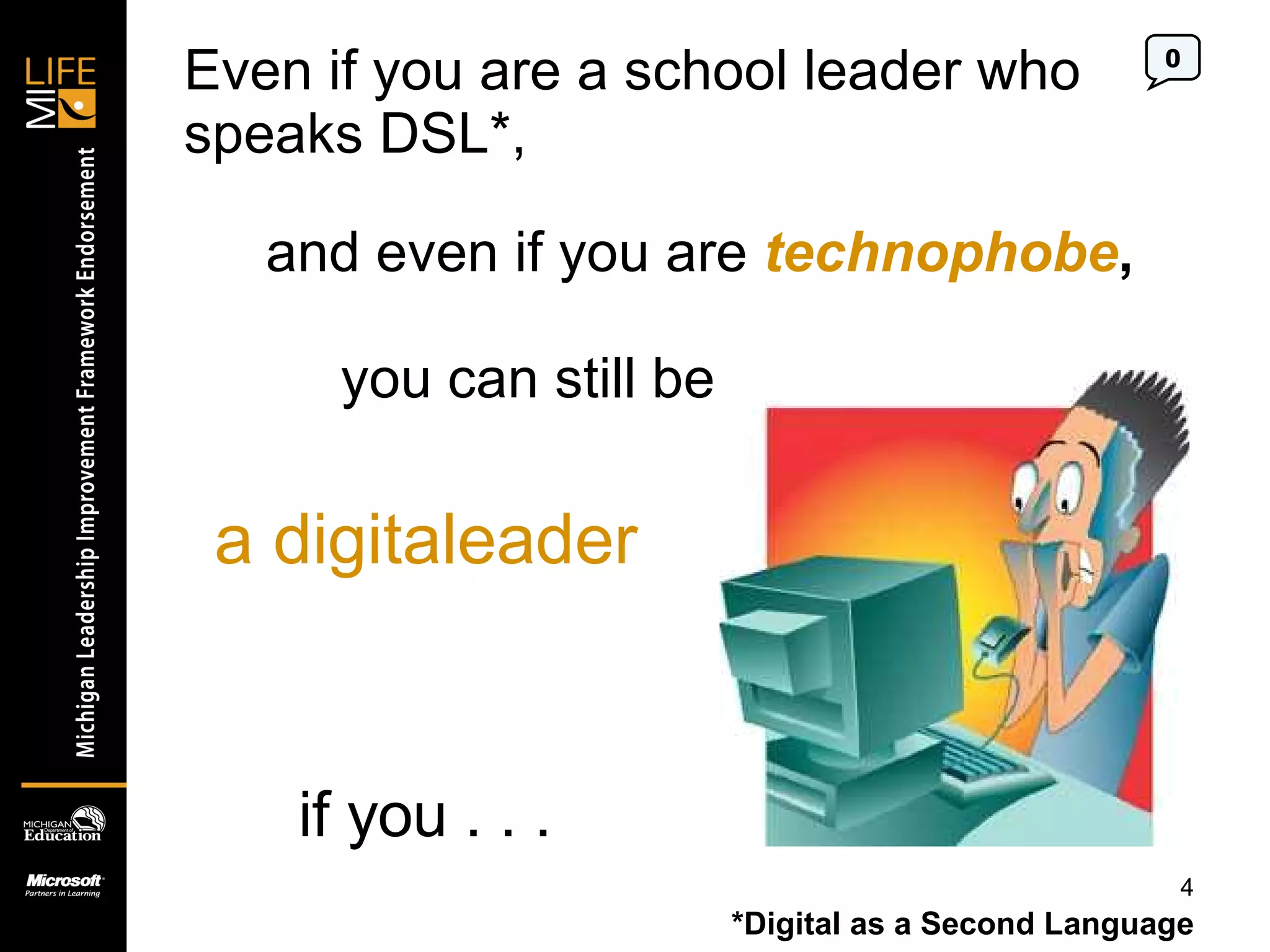
Even if you are a school leader who speaks DSL*,  and even if you are  technophobe , you can still be a   digitaleader if you . . .  0 *Digital as a Second Language
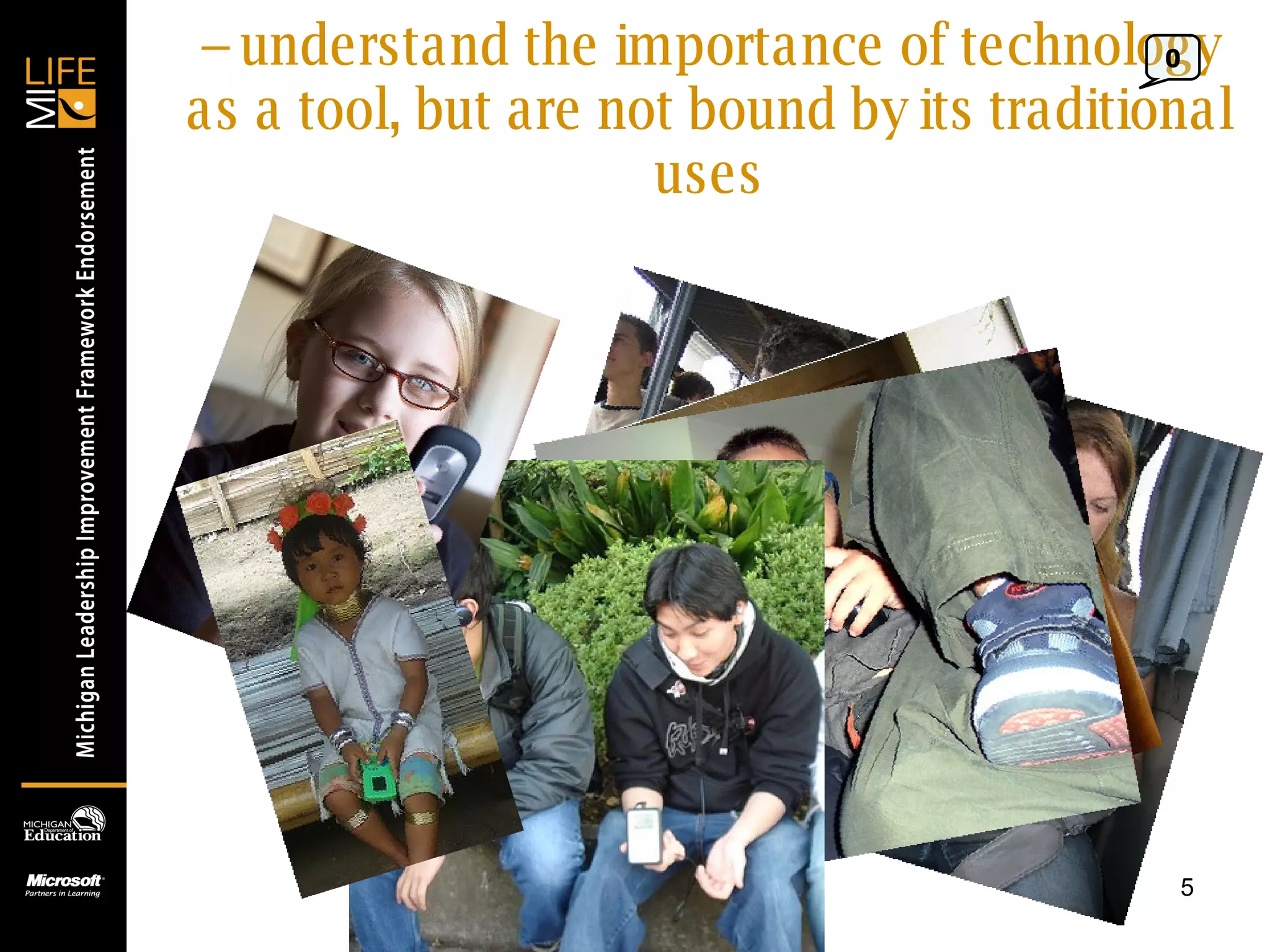
-- understand the importance of technology as a tool, but are not bound by its traditional uses 0
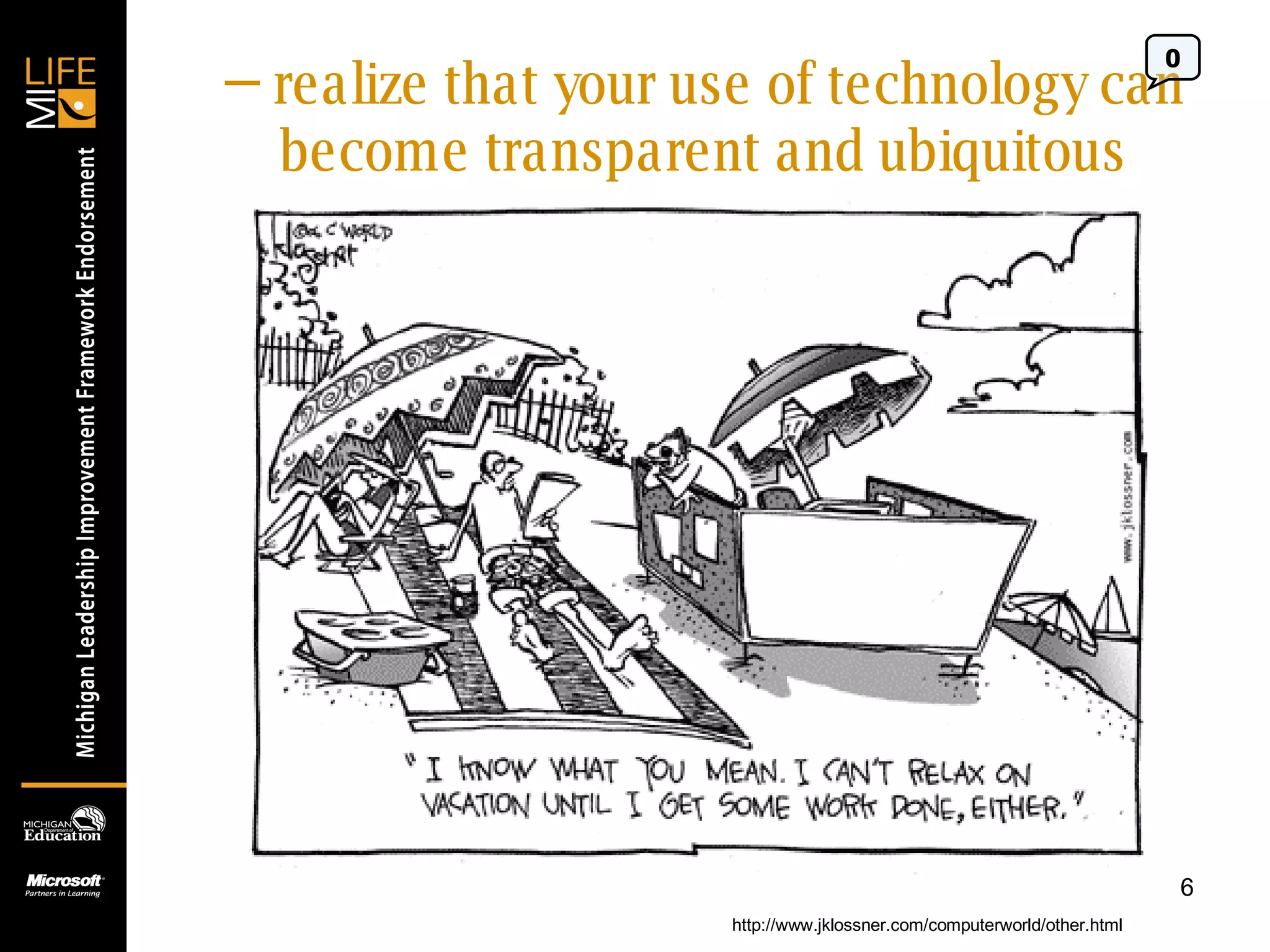
--  realize that your use of technology can become transparent and ubiquitous 0 http://www.jklossner.com/computerworld/other.html
Course Objectives for All Three Digital Leadership Unit Sessions Assess prior knowledge of each session’s technology tools Understand the significance and use of online tools for professional use and for teaching Work collaboratively with colleagues as coaches/learners 0
Course Objectives Session I Use external storage for digital documents Create online surveys to gather data Create graphic organizers to efficiently organize information Use wikis to collaborate on document creation Understand Blackboard navigation 0
Course Objectives Session II Use the Internet to efficiently search for and evaluate information Store, retrieve, and share online sources easily Navigate an online course management system Learn basic MS-Excel functions Develop a personalized web presence 0
Course Objectives Session III Create blogs to communicate with various stakeholders Create wikis to develop and share information with staff Understand use of RSS feeds  Create an online calendar scheduler Use and develop an online visual ranking tool Prepare informative PowerPoint presentations 0
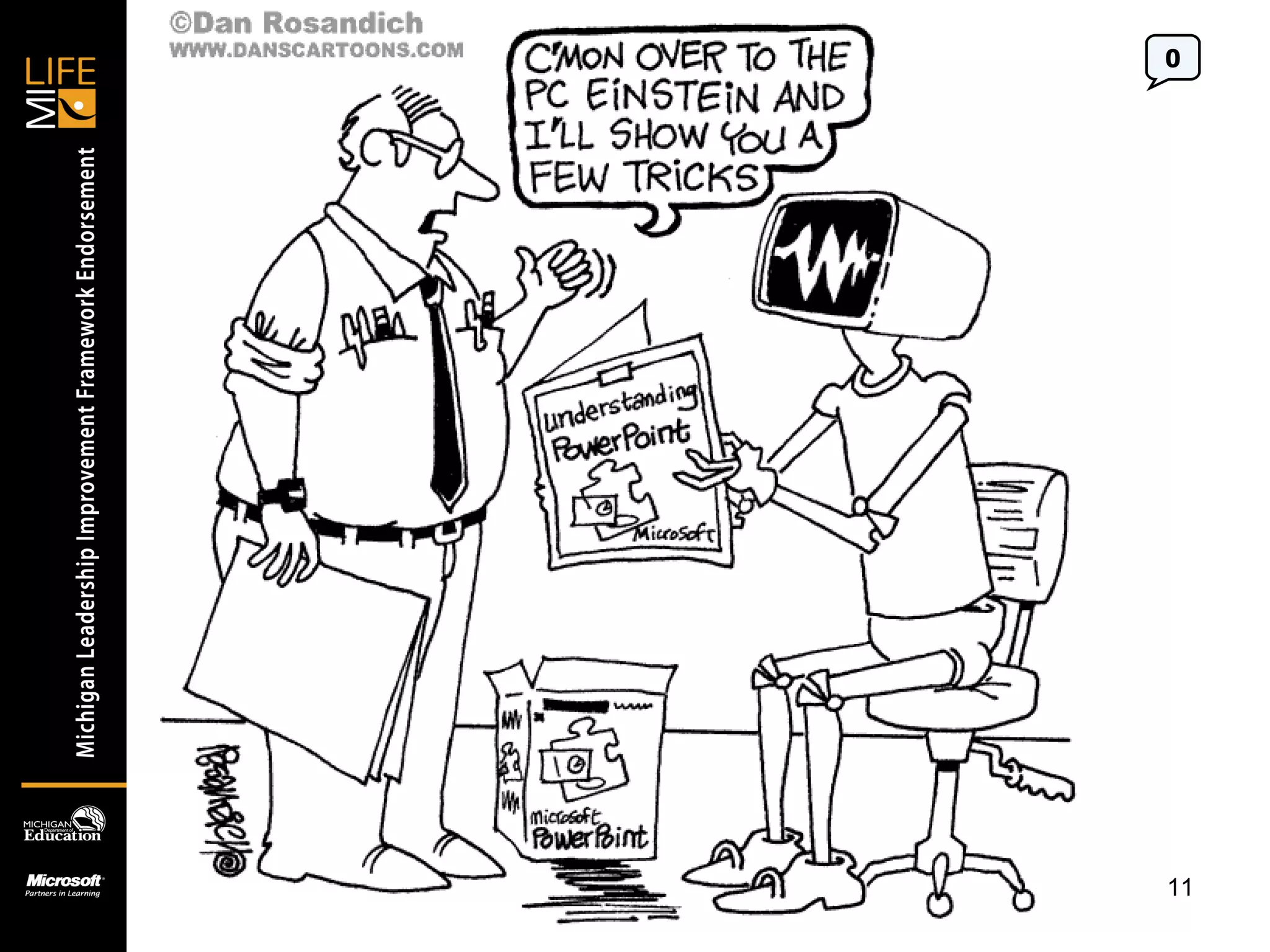
And, of course,  Feel like this at the end of the third session! 0
Our Digital Landscape 0
How would you describe yourself? Digital Native Digital Immigrant Digital Refugee Bridge Undecided 0
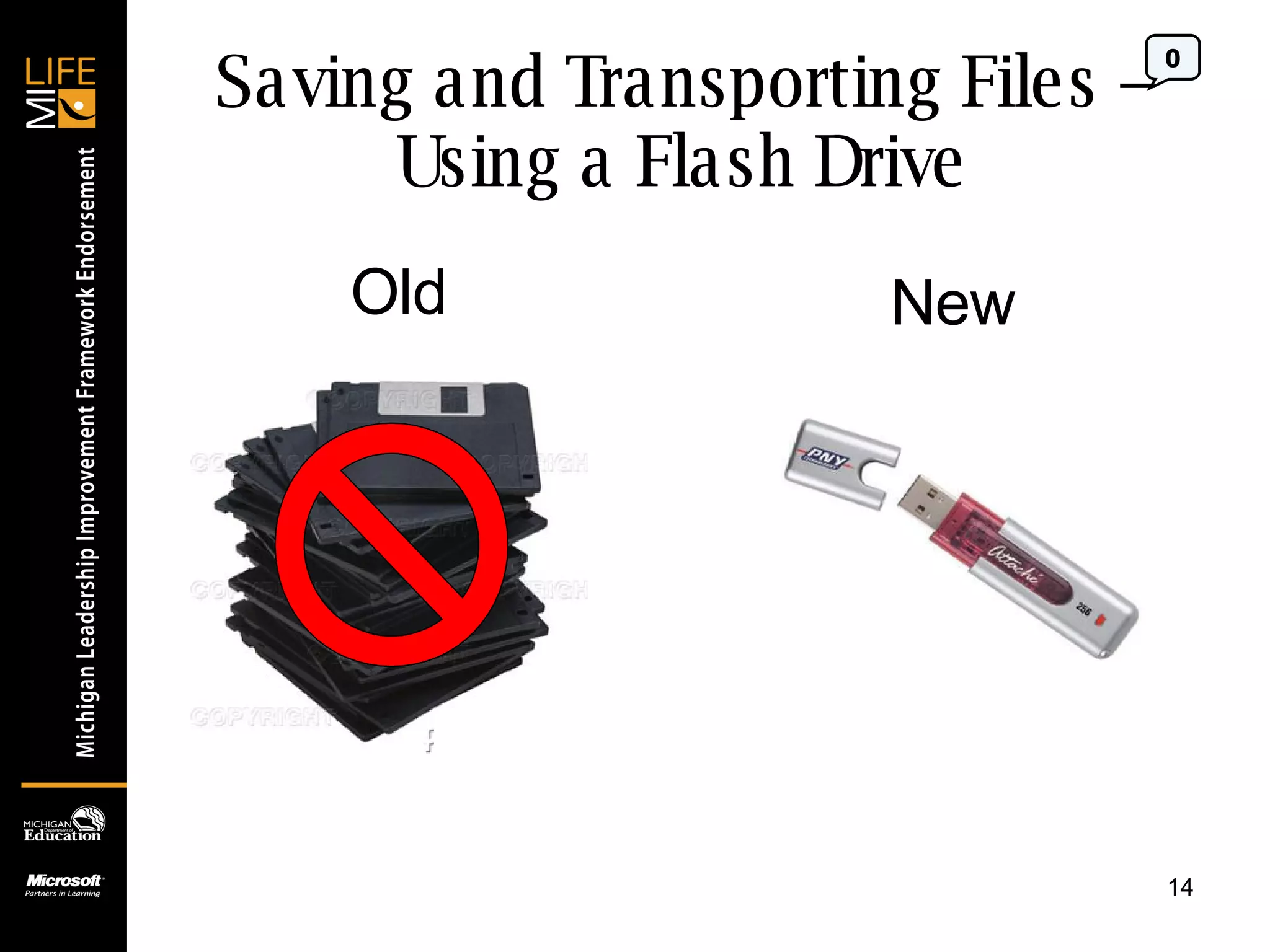
Saving and Transporting Files -- Using a Flash Drive Old  New 0
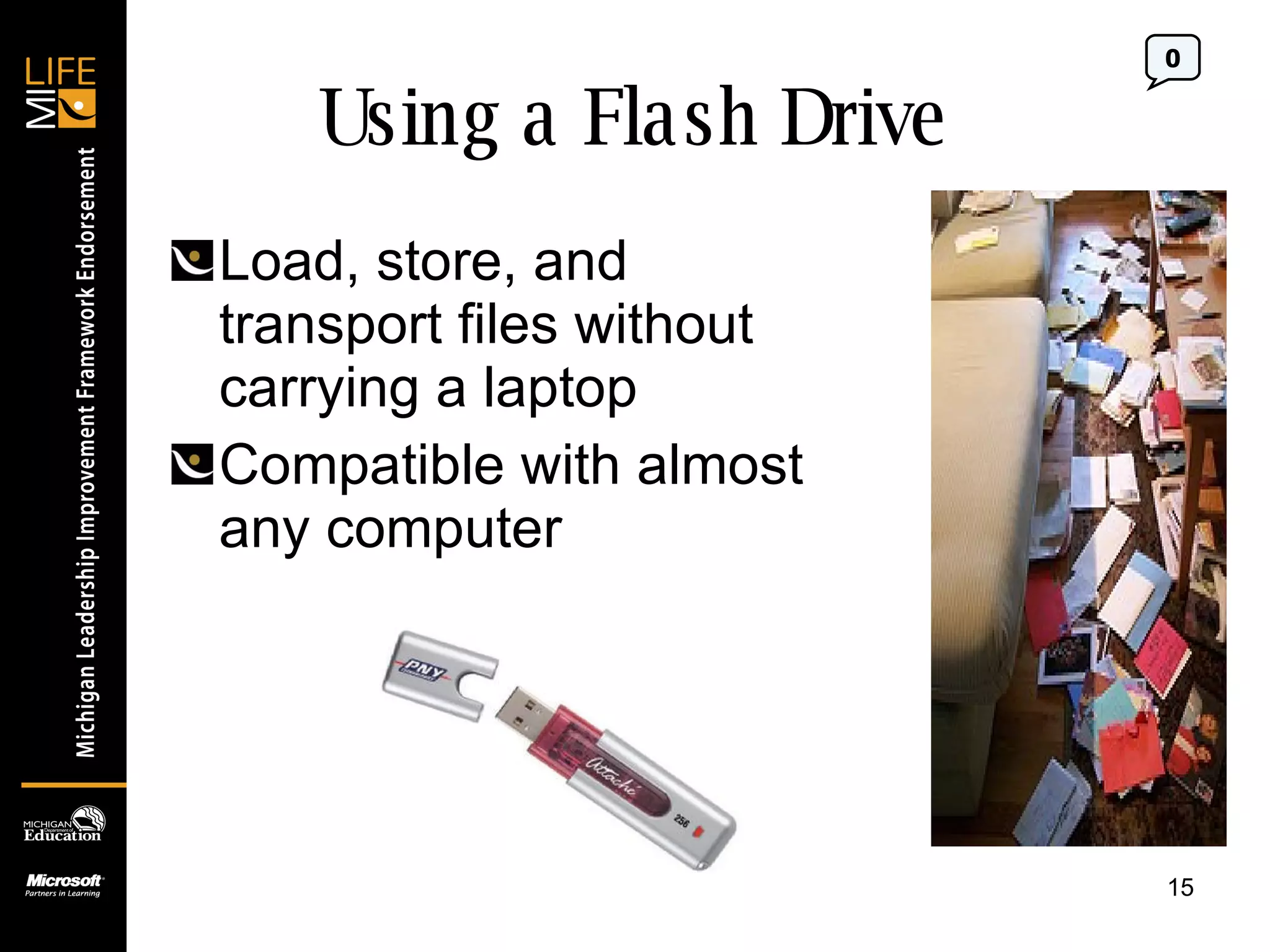
Using a Flash Drive Load, store, and transport files without carrying a laptop Compatible with almost any computer 0
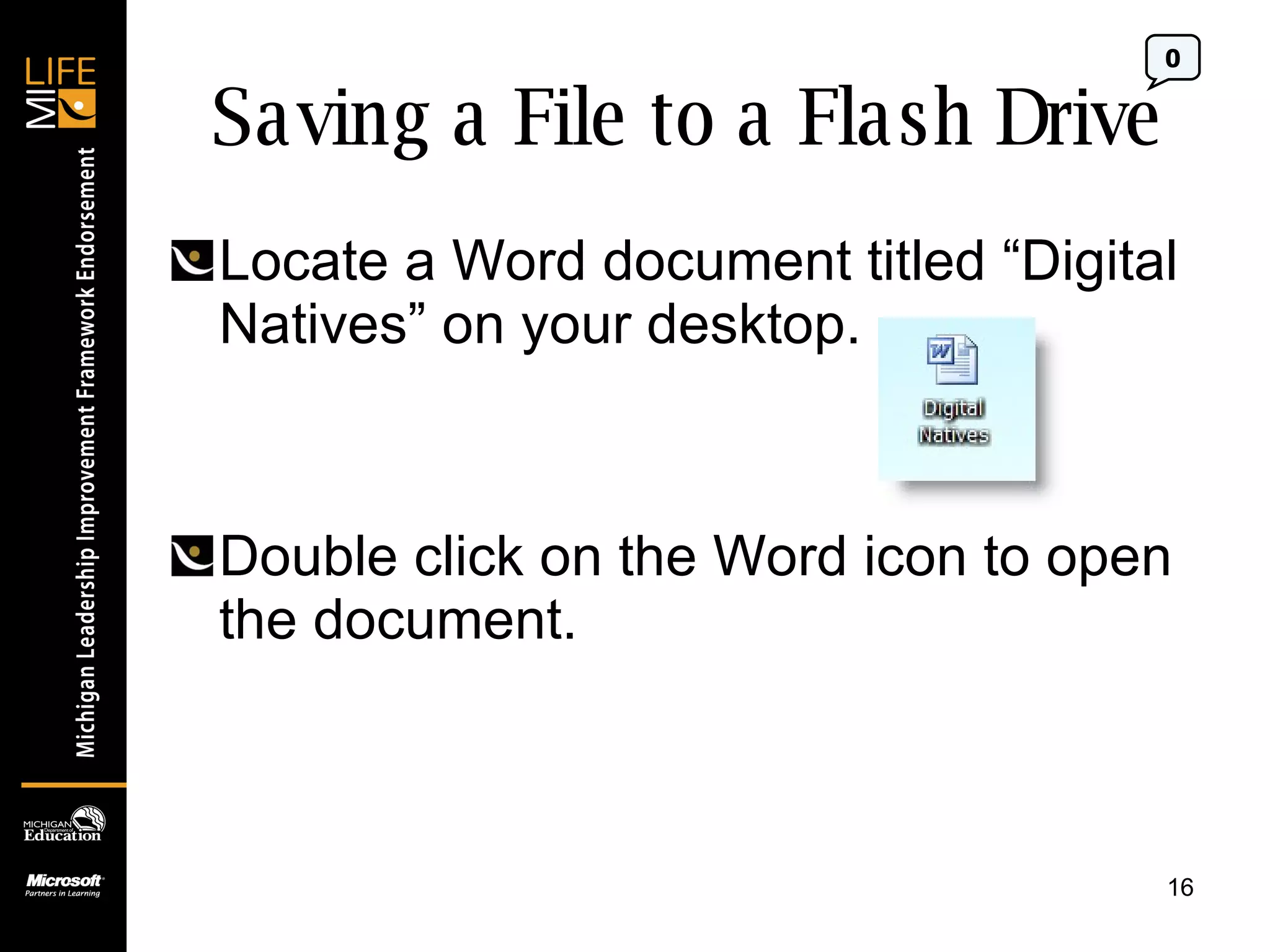
Saving a File to a Flash Drive Locate a Word document titled “Digital Natives” on your desktop. Double click on the Word icon to open the document. 0
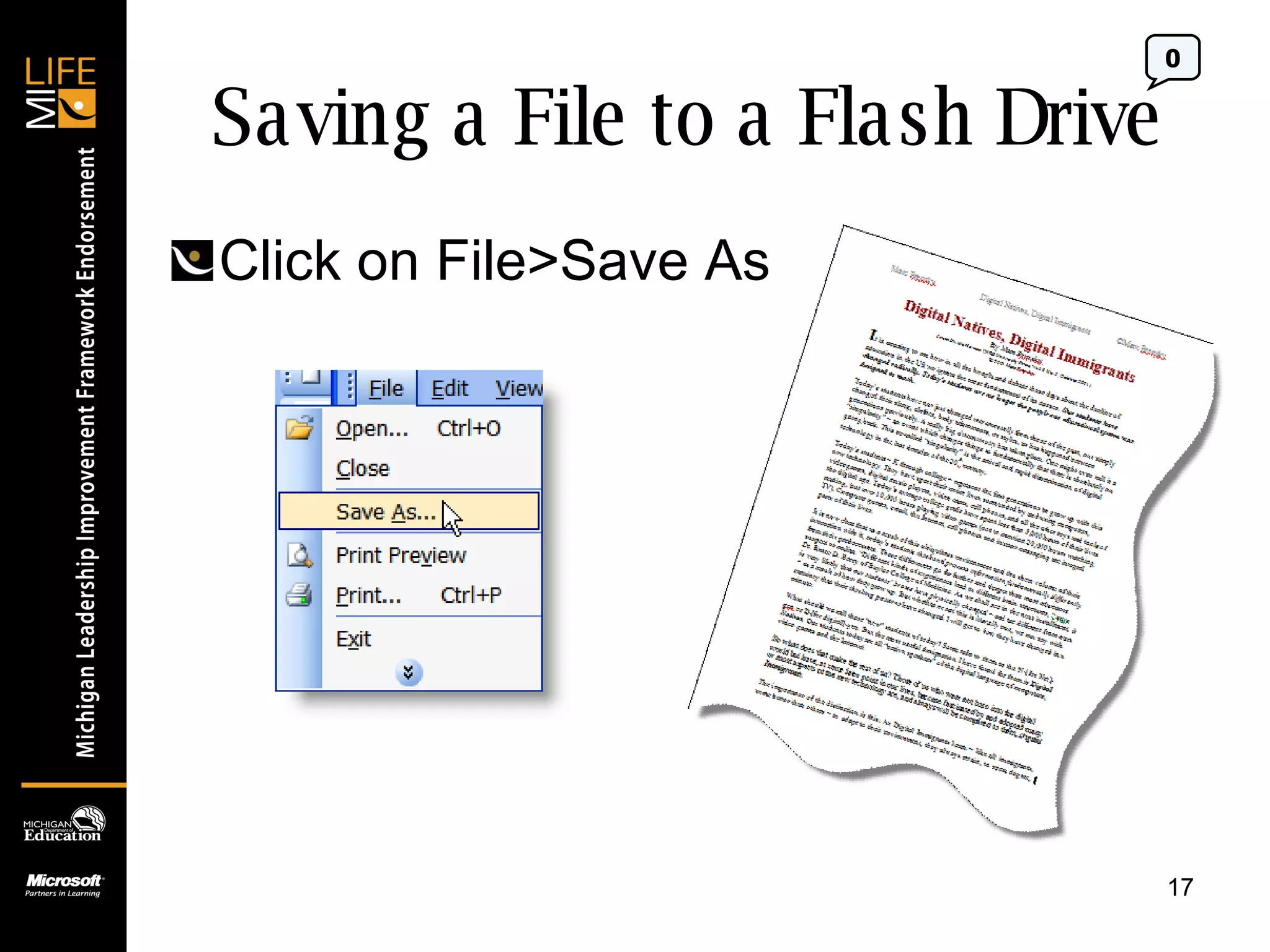
Saving a File to a Flash Drive Click on File>Save As 0
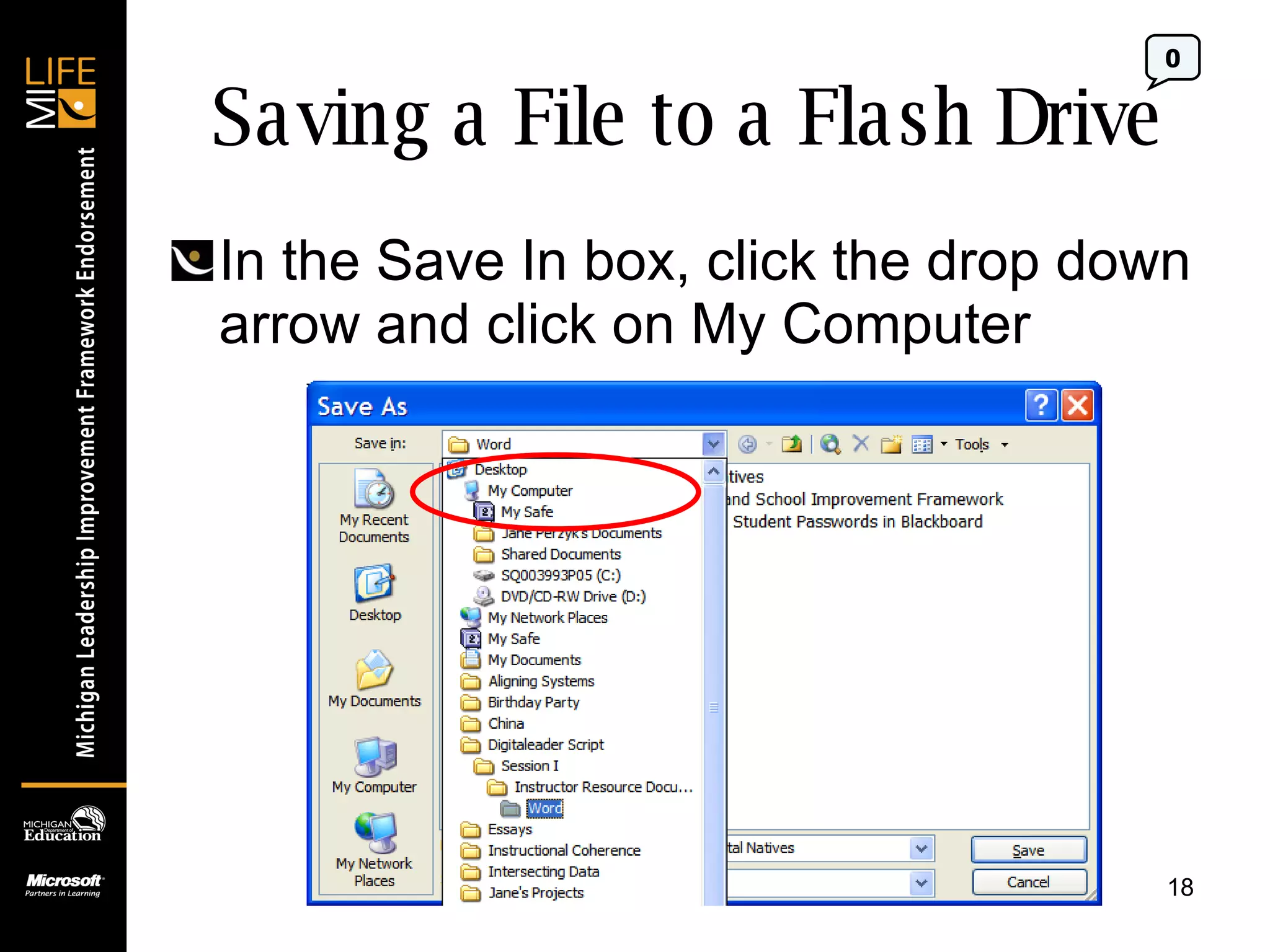
Saving a File to a Flash Drive In the Save In box, click the drop down arrow and click on My Computer 0
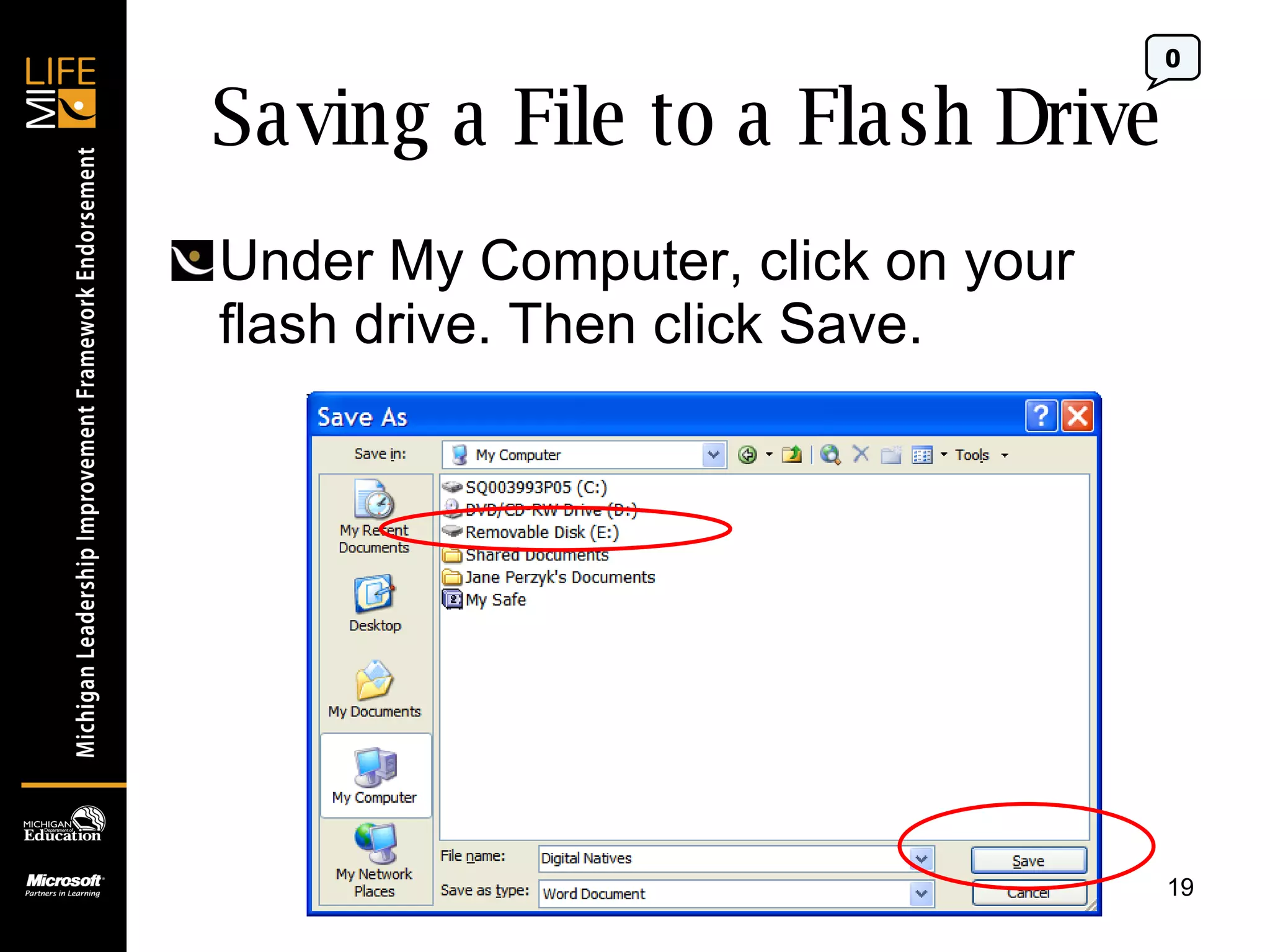
Saving a File to a Flash Drive Under My Computer, click on your flash drive. Then click Save. 0
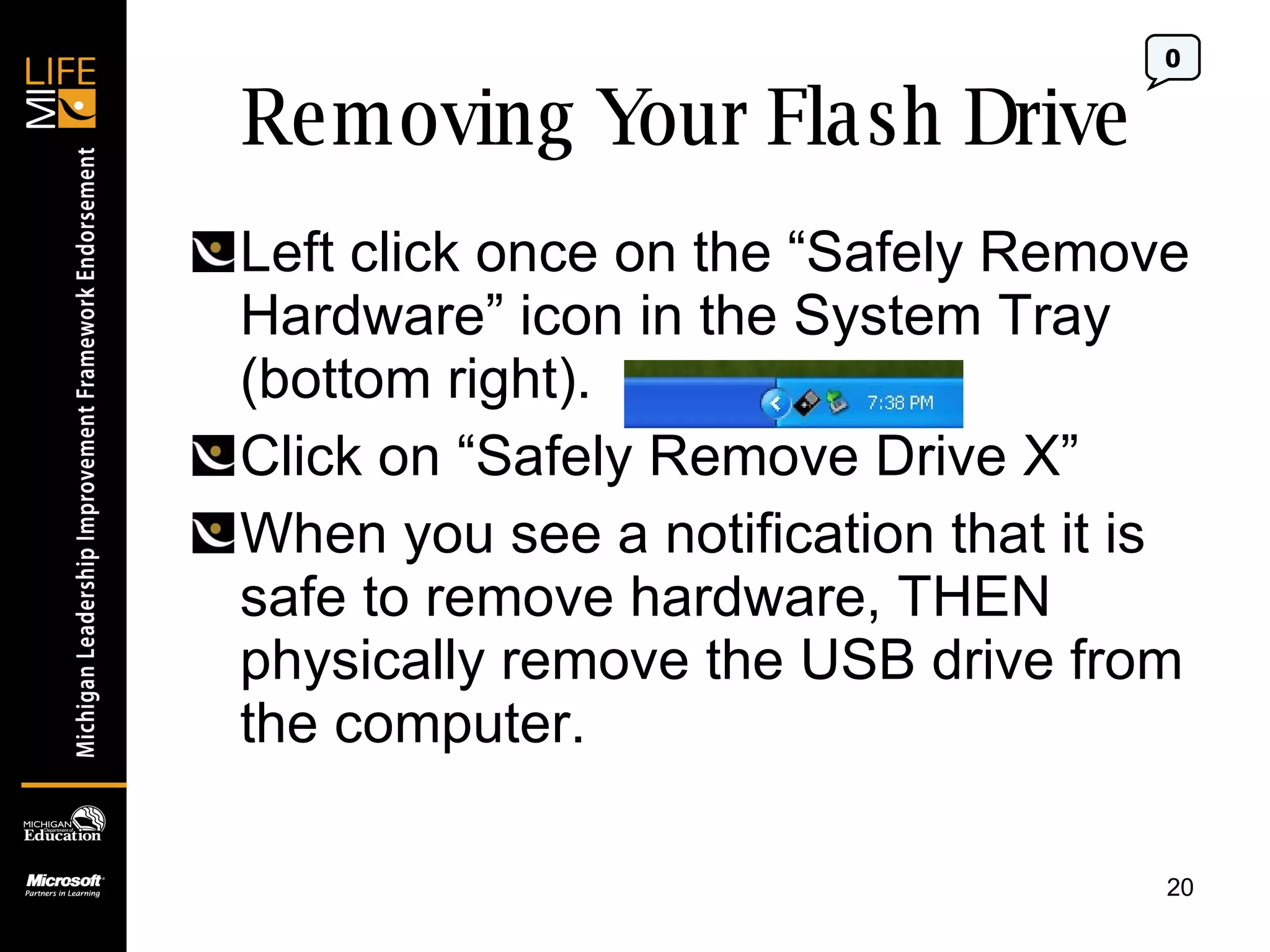
Removing Your Flash Drive Left click once on the “Safely Remove Hardware” icon in the System Tray (bottom right). Click on “Safely Remove Drive X” When you see a notification that it is safe to remove hardware, THEN physically remove the USB drive from the computer. 0
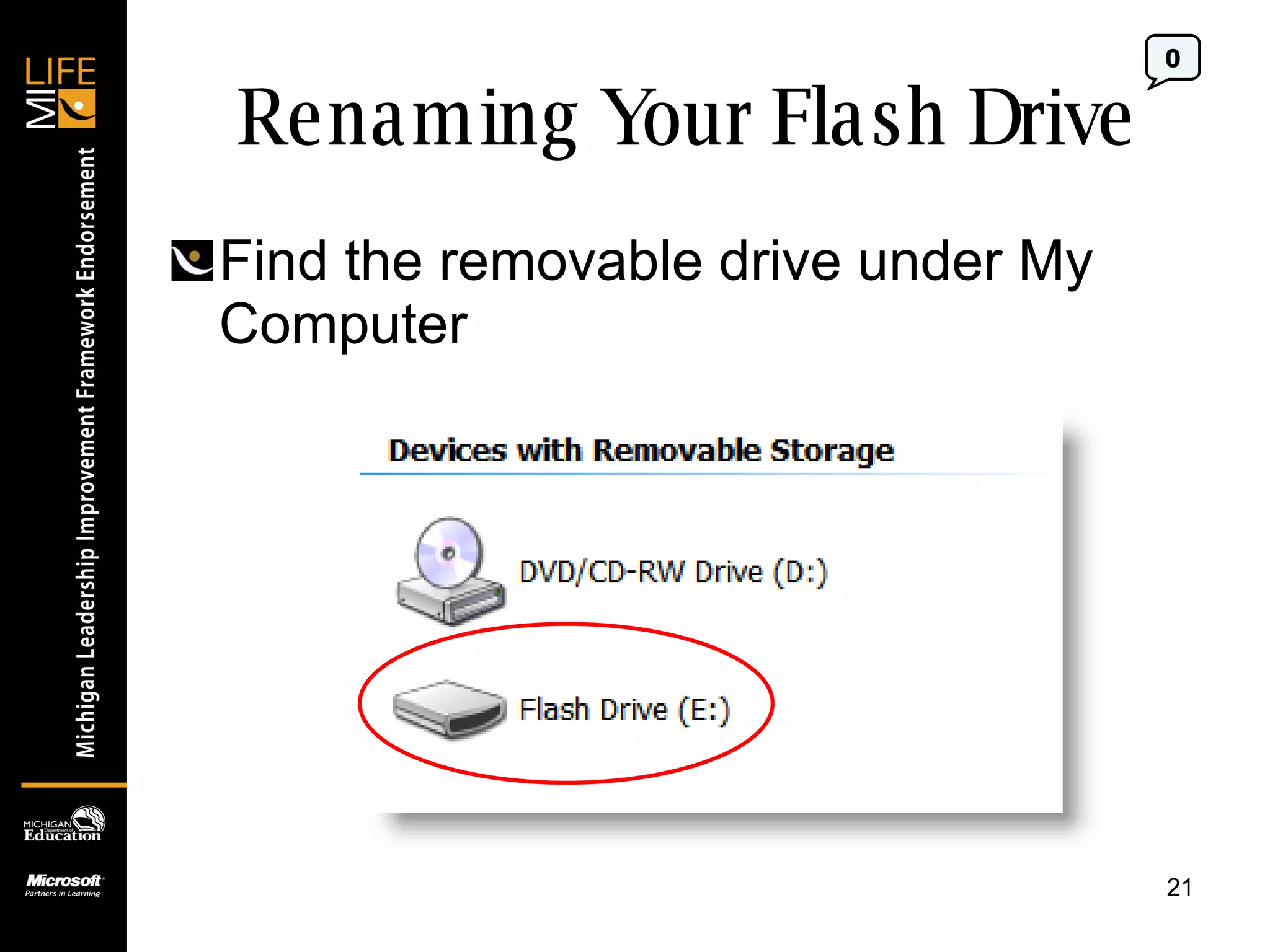
Renaming Your Flash Drive Find the removable drive under My Computer 0
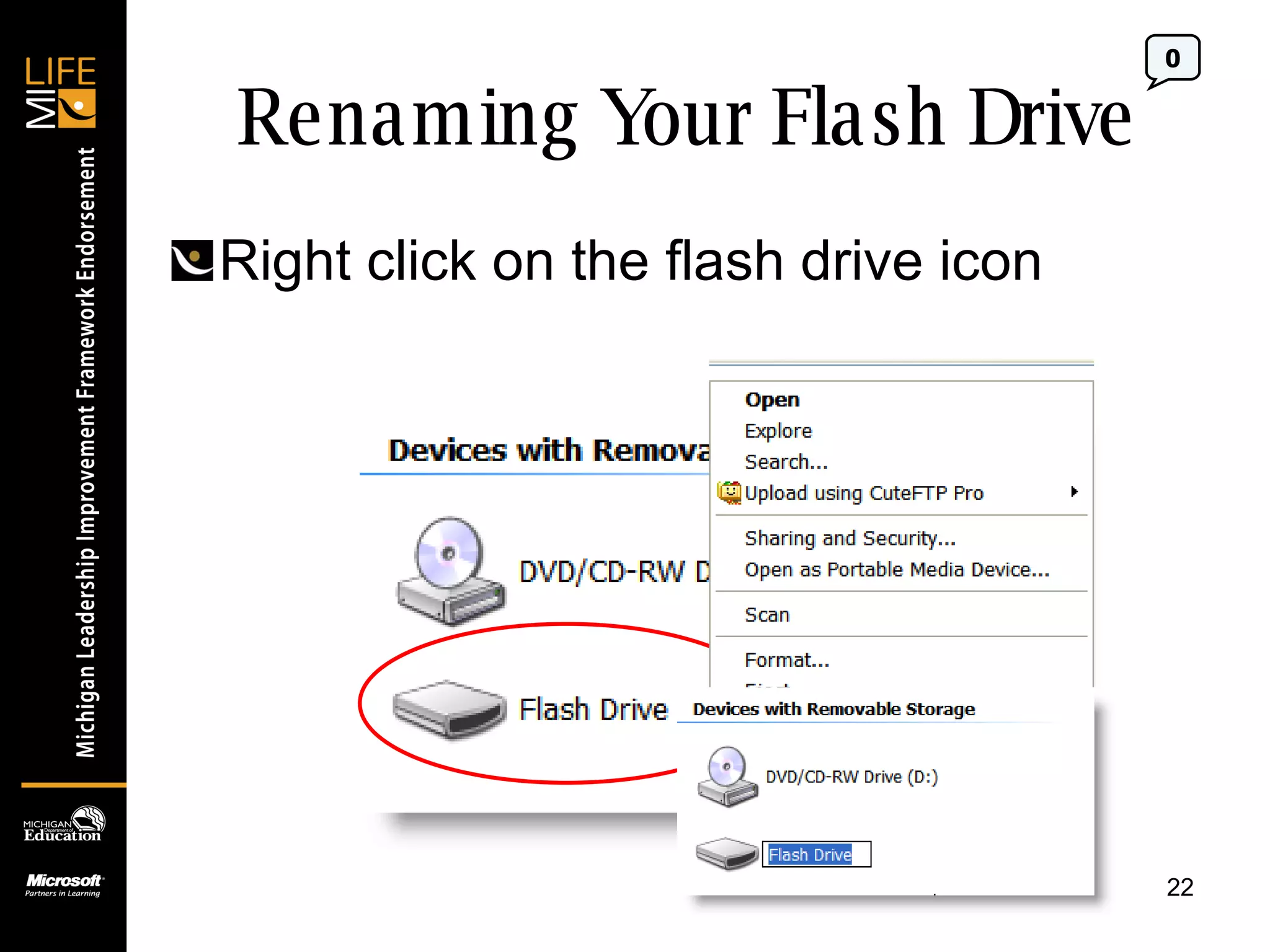
Renaming Your Flash Drive Right click on the flash drive icon 0
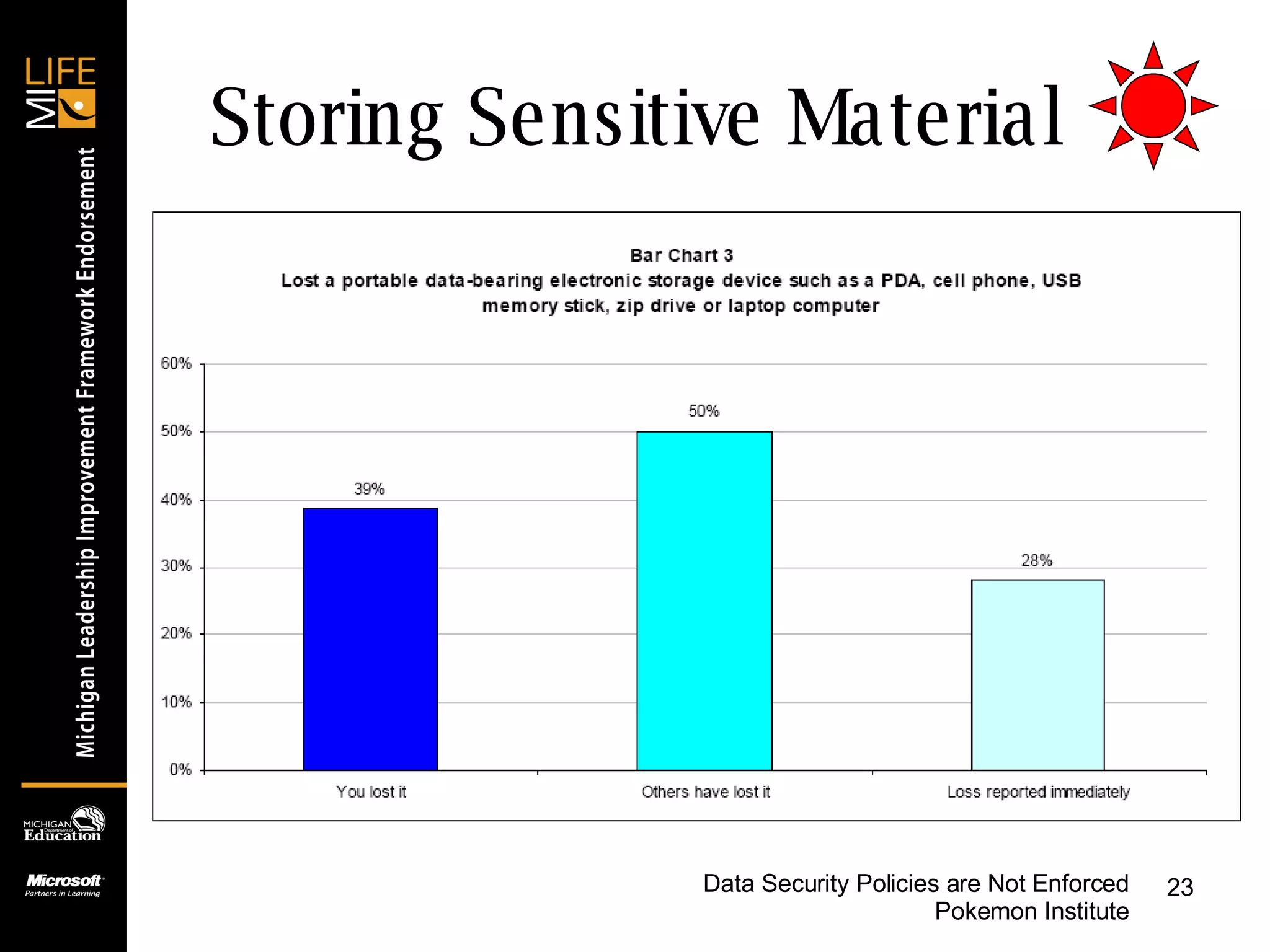
Storing Sensitive Material Data Security Policies are Not Enforced Pokemon Institute
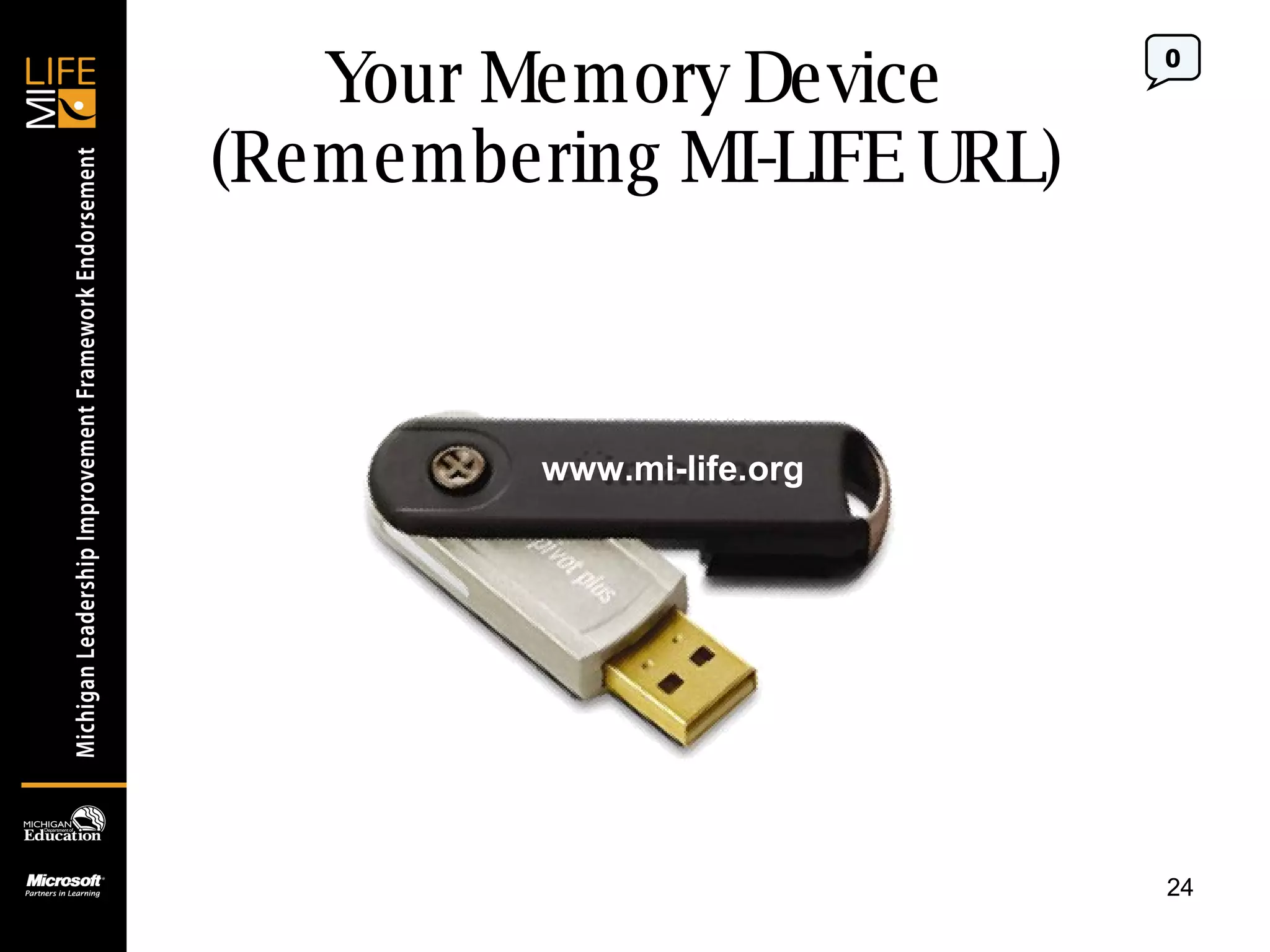
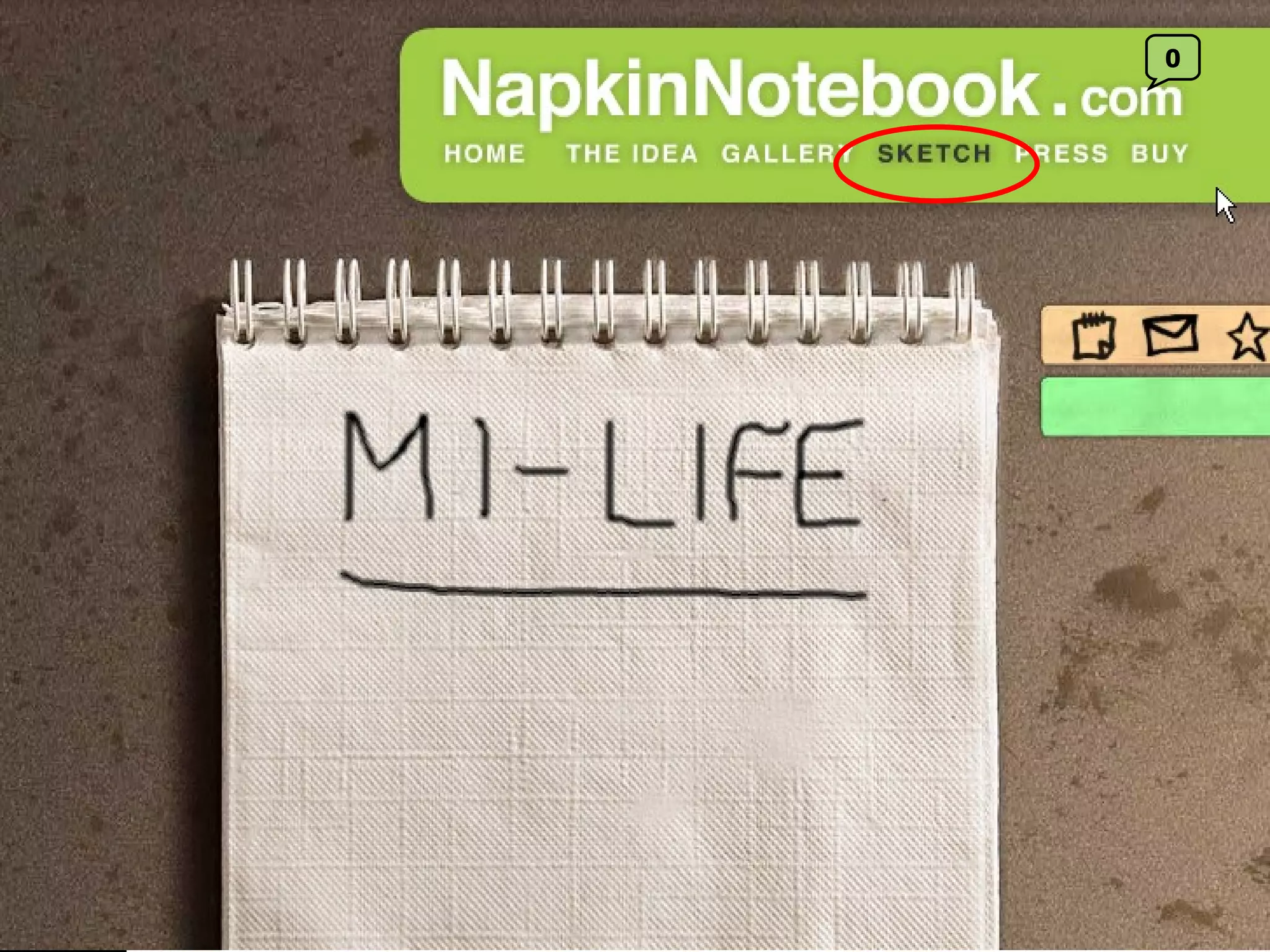
Your Memory Device (Remembering MI-LIFE URL) 0 www.mi-life.org
Course Objectives Session I Use external storage for digital documents. Create online surveys to gather data. Create graphic organizers to efficiently organize information. Use wikis to collaborate on document creation. Understand Blackboard navigation 0
Have You Ever Used Paper-Based Surveys? 0
How Do You Use Surveys? What was the purpose of your survey? 0 What kind of data did you collect? Who were the stakeholders surveyed? How were the results disseminated? How were the results used? Pair with your partner and share your responses to these questions
Benefits of Online Surveys Save time and mailing costs Collect and analyze results automatically in real time Allow mandatory questions Offer ability to launch a survey very quickly
0
Your Zoomerang Account 0 to be used in the Optimizing Leadership course
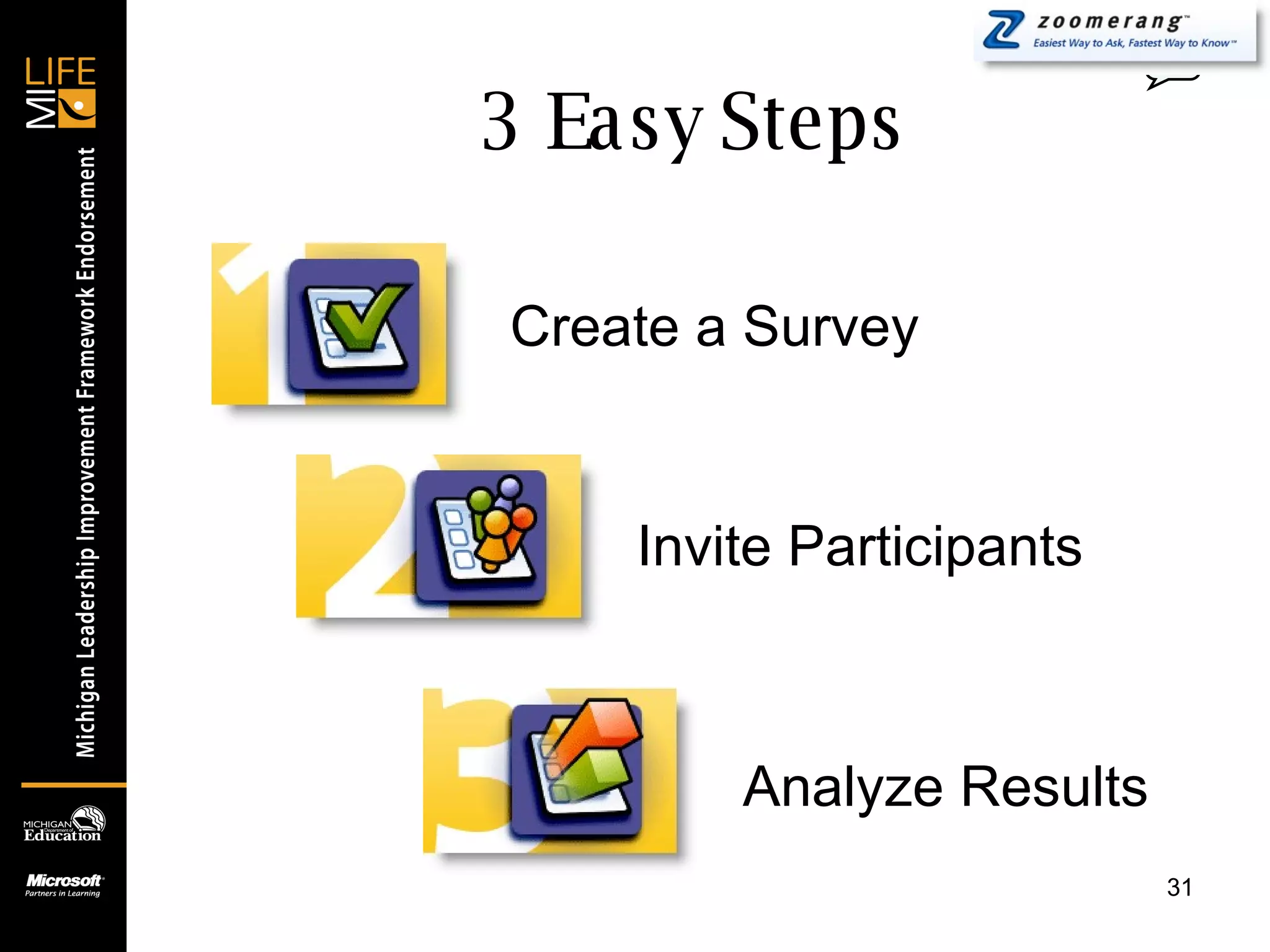
3 Easy Steps 0 Invite Participants Create a Survey Analyze Results
Create a Survey 0 Customize a template Create a survey from scratch Copy and update one of your previously used surveys Sample Survey
Invite Participants 0 Upload your email list into Zoomerang to generate an invitation Add a survey link to your website or your own email
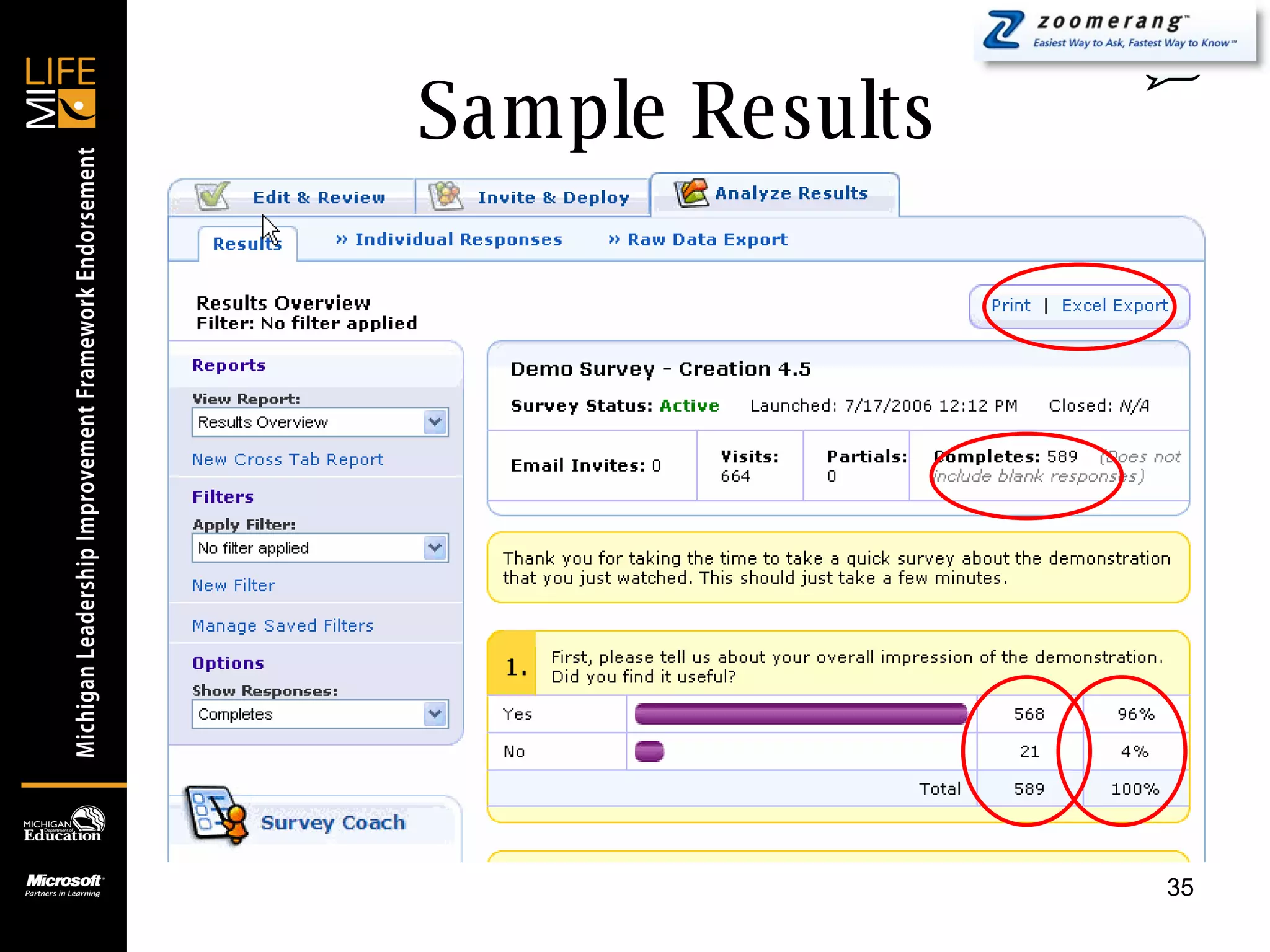
Analyze Results 0 View real time results online Export into an Excel spreadsheet Share results online privately, or allow others access also New! Export chart into PowerPoint slide
Sample Results 0
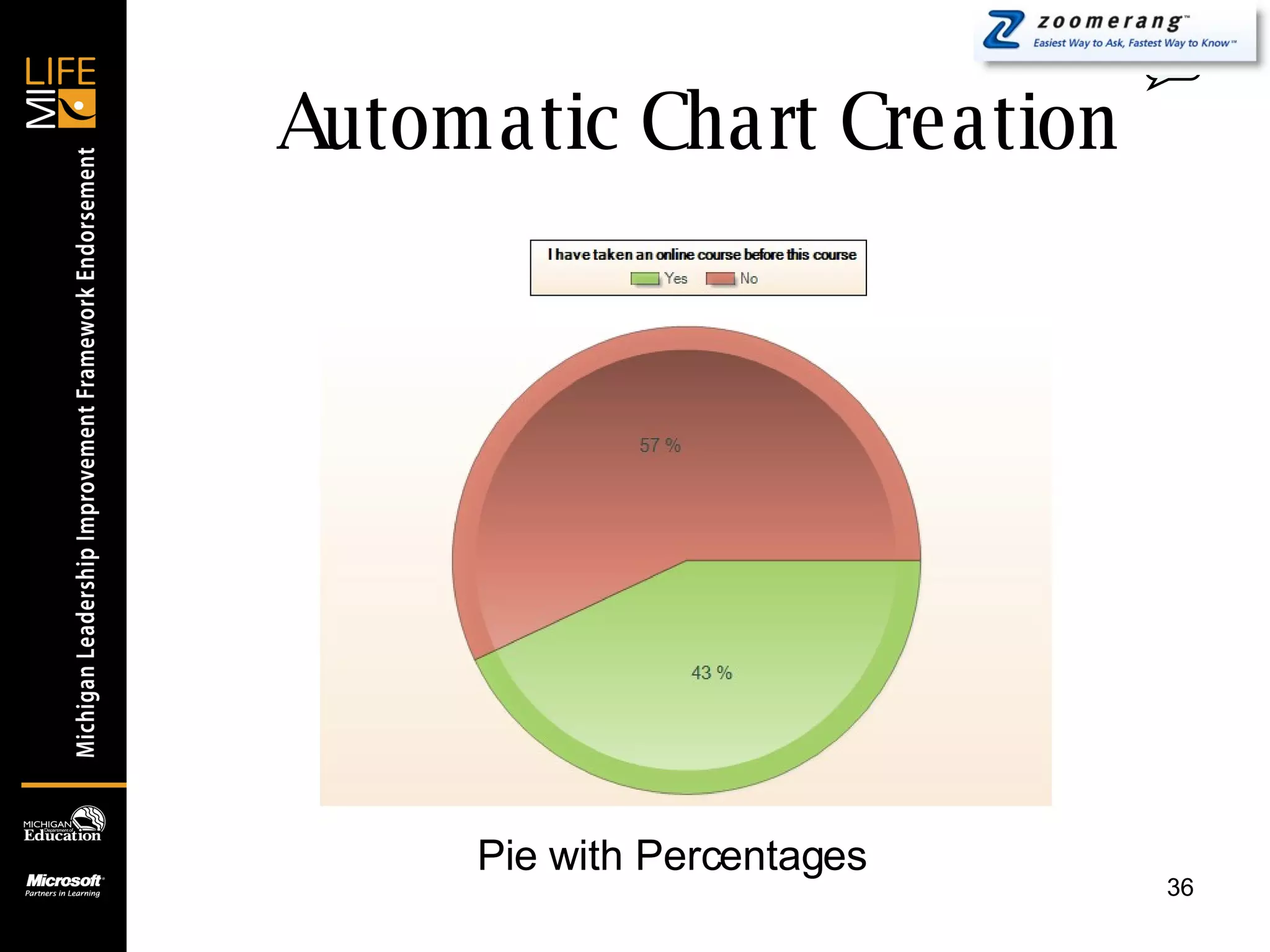
Automatic Chart Creation 0 Pie with Percentages
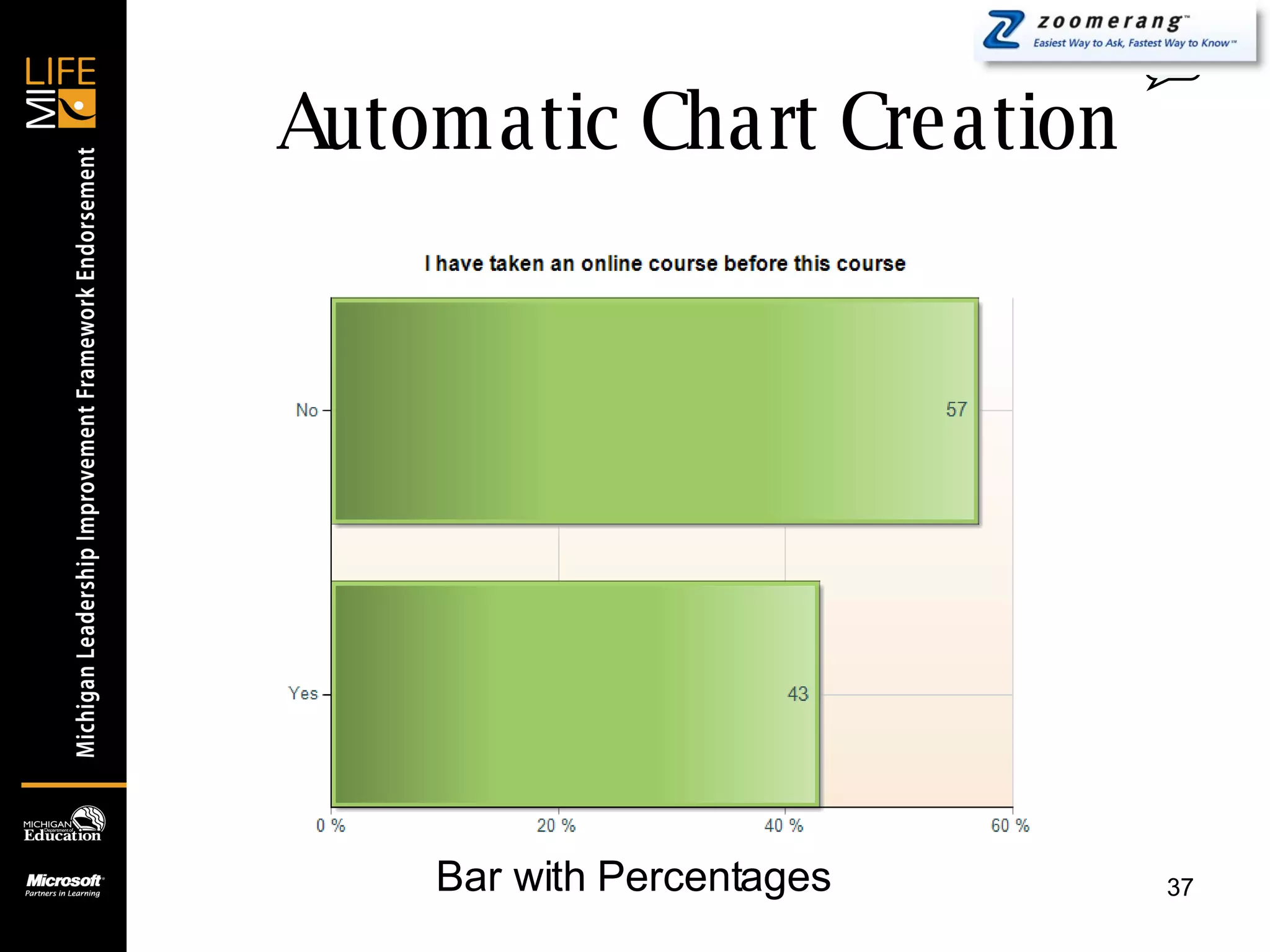
Automatic Chart Creation 0 Bar with Percentages
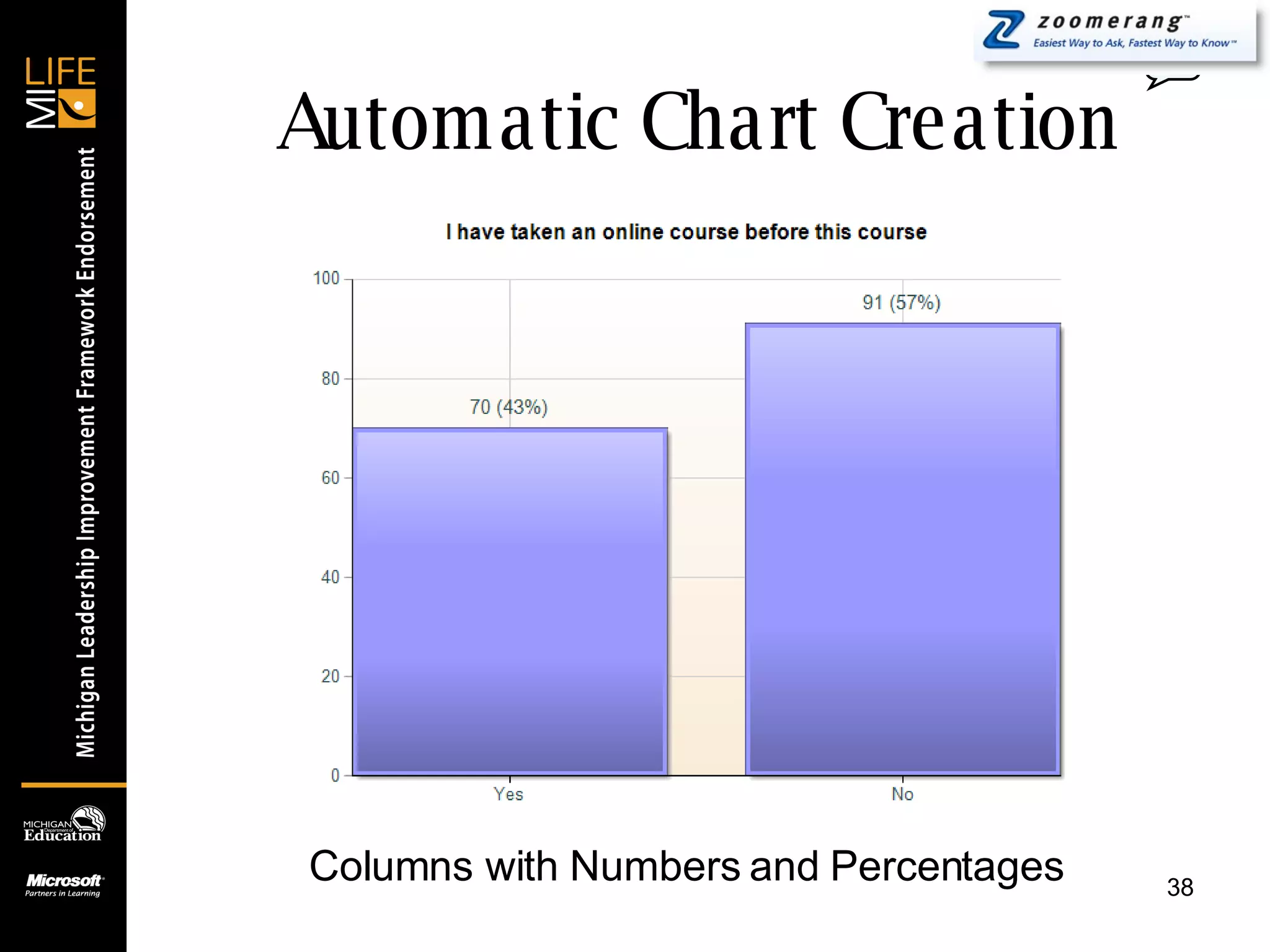
Automatic Chart Creation 0 Columns with Numbers and Percentages
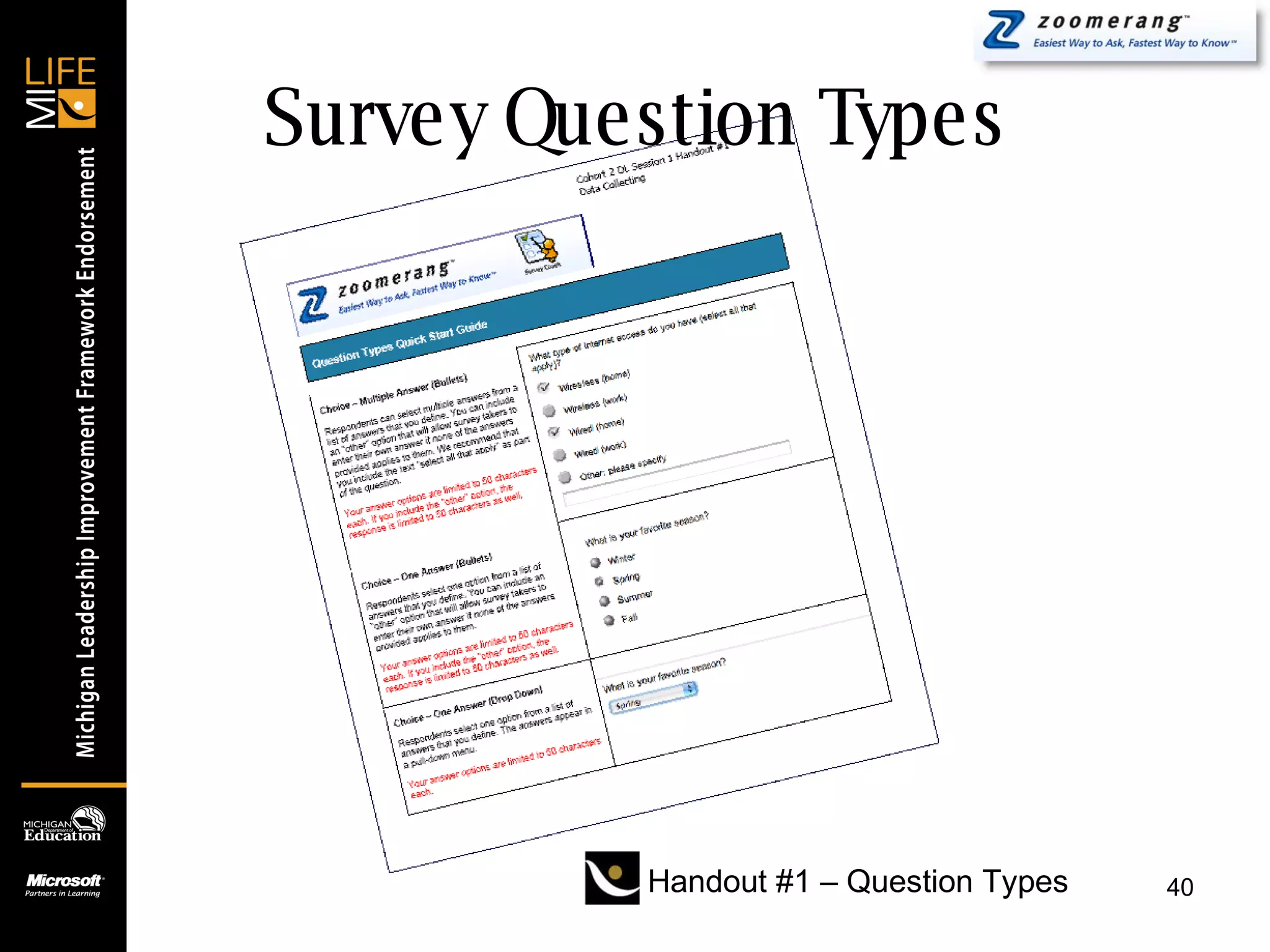
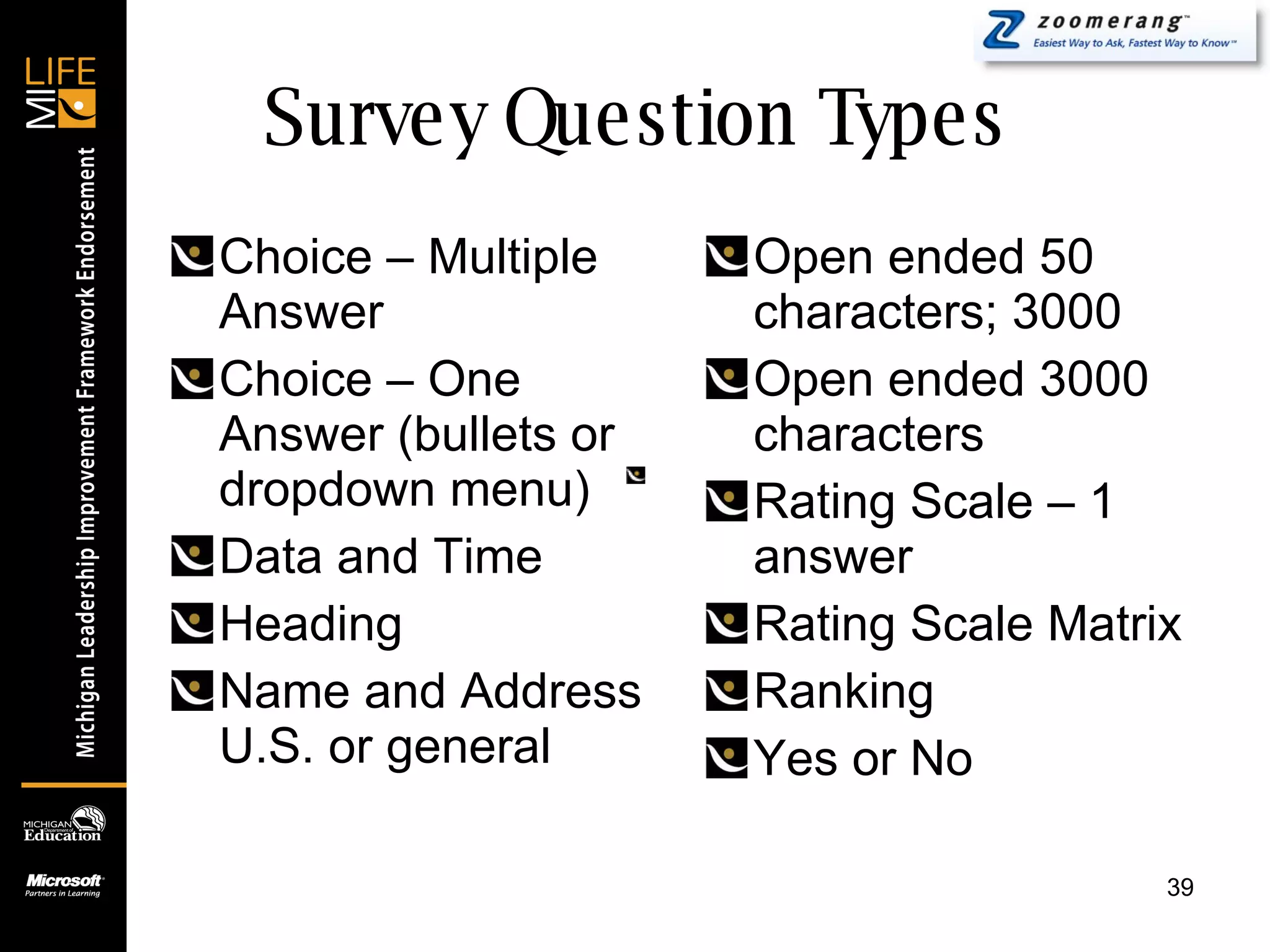
Survey Question Types Choice – Multiple Answer Choice – One Answer (bullets or dropdown menu) Data and Time Heading Name and Address U.S. or general Open ended 50 characters; 3000 Open ended 3000 characters Rating Scale – 1 answer Rating Scale Matrix Ranking Yes or No
Survey Question Types Handout #1 – Question Types
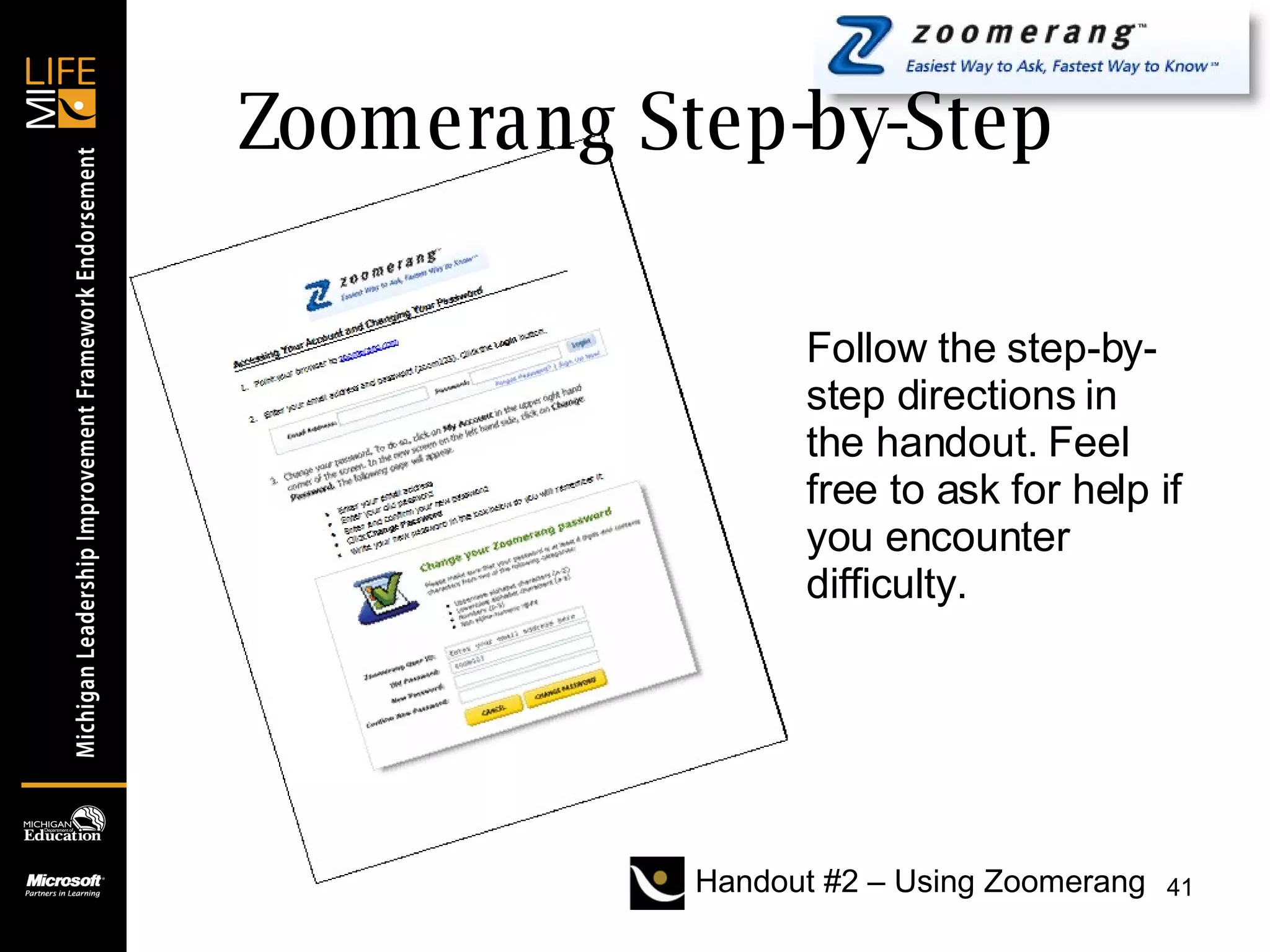
Zoomerang Step-by-Step 0 Follow the step-by-step directions in the handout. Feel free to ask for help if you encounter difficulty. Handout #2 – Using Zoomerang
Zoomerang Activity With your partner, create a short survey using several of the different question types. Then LAUNCH the survey. 0
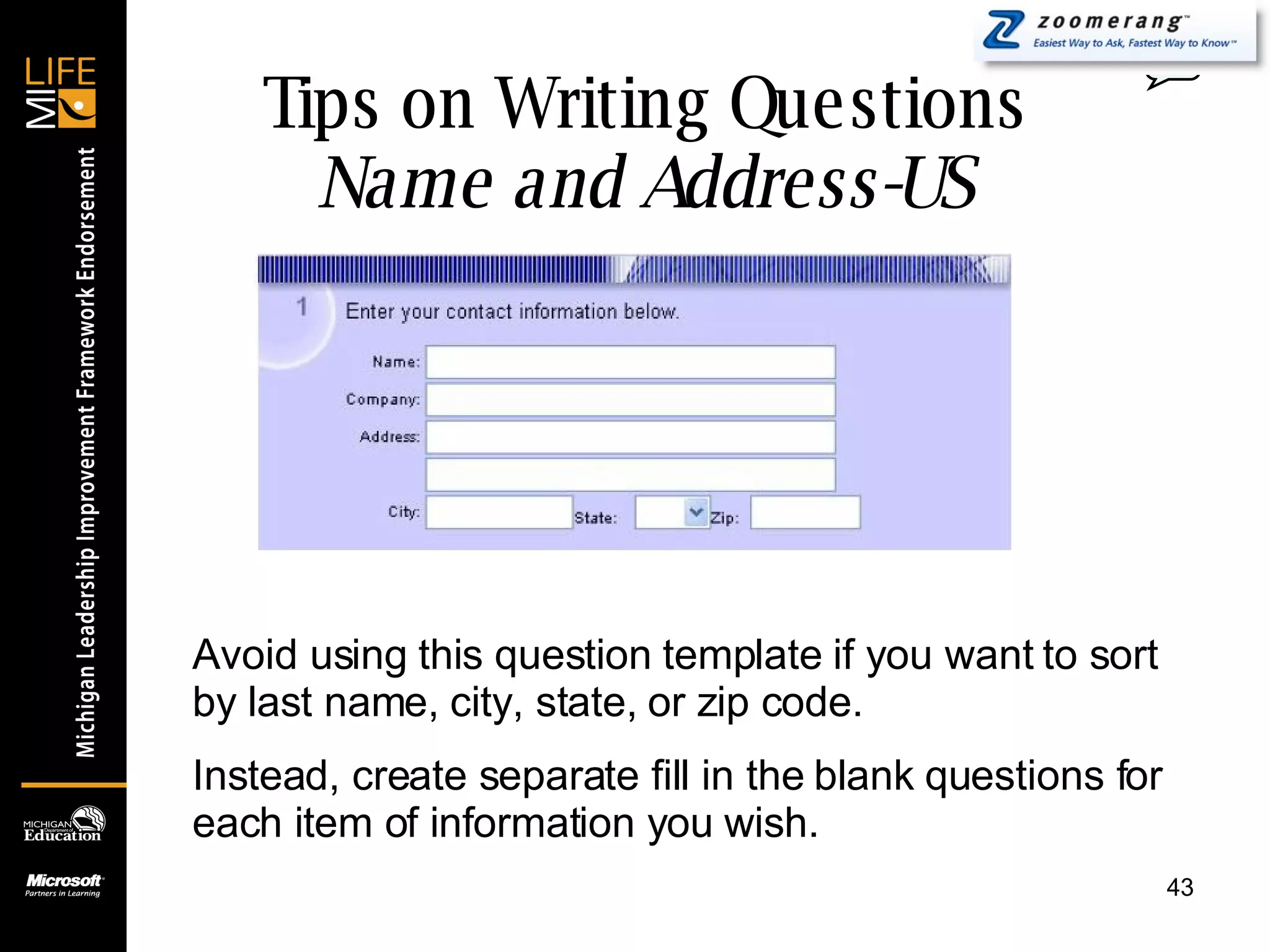
Tips on Writing Questions Name and Address-US 0 Avoid using this question template if you want to sort by last name, city, state, or zip code.  Instead, create separate fill in the blank questions for each item of information you wish.
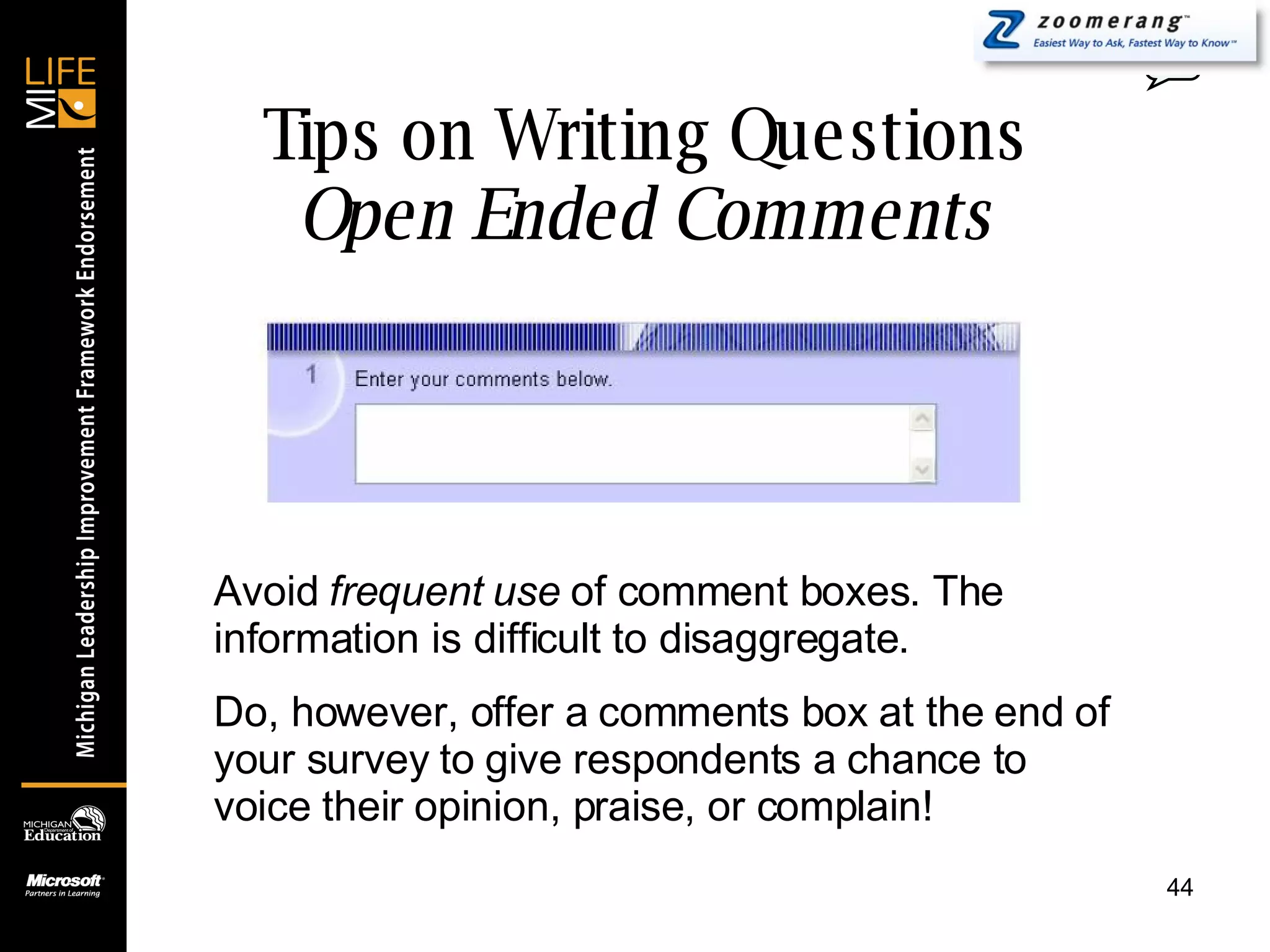
Tips on Writing Questions Open Ended Comments 0 Avoid  frequent use  of comment boxes. The information is difficult to disaggregate. Do, however, offer a comments box at the end of your survey to give respondents a chance to voice their opinion, praise, or complain!
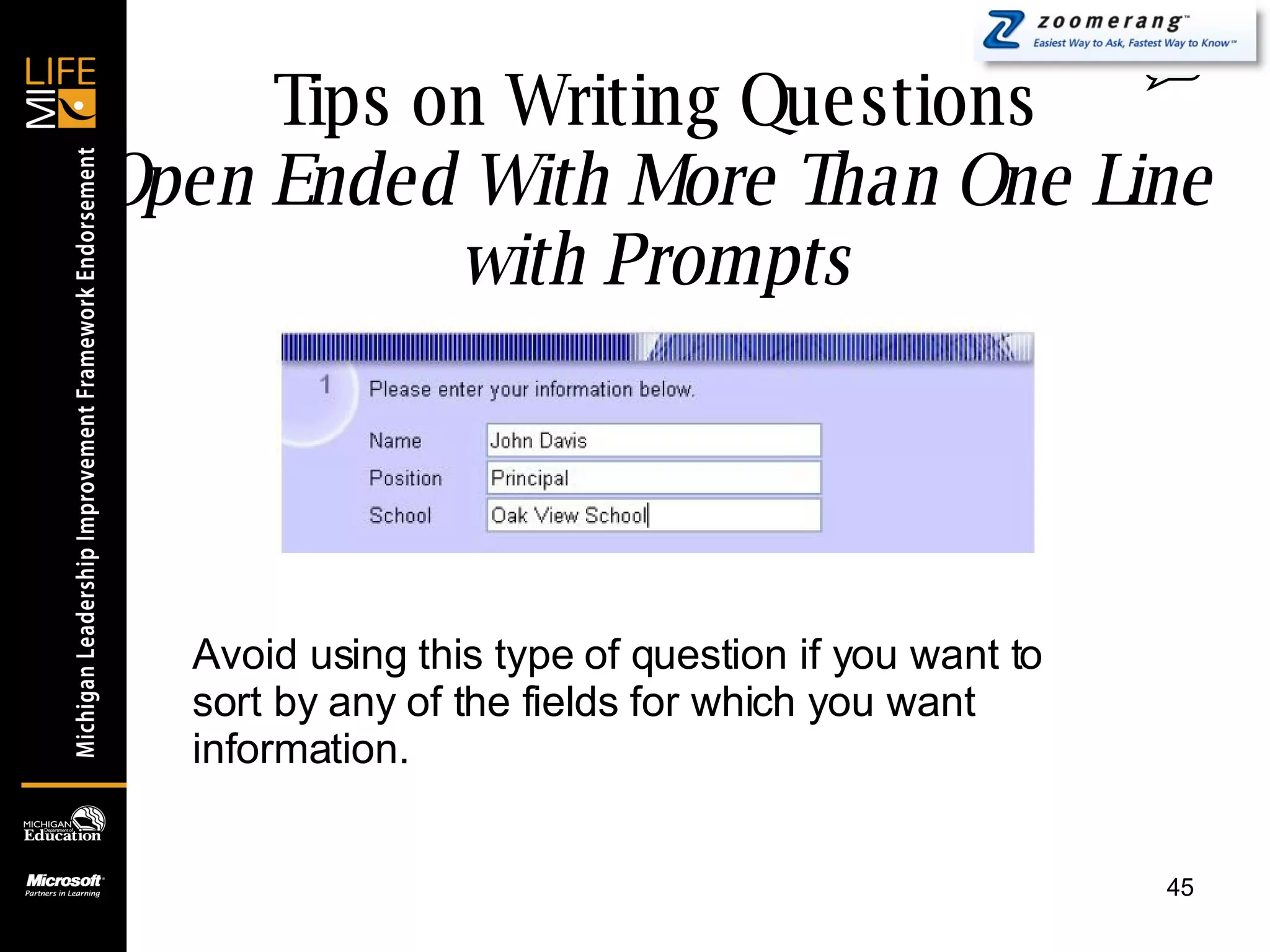
Tips on Writing Questions Open Ended With More Than One Line with Prompts 0 Avoid using this type of question if you want to sort by any of the fields for which you want information.
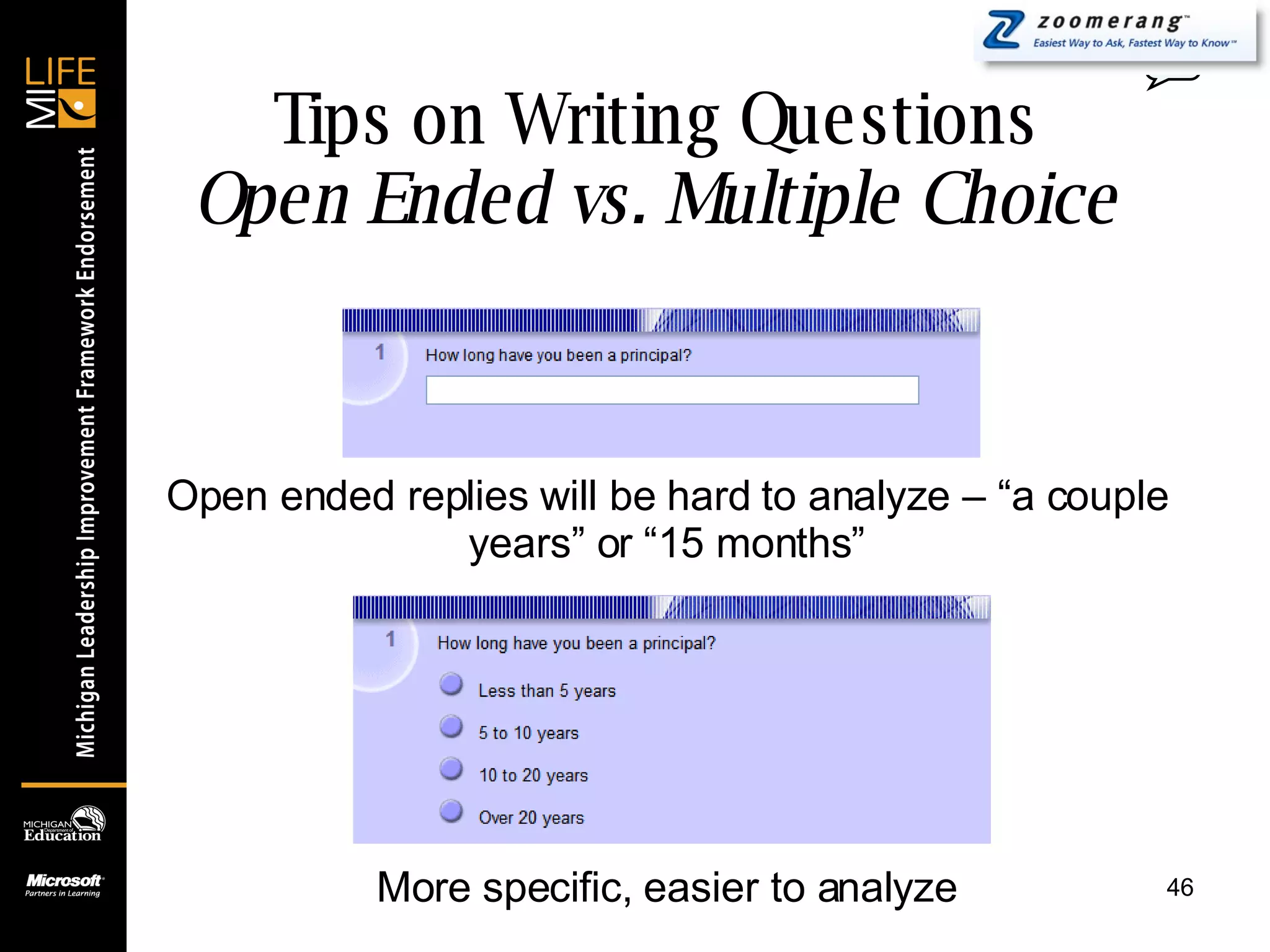
Tips on Writing Questions Open Ended vs. Multiple Choice 0 Open ended replies will be hard to analyze – “a couple years” or “15 months” More specific, easier to analyze
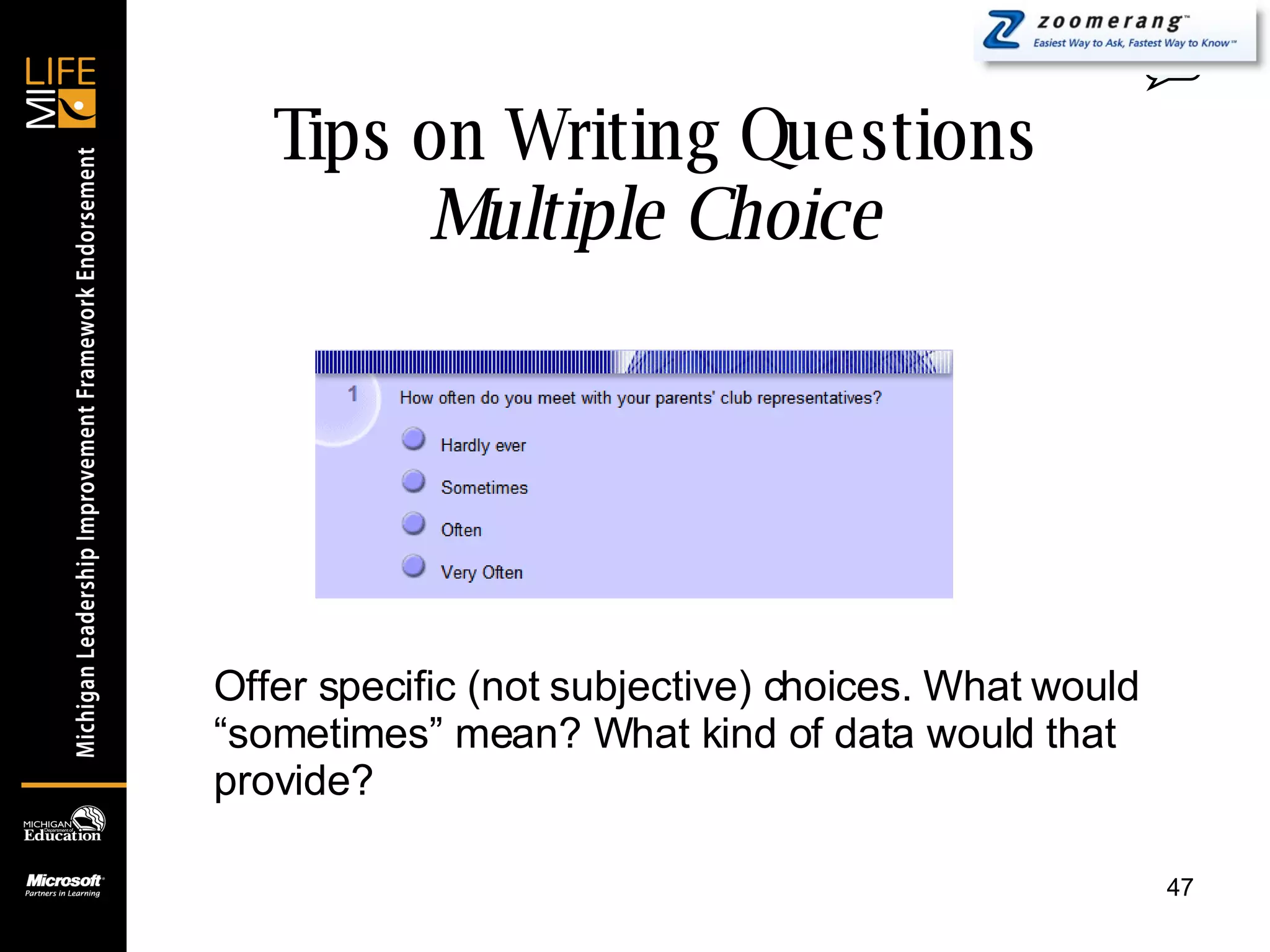
Tips on Writing Questions Multiple Choice 0 Offer specific (not subjective) choices. What would “sometimes” mean? What kind of data would that provide?
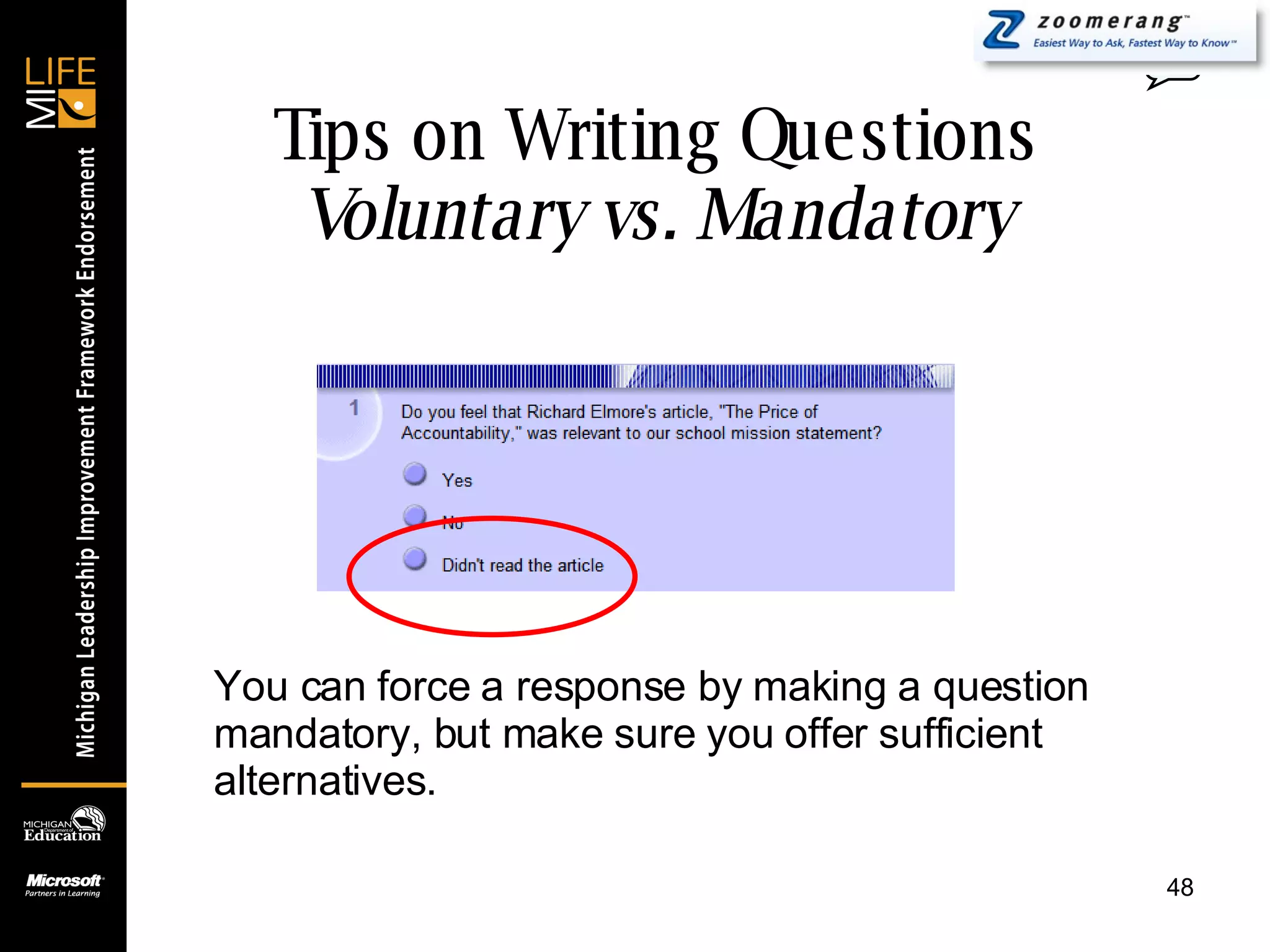
Tips on Writing Questions Voluntary vs. Mandatory 0 You can force a response by making a question mandatory, but make sure you offer sufficient alternatives.
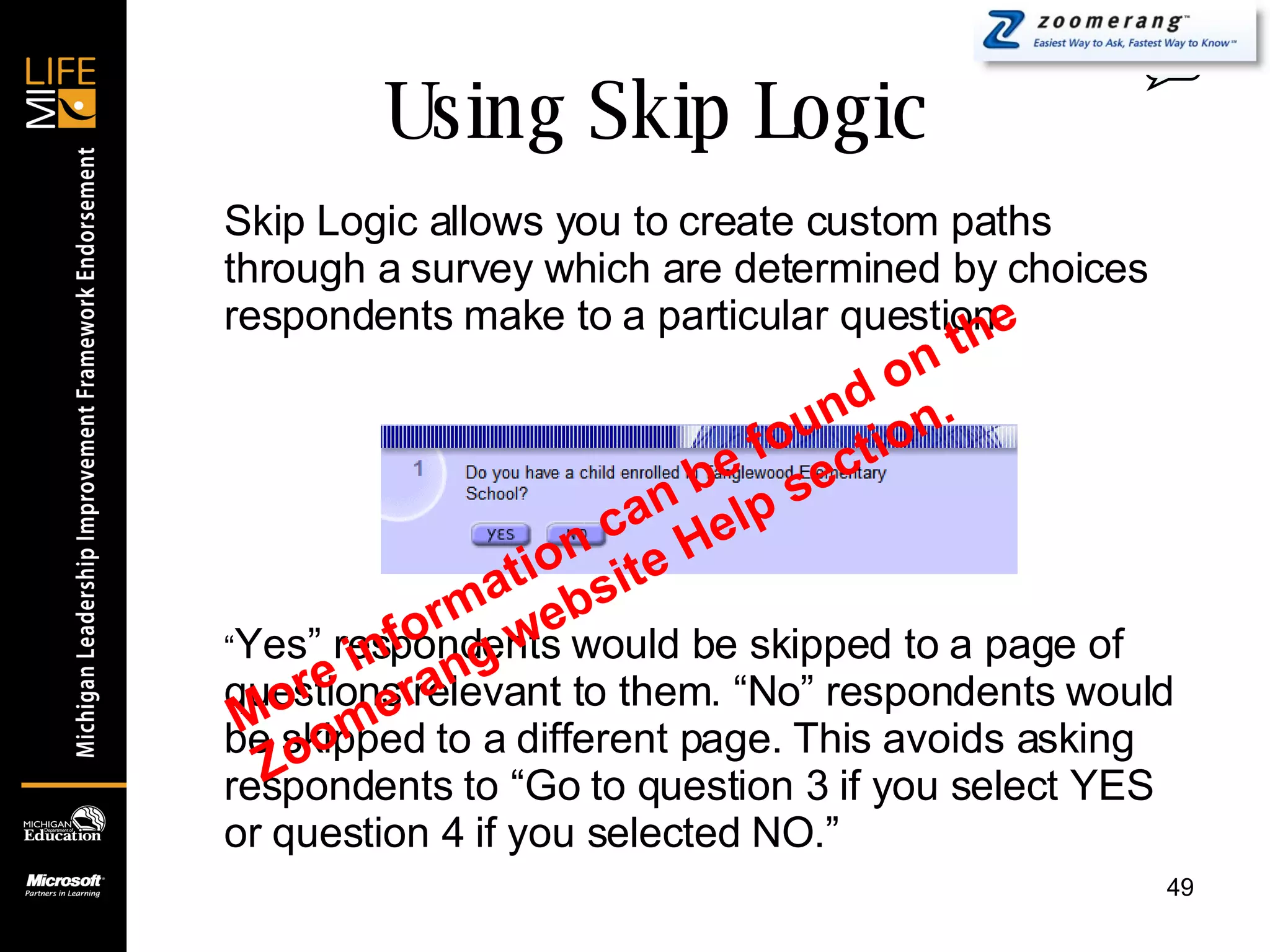
Using Skip Logic Skip Logic allows you to create custom paths through a survey which are determined by choices respondents make to a particular question. “ Yes” respondents would be skipped to a page of questions relevant to them. “No” respondents would be skipped to a different page. This avoids asking respondents to “Go to question 3 if you select YES or question 4 if you selected NO.” 0 More information can be found on the Zoomerang website Help section.
Course Objectives Session I Use external storage for digital documents. Create online surveys to gather data. Create graphic organizers to efficiently organize information. Use wikis to collaborate on document creation. Understand Blackboard navigation 0
0
Setting Up a Gliffy Account 0 to be used in the Optimizing Leadership course
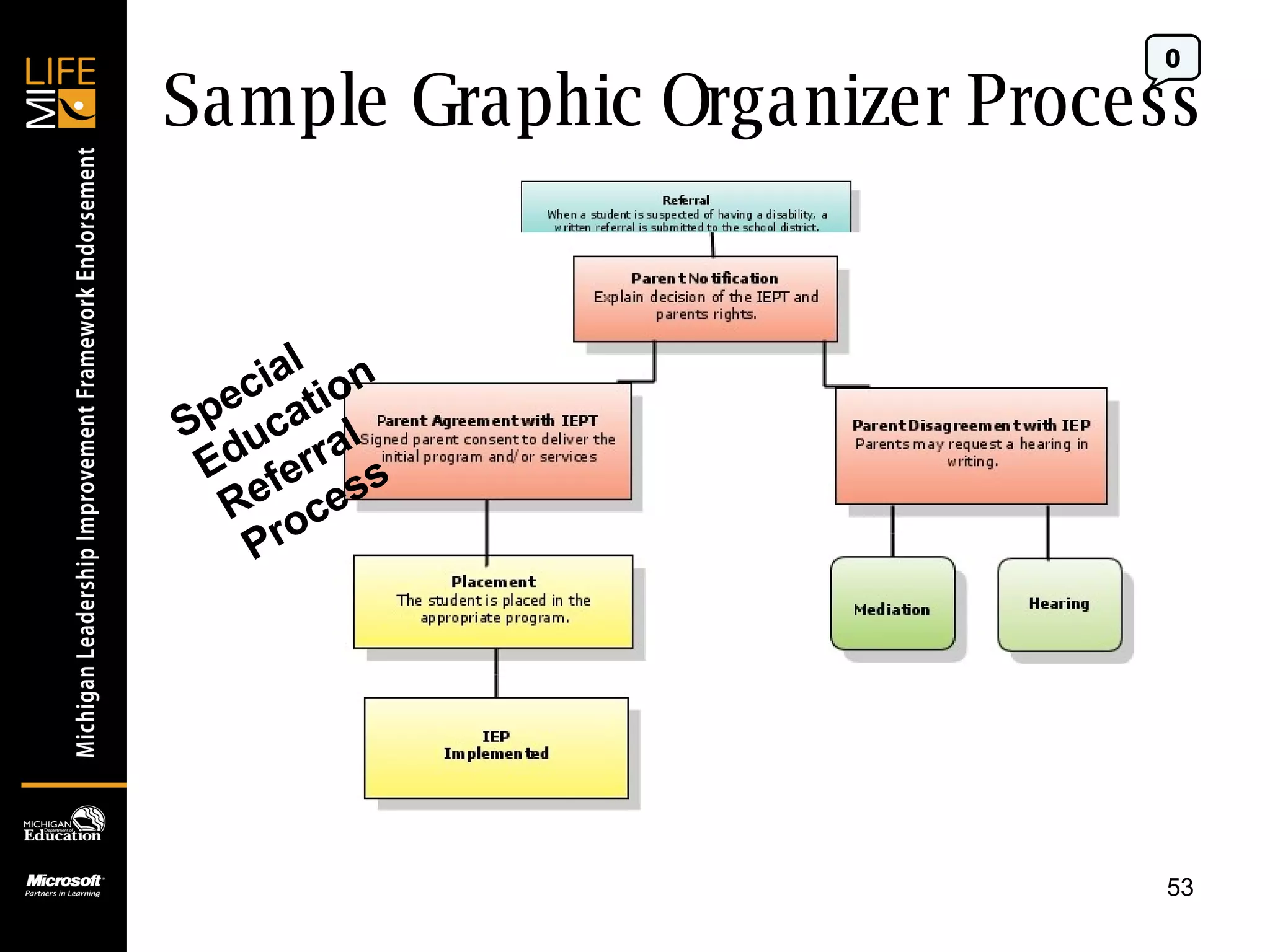
Sample Graphic Organizer Process 0 Special Education Referral Process
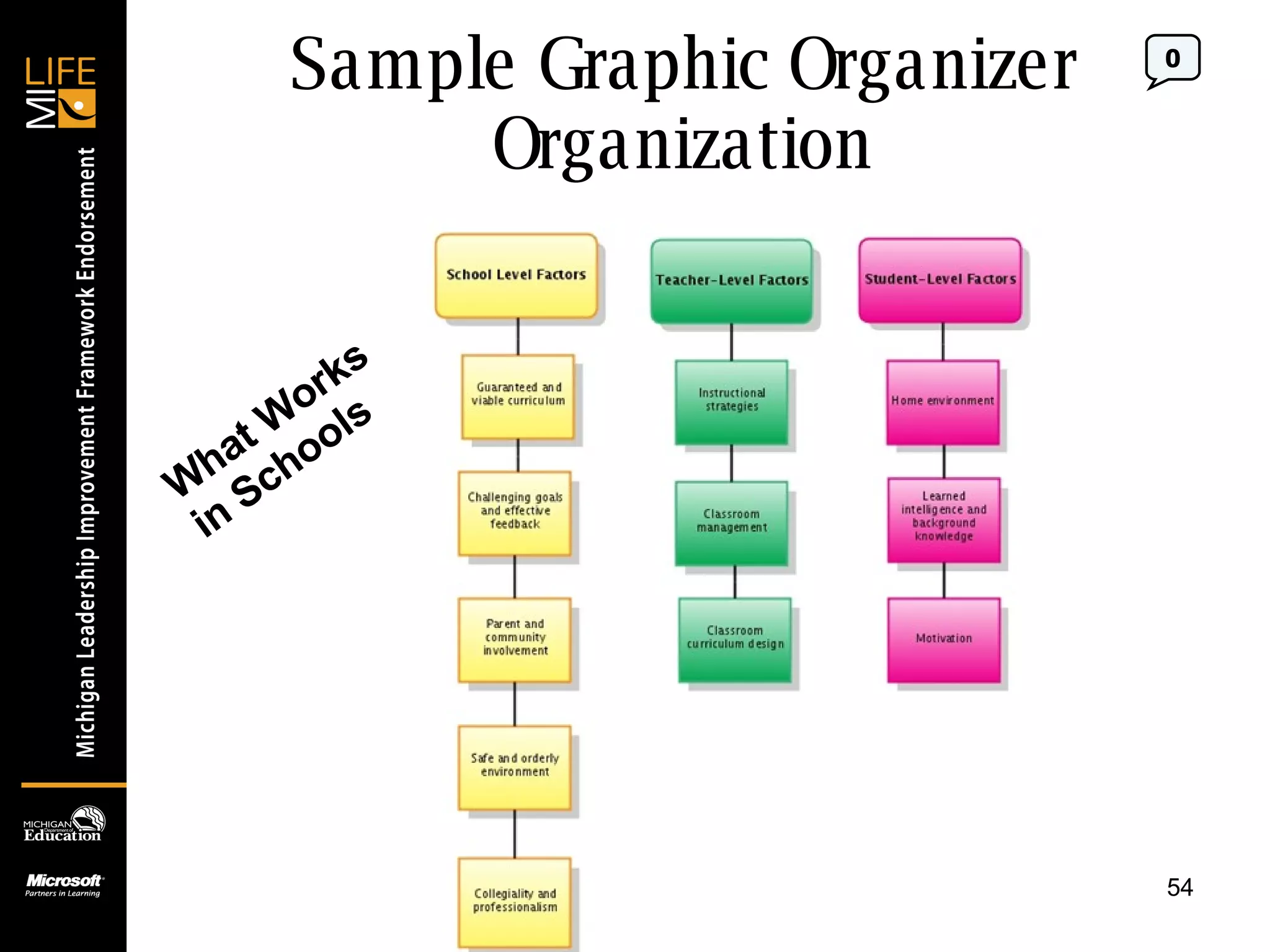
Sample Graphic Organizer Organization What Works in Schools 0
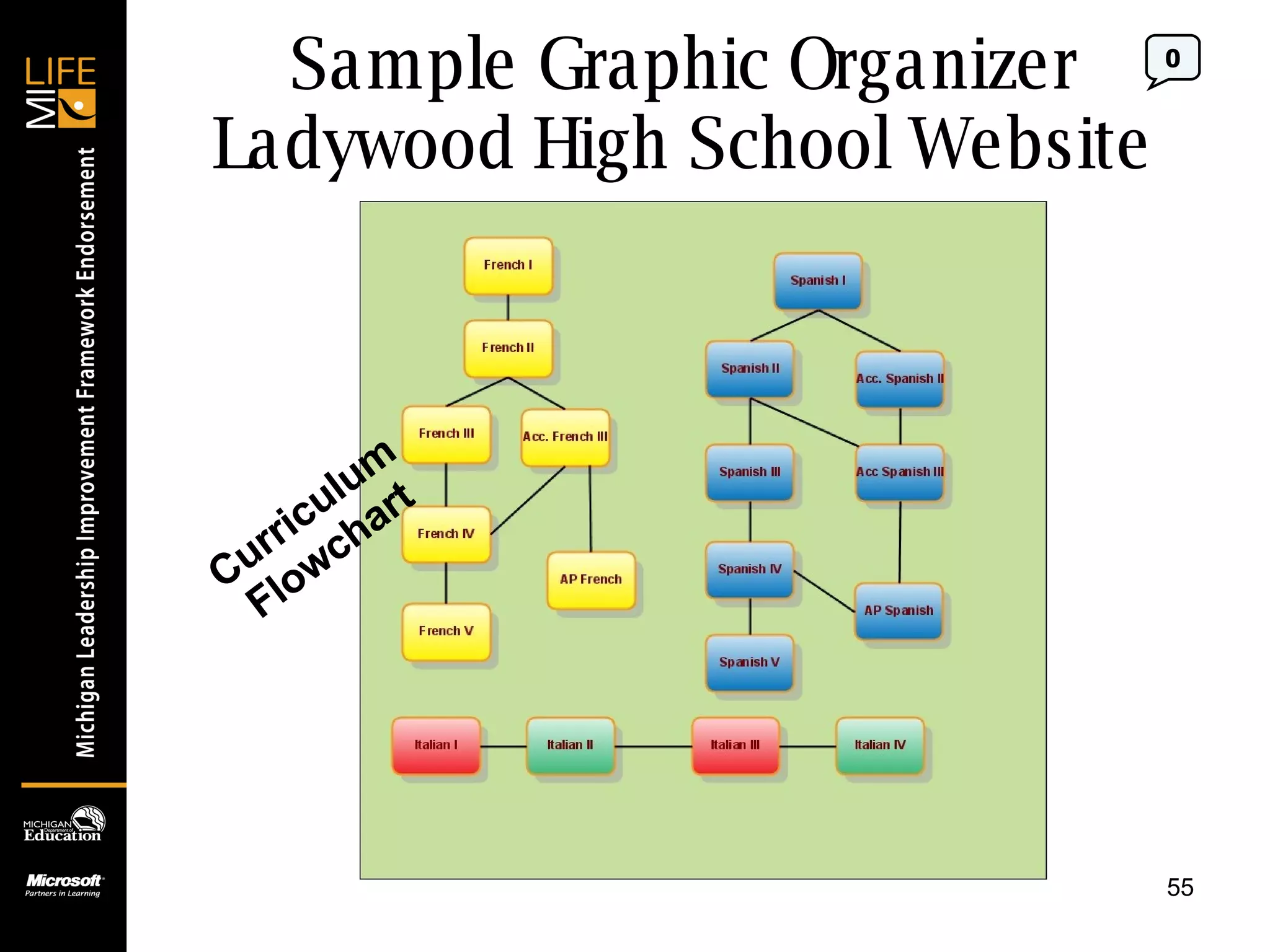
Sample Graphic Organizer Ladywood High School Website 0 Curriculum Flowchart
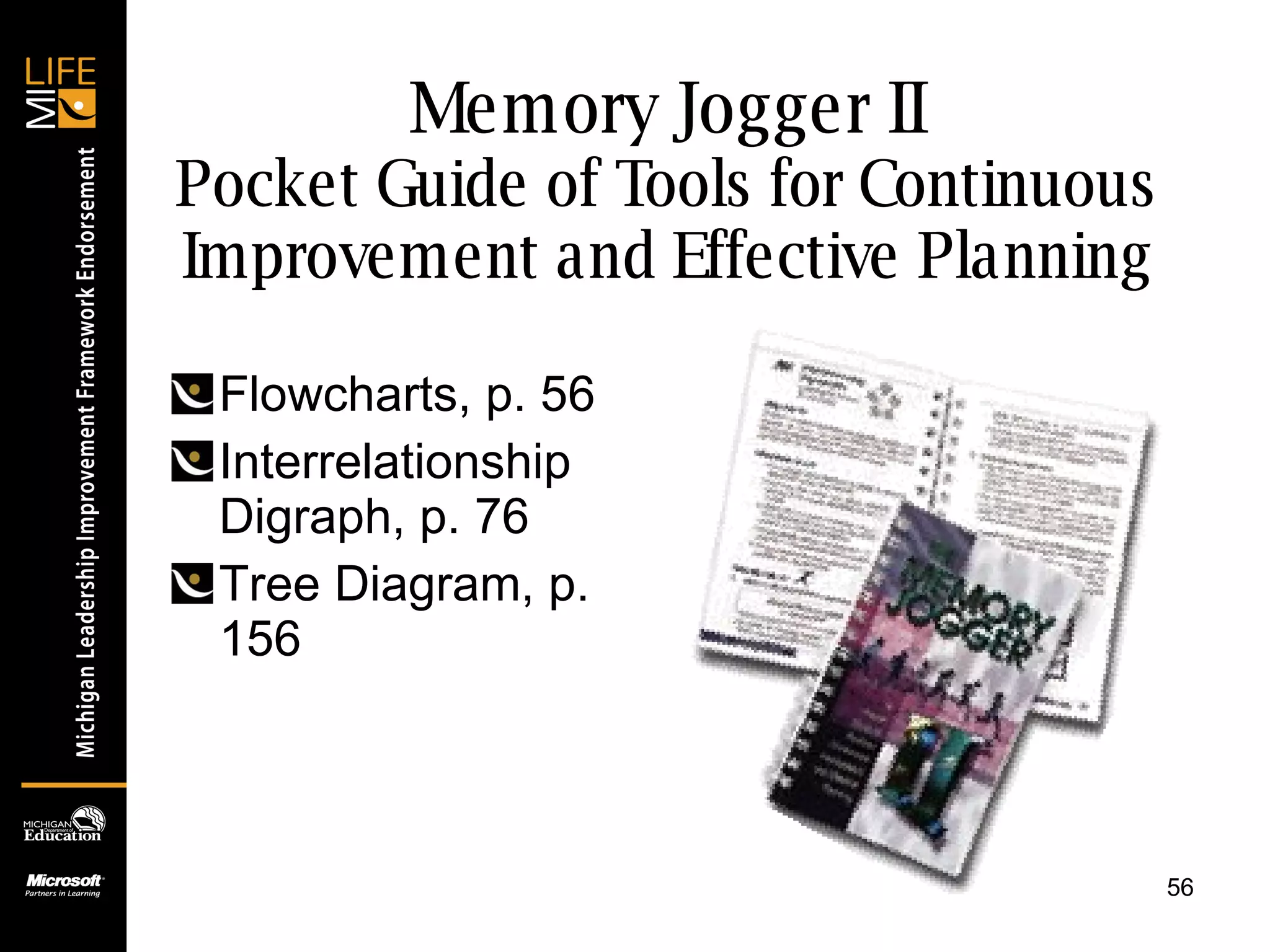
Memory Jogger II Pocket Guide of Tools for Continuous Improvement and Effective Planning Flowcharts, p. 56 Interrelationship Digraph, p. 76 Tree Diagram, p. 156
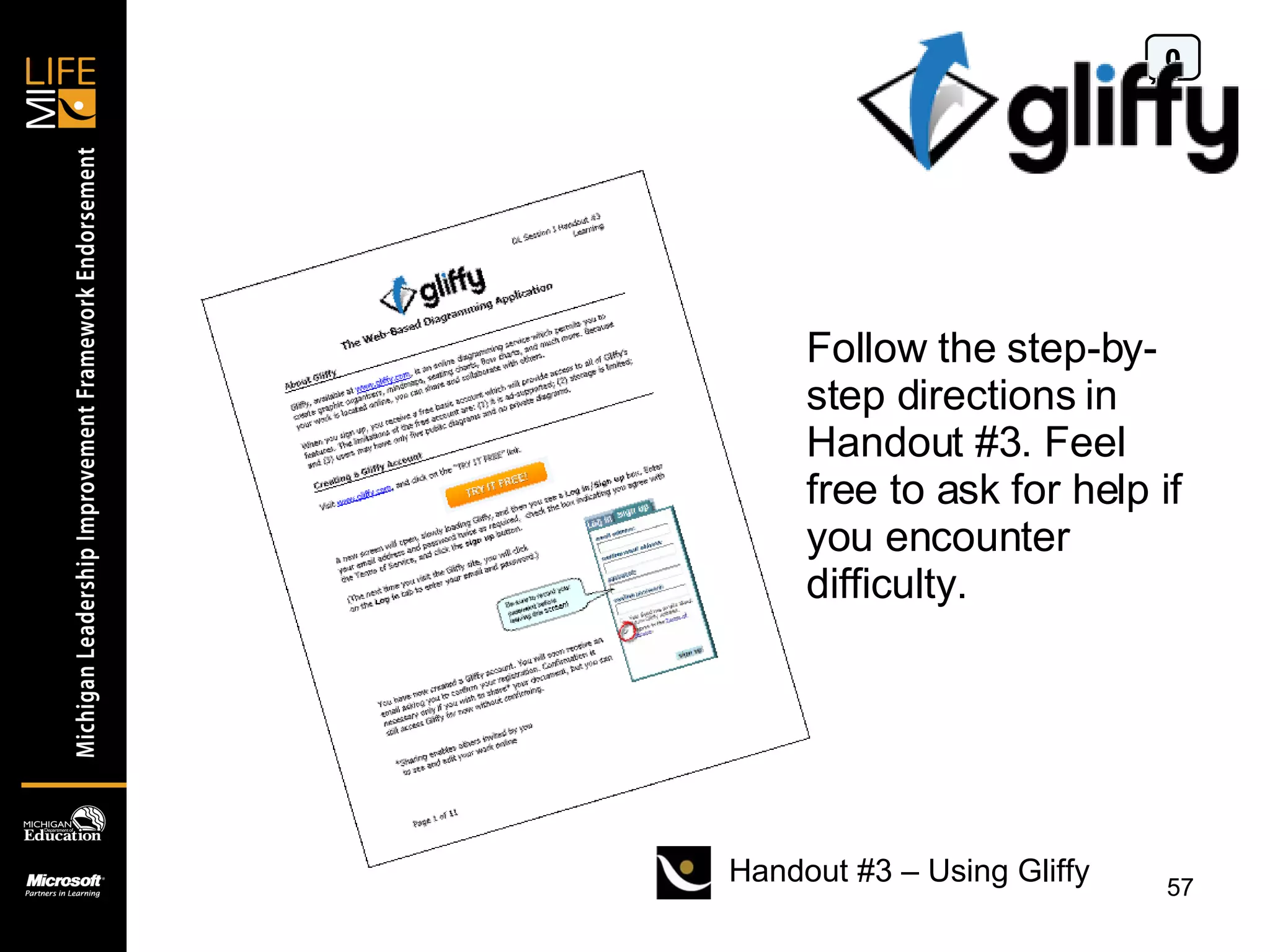
0 Follow the step-by-step directions in Handout #3. Feel free to ask for help if you encounter difficulty. Handout #3 – Using Gliffy
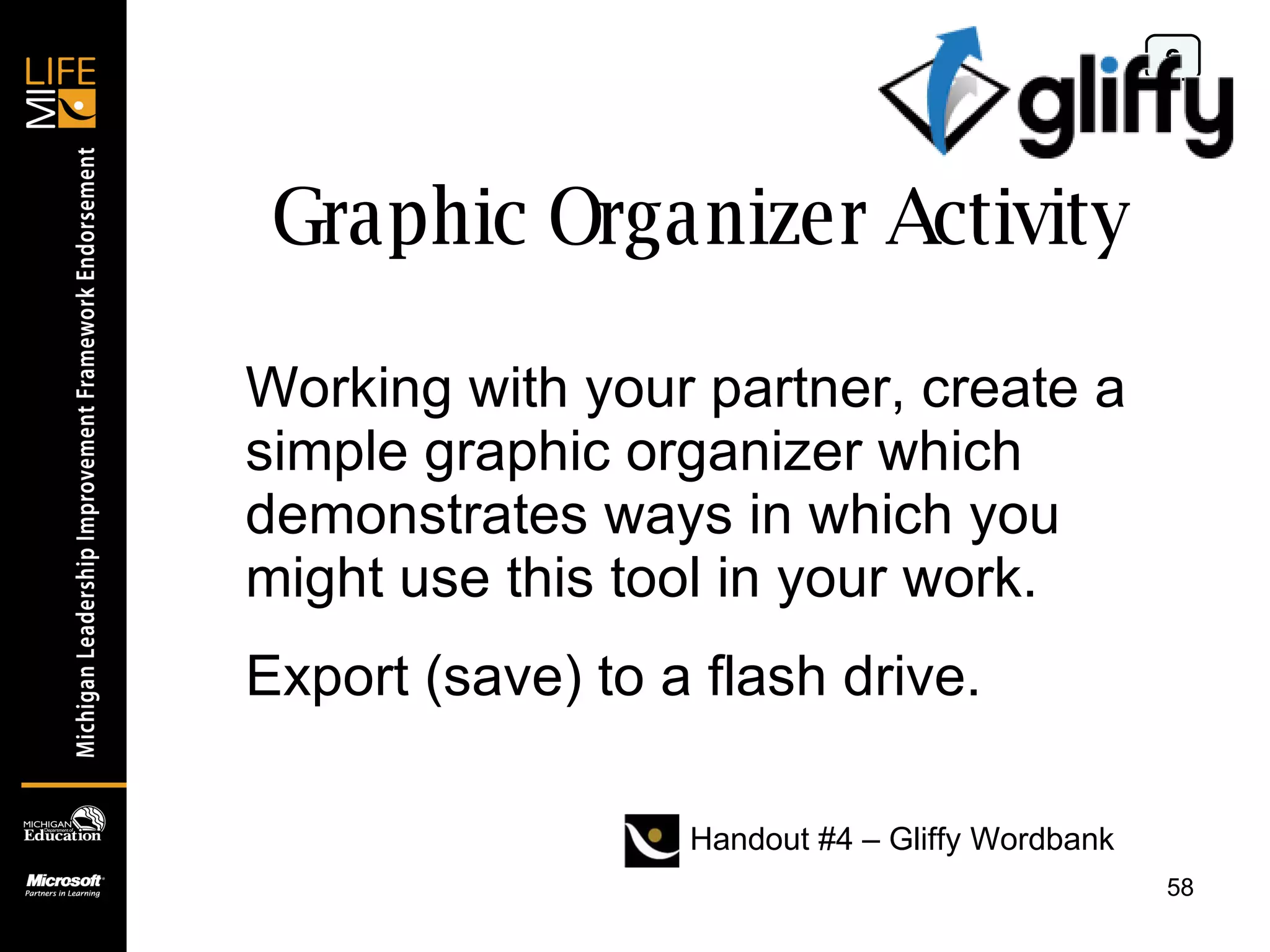
Graphic Organizer Activity 0 Working with your partner, create a simple graphic organizer which demonstrates ways in which you might use this tool in your work. Export (save) to a flash drive. Handout #4 – Gliffy Wordbank
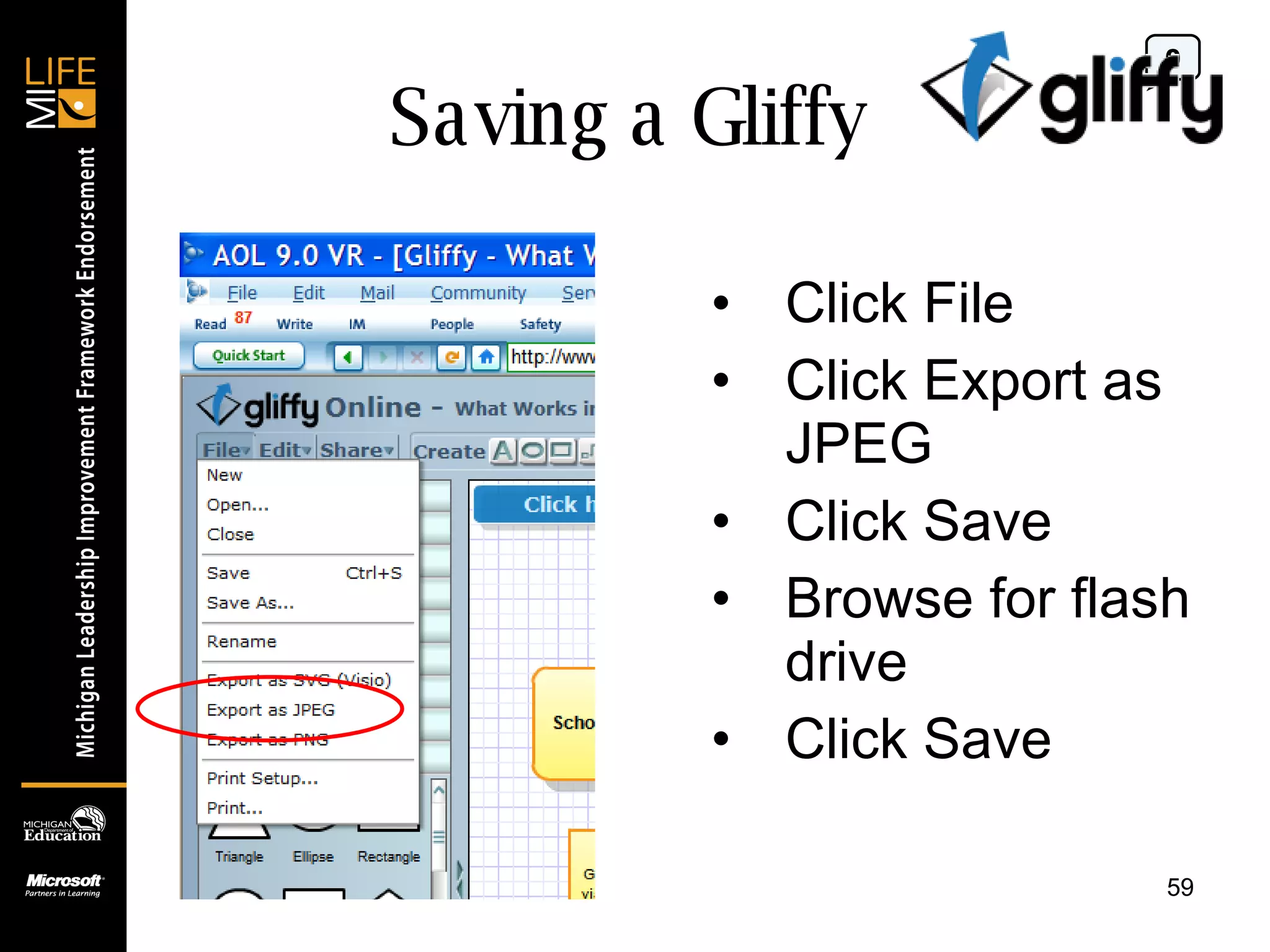
Saving a Gliffy  Click File Click Export as JPEG Click Save Browse for flash drive Click Save 0
Course Objectives Session I Use external storage for digital documents Create online surveys to gather data Create graphic organizers to efficiently organize information Use wikis to collaborate on document creation Understand Blackboard navigation 0
0
0
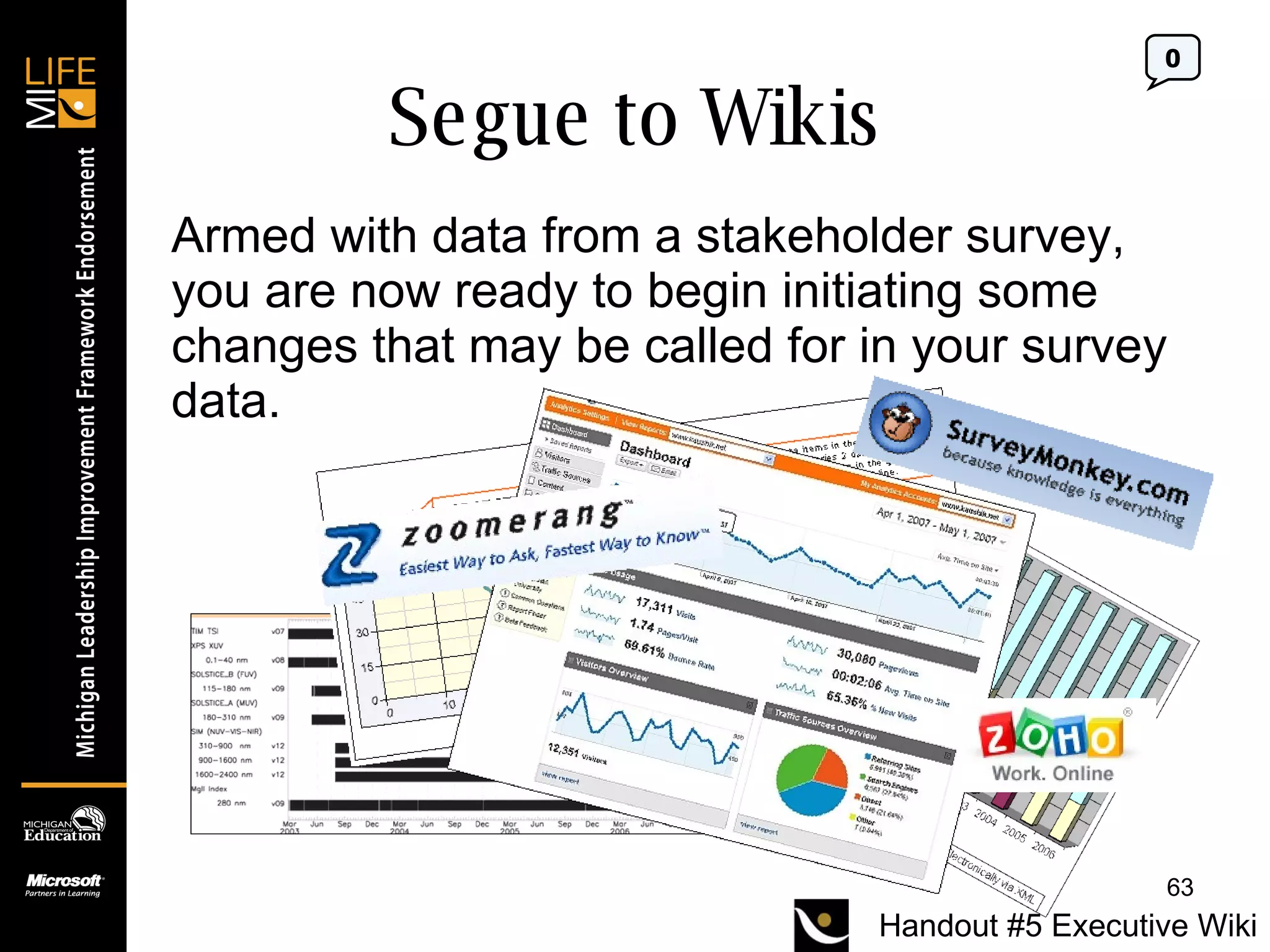
Segue to Wikis Armed with data from a stakeholder survey, you are now ready to begin initiating some changes that may be called for in your survey data. 0 Handout #5 Executive Wiki
Wiki – What’s a Wiki? A  collaborative  website that allows visitors to add, remove, edit, and change content User begins on a particular topic and invites others All changes are tracked by author and date Can be password protected 0
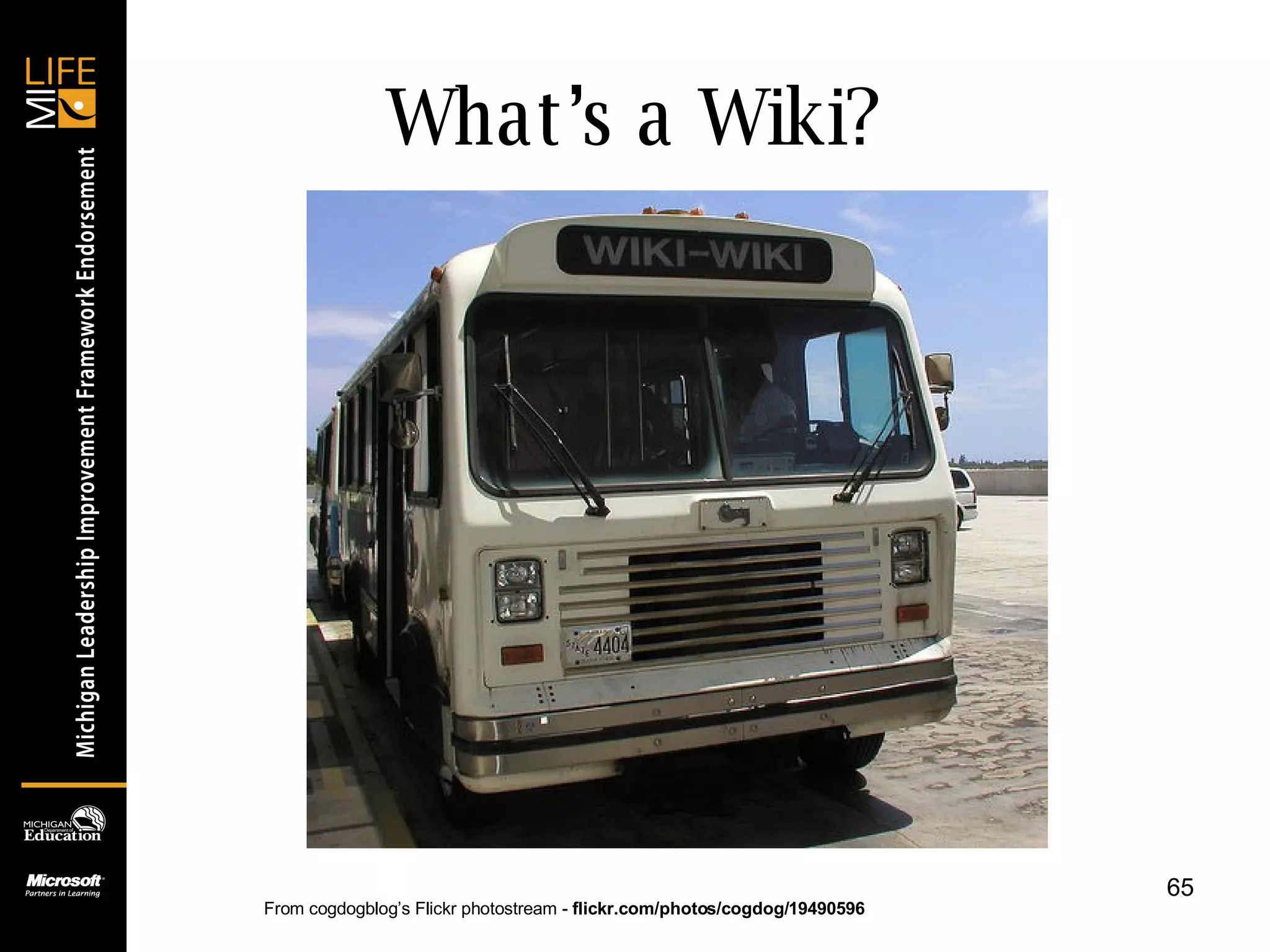
What’s a Wiki? From cogdogblog’s Flickr photostream -  flickr.com/photos/cogdog/19490596
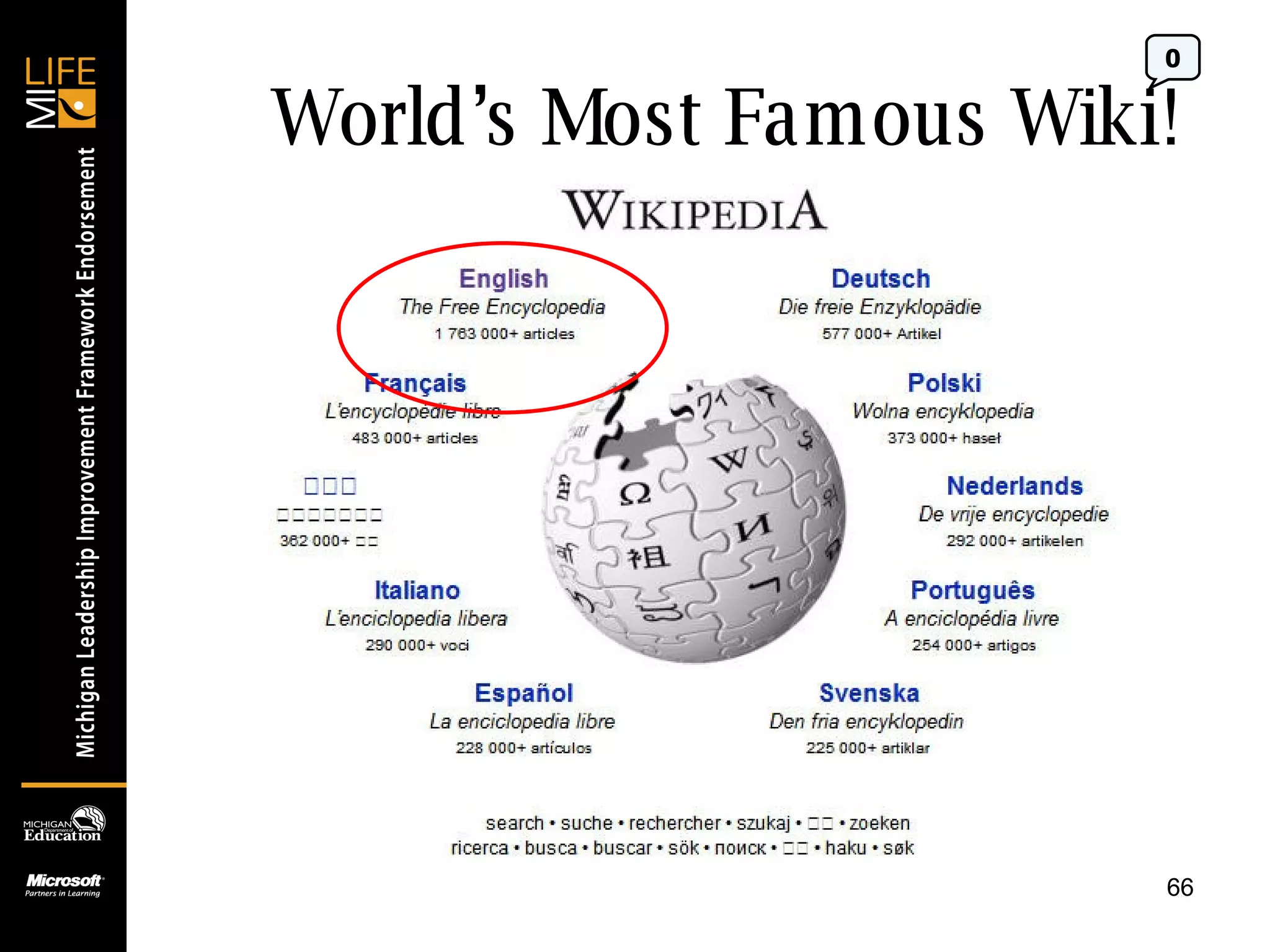
World’s Most Famous Wiki! 0
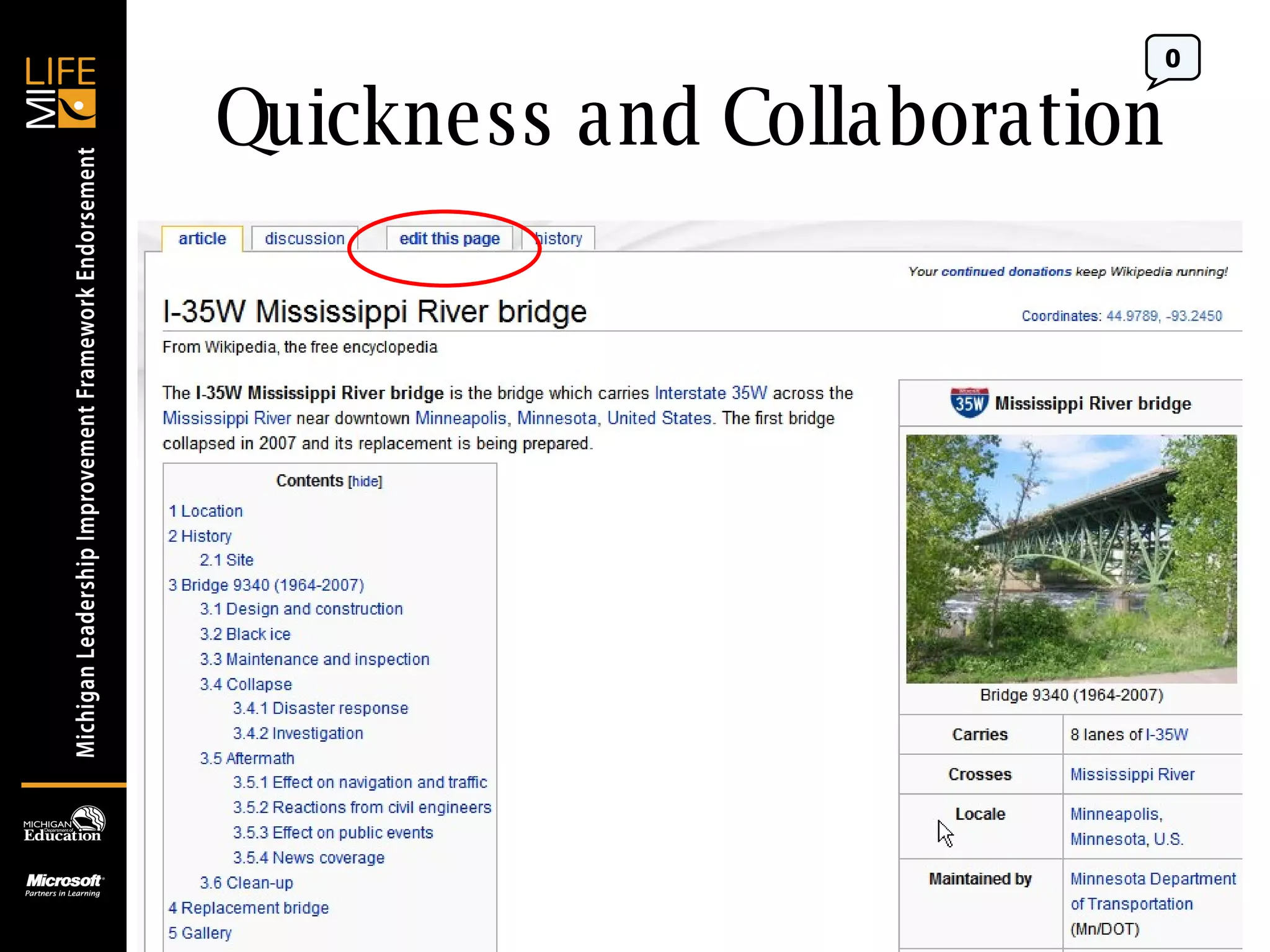
Quickness and Collaboration 0 http://en.wikipedia.org/wiki/I-35W_Mississippi_River_bridge
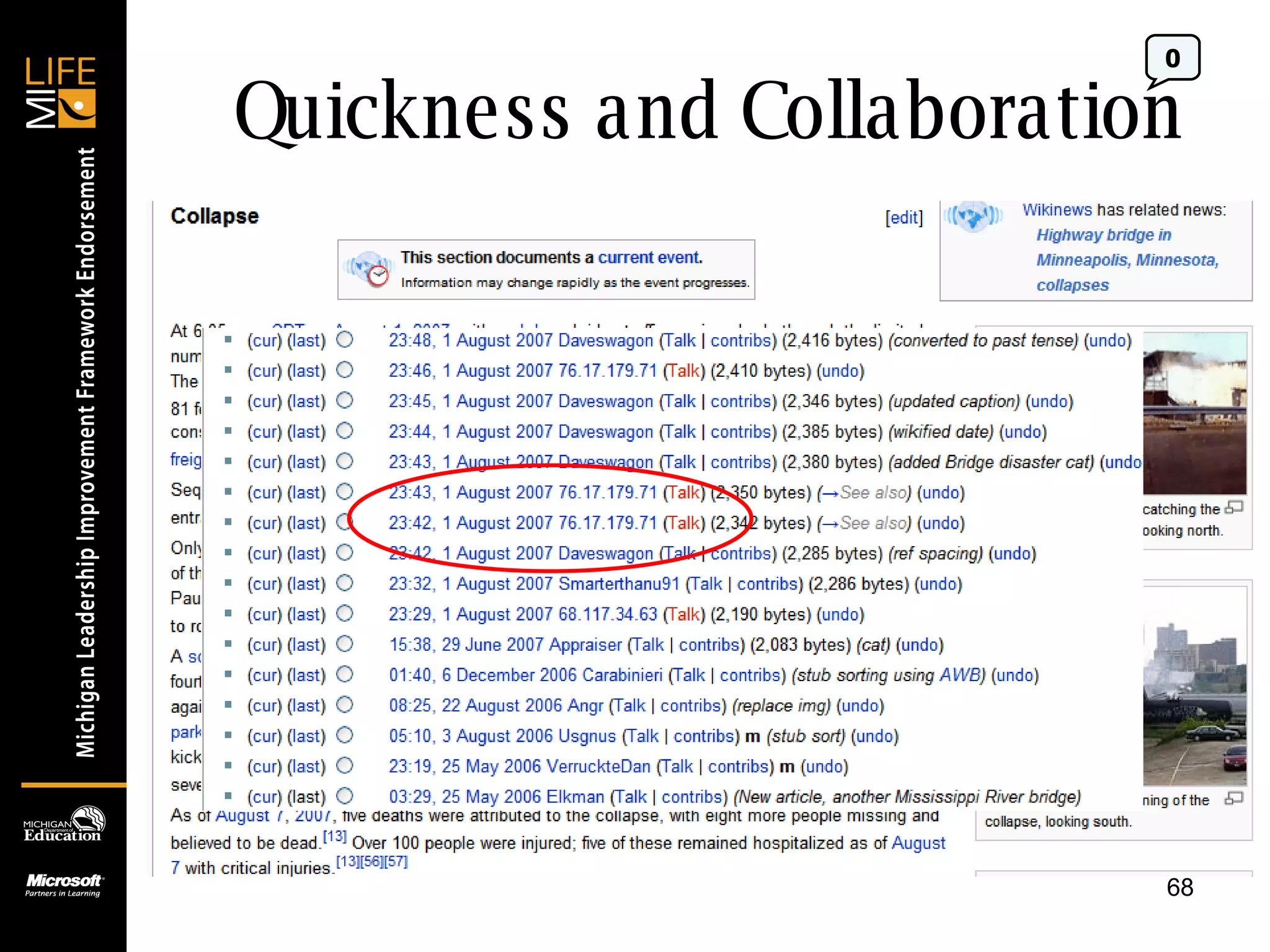
Quickness and Collaboration 0
How Do Wikis Work? Wikis in Plain English 0
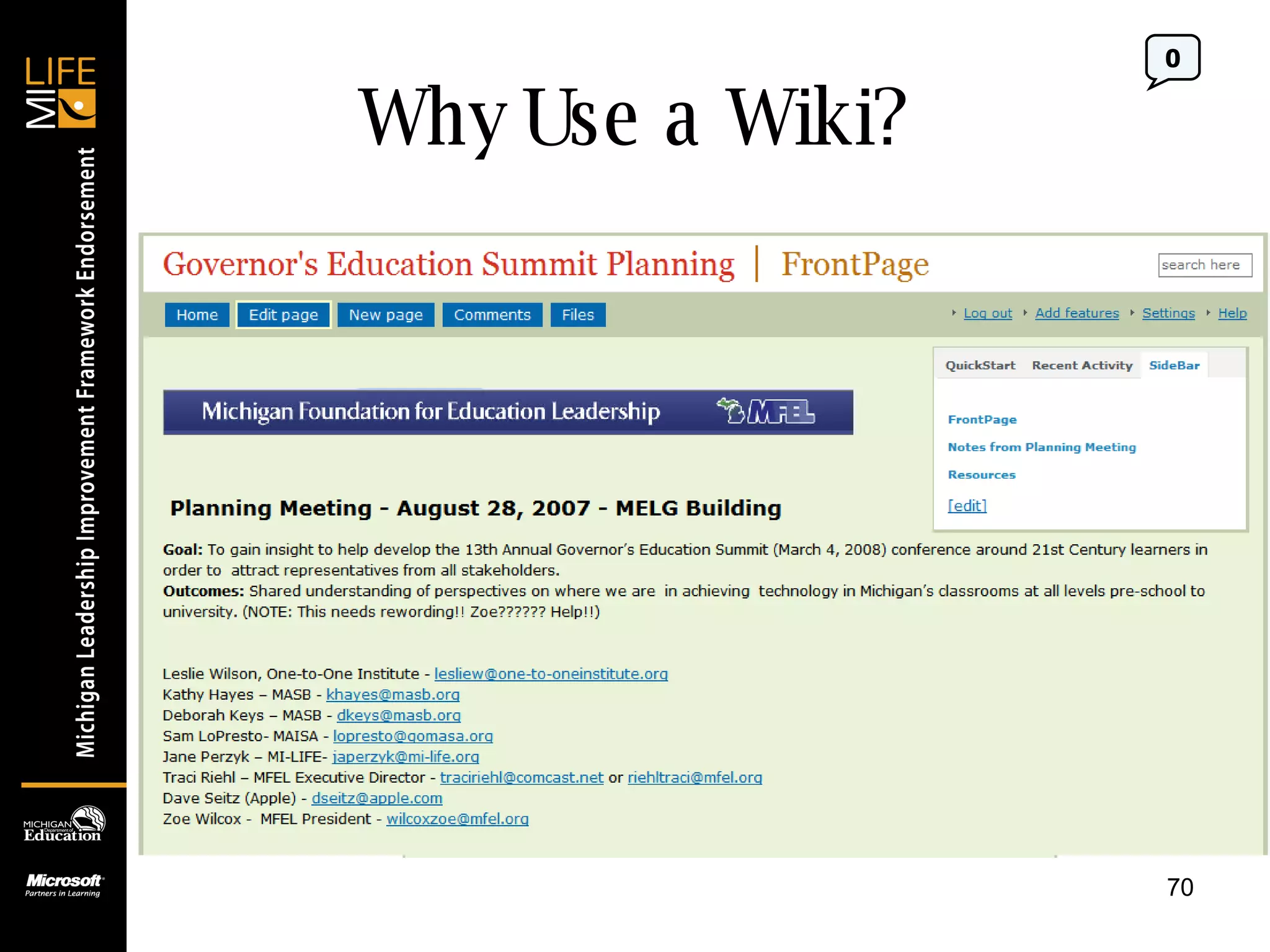
Why Use a Wiki? -- the perfect tool to collaboratively develop and maintain useful documents. 0
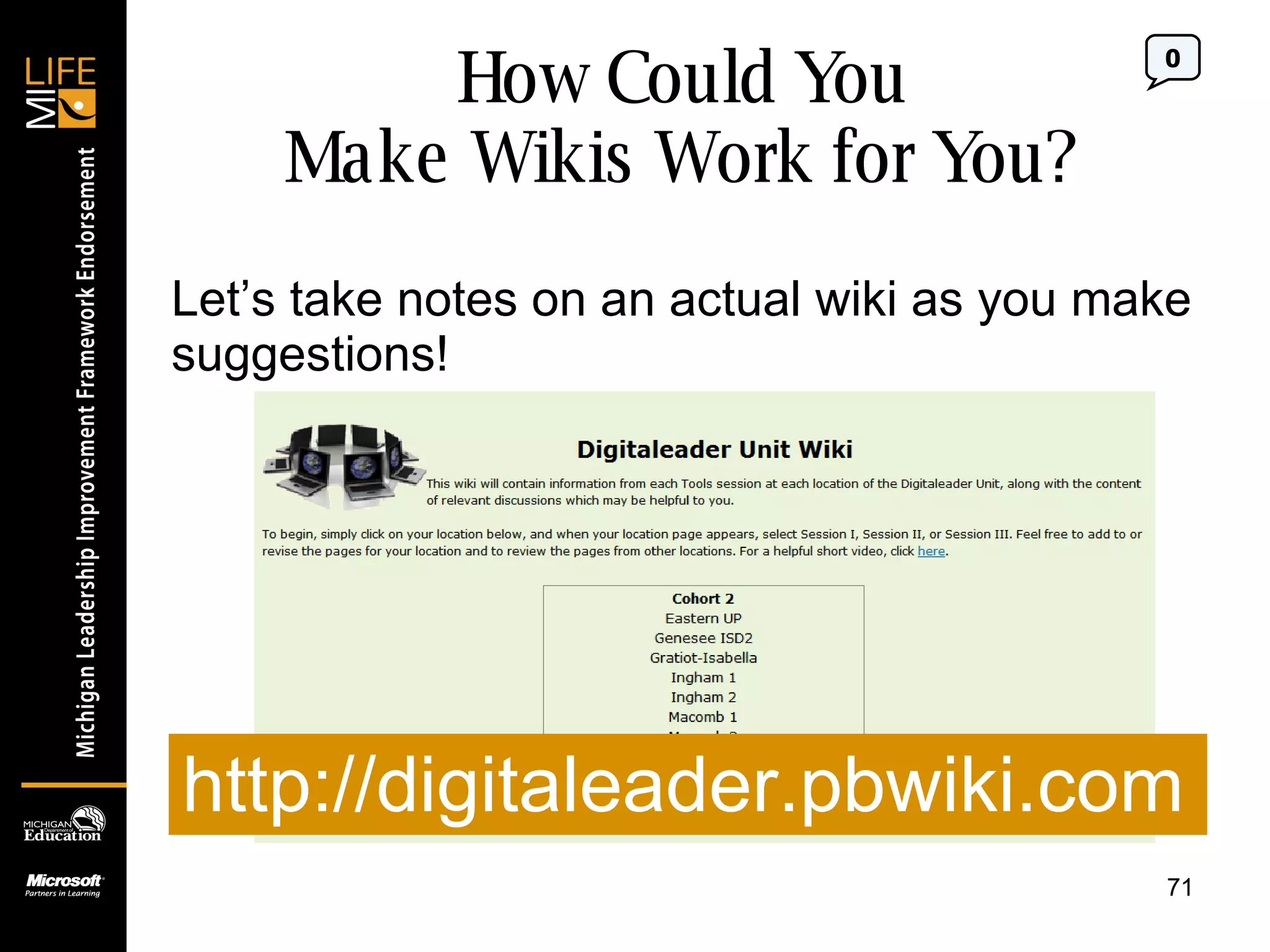
How Could You Make Wikis Work for You? 0 Let’s take notes on an actual wiki as you make suggestions! http://digitaleader.pbwiki.com
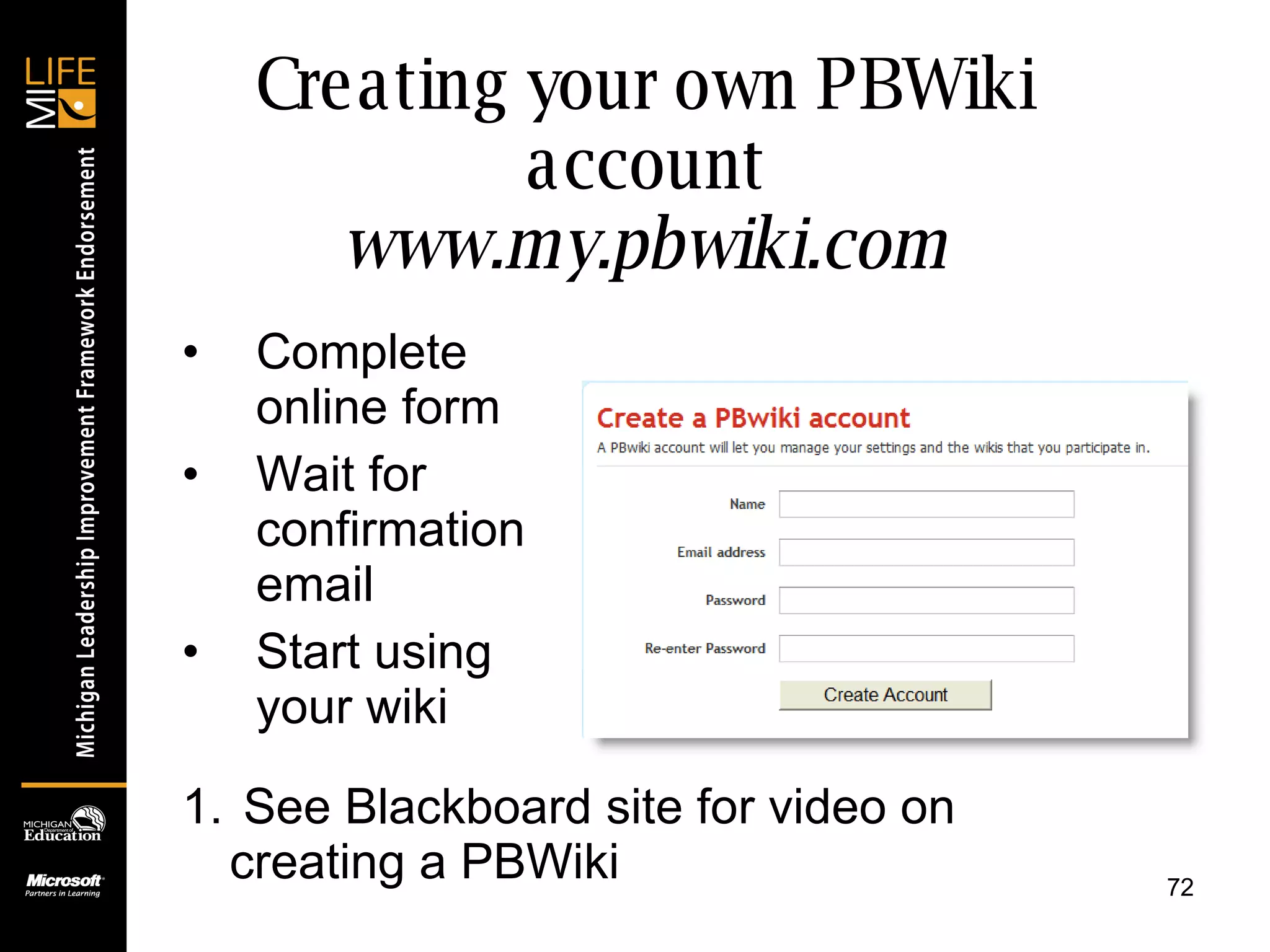
Creating your own PBWiki account www.my.pbwiki.com Complete online form Wait for confirmation email Start using your wiki See Blackboard site for video on creating a PBWiki
Course Objectives Session I Use external storage for digital documents. Create online surveys to gather data. Create graphic organizers to efficiently organize information. Use wikis to collaborate on document creation. Understand Blackboard navigation 0
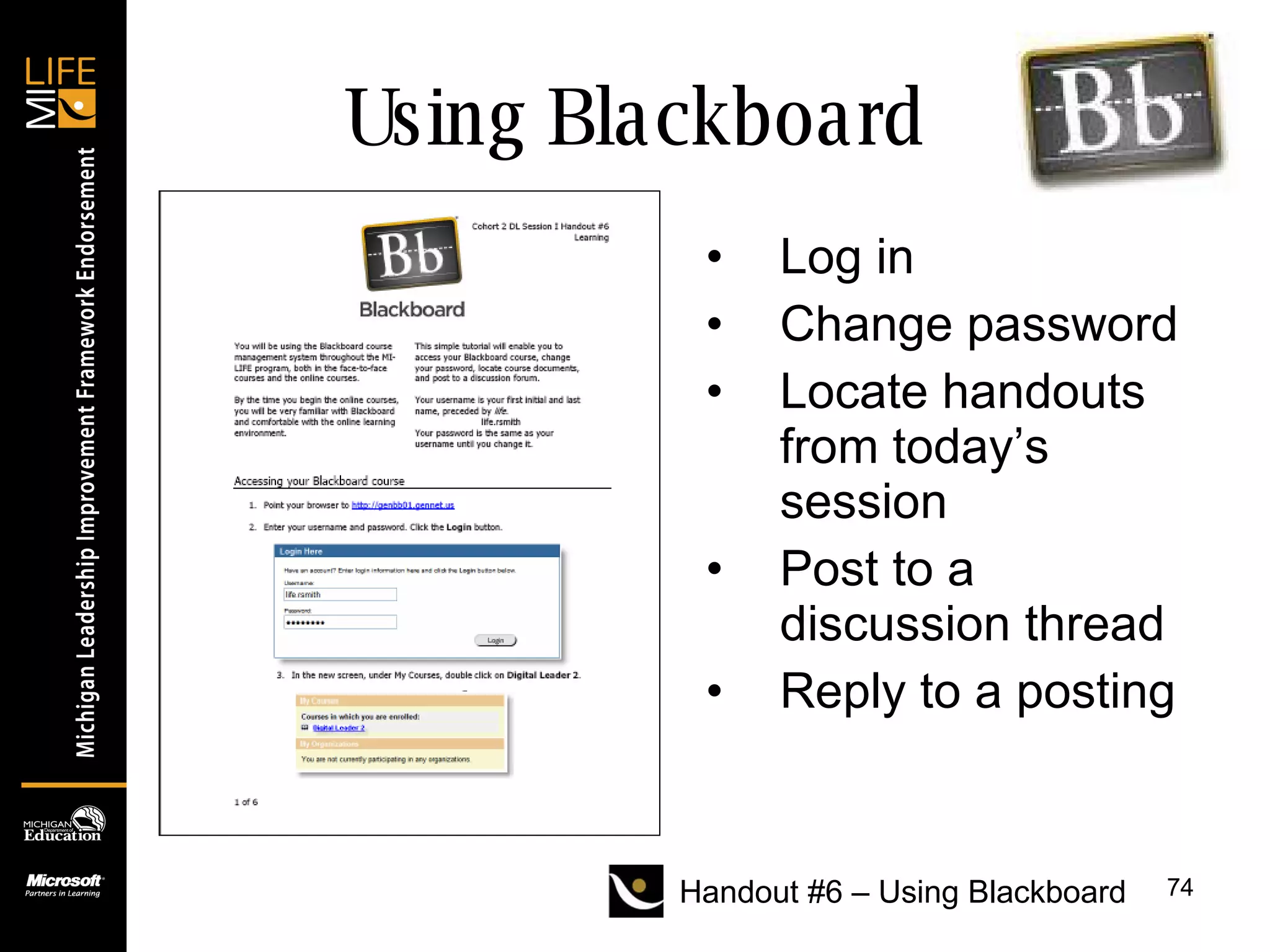
Using Blackboard Log in Change password Locate handouts from today’s session Post to a discussion thread Reply to a posting 0 Handout #6 – Using Blackboard
Course Objectives Session I Use external storage for digital documents Create online surveys to gather data. Create graphic organizers to efficiently organize information Use wikis to collaborate on document creation Understand Blackboard navigation 0
Tools We’ve Learned Today Use EXTERNAL STORAGE for digital documents Create ONLINE SURVEYS to gather data Create GRAPHIC ORGANIZERS to efficiently organize information Use WIKIS to collaborate on document creation with various stakeholders 0 Understand BLACKBOARD navigation
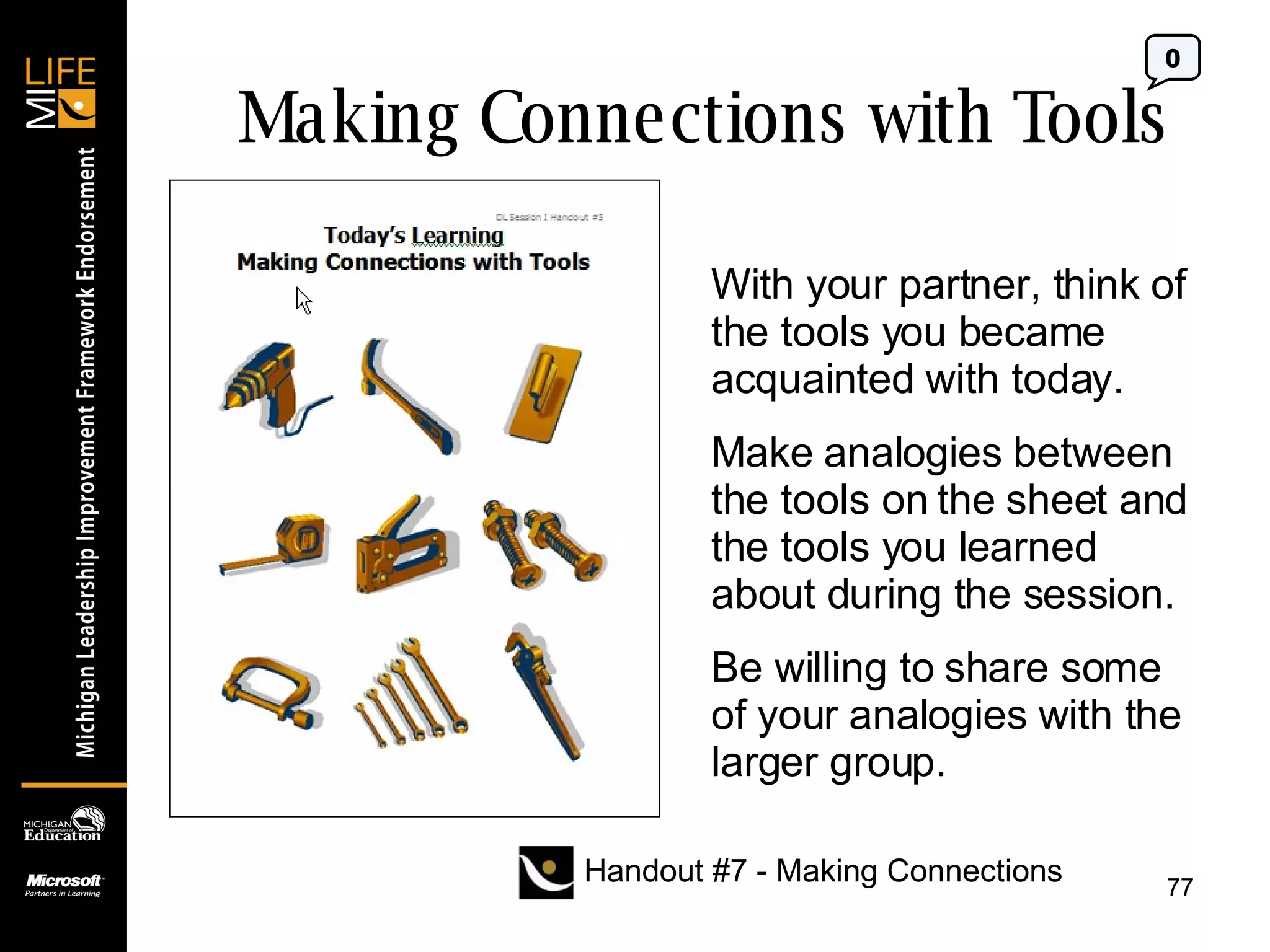
Making Connections with Tools With your partner, think of the tools you became acquainted with today. Make analogies between the tools on the sheet and the tools you learned about during the session. Be willing to share some of your analogies with the larger group.  0 Handout #7 - Making Connections
Next course will be Optimizing Leadership on 00/00/2008. Information from today’s session  will be posted on the Digitaleader Blackboard site and in the Digitaleader wiki. Our contact information: John Smith –  [email_address] Susie Jones –  [email_address] In closing . . .  0

Digital Tools Session I Cohort 2

  • 1.
  • 2.
    Abstract “ Justin time” sessions focusing on a blend of tools needed to complete the courses* and to become successful Digital Leaders Learning Collaborating Communicating Data Collecting * Each session will precede the ensuing course(s) in which the tools will be applied . 0
  • 3.
    Course Goal Encourageeducational leaders to become confident technology users and leaders Or in other words Digitaleaders 0
  • 4.
    Even if youare a school leader who speaks DSL*, and even if you are technophobe , you can still be a digitaleader if you . . . 0 *Digital as a Second Language
  • 5.
    -- understand theimportance of technology as a tool, but are not bound by its traditional uses 0
  • 6.
    -- realizethat your use of technology can become transparent and ubiquitous 0 http://www.jklossner.com/computerworld/other.html
  • 7.
    Course Objectives forAll Three Digital Leadership Unit Sessions Assess prior knowledge of each session’s technology tools Understand the significance and use of online tools for professional use and for teaching Work collaboratively with colleagues as coaches/learners 0
  • 8.
    Course Objectives SessionI Use external storage for digital documents Create online surveys to gather data Create graphic organizers to efficiently organize information Use wikis to collaborate on document creation Understand Blackboard navigation 0
  • 9.
    Course Objectives SessionII Use the Internet to efficiently search for and evaluate information Store, retrieve, and share online sources easily Navigate an online course management system Learn basic MS-Excel functions Develop a personalized web presence 0
  • 10.
    Course Objectives SessionIII Create blogs to communicate with various stakeholders Create wikis to develop and share information with staff Understand use of RSS feeds Create an online calendar scheduler Use and develop an online visual ranking tool Prepare informative PowerPoint presentations 0
  • 11.
    And, of course, Feel like this at the end of the third session! 0
  • 12.
  • 13.
    How would youdescribe yourself? Digital Native Digital Immigrant Digital Refugee Bridge Undecided 0
  • 14.
    Saving and TransportingFiles -- Using a Flash Drive Old New 0
  • 15.
    Using a FlashDrive Load, store, and transport files without carrying a laptop Compatible with almost any computer 0
  • 16.
    Saving a Fileto a Flash Drive Locate a Word document titled “Digital Natives” on your desktop. Double click on the Word icon to open the document. 0
  • 17.
    Saving a Fileto a Flash Drive Click on File>Save As 0
  • 18.
    Saving a Fileto a Flash Drive In the Save In box, click the drop down arrow and click on My Computer 0
  • 19.
    Saving a Fileto a Flash Drive Under My Computer, click on your flash drive. Then click Save. 0
  • 20.
    Removing Your FlashDrive Left click once on the “Safely Remove Hardware” icon in the System Tray (bottom right). Click on “Safely Remove Drive X” When you see a notification that it is safe to remove hardware, THEN physically remove the USB drive from the computer. 0
  • 21.
    Renaming Your FlashDrive Find the removable drive under My Computer 0
  • 22.
    Renaming Your FlashDrive Right click on the flash drive icon 0
  • 23.
    Storing Sensitive MaterialData Security Policies are Not Enforced Pokemon Institute
  • 24.
    Your Memory Device(Remembering MI-LIFE URL) 0 www.mi-life.org
  • 25.
    Course Objectives SessionI Use external storage for digital documents. Create online surveys to gather data. Create graphic organizers to efficiently organize information. Use wikis to collaborate on document creation. Understand Blackboard navigation 0
  • 26.
    Have You EverUsed Paper-Based Surveys? 0
  • 27.
    How Do YouUse Surveys? What was the purpose of your survey? 0 What kind of data did you collect? Who were the stakeholders surveyed? How were the results disseminated? How were the results used? Pair with your partner and share your responses to these questions
  • 28.
    Benefits of OnlineSurveys Save time and mailing costs Collect and analyze results automatically in real time Allow mandatory questions Offer ability to launch a survey very quickly
  • 29.
  • 30.
    Your Zoomerang Account0 to be used in the Optimizing Leadership course
  • 31.
    3 Easy Steps0 Invite Participants Create a Survey Analyze Results
  • 32.
    Create a Survey0 Customize a template Create a survey from scratch Copy and update one of your previously used surveys Sample Survey
  • 33.
    Invite Participants 0Upload your email list into Zoomerang to generate an invitation Add a survey link to your website or your own email
  • 34.
    Analyze Results 0View real time results online Export into an Excel spreadsheet Share results online privately, or allow others access also New! Export chart into PowerPoint slide
  • 35.
  • 36.
    Automatic Chart Creation0 Pie with Percentages
  • 37.
    Automatic Chart Creation0 Bar with Percentages
  • 38.
    Automatic Chart Creation0 Columns with Numbers and Percentages
  • 39.
    Survey Question TypesChoice – Multiple Answer Choice – One Answer (bullets or dropdown menu) Data and Time Heading Name and Address U.S. or general Open ended 50 characters; 3000 Open ended 3000 characters Rating Scale – 1 answer Rating Scale Matrix Ranking Yes or No
  • 40.
    Survey Question TypesHandout #1 – Question Types
  • 41.
    Zoomerang Step-by-Step 0Follow the step-by-step directions in the handout. Feel free to ask for help if you encounter difficulty. Handout #2 – Using Zoomerang
  • 42.
    Zoomerang Activity Withyour partner, create a short survey using several of the different question types. Then LAUNCH the survey. 0
  • 43.
    Tips on WritingQuestions Name and Address-US 0 Avoid using this question template if you want to sort by last name, city, state, or zip code. Instead, create separate fill in the blank questions for each item of information you wish.
  • 44.
    Tips on WritingQuestions Open Ended Comments 0 Avoid frequent use of comment boxes. The information is difficult to disaggregate. Do, however, offer a comments box at the end of your survey to give respondents a chance to voice their opinion, praise, or complain!
  • 45.
    Tips on WritingQuestions Open Ended With More Than One Line with Prompts 0 Avoid using this type of question if you want to sort by any of the fields for which you want information.
  • 46.
    Tips on WritingQuestions Open Ended vs. Multiple Choice 0 Open ended replies will be hard to analyze – “a couple years” or “15 months” More specific, easier to analyze
  • 47.
    Tips on WritingQuestions Multiple Choice 0 Offer specific (not subjective) choices. What would “sometimes” mean? What kind of data would that provide?
  • 48.
    Tips on WritingQuestions Voluntary vs. Mandatory 0 You can force a response by making a question mandatory, but make sure you offer sufficient alternatives.
  • 49.
    Using Skip LogicSkip Logic allows you to create custom paths through a survey which are determined by choices respondents make to a particular question. “ Yes” respondents would be skipped to a page of questions relevant to them. “No” respondents would be skipped to a different page. This avoids asking respondents to “Go to question 3 if you select YES or question 4 if you selected NO.” 0 More information can be found on the Zoomerang website Help section.
  • 50.
    Course Objectives SessionI Use external storage for digital documents. Create online surveys to gather data. Create graphic organizers to efficiently organize information. Use wikis to collaborate on document creation. Understand Blackboard navigation 0
  • 51.
  • 52.
    Setting Up aGliffy Account 0 to be used in the Optimizing Leadership course
  • 53.
    Sample Graphic OrganizerProcess 0 Special Education Referral Process
  • 54.
    Sample Graphic OrganizerOrganization What Works in Schools 0
  • 55.
    Sample Graphic OrganizerLadywood High School Website 0 Curriculum Flowchart
  • 56.
    Memory Jogger IIPocket Guide of Tools for Continuous Improvement and Effective Planning Flowcharts, p. 56 Interrelationship Digraph, p. 76 Tree Diagram, p. 156
  • 57.
    0 Follow thestep-by-step directions in Handout #3. Feel free to ask for help if you encounter difficulty. Handout #3 – Using Gliffy
  • 58.
    Graphic Organizer Activity0 Working with your partner, create a simple graphic organizer which demonstrates ways in which you might use this tool in your work. Export (save) to a flash drive. Handout #4 – Gliffy Wordbank
  • 59.
    Saving a Gliffy Click File Click Export as JPEG Click Save Browse for flash drive Click Save 0
  • 60.
    Course Objectives SessionI Use external storage for digital documents Create online surveys to gather data Create graphic organizers to efficiently organize information Use wikis to collaborate on document creation Understand Blackboard navigation 0
  • 61.
  • 62.
  • 63.
    Segue to WikisArmed with data from a stakeholder survey, you are now ready to begin initiating some changes that may be called for in your survey data. 0 Handout #5 Executive Wiki
  • 64.
    Wiki – What’sa Wiki? A collaborative website that allows visitors to add, remove, edit, and change content User begins on a particular topic and invites others All changes are tracked by author and date Can be password protected 0
  • 65.
    What’s a Wiki?From cogdogblog’s Flickr photostream - flickr.com/photos/cogdog/19490596
  • 66.
  • 67.
    Quickness and Collaboration0 http://en.wikipedia.org/wiki/I-35W_Mississippi_River_bridge
  • 68.
  • 69.
    How Do WikisWork? Wikis in Plain English 0
  • 70.
    Why Use aWiki? -- the perfect tool to collaboratively develop and maintain useful documents. 0
  • 71.
    How Could YouMake Wikis Work for You? 0 Let’s take notes on an actual wiki as you make suggestions! http://digitaleader.pbwiki.com
  • 72.
    Creating your ownPBWiki account www.my.pbwiki.com Complete online form Wait for confirmation email Start using your wiki See Blackboard site for video on creating a PBWiki
  • 73.
    Course Objectives SessionI Use external storage for digital documents. Create online surveys to gather data. Create graphic organizers to efficiently organize information. Use wikis to collaborate on document creation. Understand Blackboard navigation 0
  • 74.
    Using Blackboard Login Change password Locate handouts from today’s session Post to a discussion thread Reply to a posting 0 Handout #6 – Using Blackboard
  • 75.
    Course Objectives SessionI Use external storage for digital documents Create online surveys to gather data. Create graphic organizers to efficiently organize information Use wikis to collaborate on document creation Understand Blackboard navigation 0
  • 76.
    Tools We’ve LearnedToday Use EXTERNAL STORAGE for digital documents Create ONLINE SURVEYS to gather data Create GRAPHIC ORGANIZERS to efficiently organize information Use WIKIS to collaborate on document creation with various stakeholders 0 Understand BLACKBOARD navigation
  • 77.
    Making Connections withTools With your partner, think of the tools you became acquainted with today. Make analogies between the tools on the sheet and the tools you learned about during the session. Be willing to share some of your analogies with the larger group. 0 Handout #7 - Making Connections
  • 78.
    Next course willbe Optimizing Leadership on 00/00/2008. Information from today’s session will be posted on the Digitaleader Blackboard site and in the Digitaleader wiki. Our contact information: John Smith – [email_address] Susie Jones – [email_address] In closing . . . 0