• Information
management
challenges
• INIS concept and
operation
• Thesaurus as KOS
• Nuclear information
preservation
Nuclear
Information
to Knowledge:
INIS
Zaven Hakopov
IAEA
• Growth rate for science
Image courtesy of BBC
“The role of conference proceedings,
open access archives and publications
published on the net is increasing,
especially in scientific fields with high
growth rates…” [Scientometrics, Volume 84, Issue 3,
10.1007/s11192-010-0202-z]
“…researchers are uncertain about how
sharing their work will affect their
careers.” [“How open science helps researchers
succeed”,eLife,2016;10.7554/eLife.16800]
• Open access to publications – open science
• Servers all-around
• Blooming “document
retrieval systems”
• Features concourse
•Repositories in KM
•The ontologies or thesauri as Knowledge
Organization Systems (KOS’s)
•Open access repositories as KM tools
[http://dx.doi.org/10.1108/LM-03-
2014-0038]
“Because knowledge organization
systems are mechanisms for
organizing information, they are at the
heart of every library, museum, and
archive.” [Council on Library and
Information Resources]
Because knowledge organization
systems are mechanisms for organizing
information, they are at the heart of
every information management system!
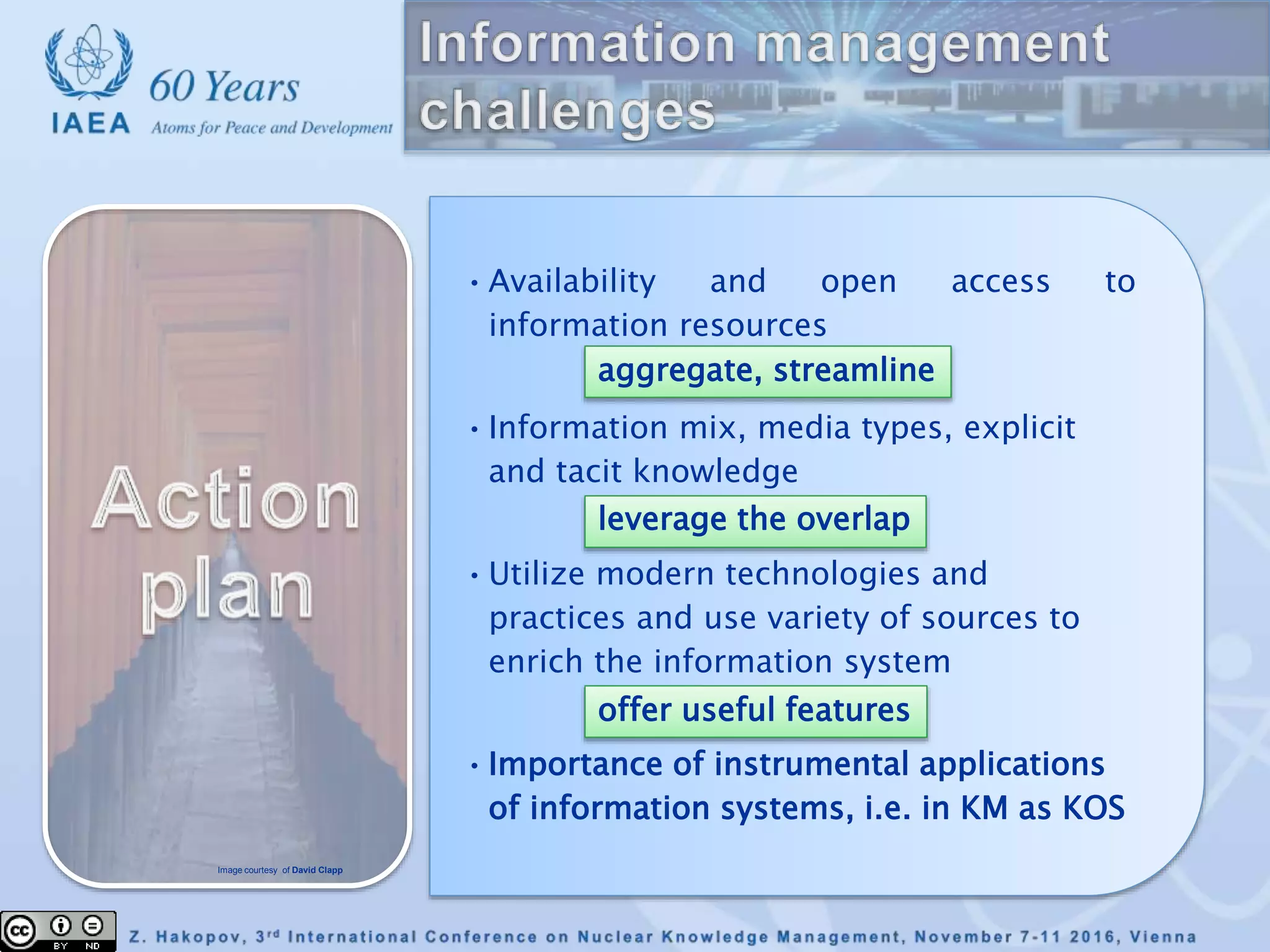
•Availability and open access to
information resources
•Information mix, media types, explicit
and tacit knowledge
•Utilize modern technologies and
practices and use variety of sources to
enrich the information system
•Importance of instrumental applications
of information systems, i.e. in KM as KOS
Image courtesy of David Clapp
aggregate, streamline
leverage the overlap
offer useful features
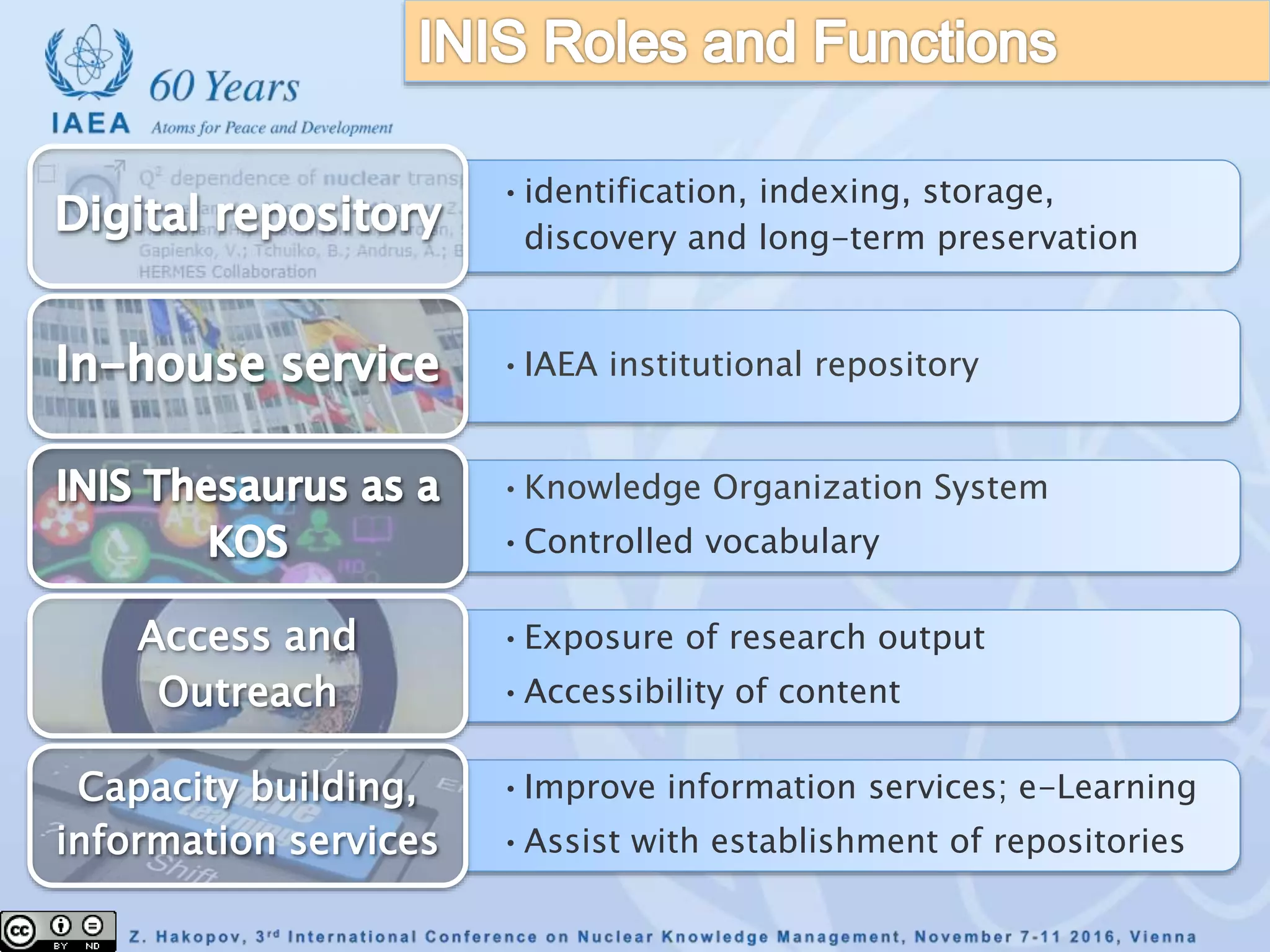
•identification, indexing, storage,
discovery and long-term preservation
•IAEA institutional repository
•Knowledge Organization System
•Controlled vocabulary
•Exposure of research output
•Accessibility of content
Access and
Outreach
•Improve information services; e-Learning
•Assist with establishment of repositories
Capacity building,
information services
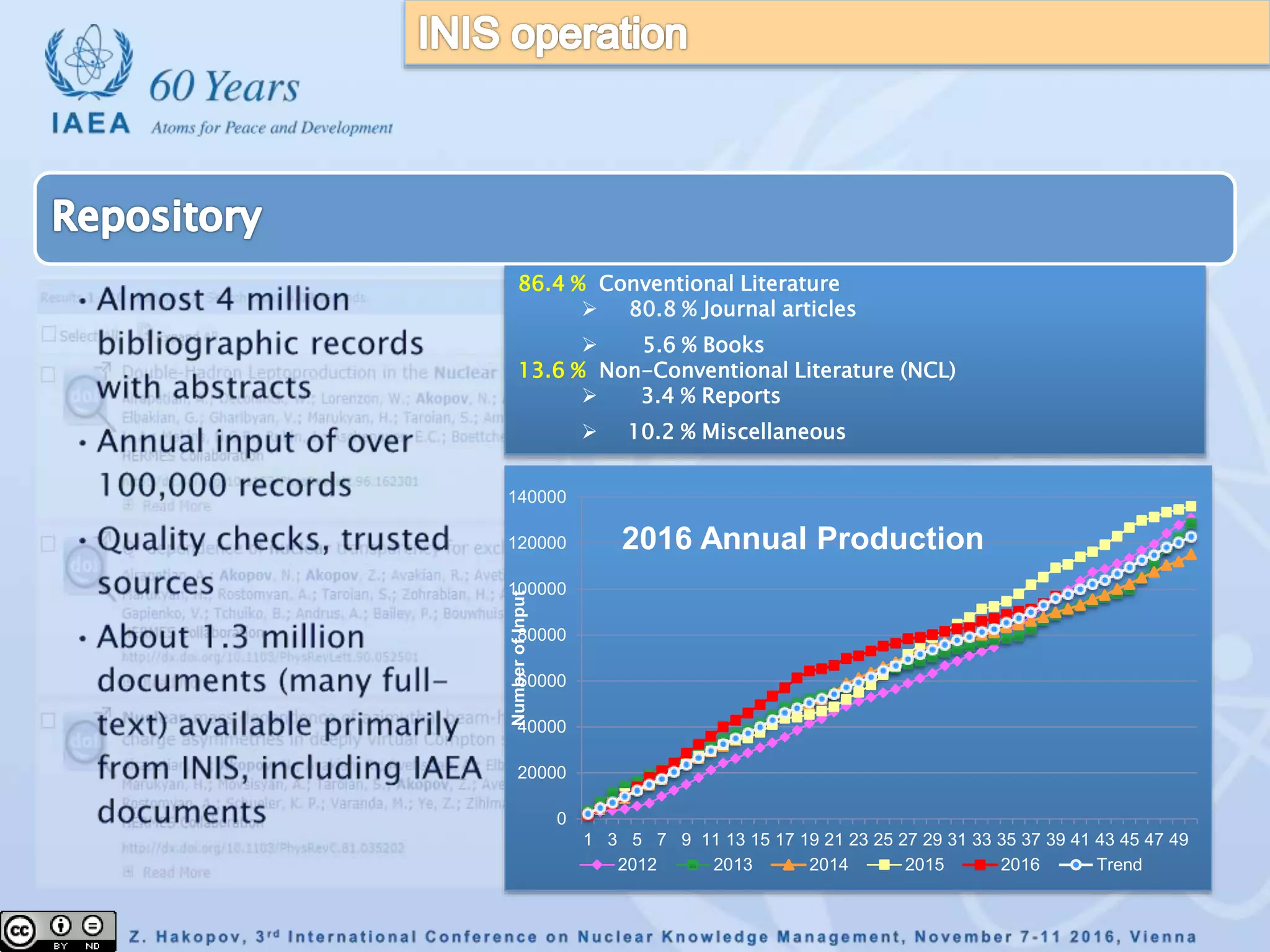
0
20000
40000
60000
80000
100000
120000
140000
1 3 5 7 9 11 13 15 17 19 21 23 25 27 29 31 33 35 37 39 41 43 45 47 49
NumberofInput
2016 Annual Production
2012 2013 2014 2015 2016 Trend
86.4 % Conventional Literature
 80.8 % Journal articles
 5.6 % Books
13.6 % Non-Conventional Literature (NCL)
 3.4 % Reports
 10.2 % Miscellaneous
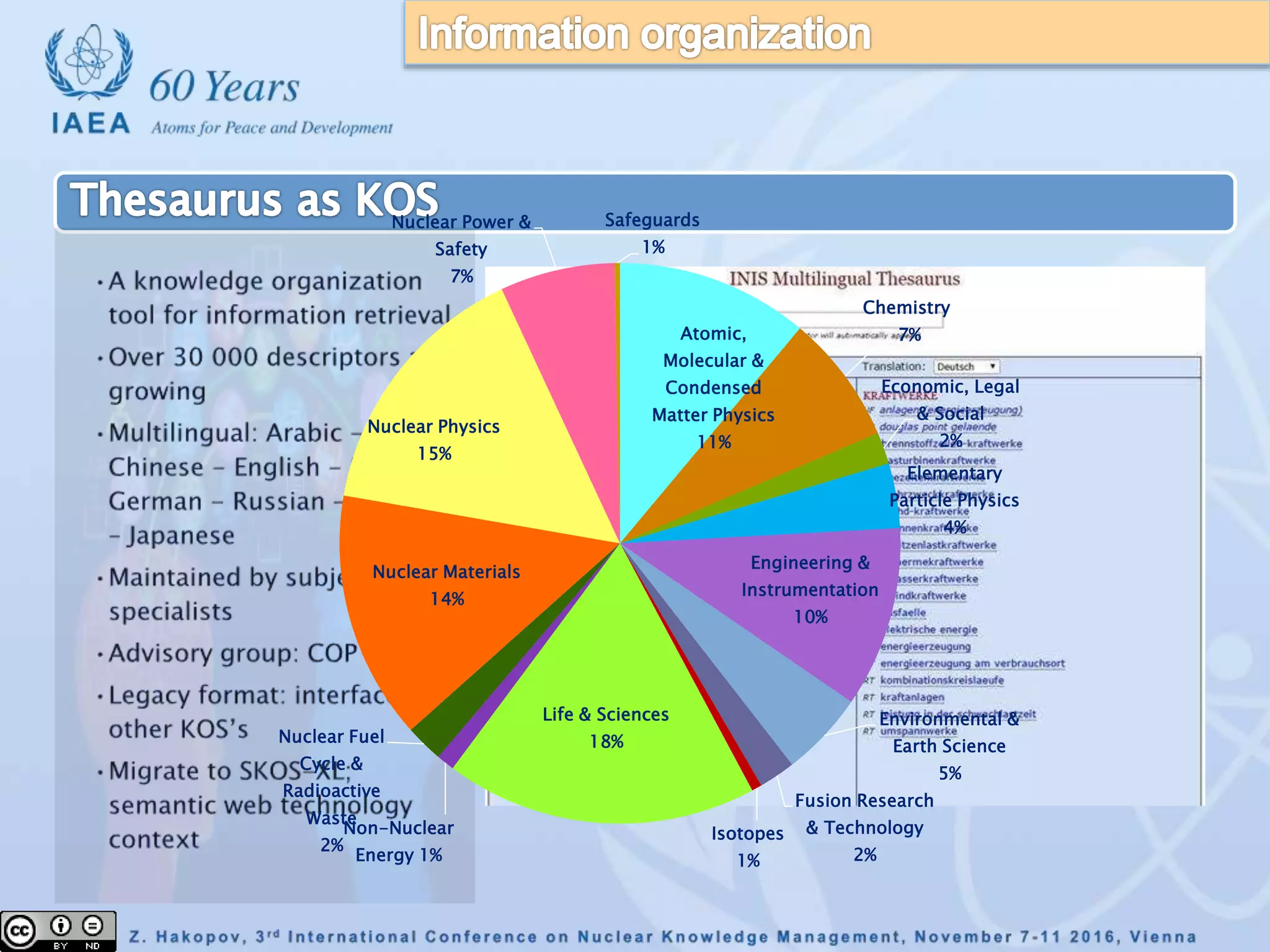
Atomic,
Molecular &
Condensed
Matter Physics
11%
Chemistry
7%
Economic, Legal
& Social
2%
Elementary
Particle Physics
4%
Engineering &
Instrumentation
10%
Environmental &
Earth Science
5%
Fusion Research
& Technology
2%
Isotopes
1%
Life & Sciences
18%
Non-Nuclear
Energy 1%
Nuclear Fuel
Cycle &
Radioactive
Waste
2%
Nuclear Materials
14%
Nuclear Physics
15%
Nuclear Power &
Safety
7%
Safeguards
1%
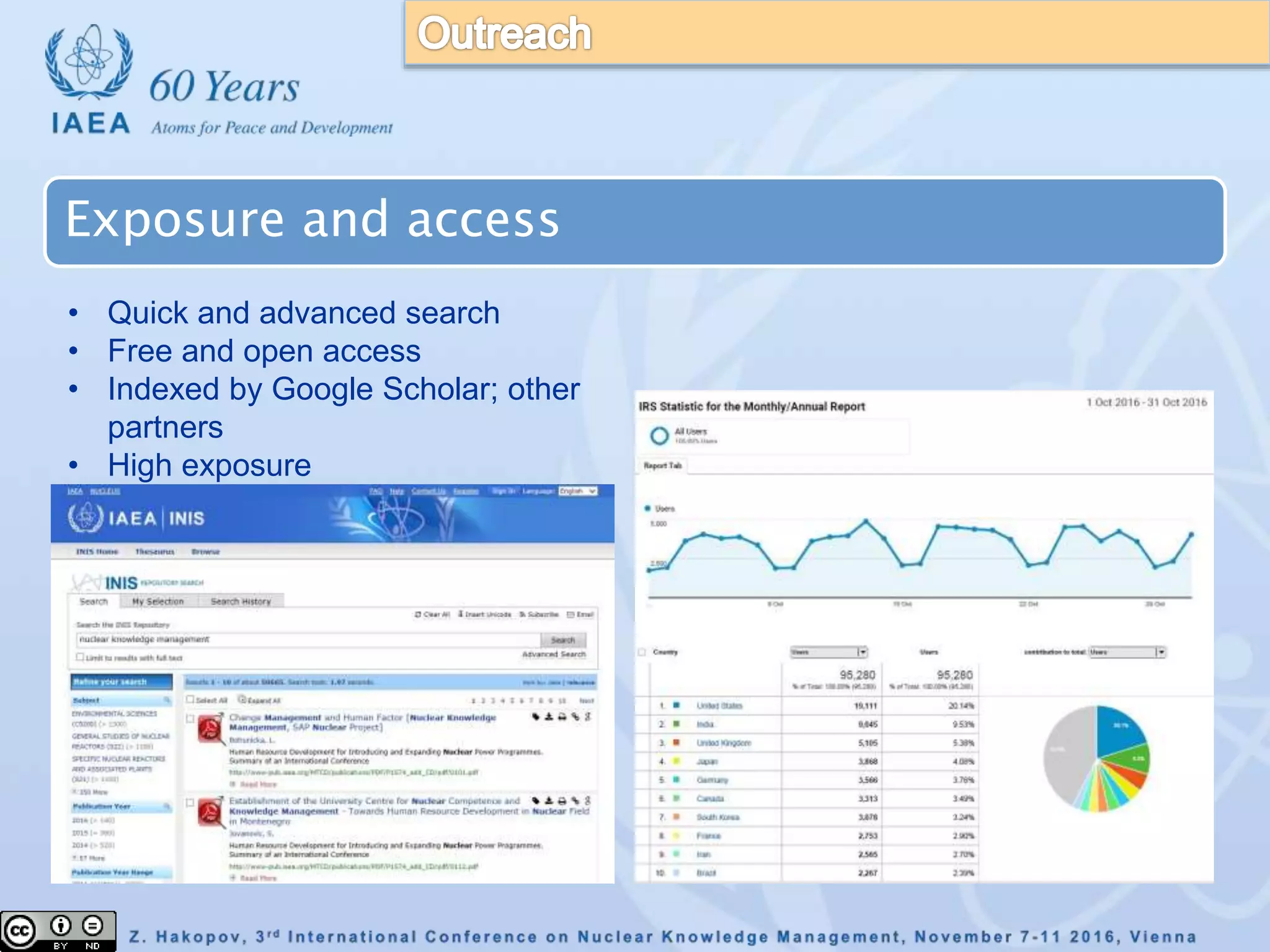
Exposure and access
• Quick and advanced search
• Free and open access
• Indexed by Google Scholar; other
partners
• High exposure
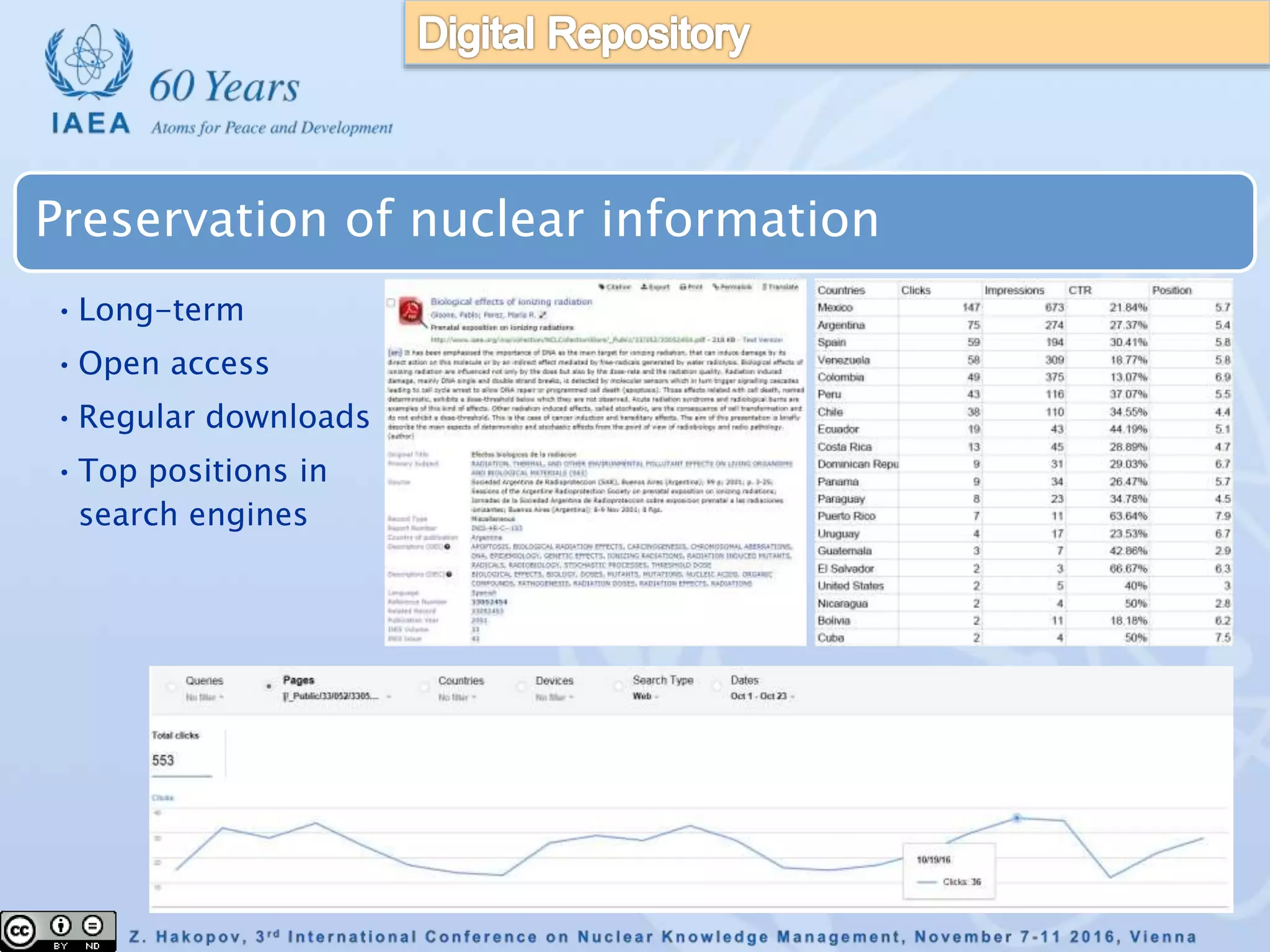
Preservation of nuclear information
•Long-term
•Open access
•Regular downloads
•Top positions in
search engines
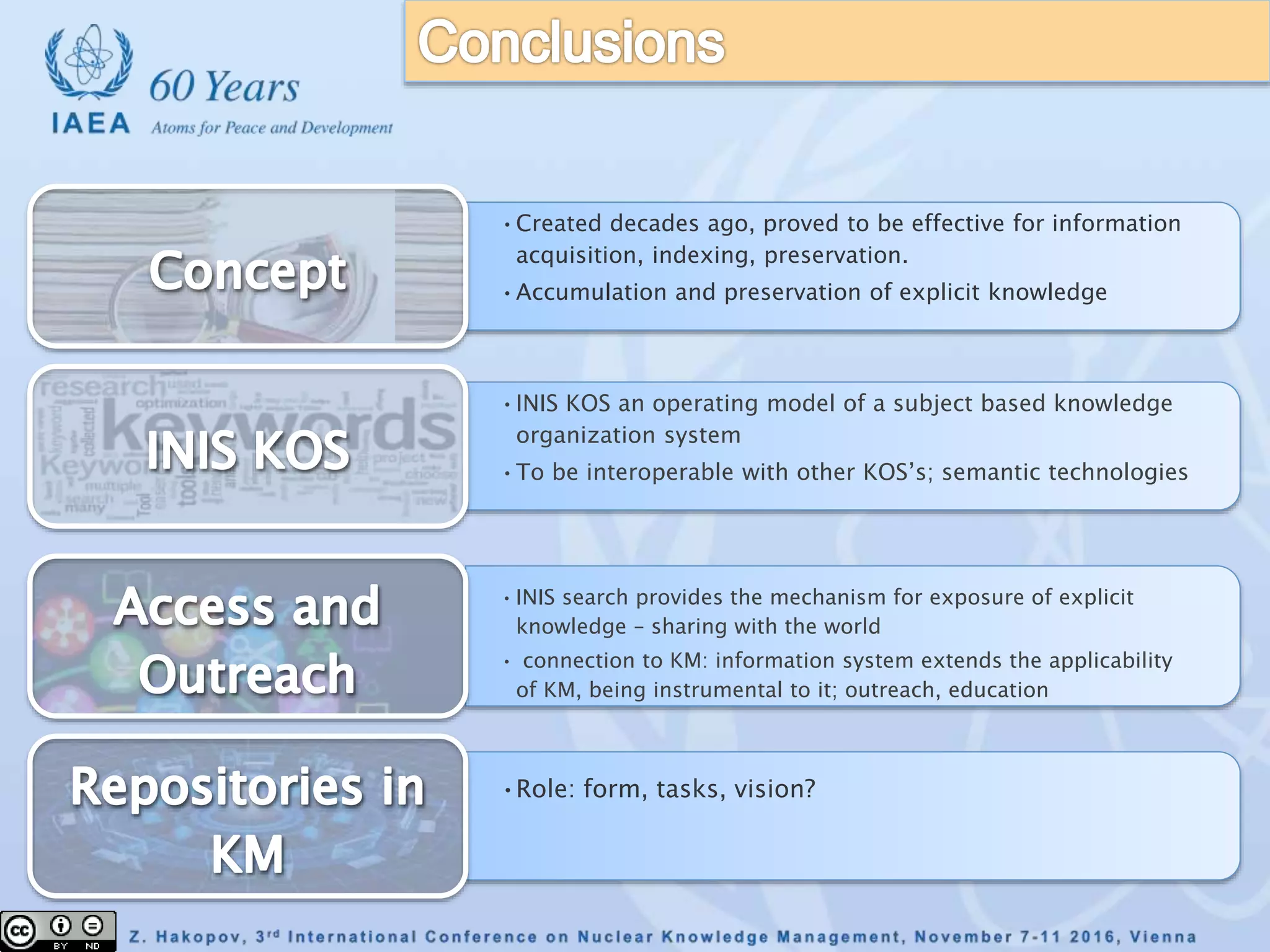
•Created decades ago, proved to be effective for information
acquisition, indexing, preservation.
•Accumulation and preservation of explicit knowledge
•INIS KOS an operating model of a subject based knowledge
organization system
•To be interoperable with other KOS’s; semantic technologies
•INIS search provides the mechanism for exposure of explicit
knowledge – sharing with the world
• connection to KM: information system extends the applicability
of KM, being instrumental to it; outreach, education
•Role: form, tasks, vision?

Digital repositories and Knowledge Management

  • 1.
    • Information management challenges • INISconcept and operation • Thesaurus as KOS • Nuclear information preservation Nuclear Information to Knowledge: INIS Zaven Hakopov IAEA
  • 2.
    • Growth ratefor science Image courtesy of BBC “The role of conference proceedings, open access archives and publications published on the net is increasing, especially in scientific fields with high growth rates…” [Scientometrics, Volume 84, Issue 3, 10.1007/s11192-010-0202-z] “…researchers are uncertain about how sharing their work will affect their careers.” [“How open science helps researchers succeed”,eLife,2016;10.7554/eLife.16800] • Open access to publications – open science
  • 3.
    • Servers all-around •Blooming “document retrieval systems” • Features concourse
  • 4.
    •Repositories in KM •Theontologies or thesauri as Knowledge Organization Systems (KOS’s) •Open access repositories as KM tools [http://dx.doi.org/10.1108/LM-03- 2014-0038] “Because knowledge organization systems are mechanisms for organizing information, they are at the heart of every library, museum, and archive.” [Council on Library and Information Resources] Because knowledge organization systems are mechanisms for organizing information, they are at the heart of every information management system!
  • 5.
    •Availability and openaccess to information resources •Information mix, media types, explicit and tacit knowledge •Utilize modern technologies and practices and use variety of sources to enrich the information system •Importance of instrumental applications of information systems, i.e. in KM as KOS Image courtesy of David Clapp aggregate, streamline leverage the overlap offer useful features
  • 7.
    •identification, indexing, storage, discoveryand long-term preservation •IAEA institutional repository •Knowledge Organization System •Controlled vocabulary •Exposure of research output •Accessibility of content Access and Outreach •Improve information services; e-Learning •Assist with establishment of repositories Capacity building, information services
  • 8.
    0 20000 40000 60000 80000 100000 120000 140000 1 3 57 9 11 13 15 17 19 21 23 25 27 29 31 33 35 37 39 41 43 45 47 49 NumberofInput 2016 Annual Production 2012 2013 2014 2015 2016 Trend 86.4 % Conventional Literature  80.8 % Journal articles  5.6 % Books 13.6 % Non-Conventional Literature (NCL)  3.4 % Reports  10.2 % Miscellaneous
  • 9.
    Atomic, Molecular & Condensed Matter Physics 11% Chemistry 7% Economic,Legal & Social 2% Elementary Particle Physics 4% Engineering & Instrumentation 10% Environmental & Earth Science 5% Fusion Research & Technology 2% Isotopes 1% Life & Sciences 18% Non-Nuclear Energy 1% Nuclear Fuel Cycle & Radioactive Waste 2% Nuclear Materials 14% Nuclear Physics 15% Nuclear Power & Safety 7% Safeguards 1%
  • 10.
    Exposure and access •Quick and advanced search • Free and open access • Indexed by Google Scholar; other partners • High exposure
  • 11.
    Preservation of nuclearinformation •Long-term •Open access •Regular downloads •Top positions in search engines
  • 12.
    •Created decades ago,proved to be effective for information acquisition, indexing, preservation. •Accumulation and preservation of explicit knowledge •INIS KOS an operating model of a subject based knowledge organization system •To be interoperable with other KOS’s; semantic technologies •INIS search provides the mechanism for exposure of explicit knowledge – sharing with the world • connection to KM: information system extends the applicability of KM, being instrumental to it; outreach, education •Role: form, tasks, vision?