1
Presentation Outlines
 Introduction
 Knowledge Management
 Knowledge Management System
 Ontology Based Knowledge Management System
 Concept Extraction Process From Natural Text Formats
 Application of Ontology Based Knowledge Management System
 Conclusion
2
Introduction
 Now days in many organizations knowledge is considered as
the most important asset that enables sustainable competitive
advantage in very dynamic and competitive markets.
 The development of KM and KMS becomes an important issue.
 Traditionally, KMS uses keyword based system to discover,
retrieve and share useful knowledge from the system.
3
Cont.
 Since keyword based system can not understand the meaning of
data users are stressed to find related terms to their query terms.
 Due to the fact that the emerging of new ontology based
knowledge management system is occurred.
 It is a content oriented system which helps users to get related
terms according their submitted query.
4
Knowledge Management
 Knowledge Management (KM) is a process that deals with the
development, storage, retrieval, and dissemination of
information and expertise within an organization to support and
improve its business performance.
5
Cont.
 Knowledge Management (KM) consists of a technique that uses
Technological tools for the management of information.
 its goal is:-
 To improve the efficiency of work teams;
 To studies methods for making knowledge explicit, and
 Sharing of informative knowledge resources.
6
Knowledge Management System
 knowledge management system, supporting the creation and storage
of knowledge,
 The goal of KMS is to provide the right knowledge to the right
people at the right time and right format.
 KMS contain both explicit and tacit knowledge.
 Tacit knowledge is more difficult to manage than explicit
knowledge and can be expressed as "we know more than we can
tell”.
7
Cont.
 KMS makes tacit knowledge better capitalize and disseminate
using different technologies.
 Those are:
 Document based technologies
 Ontology/Taxonomy based technologies
 Artificial Intelligence based technologies
8
Ontology Based Knowledge Management System
 Ontology is an explicit and formal specification of a
conceptualization.
 That is a formal description of the relevant concepts and
relationships in an area of interest, simplifying and abstracting
the view of the world for some purpose.
 It gives an understandable meaning both to humans and to
software agents.
9
Cont.
 In KMS, ontology can be regarded as the classification of
knowledge.
 Ontology defines shared vocabulary for facilitating knowledge
communication, storing, searching and sharing in knowledge
management systems.
10
Cont.
 Ontology-based knowledge management system is better at
supporting:-
 The integration of related resources,
 Searching the accurate knowledge quickly, and
 Avoiding a large number of irrelevant knowledge.
11
Ontology Development Tools
 Ontologies are built by highly trained knowledge engineers.
Some of the developmental tools for ontology are:
 Protégé 2000
 Onto Lingua
 Onto Edit
 Web Onto
12
Cont.
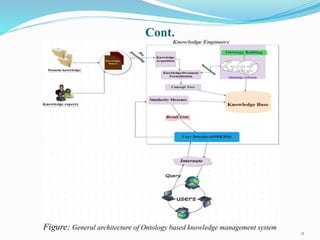
Figure: General architecture of Ontology based knowledge management system
13
Unique Features of Ontology based KMS
 Complete relation ship between the concepts, cases and facts is
stated well.
 Meaning of the facts is taking in to account to relate facts each
other
 Knowledge is represented in a formal language to make good
communication way and understanding among human and
machine.
 Logic-based inference rules - correct and provable results
achieved. 14
Concept Extraction From Natural Texts
 Concepts are sequences of words that represent real or
imaginary entities or ideas that users are interested in from the
large data source.
 Ontology based knowledge management system is used to
extract concepts and realizations from the natural language or
plain text using different techniques.
15
Cont.
 Such as:-
•Information Retrieval system
•Information Extraction
•Machine Learning
•Data Mining
 Ontologies provide a shared and common understanding of a domain
that can be communicated across people and applications.
16
Cont.
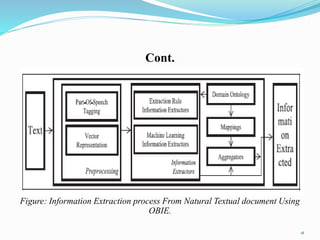
 Information Extraction is the process of automatically obtaining
knowledge from plain text.
 Because of the ambiguity of written natural language,
Information Extraction is a difficult task.
 Ontology-based Information Extraction (OBIE) reduces this
complexity by including contextual information in the form of a
domain ontology.
17
Cont.
Figure: Information Extraction process From Natural Textual document Using
OBIE.
18
APPLICATION
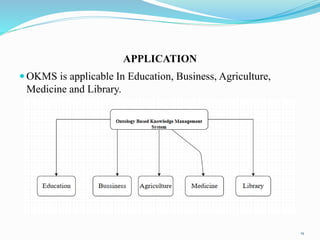
 OKMS is applicable In Education, Business, Agriculture,
Medicine and Library.
19
Advantages
 Facilitates search, exchange and integration of knowledge.
 Satisfy the users need by recommend them related items.
 Improves human to computer interaction.
 Helps to extract concepts through large datasets
 It supports business centers for competitive advantage in very
dynamic and competitive markets.
 Allow machine able to understand semantics of data.
20
Cont.
 Ontologies make domain knowledge reusable.
 Ontologies enable the interoperability among models or specific
domain vocabularies.
 Ontologies allow and simplify the communication among
humans, computational systems, and between humans and
systems.
21
Cont.
 Ontologies have the expressive power for acquiring context
from diverse and heterogeneous source.
 It is possible to apply reasoning and inference mechanisms by
means of explicit representation of semantics.
22
Disadvantages
 OBKMS systems have not been widely adopted because of the
 Its difficulties in deployment and maintenance
 Hard to implement and construct
 Space, time and money consuming.
 They have no discussion hub rather than they are suitable for
searching.
23
Conclusion
 OBKMS is useful to satisfy customers need by developing
semantic webs, Recommender systems and IR systems in
different areas such as library and business centers.
 Since our world is covered in dynamic and variety of word
sense and Knowledge fusion, it is difficult to construct ontology
based knowledge system easily.
 Knowledge representation is not a simple way process.
24
Recommendation
 While we are living in knowledge fusion world it is good to
implement multi-lingual ontology based knowledge
management system.
 According to our country it is possible to implement and
develop ontology based knowledge management system for
 Ethiopian Higher institution Library system
 Ethiopian Health System centers.
25
26

Ontologoy based Knowledge managment system

  • 1.
  • 2.
    Presentation Outlines  Introduction Knowledge Management  Knowledge Management System  Ontology Based Knowledge Management System  Concept Extraction Process From Natural Text Formats  Application of Ontology Based Knowledge Management System  Conclusion 2
  • 3.
    Introduction  Now daysin many organizations knowledge is considered as the most important asset that enables sustainable competitive advantage in very dynamic and competitive markets.  The development of KM and KMS becomes an important issue.  Traditionally, KMS uses keyword based system to discover, retrieve and share useful knowledge from the system. 3
  • 4.
    Cont.  Since keywordbased system can not understand the meaning of data users are stressed to find related terms to their query terms.  Due to the fact that the emerging of new ontology based knowledge management system is occurred.  It is a content oriented system which helps users to get related terms according their submitted query. 4
  • 5.
    Knowledge Management  KnowledgeManagement (KM) is a process that deals with the development, storage, retrieval, and dissemination of information and expertise within an organization to support and improve its business performance. 5
  • 6.
    Cont.  Knowledge Management(KM) consists of a technique that uses Technological tools for the management of information.  its goal is:-  To improve the efficiency of work teams;  To studies methods for making knowledge explicit, and  Sharing of informative knowledge resources. 6
  • 7.
    Knowledge Management System knowledge management system, supporting the creation and storage of knowledge,  The goal of KMS is to provide the right knowledge to the right people at the right time and right format.  KMS contain both explicit and tacit knowledge.  Tacit knowledge is more difficult to manage than explicit knowledge and can be expressed as "we know more than we can tell”. 7
  • 8.
    Cont.  KMS makestacit knowledge better capitalize and disseminate using different technologies.  Those are:  Document based technologies  Ontology/Taxonomy based technologies  Artificial Intelligence based technologies 8
  • 9.
    Ontology Based KnowledgeManagement System  Ontology is an explicit and formal specification of a conceptualization.  That is a formal description of the relevant concepts and relationships in an area of interest, simplifying and abstracting the view of the world for some purpose.  It gives an understandable meaning both to humans and to software agents. 9
  • 10.
    Cont.  In KMS,ontology can be regarded as the classification of knowledge.  Ontology defines shared vocabulary for facilitating knowledge communication, storing, searching and sharing in knowledge management systems. 10
  • 11.
    Cont.  Ontology-based knowledgemanagement system is better at supporting:-  The integration of related resources,  Searching the accurate knowledge quickly, and  Avoiding a large number of irrelevant knowledge. 11
  • 12.
    Ontology Development Tools Ontologies are built by highly trained knowledge engineers. Some of the developmental tools for ontology are:  Protégé 2000  Onto Lingua  Onto Edit  Web Onto 12
  • 13.
    Cont. Figure: General architectureof Ontology based knowledge management system 13
  • 14.
    Unique Features ofOntology based KMS  Complete relation ship between the concepts, cases and facts is stated well.  Meaning of the facts is taking in to account to relate facts each other  Knowledge is represented in a formal language to make good communication way and understanding among human and machine.  Logic-based inference rules - correct and provable results achieved. 14
  • 15.
    Concept Extraction FromNatural Texts  Concepts are sequences of words that represent real or imaginary entities or ideas that users are interested in from the large data source.  Ontology based knowledge management system is used to extract concepts and realizations from the natural language or plain text using different techniques. 15
  • 16.
    Cont.  Such as:- •InformationRetrieval system •Information Extraction •Machine Learning •Data Mining  Ontologies provide a shared and common understanding of a domain that can be communicated across people and applications. 16
  • 17.
    Cont.  Information Extractionis the process of automatically obtaining knowledge from plain text.  Because of the ambiguity of written natural language, Information Extraction is a difficult task.  Ontology-based Information Extraction (OBIE) reduces this complexity by including contextual information in the form of a domain ontology. 17
  • 18.
    Cont. Figure: Information Extractionprocess From Natural Textual document Using OBIE. 18
  • 19.
    APPLICATION  OKMS isapplicable In Education, Business, Agriculture, Medicine and Library. 19
  • 20.
    Advantages  Facilitates search,exchange and integration of knowledge.  Satisfy the users need by recommend them related items.  Improves human to computer interaction.  Helps to extract concepts through large datasets  It supports business centers for competitive advantage in very dynamic and competitive markets.  Allow machine able to understand semantics of data. 20
  • 21.
    Cont.  Ontologies makedomain knowledge reusable.  Ontologies enable the interoperability among models or specific domain vocabularies.  Ontologies allow and simplify the communication among humans, computational systems, and between humans and systems. 21
  • 22.
    Cont.  Ontologies havethe expressive power for acquiring context from diverse and heterogeneous source.  It is possible to apply reasoning and inference mechanisms by means of explicit representation of semantics. 22
  • 23.
    Disadvantages  OBKMS systemshave not been widely adopted because of the  Its difficulties in deployment and maintenance  Hard to implement and construct  Space, time and money consuming.  They have no discussion hub rather than they are suitable for searching. 23
  • 24.
    Conclusion  OBKMS isuseful to satisfy customers need by developing semantic webs, Recommender systems and IR systems in different areas such as library and business centers.  Since our world is covered in dynamic and variety of word sense and Knowledge fusion, it is difficult to construct ontology based knowledge system easily.  Knowledge representation is not a simple way process. 24
  • 25.
    Recommendation  While weare living in knowledge fusion world it is good to implement multi-lingual ontology based knowledge management system.  According to our country it is possible to implement and develop ontology based knowledge management system for  Ethiopian Higher institution Library system  Ethiopian Health System centers. 25
  • 26.