DIGITAL LOGIC DESIGN
ASIF ALI BHATTI
Number Systems and Codes
Decimal Number System
• The decimal number system has ten unique digits 0, 1, 2, 3… 9. Using
these single digits, ten different values can be represented. Values
greater than ten can be represented by using the same digits in different
combinations. Thus ten is represented by the number 10, two hundred
seventy five is represented by 275 etc. Thus same set of numbers 0,1 2…
9 are repeated in a specific order to represent larger numbers. The
decimal number system is a positional number system as the position of
a digit represents its true magnitude. For example, 2 is less than 7,
however 2 in 275 represents 200, whereas 7 represents 70. The left most
digit has the highest weight and the right most digit has the lowest
weight. 275 can be written in the form of an expression in terms of the
base value of the number system and weights.
Fractions in Decimal Number System
• In a Decimal Number System the fraction part is separated from the Integer part by a
decimal point. The Integer part of a number is written on the left hand side of the
decimal point. The Fraction part is written on the right side of the decimal point. The
digits of the Integer part on the left hand side of the decimal point have weights
100 , 101 , 102 etc. respectively starting from the digit to the immediate left of the
decimal point and moving away from the decimal point towards the most significant
digit on the left hand side. Fractions in decimal number system are also represented
in terms of the base value of the number system and weights. The weights of the
fraction part are represented by , , etc. The weights decrease by a factor of 10
moving right of the decimal point. The number 382.91 in terms of the base number
and weights is represented as
Caveman number system
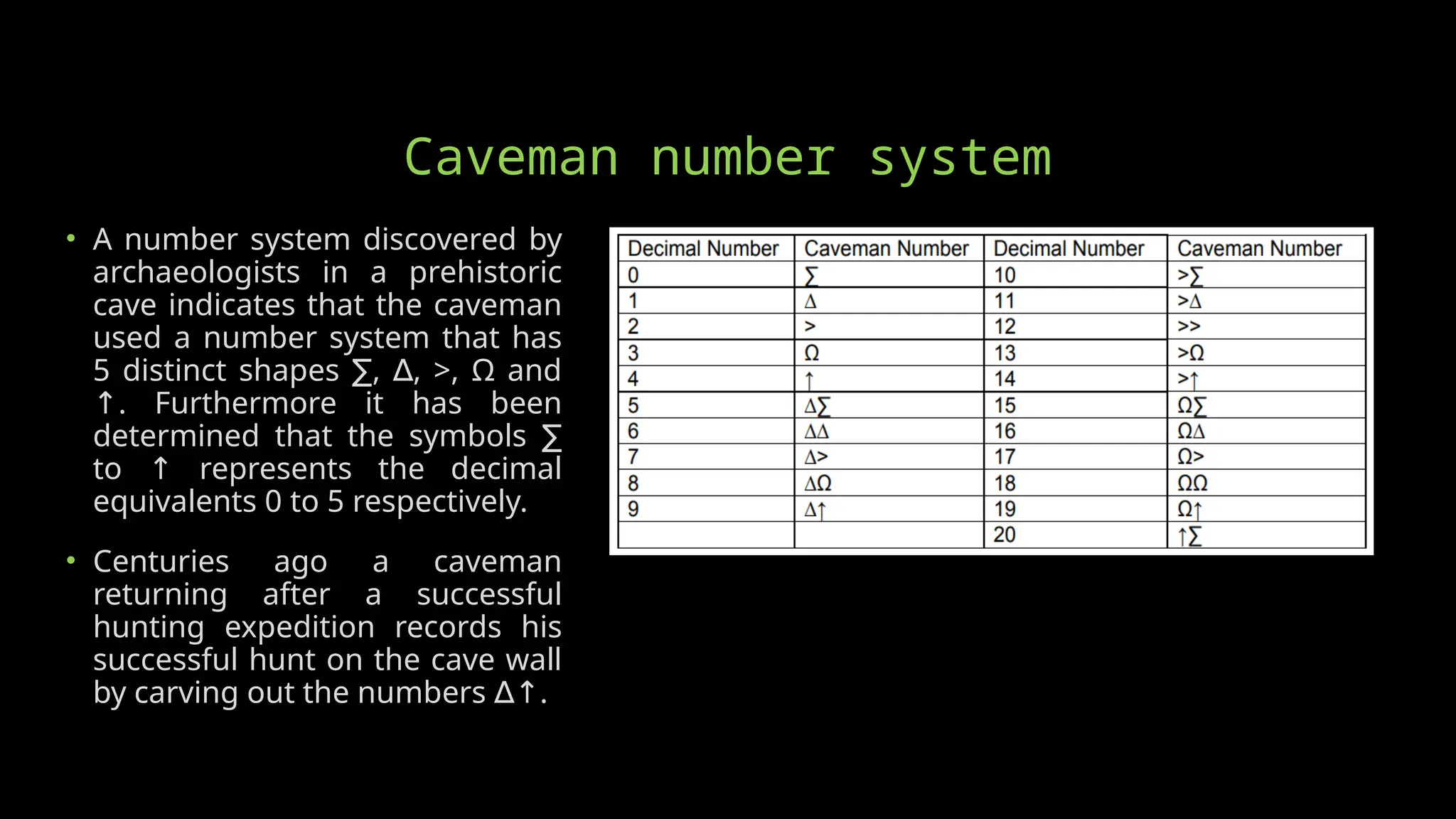
• A number system discovered by
archaeologists in a prehistoric
cave indicates that the caveman
used a number system that has
5 distinct shapes , , >, Ω and
∑ ∆
. Furthermore it has been
↑
determined that the symbols ∑
to represents the decimal
↑
equivalents 0 to 5 respectively.
• Centuries ago a caveman
returning after a successful
hunting expedition records his
successful hunt on the cave wall
by carving out the numbers .
∆↑
Continuous…
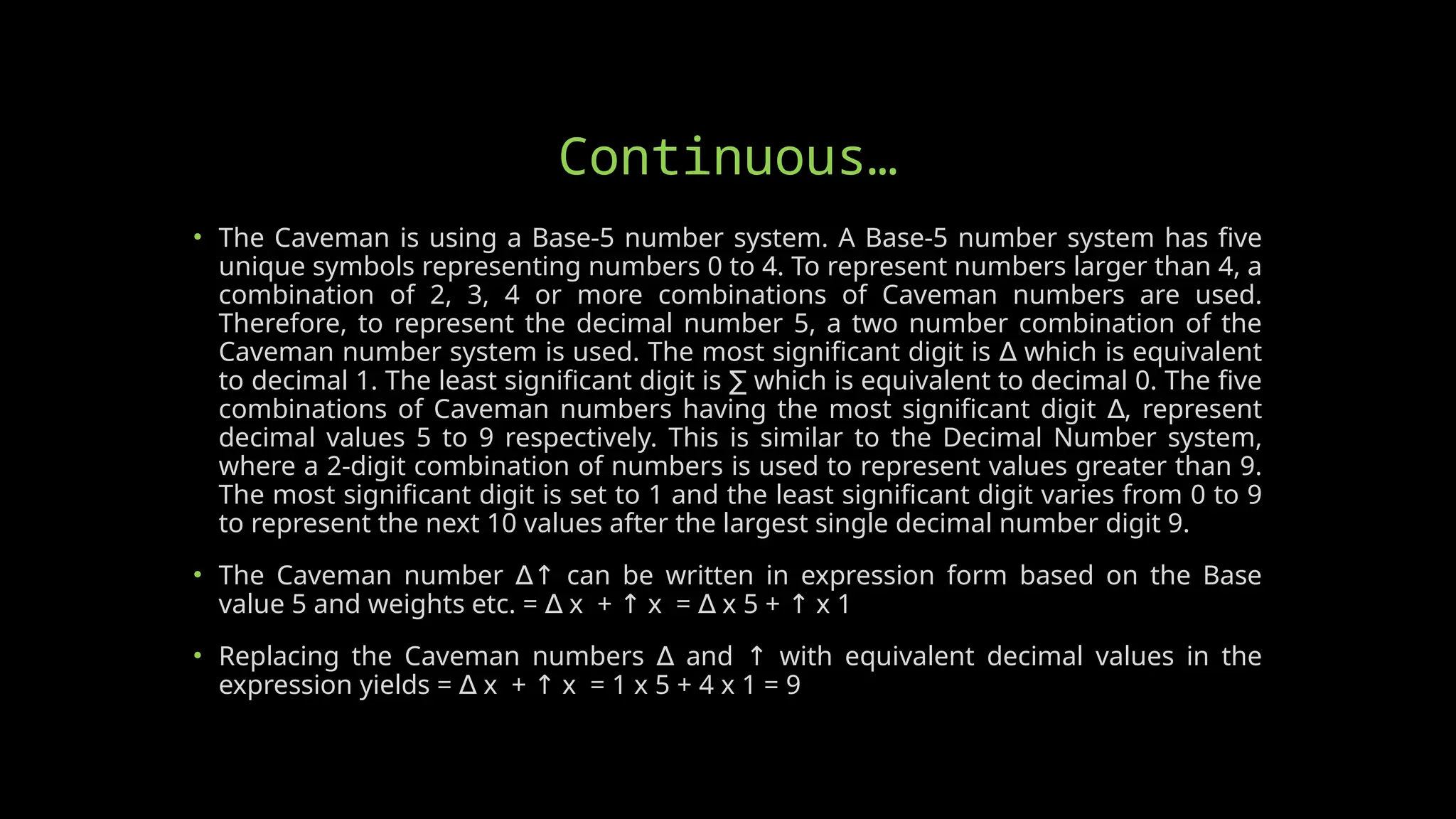
• The Caveman is using a Base-5 number system. A Base-5 number system has five
unique symbols representing numbers 0 to 4. To represent numbers larger than 4, a
combination of 2, 3, 4 or more combinations of Caveman numbers are used.
Therefore, to represent the decimal number 5, a two number combination of the
Caveman number system is used. The most significant digit is which is equivalent
∆
to decimal 1. The least significant digit is which is equivalent to decimal 0. The five
∑
combinations of Caveman numbers having the most significant digit , represent
∆
decimal values 5 to 9 respectively. This is similar to the Decimal Number system,
where a 2-digit combination of numbers is used to represent values greater than 9.
The most significant digit is set to 1 and the least significant digit varies from 0 to 9
to represent the next 10 values after the largest single decimal number digit 9.
• The Caveman number can be written in expression form based on the Base
∆↑
value 5 and weights etc. = x + x = x 5 + x 1
∆ ↑ ∆ ↑
• Replacing the Caveman numbers and with equivalent decimal values in the
∆ ↑
expression yields = x + x = 1 x 5 + 4 x 1 = 9
∆ ↑
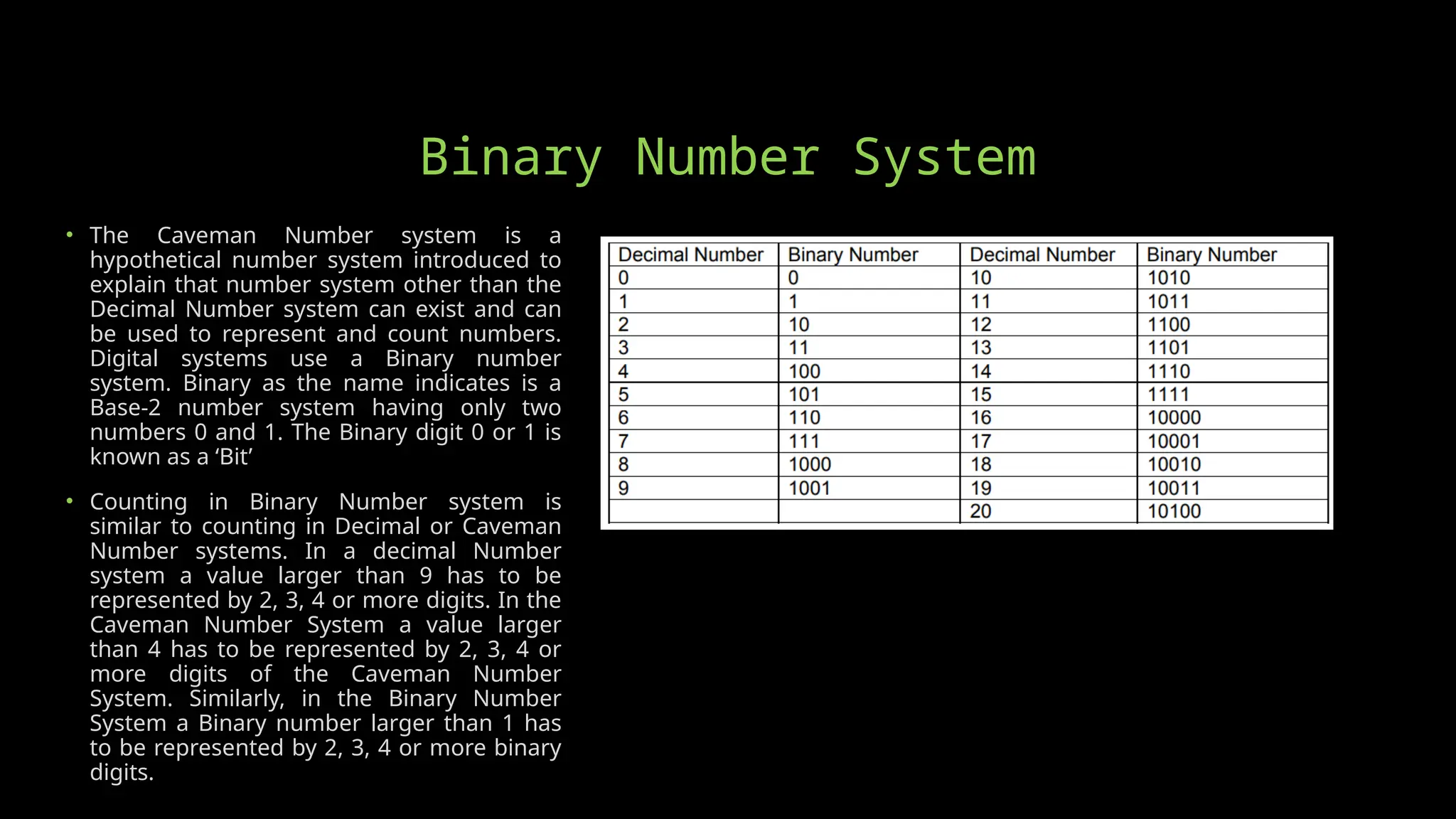
Binary Number System
• The Caveman Number system is a
hypothetical number system introduced to
explain that number system other than the
Decimal Number system can exist and can
be used to represent and count numbers.
Digital systems use a Binary number
system. Binary as the name indicates is a
Base-2 number system having only two
numbers 0 and 1. The Binary digit 0 or 1 is
known as a ‘Bit’
• Counting in Binary Number system is
similar to counting in Decimal or Caveman
Number systems. In a decimal Number
system a value larger than 9 has to be
represented by 2, 3, 4 or more digits. In the
Caveman Number System a value larger
than 4 has to be represented by 2, 3, 4 or
more digits of the Caveman Number
System. Similarly, in the Binary Number
System a Binary number larger than 1 has
to be represented by 2, 3, 4 or more binary
digits.
Continuous…
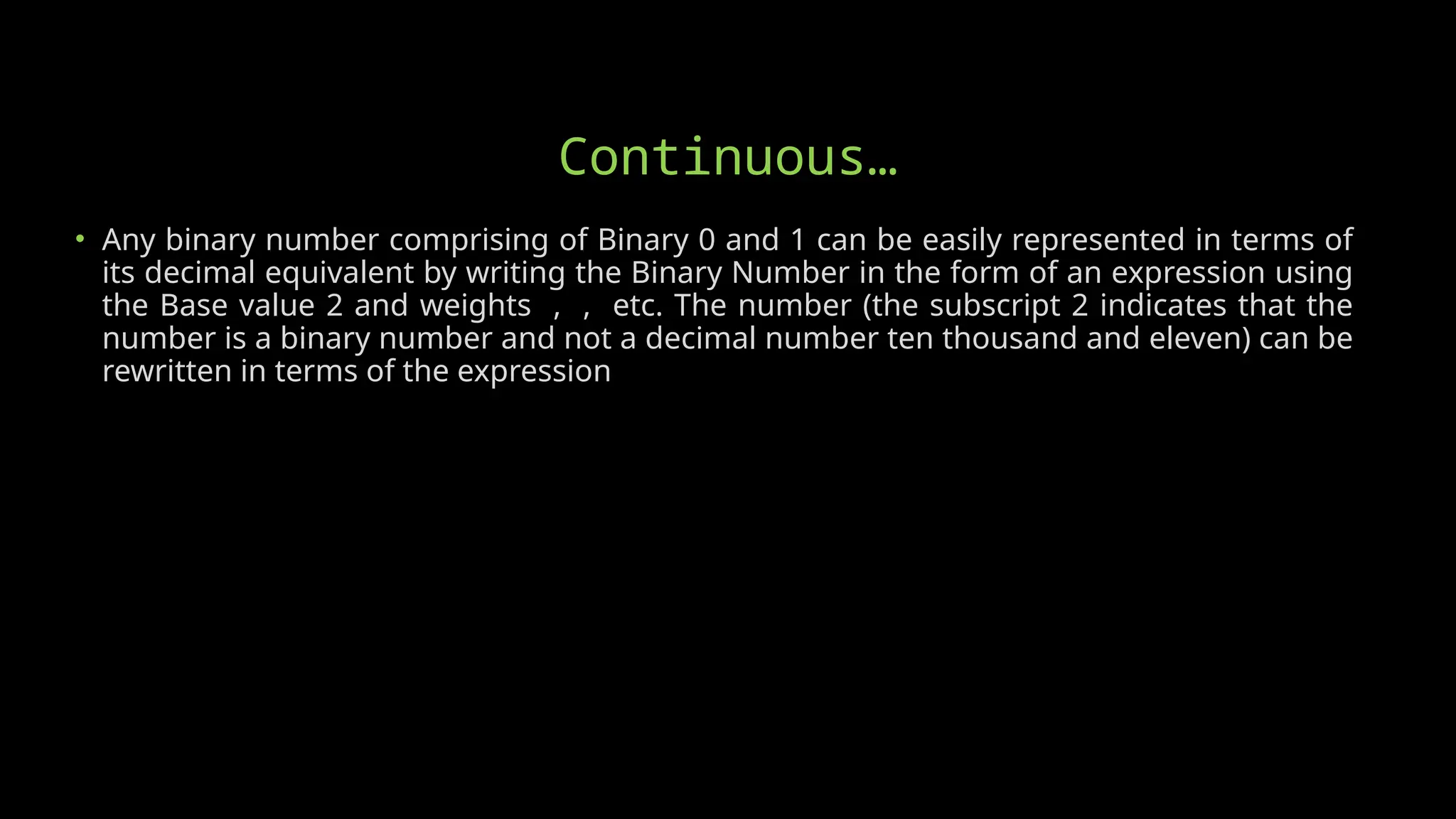
• Any binary number comprising of Binary 0 and 1 can be easily represented in terms of
its decimal equivalent by writing the Binary Number in the form of an expression using
the Base value 2 and weights , , etc. The number (the subscript 2 indicates that the
number is a binary number and not a decimal number ten thousand and eleven) can be
rewritten in terms of the expression
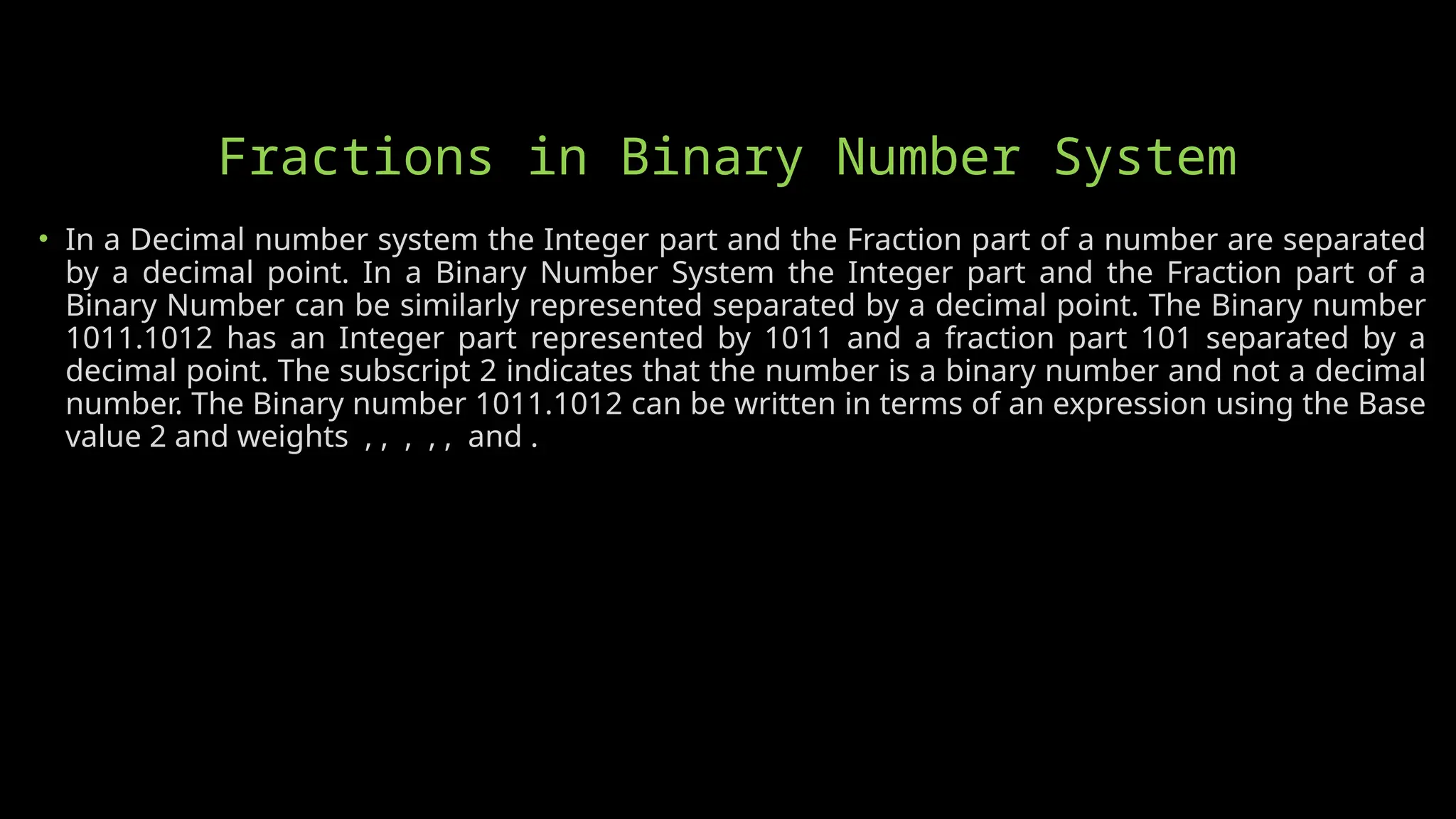
Fractions in Binary Number System
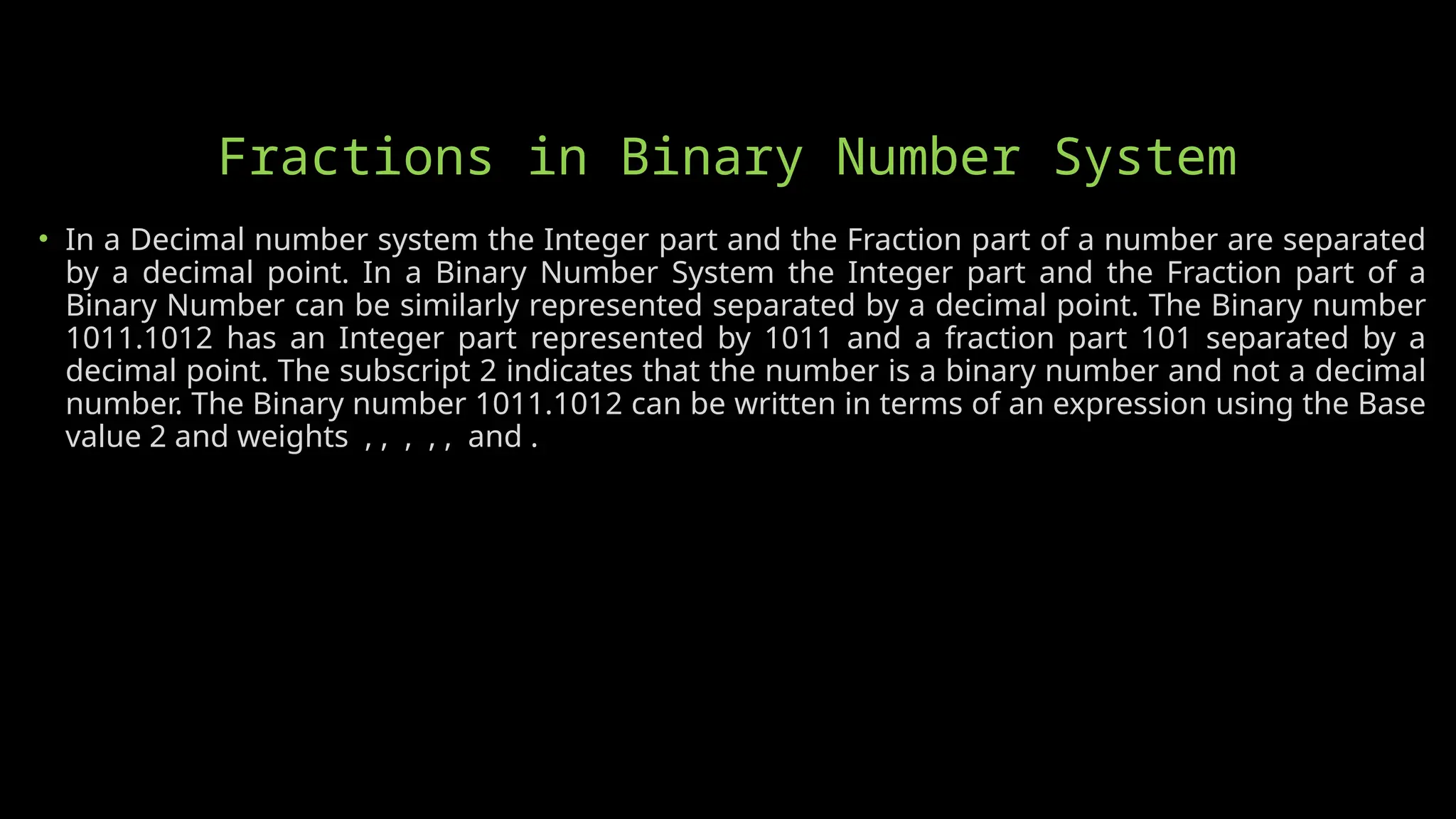
• In a Decimal number system the Integer part and the Fraction part of a number are separated
by a decimal point. In a Binary Number System the Integer part and the Fraction part of a
Binary Number can be similarly represented separated by a decimal point. The Binary number
1011.1012 has an Integer part represented by 1011 and a fraction part 101 separated by a
decimal point. The subscript 2 indicates that the number is a binary number and not a decimal
number. The Binary number 1011.1012 can be written in terms of an expression using the Base
value 2 and weights , , , , , and .
Fractions in Binary Number System
• In a Decimal number system the Integer part and the Fraction part of a number are separated
by a decimal point. In a Binary Number System the Integer part and the Fraction part of a
Binary Number can be similarly represented separated by a decimal point. The Binary number
1011.1012 has an Integer part represented by 1011 and a fraction part 101 separated by a
decimal point. The subscript 2 indicates that the number is a binary number and not a decimal
number. The Binary number 1011.1012 can be written in terms of an expression using the Base
value 2 and weights , , , , , and .

Digital Logic Design Lecture No 1 (Number System).pptx

  • 1.
  • 2.
    Number Systems andCodes Decimal Number System • The decimal number system has ten unique digits 0, 1, 2, 3… 9. Using these single digits, ten different values can be represented. Values greater than ten can be represented by using the same digits in different combinations. Thus ten is represented by the number 10, two hundred seventy five is represented by 275 etc. Thus same set of numbers 0,1 2… 9 are repeated in a specific order to represent larger numbers. The decimal number system is a positional number system as the position of a digit represents its true magnitude. For example, 2 is less than 7, however 2 in 275 represents 200, whereas 7 represents 70. The left most digit has the highest weight and the right most digit has the lowest weight. 275 can be written in the form of an expression in terms of the base value of the number system and weights.
  • 3.
    Fractions in DecimalNumber System • In a Decimal Number System the fraction part is separated from the Integer part by a decimal point. The Integer part of a number is written on the left hand side of the decimal point. The Fraction part is written on the right side of the decimal point. The digits of the Integer part on the left hand side of the decimal point have weights 100 , 101 , 102 etc. respectively starting from the digit to the immediate left of the decimal point and moving away from the decimal point towards the most significant digit on the left hand side. Fractions in decimal number system are also represented in terms of the base value of the number system and weights. The weights of the fraction part are represented by , , etc. The weights decrease by a factor of 10 moving right of the decimal point. The number 382.91 in terms of the base number and weights is represented as
  • 4.
    Caveman number system •A number system discovered by archaeologists in a prehistoric cave indicates that the caveman used a number system that has 5 distinct shapes , , >, Ω and ∑ ∆ . Furthermore it has been ↑ determined that the symbols ∑ to represents the decimal ↑ equivalents 0 to 5 respectively. • Centuries ago a caveman returning after a successful hunting expedition records his successful hunt on the cave wall by carving out the numbers . ∆↑
  • 5.
    Continuous… • The Cavemanis using a Base-5 number system. A Base-5 number system has five unique symbols representing numbers 0 to 4. To represent numbers larger than 4, a combination of 2, 3, 4 or more combinations of Caveman numbers are used. Therefore, to represent the decimal number 5, a two number combination of the Caveman number system is used. The most significant digit is which is equivalent ∆ to decimal 1. The least significant digit is which is equivalent to decimal 0. The five ∑ combinations of Caveman numbers having the most significant digit , represent ∆ decimal values 5 to 9 respectively. This is similar to the Decimal Number system, where a 2-digit combination of numbers is used to represent values greater than 9. The most significant digit is set to 1 and the least significant digit varies from 0 to 9 to represent the next 10 values after the largest single decimal number digit 9. • The Caveman number can be written in expression form based on the Base ∆↑ value 5 and weights etc. = x + x = x 5 + x 1 ∆ ↑ ∆ ↑ • Replacing the Caveman numbers and with equivalent decimal values in the ∆ ↑ expression yields = x + x = 1 x 5 + 4 x 1 = 9 ∆ ↑
  • 6.
    Binary Number System •The Caveman Number system is a hypothetical number system introduced to explain that number system other than the Decimal Number system can exist and can be used to represent and count numbers. Digital systems use a Binary number system. Binary as the name indicates is a Base-2 number system having only two numbers 0 and 1. The Binary digit 0 or 1 is known as a ‘Bit’ • Counting in Binary Number system is similar to counting in Decimal or Caveman Number systems. In a decimal Number system a value larger than 9 has to be represented by 2, 3, 4 or more digits. In the Caveman Number System a value larger than 4 has to be represented by 2, 3, 4 or more digits of the Caveman Number System. Similarly, in the Binary Number System a Binary number larger than 1 has to be represented by 2, 3, 4 or more binary digits.
  • 7.
    Continuous… • Any binarynumber comprising of Binary 0 and 1 can be easily represented in terms of its decimal equivalent by writing the Binary Number in the form of an expression using the Base value 2 and weights , , etc. The number (the subscript 2 indicates that the number is a binary number and not a decimal number ten thousand and eleven) can be rewritten in terms of the expression
  • 8.
    Fractions in BinaryNumber System • In a Decimal number system the Integer part and the Fraction part of a number are separated by a decimal point. In a Binary Number System the Integer part and the Fraction part of a Binary Number can be similarly represented separated by a decimal point. The Binary number 1011.1012 has an Integer part represented by 1011 and a fraction part 101 separated by a decimal point. The subscript 2 indicates that the number is a binary number and not a decimal number. The Binary number 1011.1012 can be written in terms of an expression using the Base value 2 and weights , , , , , and .
  • 9.
    Fractions in BinaryNumber System • In a Decimal number system the Integer part and the Fraction part of a number are separated by a decimal point. In a Binary Number System the Integer part and the Fraction part of a Binary Number can be similarly represented separated by a decimal point. The Binary number 1011.1012 has an Integer part represented by 1011 and a fraction part 101 separated by a decimal point. The subscript 2 indicates that the number is a binary number and not a decimal number. The Binary number 1011.1012 can be written in terms of an expression using the Base value 2 and weights , , , , , and .