Number System
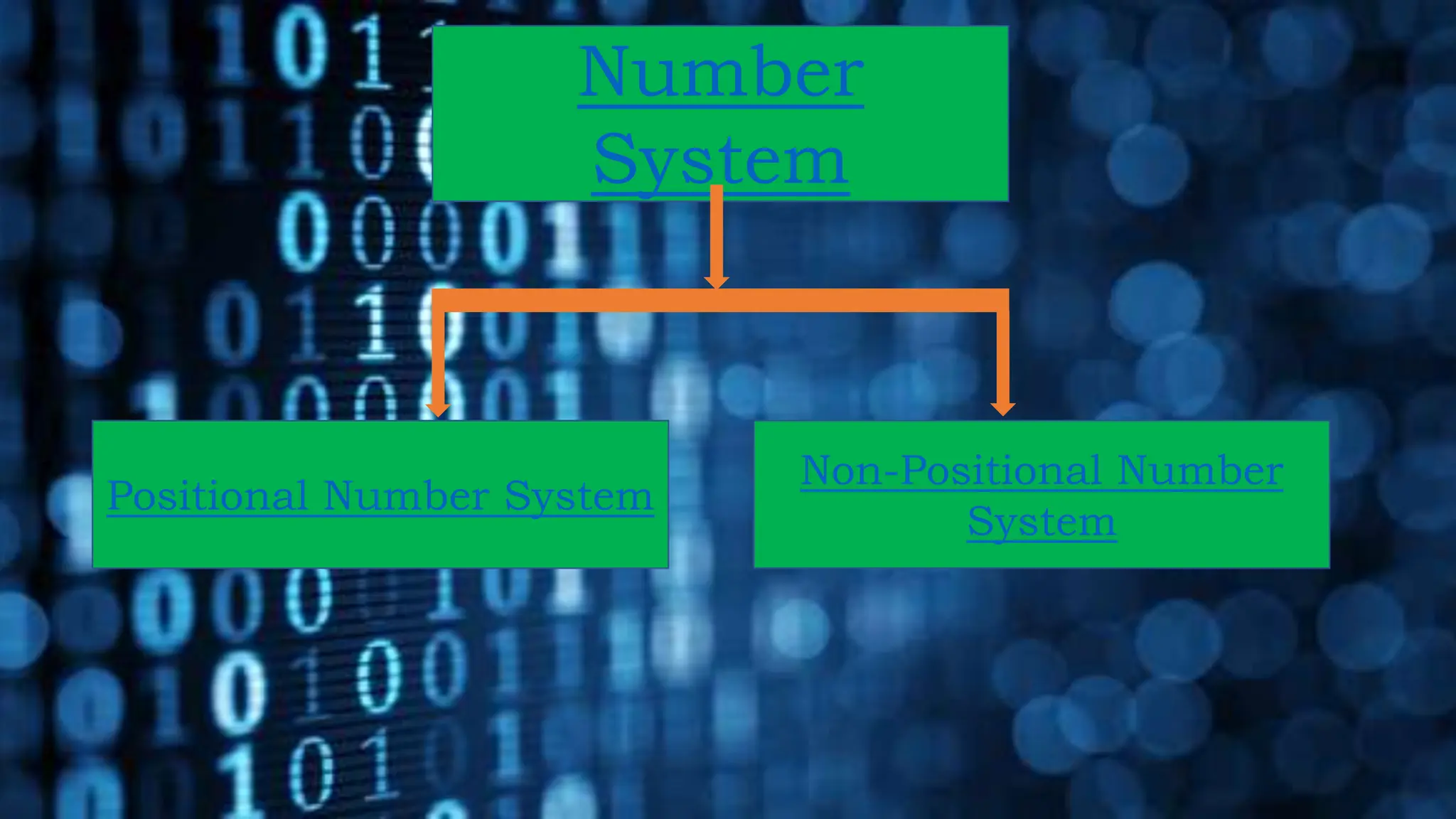
Number
System
Non-Positional Number
System
Positional Number System
Number System
• Number system can be defined as a set of symbols(digits) that
represent a value. Different number systems may use same
digit but represent value or even in same number system a
notation can have two values.
• Example: Decimal system and binary system both contain the
digit “1” but have different values when used. In decimal “11”
is eleven but in binary “11” is read as “one one” and it’s
decimal equivalent is 3.
• Similarly in roman numeral “I” is 1 and “V” is 5 but when
writing 4 “IV” is written making the value of “V” 5.
Positional Number System
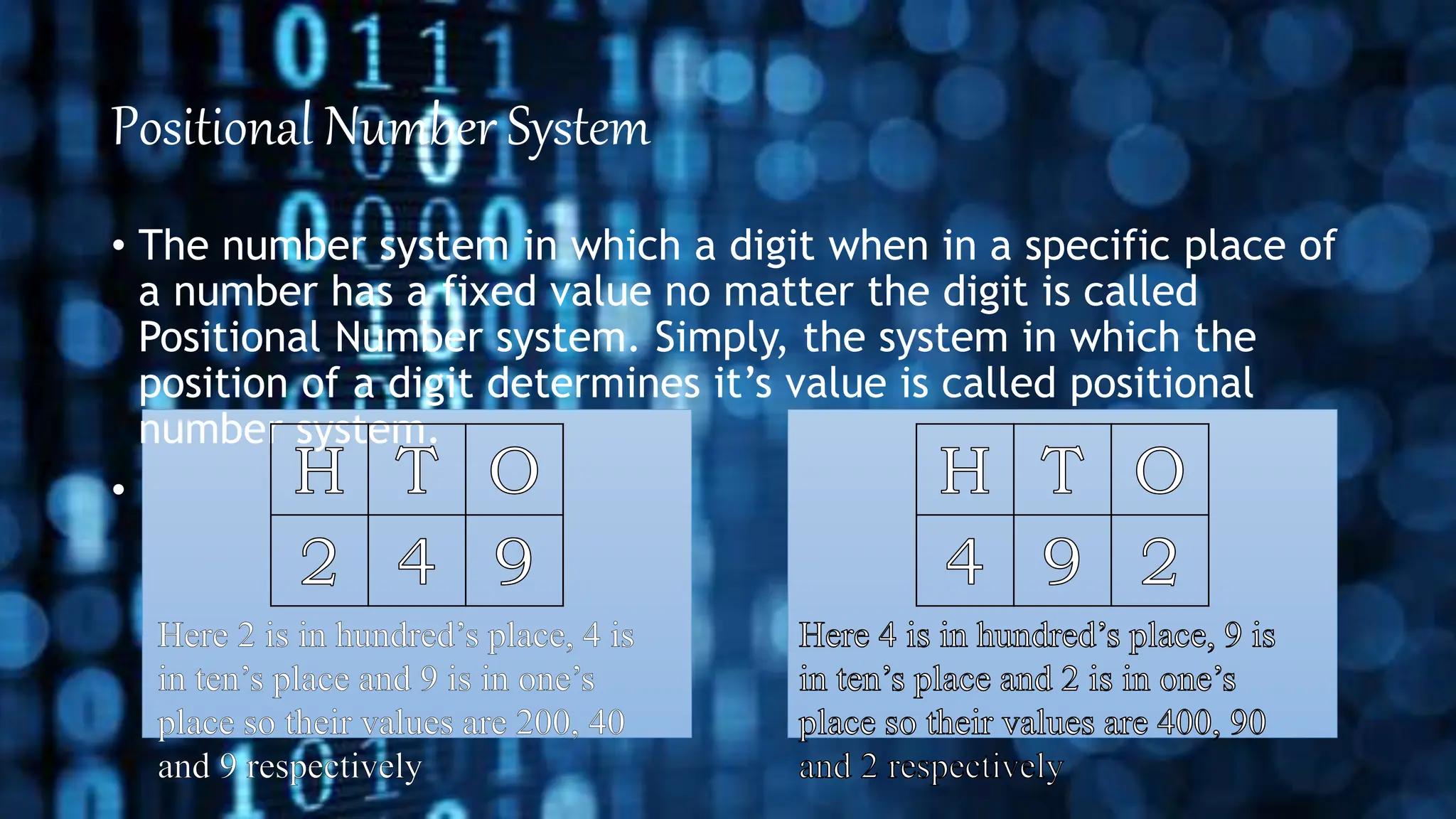
• The number system in which a digit when in a specific place of
a number has a fixed value no matter the digit is called
Positional Number system. Simply, the system in which the
position of a digit determines it’s value is called positional
number system.
•
Non-Positional Number System
• The number system in which a digit has same value no matter of it’s
position and doesn’t follow a specific pattern of logic in counting is
called non-positional number system.
• In roman number system I represents 1, V represents 5, X represents 10,
L represents 50, C represents 100, D represents 500, M represents 1000.
This is true no matter how the digits are arranged although the
arrangement of digits make a difference in resultant value.
• Example: IV is 4 and VI is 6. The logic here is that the digit written ahead
is subtracted and the digit written behind is added but in both cases I is
one and V is 5.
Binary Number System
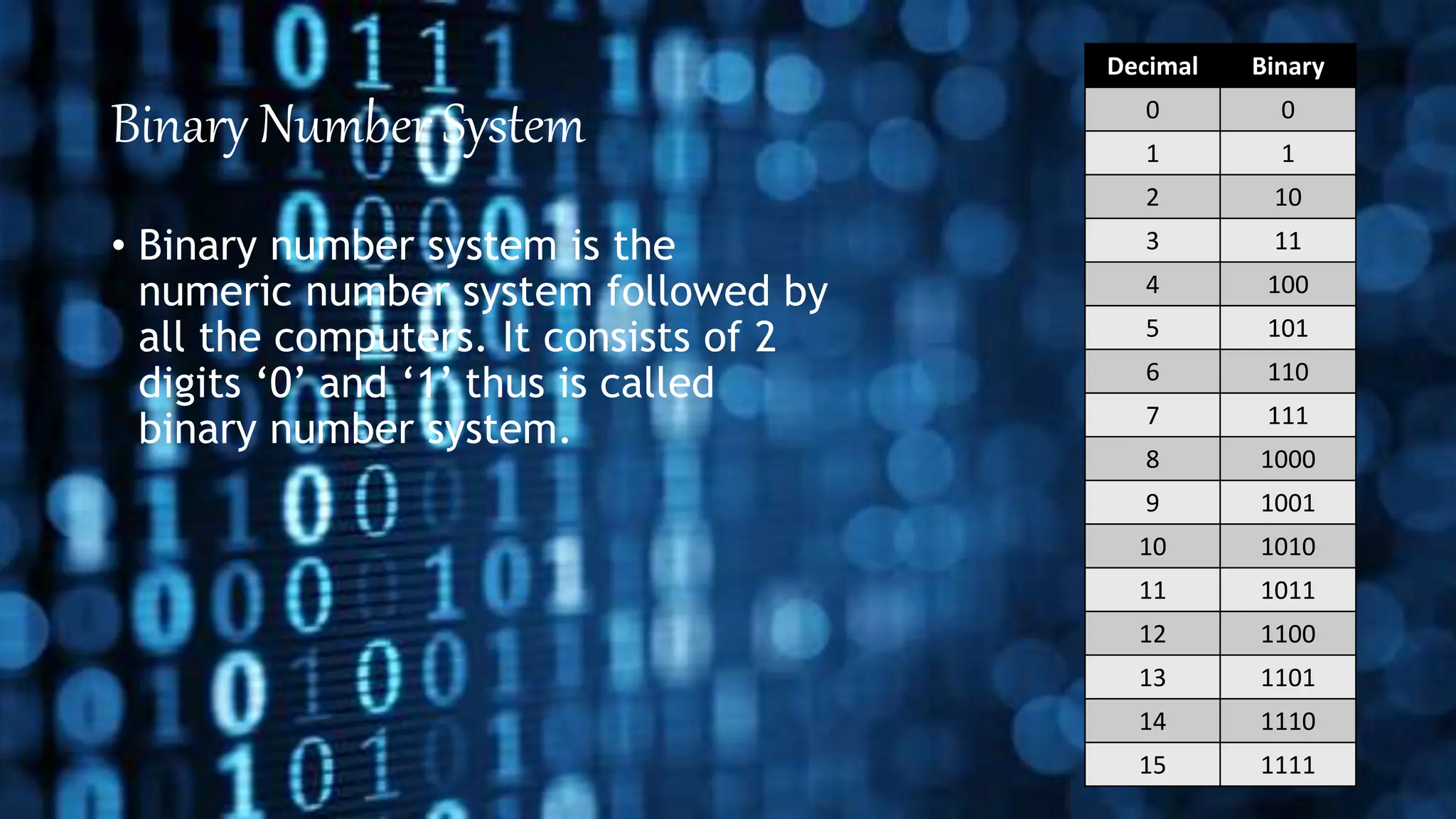
• Binary number system is the
numeric number system followed by
all the computers. It consists of 2
digits ‘0’ and ‘1’ thus is called
binary number system.
Decimal Binary
0 0
1 1
2 10
3 11
4 100
5 101
6 110
7 111
8 1000
9 1001
10 1010
11 1011
12 1100
13 1101
14 1110
15 1111
Octal Number System
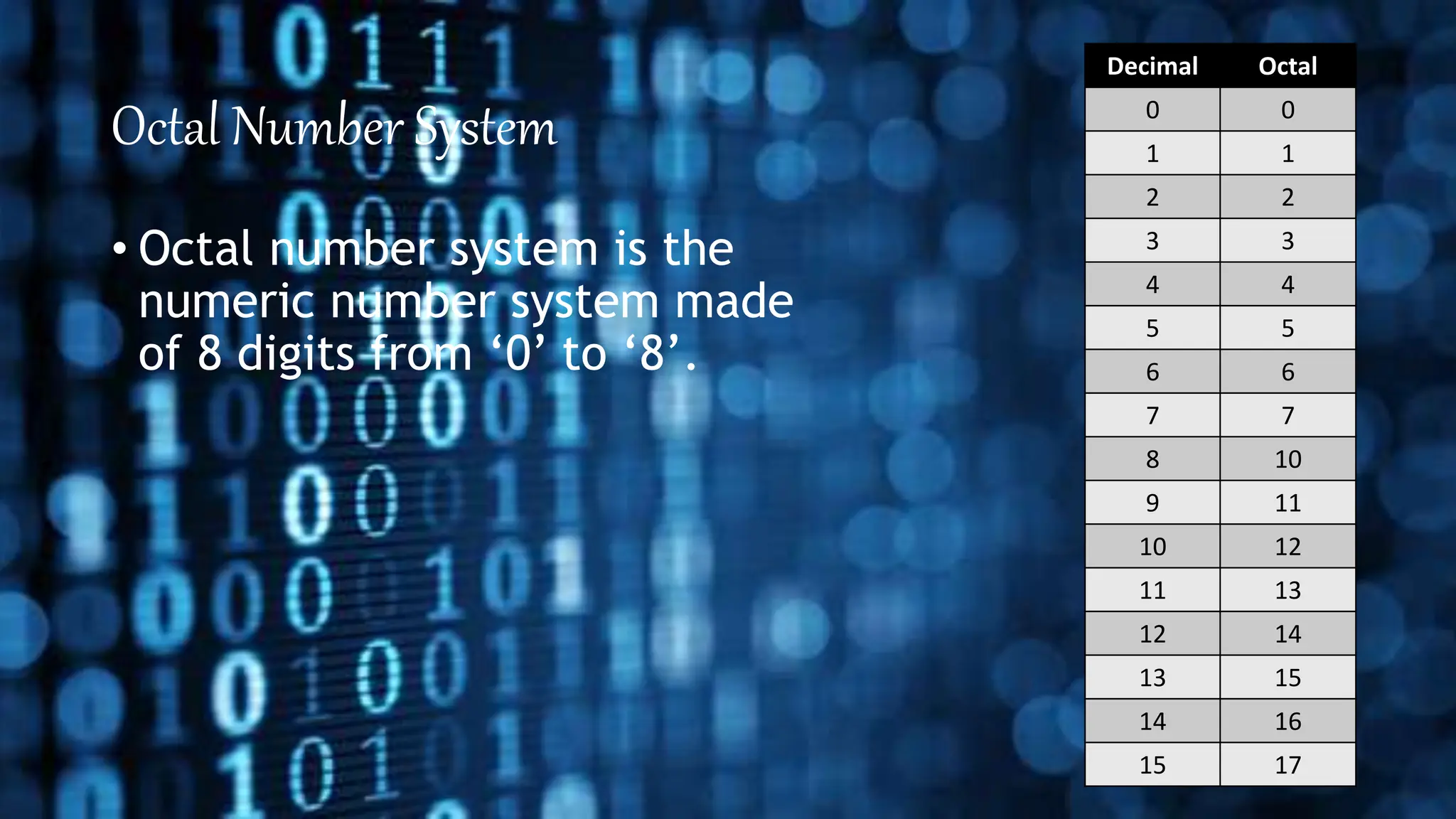
• Octal number system is the
numeric number system made
of 8 digits from ‘0’ to ‘8’.
Decimal Octal
0 0
1 1
2 2
3 3
4 4
5 5
6 6
7 7
8 10
9 11
10 12
11 13
12 14
13 15
14 16
15 17
Decimal Number System
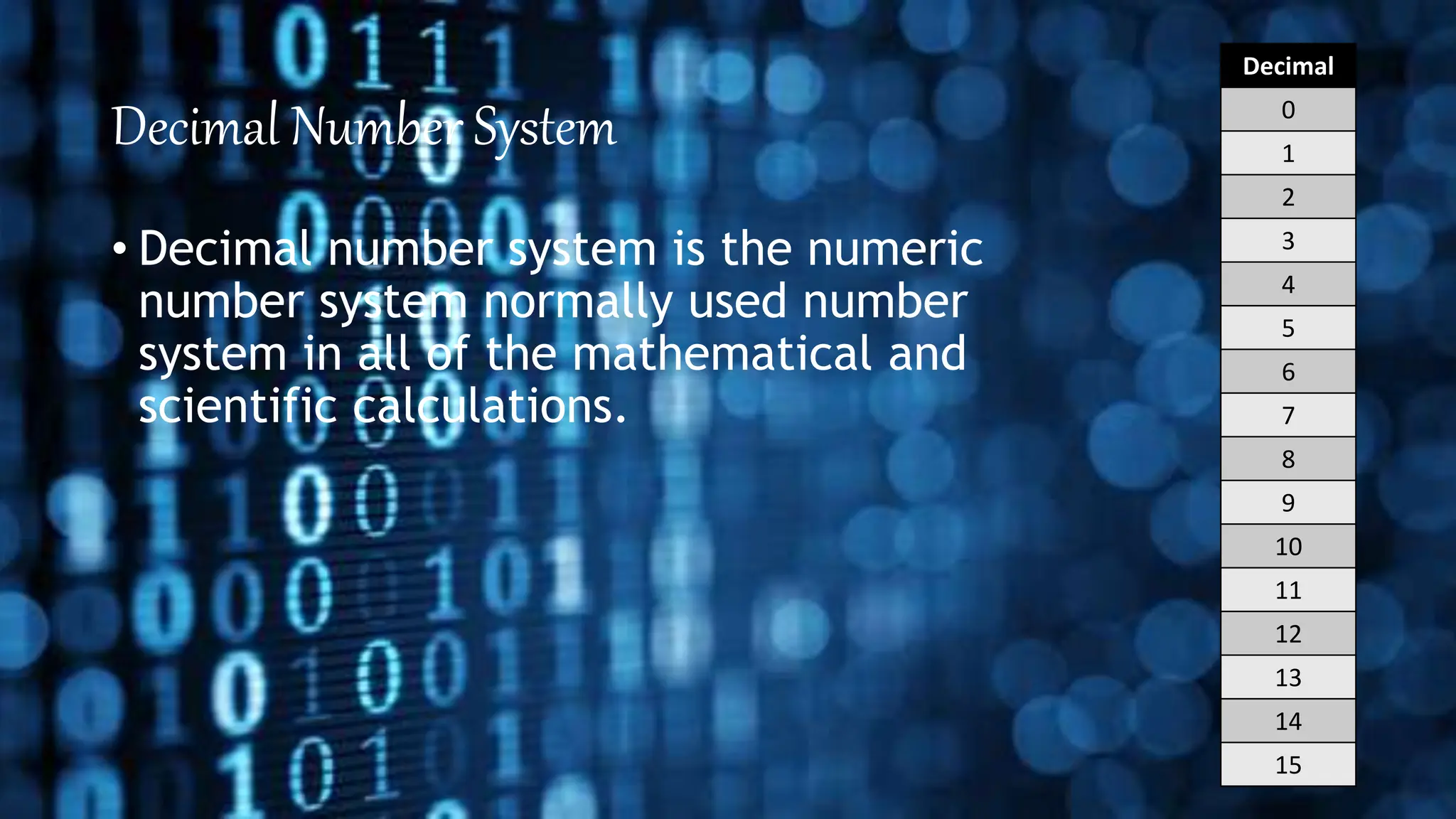
• Decimal number system is the numeric
number system normally used number
system in all of the mathematical and
scientific calculations.
Decimal
0
1
2
3
4
5
6
7
8
9
10
11
12
13
14
15
Hexadecimal Number System
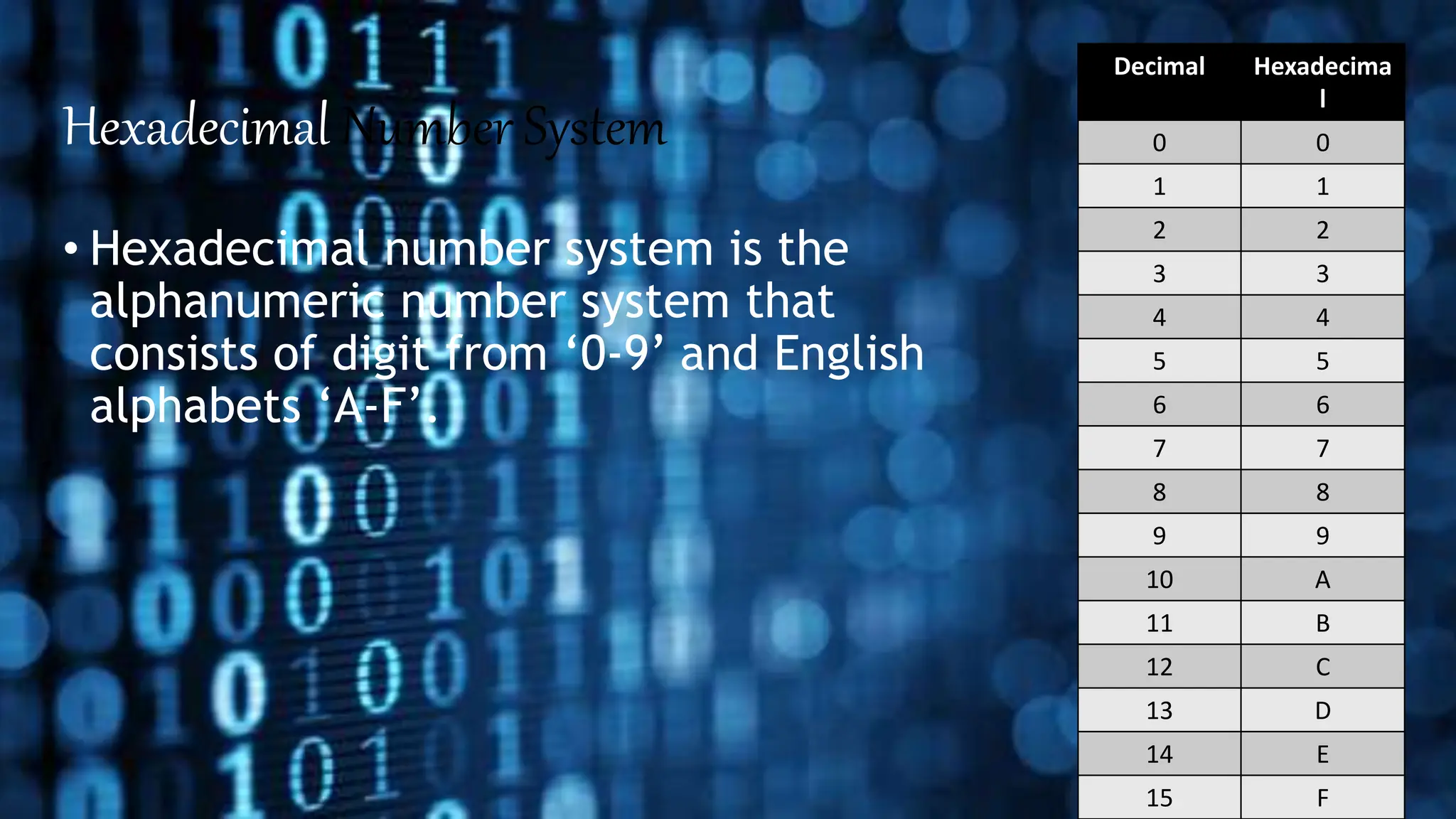
• Hexadecimal number system is the
alphanumeric number system that
consists of digit from ‘0-9’ and English
alphabets ‘A-F’.
Decimal Hexadecima
l
0 0
1 1
2 2
3 3
4 4
5 5
6 6
7 7
8 8
9 9
10 A
11 B
12 C
13 D
14 E
15 F
• Things to remember
A number is always written within
brackets and it’s radix must be
written. Radix is the number of
digits in the system.
Binary: (101101)2 -2 is the radix
Octal: (654)8 -8 is the radix
Decimal: (198)10 -10 is the radix
Hexadecimal: (6A5)16 -16 is the radix
Binary Subtraction:
0-0=0
1-0=1
0-1 [Not Possible]
1-1=0
10-1=1
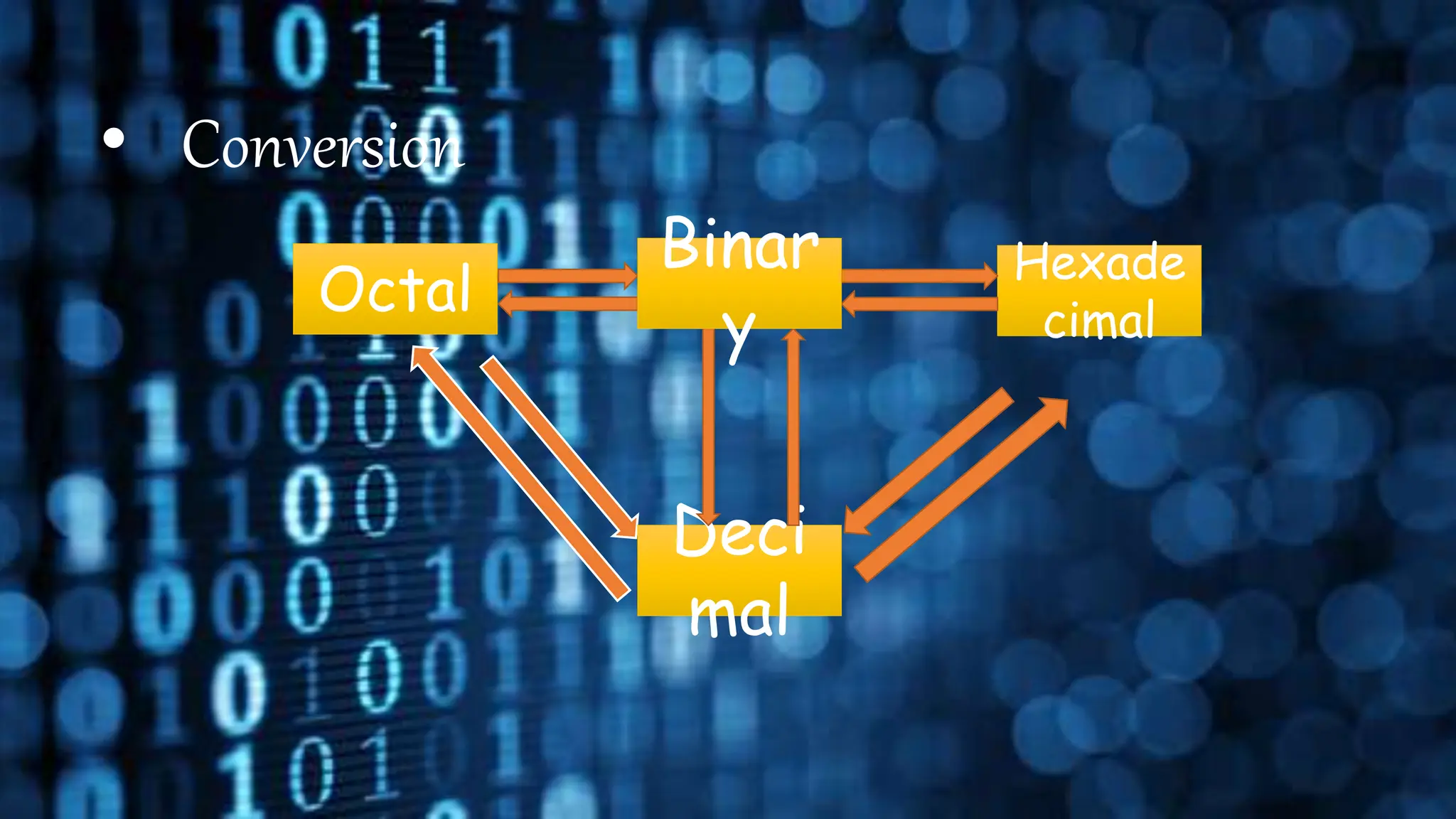
• Conversion
Octal
Deci
mal
Hexade
cimal
Binar
y
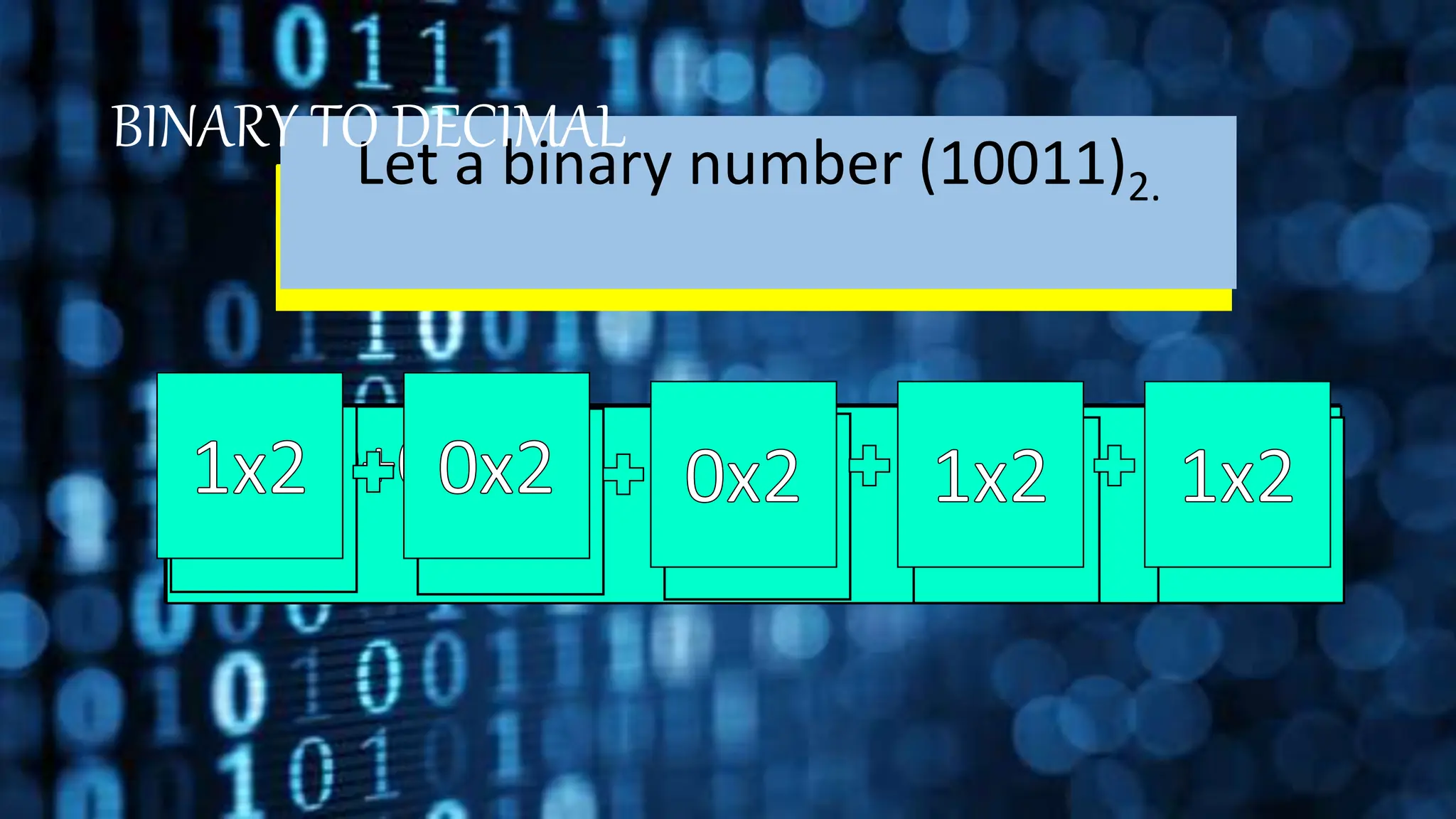
Simplify
Add power from left starting with zero.
Break the number into individual digit.
Let a binary number (10011)2.
BINARY TO DECIMAL
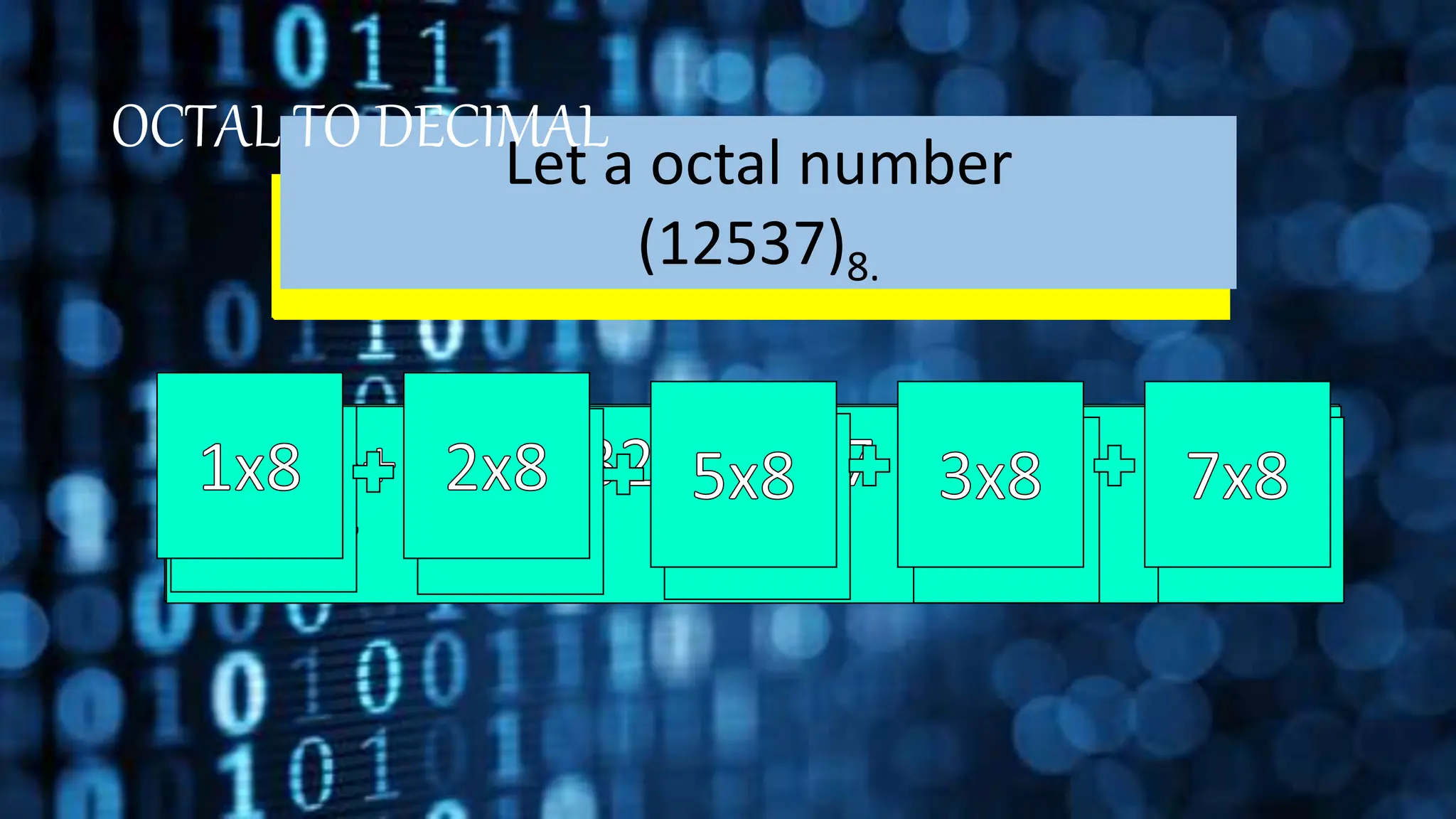
Simplify
Add power from left starting with zero.
Break the number into individual digit.
Let a octal number
(12537)8.
OCTAL TO DECIMAL
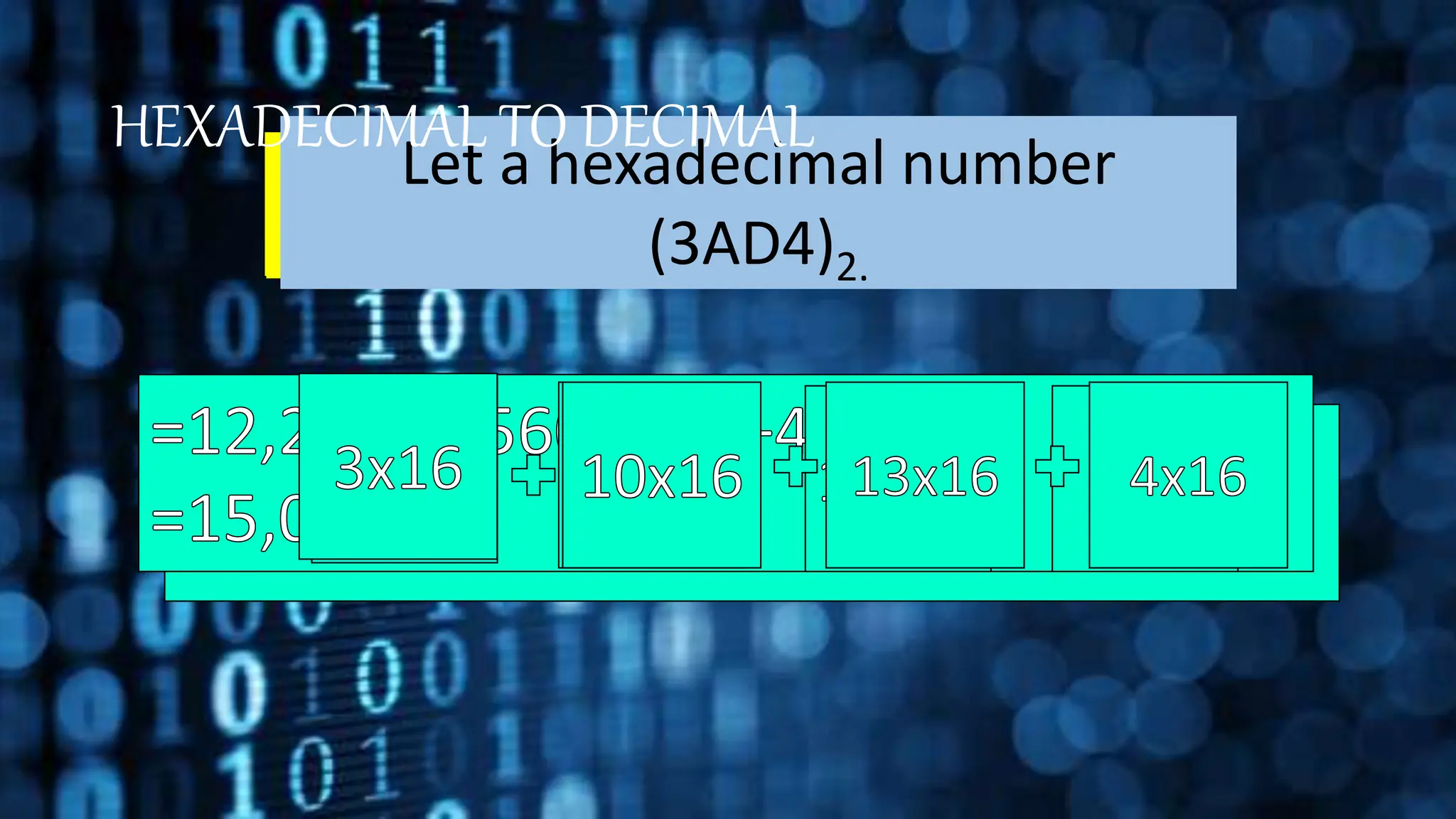
Simplify
Add power from left starting with zero.
Break the number into individual digit.
Let a hexadecimal number
(3AD4)2.
HEXADECIMAL TO DECIMAL
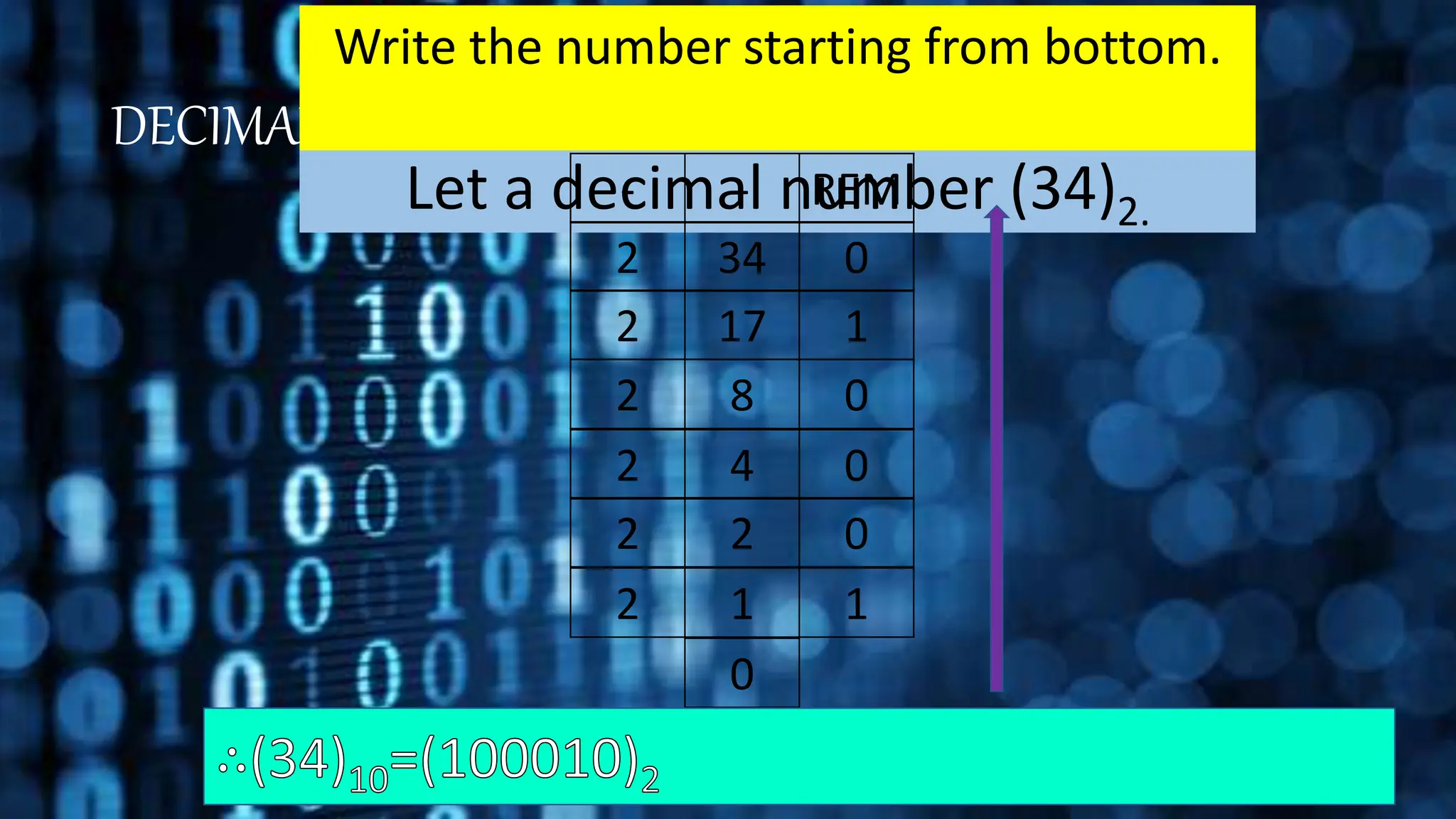
DECIMAL TO BINARY
Let a decimal number (34)2.
Take the number and divide it by 2 while
noting the remainder.
- - REM
2 34 0
2 17 1
2 8 0
2 4 0
2 2 0
2 1 1
0
Write the number starting from bottom.
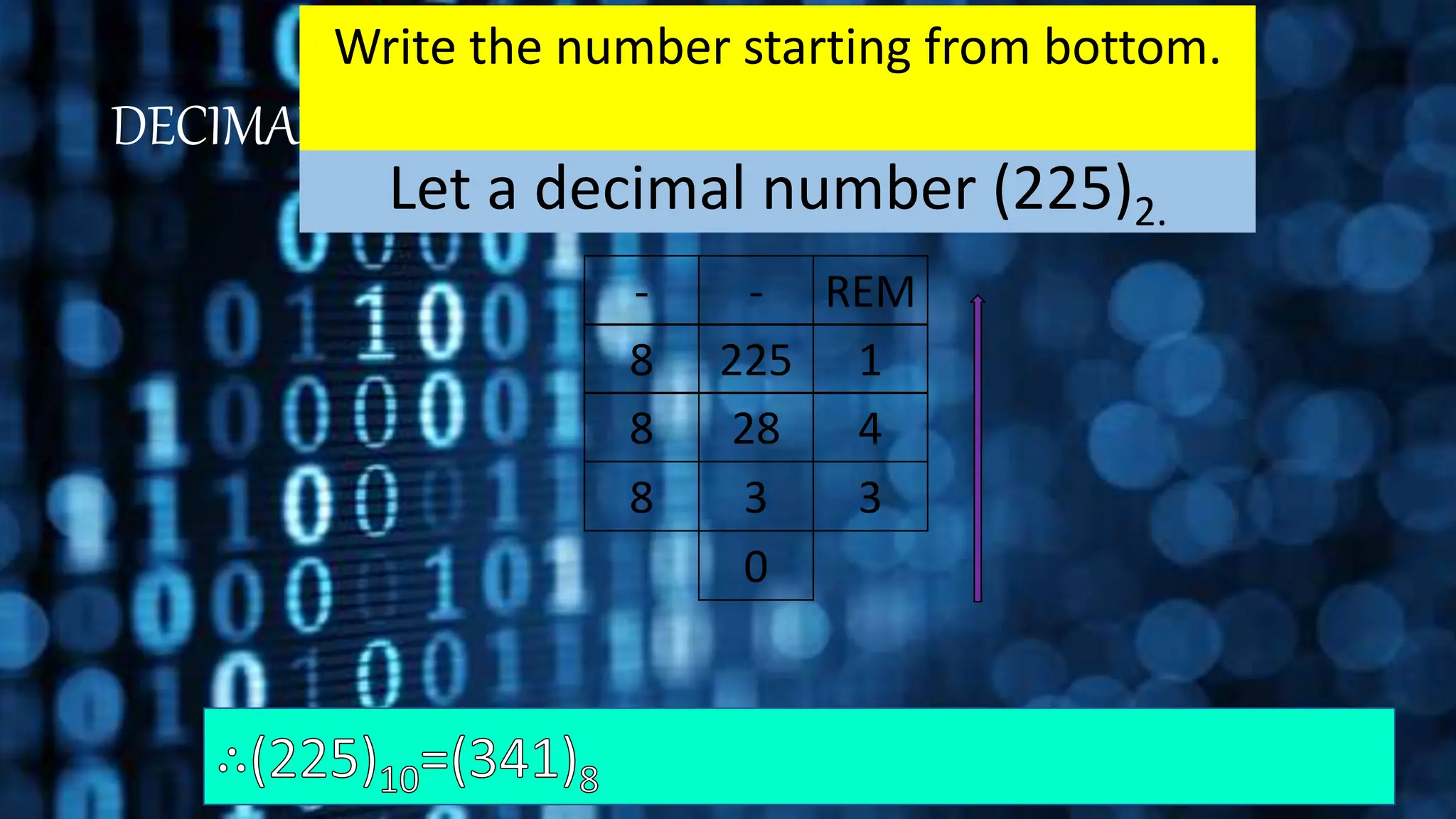
DECIMAL TO OCTAL
Let a decimal number (225)2.
Take the number and divide it by 8 while
noting the remainder.
- - REM
8 225 1
8 28 4
8 3 3
0
Write the number starting from bottom.
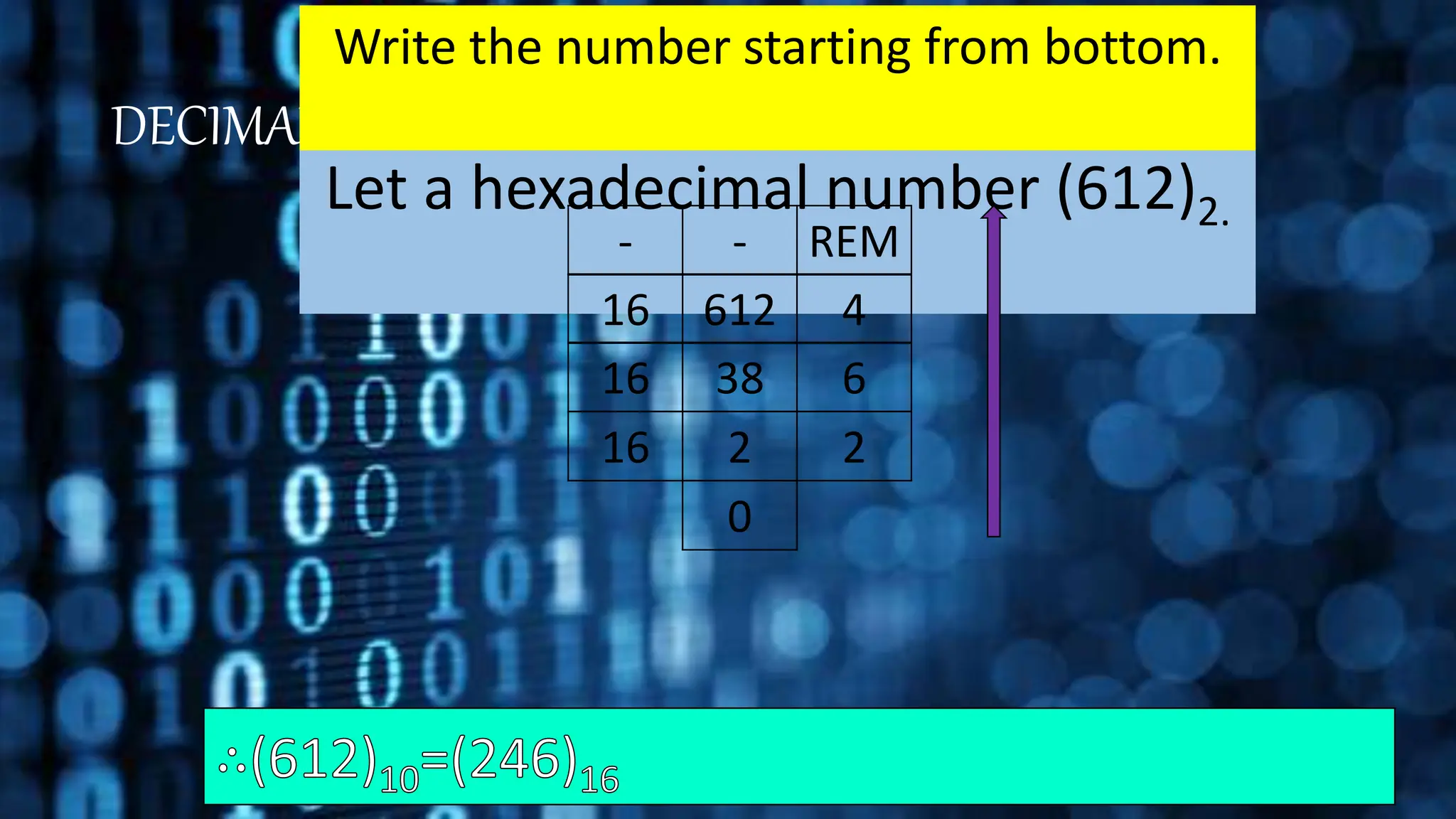
DECIMAL TO HEXADECIMAL
Let a hexadecimal number (612)2.
Take the number and divide it by 16 while
noting the remainder.
- - REM
16 612 4
16 38 6
16 2 2
0
Write the number starting from bottom.
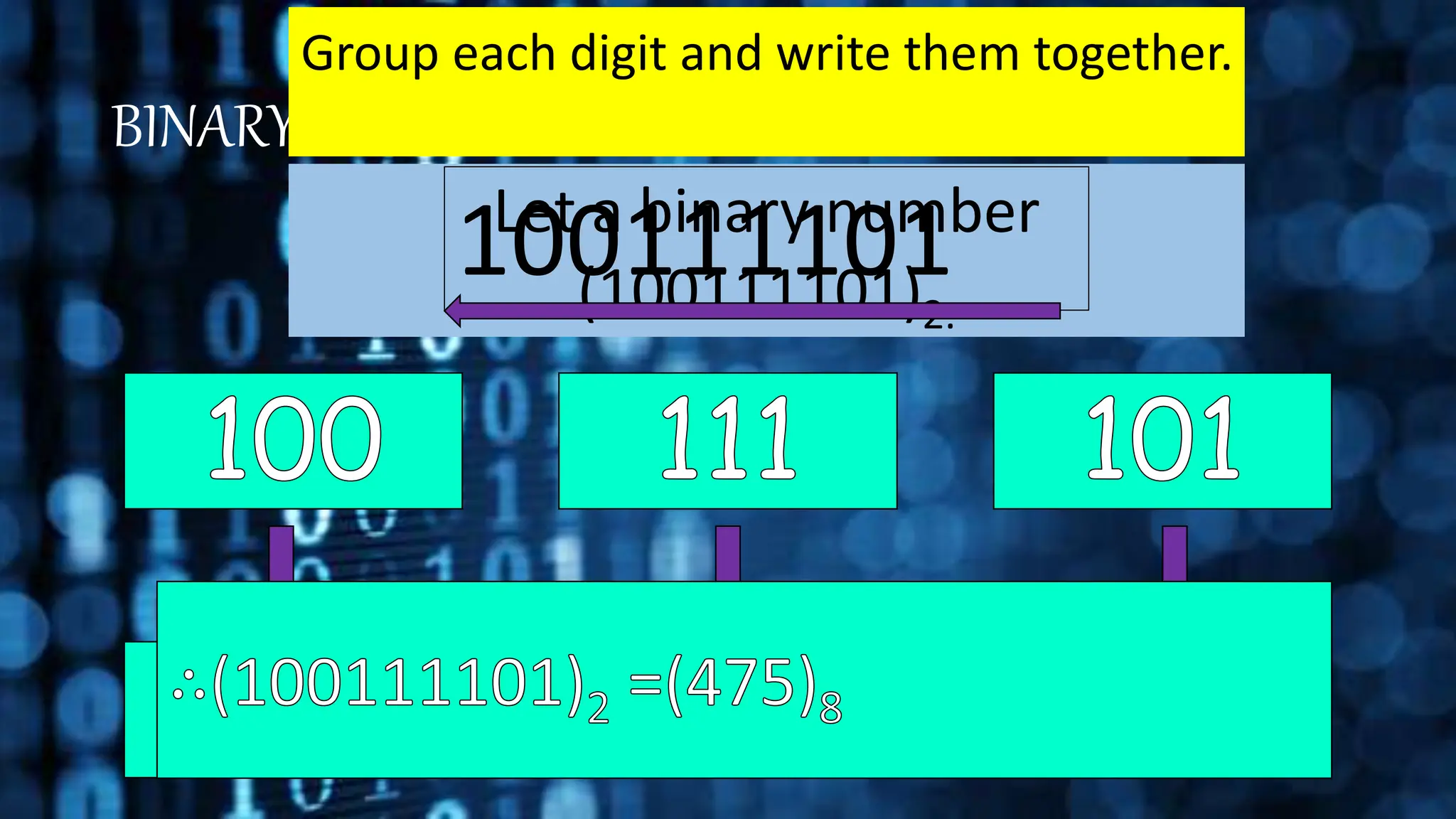
BINARY TO OCTAL
Let a binary number
(100111101)2.
Break the number into 3 digit groups from
left
100111101
Write equivalent octal digit for each
binary group.
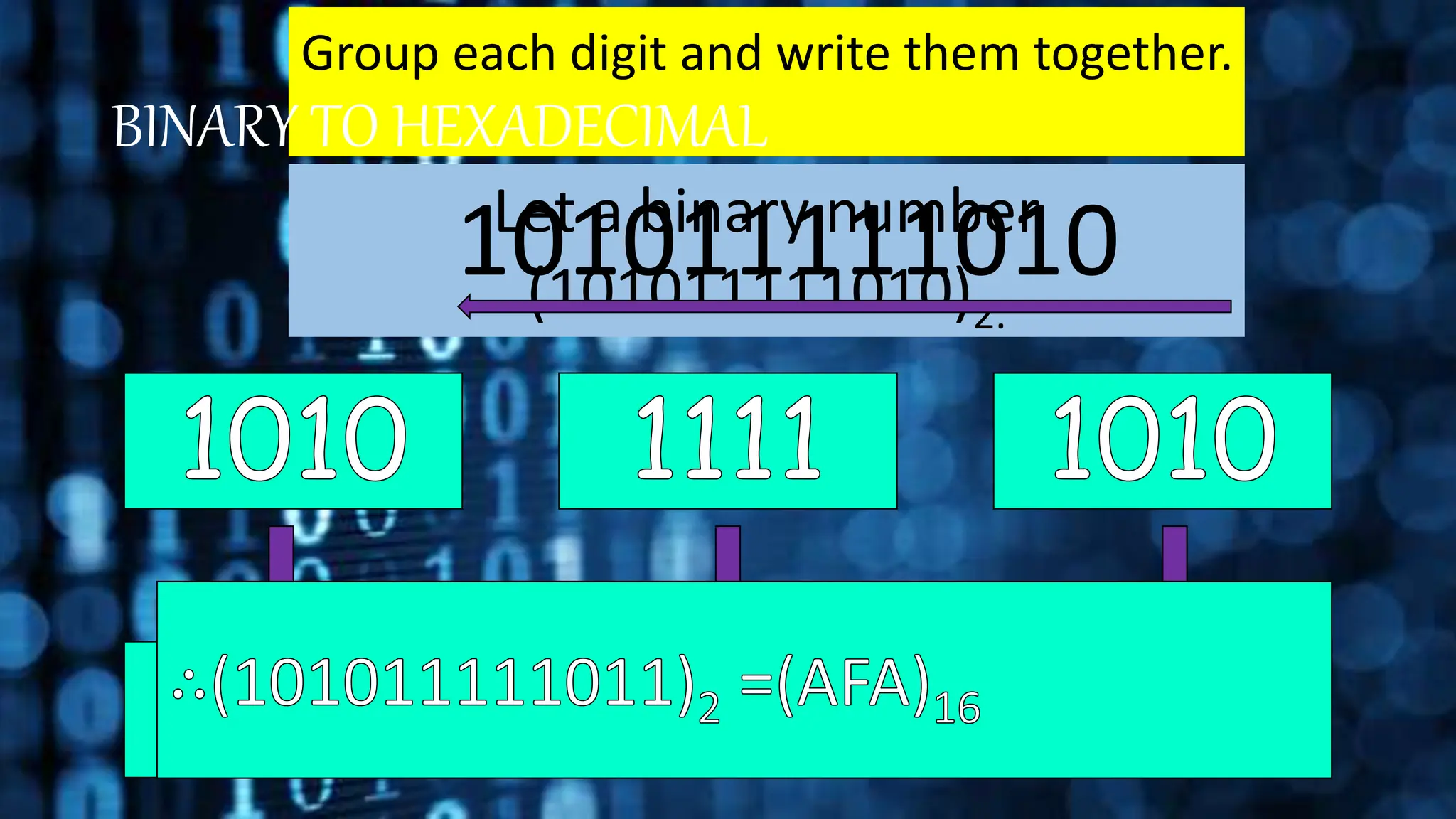
Group each digit and write them together.
Let a binary number
(101011111010)2.
Break the number into 4 digit groups from
left
101011111010
Group each digit and write them together.
BINARY TO HEXADECIMAL
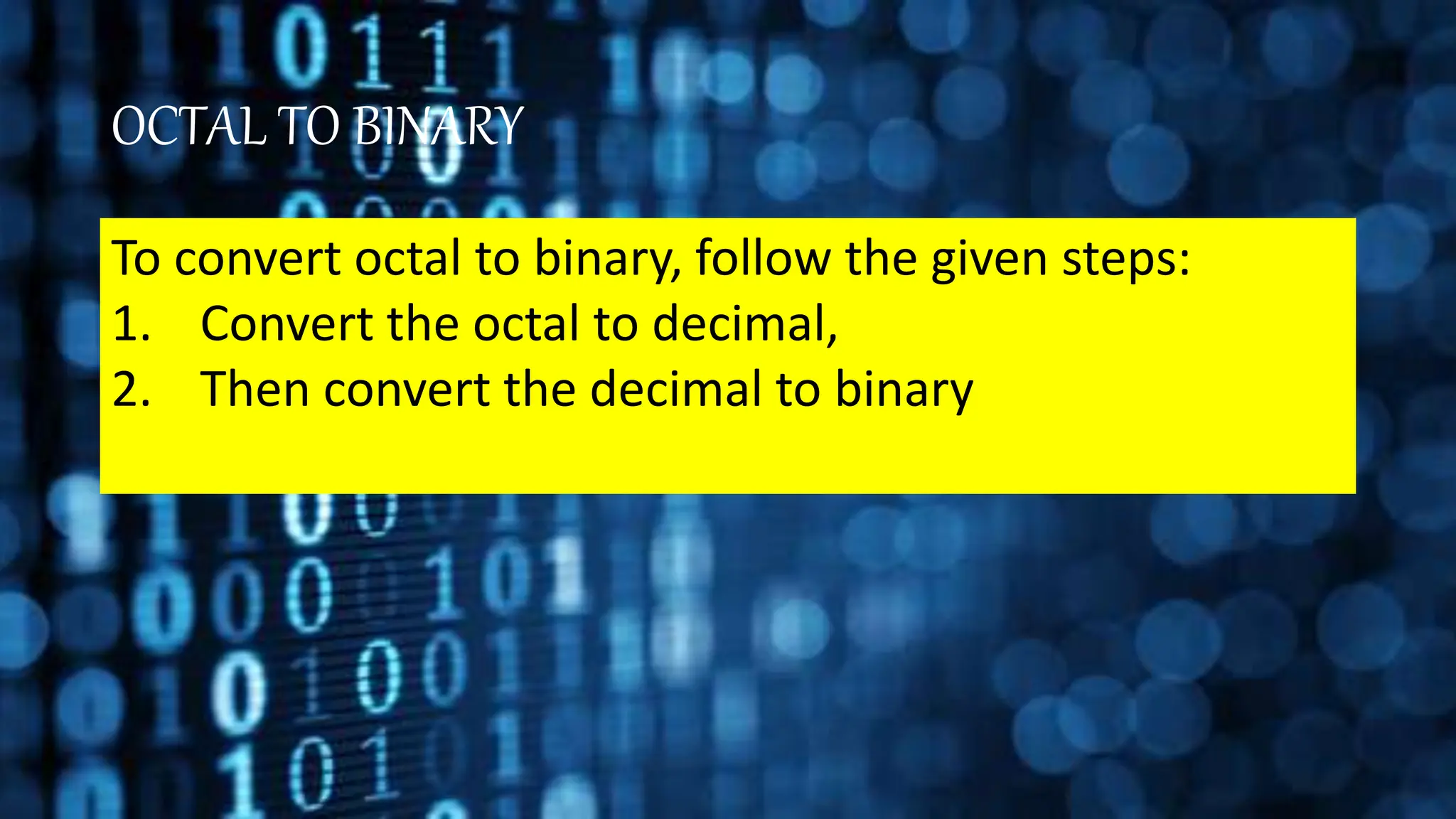
OCTAL TO BINARY
To convert octal to binary, follow the given steps:
1. Convert the octal to decimal,
2. Then convert the decimal to binary
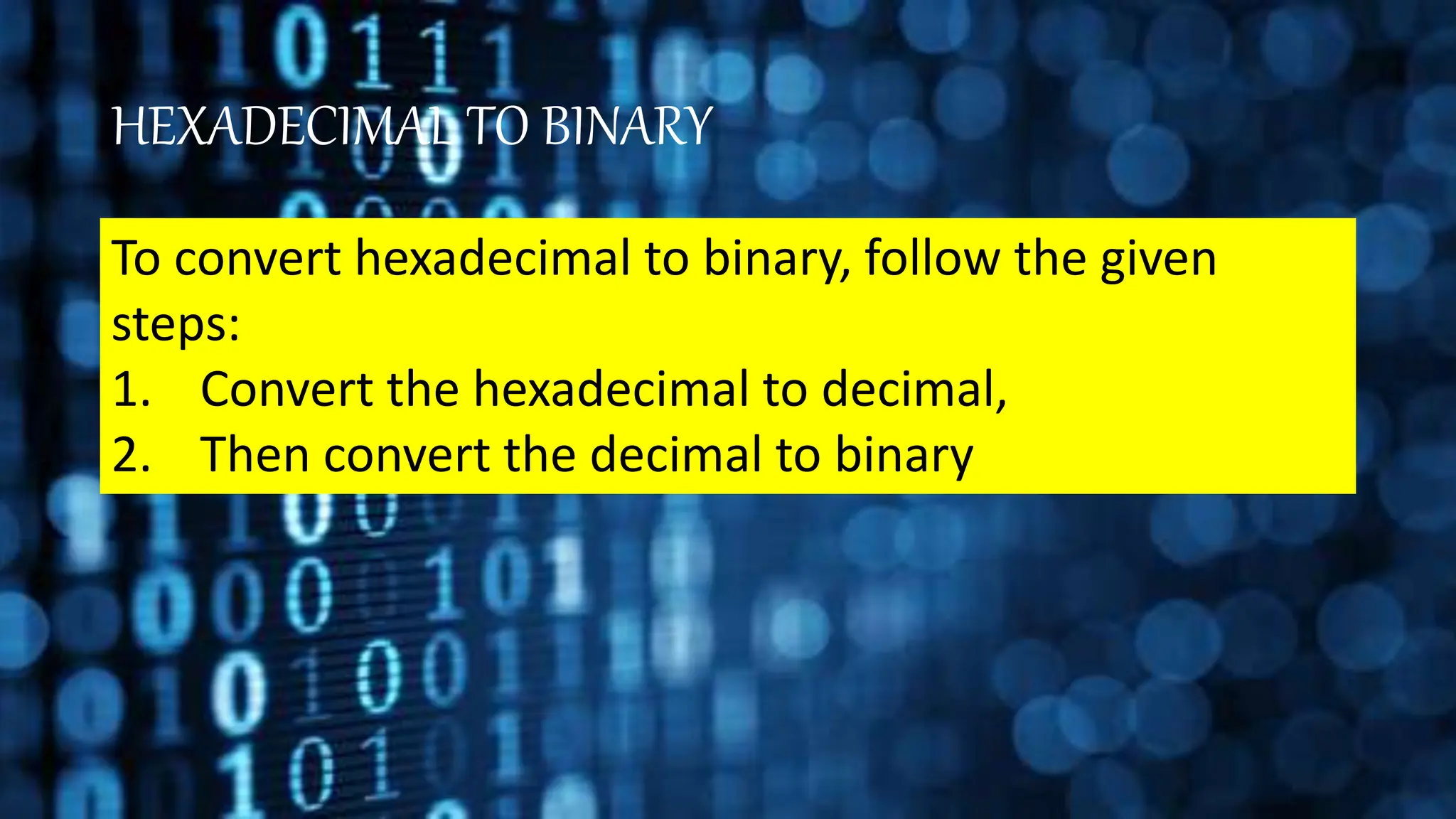
HEXADECIMAL TO BINARY
To convert hexadecimal to binary, follow the given
steps:
1. Convert the hexadecimal to decimal,
2. Then convert the decimal to binary

A presentation on number system and conversion

  • 1.
  • 2.
  • 3.
    Number System • Numbersystem can be defined as a set of symbols(digits) that represent a value. Different number systems may use same digit but represent value or even in same number system a notation can have two values. • Example: Decimal system and binary system both contain the digit “1” but have different values when used. In decimal “11” is eleven but in binary “11” is read as “one one” and it’s decimal equivalent is 3. • Similarly in roman numeral “I” is 1 and “V” is 5 but when writing 4 “IV” is written making the value of “V” 5.
  • 4.
    Positional Number System •The number system in which a digit when in a specific place of a number has a fixed value no matter the digit is called Positional Number system. Simply, the system in which the position of a digit determines it’s value is called positional number system. •
  • 5.
    Non-Positional Number System •The number system in which a digit has same value no matter of it’s position and doesn’t follow a specific pattern of logic in counting is called non-positional number system. • In roman number system I represents 1, V represents 5, X represents 10, L represents 50, C represents 100, D represents 500, M represents 1000. This is true no matter how the digits are arranged although the arrangement of digits make a difference in resultant value. • Example: IV is 4 and VI is 6. The logic here is that the digit written ahead is subtracted and the digit written behind is added but in both cases I is one and V is 5.
  • 6.
    Binary Number System •Binary number system is the numeric number system followed by all the computers. It consists of 2 digits ‘0’ and ‘1’ thus is called binary number system. Decimal Binary 0 0 1 1 2 10 3 11 4 100 5 101 6 110 7 111 8 1000 9 1001 10 1010 11 1011 12 1100 13 1101 14 1110 15 1111
  • 7.
    Octal Number System •Octal number system is the numeric number system made of 8 digits from ‘0’ to ‘8’. Decimal Octal 0 0 1 1 2 2 3 3 4 4 5 5 6 6 7 7 8 10 9 11 10 12 11 13 12 14 13 15 14 16 15 17
  • 8.
    Decimal Number System •Decimal number system is the numeric number system normally used number system in all of the mathematical and scientific calculations. Decimal 0 1 2 3 4 5 6 7 8 9 10 11 12 13 14 15
  • 9.
    Hexadecimal Number System •Hexadecimal number system is the alphanumeric number system that consists of digit from ‘0-9’ and English alphabets ‘A-F’. Decimal Hexadecima l 0 0 1 1 2 2 3 3 4 4 5 5 6 6 7 7 8 8 9 9 10 A 11 B 12 C 13 D 14 E 15 F
  • 10.
    • Things toremember A number is always written within brackets and it’s radix must be written. Radix is the number of digits in the system. Binary: (101101)2 -2 is the radix Octal: (654)8 -8 is the radix Decimal: (198)10 -10 is the radix Hexadecimal: (6A5)16 -16 is the radix Binary Subtraction: 0-0=0 1-0=1 0-1 [Not Possible] 1-1=0 10-1=1
  • 11.
  • 12.
    Simplify Add power fromleft starting with zero. Break the number into individual digit. Let a binary number (10011)2. BINARY TO DECIMAL
  • 13.
    Simplify Add power fromleft starting with zero. Break the number into individual digit. Let a octal number (12537)8. OCTAL TO DECIMAL
  • 14.
    Simplify Add power fromleft starting with zero. Break the number into individual digit. Let a hexadecimal number (3AD4)2. HEXADECIMAL TO DECIMAL
  • 15.
    DECIMAL TO BINARY Leta decimal number (34)2. Take the number and divide it by 2 while noting the remainder. - - REM 2 34 0 2 17 1 2 8 0 2 4 0 2 2 0 2 1 1 0 Write the number starting from bottom.
  • 16.
    DECIMAL TO OCTAL Leta decimal number (225)2. Take the number and divide it by 8 while noting the remainder. - - REM 8 225 1 8 28 4 8 3 3 0 Write the number starting from bottom.
  • 17.
    DECIMAL TO HEXADECIMAL Leta hexadecimal number (612)2. Take the number and divide it by 16 while noting the remainder. - - REM 16 612 4 16 38 6 16 2 2 0 Write the number starting from bottom.
  • 18.
    BINARY TO OCTAL Leta binary number (100111101)2. Break the number into 3 digit groups from left 100111101 Write equivalent octal digit for each binary group. Group each digit and write them together.
  • 19.
    Let a binarynumber (101011111010)2. Break the number into 4 digit groups from left 101011111010 Group each digit and write them together. BINARY TO HEXADECIMAL
  • 20.
    OCTAL TO BINARY Toconvert octal to binary, follow the given steps: 1. Convert the octal to decimal, 2. Then convert the decimal to binary
  • 21.
    HEXADECIMAL TO BINARY Toconvert hexadecimal to binary, follow the given steps: 1. Convert the hexadecimal to decimal, 2. Then convert the decimal to binary