An Introduction to Image Rendering
Images are Pictures!!
 A way of recording and presenting information
  visually.
 Used to save visual experiences.
 A picture is worth a 1000 words…I think more!!!
Photography
                  
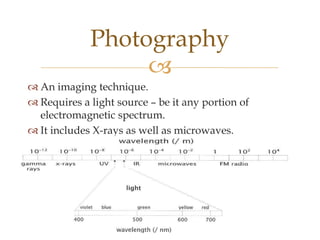
 An imaging technique.
 Requires a light source – be it any portion of
  electromagnetic spectrum.
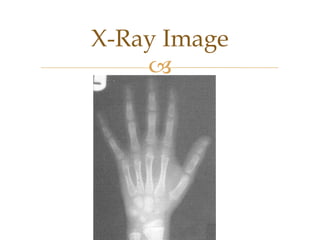
 It includes X-rays as well as microwaves.
X-Ray Image
    
Digital Elevation Model
     of Antarctica
           
Image Processing
               
 Wide range of techniques available for modifying
  and manipulating images in various ways.

 DIP-Digital Image Processing

 Processing of digital images with the help of
  computers.
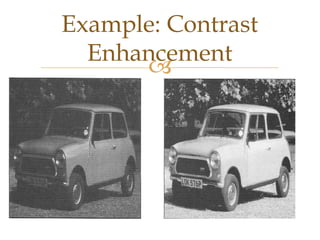
Example: Contrast
  Enhancement
      
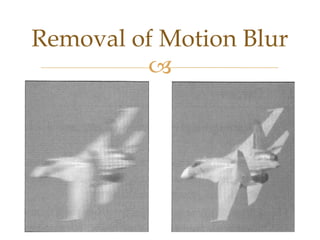
Removal of Motion Blur
         
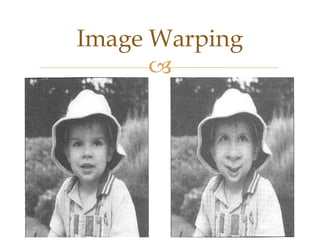
Image Warping
      
Imaging
                   
 Imaging is the process of acquiring images.
 Shorthand for image acquisition.
 Process of sensing our surroundings and then
  representing the measurements that are made in the
  form of an image.
 Passive imaging – employs energy sources that are
  already present in the scene.
 Active imaging – involves use of artificial energy
  sources to probe our surroundings.
Imaging Contd…
              
 Passive imaging is subject to the limitations of
  existing energy sources.
 Active imaging is not restrictive in this way but is
  invariably a more complicated & expensive
  procedure.
 Active imaging predominates in medical field, where
  precise control over radiations sources is essential.
 Active imaging is also an important tool in remote
  sensing.
Why prefer Light in
         imaging?
            
 Light is familiar, and inherently safe.

 Light can be generated reliably and cheaply.

 Light is easy to control and process with optical
  hardware.

 Light can be detected easily.
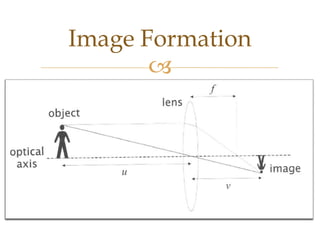
Image Formation
       
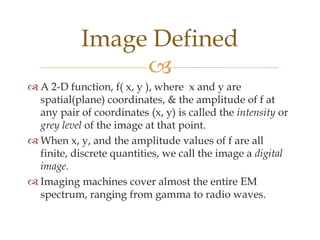
Image Defined
                 
 A 2-D function, f( x, y ), where x and y are
  spatial(plane) coordinates, & the amplitude of f at
  any pair of coordinates (x, y) is called the intensity or
  grey level of the image at that point.
 When x, y, and the amplitude values of f are all
  finite, discrete quantities, we call the image a digital
  image.
 Imaging machines cover almost the entire EM
  spectrum, ranging from gamma to radio waves.
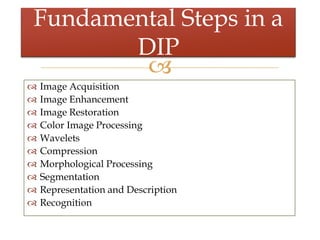
Fundamental Steps in a
       DIP
        
   Image Acquisition
   Image Enhancement
   Image Restoration
   Color Image Processing
   Wavelets
   Compression
   Morphological Processing
   Segmentation
   Representation and Description
   Recognition
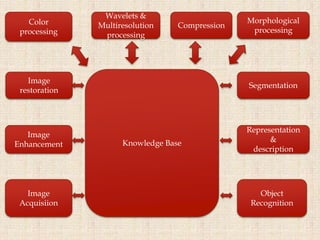
Wavelets &
   Color                                        Morphological
               Multiresolution    Compression
 processing                                      processing
                processing


   Image
                                                Segmentation
 restoration


                                                Representation
   Image
                     Knowledge Base                   &
Enhancement
                                                 description


   Image                                           Object
 Acquisiion                                      Recognition
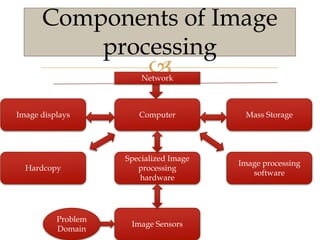
Components of Image
          processing
                       Network


Image displays         Computer          Mass Storage


                    Specialized Image
                                        Image processing
  Hardcopy             processing
                                           software
                        hardware


          Problem
                     Image Sensors
          Domain


Any Queries??

Digital image processing

  • 1.
    An Introduction toImage Rendering
  • 2.
    Images are Pictures!! A way of recording and presenting information visually.  Used to save visual experiences.  A picture is worth a 1000 words…I think more!!!
  • 3.
    Photography   An imaging technique.  Requires a light source – be it any portion of electromagnetic spectrum.  It includes X-rays as well as microwaves.
  • 4.
  • 5.
    Digital Elevation Model of Antarctica 
  • 6.
    Image Processing   Wide range of techniques available for modifying and manipulating images in various ways.  DIP-Digital Image Processing  Processing of digital images with the help of computers.
  • 7.
    Example: Contrast Enhancement 
  • 8.
  • 9.
  • 10.
    Imaging   Imaging is the process of acquiring images.  Shorthand for image acquisition.  Process of sensing our surroundings and then representing the measurements that are made in the form of an image.  Passive imaging – employs energy sources that are already present in the scene.  Active imaging – involves use of artificial energy sources to probe our surroundings.
  • 11.
    Imaging Contd…   Passive imaging is subject to the limitations of existing energy sources.  Active imaging is not restrictive in this way but is invariably a more complicated & expensive procedure.  Active imaging predominates in medical field, where precise control over radiations sources is essential.  Active imaging is also an important tool in remote sensing.
  • 12.
    Why prefer Lightin imaging?   Light is familiar, and inherently safe.  Light can be generated reliably and cheaply.  Light is easy to control and process with optical hardware.  Light can be detected easily.
  • 13.
  • 14.
    Image Defined   A 2-D function, f( x, y ), where x and y are spatial(plane) coordinates, & the amplitude of f at any pair of coordinates (x, y) is called the intensity or grey level of the image at that point.  When x, y, and the amplitude values of f are all finite, discrete quantities, we call the image a digital image.  Imaging machines cover almost the entire EM spectrum, ranging from gamma to radio waves.
  • 15.
    Fundamental Steps ina DIP   Image Acquisition  Image Enhancement  Image Restoration  Color Image Processing  Wavelets  Compression  Morphological Processing  Segmentation  Representation and Description  Recognition
  • 16.
    Wavelets & Color Morphological Multiresolution Compression processing processing processing Image Segmentation restoration Representation Image Knowledge Base & Enhancement description Image Object Acquisiion Recognition
  • 17.
    Components of Image processing  Network Image displays Computer Mass Storage Specialized Image Image processing Hardcopy processing software hardware Problem Image Sensors Domain
  • 18.