DIGITAL
COMMUNICATION
Presented by:
Urkhau Basumatary
BBA, USTM
INRODUCTION
Digital communication is a mode of
communication where the information or
thought is encoded digitally as discrete
channel and electronically transferred to the
recipients.
Digital communication is one the most
commonly used modes of communication
now a days.
Example of Digital communication system
Manager wanted to meet all his team members at the
conference room to discuss their key responsibility areas and
areas of expertise. He didn’t have the time to go to their
workstations and invite them individually. Instead he opted an
easier and cheaper mode to communicate his idea. He sent an
email marking a cc to all the participants, inviting them for the
meeting. This is an example of Digital communication where
the information was sent electronically.
Types Of Digital Communication
1. Internet
2. E-mail
3. Cell Phones (texting, phone calls)
4. Social Media
5. Video conference
6. Television, etc.
1.Internet
Internet communication is referred to as the sharing of
information, ideas, or simply words over the World Wide
Web, or the Internet. The Internet consists of a worldwide
string of connected networks that exchanges data through
packet switching using the standardized Internet Protocol
Suite (TCP/IP).
With internet communication, employees can
effortlessly communicate with one another at anytime from
anywhere in the world.
2.E-mail
Electronic mail (email or e-mail) is a method of exchanging
messages ("mail") between people using electronic devices.
Email is a store-and-forward method of writing, sending,
receiving and saving messages through computers.
Email is the most widely used tool for
business communication at the workplace. We read and
compose at least 50-60 emails a day on an average. ... It,
therefore, becomes imperative that we make the best
possible use of emails to communicate effectively at the
workplace
3.Cell Phones
Telephone Communication is the transmission
of speech over a distance either by electric signals
propagated along conductors or by radio signals. Its a
type of telecommunication.
Telephone communication permits
conversations to be carried on between people
(subscribers) separated by almost any distance.
Example: SMS , Voice Call
4.Social Media
Social media is a forms of electronic communication
(such as websites for social networking and micro-
blogging) through which users create online
communities to share information, ideas, personal
messages, and other content (such as videos).
Examples: Facebook, Messenger, Whatsapp,
Instagram, etc.
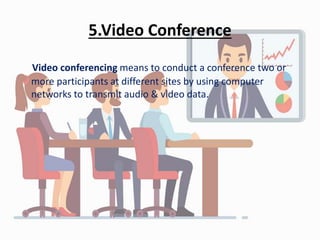
5.Video Conference
Video conferencing means to conduct a conference two or
more participants at different sites by using computer
networks to transmit audio & video data.
6.Tele Conference
A teleconferencing is a telephone meeting
among two or more participants involving
technology more sophisticated than a simple
two-way phone connection.
7.Television
Television is a system for transmitting visual images
and sound that are reproduced on screens, chiefly
used to broadcast programs for entertainment,
information, and education. The television set has
become a common place in many households,
businesses, and institutions. It is a major vehicle for
advertising for a mass reach of information world
wide.
Advantages of Digital Communication
• It is fast and easier.
• No paper is wasted.
• The messages can be stored in the device for longer
times, without being damaged.
• Digital communication can be done over large
distances through internet and other things.
Disadvantages of Digital Communication
• larger bandwidth
• synchronization problem is relatively
difficult.
Digital communication pptx

Digital communication pptx

  • 1.
  • 2.
    INRODUCTION Digital communication isa mode of communication where the information or thought is encoded digitally as discrete channel and electronically transferred to the recipients. Digital communication is one the most commonly used modes of communication now a days.
  • 3.
    Example of Digitalcommunication system Manager wanted to meet all his team members at the conference room to discuss their key responsibility areas and areas of expertise. He didn’t have the time to go to their workstations and invite them individually. Instead he opted an easier and cheaper mode to communicate his idea. He sent an email marking a cc to all the participants, inviting them for the meeting. This is an example of Digital communication where the information was sent electronically.
  • 4.
    Types Of DigitalCommunication 1. Internet 2. E-mail 3. Cell Phones (texting, phone calls) 4. Social Media 5. Video conference 6. Television, etc.
  • 5.
    1.Internet Internet communication isreferred to as the sharing of information, ideas, or simply words over the World Wide Web, or the Internet. The Internet consists of a worldwide string of connected networks that exchanges data through packet switching using the standardized Internet Protocol Suite (TCP/IP). With internet communication, employees can effortlessly communicate with one another at anytime from anywhere in the world.
  • 6.
    2.E-mail Electronic mail (emailor e-mail) is a method of exchanging messages ("mail") between people using electronic devices. Email is a store-and-forward method of writing, sending, receiving and saving messages through computers. Email is the most widely used tool for business communication at the workplace. We read and compose at least 50-60 emails a day on an average. ... It, therefore, becomes imperative that we make the best possible use of emails to communicate effectively at the workplace
  • 7.
    3.Cell Phones Telephone Communicationis the transmission of speech over a distance either by electric signals propagated along conductors or by radio signals. Its a type of telecommunication. Telephone communication permits conversations to be carried on between people (subscribers) separated by almost any distance. Example: SMS , Voice Call
  • 8.
    4.Social Media Social mediais a forms of electronic communication (such as websites for social networking and micro- blogging) through which users create online communities to share information, ideas, personal messages, and other content (such as videos). Examples: Facebook, Messenger, Whatsapp, Instagram, etc.
  • 9.
    5.Video Conference Video conferencingmeans to conduct a conference two or more participants at different sites by using computer networks to transmit audio & video data.
  • 10.
    6.Tele Conference A teleconferencingis a telephone meeting among two or more participants involving technology more sophisticated than a simple two-way phone connection.
  • 11.
    7.Television Television is asystem for transmitting visual images and sound that are reproduced on screens, chiefly used to broadcast programs for entertainment, information, and education. The television set has become a common place in many households, businesses, and institutions. It is a major vehicle for advertising for a mass reach of information world wide.
  • 12.
    Advantages of DigitalCommunication • It is fast and easier. • No paper is wasted. • The messages can be stored in the device for longer times, without being damaged. • Digital communication can be done over large distances through internet and other things.
  • 13.
    Disadvantages of DigitalCommunication • larger bandwidth • synchronization problem is relatively difficult.