Physiology and biochemistry
By: Hukam Chand
AP Zoology
GC Drang at Narla
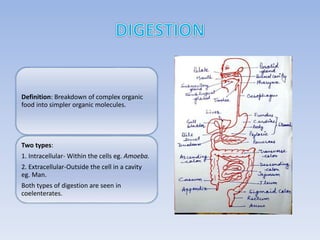
Definition: Breakdown of complex organic
food into simpler organic molecules.
Two types:
1. Intracellular- Within the cells eg. Amoeba.
2. Extracellular-Outside the cell in a cavity
eg. Man.
Both types of digestion are seen in
coelenterates.
Digestive system
Alimentary
canal
• Foregut-mouth
and buccal cavity.
• Midgut- pharynx
to colon.
• Hindgut- Rectum
and anus.
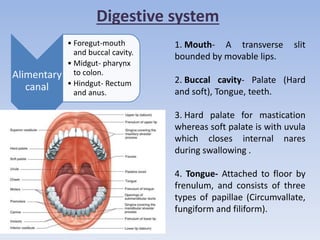
1. Mouth- A transverse slit
bounded by movable lips.
2. Buccal cavity- Palate (Hard
and soft), Tongue, teeth.
3. Hard palate for mastication
whereas soft palate is with uvula
which closes internal nares
during swallowing .
4. Tongue- Attached to floor by
frenulum, and consists of three
types of papillae (Circumvallate,
fungiform and filiform).
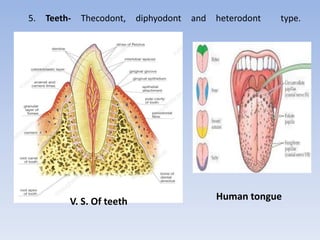
5. Teeth- Thecodont, diphyodont and heterodont type.
Human tongueV. S. Of teeth
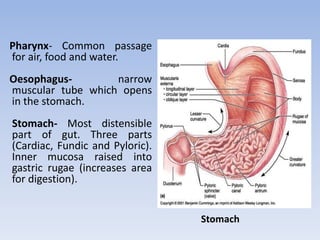
Pharynx- Common passage
for air, food and water.
Oesophagus- narrow
muscular tube which opens
in the stomach.
Stomach- Most distensible
part of gut. Three parts
(Cardiac, Fundic and Pyloric).
Inner mucosa raised into
gastric rugae (increases area
for digestion).
Stomach
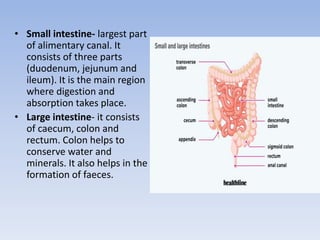
• Small intestine- largest part
of alimentary canal. It
consists of three parts
(duodenum, jejunum and
ileum). It is the main region
where digestion and
absorption takes place.
• Large intestine- it consists
of caecum, colon and
rectum. Colon helps to
conserve water and
minerals. It also helps in the
formation of faeces.
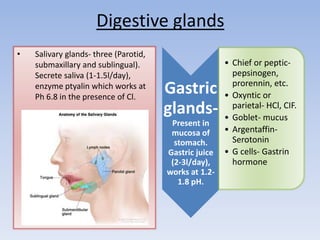
Digestive glands
• Salivary glands- three (Parotid,
submaxillary and sublingual).
Secrete saliva (1-1.5l/day),
enzyme ptyalin which works at
Ph 6.8 in the presence of Cl.
Gastric
glands-
Present in
mucosa of
stomach.
Gastric juice
(2-3l/day),
works at 1.2-
1.8 pH.
• Chief or peptic-
pepsinogen,
prorennin, etc.
• Oxyntic or
parietal- HCl, CIF.
• Goblet- mucus
• Argentaffin-
Serotonin
• G cells- Gastrin
hormone
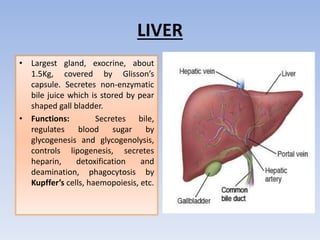
LIVER
• Largest gland, exocrine, about
1.5Kg, covered by Glisson’s
capsule. Secretes non-enzymatic
bile juice which is stored by pear
shaped gall bladder.
• Functions: Secretes bile,
regulates blood sugar by
glycogenesis and glycogenolysis,
controls lipogenesis, secretes
heparin, detoxification and
deamination, phagocytosis by
Kupffer’s cells, haemopoiesis, etc.
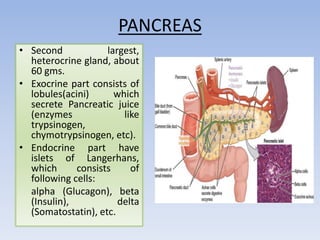
PANCREAS
• Second largest,
heterocrine gland, about
60 gms.
• Exocrine part consists of
lobules(acini) which
secrete Pancreatic juice
(enzymes like
trypsinogen,
chymotrypsinogen, etc).
• Endocrine part have
islets of Langerhans,
which consists of
following cells:
alpha (Glucagon), beta
(Insulin), delta
(Somatostatin), etc.
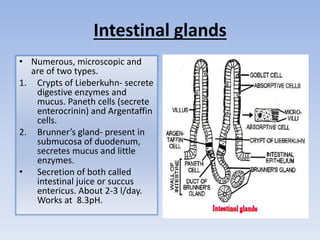
Intestinal glands
• Numerous, microscopic and
are of two types.
1. Crypts of Lieberkuhn- secrete
digestive enzymes and
mucus. Paneth cells (secrete
enterocrinin) and Argentaffin
cells.
2. Brunner’s gland- present in
submucosa of duodenum,
secretes mucus and little
enzymes.
• Secretion of both called
intestinal juice or succus
entericus. About 2-3 l/day.
Works at 8.3pH.

digestive system by Hukam

  • 1.
    Physiology and biochemistry By:Hukam Chand AP Zoology GC Drang at Narla
  • 2.
    Definition: Breakdown ofcomplex organic food into simpler organic molecules. Two types: 1. Intracellular- Within the cells eg. Amoeba. 2. Extracellular-Outside the cell in a cavity eg. Man. Both types of digestion are seen in coelenterates.
  • 3.
    Digestive system Alimentary canal • Foregut-mouth andbuccal cavity. • Midgut- pharynx to colon. • Hindgut- Rectum and anus. 1. Mouth- A transverse slit bounded by movable lips. 2. Buccal cavity- Palate (Hard and soft), Tongue, teeth. 3. Hard palate for mastication whereas soft palate is with uvula which closes internal nares during swallowing . 4. Tongue- Attached to floor by frenulum, and consists of three types of papillae (Circumvallate, fungiform and filiform).
  • 4.
    5. Teeth- Thecodont,diphyodont and heterodont type. Human tongueV. S. Of teeth
  • 5.
    Pharynx- Common passage forair, food and water. Oesophagus- narrow muscular tube which opens in the stomach. Stomach- Most distensible part of gut. Three parts (Cardiac, Fundic and Pyloric). Inner mucosa raised into gastric rugae (increases area for digestion). Stomach
  • 6.
    • Small intestine-largest part of alimentary canal. It consists of three parts (duodenum, jejunum and ileum). It is the main region where digestion and absorption takes place. • Large intestine- it consists of caecum, colon and rectum. Colon helps to conserve water and minerals. It also helps in the formation of faeces.
  • 7.
    Digestive glands • Salivaryglands- three (Parotid, submaxillary and sublingual). Secrete saliva (1-1.5l/day), enzyme ptyalin which works at Ph 6.8 in the presence of Cl. Gastric glands- Present in mucosa of stomach. Gastric juice (2-3l/day), works at 1.2- 1.8 pH. • Chief or peptic- pepsinogen, prorennin, etc. • Oxyntic or parietal- HCl, CIF. • Goblet- mucus • Argentaffin- Serotonin • G cells- Gastrin hormone
  • 8.
    LIVER • Largest gland,exocrine, about 1.5Kg, covered by Glisson’s capsule. Secretes non-enzymatic bile juice which is stored by pear shaped gall bladder. • Functions: Secretes bile, regulates blood sugar by glycogenesis and glycogenolysis, controls lipogenesis, secretes heparin, detoxification and deamination, phagocytosis by Kupffer’s cells, haemopoiesis, etc.
  • 9.
    PANCREAS • Second largest, heterocrinegland, about 60 gms. • Exocrine part consists of lobules(acini) which secrete Pancreatic juice (enzymes like trypsinogen, chymotrypsinogen, etc). • Endocrine part have islets of Langerhans, which consists of following cells: alpha (Glucagon), beta (Insulin), delta (Somatostatin), etc.
  • 10.
    Intestinal glands • Numerous,microscopic and are of two types. 1. Crypts of Lieberkuhn- secrete digestive enzymes and mucus. Paneth cells (secrete enterocrinin) and Argentaffin cells. 2. Brunner’s gland- present in submucosa of duodenum, secretes mucus and little enzymes. • Secretion of both called intestinal juice or succus entericus. About 2-3 l/day. Works at 8.3pH.