
Differentiation  & Mixed Age Classes Adapted & updated from an RSG presentation in Devon  on14 th  June 2007 Jo Rhys-Jones Kingswear Primary School 2007, (& now Hampshire LA 2009)
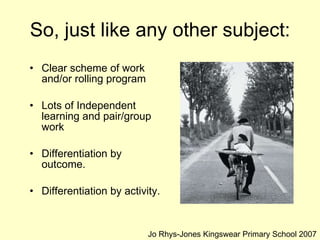
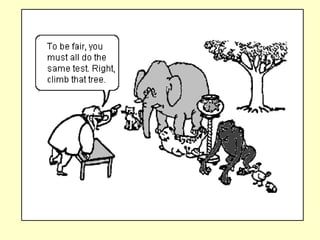
So, just like any other subject: Clear scheme of work and/or rolling program Lots of Independent learning and pair/group work Differentiation by outcome. Differentiation by activity. Jo Rhys-Jones Kingswear Primary School 2007
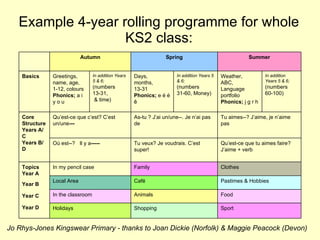
Example 4-year rolling programme for whole KS2 class: Jo Rhys-Jones Kingswear Primary - thanks to Joan Dickie (Norfolk) & Maggie Peacock (Devon) Sport Shopping Holidays Food Animals In the classroom Pastimes & Hobbies Café Local Area Clothes Family In my pencil case Topics Year A Year B Year C Year D Qu’est-ce que tu aimes faire? J’aime +  verb Tu veux? Je voudrais. C’est super! Où est--?   Il y a ----- Tu aimes--? J’aime, je n’aime pas As-tu   ? J’ai un/une--. Je n’ai pas de Qu’est-ce que c’est? C’est un/une --- Core Structure Years A/C Years B/D In addition Years 5 & 6; (numbers  60-100) Weather,  ABC, Language portfolio Phonics;  j g r h In addition Years 5 & 6; (numbers 31-60, Money) Days,  months,  13-31 Phonics;  e é è ê In addition Years 5 & 6; (numbers  13-31,  & time)  Greetings, name, age,  1-12, colours Phonics;  a i y o u Basics Summer Spring Autumn
What rolling program? Part 3 of the Framework p.117 gives 4 ‘models’ from small schools. Complete 2-year rolling programmes for Y3/4 and Y5/6 and a 4-year programme for Y3,4,5,6 start on p.123 You can download Kingswear’s rolling programme for a whole KS2 class from  www.primarymfl.ning.com/   West Sussex GfL  http://wsgfl.westsussex.gov.uk/ccm/content/curriculum/mfl/ks2/schemes-of-work/ks2-mixed-age-scheme-of-work-years-3-and-4-term-1.en;jsessionid=awlLXdYKLXWd   Tout le monde has even had a go:  http://www.pearsonschoolsandfecolleges.co.uk/Primary/MFL/AllMFLresources/ToutLeMondeHeinemannPrimaryFrench/FreeResources/FreeResources.aspx#1
 
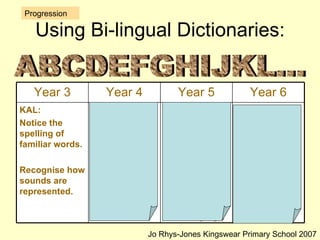
Using Bi-lingual Dictionaries: Progression ABCDEFGHIJKL... Jo Rhys-Jones Kingswear Primary School 2007 LLS:  Use a dictionary.   L5.3: Use a bilingual dictionary to check the spelling of familiar words.  KAL: Understand that words will not always have a direct equivalent in the language.  LLS:  Use a dictionary to look up spellings.   KAL: Notice the spelling of familiar words.  Recognise how sounds are represented. Year 6 Year 5 Year 4 Year 3
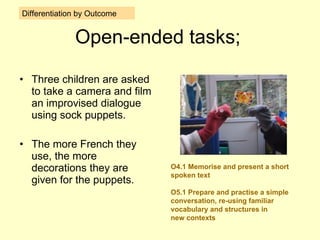
Open-ended tasks; Three children are asked to take a camera and film an improvised dialogue using sock puppets. The more French they use, the more decorations they are given for the puppets. Differentiation by Outcome O4.1 Memorise and present a short spoken text O5.1 Prepare and practise a simple conversation, re-using familiar vocabulary and structures in new contexts
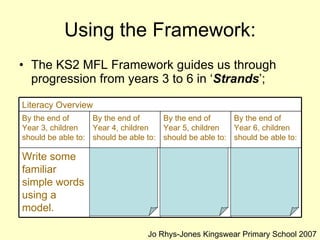
Using the Framework: The KS2 MFL Framework guides us through progression from years 3 to 6 in ‘ Strands ’; Jo Rhys-Jones Kingswear Primary School 2007 Write several sentences from memory. Write words, phrases & sentences using a model. Write some familiar words and phrases without help. Write some familiar simple words using a model. By the end of Year 6, children should be able to: By the end of Year 5, children should be able to: By the end of Year 4, children should be able to: By the end of Year 3, children should be able to: Literacy Overview
Differentiating a puzzle worksheet: Design a crossword in Spanish & write own clues in the target language. Complete a crossword in Spanish with clues in the target language. Complete a crossword in Spanish with picture clues or word prompts. Design a crossword/wordsearch in Spanish. Complete a wordsearch in Spanish with picture clues. Complete a wordsearch in Spanish with word prompts. Jo Rhys-Jones Kingswear Primary School 2007
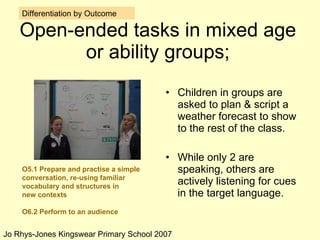
Open-ended tasks in mixed age or ability groups; Children in groups are asked to plan & script a weather forecast to show to the rest of the class. While only 2 are speaking, others are actively listening for cues in the target language. Differentiation by Outcome O5.1 Prepare and practise a simple conversation, re-using familiar vocabulary and structures in new contexts O6.2 Perform to an audience Jo Rhys-Jones Kingswear Primary School 2007
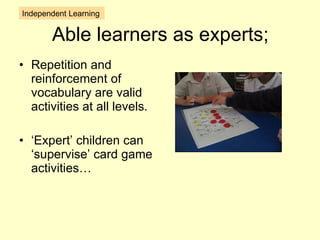
Able learners as experts; Repetition and reinforcement of vocabulary are valid activities at all levels. ‘ Expert’ children can ‘supervise’ card game activities…  Independent Learning
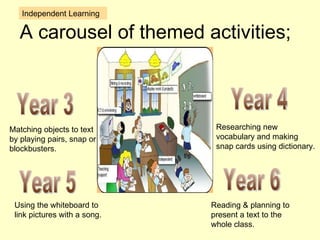
A carousel of themed activities; Matching objects to text by playing pairs, snap or blockbusters. Researching new vocabulary and making snap cards using dictionary. Using the whiteboard to link pictures with a song. Reading & planning to present a text to the whole class. Year 3 Year 6 Year 5 Year 4 Independent Learning
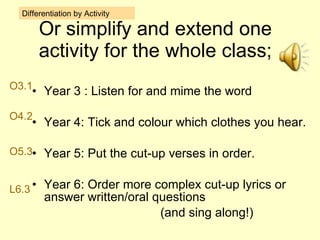
Or simplify and extend one activity for the whole class; Year 3 : Listen for and mime the word  Year 4: Tick and colour which clothes you hear. Year 5: Put the cut-up verses in order. Year 6: Order more complex cut-up lyrics or answer written/oral questions (and sing along!) Differentiation by Activity O3.1 O4.2 O5.3 L6.3
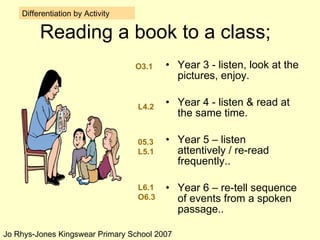
Reading a book to a class; Year 3 - listen, look at the pictures, enjoy. Year 4 - listen & read at the same time. Year 5 – listen attentively / re-read frequently.. Year 6 – re-tell sequence of events from a spoken passage.. O3.1 L4.2 05.3 L5.1 L6.1 O6.3 Differentiation by Activity Jo Rhys-Jones Kingswear Primary School 2007
KS2 MFL Framework – Part 3 It is unrealistic for one teacher to plan & deliver separate lessons to each age group, although this model can be followed occasionally… p.119 The key to mixed age planning will be to look at the three main strands of the Framework longitudinally, depending on the age range in a class… p.120 Frequent revisiting is crucial to successful language learning and is indispensable when planning for mixed age classes.   P.121
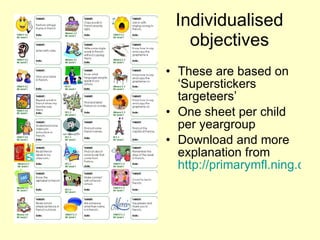
Individualised objectives These are based on ‘Superstickers targeteers’ One sheet per child per yeargroup Download and more explanation from  http://primarymfl.ning.com/profiles/blogs/ks2-assessment-target
Open-ended self-assessment  End of each term children assess their own learning using ‘I can ..’ sheets. These go into a loose folder with their own favourite work which makes up their European Language Portfolio. http://www.nacell.org.uk/resources/pub_cilt/portfolio.htm
Please share your solutions too!

Differentiation Slideshare Version

  • 1.
    Differentiation &Mixed Age Classes Adapted & updated from an RSG presentation in Devon on14 th June 2007 Jo Rhys-Jones Kingswear Primary School 2007, (& now Hampshire LA 2009)
  • 2.
    So, just likeany other subject: Clear scheme of work and/or rolling program Lots of Independent learning and pair/group work Differentiation by outcome. Differentiation by activity. Jo Rhys-Jones Kingswear Primary School 2007
  • 3.
    Example 4-year rollingprogramme for whole KS2 class: Jo Rhys-Jones Kingswear Primary - thanks to Joan Dickie (Norfolk) & Maggie Peacock (Devon) Sport Shopping Holidays Food Animals In the classroom Pastimes & Hobbies Café Local Area Clothes Family In my pencil case Topics Year A Year B Year C Year D Qu’est-ce que tu aimes faire? J’aime + verb Tu veux? Je voudrais. C’est super! Où est--? Il y a ----- Tu aimes--? J’aime, je n’aime pas As-tu ? J’ai un/une--. Je n’ai pas de Qu’est-ce que c’est? C’est un/une --- Core Structure Years A/C Years B/D In addition Years 5 & 6; (numbers 60-100) Weather, ABC, Language portfolio Phonics; j g r h In addition Years 5 & 6; (numbers 31-60, Money) Days, months, 13-31 Phonics; e é è ê In addition Years 5 & 6; (numbers 13-31, & time) Greetings, name, age, 1-12, colours Phonics; a i y o u Basics Summer Spring Autumn
  • 4.
    What rolling program?Part 3 of the Framework p.117 gives 4 ‘models’ from small schools. Complete 2-year rolling programmes for Y3/4 and Y5/6 and a 4-year programme for Y3,4,5,6 start on p.123 You can download Kingswear’s rolling programme for a whole KS2 class from www.primarymfl.ning.com/ West Sussex GfL http://wsgfl.westsussex.gov.uk/ccm/content/curriculum/mfl/ks2/schemes-of-work/ks2-mixed-age-scheme-of-work-years-3-and-4-term-1.en;jsessionid=awlLXdYKLXWd Tout le monde has even had a go: http://www.pearsonschoolsandfecolleges.co.uk/Primary/MFL/AllMFLresources/ToutLeMondeHeinemannPrimaryFrench/FreeResources/FreeResources.aspx#1
  • 5.
  • 6.
    Using Bi-lingual Dictionaries:Progression ABCDEFGHIJKL... Jo Rhys-Jones Kingswear Primary School 2007 LLS: Use a dictionary. L5.3: Use a bilingual dictionary to check the spelling of familiar words. KAL: Understand that words will not always have a direct equivalent in the language. LLS: Use a dictionary to look up spellings. KAL: Notice the spelling of familiar words. Recognise how sounds are represented. Year 6 Year 5 Year 4 Year 3
  • 7.
    Open-ended tasks; Threechildren are asked to take a camera and film an improvised dialogue using sock puppets. The more French they use, the more decorations they are given for the puppets. Differentiation by Outcome O4.1 Memorise and present a short spoken text O5.1 Prepare and practise a simple conversation, re-using familiar vocabulary and structures in new contexts
  • 8.
    Using the Framework:The KS2 MFL Framework guides us through progression from years 3 to 6 in ‘ Strands ’; Jo Rhys-Jones Kingswear Primary School 2007 Write several sentences from memory. Write words, phrases & sentences using a model. Write some familiar words and phrases without help. Write some familiar simple words using a model. By the end of Year 6, children should be able to: By the end of Year 5, children should be able to: By the end of Year 4, children should be able to: By the end of Year 3, children should be able to: Literacy Overview
  • 9.
    Differentiating a puzzleworksheet: Design a crossword in Spanish & write own clues in the target language. Complete a crossword in Spanish with clues in the target language. Complete a crossword in Spanish with picture clues or word prompts. Design a crossword/wordsearch in Spanish. Complete a wordsearch in Spanish with picture clues. Complete a wordsearch in Spanish with word prompts. Jo Rhys-Jones Kingswear Primary School 2007
  • 10.
    Open-ended tasks inmixed age or ability groups; Children in groups are asked to plan & script a weather forecast to show to the rest of the class. While only 2 are speaking, others are actively listening for cues in the target language. Differentiation by Outcome O5.1 Prepare and practise a simple conversation, re-using familiar vocabulary and structures in new contexts O6.2 Perform to an audience Jo Rhys-Jones Kingswear Primary School 2007
  • 11.
    Able learners asexperts; Repetition and reinforcement of vocabulary are valid activities at all levels. ‘ Expert’ children can ‘supervise’ card game activities… Independent Learning
  • 12.
    A carousel ofthemed activities; Matching objects to text by playing pairs, snap or blockbusters. Researching new vocabulary and making snap cards using dictionary. Using the whiteboard to link pictures with a song. Reading & planning to present a text to the whole class. Year 3 Year 6 Year 5 Year 4 Independent Learning
  • 13.
    Or simplify andextend one activity for the whole class; Year 3 : Listen for and mime the word Year 4: Tick and colour which clothes you hear. Year 5: Put the cut-up verses in order. Year 6: Order more complex cut-up lyrics or answer written/oral questions (and sing along!) Differentiation by Activity O3.1 O4.2 O5.3 L6.3
  • 14.
    Reading a bookto a class; Year 3 - listen, look at the pictures, enjoy. Year 4 - listen & read at the same time. Year 5 – listen attentively / re-read frequently.. Year 6 – re-tell sequence of events from a spoken passage.. O3.1 L4.2 05.3 L5.1 L6.1 O6.3 Differentiation by Activity Jo Rhys-Jones Kingswear Primary School 2007
  • 15.
    KS2 MFL Framework– Part 3 It is unrealistic for one teacher to plan & deliver separate lessons to each age group, although this model can be followed occasionally… p.119 The key to mixed age planning will be to look at the three main strands of the Framework longitudinally, depending on the age range in a class… p.120 Frequent revisiting is crucial to successful language learning and is indispensable when planning for mixed age classes. P.121
  • 16.
    Individualised objectives Theseare based on ‘Superstickers targeteers’ One sheet per child per yeargroup Download and more explanation from http://primarymfl.ning.com/profiles/blogs/ks2-assessment-target
  • 17.
    Open-ended self-assessment End of each term children assess their own learning using ‘I can ..’ sheets. These go into a loose folder with their own favourite work which makes up their European Language Portfolio. http://www.nacell.org.uk/resources/pub_cilt/portfolio.htm
  • 18.
    Please share yoursolutions too!

Editor's Notes

  • #3 1 – mine is on my website; 2- so the pressure is taken off the teacher as centre stage all the time 3 - the ‘natural’ way – children do as much as they are able… 4 -needs thorough knowledge of KS2 Framework and progression.
  • #5 Keep it brief – don’t get bogged down with planning
  • #6 Get back on target – we’ve got our porgram- how do we make it different/adapt it for each year group and every ability?
  • #7 Progression is often subtle; Can you find/work out what the progression is? I think it is; Yr 3 -Explore the dictionary; identify similarities/differences with monolingual dictionaries. Yr 4 --Compare words that look English already, do they mean the same? Are they pronounced the same? -Reinforce concepts of English grammar when referring to FL equivalent terminology e.g. adjectif Yr 5 Discuss ‘faux amis’ and find examples (e.g. ‘car’ in French = a coach) Yr 6 -Insist on children looking up new words for themselves but always check answers with each other/TA/ teacher and discuss.
  • #8 Another group may only return with bonjour / au revoir. Another with a song. The camera and a time limit act as an extra TA to keep them on task.
  • #9 Go through the progression – note that it is very gradual. You can find an overview of the progression in the Framework part 2 on pages 45-59 ‘Moving on’ and it is referred to agin with more examples in the new part 3 – module 5 ‘Leaps and bounds – progression’ The key is finding opportunities to perform these tasks simultaneously in class.
  • #10 Hand out the above tasks and ask audience to order in ascending difficulty. Then click for my opinion – open to discussion…
  • #11 Older/more able children act as experts/advisors. Others as the year ¾ boys not seen but actively participating in this video clip may just produce sound/special effects – just as valid as actively listening for cues in target language (il pleut = throw bucket).
  • #13 While this might mean some preparation, you only need to do it once to be re-used every year.. and the teacher is then free to ‘float’ around the class and work with groups or individuals. My mum said – but that’s what we used to do all the time in the 70’s – what’s the fuss?
  • #14 Singing French – Helen MacGregor and Stephen Chadwick: ISBN 0 7136 6898 9
  • #15 Powerpoint – je m’habille story CC3 – yr 3 enjoy, show words so yr 4 can read and occasionally pause for them to join in, Yr 5 need to identify which clothes are missed out and answer q’s about plurals /masc/fem. Etc.. Yr 6 answer q’s in target lang. vrai/faux je mets ma cravate? Then replay the picture only of the power point by using the hide screen of projector and ask yr 6 to retell the story.
  • #18 . Bring in an example. Explain adapt sheets provided using adobe or by copying and pasting, or children design own. Can also be done online/in electronic format to save space but nicer for children to have a copy of their work.