Year 2
Parents’
Workshop
Spring 2015
What are SATs?
 SAT’s are Statutory Assessment Test’s
 All year 2 children have to complete SAT’s to give a level of
attainment they have reached at the end of their infant
education.
 They are given a level in Reading, Writing, Maths, Science and
Speaking and Listening
 These levels are reported to the Local Authority and are used in
school to set a target for the end of year 6.
 Your child’s level must be reported by July. We can do the
test’s at any time in the year but normally they are done in
last half term of the year (beginning of June).
 The test’s are done in the classroom and are marked in
school by myself.
 The test score is not the ‘be all and end all’ I can give a
level based on all of the evidence of your child’s
ability. For example; class work, other independent work,
1:1 assessments.
End of Year Expectations
SATs
 An child working at age appropriate levels should achieve a
level 2B at the end of year 2
3b Above expected
3c
2a Expected
2b
2c Below expected
1a
1b Well below expected
1c
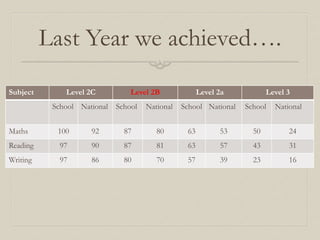
Last Year we achieved….
Last Year, we achieved….
Subject Level 2C Level 2B Level 2a Level 3
School National School National School National School National
Maths 100 92 87 80 63 53 50 24
Reading 97 90 87 81 63 57 43 31
Writing 97 86 80 70 57 39 23 16
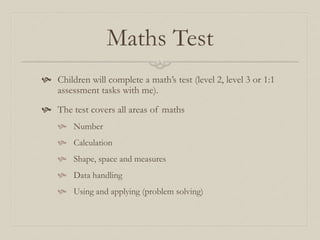
Maths Test
 Children will complete a math’s test (level 2, level 3 or 1:1
assessment tasks with me).
 The test covers all areas of maths
 Number
 Calculation
 Shape, space and measures
 Data handling
 Using and applying (problem solving)
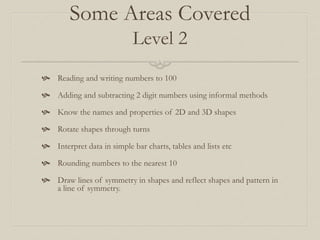
Some Areas Covered
Level 2
 Reading and writing numbers to 100
 Adding and subtracting 2 digit numbers using informal methods
 Know the names and properties of 2D and 3D shapes
 Rotate shapes through turns
 Interpret data in simple bar charts, tables and lists etc
 Rounding numbers to the nearest 10
 Draw lines of symmetry in shapes and reflect shapes and pattern in
a line of symmetry.
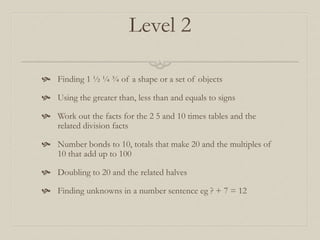
Level 2
 Finding 1 ½ ¼ ¾ of a shape or a set of objects
 Using the greater than, less than and equals to signs
 Work out the facts for the 2 5 and 10 times tables and the
related division facts
 Number bonds to 10, totals that make 20 and the multiples of
10 that add up to 100
 Doubling to 20 and the related halves
 Finding unknowns in a number sentence eg ? + 7 = 12
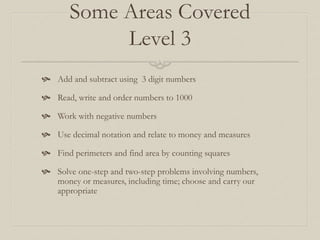
Some Areas Covered
Level 3
 Add and subtract using 3 digit numbers
 Read, write and order numbers to 1000
 Work with negative numbers
 Use decimal notation and relate to money and measures
 Find perimeters and find area by counting squares
 Solve one-step and two-step problems involving numbers,
money or measures, including time; choose and carry our
appropriate
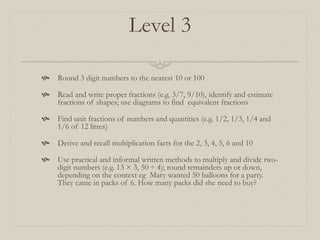
Level 3
 Round 3 digit numbers to the nearest 10 or 100
 Read and write proper fractions (e.g. 3/7, 9/10), identify and estimate
fractions of shapes; use diagrams to find equivalent fractions
 Find unit fractions of numbers and quantities (e.g. 1/2, 1/3, 1/4 and
1/6 of 12 litres)
 Derive and recall multiplication facts for the 2, 3, 4, 5, 6 and 10
 Use practical and informal written methods to multiply and divide two-
digit numbers (e.g. 13 × 3, 50 ÷ 4); round remainders up or down,
depending on the context eg Mary wanted 50 balloons for a party.
They came in packs of 6. How many packs did she need to buy?
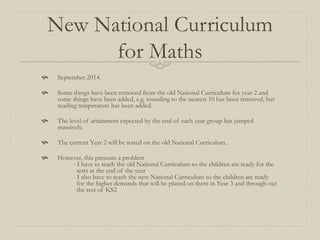
New National Curriculum
for Maths
 September 2014.
 Some things have been removed from the old National Curriculum for year 2 and
some things have been added, e.g. rounding to the nearest 10 has been removed, but
reading temperature has been added.
 The level of attainment expected by the end of each year group has jumped
massively.
 The current Year 2 will be tested on the old National Curriculum.
 However, this presents a problem
- I have to teach the old National Curriculum so the children are ready for the
tests at the end of the year
- I also have to teach the new National Curriculum so the children are ready
for the higher demands that will be placed on them in Year 3 and through out
the rest of KS2
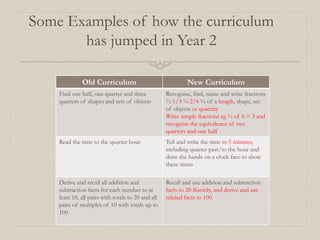
Some Examples of how the curriculum
has jumped in Year 2
Old Curriculum New Curriculum
Find one half, one quarter and three
quarters of shapes and sets of objects
Recognise, find, name and write fractions
½ 1/3 ¼ 2/4 ¾ of a length, shape, set
of objects or quantity
Write simple fractions eg ½ of 6 = 3 and
recognise the equivalence of two
quarters and one half
Read the time to the quarter hour Tell and write the time to 5 minutes,
including quarter past/to the hour and
draw the hands on a clock face to show
these times
Derive and recall all addition and
subtraction facts for each number to at
least 10, all pairs with totals to 20 and all
pairs of multiples of 10 with totals up to
100
Recall and use addition and subtraction
facts to 20 fluently, and derive and use
related facts to 100.
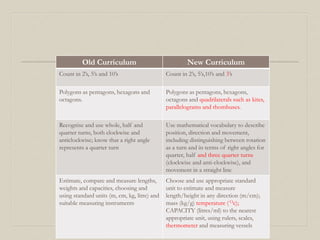
Old Curriculum New Curriculum
Count in 2’s, 5’s and 10’s Count in 2’s, 5’s,10’s and 3’s
Polygons as pentagons, hexagons and
octagons.
Polygons as pentagons, hexagons,
octagons and quadrilaterals such as kites,
parallelograms and rhombuses.
Recognise and use whole, half and
quarter turns, both clockwise and
anticlockwise; know that a right angle
represents a quarter turn
Use mathematical vocabulary to describe
position, direction and movement,
including distinguishing between rotation
as a turn and in terms of right angles for
quarter, half and three quarter turns
(clockwise and anti-clockwise), and
movement in a straight line
Estimate, compare and measure lengths,
weights and capacities, choosing and
using standard units (m, cm, kg, litre) and
suitable measuring instruments
Choose and use appropriate standard
unit to estimate and measure
length/height in any direction (m/cm);
mass (kg/g) temperature ( Oc);
CAPACITY (litres/ml) to the nearest
appropriate unit, using rulers, scales,
thermometer and measuring vessels
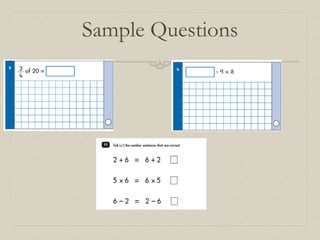
Sample Questions
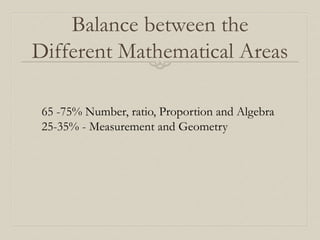
Balance between the
Different Mathematical Areas
65 -75% Number, ratio, Proportion and Algebra
25-35% - Measurement and Geometry
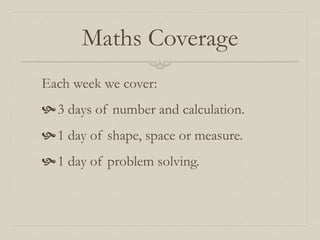
Maths Coverage
Each week we cover:
3 days of number and calculation.
1 day of shape, space or measure.
1 day of problem solving.
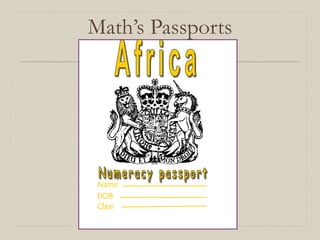
Math’s Passports
DOB
Name
Class
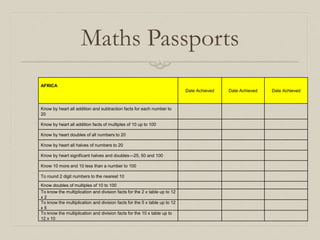
Maths Passports
AFRICA
Date Achieved Date Achieved Date Achieved
Know by heart all addition and subtraction facts for each number to
20
Know by heart all addition facts of multiples of 10 up to 100
Know by heart doubles of all numbers to 20
Know by heart all halves of numbers to 20
Know by heart significant halves and doubles—25, 50 and 100
Know 10 more and 10 less than a number to 100
To round 2 digit numbers to the nearest 10
Know doubles of multiples of 10 to 100
To know the multiplication and division facts for the 2 x table up to 12
x 2
To know the multiplication and division facts for the 5 x table up to 12
x 5
To know the multiplication and division facts for the 10 x table up to
12 x 10
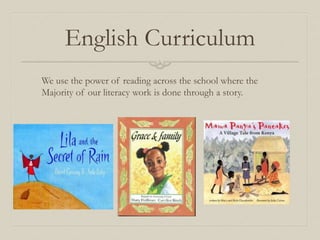
English Curriculum
We use the power of reading across the school where the
Majority of our literacy work is done through a story.
Reading
More than any other skill, the ability to read is crucial in order
to be successful and achieve.
We learn to read so that we can read to learn.
A child that reads widely and for pleasure is more likely to do
well at school than those children who do not.
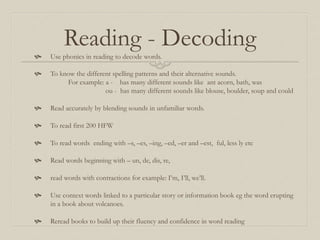
Reading - Decoding
 Use phonics in reading to decode words.
 To know the different spelling patterns and their alternative sounds.
For example: a - has many different sounds like ant acorn, bath, was
ou - has many different sounds like blouse, boulder, soup and could
 Read accurately by blending sounds in unfamiliar words.
 To read first 200 HFW
 To read words ending with –s, –es, –ing, –ed, –er and –est, ful, less ly etc
 Read words beginning with – un, de, dis, re,
 read words with contractions for example: I’m, I’ll, we’ll.
 Use context words linked to a particular story or information book eg the word erupting
in a book about volcanoes.
 Reread books to build up their fluency and confidence in word reading
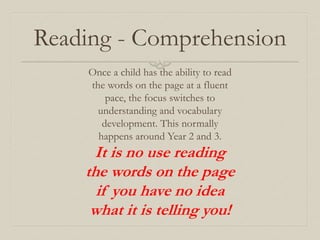
Reading - Comprehension
Once a child has the ability to read
the words on the page at a fluent
pace, the focus switches to
understanding and vocabulary
development. This normally
happens around Year 2 and 3.
It is no use reading
the words on the page
if you have no idea
what it is telling you!
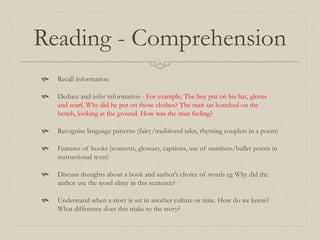
Reading - Comprehension
 Recall information
 Deduce and infer information - For example; The boy put on his hat, gloves
and scarf. Why did he put on those clothes? The man sat hunched on the
bench, looking at the ground. How was the man feeling?
 Recognise language patterns (fairy/traditional tales, rhyming couplets in a poem)
 Features of books (contents, glossary, captions, use of numbers/bullet points in
instructional texts)
 Discuss thoughts about a book and author’s choice of words eg Why did the
author use the word slimy in this sentence?
 Understand when a story is set in another culture or time. How do we know?
What difference does this make to the story?
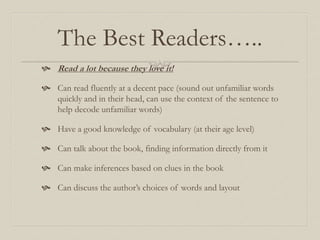
The Best Readers…..
 Read a lot because they love it!
 Can read fluently at a decent pace (sound out unfamiliar words
quickly and in their head, can use the context of the sentence to
help decode unfamiliar words)
 Have a good knowledge of vocabulary (at their age level)
 Can talk about the book, finding information directly from it
 Can make inferences based on clues in the book
 Can discuss the author’s choices of words and layout
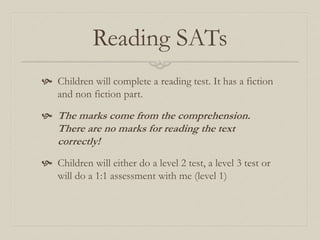
Reading SATs
 Children will complete a reading test. It has a fiction
and non fiction part.
 The marks come from the comprehension.
There are no marks for reading the text
correctly!
 Children will either do a level 2 test, a level 3 test or
will do a 1:1 assessment with me (level 1)
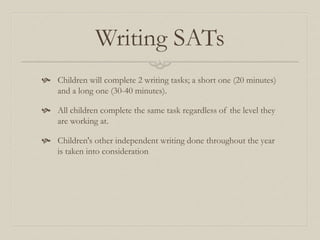
Writing SATs
 Children will complete 2 writing tasks; a short one (20 minutes)
and a long one (30-40 minutes).
 All children complete the same task regardless of the level they
are working at.
 Children's other independent writing done throughout the year
is taken into consideration
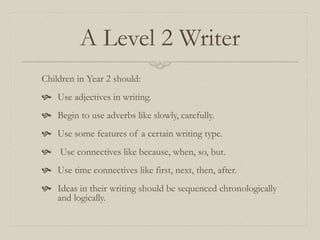
A Level 2 Writer
Children in Year 2 should:
 Use adjectives in writing.
 Begin to use adverbs like slowly, carefully.
 Use some features of a certain writing type.
 Use connectives like because, when, so, but.
 Use time connectives like first, next, then, after.
 Ideas in their writing should be sequenced chronologically
and logically.
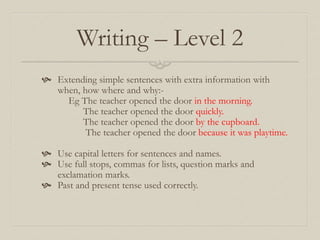
Writing – Level 2
 Extending simple sentences with extra information with
when, how where and why:-
Eg The teacher opened the door in the morning.
The teacher opened the door quickly.
The teacher opened the door by the cupboard.
The teacher opened the door because it was playtime.
 Use capital letters for sentences and names.
 Use full stops, commas for lists, question marks and
exclamation marks.
 Past and present tense used correctly.
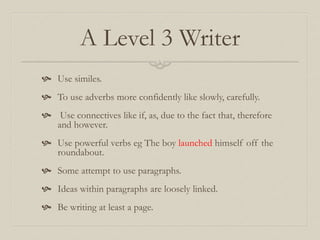
A Level 3 Writer
 Use similes.
 To use adverbs more confidently like slowly, carefully.
 Use connectives like if, as, due to the fact that, therefore
and however.
 Use powerful verbs eg The boy launched himself off the
roundabout.
 Some attempt to use paragraphs.
 Ideas within paragraphs are loosely linked.
 Be writing at least a page.
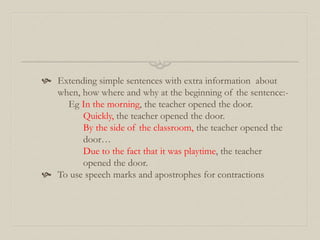
 Extending simple sentences with extra information about
when, how where and why at the beginning of the sentence:-
Eg In the morning, the teacher opened the door.
Quickly, the teacher opened the door.
By the side of the classroom, the teacher opened the
door…
Due to the fact that it was playtime, the teacher
opened the door.
 To use speech marks and apostrophes for contractions
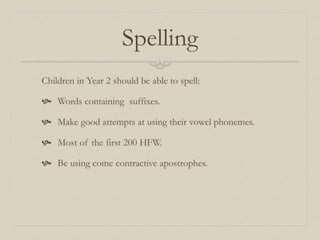
Spelling
Children in Year 2 should be able to spell:
 Words containing suffixes.
 Make good attempts at using their vowel phonemes.
 Most of the first 200 HFW.
 Be using come contractive apostrophes.
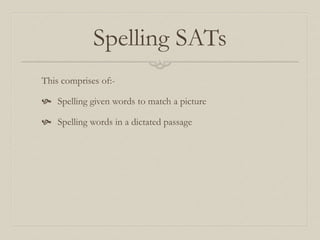
Spelling SATs
This comprises of:-
 Spelling given words to match a picture
 Spelling words in a dictated passage
Science SATs
 Children do not complete a science test.
 Each half term we learn about a different area of science.
 Physical process (electricity, forces)
 Environment and living process (plants, humans, animals)
 Materials
 At the end of he year a level is given for each area
Speaking and Listening -
SATs
Your child will be assessed on going through the year and will be given a level 1,2 or
3.
They need to show
 Confidence to speak in different situations in a clear voice
 Use Standard English
 An understanding of what has been said and be able repeat back
 An ability to explain and talk about their thinking
 Give instructions
 A developing range of vocabulary
Key Information
 Homework- We have started using a new homework book from last week. The
homework given will be to consolidate learning throughout the week. It is
handed out on a Friday and needs to be completed and handed in by
Wednesday. It is usually Maths based due the extra demands of the new
National Curriculum .
 Spellings – These are put in the children’s contact books. They consolidate the
spelling patterns covered in school during the week. They are tested every
Friday
 Reading – Books are changed on a Tuesday and a Friday. Their banded level
is based on their ability to read and comprehend the books read. Judgments are
based on my “Guided Reading” sessions with the children and tests.
 Some children are still learning Key Words. These are normally tested on a
Friday.
 Number bonds are tested Wednesday. When they know their addition and
subtraction bonds fluently to 20, they move onto their multiplication facts.
Helping Your Child at Home
Reading
 National Literacy Trust research – parents are the
most important reading role models for their
children. 71% of young people say their mothers are
the most important role model for reading and 62%
say their fathers.
Read to them
Read with them
Enjoy reading!
But Remember
Comprehension! Comprehension!
Supporting your child
Helping Your Child at Home
Writing
 Helping write shopping lists
 Thank you letters
 Party invitations
 Finding out about things that interest them
Helping Your Child at Home
Maths
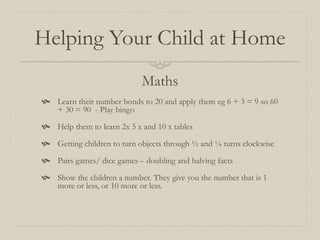
 Learn their number bonds to 20 and apply them eg 6 + 3 = 9 so 60
+ 30 = 90 - Play bingo
 Help them to learn 2x 5 x and 10 x tables
 Getting children to turn objects through ½ and ¼ turns clockwise
 Pairs games/ dice games – doubling and halving facts
 Show the children a number. They give you the number that is 1
more or less, or 10 more or less.
Helping Your Child at Home
Maths
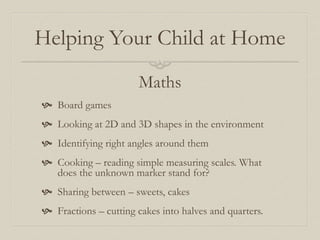
 Board games
 Looking at 2D and 3D shapes in the environment
 Identifying right angles around them
 Cooking – reading simple measuring scales. What
does the unknown marker stand for?
 Sharing between – sweets, cakes
 Fractions – cutting cakes into halves and quarters.
Helping Your Child at Home
Maths
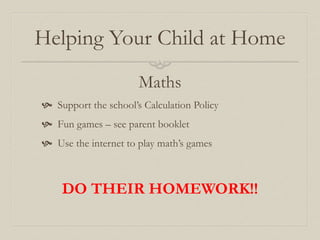
 Support the school’s Calculation Policy
 Fun games – see parent booklet
 Use the internet to play math’s games
DO THEIR HOMEWORK!!
Helping Your Child at Home
Maths
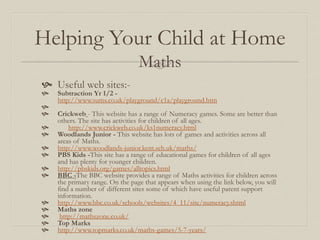
 Useful web sites:-
 Subtraction Yr 1/2 -
http://www.sums.co.uk/playground/c1a/playground.htm

 Crickweb - This website has a range of Numeracy games. Some are better than
others. The site has activities for children of all ages.
 http://www.crickweb.co.uk/ks1numeracy.html
 Woodlands Junior - This website has lots of games and activities across all
areas of Maths.
 http://www.woodlands-junior.kent.sch.uk/maths/
 PBS Kids -This site has a range of educational games for children of all ages
and has plenty for younger children.
 http://pbskids.org/games/alltopics.html
 BBC -The BBC website provides a range of Maths activities for children across
the primary range. On the page that appears when using the link below, you will
find a number of different sites some of which have useful parent support
information.
 http://www.bbc.co.uk/schools/websites/4_11/site/numeracy.shtml
 Maths zone
 http://mathszone.co.uk/
 Top Marks
 http://www.topmarks.co.uk/maths-games/5-7-years/

Year 2 information

  • 1.
  • 2.
    What are SATs? SAT’s are Statutory Assessment Test’s  All year 2 children have to complete SAT’s to give a level of attainment they have reached at the end of their infant education.  They are given a level in Reading, Writing, Maths, Science and Speaking and Listening  These levels are reported to the Local Authority and are used in school to set a target for the end of year 6.
  • 3.
     Your child’slevel must be reported by July. We can do the test’s at any time in the year but normally they are done in last half term of the year (beginning of June).  The test’s are done in the classroom and are marked in school by myself.  The test score is not the ‘be all and end all’ I can give a level based on all of the evidence of your child’s ability. For example; class work, other independent work, 1:1 assessments.
  • 4.
    End of YearExpectations SATs  An child working at age appropriate levels should achieve a level 2B at the end of year 2 3b Above expected 3c 2a Expected 2b 2c Below expected 1a 1b Well below expected 1c
  • 5.
    Last Year weachieved…. Last Year, we achieved…. Subject Level 2C Level 2B Level 2a Level 3 School National School National School National School National Maths 100 92 87 80 63 53 50 24 Reading 97 90 87 81 63 57 43 31 Writing 97 86 80 70 57 39 23 16
  • 6.
    Maths Test  Childrenwill complete a math’s test (level 2, level 3 or 1:1 assessment tasks with me).  The test covers all areas of maths  Number  Calculation  Shape, space and measures  Data handling  Using and applying (problem solving)
  • 7.
    Some Areas Covered Level2  Reading and writing numbers to 100  Adding and subtracting 2 digit numbers using informal methods  Know the names and properties of 2D and 3D shapes  Rotate shapes through turns  Interpret data in simple bar charts, tables and lists etc  Rounding numbers to the nearest 10  Draw lines of symmetry in shapes and reflect shapes and pattern in a line of symmetry.
  • 8.
    Level 2  Finding1 ½ ¼ ¾ of a shape or a set of objects  Using the greater than, less than and equals to signs  Work out the facts for the 2 5 and 10 times tables and the related division facts  Number bonds to 10, totals that make 20 and the multiples of 10 that add up to 100  Doubling to 20 and the related halves  Finding unknowns in a number sentence eg ? + 7 = 12
  • 9.
    Some Areas Covered Level3  Add and subtract using 3 digit numbers  Read, write and order numbers to 1000  Work with negative numbers  Use decimal notation and relate to money and measures  Find perimeters and find area by counting squares  Solve one-step and two-step problems involving numbers, money or measures, including time; choose and carry our appropriate
  • 10.
    Level 3  Round3 digit numbers to the nearest 10 or 100  Read and write proper fractions (e.g. 3/7, 9/10), identify and estimate fractions of shapes; use diagrams to find equivalent fractions  Find unit fractions of numbers and quantities (e.g. 1/2, 1/3, 1/4 and 1/6 of 12 litres)  Derive and recall multiplication facts for the 2, 3, 4, 5, 6 and 10  Use practical and informal written methods to multiply and divide two- digit numbers (e.g. 13 × 3, 50 ÷ 4); round remainders up or down, depending on the context eg Mary wanted 50 balloons for a party. They came in packs of 6. How many packs did she need to buy?
  • 11.
    New National Curriculum forMaths  September 2014.  Some things have been removed from the old National Curriculum for year 2 and some things have been added, e.g. rounding to the nearest 10 has been removed, but reading temperature has been added.  The level of attainment expected by the end of each year group has jumped massively.  The current Year 2 will be tested on the old National Curriculum.  However, this presents a problem - I have to teach the old National Curriculum so the children are ready for the tests at the end of the year - I also have to teach the new National Curriculum so the children are ready for the higher demands that will be placed on them in Year 3 and through out the rest of KS2
  • 12.
    Some Examples ofhow the curriculum has jumped in Year 2 Old Curriculum New Curriculum Find one half, one quarter and three quarters of shapes and sets of objects Recognise, find, name and write fractions ½ 1/3 ¼ 2/4 ¾ of a length, shape, set of objects or quantity Write simple fractions eg ½ of 6 = 3 and recognise the equivalence of two quarters and one half Read the time to the quarter hour Tell and write the time to 5 minutes, including quarter past/to the hour and draw the hands on a clock face to show these times Derive and recall all addition and subtraction facts for each number to at least 10, all pairs with totals to 20 and all pairs of multiples of 10 with totals up to 100 Recall and use addition and subtraction facts to 20 fluently, and derive and use related facts to 100.
  • 13.
    Old Curriculum NewCurriculum Count in 2’s, 5’s and 10’s Count in 2’s, 5’s,10’s and 3’s Polygons as pentagons, hexagons and octagons. Polygons as pentagons, hexagons, octagons and quadrilaterals such as kites, parallelograms and rhombuses. Recognise and use whole, half and quarter turns, both clockwise and anticlockwise; know that a right angle represents a quarter turn Use mathematical vocabulary to describe position, direction and movement, including distinguishing between rotation as a turn and in terms of right angles for quarter, half and three quarter turns (clockwise and anti-clockwise), and movement in a straight line Estimate, compare and measure lengths, weights and capacities, choosing and using standard units (m, cm, kg, litre) and suitable measuring instruments Choose and use appropriate standard unit to estimate and measure length/height in any direction (m/cm); mass (kg/g) temperature ( Oc); CAPACITY (litres/ml) to the nearest appropriate unit, using rulers, scales, thermometer and measuring vessels
  • 14.
  • 15.
    Balance between the DifferentMathematical Areas 65 -75% Number, ratio, Proportion and Algebra 25-35% - Measurement and Geometry
  • 16.
    Maths Coverage Each weekwe cover: 3 days of number and calculation. 1 day of shape, space or measure. 1 day of problem solving.
  • 17.
  • 18.
    Maths Passports AFRICA Date AchievedDate Achieved Date Achieved Know by heart all addition and subtraction facts for each number to 20 Know by heart all addition facts of multiples of 10 up to 100 Know by heart doubles of all numbers to 20 Know by heart all halves of numbers to 20 Know by heart significant halves and doubles—25, 50 and 100 Know 10 more and 10 less than a number to 100 To round 2 digit numbers to the nearest 10 Know doubles of multiples of 10 to 100 To know the multiplication and division facts for the 2 x table up to 12 x 2 To know the multiplication and division facts for the 5 x table up to 12 x 5 To know the multiplication and division facts for the 10 x table up to 12 x 10
  • 19.
    English Curriculum We usethe power of reading across the school where the Majority of our literacy work is done through a story.
  • 20.
    Reading More than anyother skill, the ability to read is crucial in order to be successful and achieve. We learn to read so that we can read to learn. A child that reads widely and for pleasure is more likely to do well at school than those children who do not.
  • 21.
    Reading - Decoding Use phonics in reading to decode words.  To know the different spelling patterns and their alternative sounds. For example: a - has many different sounds like ant acorn, bath, was ou - has many different sounds like blouse, boulder, soup and could  Read accurately by blending sounds in unfamiliar words.  To read first 200 HFW  To read words ending with –s, –es, –ing, –ed, –er and –est, ful, less ly etc  Read words beginning with – un, de, dis, re,  read words with contractions for example: I’m, I’ll, we’ll.  Use context words linked to a particular story or information book eg the word erupting in a book about volcanoes.  Reread books to build up their fluency and confidence in word reading
  • 22.
    Reading - Comprehension Oncea child has the ability to read the words on the page at a fluent pace, the focus switches to understanding and vocabulary development. This normally happens around Year 2 and 3. It is no use reading the words on the page if you have no idea what it is telling you!
  • 23.
    Reading - Comprehension Recall information  Deduce and infer information - For example; The boy put on his hat, gloves and scarf. Why did he put on those clothes? The man sat hunched on the bench, looking at the ground. How was the man feeling?  Recognise language patterns (fairy/traditional tales, rhyming couplets in a poem)  Features of books (contents, glossary, captions, use of numbers/bullet points in instructional texts)  Discuss thoughts about a book and author’s choice of words eg Why did the author use the word slimy in this sentence?  Understand when a story is set in another culture or time. How do we know? What difference does this make to the story?
  • 24.
    The Best Readers….. Read a lot because they love it!  Can read fluently at a decent pace (sound out unfamiliar words quickly and in their head, can use the context of the sentence to help decode unfamiliar words)  Have a good knowledge of vocabulary (at their age level)  Can talk about the book, finding information directly from it  Can make inferences based on clues in the book  Can discuss the author’s choices of words and layout
  • 25.
    Reading SATs  Childrenwill complete a reading test. It has a fiction and non fiction part.  The marks come from the comprehension. There are no marks for reading the text correctly!  Children will either do a level 2 test, a level 3 test or will do a 1:1 assessment with me (level 1)
  • 26.
    Writing SATs  Childrenwill complete 2 writing tasks; a short one (20 minutes) and a long one (30-40 minutes).  All children complete the same task regardless of the level they are working at.  Children's other independent writing done throughout the year is taken into consideration
  • 27.
    A Level 2Writer Children in Year 2 should:  Use adjectives in writing.  Begin to use adverbs like slowly, carefully.  Use some features of a certain writing type.  Use connectives like because, when, so, but.  Use time connectives like first, next, then, after.  Ideas in their writing should be sequenced chronologically and logically.
  • 28.
    Writing – Level2  Extending simple sentences with extra information with when, how where and why:- Eg The teacher opened the door in the morning. The teacher opened the door quickly. The teacher opened the door by the cupboard. The teacher opened the door because it was playtime.  Use capital letters for sentences and names.  Use full stops, commas for lists, question marks and exclamation marks.  Past and present tense used correctly.
  • 29.
    A Level 3Writer  Use similes.  To use adverbs more confidently like slowly, carefully.  Use connectives like if, as, due to the fact that, therefore and however.  Use powerful verbs eg The boy launched himself off the roundabout.  Some attempt to use paragraphs.  Ideas within paragraphs are loosely linked.  Be writing at least a page.
  • 30.
     Extending simplesentences with extra information about when, how where and why at the beginning of the sentence:- Eg In the morning, the teacher opened the door. Quickly, the teacher opened the door. By the side of the classroom, the teacher opened the door… Due to the fact that it was playtime, the teacher opened the door.  To use speech marks and apostrophes for contractions
  • 31.
    Spelling Children in Year2 should be able to spell:  Words containing suffixes.  Make good attempts at using their vowel phonemes.  Most of the first 200 HFW.  Be using come contractive apostrophes.
  • 32.
    Spelling SATs This comprisesof:-  Spelling given words to match a picture  Spelling words in a dictated passage
  • 33.
    Science SATs  Childrendo not complete a science test.  Each half term we learn about a different area of science.  Physical process (electricity, forces)  Environment and living process (plants, humans, animals)  Materials  At the end of he year a level is given for each area
  • 34.
    Speaking and Listening- SATs Your child will be assessed on going through the year and will be given a level 1,2 or 3. They need to show  Confidence to speak in different situations in a clear voice  Use Standard English  An understanding of what has been said and be able repeat back  An ability to explain and talk about their thinking  Give instructions  A developing range of vocabulary
  • 35.
    Key Information  Homework-We have started using a new homework book from last week. The homework given will be to consolidate learning throughout the week. It is handed out on a Friday and needs to be completed and handed in by Wednesday. It is usually Maths based due the extra demands of the new National Curriculum .  Spellings – These are put in the children’s contact books. They consolidate the spelling patterns covered in school during the week. They are tested every Friday  Reading – Books are changed on a Tuesday and a Friday. Their banded level is based on their ability to read and comprehend the books read. Judgments are based on my “Guided Reading” sessions with the children and tests.  Some children are still learning Key Words. These are normally tested on a Friday.  Number bonds are tested Wednesday. When they know their addition and subtraction bonds fluently to 20, they move onto their multiplication facts.
  • 36.
    Helping Your Childat Home Reading  National Literacy Trust research – parents are the most important reading role models for their children. 71% of young people say their mothers are the most important role model for reading and 62% say their fathers.
  • 37.
    Read to them Readwith them Enjoy reading! But Remember Comprehension! Comprehension! Supporting your child
  • 38.
    Helping Your Childat Home Writing  Helping write shopping lists  Thank you letters  Party invitations  Finding out about things that interest them
  • 39.
    Helping Your Childat Home Maths  Learn their number bonds to 20 and apply them eg 6 + 3 = 9 so 60 + 30 = 90 - Play bingo  Help them to learn 2x 5 x and 10 x tables  Getting children to turn objects through ½ and ¼ turns clockwise  Pairs games/ dice games – doubling and halving facts  Show the children a number. They give you the number that is 1 more or less, or 10 more or less.
  • 40.
    Helping Your Childat Home Maths  Board games  Looking at 2D and 3D shapes in the environment  Identifying right angles around them  Cooking – reading simple measuring scales. What does the unknown marker stand for?  Sharing between – sweets, cakes  Fractions – cutting cakes into halves and quarters.
  • 41.
    Helping Your Childat Home Maths  Support the school’s Calculation Policy  Fun games – see parent booklet  Use the internet to play math’s games DO THEIR HOMEWORK!!
  • 42.
    Helping Your Childat Home Maths  Useful web sites:-  Subtraction Yr 1/2 - http://www.sums.co.uk/playground/c1a/playground.htm   Crickweb - This website has a range of Numeracy games. Some are better than others. The site has activities for children of all ages.  http://www.crickweb.co.uk/ks1numeracy.html  Woodlands Junior - This website has lots of games and activities across all areas of Maths.  http://www.woodlands-junior.kent.sch.uk/maths/  PBS Kids -This site has a range of educational games for children of all ages and has plenty for younger children.  http://pbskids.org/games/alltopics.html  BBC -The BBC website provides a range of Maths activities for children across the primary range. On the page that appears when using the link below, you will find a number of different sites some of which have useful parent support information.  http://www.bbc.co.uk/schools/websites/4_11/site/numeracy.shtml  Maths zone  http://mathszone.co.uk/  Top Marks  http://www.topmarks.co.uk/maths-games/5-7-years/