APPROACHES TO READING

• Reading is the language skill which is
  easiest to keep up.
• Books open up other worlds to young
  children, and making reading an enjoyable
  activity is a very important part of the
  language learning experience.
APPROACHES TO READING
 From five to ten children are in the process of
  learning to read in their own language.
 There are some differences between children whose
  mother tongue is not written in the Roman alphabet
  (Japanese). They have more stages to go through
  when learning to read in English.
PHONICS
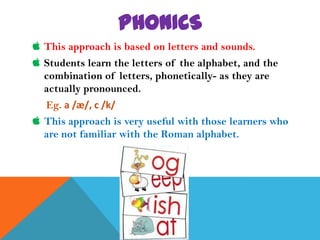
 This approach is based on letters and sounds.
 Students learn the letters of the alphabet, and the
  combination of letters, phonetically- as they are
  actually pronounced.
   Eg. a /æ/, c /k/
 This approach is very useful with those learners who
  are not familiar with the Roman alphabet.
LOOK AND SAY
 This approach is based on words and phrases, and makes
  a lot of use of flashcards.
    A book            My book           The blackboard
 It is usual to teach everyday words which are already
  familiar to the children.
 The teacher shows the children the word and says it
  while pointing to the object. The children repeat the
  word. This happens several times with each word.
 The introduction of the words takes only a short
  time, and goes quite quickly, so the teacher spends five
  minutes of a thirty minute lesson on four new words.
WORD RECOGNITION GAMES
 Matching words and pictures
 Pointing to the object on the card
 Guessing which card Teddy has picked out of the hat.


This approach encourages recognition of a range of
words and phrases before ‘reading’ a text.
WHOLE SENTENCE READING
 The teacher teaches recognition of whole phrases and
  sentences which have meaning in themselves.
 A story which the children read for the first time themselves
  after the whole text is familiar to them.
 The words are not presented in isolation, but as whole phrases
  or sentences.
 Reading for meaning should be encourage as soon as possible.
LANGUAGE EXPERIENCE APPROACH
 This approach is based on the child’s spoken language. The
  teacher writes down a sentence for the child to read which is
  based on what the child has said.
   This is me.
    My sister is nine. She is in class 3F.
     This a postcard from my uncle in Milan.
WHICH METHOD TO CHOOSE?
 It’s recommendable an approach which concentrates on
  meaning from the beginning.
 However if your learners have a mother tongue which is not
  based on the Roman script, you will have to spend quite some
  time teaching phonics and word recognition first.
 No matter which approach to reading you choose, you need to
  remember that there’s no the perfect one.
 You will probably use more than one depending on which
  stage of the process of learning to read you are.
FIVE TO SEVEN YEAR OLDS
 Children at this age take longer to learn to read in a foreign
  language than eight to ten year olds.
 They have to go through the process of doing reading-like
  activities first – ‘reading’ from left to right, turning the pages
  at the right place, going back and reading the same pages
  again, etc.
 Picture books with and without text are very useful at this
  stage.
FIVE TO SEVEN YEAR OLDS
 If they have not learnt to read in their own language, many
  will not yet have understood what a word is, nor what the
  connection is between the spoken and the written word.
 Sentence structure, paragraphing, grammar- none of this
  means anything to most pupils at this stage.
 Decoding reading – making sense of what we see on the page
  of clues on the written page – punctuation, paragraphing, use
  of special words, references to things which have
  happened, hints as to what can happen. What five to seven year
  olds have instead is often a visual clue and this clue is vital to
  meaning.
EIGHT TO TEN YEAR OLDS BEGINNERS
 Most of eight to ten year olds will be able to read a bit in
  their own language and most seem to have little difficulty in
  transferring their reading skills to English.
 You can spend less time teaching the mechanics of reading
  and concentrate more on the content.
 Children whose mother tongue is not based on the Roman
  alphabet will take more time on the mechanics of reading, but
  they know what reading is about, and this speeds up the
  process.
STARTING OFF
• Example of a class of six year olds who have English for three
  short lessons a week.
• We’ll see four starting points:
 Reading a story from a book
 Reading a class story
 Reading texts based on the child’s language
 Reading familiar nursery rhymes or songs
READING A STORY FROM A BOOK
a) Create a routine for story reading.
b) Read the book so that all the students can see it, and point to
   the words as you read them. So that your pupils can get the
   connection between the spoken and written word. Read at
   normal speed the first time, keeping your intonation correct.
c) Let pupils point and ask questions if they want to, but not so
   much that interrupts the flow of the story.
d) Encourage the students to talk about the story. Ask them
   questions in their own language.
e) Leave the book in the book corner. Tell them they can read on
   their own if they want to.
READING A STORY FROM A BOOK
f)   The next week, read the story again. Let them give you some of
     the words.
g)   Give all the pupils their own copy if possible and tell them to
     follow it while you read to them. Encourage them to point to the
     words as you read, but don’t slow down.
h)   If they are point to the wrong words, sit with them and point
     with them.
i)   Let them read the book silently for themselves.
j)   Tell them they can read the book whenever they have time. Go
     back to it from time to time and read it with the whole class.
     Pupils don’t usually get tired of good stories.
READING A CLASS STORY
Reading
Reading

Reading

  • 2.
    APPROACHES TO READING •Reading is the language skill which is easiest to keep up. • Books open up other worlds to young children, and making reading an enjoyable activity is a very important part of the language learning experience.
  • 3.
    APPROACHES TO READING From five to ten children are in the process of learning to read in their own language.  There are some differences between children whose mother tongue is not written in the Roman alphabet (Japanese). They have more stages to go through when learning to read in English.
  • 4.
    PHONICS  This approachis based on letters and sounds.  Students learn the letters of the alphabet, and the combination of letters, phonetically- as they are actually pronounced. Eg. a /æ/, c /k/  This approach is very useful with those learners who are not familiar with the Roman alphabet.
  • 5.
    LOOK AND SAY This approach is based on words and phrases, and makes a lot of use of flashcards. A book My book The blackboard  It is usual to teach everyday words which are already familiar to the children.  The teacher shows the children the word and says it while pointing to the object. The children repeat the word. This happens several times with each word.  The introduction of the words takes only a short time, and goes quite quickly, so the teacher spends five minutes of a thirty minute lesson on four new words.
  • 6.
    WORD RECOGNITION GAMES Matching words and pictures  Pointing to the object on the card  Guessing which card Teddy has picked out of the hat. This approach encourages recognition of a range of words and phrases before ‘reading’ a text.
  • 7.
    WHOLE SENTENCE READING The teacher teaches recognition of whole phrases and sentences which have meaning in themselves.  A story which the children read for the first time themselves after the whole text is familiar to them.  The words are not presented in isolation, but as whole phrases or sentences.  Reading for meaning should be encourage as soon as possible.
  • 8.
    LANGUAGE EXPERIENCE APPROACH This approach is based on the child’s spoken language. The teacher writes down a sentence for the child to read which is based on what the child has said. This is me. My sister is nine. She is in class 3F. This a postcard from my uncle in Milan.
  • 9.
    WHICH METHOD TOCHOOSE?  It’s recommendable an approach which concentrates on meaning from the beginning.  However if your learners have a mother tongue which is not based on the Roman script, you will have to spend quite some time teaching phonics and word recognition first.  No matter which approach to reading you choose, you need to remember that there’s no the perfect one.  You will probably use more than one depending on which stage of the process of learning to read you are.
  • 10.
    FIVE TO SEVENYEAR OLDS  Children at this age take longer to learn to read in a foreign language than eight to ten year olds.  They have to go through the process of doing reading-like activities first – ‘reading’ from left to right, turning the pages at the right place, going back and reading the same pages again, etc.  Picture books with and without text are very useful at this stage.
  • 11.
    FIVE TO SEVENYEAR OLDS  If they have not learnt to read in their own language, many will not yet have understood what a word is, nor what the connection is between the spoken and the written word.  Sentence structure, paragraphing, grammar- none of this means anything to most pupils at this stage.  Decoding reading – making sense of what we see on the page of clues on the written page – punctuation, paragraphing, use of special words, references to things which have happened, hints as to what can happen. What five to seven year olds have instead is often a visual clue and this clue is vital to meaning.
  • 12.
    EIGHT TO TENYEAR OLDS BEGINNERS  Most of eight to ten year olds will be able to read a bit in their own language and most seem to have little difficulty in transferring their reading skills to English.  You can spend less time teaching the mechanics of reading and concentrate more on the content.  Children whose mother tongue is not based on the Roman alphabet will take more time on the mechanics of reading, but they know what reading is about, and this speeds up the process.
  • 13.
    STARTING OFF • Exampleof a class of six year olds who have English for three short lessons a week. • We’ll see four starting points:  Reading a story from a book  Reading a class story  Reading texts based on the child’s language  Reading familiar nursery rhymes or songs
  • 14.
    READING A STORYFROM A BOOK a) Create a routine for story reading. b) Read the book so that all the students can see it, and point to the words as you read them. So that your pupils can get the connection between the spoken and written word. Read at normal speed the first time, keeping your intonation correct. c) Let pupils point and ask questions if they want to, but not so much that interrupts the flow of the story. d) Encourage the students to talk about the story. Ask them questions in their own language. e) Leave the book in the book corner. Tell them they can read on their own if they want to.
  • 15.
    READING A STORYFROM A BOOK f) The next week, read the story again. Let them give you some of the words. g) Give all the pupils their own copy if possible and tell them to follow it while you read to them. Encourage them to point to the words as you read, but don’t slow down. h) If they are point to the wrong words, sit with them and point with them. i) Let them read the book silently for themselves. j) Tell them they can read the book whenever they have time. Go back to it from time to time and read it with the whole class. Pupils don’t usually get tired of good stories.
  • 16.