CURRICULU
M
ASSESSMENT INSTURCTION
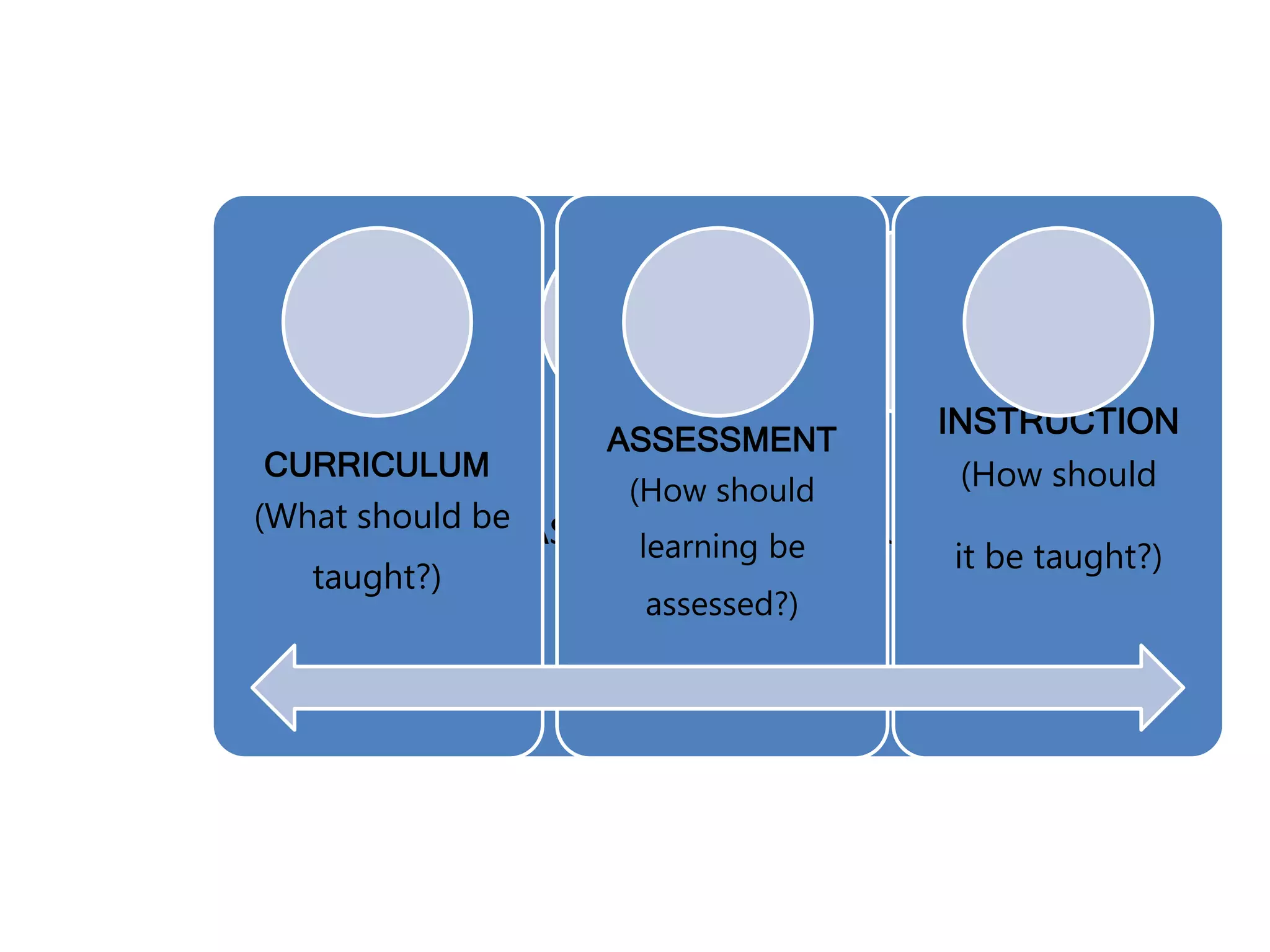
CURRICULUM
(What should be
taught?)
ASSESSMENT
(How should
learning be
assessed?)
INSTRUCTION
(How should
it be taught?)
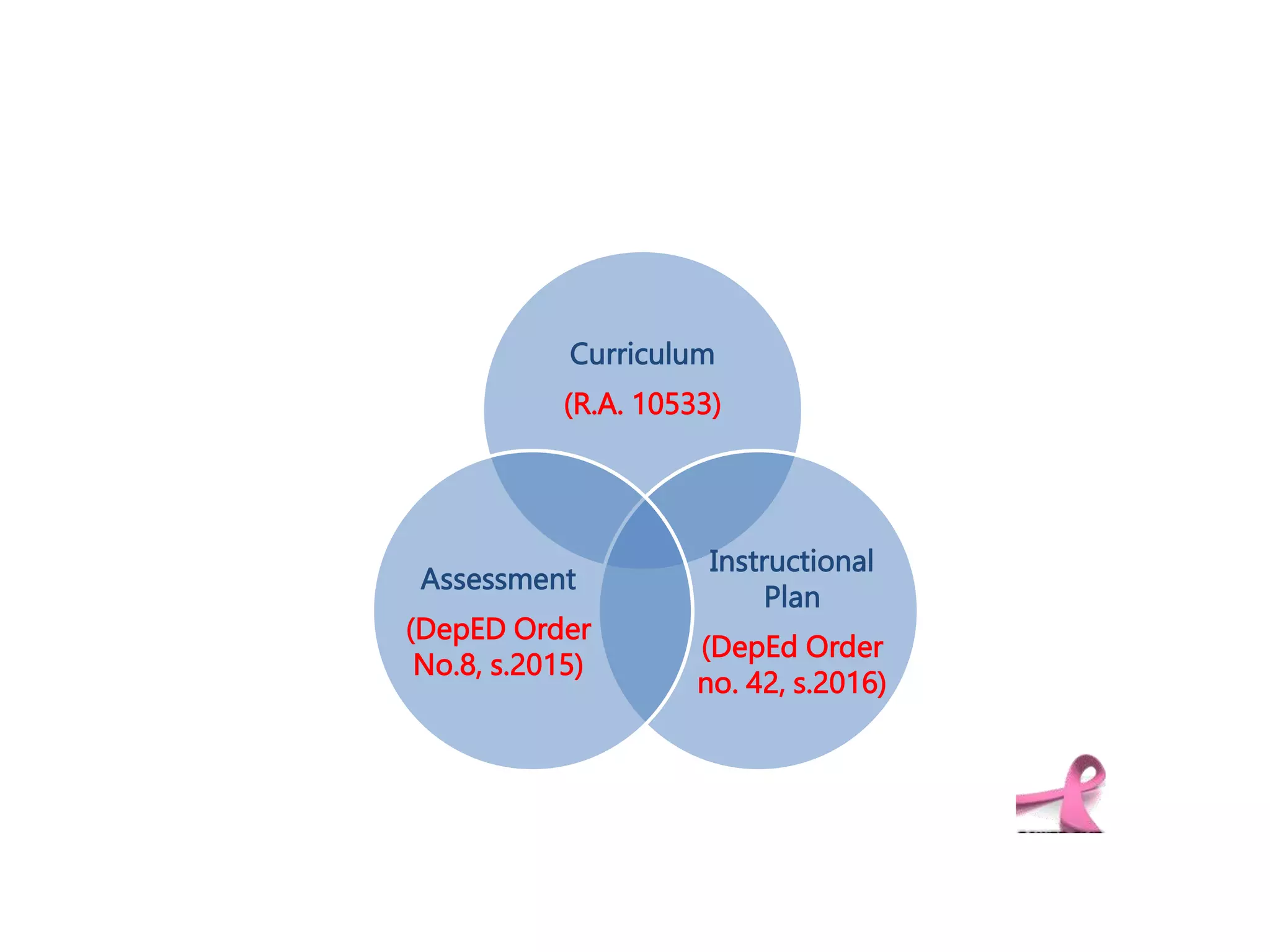
Curriculum
(R.A. 10533)
Instructional
Plan
(DepEd Order
no. 42, s.2016)
Assessment
(DepED Order
No.8, s.2015)
DIFFERENTIATED
INSTRUCTION
CRISTINA S. CHIOCO
Education Program Specialist II
SDO- Nueva Ecija
Objectives:
At the end of the session, the
participant will be able to:
1. discuss the basic principles of
Differentiated Instruction;
Objectives:
2. Identify activities suited to each
component of D.I.– content, process,
product, environment;
3. Identify activities that respond to
learners’ needs—readiness, interest,
learning profile;
ACTIVITY: Fact or Bluff
• Choose your TEAM LEADER and
RECORDER.
• Discuss within your group if each
statement is FACT OR BLUFF. Arrive at a
consensus.
• At a given signal, the team will stand if
their answer is FACT. They will remain
seated if their response is BLUFF.
• The Team Leader must be ready to justify
the group’s answer in 1 minute.
FACT OR BLUFF
DIFFERENTIATED INSTRUCTION is:
1. Group work
2. Individualization
3. Stand and deliver
4. Covering the content
5. Related to competencies
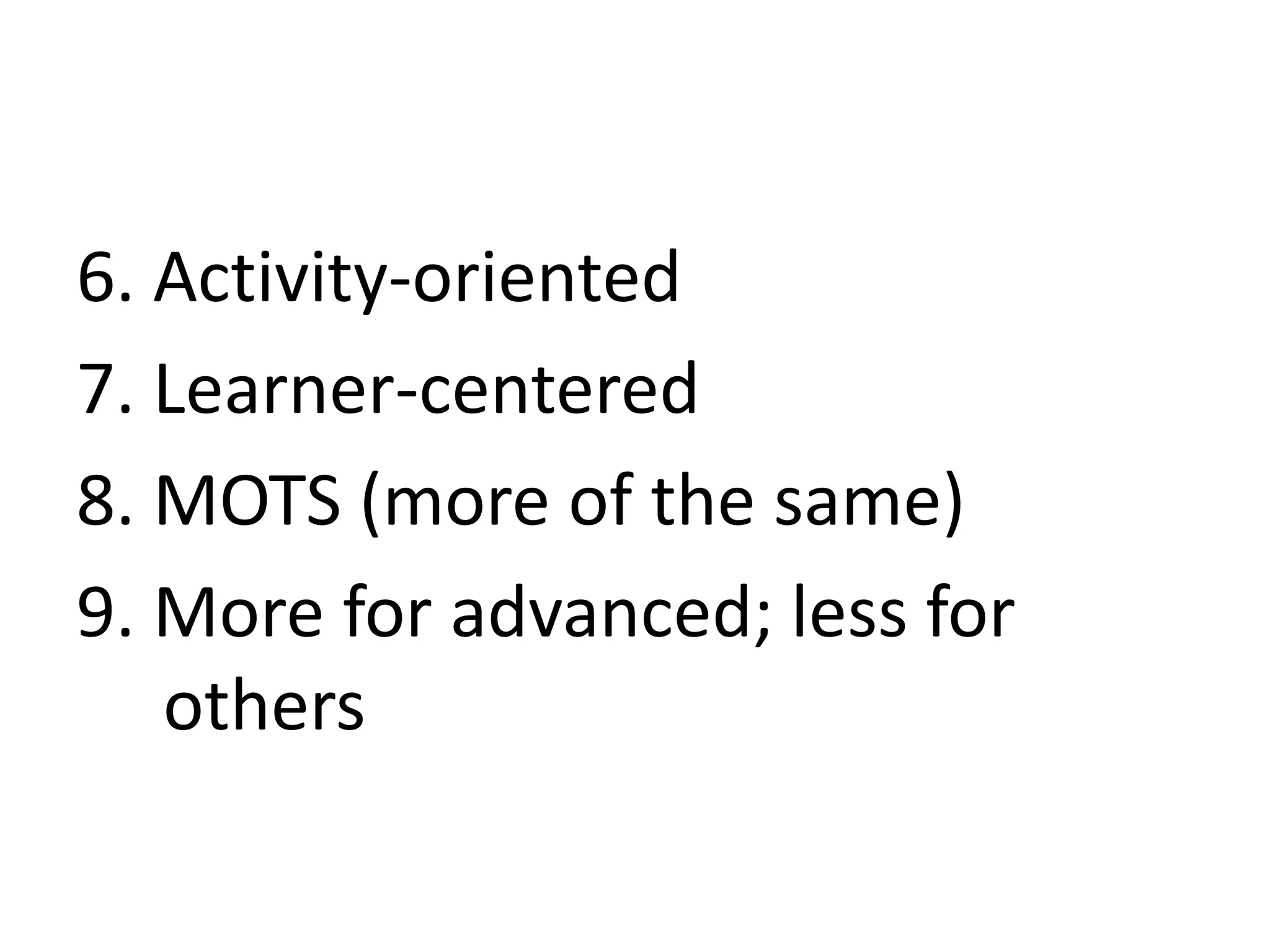
6. Activity-oriented
7. Learner-centered
8. MOTS (more of the same)
9. More for advanced; less for
others
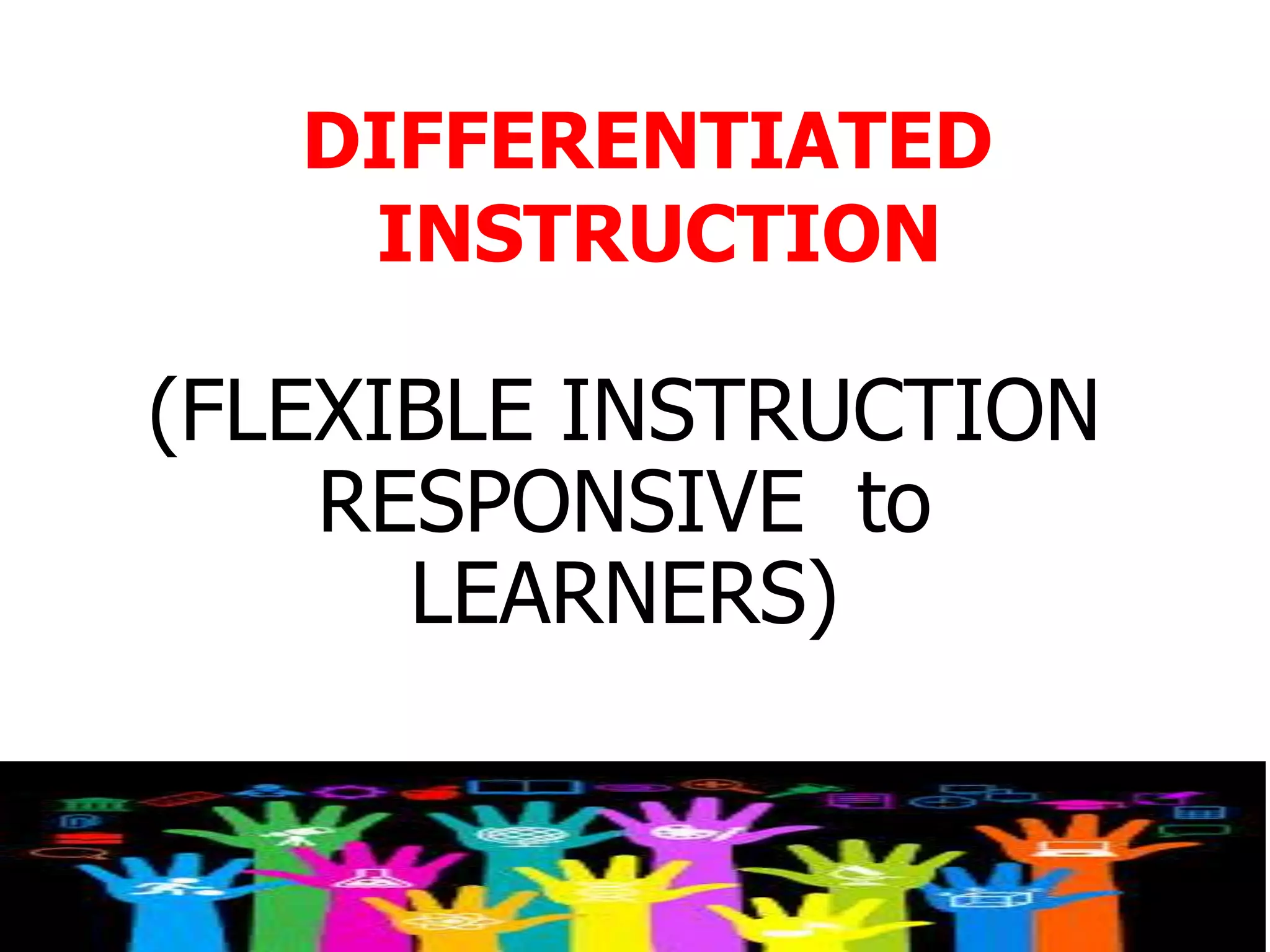
(FLEXIBLE INSTRUCTION
RESPONSIVE to
LEARNERS)
DIFFERENTIATED
INSTRUCTION
FOR A BIT OF HISTORY…
1985- “Differential Education” for
gifted & talented invented by Virgil
Ward (U of Virginia)
1995 popularized by Carol Ann
Tomlinson (U of Virginia)
The ‘SPIRIT’ of Differentiated
Teaching for Learning
• In teaching, what ultimately
matters is NOT what is taught, but
what is learned;
• If the students have not learned,
the teacher has not taught.
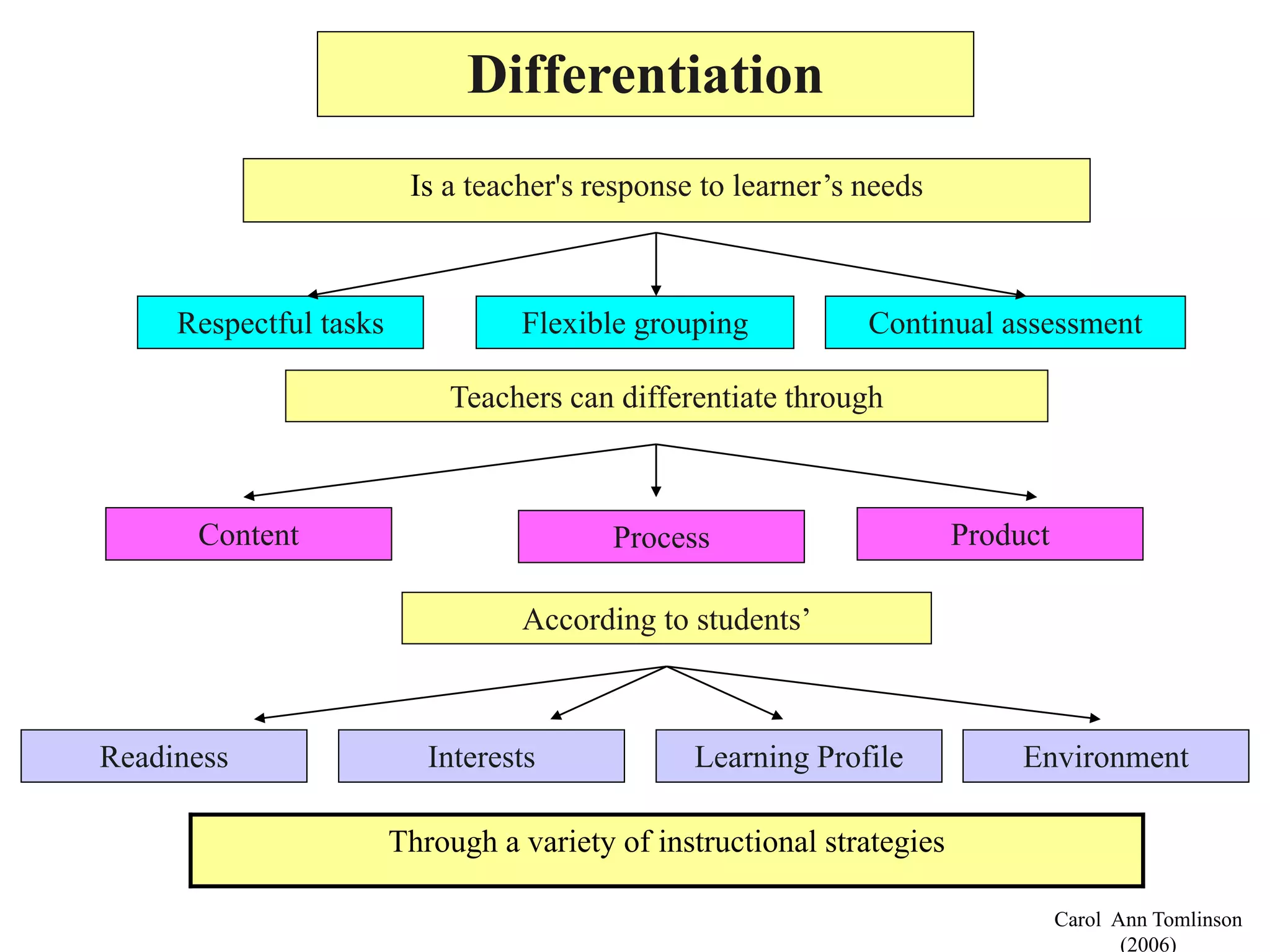
Product
Through a variety of instructional strategies
Carol Ann Tomlinson
(2006)
Differentiation
Is a teacher's response to learner’s needs
Respectful tasks Continual assessmentFlexible grouping
Teachers can differentiate through
Content Process
According to students’
Readiness Interests Learning Profile Environment
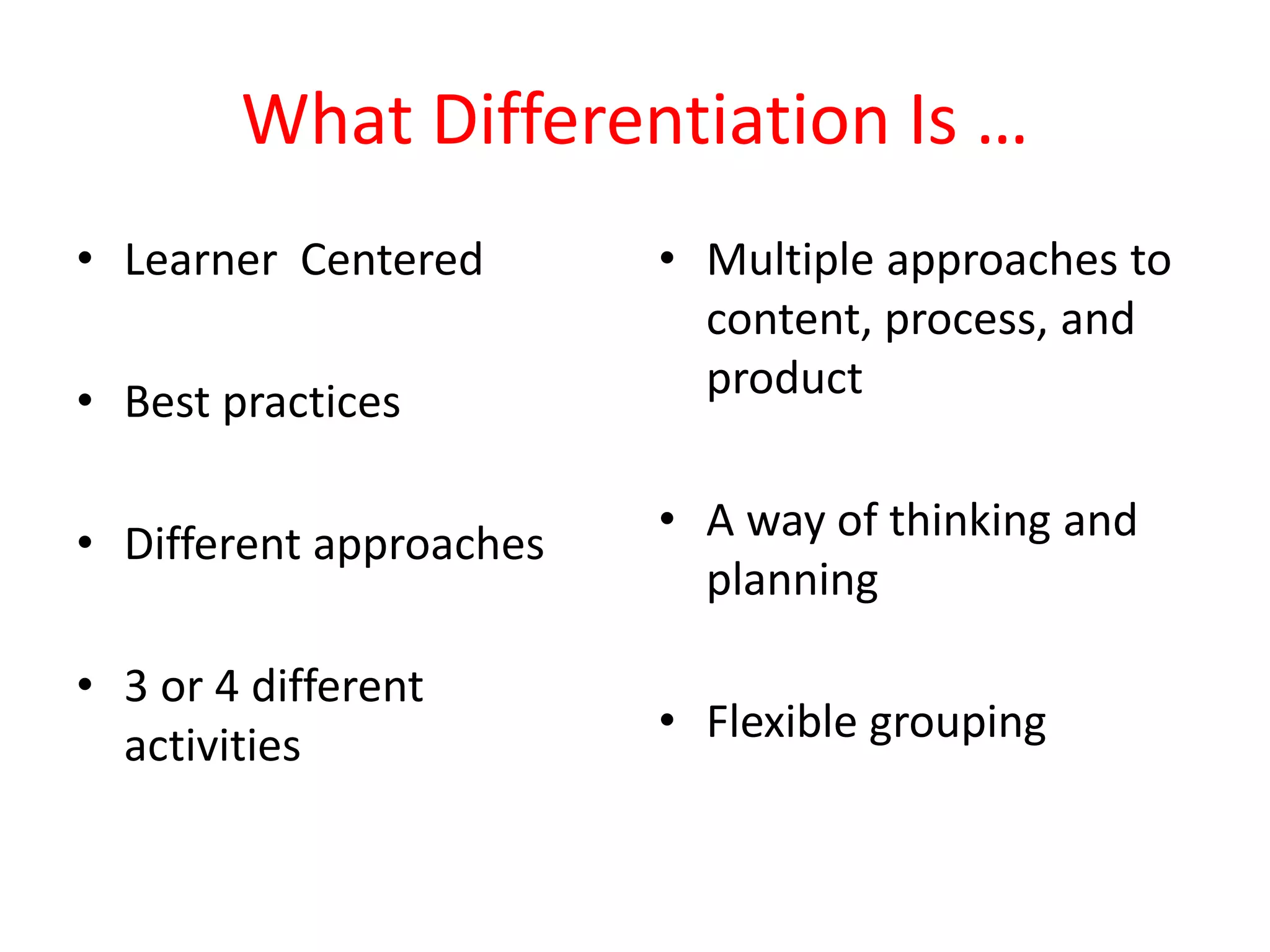
What Differentiation Is …
• Learner Centered
• Best practices
• Different approaches
• 3 or 4 different
activities
• Multiple approaches to
content, process, and
product
• A way of thinking and
planning
• Flexible grouping
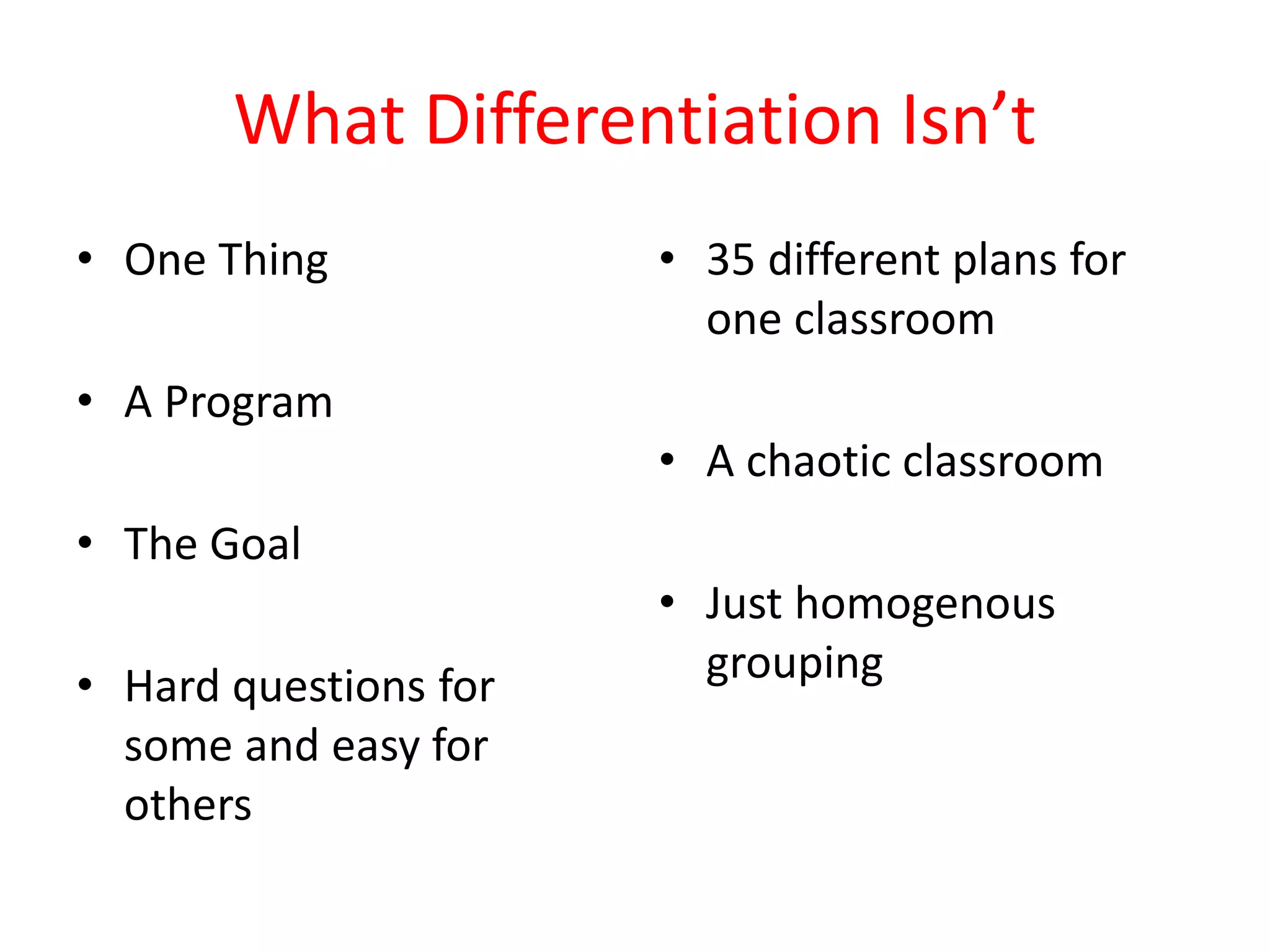
What Differentiation Isn’t
• One Thing
• A Program
• The Goal
• Hard questions for
some and easy for
others
• 35 different plans for
one classroom
• A chaotic classroom
• Just homogenous
grouping
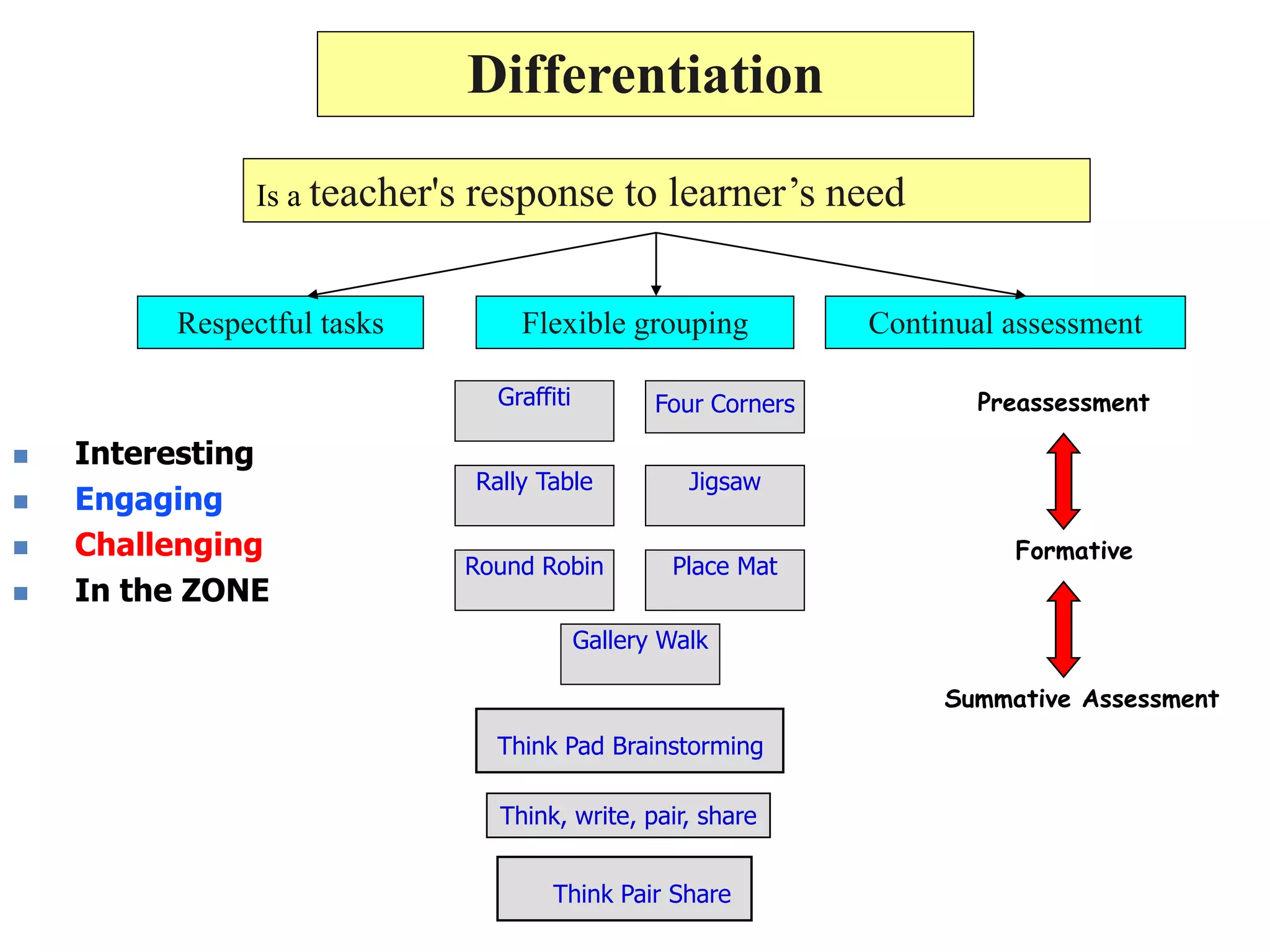
Differentiation
Is a teacher's response to learner’s need
Respectful tasks Continual assessmentFlexible grouping
 Interesting
 Engaging
 Challenging
 In the ZONE
Think Pair Share
Jigsaw
Think Pad Brainstorming
Preassessment
Summative Assessment
Formative
Think, write, pair, share
Graffiti Four Corners
Rally Table
Round Robin Place Mat
Gallery Walk
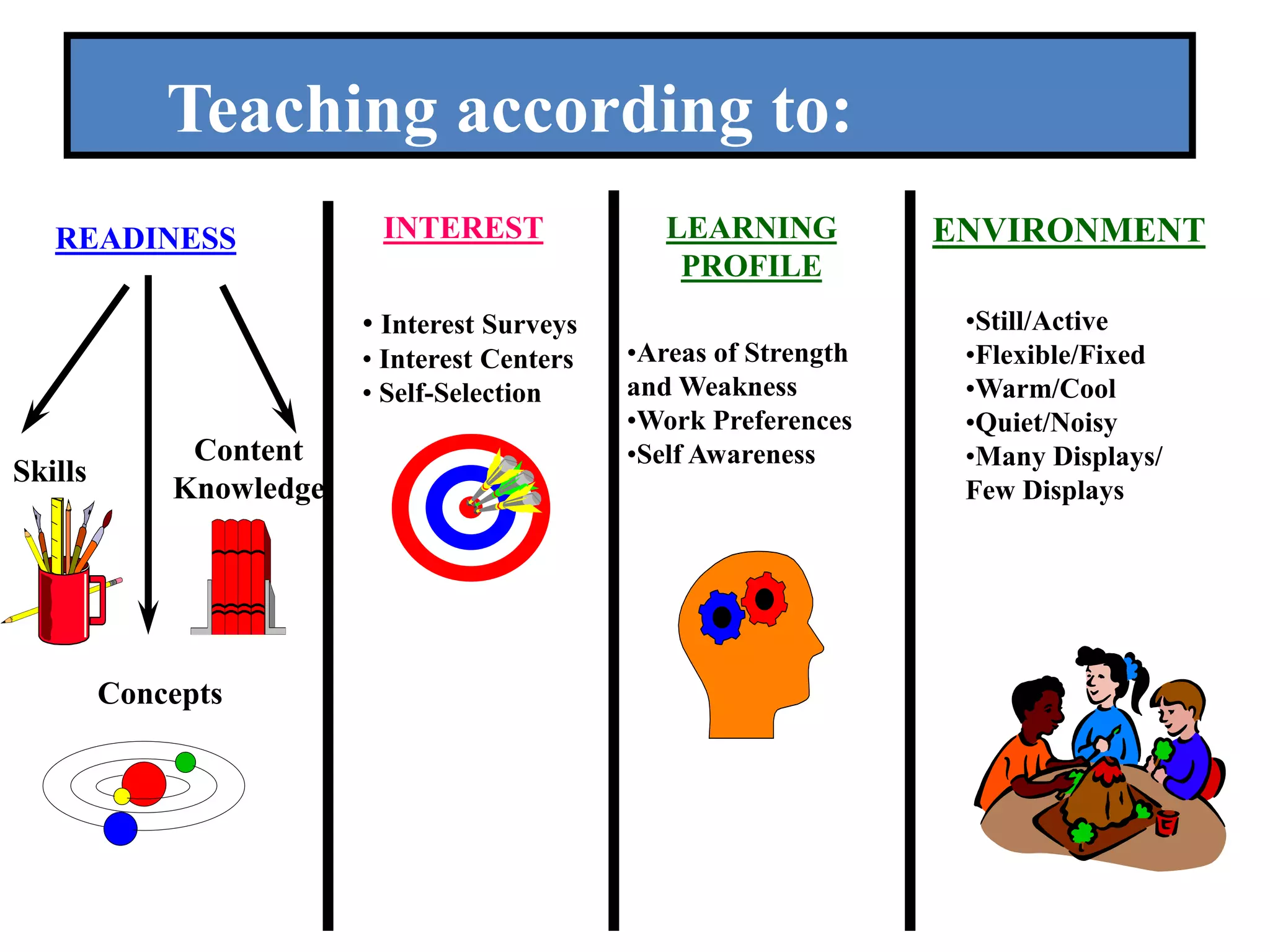
Teaching according to:
Skills
Concepts
READINESS INTEREST LEARNING
PROFILE
Content
Knowledge
• Interest Surveys
• Interest Centers
• Self-Selection
•Areas of Strength
and Weakness
•Work Preferences
•Self Awareness
ENVIRONMENT
•Still/Active
•Flexible/Fixed
•Warm/Cool
•Quiet/Noisy
•Many Displays/
Few Displays
Environment (Where of teaching)
• “He who wishes to teach, teaches
everywhere, in the open air.
• Socrates taught in the public street,
• Plato in the gardens of the Academy,
• Even Christ among the mountains and
lakes.”
-Jose Rizal
Content: What is
taught and how all
students are
provided access to
the program of
study.
PAMANTAYANG PANGNILALAMAN
(CONTENT STANDARD)
These cover a specified scope of
sequential topics within each learning
strand, domain, theme or component.
They answer the question “What should
learners know?”
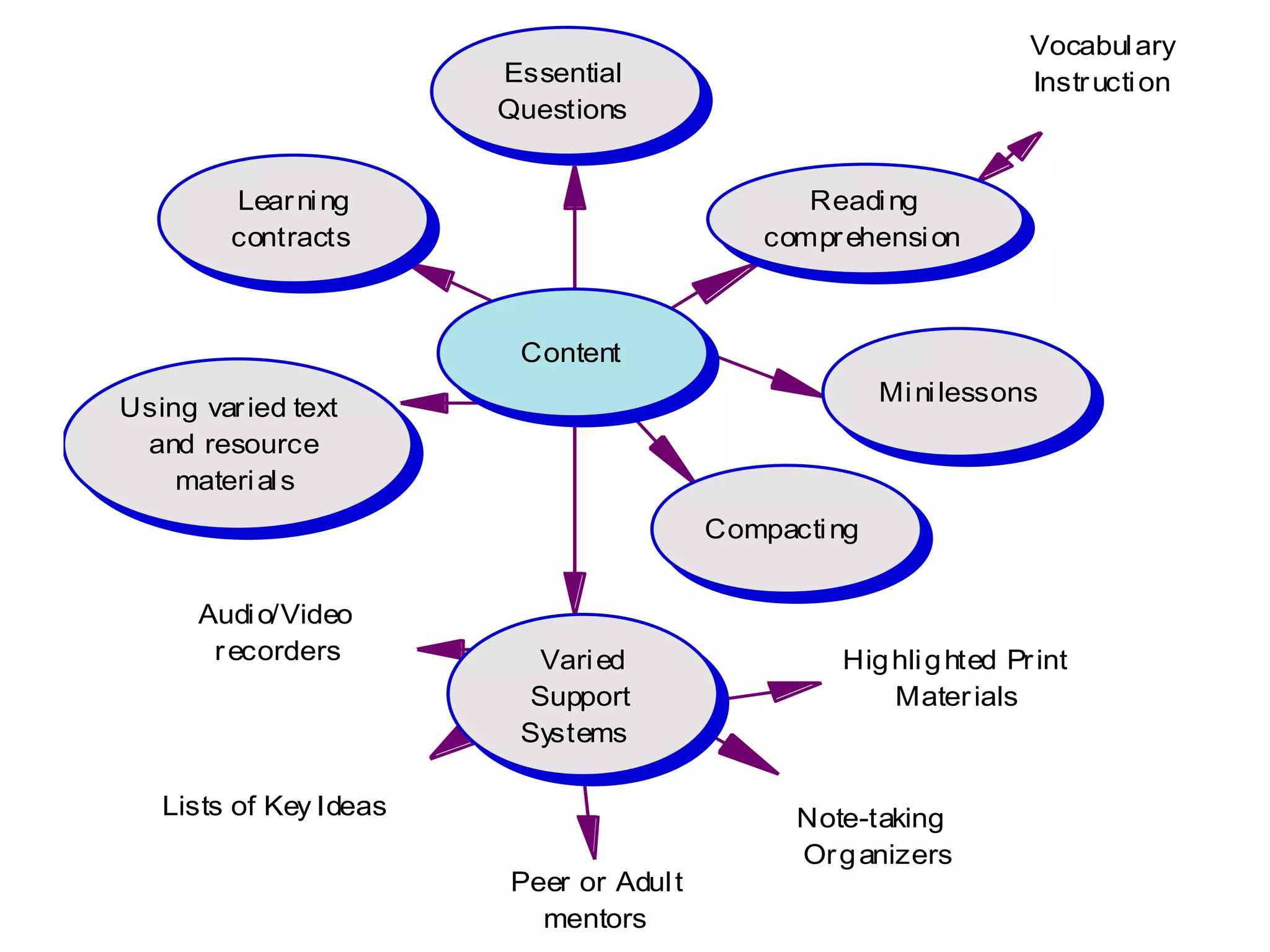
Content
Essential
Questions
Reading
comprehension
Vocabulary
Instruction
Compacting
Using varied text
and resource
materials
Learning
contracts
Minilessons
Varied
Support
Systems
Audio/Video
recorders
Note-taking
Organizers
Highlighted Print
Materials
Lists of Key Ideas
Peer or Adult
mentors
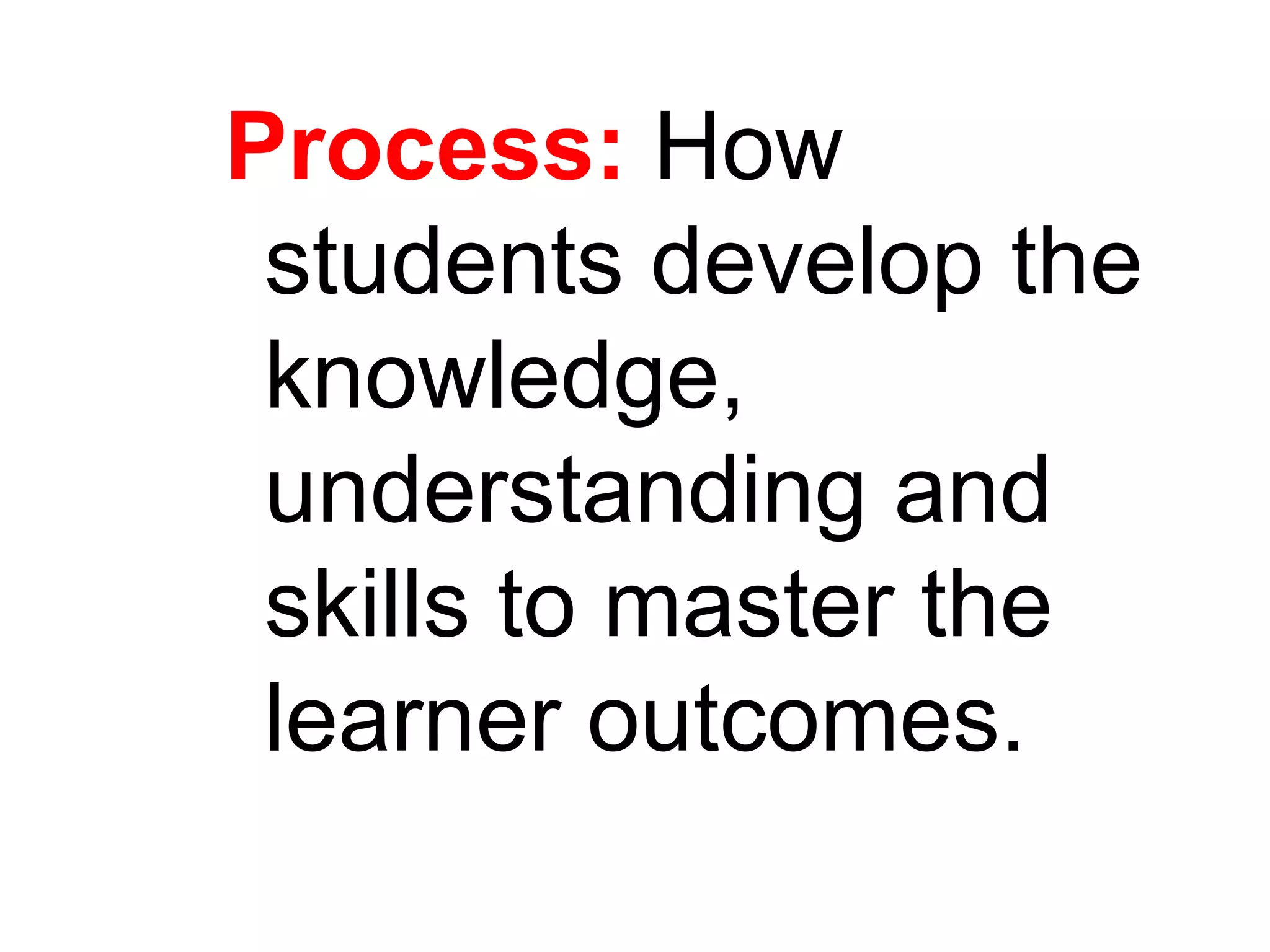
Process: How
students develop the
knowledge,
understanding and
skills to master the
learner outcomes.
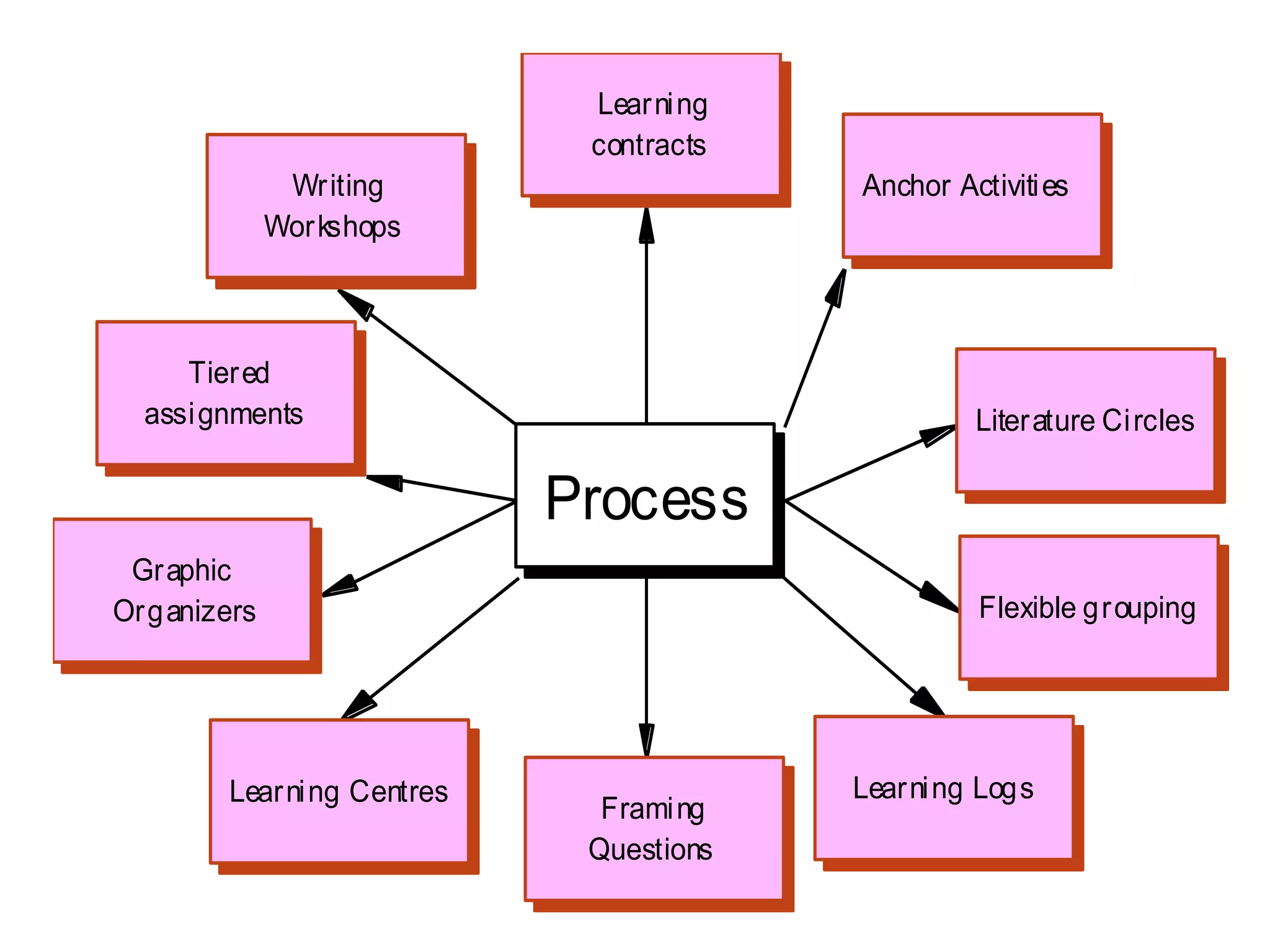
Process
Flexible grouping
Graphic
Organizers
Tiered
assignments
Anchor Activities
Framing
Questions
Learning LogsLearning Centres
Learning
contracts
Literature Circles
Writing
Workshops
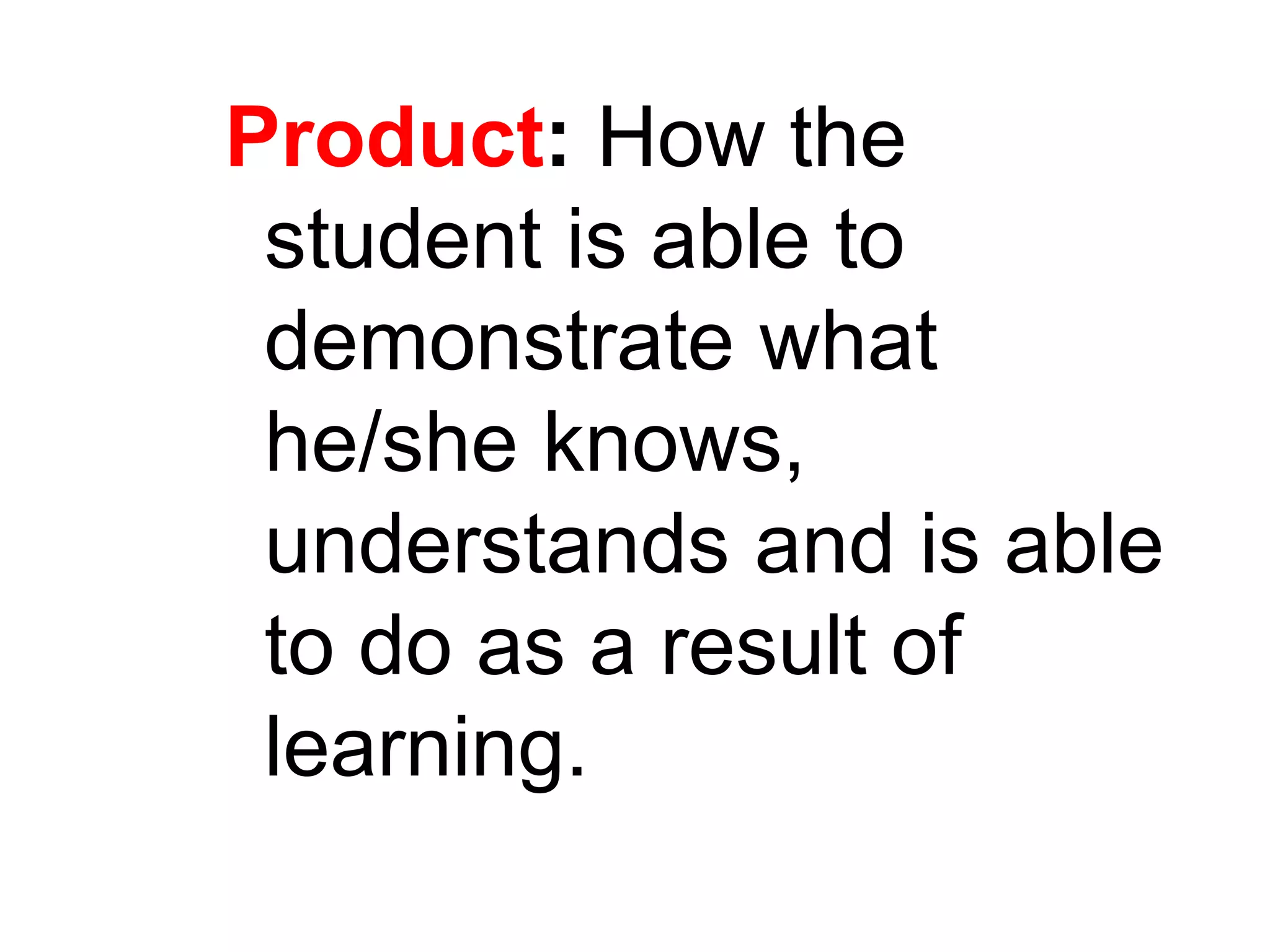
Product: How the
student is able to
demonstrate what
he/she knows,
understands and is able
to do as a result of
learning.
(PAMANTAYAN SA PAGGANAP
(PERFORMANCE STANDARD)
These describe the abilities and skills that
learners are expected to demonstrate
( product & performance) in relation to the
content standards and integration of 21st-
century skills.
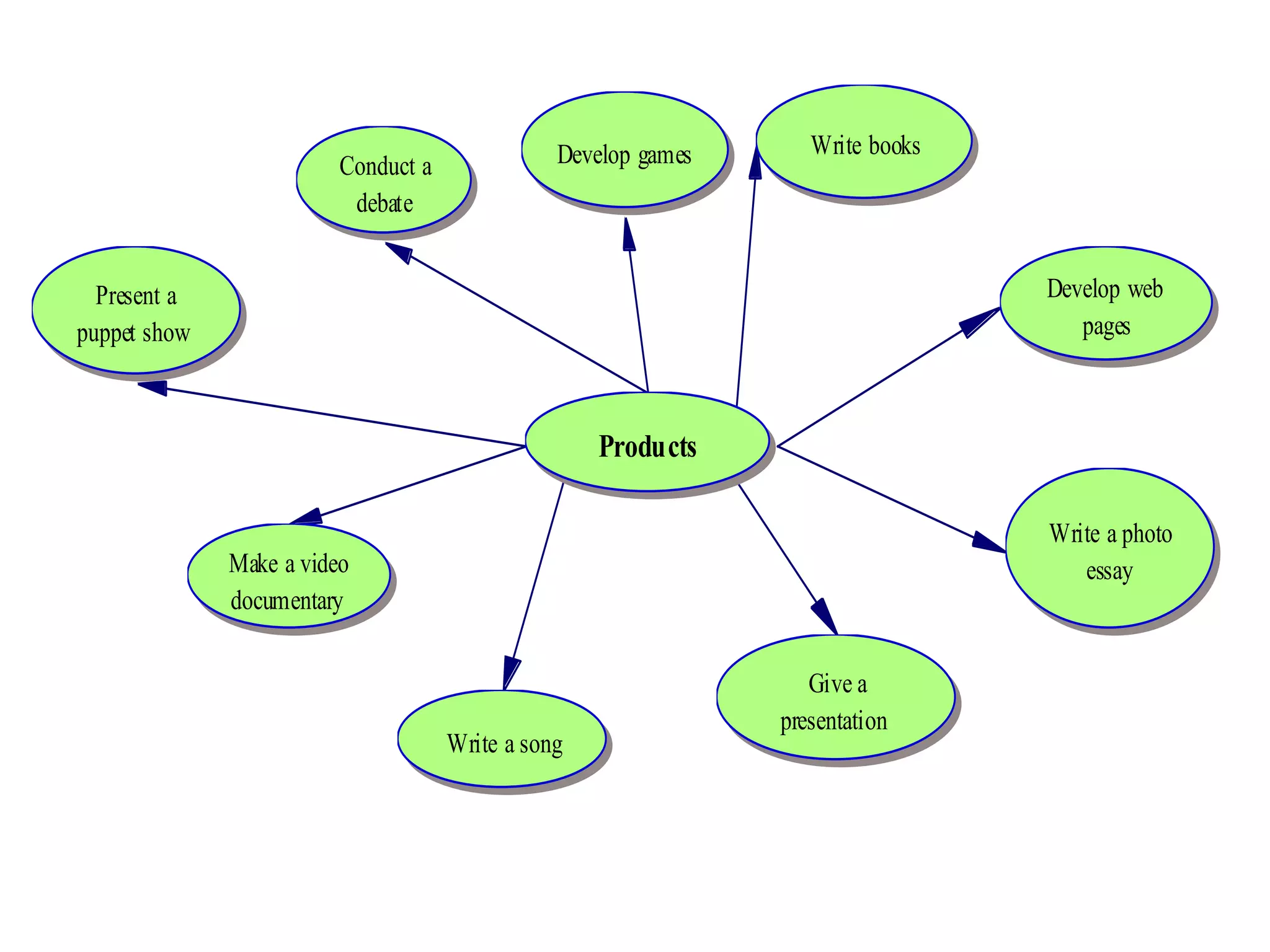
Products
Develop games Write books
Give a
presentation
Write a song
Conduct a
debate
Make a video
documentary
Present a
puppet show
Write a photo
essay
Develop web
pages
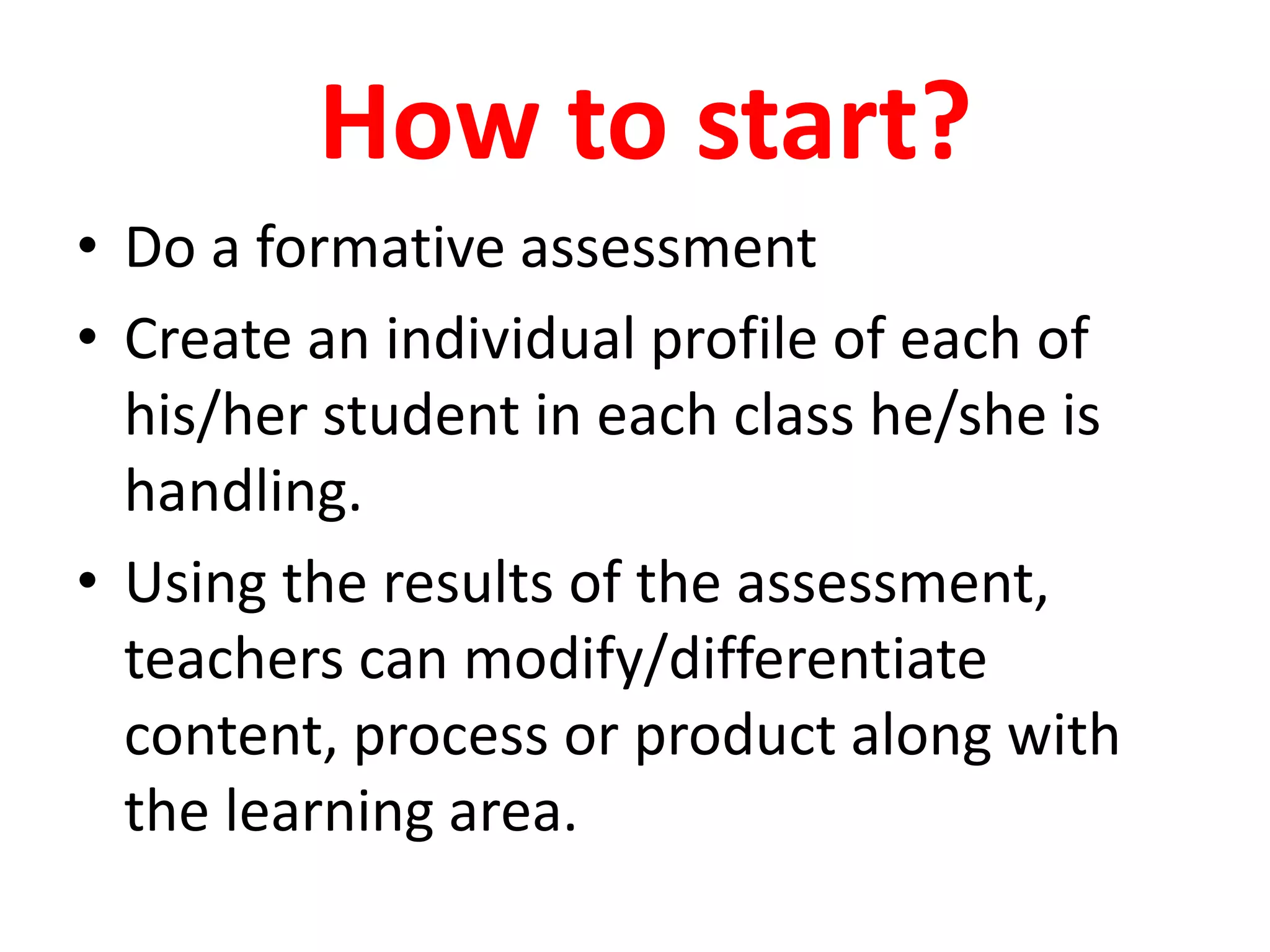
How to start?
• Do a formative assessment
• Create an individual profile of each of
his/her student in each class he/she is
handling.
• Using the results of the assessment,
teachers can modify/differentiate
content, process or product along with
the learning area.
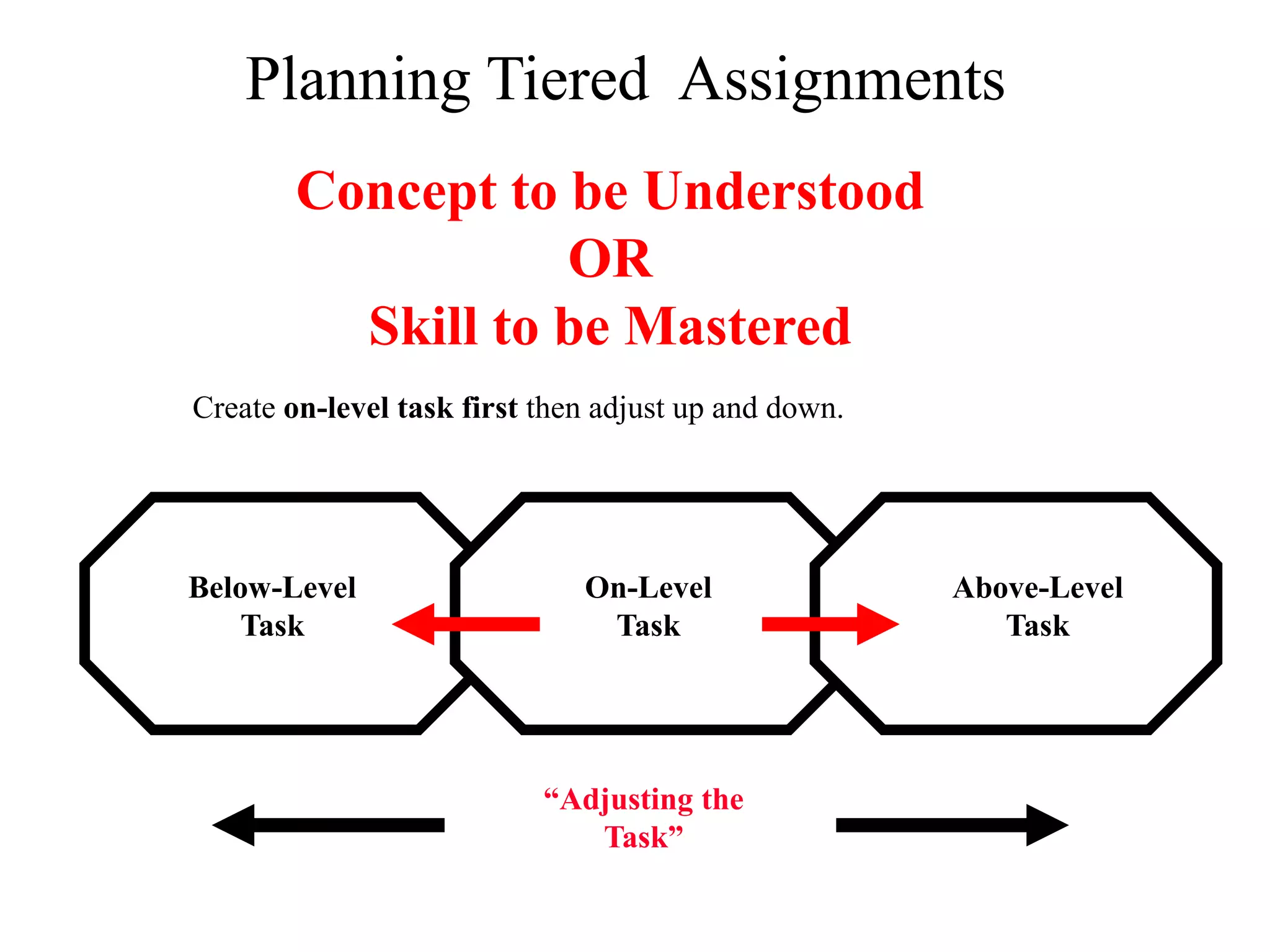
Planning Tiered Assignments
Concept to be Understood
OR
Skill to be Mastered
Below-Level
Task
On-Level
Task
Above-Level
Task
Create on-level task first then adjust up and down.
“Adjusting the
Task”
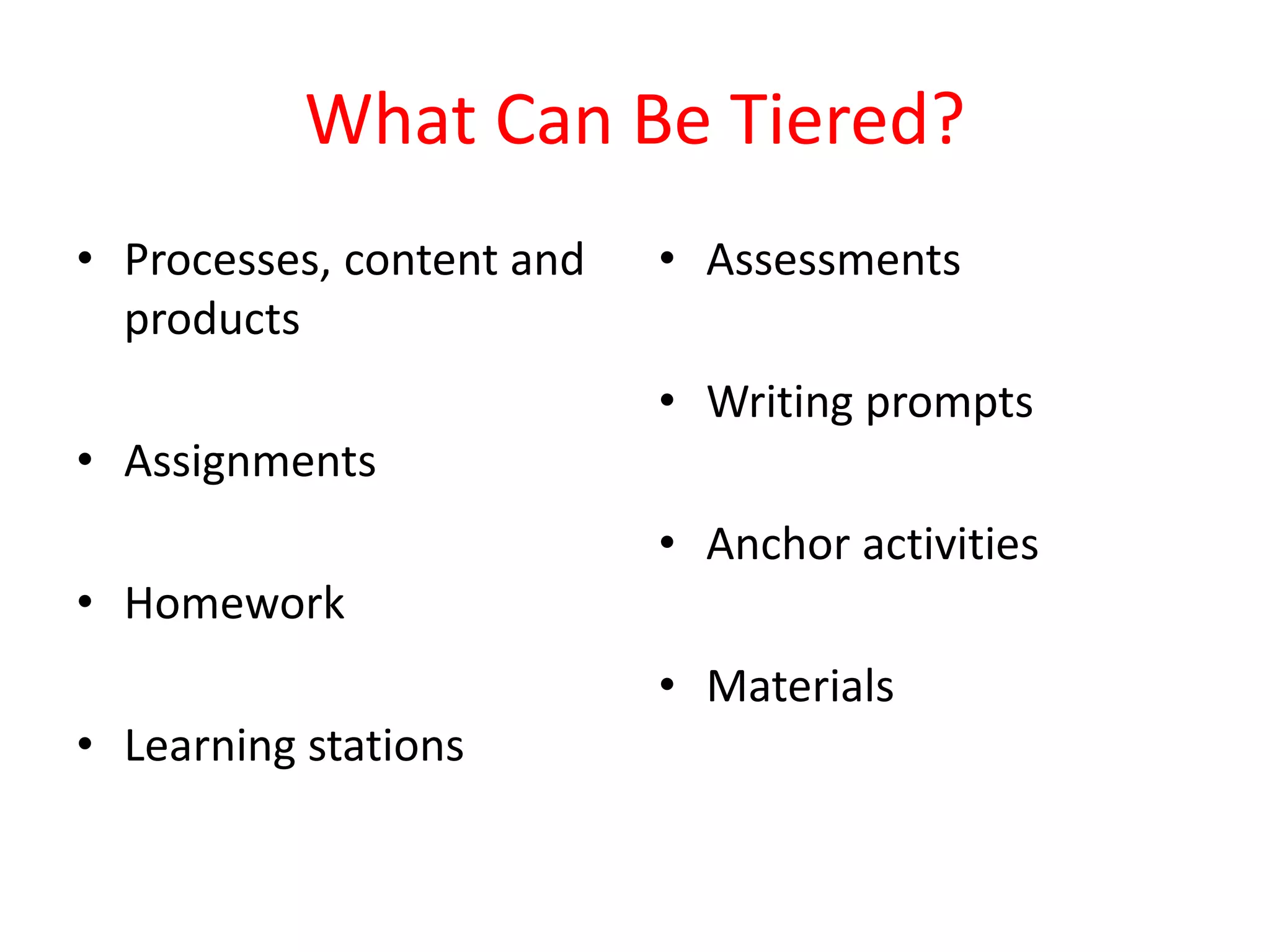
What Can Be Tiered?
• Processes, content and
products
• Assignments
• Homework
• Learning stations
• Assessments
• Writing prompts
• Anchor activities
• Materials
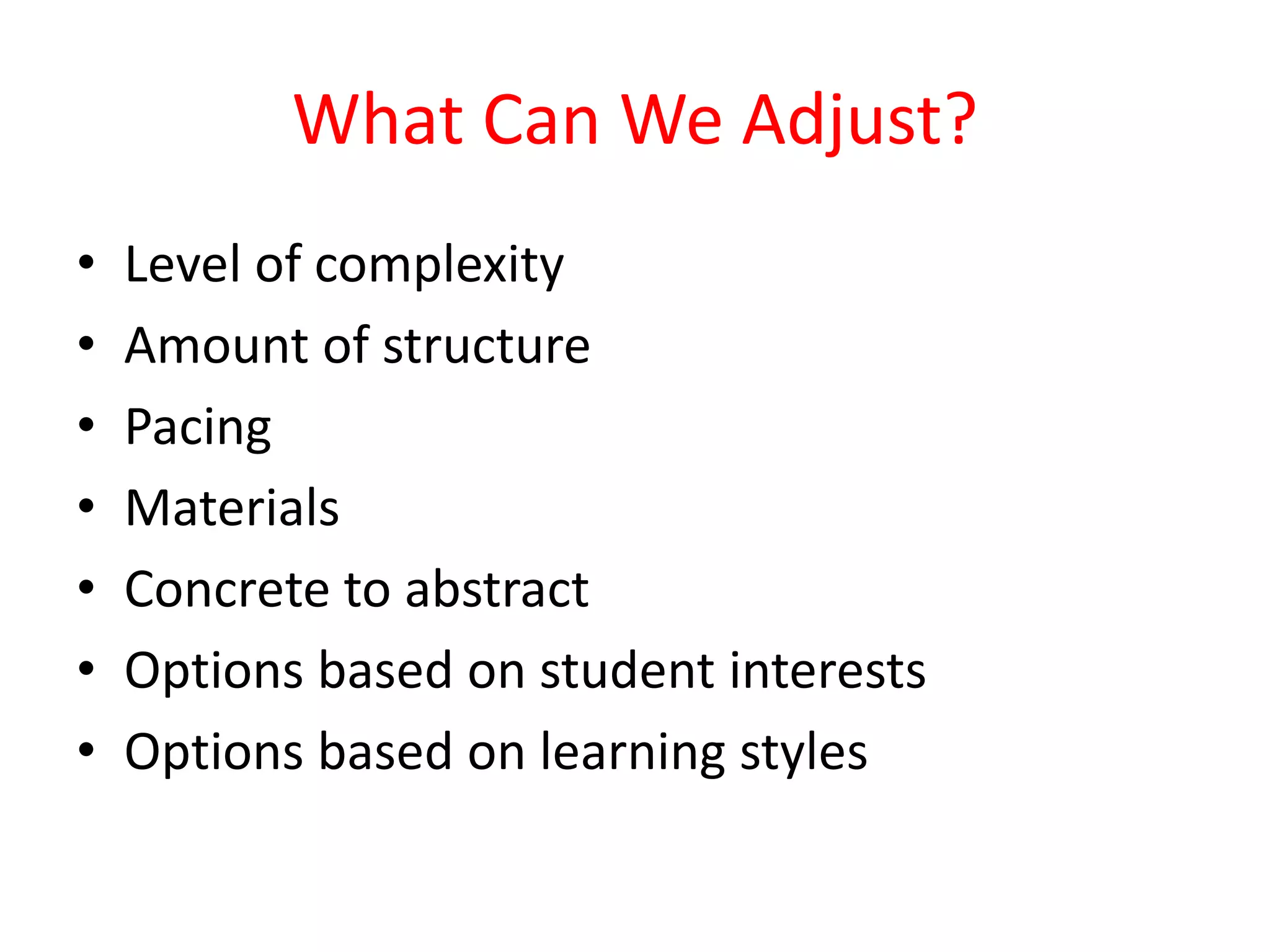
What Can We Adjust?
• Level of complexity
• Amount of structure
• Pacing
• Materials
• Concrete to abstract
• Options based on student interests
• Options based on learning styles
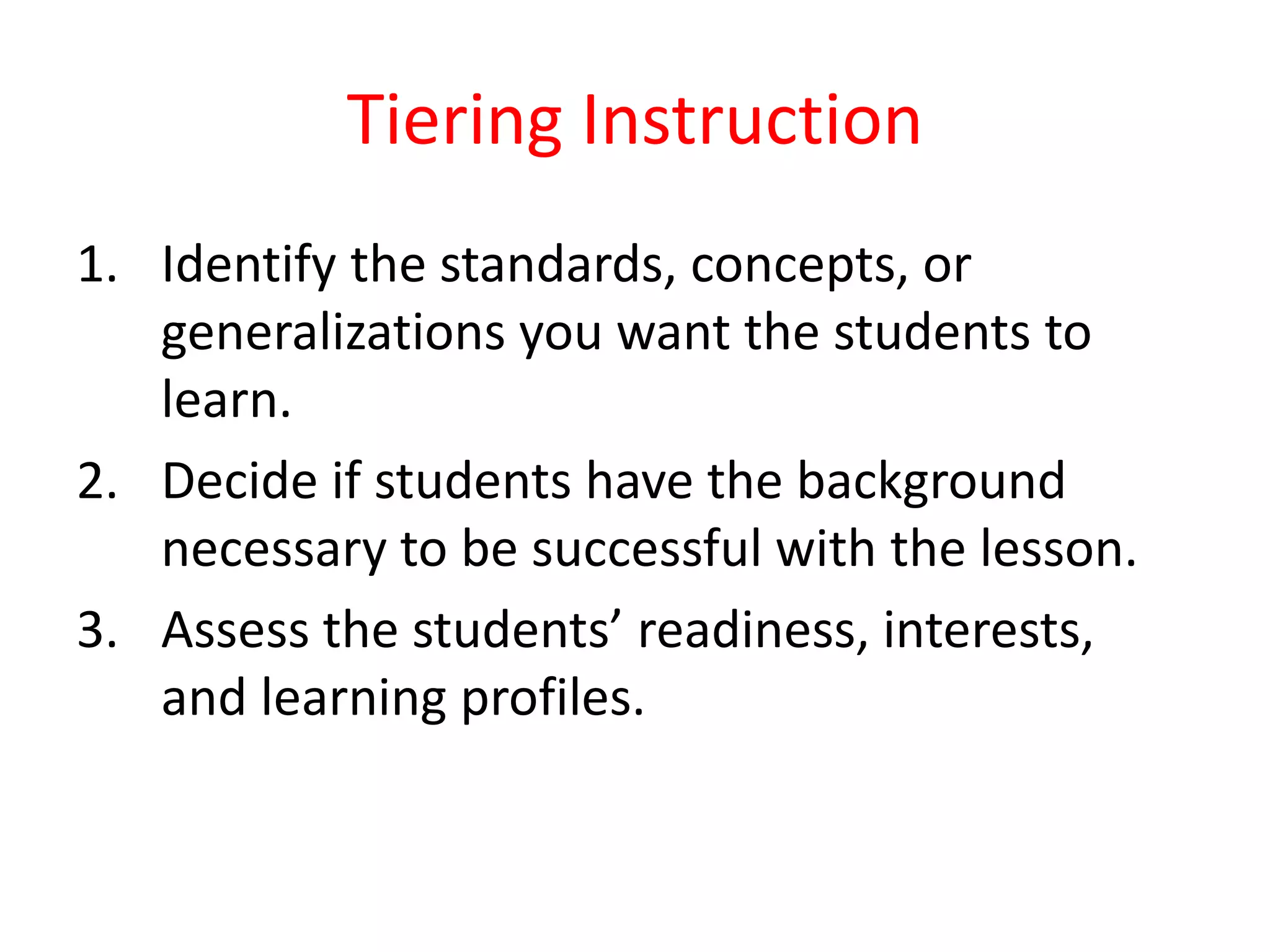
Tiering Instruction
1. Identify the standards, concepts, or
generalizations you want the students to
learn.
2. Decide if students have the background
necessary to be successful with the lesson.
3. Assess the students’ readiness, interests,
and learning profiles.
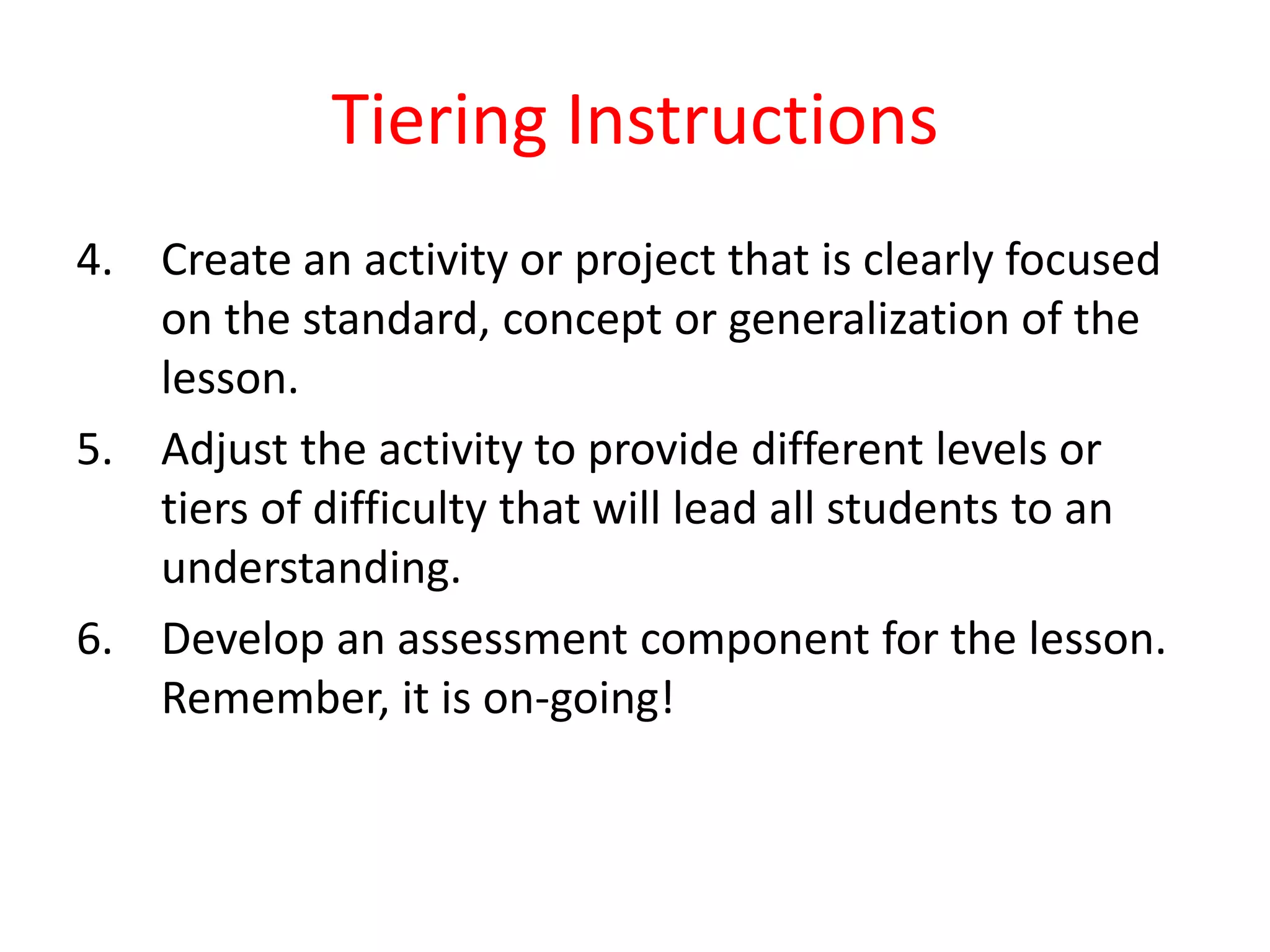
Tiering Instructions
4. Create an activity or project that is clearly focused
on the standard, concept or generalization of the
lesson.
5. Adjust the activity to provide different levels or
tiers of difficulty that will lead all students to an
understanding.
6. Develop an assessment component for the lesson.
Remember, it is on-going!
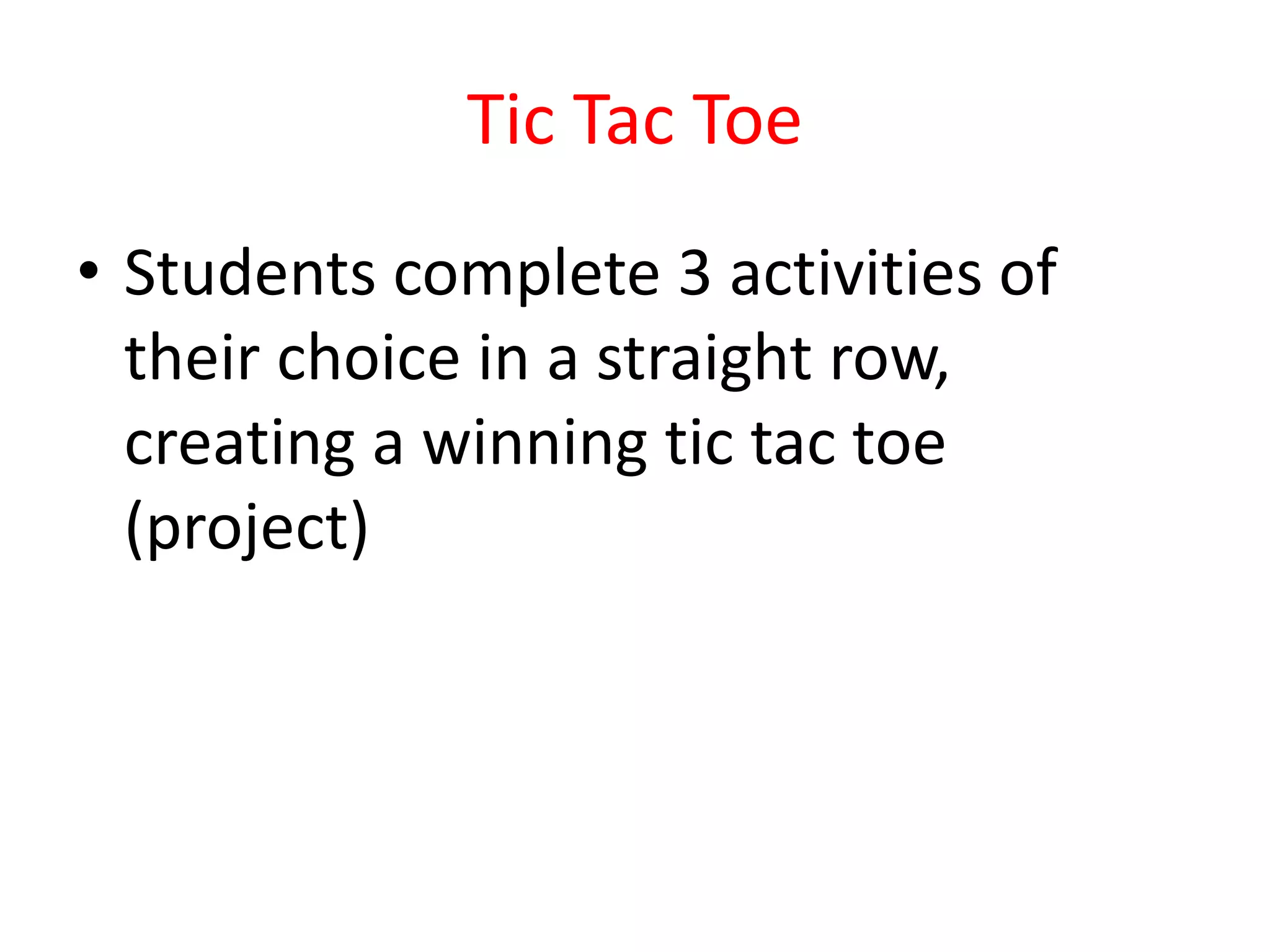
Tic Tac Toe
• Students complete 3 activities of
their choice in a straight row,
creating a winning tic tac toe
(project)
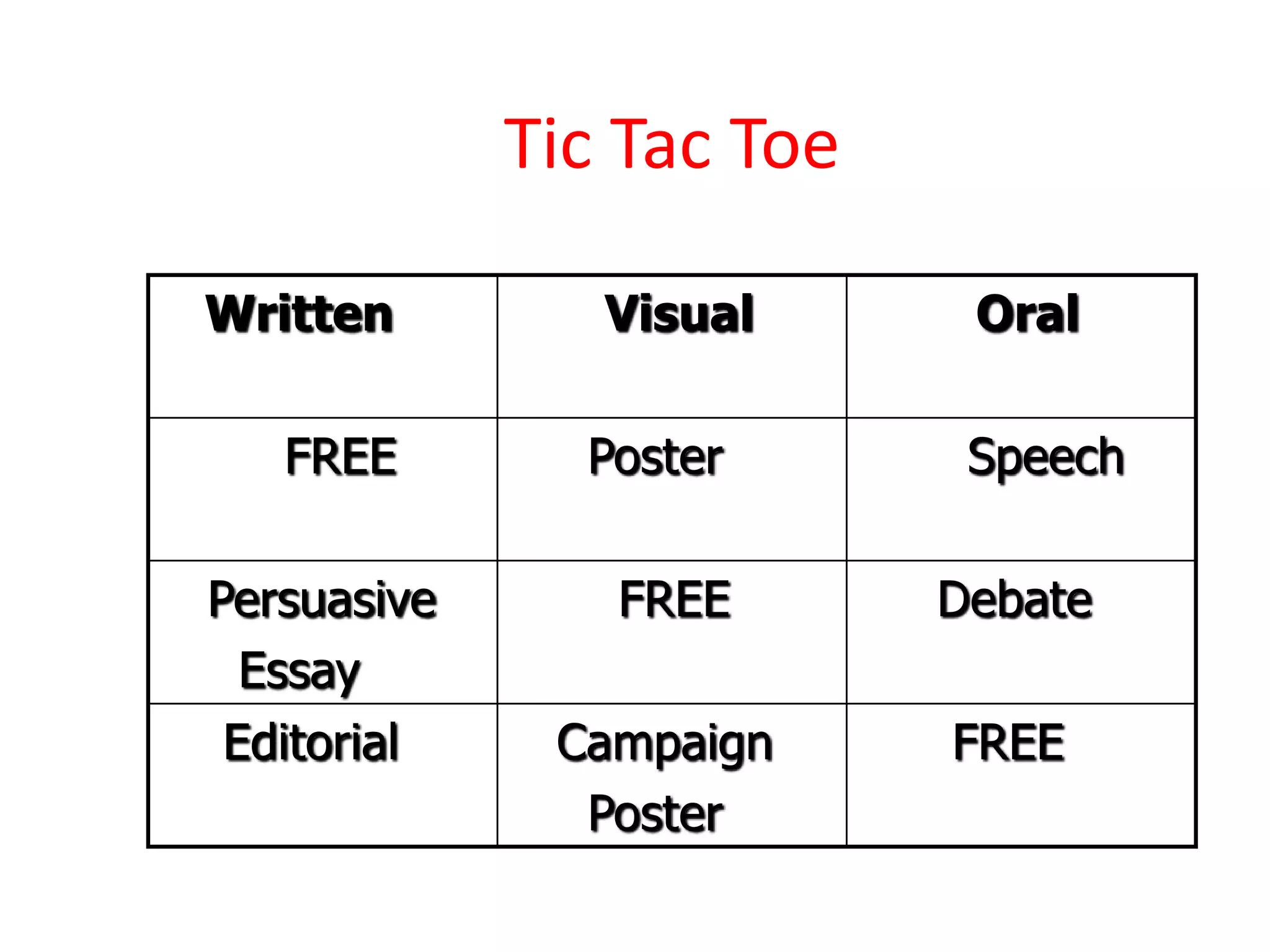
Tic Tac Toe
Written Visual Oral
FREE Poster Speech
Persuasive
Essay
FREE Debate
Editorial Campaign
Poster
FREE
Compose
Create
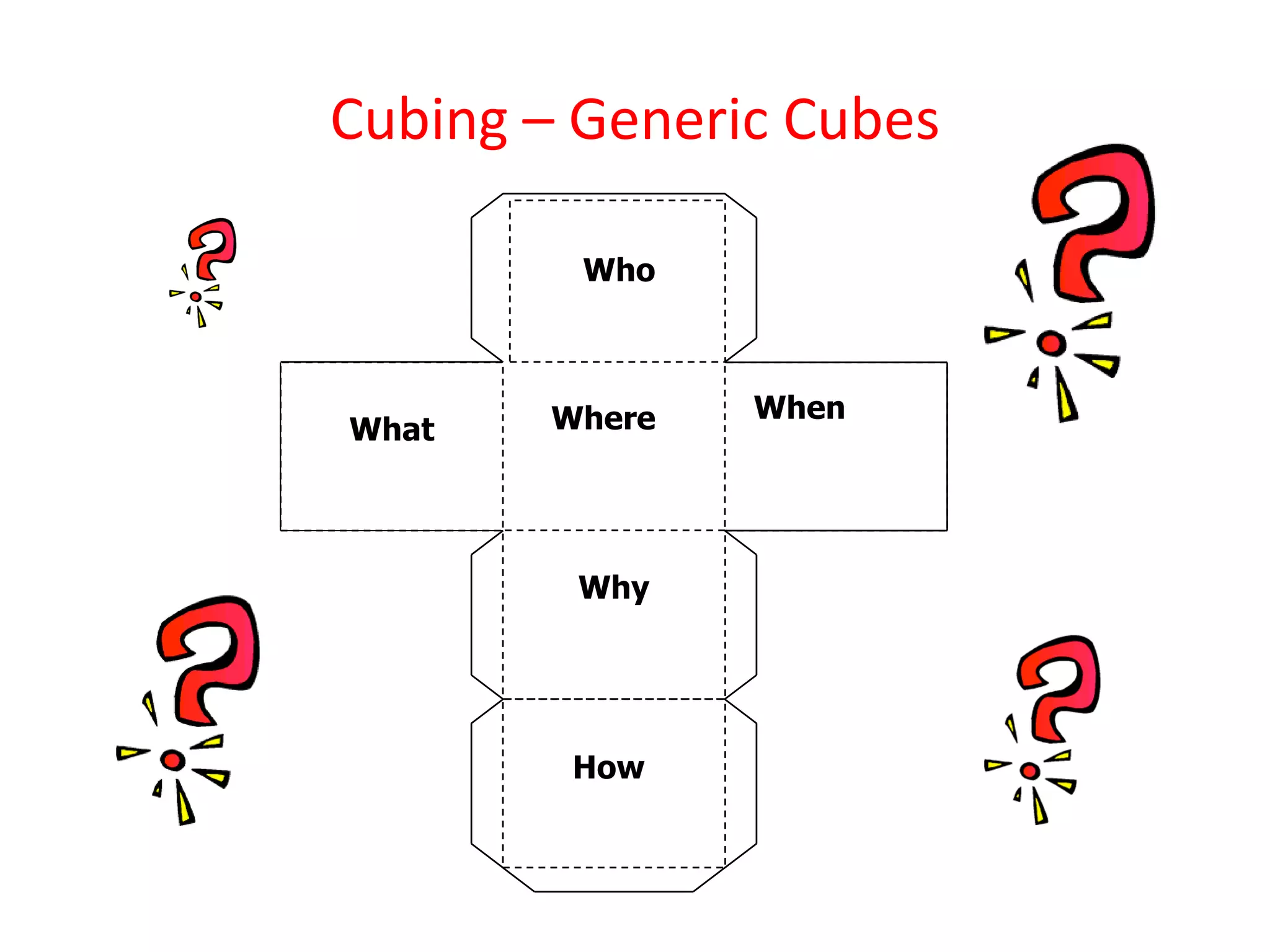
Cubing – Generic Cubes
Who
WhenWhere
Why
How
What
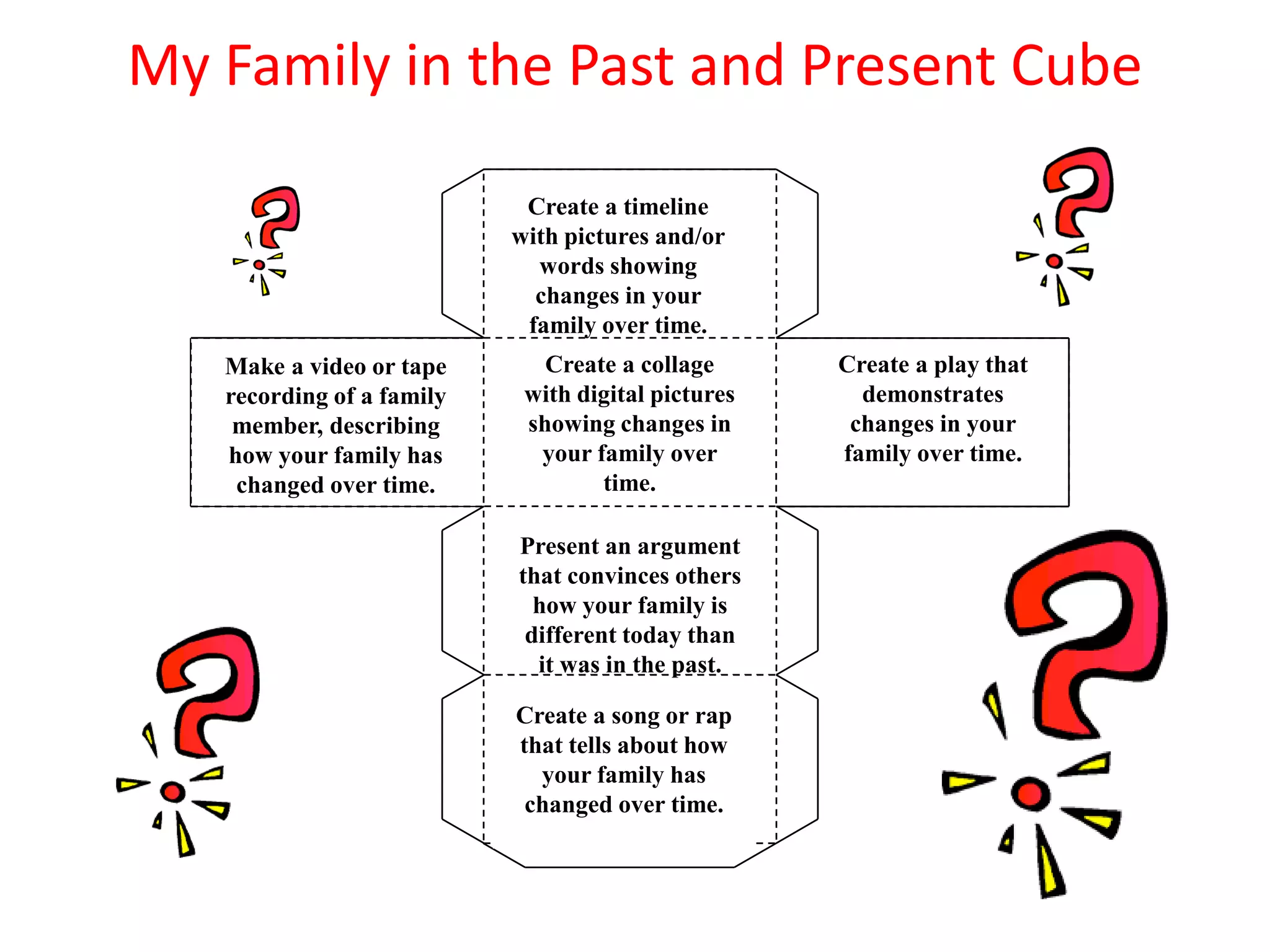
My Family in the Past and Present Cube
Make a video or tape recording,
interviewing members of your
families telling about their
responsibilities.
Create a timeline
with pictures and/or
words showing
changes in your
family over time.
Create a song or rap
that tells about how
your family has
changed over time.
Present an argument
that convinces others
how your family is
different today than
it was in the past.
Create a collage
with digital pictures
showing changes in
your family over
time.
Create a play that
demonstrates
changes in your
family over time.
Make a video or tape
recording of a family
member, describing
how your family has
changed over time.
Student Survey
At school, I like _____________________
Because___________________________
I do not like_________________________
Because___________________________
If I have free time, I prefer to __________ or
_____________.
My favorite thing to read is_____________.
Carolyn Chapman / Rita King 2005
Student Survey
Name ________ Date_________
Answer the following questions with either a yes or no answer or fill in the blank.
Yes NO
I like to read. 4 3 2 1
I like to make up songs. 4 3 2 1
I am challenged by things that are difficult to do. 4 3 2 1
Taking things apart and reassembling 4 3 2 1
them intrigues me.
I like to play outside. 4 3 2 1
I prefer to work by myself. 4 3 2 1
I enjoy working with others. 4 3 2 1
I like to draw my own pictures. 4 3 2 1
I like school. 4 3 2 1
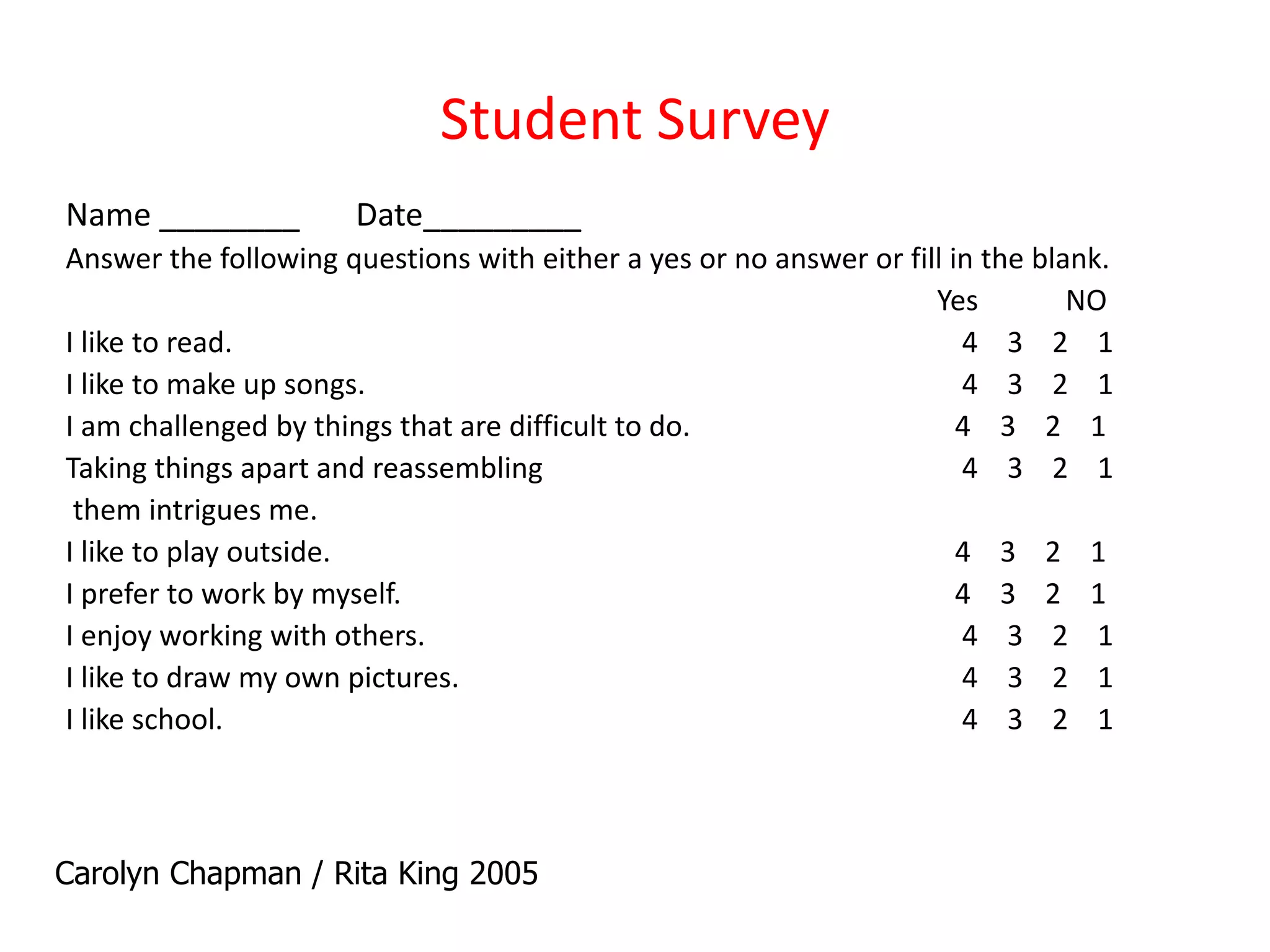
Carolyn Chapman / Rita King 2005
Interest Inventory
Diane Heacox, 2002
1. What is your favorite activity or subject at school? Why?
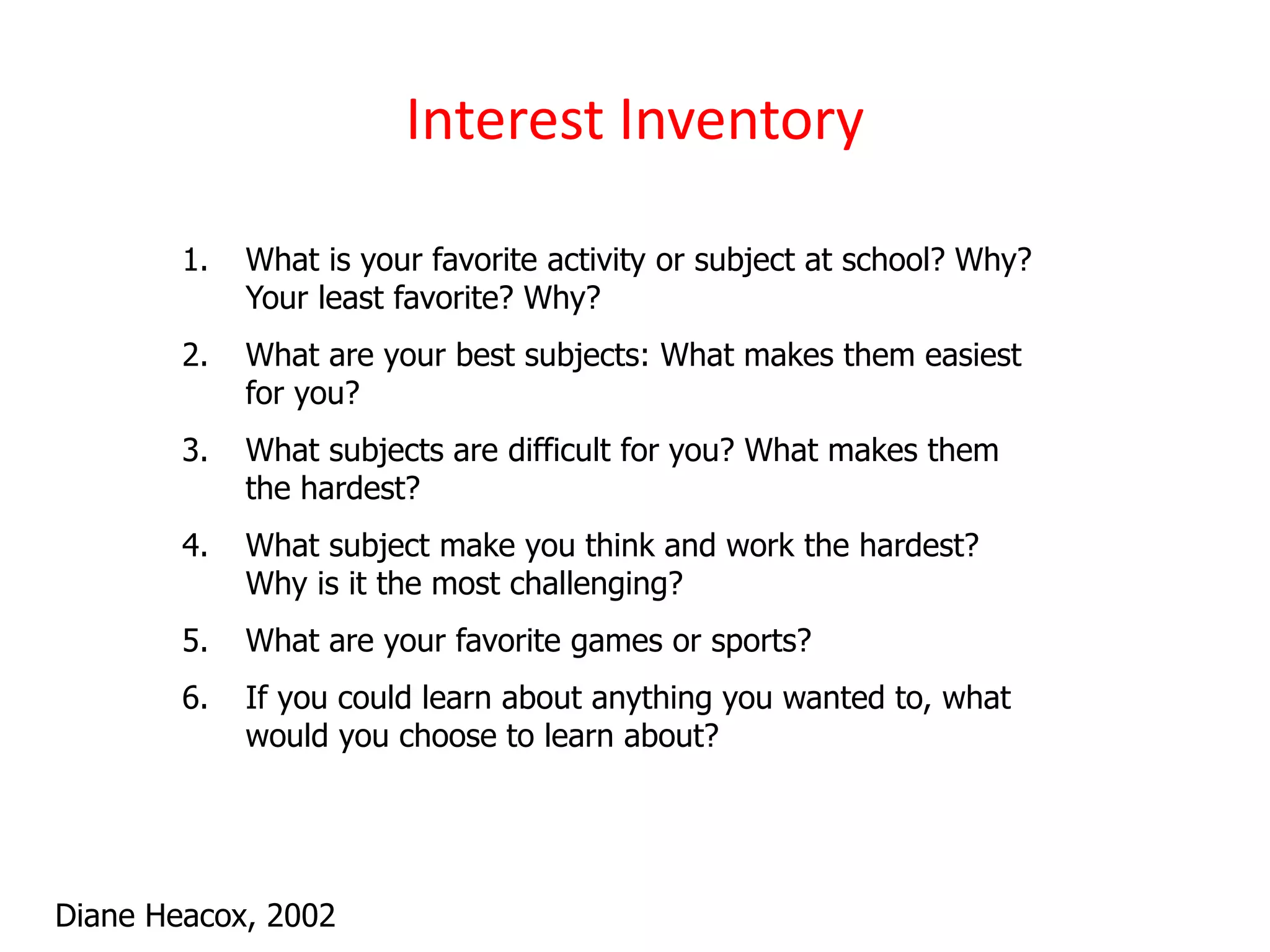
Your least favorite? Why?
2. What are your best subjects: What makes them easiest
for you?
3. What subjects are difficult for you? What makes them
the hardest?
4. What subject make you think and work the hardest?
Why is it the most challenging?
5. What are your favorite games or sports?
6. If you could learn about anything you wanted to, what
would you choose to learn about?
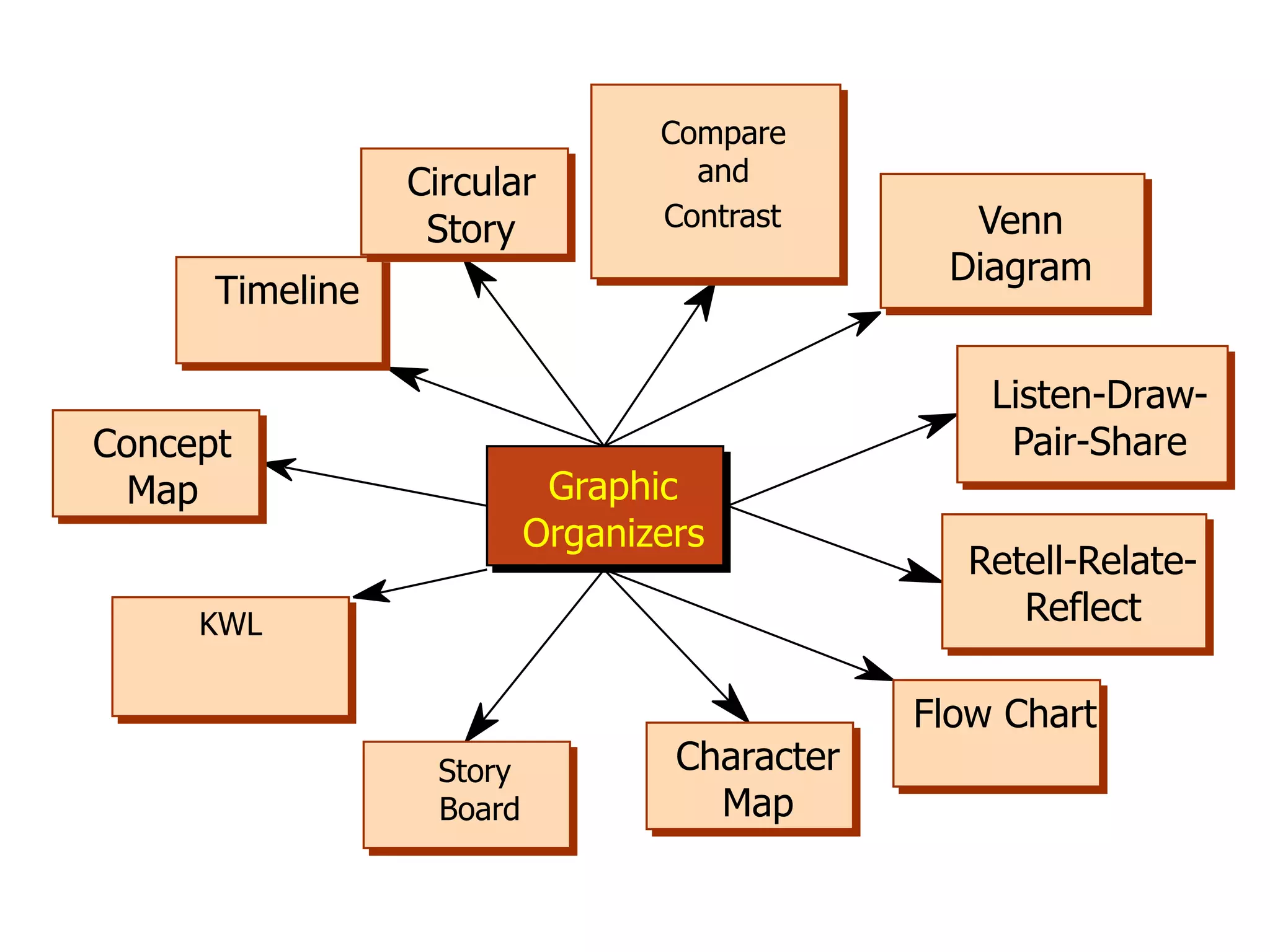
Graphic
Organizers
Flow Chart
KWL
Timeline
Venn
Diagram
Character
Map
Story
Board
Circular
Story
Compare
and
Contrast
Listen-Draw-
Pair-ShareConcept
Map
Retell-Relate-
Reflect
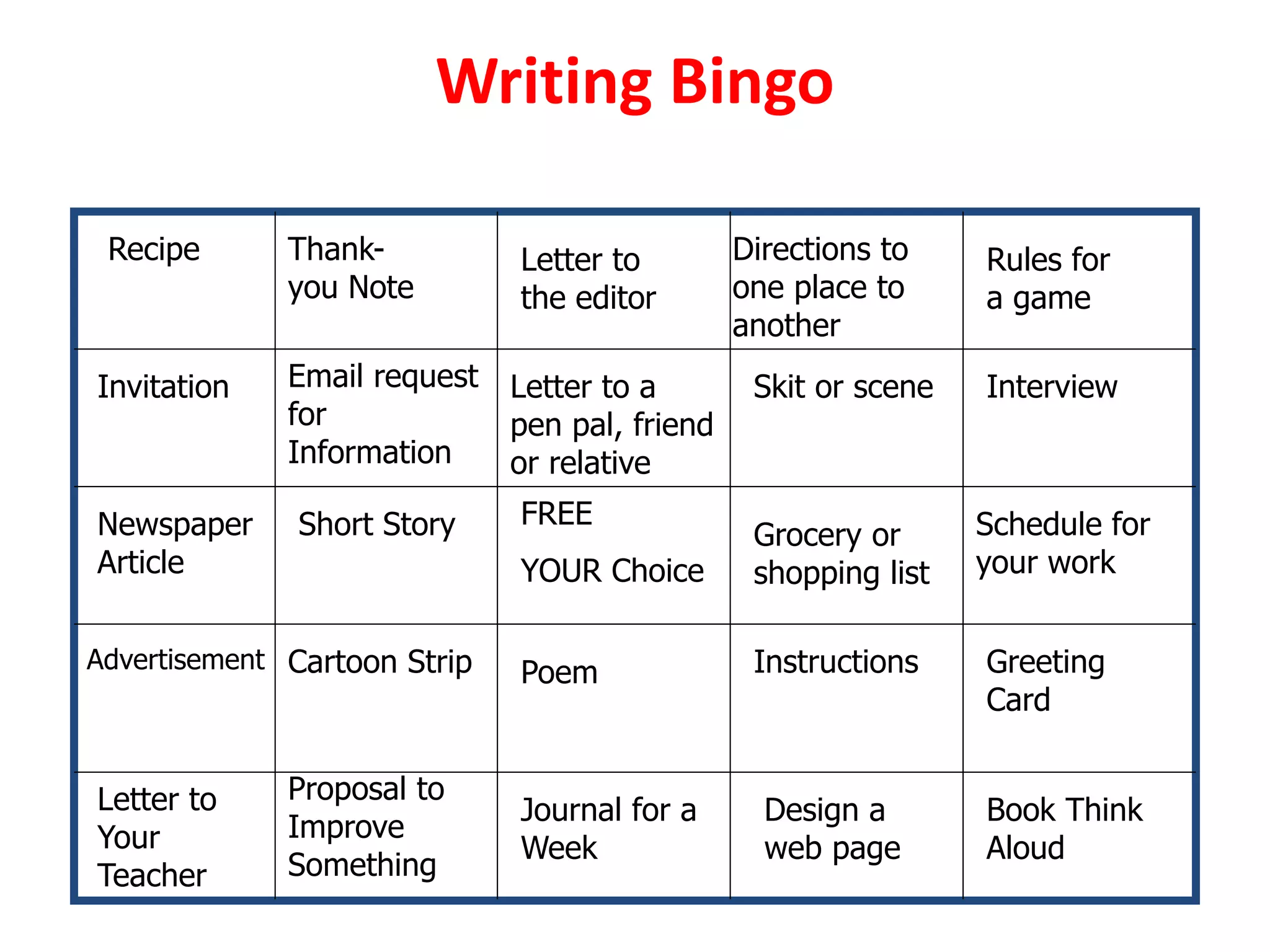
Writing Bingo
Recipe
Invitation
Newspaper
Article
Advertisement
Letter to
Your
Teacher
Directions to
one place to
another
Rules for
a game
Letter to
the editor
Thank-
you Note
Email request
for
Information
Letter to a
pen pal, friend
or relative
Skit or scene Interview
Schedule for
your work
Grocery or
shopping list
FREE
YOUR Choice
Short Story
Design a
web page
Journal for a
Week
Proposal to
Improve
Something
Cartoon Strip Poem Instructions Greeting
Card
Book Think
Aloud
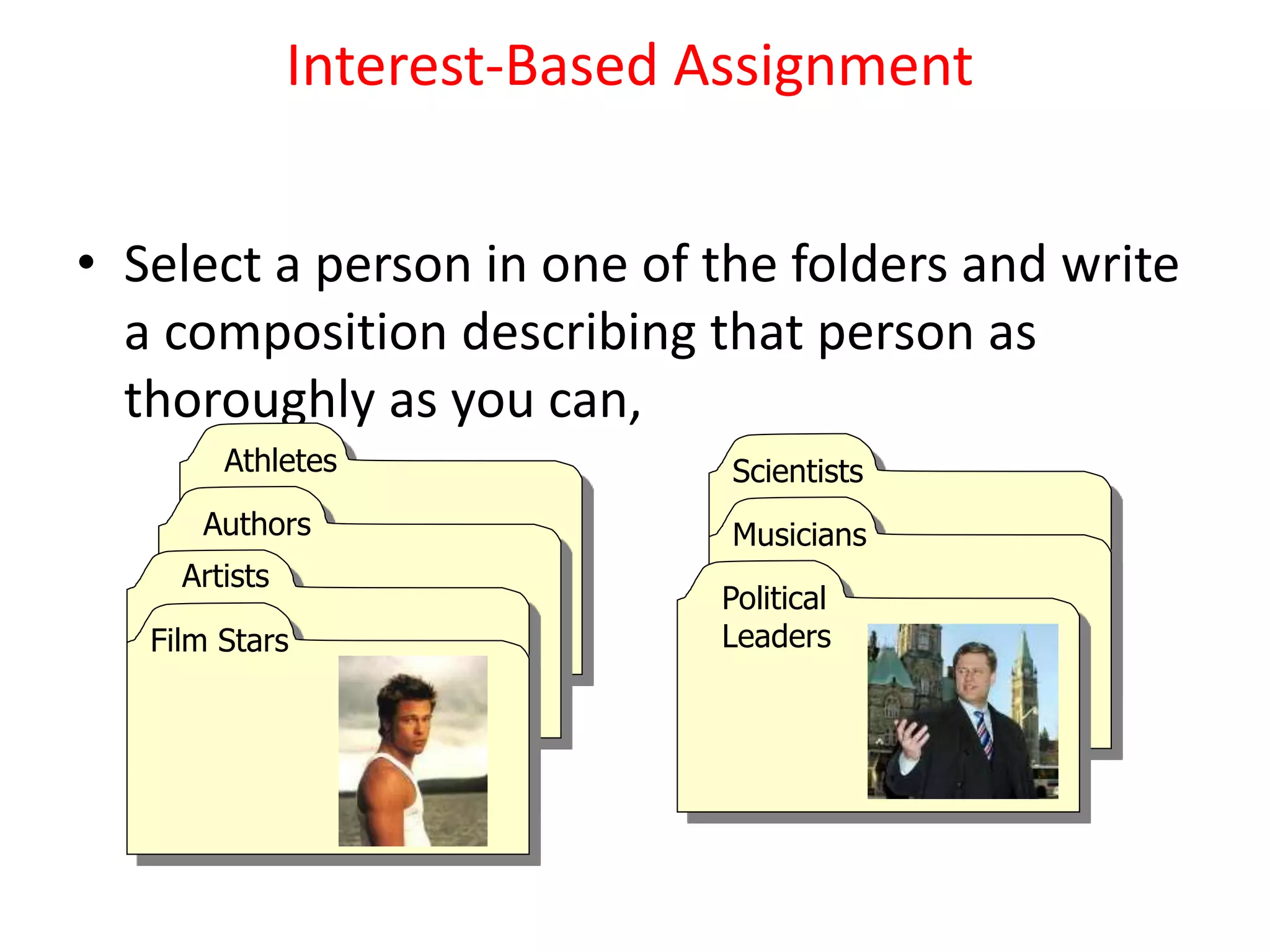
Interest-Based Assignment
• Select a person in one of the folders and write
a composition describing that person as
thoroughly as you can,
Athletes
Authors
Artists
Film Stars
Scientists
Musicians
Political
Leaders
Application
1. Divide the class into 3 subgroups assigning one
component for each group:
Content
Process or Learning Activities
Products or Assessment
2. Select a specific topic and prepare three
differentiated activities taking note of the
learners’:
Readiness
Interests
Learning Profiles
Environment
Differentiated instruction

Differentiated instruction

  • 1.
    CURRICULU M ASSESSMENT INSTURCTION CURRICULUM (What shouldbe taught?) ASSESSMENT (How should learning be assessed?) INSTRUCTION (How should it be taught?)
  • 2.
    Curriculum (R.A. 10533) Instructional Plan (DepEd Order no.42, s.2016) Assessment (DepED Order No.8, s.2015)
  • 3.
    DIFFERENTIATED INSTRUCTION CRISTINA S. CHIOCO EducationProgram Specialist II SDO- Nueva Ecija
  • 4.
    Objectives: At the endof the session, the participant will be able to: 1. discuss the basic principles of Differentiated Instruction;
  • 5.
    Objectives: 2. Identify activitiessuited to each component of D.I.– content, process, product, environment; 3. Identify activities that respond to learners’ needs—readiness, interest, learning profile;
  • 7.
    ACTIVITY: Fact orBluff • Choose your TEAM LEADER and RECORDER. • Discuss within your group if each statement is FACT OR BLUFF. Arrive at a consensus. • At a given signal, the team will stand if their answer is FACT. They will remain seated if their response is BLUFF. • The Team Leader must be ready to justify the group’s answer in 1 minute.
  • 8.
    FACT OR BLUFF DIFFERENTIATEDINSTRUCTION is: 1. Group work 2. Individualization 3. Stand and deliver 4. Covering the content 5. Related to competencies
  • 9.
    6. Activity-oriented 7. Learner-centered 8.MOTS (more of the same) 9. More for advanced; less for others
  • 10.
  • 11.
    FOR A BITOF HISTORY… 1985- “Differential Education” for gifted & talented invented by Virgil Ward (U of Virginia) 1995 popularized by Carol Ann Tomlinson (U of Virginia)
  • 12.
    The ‘SPIRIT’ ofDifferentiated Teaching for Learning • In teaching, what ultimately matters is NOT what is taught, but what is learned; • If the students have not learned, the teacher has not taught.
  • 13.
    Product Through a varietyof instructional strategies Carol Ann Tomlinson (2006) Differentiation Is a teacher's response to learner’s needs Respectful tasks Continual assessmentFlexible grouping Teachers can differentiate through Content Process According to students’ Readiness Interests Learning Profile Environment
  • 14.
    What Differentiation Is… • Learner Centered • Best practices • Different approaches • 3 or 4 different activities • Multiple approaches to content, process, and product • A way of thinking and planning • Flexible grouping
  • 15.
    What Differentiation Isn’t •One Thing • A Program • The Goal • Hard questions for some and easy for others • 35 different plans for one classroom • A chaotic classroom • Just homogenous grouping
  • 16.
    Differentiation Is a teacher'sresponse to learner’s need Respectful tasks Continual assessmentFlexible grouping  Interesting  Engaging  Challenging  In the ZONE Think Pair Share Jigsaw Think Pad Brainstorming Preassessment Summative Assessment Formative Think, write, pair, share Graffiti Four Corners Rally Table Round Robin Place Mat Gallery Walk
  • 17.
    Teaching according to: Skills Concepts READINESSINTEREST LEARNING PROFILE Content Knowledge • Interest Surveys • Interest Centers • Self-Selection •Areas of Strength and Weakness •Work Preferences •Self Awareness ENVIRONMENT •Still/Active •Flexible/Fixed •Warm/Cool •Quiet/Noisy •Many Displays/ Few Displays
  • 18.
    Environment (Where ofteaching) • “He who wishes to teach, teaches everywhere, in the open air. • Socrates taught in the public street, • Plato in the gardens of the Academy, • Even Christ among the mountains and lakes.” -Jose Rizal
  • 19.
    Content: What is taughtand how all students are provided access to the program of study.
  • 20.
    PAMANTAYANG PANGNILALAMAN (CONTENT STANDARD) Thesecover a specified scope of sequential topics within each learning strand, domain, theme or component. They answer the question “What should learners know?”
  • 21.
    Content Essential Questions Reading comprehension Vocabulary Instruction Compacting Using varied text andresource materials Learning contracts Minilessons Varied Support Systems Audio/Video recorders Note-taking Organizers Highlighted Print Materials Lists of Key Ideas Peer or Adult mentors
  • 22.
    Process: How students developthe knowledge, understanding and skills to master the learner outcomes.
  • 23.
    Process Flexible grouping Graphic Organizers Tiered assignments Anchor Activities Framing Questions LearningLogsLearning Centres Learning contracts Literature Circles Writing Workshops
  • 24.
    Product: How the studentis able to demonstrate what he/she knows, understands and is able to do as a result of learning.
  • 25.
    (PAMANTAYAN SA PAGGANAP (PERFORMANCESTANDARD) These describe the abilities and skills that learners are expected to demonstrate ( product & performance) in relation to the content standards and integration of 21st- century skills.
  • 26.
    Products Develop games Writebooks Give a presentation Write a song Conduct a debate Make a video documentary Present a puppet show Write a photo essay Develop web pages
  • 27.
    How to start? •Do a formative assessment • Create an individual profile of each of his/her student in each class he/she is handling. • Using the results of the assessment, teachers can modify/differentiate content, process or product along with the learning area.
  • 28.
    Planning Tiered Assignments Conceptto be Understood OR Skill to be Mastered Below-Level Task On-Level Task Above-Level Task Create on-level task first then adjust up and down. “Adjusting the Task”
  • 29.
    What Can BeTiered? • Processes, content and products • Assignments • Homework • Learning stations • Assessments • Writing prompts • Anchor activities • Materials
  • 30.
    What Can WeAdjust? • Level of complexity • Amount of structure • Pacing • Materials • Concrete to abstract • Options based on student interests • Options based on learning styles
  • 31.
    Tiering Instruction 1. Identifythe standards, concepts, or generalizations you want the students to learn. 2. Decide if students have the background necessary to be successful with the lesson. 3. Assess the students’ readiness, interests, and learning profiles.
  • 32.
    Tiering Instructions 4. Createan activity or project that is clearly focused on the standard, concept or generalization of the lesson. 5. Adjust the activity to provide different levels or tiers of difficulty that will lead all students to an understanding. 6. Develop an assessment component for the lesson. Remember, it is on-going!
  • 33.
    Tic Tac Toe •Students complete 3 activities of their choice in a straight row, creating a winning tic tac toe (project)
  • 34.
    Tic Tac Toe WrittenVisual Oral FREE Poster Speech Persuasive Essay FREE Debate Editorial Campaign Poster FREE
  • 35.
    Compose Create Cubing – GenericCubes Who WhenWhere Why How What
  • 36.
    My Family inthe Past and Present Cube Make a video or tape recording, interviewing members of your families telling about their responsibilities. Create a timeline with pictures and/or words showing changes in your family over time. Create a song or rap that tells about how your family has changed over time. Present an argument that convinces others how your family is different today than it was in the past. Create a collage with digital pictures showing changes in your family over time. Create a play that demonstrates changes in your family over time. Make a video or tape recording of a family member, describing how your family has changed over time.
  • 37.
    Student Survey At school,I like _____________________ Because___________________________ I do not like_________________________ Because___________________________ If I have free time, I prefer to __________ or _____________. My favorite thing to read is_____________. Carolyn Chapman / Rita King 2005
  • 38.
    Student Survey Name ________Date_________ Answer the following questions with either a yes or no answer or fill in the blank. Yes NO I like to read. 4 3 2 1 I like to make up songs. 4 3 2 1 I am challenged by things that are difficult to do. 4 3 2 1 Taking things apart and reassembling 4 3 2 1 them intrigues me. I like to play outside. 4 3 2 1 I prefer to work by myself. 4 3 2 1 I enjoy working with others. 4 3 2 1 I like to draw my own pictures. 4 3 2 1 I like school. 4 3 2 1 Carolyn Chapman / Rita King 2005
  • 39.
    Interest Inventory Diane Heacox,2002 1. What is your favorite activity or subject at school? Why? Your least favorite? Why? 2. What are your best subjects: What makes them easiest for you? 3. What subjects are difficult for you? What makes them the hardest? 4. What subject make you think and work the hardest? Why is it the most challenging? 5. What are your favorite games or sports? 6. If you could learn about anything you wanted to, what would you choose to learn about?
  • 40.
  • 41.
    Writing Bingo Recipe Invitation Newspaper Article Advertisement Letter to Your Teacher Directionsto one place to another Rules for a game Letter to the editor Thank- you Note Email request for Information Letter to a pen pal, friend or relative Skit or scene Interview Schedule for your work Grocery or shopping list FREE YOUR Choice Short Story Design a web page Journal for a Week Proposal to Improve Something Cartoon Strip Poem Instructions Greeting Card Book Think Aloud
  • 42.
    Interest-Based Assignment • Selecta person in one of the folders and write a composition describing that person as thoroughly as you can, Athletes Authors Artists Film Stars Scientists Musicians Political Leaders
  • 43.
    Application 1. Divide theclass into 3 subgroups assigning one component for each group: Content Process or Learning Activities Products or Assessment 2. Select a specific topic and prepare three differentiated activities taking note of the learners’: Readiness Interests Learning Profiles Environment