Kulanu Torah
Academy
Professional Development Conference
Differentiated Instruction
January 29, 2010
Developed By:
Sholom Fried MS Ed, SBL, SDL
“Our task is to provide
an education for the
kinds of kids we
have, not the kinds
of kids we used to
have,
or want to have,
or the kids that exist
in our dreams.”
~K. P. Gerlach
Teachers are the
Teachers are the
lifeblood of our
lifeblood of our
nation. They educate
our children, they
our children, they
prepare our
prepare our
workforce, and shape
tomorrows citizens
tomorrows citizens
FACT:
FACT: Our nation’s schools
Our nation’s schools
today are educating the
largest, most diverse student
population ever, to higher
standards than ever before.
This is the reason
This is the reason
why the need for
why the need for
Differentiated
Differentiated
Instruction is so
Instruction is so
necessary
necessary
Differentiated Instruction
Defined
“Differentiated instruction is a teaching philosophy
based on the premise that teachers should adapt
instruction to student differences.
Rather than marching students through the
curriculum lockstep, teachers should modify their
instruction to meet students’ varying readiness
levels, learning preferences, and interests.
Therefore, the teacher proactively plans a variety of
ways to ‘get at’ and express learning.”
Carol Ann Tomlinson
What is differentiation?
Differentiation is
classroom practice
that looks eyeball
to eyeball with
the reality that
kids differ, and the most effective
teachers do whatever it takes to hook
the whole range of kids on learning.
-Tomlinson (2001)
Differentiation is
responsive teaching
rather than one-size-
fits-all teaching.
“It means teachers proactively
plan varied approaches to what
students need to learn, how they
will learn it, and/or how they will
show what they have learned in
order to increase the likelihood
that each student will learn as
much as he or she can, as
efficiently as possible.”
Differentiation doesn’t suggest
that a teacher can be all things
to all individuals all the time. It
does, however, mandate that a
teacher create a reasonable
range of approaches to
learning much of the time, so
that most students find learning
a fit much of the time.
“Differentiation is making sure that
the right students get the right
learning tasks at the right time.
Once you have a sense of what each
student knows and what he or she
needs in order to learn,
differentiation is no longer an
option; it is an obvious response.”
At its most basic level,
differentiating instruction
means “shaking up
shaking up” what
goes on in the classroom
so that students have
multiple options for
taking in information,
making sense of ideas,
and expressing
what they learn.
Differentiation
Is a teacher’s response to learner’s needs
Guided by general principles of differentiation
Meaningful tasks Flexible grouping Continual assessment
Teachers can differentiate through
Content Process Product Affect/Environment
According to students’
Readiness Interest Learning Profile
Through a variety of instructional strategies such as:
RAFTS…Graphic Organizers…Scaffolding …Cubing…Tic-Tac-Toe…Learning
Contracts….Tiering… Learning/Interest Centers… Independent Studies…Intelligence
Preferences..Orbitals..Complex Instruction…ETC.
Quality Curriculum Building Community
Key Principles of a Differentiated Classroom
• The teacher is clear about what matters in subject matter.
• The teacher understands, appreciates, and builds upon student
differences.
• Assessment and instruction are inseparable.
• The teacher adjusts content, process, and product in response to
student readiness, interests, and learning profile.
• All students participate in respectful work.
• Students and teachers are collaborators in learning.
• Goals of a differentiated classroom are maximum growth and
individual success.
• Flexibility is the hallmark of a differentiated classroom.
Assumptions We Need
To Have…
• Students differ as learners and need
appropriate challenge, success, and
learning experiences
• It’s unlikely that we will achieve challenge,
success, and instructional fit for each
learner by ignoring student differences
Assumptions We Need
To Have…
• Attending to student differences requires
a flexible approach to teaching
• Successful attention to student
differences must be rooted in solid
curriculum and instruction
Assumptions We Need
To Have…
• There are many routes to achieving high
quality curriculum taught in ways that
attend to student differences and build
community
• Developing differentiated classrooms
calls on us not so much to develop a bag
of tricks as to rethink teaching and the
power of learning
Differentiation is a Response to
Beliefs About Teaching and Learning
• We probably underestimate the capacity of
every child as a learner
• Students should be a the center of the
learning process.
• All learners require meaningful, powerful, and
engaging schoolwork to develop their individual
capacities so that they can become fulfilled
and productive members of society
• A major emphasis in learner development is
competition against oneself and not against
someone else for progression
Discussion Question
What are you already
doing to differentiate
instruction in your
classroom?
WE MUST
REMEMBER THAT…
Excellent differentiated
classrooms are…
excellent FIRST and
differentiated SECOND!
Assessment in a
Differentiated Classroom
• Assessment drives instruction. (Assessment
information helps the teacher map next steps
for varied learners and the class as a whole.)
• Assessment occurs consistently as the unit
begins, throughout the unit and as the unit
ends.
• Teachers assess student readiness, interest
and learning profile.
Assessment in a
Differentiated Classroom
• Assessment is part of “teaching for
success.”
• Assessment information helps students
chart and contribute to their own growth.
• Assessment is more focused on personal
growth than on peer competition.
• Assessment information is more useful to
the teacher than grades.
for
Interest – Readiness – Learning Profile
by
Self – Peers - Teachers
WHAT CAN BE ASSESSED?
Skills
Concepts
READINESS INTEREST LEARNING
PROFILE
Content
Knowledge
• Interest Surveys
• Interest Centers
• Self-Selection
• Areas of Strength
and Weakness
• Work Preferences
• Self Awareness
Most teachers assess students at the
end of an instructional unit or sequence.
When assessment and instruction are
interwoven, both the students and the
teacher benefit. The next slide suggests
a diagnostic continuum for
ongoing assessment.
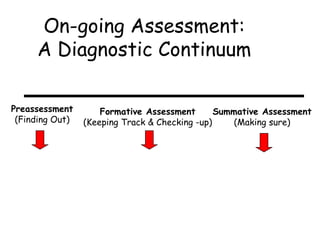
On-going Assessment:
A Diagnostic Continuum
Preassessment
(Finding Out)
Formative Assessment
(Keeping Track & Checking -up)
Summative Assessment
(Making sure)
On-going Assessment:
A Diagnostic Continuum
Preassessment
(Finding Out)
Formative Assessment
(Keeping Track & Checking -up)
Summative Assessment
(Making sure)
Feedback and Goal Setting
Pre-test
KWL
Checklist
Observation/Evaluation
Questioning
Conference Exit Card
Peer evaluation Portfolio Check
3-minute pause Quiz
Observation Journal Entry
Talk around Self-evaluation
Questioning
Unit Test
Performance Task
Product/Exhibit
Demonstration
Portfolio Review
Pre-assessment Is...
Any method, strategy or process used to determine a
student’s current level of readiness or interest in order to
plan for appropriate instruction.
• provides data to determine options for students
• helps determine differences before planning
•helps teacher design activities that are meaningful and
challenging
•allows teachers to meet students where they are
•identifies starting point for instruction
•identifies learning gaps
• makes efficient use of instructional time
Examples of Pre-Assessments:
What Do You Want to Learn About Rome?
Name: _______________________
These are some of the topics we will be studying in our unit on Ancient Rome.
We want to know what you want to learn about. Number your choices from 1
to 8. Make sure that 1 is your favorite and 8 is your least favorite.
____ geography
____ government (laws)
____ agriculture (foods they grew)
____ architecture (buildings)
____ music and art
____ religion and sports
____ roles of men, women, and children
What Can You Tell Us About Rome?
1. What country is Rome in? ________________________________________________
2. What does the word civilization mean?_______________________________________
_________________________________________________________________.
3. Can you give us some examples of different civilizations? ________________________
__________________________________________________________________.
4. Can you name any famous Roman people? ___________________________________
__________________________________________________________________.
5. Many things in our country and culture came from the Romans. Can you think of any?
___________________________________________________________________
___________________________________________________________________
___________________________________________________________________.
Examples of Pre-Assessments: How Do You Like to Learn?
1. I study best when it is quiet. Yes No
2. I am able to ignore the noise of
other people talking while I am working. Yes No
3. I like to work at a table or desk. Yes No
4. I like to work on the floor. Yes No
5. I work hard by myself. Yes No
6. I work hard for my parents or teacher. Yes No
7. I will work on an assignment until it is completed, no
matter what. Yes No
8. Sometimes I get frustrated with my work
and do not finish it. Yes No
9. When my teacher gives an assignment, I like to
have exact steps on how to complete it. Yes No
10. When my teacher gives an assignment, I like to
create my own steps on how to complete it. Yes No
11. I like to work by myself. Yes No
12. I like to work in pairs or in groups. Yes No
13. I like to have unlimited amount of time to work on
an assignment. Yes No
14. I like to have a certain amount of time to work on
an assignment. Yes No
15. I like to learn by moving and doing. Yes No
16. I like to learn while sitting at my desk. Yes No
Formative Assessment Is...
A process of accumulating information about a student’s
progress to help make instructional decisions that will
improve his/her understandings and achievement levels.
• Depicts student’s life as a learner
• used to make instructional adjustments
• alerts the teacher about student misconceptions
“early warning signal”
• allows students to build on previous experiences
• provides regular feedback
• provides evidence of progress
• a aligns with instructional/curricular outcomes
Summative Assessment Is...
A means to determine a student’s mastery and
understanding of information, skills, concepts, or
processes.
• Should reflect formative assessments that precede it
• should match material taught
• may determine student’s exit achievement
• may be tied to a final decision, grade or report
• should align with instructional/curricular outcomes
• may be a form of alternative assessment
. “Teaching facts in
isolation is like
trying to pump
water uphill.”
(Carol Tomlinson)
Differentiation
Strategies
Flexible Grouping
Students are part of many different groups (and also
work alone) based on the match of the task to student
readiness, interest, or learning style.
Teachers may create skills based or interest based
groups that are heterogeneous or homogeneous in
readiness level. Sometimes students select work groups,
and sometimes teachers select them. Sometimes student
group assignments are purposeful and
sometimes random.
RAFT
RAFT is an acronym that stands for
Role of the student. What is the student’s role:
reporter, observer, eyewitness, object?
Audience. Who will be addressed by this raft: the
teacher, other students, a parent, people in the
community, an editor, another object?
Format. What is the best way to present this
information: in a letter, an article, a report, a poem, a
monologue, a picture, a song?
Topic. Who or what is the subject of this writing: a
famous mathematician, a prehistoric cave dweller, a
reaction to a specific event?
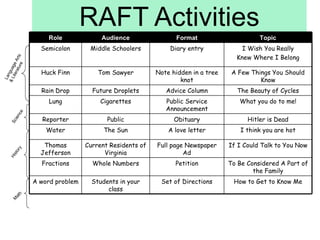
RAFT Activities
Role Audience Format Topic
Semicolon Middle Schoolers Diary entry I Wish You Really
Knew Where I Belong
Huck Finn Tom Sawyer Note hidden in a tree
knot
A Few Things You Should
Know
Rain Drop Future Droplets Advice Column The Beauty of Cycles
Lung Cigarettes Public Service
Announcement
What you do to me!
Reporter Public Obituary Hitler is Dead
Water The Sun A love letter I think you are hot
Thomas
Jefferson
Current Residents of
Virginia
Full page Newspaper
Ad
If I Could Talk to You Now
Fractions Whole Numbers Petition To Be Considered A Part of
the Family
A word problem Students in your
class
Set of Directions How to Get to Know Me
L
a
n
g
u
a
g
e
A
r
t
s
&
L
i
t
e
r
a
t
u
r
e
S
c
i
e
n
c
e
H
i
s
t
o
r
y
M
a
t
h
Entrée (Select One)
•Draw a picture that shows what happens during photosynthesis.
•Write two paragraphs about what happens during photosynthesis.
•Create a rap that explains what happens during photosynthesis.
Diner Menu – Photosynthesis
Appetizer (Everyone Shares)
•Write the chemical equation for photosynthesis.
Side Dishes (Select at Least Two)
•Define respiration, in writing.
•Compare photosynthesis to respiration using a Venn
Diagram.
•Write a journal entry from the point of view of a green
plant.
•With a partner, create and perform a skit that shows the
differences between photosynthesis and respiration.
Dessert (Optional)
•Create a test to assess the teacher’s knowledge of
photosynthesis.
TIC-TAC-TOE Choice Board
For a Book Report
Draw a picture
of the main
character.
Perform a play
that shows the
conclusion of a
story.
Write a song
about one of
the main
events.
Write a poem
about two main
events in the
story.
Make a poster
that shows the
order of events
in the story.
Dress up as
your favorite
character and
perform a
speech telling
who you are.
Create a Venn
diagram
comparing and
contrasting the
introduction to
the closing.
Write two
paragraphs
about the main
character.
Write two
paragraphs
about the
setting.
I will read: I will look at and listen to: I will write:
I will draw: I will need:
Here’s how I will share what I know:
My question or topic is:
I will finish by this date:
To find out about my question or topic…
Learning Contract #1
Name _______________________
Learning Contract #2
To demonstrate what I have learned about ____________________, I want to
_ Write a report
_ Put on a demonstration
_ Set up an experiment
_ Develop a computer presentation
_ Build a model
_ Design a mural
_ Write a song
_ Make a movie
_ Create a graphic organizer or diagram
_ Other
This will be a good way to demonstrate understanding of this concept because
______________________________________________________________
To do this project, I will need help with
______________________________________________________________
My Action Plan is________________________________________________
The criteria/rubric which will be used to assess my final product is _________
______________________________________________________________
My project will be completed by this date _____________________________
Student signature: ________________________________ Date __/__/__
Teacher signature: ________________________________ Date __/__/__
Squaring Off
Whole Group Assessment
1. Place a card in each corner of the room with one of the
following words or phrases that are effective ways to
group according to learner knowledge.
Rarely ever Sometimes Often I have it!
Dirt road Paved road Highway Yellow brick road
5. Tell the students to go to the corner of the room that
matches their place in the learning journey.
6. Participants go to the corner that most closely matches
their own learning status and discuss what they know
about the topic and why they chose to go there.
Gregory, G.H. & Chapman, C. (2001). Differentiated Instructional Strategies: One Size Doesn’t Fit
All. Thousand Oaks CA: Corwin Press.
Yes/No Cards
• Using a 4x6 index card the student writes YES on
one side and NO on the other.
• When a question is asked the students hold up YES
or NO.
• Ask the students if they know the following
vocabulary words and what they mean.
• Call out a word. If a student is holding a YES they
may be called on to give the correct answer.
• Remind them that if they don’t know the words it is
OK because they will be learning them.
• You can do the same thing with conceptual ideas,
etc.
YES
NO
Gregory, G.H. & Chapman, C. (2001). Differentiated Instructional Strategies: One Size Doesn’t
Fit All. Thousand Oaks CA: Corwin Press.
Thumb It!
• Have students respond with the position of their
thumb to get an assessment of what their current
understanding of a topic being studied.
• Where I am now in my understanding of ______?
Up Sideways Down
I know a lot I know some I know very little
Gregory, G.H. & Chapman, C. (2001). Differentiated Instructional Strategies: One Size Doesn’t Fit
All. Thousand Oaks CA: Corwin Press.
Fist of Five
Show the number of fingers on a scale, with 1 being
lowest and 5 the highest.
Ask, How well do you feel you know this
information?
4. I know it so well I could explain it to anyone.
5. I can do it alone.
6. I need some help.
7. I could use more practice.
1. I am only beginning.
Gregory, G.H. & Chapman, C. (2001). Differentiated Instructional Strategies: One Size Doesn’t
Fit All. Thousand Oaks CA: Corwin Press.
Teacher prepared pretests
KWL charts and other graphic organizers
Writing prompts/samples
Questioning
Guess Box
Picture Interpretation
Prediction
Teacher observation/checklists
Student demonstrations and discussions
Initiating activities
Informational surveys/Questionnaires/Inventories
Student interviews
Student products and work samples
Self-evaluations
Portfolio analysis
Game activities
Show of hands to determine understanding
Drawing related to topic or content
Standardized test information
Anticipation journals
What Zone Am I In?
Too Easy
• I get it right away…
• I already know how…
• This is a cinch…
• I’m sure to make an A…
• I’m coasting…
• I feel relaxed…
• I’m bored…
• No big effort
necessary…
On Target
• I know some things…
• I have to think…
• I have to work…
• I have to persist…
• I hit some walls…
• I’m on my toes…
• I have to re-group…
• I feel challenged…
• Effort leads to
success…
Too Hard
• I don’t know where to
start…
• I can’t figure it out…
• I’m spinning my wheels…
• I’m missing key skills…
• I feel frustrated…
• I feel angry
• This makes no sense…
• Effort doesn’t pay off…
THIS is the place to be… THIS is the achievement zone…
Cubing
• Describe It
Look at the subject closely (perhaps with your senses in mind).
• Compare It
What is it similar to? What is it different from?
• Associate It
What does it make you think of? What comes to your mind
when you think of it? Perhaps people? Places? Things?
Feelings? Let your mind go and see what feelings you have for
the subject.
• Analyze It
Tell how it is made. If you can’t really know, use your
imagination.
• Apply It
Tell what you can do with it. How can it be used?
• Argue for It or Against It
Take a stand. Use any kind of reasoning you want—logical, silly,
anywhere in between.
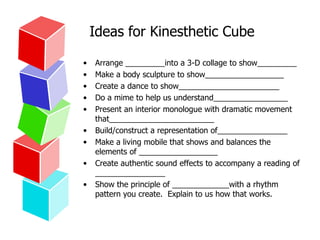
Ideas for Kinesthetic Cube
• Arrange _________into a 3-D collage to show_________
• Make a body sculpture to show__________________
• Create a dance to show_______________________
• Do a mime to help us understand_________________
• Present an interior monologue with dramatic movement
that________________________
• Build/construct a representation of________________
• Make a living mobile that shows and balances the
elements of __________________
• Create authentic sound effects to accompany a reading of
________________
• Show the principle of _____________with a rhythm
pattern you create. Explain to us how that works.
Ideas for Cubing in Math…
• Describe: how you would solve_____________
• Analyze: how this problem helps us use
mathematical thinking and problem solving.
• Compare or Contrast: this problem to one on p._____
• Demonstrate: how a professional (or just a regular
person) could apply this kind of problem
to their work or life.
• Change: one or more numbers (elements, signs) in
the problem. Give a rule for what that
change does.
• Create: an interesting and challenging word
problem from the number problem. (Show us how to
solve it too)
• Diagram or Illustrate: the solution to the problem. Interpret
the visual so we understand.
Differentiated
Instruction as…
THE GREAT
EQUALIZER!!!
Think About…
HOW?
Information, Ideas, Materials, Applications
Representations, Ideas, Applications, Materials
Resources, Research, Issues, Problems, Skills, Goals
Directions, Problems, Application, Solutions, Approaches, Disciplinary Connections
Application, Insight, Transfer
Solutions, Decisions, Approaches
Planning, Designing, Monitoring
Pace of Study, Pace of Thought
The Equalizer
1. Foundational Transformational
3. Concrete Abstract
3. Simple Complex
4. Single Facet Multiple Facets
5. Small Leap Great Leap
6. More Structured More Open
7. Less Independence Greater Independence
8. Slow Quick
Map
Diagram
Sculpture
Discussion
Demonstration
Poem
Profile
Chart
Play
Dance
Campaign
Cassette
Quiz Show
Banner
Brochure
Debate
Flow Chart
Puppet Show
Tour
Lecture
Editorial
Painting
Costume
Placement
Blueprint
Catalogue
Dialogue
Newspaper
Scrapbook
Lecture
Questionnaire
Flag
Scrapbook
Graph
Debate
Museum
Learning Center
Advertisement
Book List
Calendar
Coloring Book
Game
Research Project
TV Show
Song
Dictionary
Film
Collection
Trial
Machine
Book
Mural
Award
Recipe
Test
Puzzle
Model
Timeline
Toy
Article
Diary
Poster
Magazine
Computer
Program
Photographs
Terrarium
Petition Drive
Teaching
Lesson
Prototype
Speech
Club
Cartoon
Biography
Review
Invention
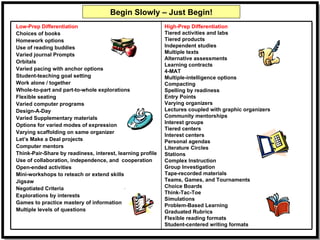
Begin Slowly – Just Begin!
Low-Prep Differentiation
Choices of books
Homework options
Use of reading buddies
Varied journal Prompts
Orbitals
Varied pacing with anchor options
Student-teaching goal setting
Work alone / together
Whole-to-part and part-to-whole explorations
Flexible seating
Varied computer programs
Design-A-Day
Varied Supplementary materials
Options for varied modes of expression
Varying scaffolding on same organizer
Let’s Make a Deal projects
Computer mentors
Think-Pair-Share by readiness, interest, learning profile
Use of collaboration, independence, and cooperation
Open-ended activities
Mini-workshops to reteach or extend skills
Jigsaw
Negotiated Criteria
Explorations by interests
Games to practice mastery of information
Multiple levels of questions
High-Prep Differentiation
Tiered activities and labs
Tiered products
Independent studies
Multiple texts
Alternative assessments
Learning contracts
4-MAT
Multiple-intelligence options
Compacting
Spelling by readiness
Entry Points
Varying organizers
Lectures coupled with graphic organizers
Community mentorships
Interest groups
Tiered centers
Interest centers
Personal agendas
Literature Circles
Stations
Complex Instruction
Group Investigation
Tape-recorded materials
Teams, Games, and Tournaments
Choice Boards
Think-Tac-Toe
Simulations
Problem-Based Learning
Graduated Rubrics
Flexible reading formats
Student-centered writing formats
Reform must come
from within, not
from without.
James Gibbons
WE, are the Agents of
Change… nothing can change
unless we change ourselves
and our ways of teaching
We Need To Ask
We Need To Ask
Ourselves…
Ourselves…
Do all students have access to the
tools, knowledge and guidance that
they need to succeed?
If not, what can we do to give them
those tools?
those tools?
Where do I Go From Here?
Some Tips for Implementing
Differentiation in your
Classroom
Classroom
 Start slowly
Start slowly
 Organize classroom space
Organize classroom space
 Find out student interests
Find out student interests
Where do I Go From Here?
Some Tips for Implementing
Differentiation in your
Classroom
Classroom
 Use technology
Use technology
 Start class with familiar tasks
Start class with familiar tasks
(Do Now)
(Do Now)
 Start student port(data)folios
Start student port(data)folios
Investing Students
Investing Students
Students must “buy-in” to what
you’re doing
you’re doing
Provide choice to students
Adjust physical environment
sit visually impaired at front of room
arrangement of desks
quiet/safe area
quiet/safe area
Increase student accountability
THINK ABOUT
THINK ABOUT
ON-GOING ASSESSMENT
ON-GOING ASSESSMENT
STUDENT DATA
STUDENT DATA
Open response test
Open response test
Oral response
Oral response
Portfolio entry
Portfolio entry
Exhibition
Exhibition
Culminating product
Culminating product
Question writing
Question writing
Problem solving
Problem solving
Journal Entry
Journal Entry
Short Answer Test
Short Answer Test
TEACHER DATA
TEACHER DATA
Anecdotal records
Anecdotal records
Observation by checklist
Skills checklist
Skills checklist
Class discussion
Class discussion
Small group interaction
Teacher – student
Teacher – student
conference
conference
Assessment stations
Assessment stations
Exit cards
Exit cards
Performance tasks and
rubrics
rubrics
DIFFERENTIATED
INSTRUCTION
JUST DO IT!!!
JUST DO IT!!!

differentiatedinstructionpowerpointforpdworkshop-12761774762565-phpapp02 (1).pdf

  • 1.
    Kulanu Torah Academy Professional DevelopmentConference Differentiated Instruction January 29, 2010 Developed By: Sholom Fried MS Ed, SBL, SDL
  • 2.
    “Our task isto provide an education for the kinds of kids we have, not the kinds of kids we used to have, or want to have, or the kids that exist in our dreams.” ~K. P. Gerlach
  • 3.
    Teachers are the Teachersare the lifeblood of our lifeblood of our nation. They educate nation. They educate our children, they our children, they prepare our prepare our workforce, and shape workforce, and shape tomorrows citizens tomorrows citizens
  • 4.
    FACT: FACT: Our nation’sschools Our nation’s schools today are educating the today are educating the largest, most diverse student largest, most diverse student population ever, to higher population ever, to higher standards than ever before. standards than ever before. This is the reason This is the reason why the need for why the need for Differentiated Differentiated Instruction is so Instruction is so necessary necessary
  • 5.
    Differentiated Instruction Defined “Differentiated instructionis a teaching philosophy based on the premise that teachers should adapt instruction to student differences. Rather than marching students through the curriculum lockstep, teachers should modify their instruction to meet students’ varying readiness levels, learning preferences, and interests. Therefore, the teacher proactively plans a variety of ways to ‘get at’ and express learning.” Carol Ann Tomlinson
  • 6.
    What is differentiation? Differentiationis classroom practice that looks eyeball to eyeball with the reality that kids differ, and the most effective teachers do whatever it takes to hook the whole range of kids on learning. -Tomlinson (2001)
  • 7.
    Differentiation is responsive teaching ratherthan one-size- fits-all teaching.
  • 8.
    “It means teachersproactively plan varied approaches to what students need to learn, how they will learn it, and/or how they will show what they have learned in order to increase the likelihood that each student will learn as much as he or she can, as efficiently as possible.”
  • 9.
    Differentiation doesn’t suggest thata teacher can be all things to all individuals all the time. It does, however, mandate that a teacher create a reasonable range of approaches to learning much of the time, so that most students find learning a fit much of the time.
  • 10.
    “Differentiation is makingsure that the right students get the right learning tasks at the right time. Once you have a sense of what each student knows and what he or she needs in order to learn, differentiation is no longer an option; it is an obvious response.”
  • 11.
    At its mostbasic level, differentiating instruction means “shaking up shaking up” what goes on in the classroom so that students have multiple options for taking in information, making sense of ideas, and expressing what they learn.
  • 12.
    Differentiation Is a teacher’sresponse to learner’s needs Guided by general principles of differentiation Meaningful tasks Flexible grouping Continual assessment Teachers can differentiate through Content Process Product Affect/Environment According to students’ Readiness Interest Learning Profile Through a variety of instructional strategies such as: RAFTS…Graphic Organizers…Scaffolding …Cubing…Tic-Tac-Toe…Learning Contracts….Tiering… Learning/Interest Centers… Independent Studies…Intelligence Preferences..Orbitals..Complex Instruction…ETC. Quality Curriculum Building Community
  • 13.
    Key Principles ofa Differentiated Classroom • The teacher is clear about what matters in subject matter. • The teacher understands, appreciates, and builds upon student differences. • Assessment and instruction are inseparable. • The teacher adjusts content, process, and product in response to student readiness, interests, and learning profile. • All students participate in respectful work. • Students and teachers are collaborators in learning. • Goals of a differentiated classroom are maximum growth and individual success. • Flexibility is the hallmark of a differentiated classroom.
  • 14.
    Assumptions We Need ToHave… • Students differ as learners and need appropriate challenge, success, and learning experiences • It’s unlikely that we will achieve challenge, success, and instructional fit for each learner by ignoring student differences
  • 15.
    Assumptions We Need ToHave… • Attending to student differences requires a flexible approach to teaching • Successful attention to student differences must be rooted in solid curriculum and instruction
  • 16.
    Assumptions We Need ToHave… • There are many routes to achieving high quality curriculum taught in ways that attend to student differences and build community • Developing differentiated classrooms calls on us not so much to develop a bag of tricks as to rethink teaching and the power of learning
  • 17.
    Differentiation is aResponse to Beliefs About Teaching and Learning • We probably underestimate the capacity of every child as a learner • Students should be a the center of the learning process. • All learners require meaningful, powerful, and engaging schoolwork to develop their individual capacities so that they can become fulfilled and productive members of society • A major emphasis in learner development is competition against oneself and not against someone else for progression
  • 18.
    Discussion Question What areyou already doing to differentiate instruction in your classroom?
  • 19.
    WE MUST REMEMBER THAT… Excellentdifferentiated classrooms are… excellent FIRST and differentiated SECOND!
  • 20.
    Assessment in a DifferentiatedClassroom • Assessment drives instruction. (Assessment information helps the teacher map next steps for varied learners and the class as a whole.) • Assessment occurs consistently as the unit begins, throughout the unit and as the unit ends. • Teachers assess student readiness, interest and learning profile.
  • 21.
    Assessment in a DifferentiatedClassroom • Assessment is part of “teaching for success.” • Assessment information helps students chart and contribute to their own growth. • Assessment is more focused on personal growth than on peer competition. • Assessment information is more useful to the teacher than grades.
  • 22.
    for Interest – Readiness– Learning Profile by Self – Peers - Teachers
  • 23.
    WHAT CAN BEASSESSED? Skills Concepts READINESS INTEREST LEARNING PROFILE Content Knowledge • Interest Surveys • Interest Centers • Self-Selection • Areas of Strength and Weakness • Work Preferences • Self Awareness
  • 24.
    Most teachers assessstudents at the end of an instructional unit or sequence. When assessment and instruction are interwoven, both the students and the teacher benefit. The next slide suggests a diagnostic continuum for ongoing assessment.
  • 25.
    On-going Assessment: A DiagnosticContinuum Preassessment (Finding Out) Formative Assessment (Keeping Track & Checking -up) Summative Assessment (Making sure)
  • 26.
    On-going Assessment: A DiagnosticContinuum Preassessment (Finding Out) Formative Assessment (Keeping Track & Checking -up) Summative Assessment (Making sure) Feedback and Goal Setting Pre-test KWL Checklist Observation/Evaluation Questioning Conference Exit Card Peer evaluation Portfolio Check 3-minute pause Quiz Observation Journal Entry Talk around Self-evaluation Questioning Unit Test Performance Task Product/Exhibit Demonstration Portfolio Review
  • 27.
    Pre-assessment Is... Any method,strategy or process used to determine a student’s current level of readiness or interest in order to plan for appropriate instruction. • provides data to determine options for students • helps determine differences before planning •helps teacher design activities that are meaningful and challenging •allows teachers to meet students where they are •identifies starting point for instruction •identifies learning gaps • makes efficient use of instructional time
  • 28.
    Examples of Pre-Assessments: WhatDo You Want to Learn About Rome? Name: _______________________ These are some of the topics we will be studying in our unit on Ancient Rome. We want to know what you want to learn about. Number your choices from 1 to 8. Make sure that 1 is your favorite and 8 is your least favorite. ____ geography ____ government (laws) ____ agriculture (foods they grew) ____ architecture (buildings) ____ music and art ____ religion and sports ____ roles of men, women, and children What Can You Tell Us About Rome? 1. What country is Rome in? ________________________________________________ 2. What does the word civilization mean?_______________________________________ _________________________________________________________________. 3. Can you give us some examples of different civilizations? ________________________ __________________________________________________________________. 4. Can you name any famous Roman people? ___________________________________ __________________________________________________________________. 5. Many things in our country and culture came from the Romans. Can you think of any? ___________________________________________________________________ ___________________________________________________________________ ___________________________________________________________________.
  • 29.
    Examples of Pre-Assessments:How Do You Like to Learn? 1. I study best when it is quiet. Yes No 2. I am able to ignore the noise of other people talking while I am working. Yes No 3. I like to work at a table or desk. Yes No 4. I like to work on the floor. Yes No 5. I work hard by myself. Yes No 6. I work hard for my parents or teacher. Yes No 7. I will work on an assignment until it is completed, no matter what. Yes No 8. Sometimes I get frustrated with my work and do not finish it. Yes No 9. When my teacher gives an assignment, I like to have exact steps on how to complete it. Yes No 10. When my teacher gives an assignment, I like to create my own steps on how to complete it. Yes No 11. I like to work by myself. Yes No 12. I like to work in pairs or in groups. Yes No 13. I like to have unlimited amount of time to work on an assignment. Yes No 14. I like to have a certain amount of time to work on an assignment. Yes No 15. I like to learn by moving and doing. Yes No 16. I like to learn while sitting at my desk. Yes No
  • 30.
    Formative Assessment Is... Aprocess of accumulating information about a student’s progress to help make instructional decisions that will improve his/her understandings and achievement levels. • Depicts student’s life as a learner • used to make instructional adjustments • alerts the teacher about student misconceptions “early warning signal” • allows students to build on previous experiences • provides regular feedback • provides evidence of progress • a aligns with instructional/curricular outcomes
  • 31.
    Summative Assessment Is... Ameans to determine a student’s mastery and understanding of information, skills, concepts, or processes. • Should reflect formative assessments that precede it • should match material taught • may determine student’s exit achievement • may be tied to a final decision, grade or report • should align with instructional/curricular outcomes • may be a form of alternative assessment
  • 32.
    . “Teaching factsin isolation is like trying to pump water uphill.” (Carol Tomlinson)
  • 33.
  • 34.
    Flexible Grouping Students arepart of many different groups (and also work alone) based on the match of the task to student readiness, interest, or learning style. Teachers may create skills based or interest based groups that are heterogeneous or homogeneous in readiness level. Sometimes students select work groups, and sometimes teachers select them. Sometimes student group assignments are purposeful and sometimes random.
  • 35.
    RAFT RAFT is anacronym that stands for Role of the student. What is the student’s role: reporter, observer, eyewitness, object? Audience. Who will be addressed by this raft: the teacher, other students, a parent, people in the community, an editor, another object? Format. What is the best way to present this information: in a letter, an article, a report, a poem, a monologue, a picture, a song? Topic. Who or what is the subject of this writing: a famous mathematician, a prehistoric cave dweller, a reaction to a specific event?
  • 36.
    RAFT Activities Role AudienceFormat Topic Semicolon Middle Schoolers Diary entry I Wish You Really Knew Where I Belong Huck Finn Tom Sawyer Note hidden in a tree knot A Few Things You Should Know Rain Drop Future Droplets Advice Column The Beauty of Cycles Lung Cigarettes Public Service Announcement What you do to me! Reporter Public Obituary Hitler is Dead Water The Sun A love letter I think you are hot Thomas Jefferson Current Residents of Virginia Full page Newspaper Ad If I Could Talk to You Now Fractions Whole Numbers Petition To Be Considered A Part of the Family A word problem Students in your class Set of Directions How to Get to Know Me L a n g u a g e A r t s & L i t e r a t u r e S c i e n c e H i s t o r y M a t h
  • 37.
    Entrée (Select One) •Drawa picture that shows what happens during photosynthesis. •Write two paragraphs about what happens during photosynthesis. •Create a rap that explains what happens during photosynthesis. Diner Menu – Photosynthesis Appetizer (Everyone Shares) •Write the chemical equation for photosynthesis. Side Dishes (Select at Least Two) •Define respiration, in writing. •Compare photosynthesis to respiration using a Venn Diagram. •Write a journal entry from the point of view of a green plant. •With a partner, create and perform a skit that shows the differences between photosynthesis and respiration. Dessert (Optional) •Create a test to assess the teacher’s knowledge of photosynthesis.
  • 38.
    TIC-TAC-TOE Choice Board Fora Book Report Draw a picture of the main character. Perform a play that shows the conclusion of a story. Write a song about one of the main events. Write a poem about two main events in the story. Make a poster that shows the order of events in the story. Dress up as your favorite character and perform a speech telling who you are. Create a Venn diagram comparing and contrasting the introduction to the closing. Write two paragraphs about the main character. Write two paragraphs about the setting.
  • 39.
    I will read:I will look at and listen to: I will write: I will draw: I will need: Here’s how I will share what I know: My question or topic is: I will finish by this date: To find out about my question or topic… Learning Contract #1 Name _______________________
  • 40.
    Learning Contract #2 Todemonstrate what I have learned about ____________________, I want to _ Write a report _ Put on a demonstration _ Set up an experiment _ Develop a computer presentation _ Build a model _ Design a mural _ Write a song _ Make a movie _ Create a graphic organizer or diagram _ Other This will be a good way to demonstrate understanding of this concept because ______________________________________________________________ To do this project, I will need help with ______________________________________________________________ My Action Plan is________________________________________________ The criteria/rubric which will be used to assess my final product is _________ ______________________________________________________________ My project will be completed by this date _____________________________ Student signature: ________________________________ Date __/__/__ Teacher signature: ________________________________ Date __/__/__
  • 41.
    Squaring Off Whole GroupAssessment 1. Place a card in each corner of the room with one of the following words or phrases that are effective ways to group according to learner knowledge. Rarely ever Sometimes Often I have it! Dirt road Paved road Highway Yellow brick road 5. Tell the students to go to the corner of the room that matches their place in the learning journey. 6. Participants go to the corner that most closely matches their own learning status and discuss what they know about the topic and why they chose to go there. Gregory, G.H. & Chapman, C. (2001). Differentiated Instructional Strategies: One Size Doesn’t Fit All. Thousand Oaks CA: Corwin Press.
  • 42.
    Yes/No Cards • Usinga 4x6 index card the student writes YES on one side and NO on the other. • When a question is asked the students hold up YES or NO. • Ask the students if they know the following vocabulary words and what they mean. • Call out a word. If a student is holding a YES they may be called on to give the correct answer. • Remind them that if they don’t know the words it is OK because they will be learning them. • You can do the same thing with conceptual ideas, etc. YES NO Gregory, G.H. & Chapman, C. (2001). Differentiated Instructional Strategies: One Size Doesn’t Fit All. Thousand Oaks CA: Corwin Press.
  • 43.
    Thumb It! • Havestudents respond with the position of their thumb to get an assessment of what their current understanding of a topic being studied. • Where I am now in my understanding of ______? Up Sideways Down I know a lot I know some I know very little Gregory, G.H. & Chapman, C. (2001). Differentiated Instructional Strategies: One Size Doesn’t Fit All. Thousand Oaks CA: Corwin Press.
  • 44.
    Fist of Five Showthe number of fingers on a scale, with 1 being lowest and 5 the highest. Ask, How well do you feel you know this information? 4. I know it so well I could explain it to anyone. 5. I can do it alone. 6. I need some help. 7. I could use more practice. 1. I am only beginning. Gregory, G.H. & Chapman, C. (2001). Differentiated Instructional Strategies: One Size Doesn’t Fit All. Thousand Oaks CA: Corwin Press.
  • 45.
    Teacher prepared pretests KWLcharts and other graphic organizers Writing prompts/samples Questioning Guess Box Picture Interpretation Prediction Teacher observation/checklists Student demonstrations and discussions Initiating activities Informational surveys/Questionnaires/Inventories Student interviews Student products and work samples Self-evaluations Portfolio analysis Game activities Show of hands to determine understanding Drawing related to topic or content Standardized test information Anticipation journals
  • 46.
    What Zone AmI In? Too Easy • I get it right away… • I already know how… • This is a cinch… • I’m sure to make an A… • I’m coasting… • I feel relaxed… • I’m bored… • No big effort necessary… On Target • I know some things… • I have to think… • I have to work… • I have to persist… • I hit some walls… • I’m on my toes… • I have to re-group… • I feel challenged… • Effort leads to success… Too Hard • I don’t know where to start… • I can’t figure it out… • I’m spinning my wheels… • I’m missing key skills… • I feel frustrated… • I feel angry • This makes no sense… • Effort doesn’t pay off… THIS is the place to be… THIS is the achievement zone…
  • 47.
    Cubing • Describe It Lookat the subject closely (perhaps with your senses in mind). • Compare It What is it similar to? What is it different from? • Associate It What does it make you think of? What comes to your mind when you think of it? Perhaps people? Places? Things? Feelings? Let your mind go and see what feelings you have for the subject. • Analyze It Tell how it is made. If you can’t really know, use your imagination. • Apply It Tell what you can do with it. How can it be used? • Argue for It or Against It Take a stand. Use any kind of reasoning you want—logical, silly, anywhere in between.
  • 48.
    Ideas for KinestheticCube • Arrange _________into a 3-D collage to show_________ • Make a body sculpture to show__________________ • Create a dance to show_______________________ • Do a mime to help us understand_________________ • Present an interior monologue with dramatic movement that________________________ • Build/construct a representation of________________ • Make a living mobile that shows and balances the elements of __________________ • Create authentic sound effects to accompany a reading of ________________ • Show the principle of _____________with a rhythm pattern you create. Explain to us how that works.
  • 49.
    Ideas for Cubingin Math… • Describe: how you would solve_____________ • Analyze: how this problem helps us use mathematical thinking and problem solving. • Compare or Contrast: this problem to one on p._____ • Demonstrate: how a professional (or just a regular person) could apply this kind of problem to their work or life. • Change: one or more numbers (elements, signs) in the problem. Give a rule for what that change does. • Create: an interesting and challenging word problem from the number problem. (Show us how to solve it too) • Diagram or Illustrate: the solution to the problem. Interpret the visual so we understand.
  • 50.
  • 51.
  • 52.
    Information, Ideas, Materials,Applications Representations, Ideas, Applications, Materials Resources, Research, Issues, Problems, Skills, Goals Directions, Problems, Application, Solutions, Approaches, Disciplinary Connections Application, Insight, Transfer Solutions, Decisions, Approaches Planning, Designing, Monitoring Pace of Study, Pace of Thought The Equalizer 1. Foundational Transformational 3. Concrete Abstract 3. Simple Complex 4. Single Facet Multiple Facets 5. Small Leap Great Leap 6. More Structured More Open 7. Less Independence Greater Independence 8. Slow Quick
  • 53.
    Map Diagram Sculpture Discussion Demonstration Poem Profile Chart Play Dance Campaign Cassette Quiz Show Banner Brochure Debate Flow Chart PuppetShow Tour Lecture Editorial Painting Costume Placement Blueprint Catalogue Dialogue Newspaper Scrapbook Lecture Questionnaire Flag Scrapbook Graph Debate Museum Learning Center Advertisement Book List Calendar Coloring Book Game Research Project TV Show Song Dictionary Film Collection Trial Machine Book Mural Award Recipe Test Puzzle Model Timeline Toy Article Diary Poster Magazine Computer Program Photographs Terrarium Petition Drive Teaching Lesson Prototype Speech Club Cartoon Biography Review Invention
  • 54.
    Begin Slowly –Just Begin! Low-Prep Differentiation Choices of books Homework options Use of reading buddies Varied journal Prompts Orbitals Varied pacing with anchor options Student-teaching goal setting Work alone / together Whole-to-part and part-to-whole explorations Flexible seating Varied computer programs Design-A-Day Varied Supplementary materials Options for varied modes of expression Varying scaffolding on same organizer Let’s Make a Deal projects Computer mentors Think-Pair-Share by readiness, interest, learning profile Use of collaboration, independence, and cooperation Open-ended activities Mini-workshops to reteach or extend skills Jigsaw Negotiated Criteria Explorations by interests Games to practice mastery of information Multiple levels of questions High-Prep Differentiation Tiered activities and labs Tiered products Independent studies Multiple texts Alternative assessments Learning contracts 4-MAT Multiple-intelligence options Compacting Spelling by readiness Entry Points Varying organizers Lectures coupled with graphic organizers Community mentorships Interest groups Tiered centers Interest centers Personal agendas Literature Circles Stations Complex Instruction Group Investigation Tape-recorded materials Teams, Games, and Tournaments Choice Boards Think-Tac-Toe Simulations Problem-Based Learning Graduated Rubrics Flexible reading formats Student-centered writing formats
  • 55.
    Reform must come fromwithin, not from without. James Gibbons WE, are the Agents of Change… nothing can change unless we change ourselves and our ways of teaching
  • 56.
    We Need ToAsk We Need To Ask Ourselves… Ourselves… Do all students have access to the Do all students have access to the tools, knowledge and guidance that tools, knowledge and guidance that they need to succeed? they need to succeed? If not, what can we do to give them If not, what can we do to give them those tools? those tools?
  • 57.
    Where do IGo From Here? Where do I Go From Here? Some Tips for Implementing Some Tips for Implementing Differentiation in your Differentiation in your Classroom Classroom  Start slowly Start slowly  Organize classroom space Organize classroom space  Find out student interests Find out student interests
  • 58.
    Where do IGo From Here? Where do I Go From Here? Some Tips for Implementing Some Tips for Implementing Differentiation in your Differentiation in your Classroom Classroom  Use technology Use technology  Start class with familiar tasks Start class with familiar tasks (Do Now) (Do Now)  Start student port(data)folios Start student port(data)folios
  • 59.
    Investing Students Investing Students Studentsmust “buy-in” to what Students must “buy-in” to what you’re doing you’re doing Provide choice to students Provide choice to students Adjust physical environment Adjust physical environment sit visually impaired at front of room sit visually impaired at front of room arrangement of desks arrangement of desks quiet/safe area quiet/safe area Increase student accountability Increase student accountability
  • 60.
    THINK ABOUT THINK ABOUT ON-GOINGASSESSMENT ON-GOING ASSESSMENT STUDENT DATA STUDENT DATA Open response test Open response test Oral response Oral response Portfolio entry Portfolio entry Exhibition Exhibition Culminating product Culminating product Question writing Question writing Problem solving Problem solving Journal Entry Journal Entry Short Answer Test Short Answer Test TEACHER DATA TEACHER DATA Anecdotal records Anecdotal records Observation by checklist Observation by checklist Skills checklist Skills checklist Class discussion Class discussion Small group interaction Small group interaction Teacher – student Teacher – student conference conference Assessment stations Assessment stations Exit cards Exit cards Performance tasks and Performance tasks and rubrics rubrics
  • 61.