MERCHANT VESSELS
A merchant vessel or trading vessel is a boat or ship that transports cargo or carries passengers for hire. This excludes pleasure craft that do
not carry passengers for hire and warships
Bressi Letizia
Simio Concolino Samuele
DRY CARGO SHIPS
A cargo ship or freighter
is any sort of ship or
vessel that carries cargo,
goods, and materials
from one port to
another. Cargo ships are
usually specially
designed for the task,
often being equipped
with cranes and other
mechanisms to load and
unload, and come in all
sizes.
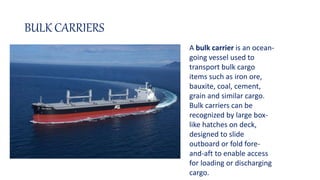
BULK CARRIERS
A bulk carrier is an ocean-
going vessel used to
transport bulk cargo
items such as iron ore,
bauxite, coal, cement,
grain and similar cargo.
Bulk carriers can be
recognized by large box-
like hatches on deck,
designed to slide
outboard or fold fore-
and-aft to enable access
for loading or discharging
cargo.
CONTAINER SHIPS
Container ships are cargo
ships that carry all of their
load in truck-size
containers, in a technique
called containerization.
They form a common
means of commercial
intermodal freight
transport.
TANKERS
A tanker is a ship
designed to transport
liquids in bulk.
Oil tankers for the
transport of fluids, such
as crude oil, petroleum
products, liquefied
petroleum gas, liquefied
natural gas and chemicals,
also vegetable oils, wine
and other food - the
tanker sector comprises
one third of the world
tonnage
COASTERS
Coasters, smaller ships for any
category of cargo which are
normally not on ocean-
crossing routes, but in
coastwise trades. Coasters are
shallow-hulled ships used for
trade between locations on
the same island or continent.
Their shallow hulls mean that
they can get through reefs
where seagoing ships usually
cannot (seagoing ships have a
very deep hull for supplies
and trade, etc)
PASSENGER SHIPS
A passenger ship is a ship
whose primary function is
to carry passengers. The
category does not include
cargo vessels which have
accommodations for
limited numbers of
passengers, such as the
formerly ubiquitous
twelve-passenger
freighters in which the
transport of passengers is
secondary to the carriage
of freight.

Different vessels

  • 1.
    MERCHANT VESSELS A merchantvessel or trading vessel is a boat or ship that transports cargo or carries passengers for hire. This excludes pleasure craft that do not carry passengers for hire and warships Bressi Letizia Simio Concolino Samuele
  • 2.
    DRY CARGO SHIPS Acargo ship or freighter is any sort of ship or vessel that carries cargo, goods, and materials from one port to another. Cargo ships are usually specially designed for the task, often being equipped with cranes and other mechanisms to load and unload, and come in all sizes.
  • 3.
    BULK CARRIERS A bulkcarrier is an ocean- going vessel used to transport bulk cargo items such as iron ore, bauxite, coal, cement, grain and similar cargo. Bulk carriers can be recognized by large box- like hatches on deck, designed to slide outboard or fold fore- and-aft to enable access for loading or discharging cargo.
  • 4.
    CONTAINER SHIPS Container shipsare cargo ships that carry all of their load in truck-size containers, in a technique called containerization. They form a common means of commercial intermodal freight transport.
  • 5.
    TANKERS A tanker isa ship designed to transport liquids in bulk. Oil tankers for the transport of fluids, such as crude oil, petroleum products, liquefied petroleum gas, liquefied natural gas and chemicals, also vegetable oils, wine and other food - the tanker sector comprises one third of the world tonnage
  • 6.
    COASTERS Coasters, smaller shipsfor any category of cargo which are normally not on ocean- crossing routes, but in coastwise trades. Coasters are shallow-hulled ships used for trade between locations on the same island or continent. Their shallow hulls mean that they can get through reefs where seagoing ships usually cannot (seagoing ships have a very deep hull for supplies and trade, etc)
  • 7.
    PASSENGER SHIPS A passengership is a ship whose primary function is to carry passengers. The category does not include cargo vessels which have accommodations for limited numbers of passengers, such as the formerly ubiquitous twelve-passenger freighters in which the transport of passengers is secondary to the carriage of freight.