









Different approaches to
sustainable development
BY: MARYAM ELSADEK
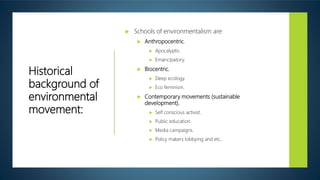
Historical
background of
environmental
movement:
 Schools of environmentalism are:
 Anthropocentric.
 Apocalyptic.
 Emancipatory.
 Biocentric.
 Deep ecology.
 Eco feminism.
 Contemporary movements (sustainable
development).
 Self conscious activist.
 Public education.
 Media campaigns.
 Policy makers lobbying and etc..
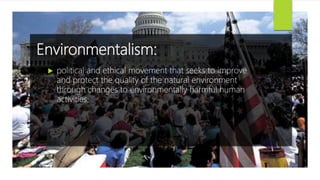
Environmentalism:
 political and ethical movement that seeks to improve
and protect the quality of the natural environment
through changes to environmentally harmful human
activities.
Anthropocentric school:
Human centric.
01
focus mainly on the
negative effects that
environmental
has on human beings and
their interests.
02
including their interests
in health, recreation, and
quality of life.
03
Anthropocentric: Apocalyptic.Emancipatory.
Emancipatory:
 Develop strategies for limiting environmental
degradation through Recycling, the use of alternative
energy technologies,
 The decentralization and democratization of economic
and social planning, and, for some, a reorganization of
major industrial sectors.
 Postmaterialist.
Apocalyptic:
 Humanity’s ability to find
or to invent substitutes
for resources that were
scarce and in danger of
being exhausted.
 Resources like: Rachel
Carson about silent
spring.
Biocentrism:
Deep Ecofeminism
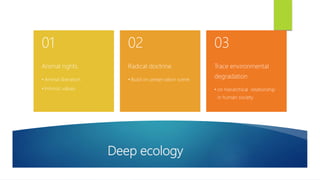
Deep ecology
Animal rights.
• Animal liberation.
• Intrinsic values.
01
Radical doctrine.
• Build on preservation scene.
02
Trace environmental
degradation
• on hierarchical relationship
in human society.
03
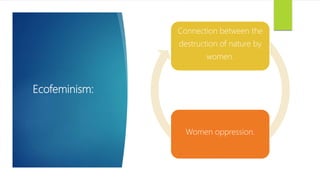
Ecofeminism:
Connection between the
destruction of nature by
women.
Women oppression.
Contemporary movement:
Self conscious
activists.
Public education.
Media
campaigns.
Community
directed activities.
lobbying to policy
makers.
Recycling.
Green
consumerism.
Sustainability.
Diagrams to explain the
sustainable development
perspectives
Permanence.
Persons.
Places.
Psychological
Physical
Geographical
Cultural.
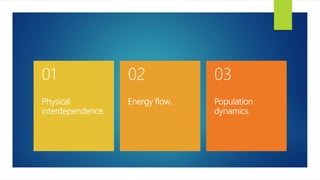
Physical
interdependence.
01
Energy flow.
02
Population
dynamics.
03
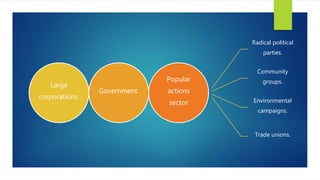
Large
corporations.
Government.
Popular
actions
sector
Radical political
parties.
Community
groups.
Environmental
campaigns.
Trade unions.
Citizenship
ConsumptionProduction
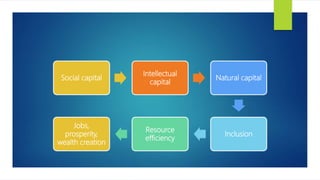
Social capital
Intellectual
capital
Natural capital
Inclusion
Resource
efficiency
Jobs,
prosperity,
wealth creation
Reference:
 http://06107rd8c.1104.y.h
ttps.academic.eb.com.mp
lbci.ekb.eg/levels/collegia
te/article/environmentalis
m/32737.

Different approaches to sustainable development