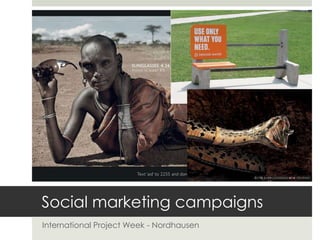
Social marketing campaignsInternational Project Week - Nordhausen
TodayPresentations (case, background, purpose, focus and environmental analysisStep 3- 5:Select target marketSet objectives and goalsIdentify competition, barriers and motivators…Feedback / help
Step 3: establishing target audiences
Target market? “ A set of buyers sharing common needs or characteristics that the company decides to serve” Kotler & Armstrong 2001
ExampleChildren (Happy Meal)! Toys; logoWorkingparentsGrand parents; have funFree coffeeonMondaymorningfor yups?http://www.youtube.com/watch?v=Cg87E1tjTOE&feature=player_embedded
Audience segmentation: WHY?To identify distinct groups of people who are like each other in key ways and, therefore, are liable to respond to particular messages similarlyNot all people are the same, so not all people can be treated the sameCommunication target group =group of people you can effectively reach through the same kind of media and channels with the same kind of message(s). If not? 					SEGMENTATION
Audience segmentation: WHY?Effective use of resourcesCustomized strategiesAppropriate channels of communicationProviding opportunity to establish partnerships with audience focus (i.e. funding support)Identification of the “easier to change” audiences (Diffusion of Innovations Theory)
Segmentation criteriaBreak your audiences into similar groups based on things such as (relevant to the issue/behaviour):Geographical factorsDemographical factorsPhysical/medical statusPsychographic factors (lifestyle; personality; values; interestsetc.)Attitudes towardsbehaviour/issueBehavioural factors(heavy usersvslightusers)Etc.
Apply to smokers Smoking status (current smoker/not current smoker)Desire to quit (yes/ambivalent/no)Ever tried to quit (yes/no)Self-efficacy about quitting (high/medium/low)Attitudes about consequences (worried/not worried/fatalistic)Age (child/teenager/young adult/middle-aged/older adult)Gender (female/male)Lifestyle (like to go out; like to sport etc.).
Stages of change modelProcontemplation: people at this stage usually have no intention of changing their behavior, and typically deny having a problemContemplation: people acknowledge that they have a problem and begin to think seriously about solving itPreparation: People are planning to take actionAction: People overtly modify their behavior and their surroundingsMaintenance: People work to consolidate the gains attained during action and struggle to prevent lapses and relapseTermination: former addiction or problem will no longer present any temptation or threat.
Seven criteria good segmentationClarity; IdentifiableAccessibleBig enoughDifferent fromeachother; uniqueHomogeneouswithin the groupsStableAnchorpoints/directionforcommunication
Motivactionhttp://xs.motivaction.nl/s.r4a?extid=200&d=74318240&k=ydzkhppxSlides on motivaction
What to do?Segment the marketEvaluate segmentsChoose one or more segments to targetAssignment 1:Segment a target market and motivate your choices by analysis.
Photo credit: zoom in tightStep 4: Setting objectives and goals
Objectives in social marketing	Behavior objectivesBelief / attitude objectivesKnowledge objectivesSounds logical!But is it?
SMART objectives are objectives that are...Specific: they describe a specific outcome linked to a rate, number, percentage or frequencyMeasurable: they include a rate, number, percentage or frequencyAchievable: with a reasonable amount of effort, they can actually be achievedRelevant: the people involved have the necessary knowledge, authority and skillTime-based: they include a clearly stated or defined finish and/or start date
Examples of objectivesTurn off computer monitors when leaving work at the end of the dayBuy bulk and unpackaged goods rather than packaged itemsGive 5 hours a week to a volunteer effortAre these objectives SMART?Could you rephrase these objectives?
Example reduce birth defects
What to do?Establish goals and objectives for your campaignDefine objectives in terms of knowlegde, beliefs and behaviorAssignment 2:Define your goals and objectives
Photo credit: MonitorpopStep 5: Deepeningyourunderstanding of the target audience
Exchange theory in marketing“In order foran exchange to take place, target markets must perceivebenefitsequal to orgreaterthanperceivedcosts.”Thistheorycanbeapplied to more than the purchase of goods, itcaninvolve e.g. symbolicproducts and payments are notlimited to financialones (e.g. time and effort).
Perspectiveson exchangeBarriers: the “costs” the target audienceperceivesBenefits:  What are potential “motivators” for the target audience?Competition: Whatbenefits does the audienceperceive in competing offers? What do competing offers cost? How do theycompare to your offer?
Peoplewhotake the bus can’taffordanyother mode of transportPhotocredit: LokomevTaking a bus willtakelongerthandriving to workRealPerceivedKnowledge
Beliefs
Skills
Abilities
…InternalBarriersExternalInfrastructures
Technology
Culturalinfluences
Ecnomicsituation
…BenefitsSomethingyour target markt wants orneeds and therforevaluesthat the behavioryou are promoting has the potential to provide. Whatmotivatesyouraudience to act?
CompetitionWhat is competition in social marketing?Behaviorsour target audiencewouldprefer over the ones we are promoting (e.g. use of pills over condoms in preventingunwantedpregnancies)Behaviors the have been doing ‘forever’ thatheywould have to give up (e.g. drivingalone to work)Organizations and individualswhosendmessagesthat counter oroppose the desiredbehavior (e.g. Marlborro man)
Tactics …Increase the benefits of the target behaviorDecrease the barriers (and/orcosts) to the target behavior(s)Decrease the benefits of the competingbehavior(s)Increase the barriers (and / orcosts) of the competingbehavior
Whattactics are usedhere?BingedrinkingcampaignCampaignby British Government

Dienstag

  • 1.
  • 2.
    TodayPresentations (case, background,purpose, focus and environmental analysisStep 3- 5:Select target marketSet objectives and goalsIdentify competition, barriers and motivators…Feedback / help
  • 3.
    Step 3: establishingtarget audiences
  • 4.
    Target market? “A set of buyers sharing common needs or characteristics that the company decides to serve” Kotler & Armstrong 2001
  • 5.
    ExampleChildren (Happy Meal)!Toys; logoWorkingparentsGrand parents; have funFree coffeeonMondaymorningfor yups?http://www.youtube.com/watch?v=Cg87E1tjTOE&feature=player_embedded
  • 6.
    Audience segmentation: WHY?Toidentify distinct groups of people who are like each other in key ways and, therefore, are liable to respond to particular messages similarlyNot all people are the same, so not all people can be treated the sameCommunication target group =group of people you can effectively reach through the same kind of media and channels with the same kind of message(s). If not? SEGMENTATION
  • 7.
    Audience segmentation: WHY?Effectiveuse of resourcesCustomized strategiesAppropriate channels of communicationProviding opportunity to establish partnerships with audience focus (i.e. funding support)Identification of the “easier to change” audiences (Diffusion of Innovations Theory)
  • 8.
    Segmentation criteriaBreak youraudiences into similar groups based on things such as (relevant to the issue/behaviour):Geographical factorsDemographical factorsPhysical/medical statusPsychographic factors (lifestyle; personality; values; interestsetc.)Attitudes towardsbehaviour/issueBehavioural factors(heavy usersvslightusers)Etc.
  • 9.
    Apply to smokersSmoking status (current smoker/not current smoker)Desire to quit (yes/ambivalent/no)Ever tried to quit (yes/no)Self-efficacy about quitting (high/medium/low)Attitudes about consequences (worried/not worried/fatalistic)Age (child/teenager/young adult/middle-aged/older adult)Gender (female/male)Lifestyle (like to go out; like to sport etc.).
  • 10.
    Stages of changemodelProcontemplation: people at this stage usually have no intention of changing their behavior, and typically deny having a problemContemplation: people acknowledge that they have a problem and begin to think seriously about solving itPreparation: People are planning to take actionAction: People overtly modify their behavior and their surroundingsMaintenance: People work to consolidate the gains attained during action and struggle to prevent lapses and relapseTermination: former addiction or problem will no longer present any temptation or threat.
  • 11.
    Seven criteria goodsegmentationClarity; IdentifiableAccessibleBig enoughDifferent fromeachother; uniqueHomogeneouswithin the groupsStableAnchorpoints/directionforcommunication
  • 12.
  • 13.
    What to do?Segmentthe marketEvaluate segmentsChoose one or more segments to targetAssignment 1:Segment a target market and motivate your choices by analysis.
  • 14.
    Photo credit: zoomin tightStep 4: Setting objectives and goals
  • 15.
    Objectives in socialmarketing Behavior objectivesBelief / attitude objectivesKnowledge objectivesSounds logical!But is it?
  • 16.
    SMART objectives areobjectives that are...Specific: they describe a specific outcome linked to a rate, number, percentage or frequencyMeasurable: they include a rate, number, percentage or frequencyAchievable: with a reasonable amount of effort, they can actually be achievedRelevant: the people involved have the necessary knowledge, authority and skillTime-based: they include a clearly stated or defined finish and/or start date
  • 17.
    Examples of objectivesTurnoff computer monitors when leaving work at the end of the dayBuy bulk and unpackaged goods rather than packaged itemsGive 5 hours a week to a volunteer effortAre these objectives SMART?Could you rephrase these objectives?
  • 18.
  • 19.
    What to do?Establishgoals and objectives for your campaignDefine objectives in terms of knowlegde, beliefs and behaviorAssignment 2:Define your goals and objectives
  • 20.
    Photo credit: MonitorpopStep5: Deepeningyourunderstanding of the target audience
  • 21.
    Exchange theory inmarketing“In order foran exchange to take place, target markets must perceivebenefitsequal to orgreaterthanperceivedcosts.”Thistheorycanbeapplied to more than the purchase of goods, itcaninvolve e.g. symbolicproducts and payments are notlimited to financialones (e.g. time and effort).
  • 22.
    Perspectiveson exchangeBarriers: the“costs” the target audienceperceivesBenefits: What are potential “motivators” for the target audience?Competition: Whatbenefits does the audienceperceive in competing offers? What do competing offers cost? How do theycompare to your offer?
  • 23.
    Peoplewhotake the buscan’taffordanyother mode of transportPhotocredit: LokomevTaking a bus willtakelongerthandriving to workRealPerceivedKnowledge
  • 24.
  • 25.
  • 26.
  • 27.
  • 28.
  • 29.
  • 30.
  • 31.
    …BenefitsSomethingyour target marktwants orneeds and therforevaluesthat the behavioryou are promoting has the potential to provide. Whatmotivatesyouraudience to act?
  • 32.
    CompetitionWhat is competitionin social marketing?Behaviorsour target audiencewouldprefer over the ones we are promoting (e.g. use of pills over condoms in preventingunwantedpregnancies)Behaviors the have been doing ‘forever’ thatheywould have to give up (e.g. drivingalone to work)Organizations and individualswhosendmessagesthat counter oroppose the desiredbehavior (e.g. Marlborro man)
  • 33.
    Tactics …Increase thebenefits of the target behaviorDecrease the barriers (and/orcosts) to the target behavior(s)Decrease the benefits of the competingbehavior(s)Increase the barriers (and / orcosts) of the competingbehavior
  • 34.