













Introduction to Social
Marketing Planning for
Behaviour Change
Presented by:
Jim Mintz
What we do
• Product & Service Marketing
• Policy & Program Marketing
• Social Marketing
• Sponsorship/Partnerships
• Organizational Branding
• Social Media/Digital Engagement
Agenda
• Introductions
• Overview: Social marketing
• Developing the Plan I
• Lunch
• Developing the Plan II
• Wrap up
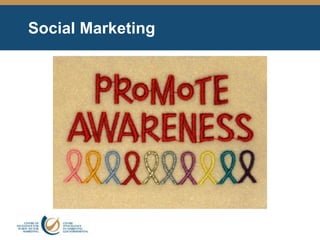
Social Marketing
Social Marketing
Social Marketing
Social Marketing
Social Marketing
Organizations
don’t plan to fail
… they fail to
plan
Social Marketing
“Social marketing is simply about
influencing the behaviour of target
audiences. There are many more
target audiences who need to act
besides “problem people” if we are
to solve major social problems.”
Alan Andreasen, Social Marketing in the 21st
Century
Social Marketing
What are the Benefits
of Adopting a Social
Marketing Approach?
Benefits of Social Marketing
Comprehensive integrated innovative strategic approach
Integrate and coordinate other components
Make better resource decisions
Assist in attraction of resources
Benefits of Social Marketing
Executing integrated campaigns
Offers an organization a strategic framework from which to
work
Building your reputation with stakeholders
Providing a performance measurement framework
Social Marketing
Social Marketing is a Way of Thinking
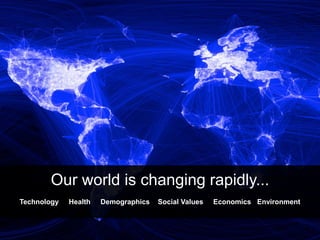
Our world is changing rapidly...
Technology Health Demographics Social Values Economics Environment
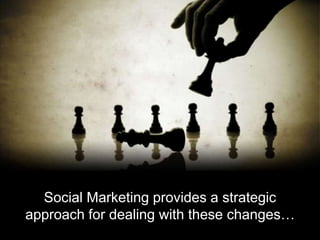
Social Marketing provides a strategic
approach for dealing with these changes…
Social Marketing
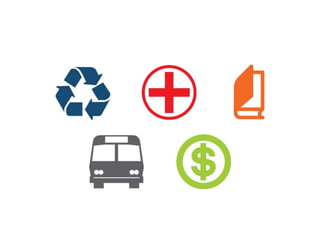
Who is doing Social Marketing to
change peoples attitudes and
encourage behaviour change?
• Barrier of introducing "performance
based culture”
• Conflict with core values
• Requires significant management
support and time
Challenges of
Introducing Social
Marketing into a
Public Sector/ Non-
Profit Organization
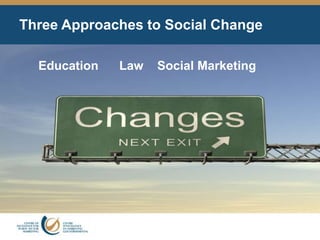
Three Approaches to Social Change
Education Law Social Marketing
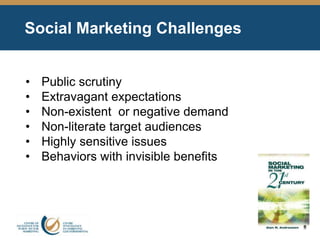
Social Marketing Challenges
• Public scrutiny
• Extravagant expectations
• Non-existent or negative demand
• Non-literate target audiences
• Highly sensitive issues
• Behaviors with invisible benefits
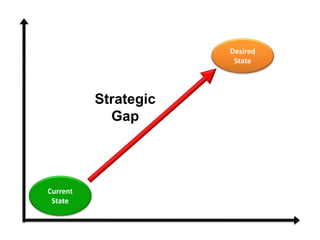
Current
State
Desired
State
Strategic
Gap
Current
State
Desired
State
Strategic
Gap
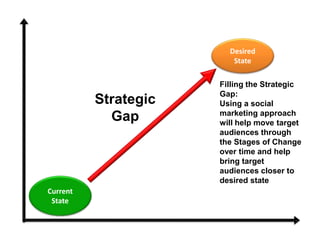
Filling the Strategic
Gap:
Using a social
marketing approach
will help move target
audiences through
the Stages of Change
over time and help
bring target
audiences closer to
desired state
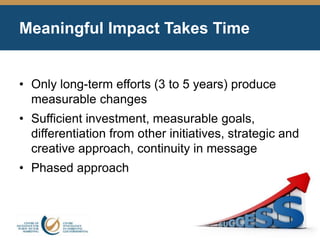
Meaningful Impact Takes Time
• Only long-term efforts (3 to 5 years) produce
measurable changes
• Sufficient investment, measurable goals,
differentiation from other initiatives, strategic and
creative approach, continuity in message
• Phased approach
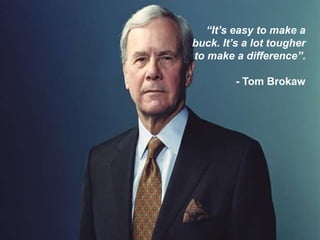
“It’s easy to make a
buck. It’s a lot tougher
to make a difference”.
- Tom Brokaw
Let’s Get Started
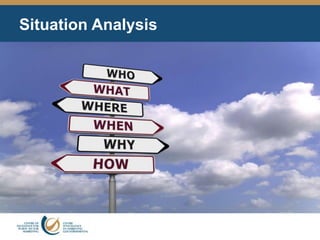
Situation Analysis
Background and Issue Definition
• The intended impact of a
successful campaign
• The campaign focus
• The purpose of the campaign
Environmental Scan
An environmental scan is a
synopsis of research on external
factors that could affect your
campaign
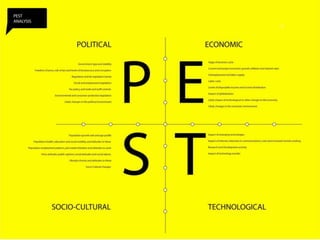
PEST Analysis
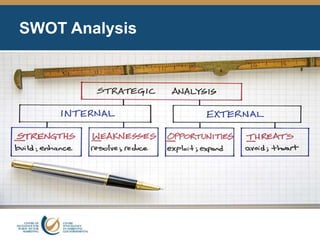
SWOT Analysis
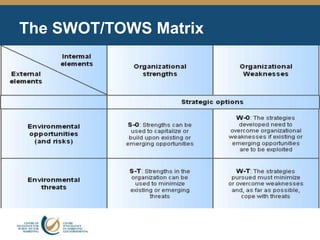
The SWOT/TOWS Matrix
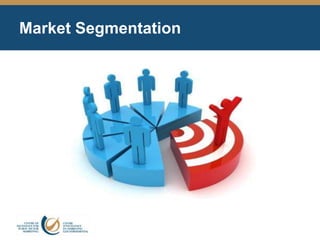
Market Segmentation
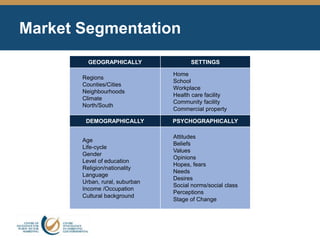
Market Segmentation
GEOGRAPHICALLY SETTINGS
Regions
Counties/Cities
Neighbourhoods
Climate
North/South
Home
School
Workplace
Health care facility
Community facility
Commercial property
DEMOGRAPHICALLY PSYCHOGRAPHICALLY
Age
Life-cycle
Gender
Level of education
Religion/nationality
Language
Urban, rural, suburban
Income /Occupation
Cultural background
Attitudes
Beliefs
Values
Opinions
Hopes, fears
Needs
Desires
Social norms/social class
Perceptions
Stage of Change
Identifying Target Audiences
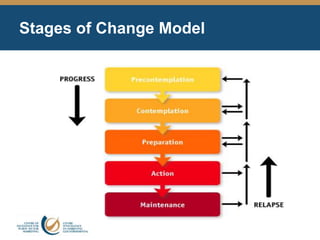
Stages of Change Model
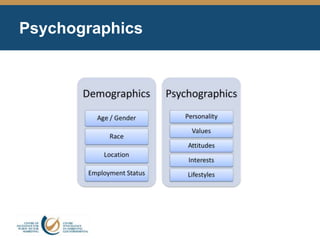
Psychographics
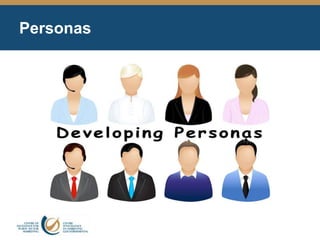
Personas
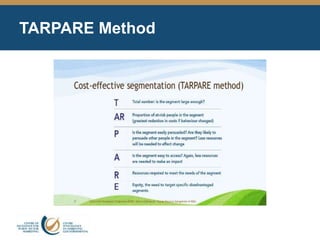
TARPARE Method
Analysis of Target Audience
Influencers
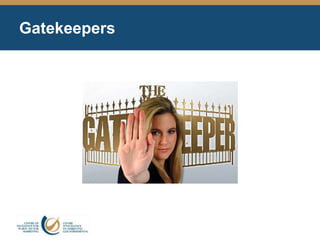
Gatekeepers
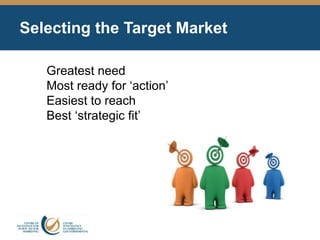
Selecting the Target Market
Greatest need
Most ready for ‘action’
Easiest to reach
Best ‘strategic fit’
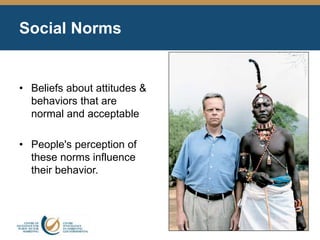
Social Norms
• Beliefs about attitudes &
behaviors that are
normal and acceptable
• People's perception of
these norms influence
their behavior.
Social Norms
• Beliefs about attitudes &
behaviors that are normal
and acceptable
• People's perception of these
norms influence their
behavior.
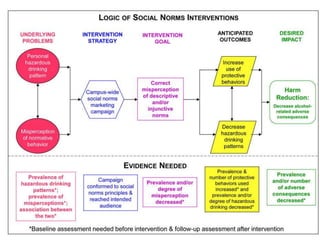
7 Assumptions of Social Norms
Approach
• Actions based on misinformation/misperceptions of others'
attitudes/behaviour.
• When misperceptions defined/perceived as real, they have
consequences.
• Individuals accept misperceptions rather than changing them,
hiding from others true perceptions, feelings, or beliefs.
• Effects of misperceptions self-perpetuating they discourage
expression of opinions & actions falsely believed to be
nonconforming while encouraging problem behaviors falsely
believed to be normative.
7 Assumptions of Social Norms
Approach
• Information about actual norm encourage individuals to
express beliefs consistent with true norm & inhibit problem
behaviours inconsistent with it.
• Individuals who do not engage in problematic behaviour
contribute to problem by how they talk about their behaviour.
Misperceptions strengthen beliefs & values that they do not
themselves hold & contribute to climate that encourages
problem behaviour.
• For norm to be perpetuated not necessary for majority to
believe it, but only for majority to believe majority believes it.
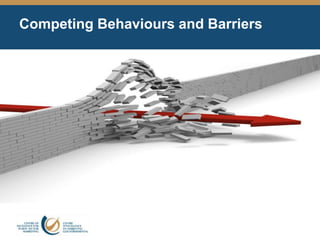
Competing Behaviours and Barriers
Mistake Number 4
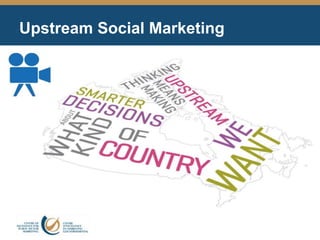
Upstream Social Marketing
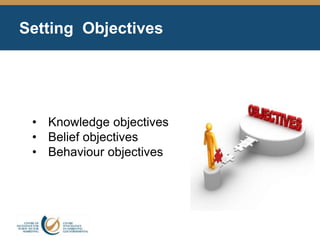
Setting Objectives
• Knowledge objectives
• Belief objectives
• Behaviour objectives
Setting Objectives
Mistake Number
Research in Objective Setting
• Important to consider research conducted with
audience before the campaign.
• Research can help to identify information most
needed by audience, current attitudes and
perceived barriers, thus indicating what
objectives may lead to behaviour change.
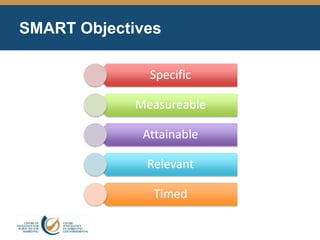
SMART Objectives
Specific
Measureable
Attainable
Relevant
Timed
Social Marketing Research
Primary and
Secondary Research
Social Marketing Research
• Exploratory
• Formative
• Pre-Test
• Monitoring
• Evaluation
Marketing Research Brief
possesses clarity, depth of
thought and provides direction
Branding
Branding
Social Marketing Branding
Social marketers branding serves a number of purposes:
• Provide a recognizable symbol
• Create associations in the minds of consumers
• Create a personality for intervention
• Convey positioning & image
• Make it easier and save money introducing new
products/programs/services
• Less need to devote resources to communication
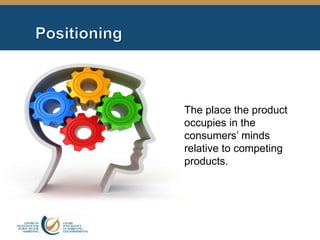
The place the product
occupies in the
consumers’ minds
relative to competing
products.
Positioning
I want my target audience to see______
(desired behaviour) as ______ (a phrase
describing positive benefits of adopting the
behaviour) and as more important and
beneficial than______ (the competing
behaviour).
“I want my target audience to see breastfeeding as
loving and healthy and as more important than
concerns with nursing in public”
“I want my target audience to see moderate
physical activity as easy and something they can
fit into their everyday lives and more important
than sleeping in.”
Positioning
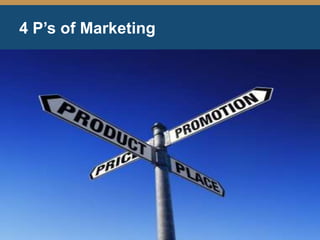
4 P’s of Marketing
4 P’s of Social Marketing
•
Product - Desired behaviour change
Price - Costs to make the change
Place - Locations to deliver the message
Promotion - Messages to encourage change
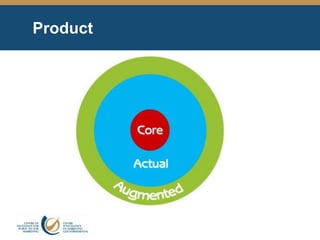
Product
Product
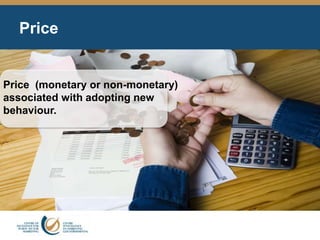
Price
Price (monetary or non-monetary)
associated with adopting new
behaviour.
Monetary Costs
Tangible objects/services that accompany the campaign:
Bike helmets, life vests, emergency preparedness kits,
sunscreen, condoms, birth control pills, recycled paper,
energy saving appliances.
Fees for family planning services, swimming classes,
parenting classes, smoking cessation products, fitness clubs,
taxi rides.
Non-Monetary Costs
Time
Sorting garbage, pulling over to use phone, cooking balanced
meal, getting rid of weeds by hand, putting together
emergency preparedness kit, reusing grocery bags, using
mass transit instead of automobile.
Psychological risks
Letting lawn go brown in summer, telling loved one that
he/she drinks/eats too much, using sunscreen and coming
back from “south” pale
Non-Monetary Costs
Physical discomfort or loss of pleasures from activities
Mammogram, wearing life vest, doing exercise when
“out of shape”, craving drink or cigarette, rejecting
dessert when on diet.
Some incentives will come naturally with behaviour change
and in other cases campaign can build in rewards or
recognition as incentives.
Place
• Place is where and when target will perform desired
behaviour & access products and services.
• Objective is to make it as easy as possible for target to
get the tools they need to make behaviour change.
Place
• Where does target make decisions about
the desired behaviour
• Network of intermediaries may be
established to reach target groups.
Promotion
Promotion is persuasive
communication and a tool that
ensures the target audience
knows about the offer, believes
they will experience the stated
benefits and is inspired to act.
Promotion
Promotion has two components:
The messages and the tactics
used to deliver the messages.
Messaging: Key messages are not
necessarily slogans or taglines but
brief statements highlighting the
bottom-line message(s) to a
campaign.
Promotion
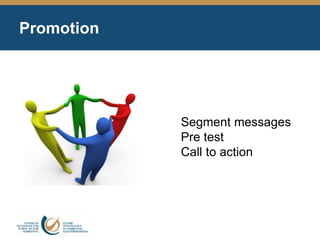
Segment messages
Pre test
Call to action
Promotional Tactics
• Advertising & Public service announcements
• Proactive public relations
• Promotional and collateral material
• Web and digital /social media marketing
• Direct marketing - print and e-mail
• Face to face marketing
• Publications/posters/ other print materials
• Educational and promotional products
• Strategic alliances and partnerships
Low Cost Tactics
• Misconception that you need a lot of money to develop a
comprehensive social marketing campaign.
• Two reasons for this misconception:
• Organizations that don’t have a lot of money feel it is
hopeless to do social marketing and run “public education”
campaigns which focus on awareness but not much else.
• Organizations e.g. government believe they have to spend a
lot of money on paid media
Low Cost Tactics
Strategic Alliances and Partnerships
Face to Face Marketing
Proactive Public Relations
Social Media Tools and Tactics
Strategic Alliances and Partnerships
Benefits of Strategic Alliances
• Financial
• Credibility and enhanced influence
• Strengthened relationships
• Access to new networks and
distribution channels
• Access to new sources
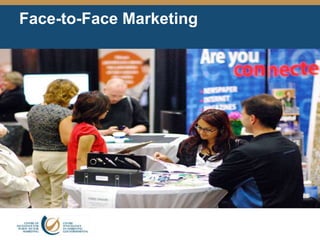
Face-to-Face Marketing
Benefits of Face-to-Face Marketing
• Provides opportunity to meet with key
stakeholders or targeted populations.
• Most appropriate for personal intervention to
deliver detailed information, build trust and gain
commitment.
• Excellent way to compile data and build a
database.
• Provides fast and flexible solutions in a changing
environment.
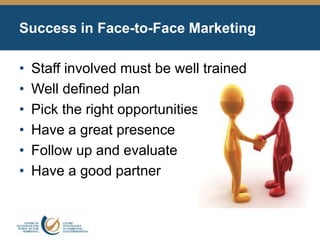
Success in Face-to-Face Marketing
• Staff involved must be well trained
• Well defined plan
• Pick the right opportunities
• Have a great presence
• Follow up and evaluate
• Have a good partner
Proactive Public Relations
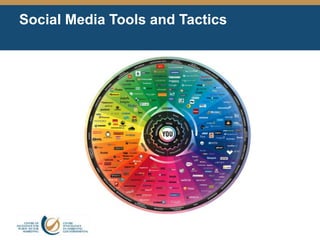
Social Media Tools and Tactics
Social Media Tools and Applications
5 Categories of Social Media Tools
• Social/relationship networks (there are
numerous sub-categories here)
• Social/instant messaging
• Blogging
• Review/rating sites
• Discussion forums
Creative Brief
3 key things your creative team
needs to know:
Who are we talking to?
What do we want them to do?
And why should they do it?
Creative Brief
How not to do a creative brief
https://www.youtube.com/watch?v=Wa
c3aGn5twc&feature=youtu.be
Monitoring and Evaluation
Measuring Outputs
• web analytics
• reach and frequency
• media coverage
• materials distributed.
• accomplishment of planned activities
• evaluating partnership relationships
• campaign awareness
• partnerships created
• upstream programs
Measuring Outcomes
• changes in behaviour/behaviour intent
• changes in knowledge
• changes in belief/attitudes/opinions/perceptions/ values
• also may include:
• response to social media and direct marketing
• purchase of products and services
• client satisfaction levels
Measuring Impacts
• lives saved
• diseases prevented
• violence prevented
• injuries avoided
• improvement in the environment
• crimes prevented
Monitoring and Evaluation Methods
• Surveys of target audience
• Benchmark surveys
• Qualitative techniques
• Records and databases
• Scientific and technical surveys
Budgeting
The affordable method
The competitive-parity method
The objective-and-task method
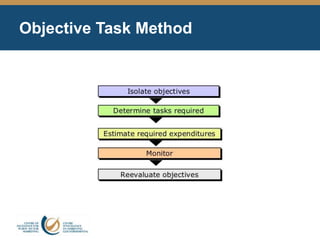
Objective Task Method
Implementation
• What actions need to be performed;
• Who will be responsible;
• When activities will be completed; and
• Costs associated with each activity
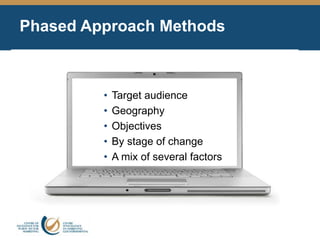
• Target audience
• Geography
• Objectives
• By stage of change
• A mix of several factors
Phased Approach Methods
Thank You!
109
E-mail: jimmintz@cepsm.ca
Phone: 343.291.1137
Mobile: 613.298.4549
Website: www.cepsm.ca
Blog: www.jimmintz.ca
Twitter: @jimmintz
343 Preston Street
Ottawa, ON K1S 1N4
Blog: www.jimmintz.ca

Social marketing presentation november 2016

  • 1.
    Introduction to Social MarketingPlanning for Behaviour Change Presented by: Jim Mintz
  • 2.
    What we do •Product & Service Marketing • Policy & Program Marketing • Social Marketing • Sponsorship/Partnerships • Organizational Branding • Social Media/Digital Engagement
  • 3.
    Agenda • Introductions • Overview:Social marketing • Developing the Plan I • Lunch • Developing the Plan II • Wrap up
  • 4.
  • 5.
  • 6.
  • 7.
  • 8.
    Social Marketing Organizations don’t planto fail … they fail to plan
  • 9.
    Social Marketing “Social marketingis simply about influencing the behaviour of target audiences. There are many more target audiences who need to act besides “problem people” if we are to solve major social problems.” Alan Andreasen, Social Marketing in the 21st Century
  • 10.
    Social Marketing What arethe Benefits of Adopting a Social Marketing Approach?
  • 11.
    Benefits of SocialMarketing Comprehensive integrated innovative strategic approach Integrate and coordinate other components Make better resource decisions Assist in attraction of resources
  • 12.
    Benefits of SocialMarketing Executing integrated campaigns Offers an organization a strategic framework from which to work Building your reputation with stakeholders Providing a performance measurement framework
  • 13.
  • 14.
    Our world ischanging rapidly... Technology Health Demographics Social Values Economics Environment
  • 15.
    Social Marketing providesa strategic approach for dealing with these changes…
  • 16.
    Social Marketing Who isdoing Social Marketing to change peoples attitudes and encourage behaviour change?
  • 18.
    • Barrier ofintroducing "performance based culture” • Conflict with core values • Requires significant management support and time Challenges of Introducing Social Marketing into a Public Sector/ Non- Profit Organization
  • 19.
    Three Approaches toSocial Change Education Law Social Marketing
  • 20.
    Social Marketing Challenges •Public scrutiny • Extravagant expectations • Non-existent or negative demand • Non-literate target audiences • Highly sensitive issues • Behaviors with invisible benefits
  • 21.
  • 22.
    Current State Desired State Strategic Gap Filling the Strategic Gap: Usinga social marketing approach will help move target audiences through the Stages of Change over time and help bring target audiences closer to desired state
  • 23.
    Meaningful Impact TakesTime • Only long-term efforts (3 to 5 years) produce measurable changes • Sufficient investment, measurable goals, differentiation from other initiatives, strategic and creative approach, continuity in message • Phased approach
  • 24.
    “It’s easy tomake a buck. It’s a lot tougher to make a difference”. - Tom Brokaw
  • 25.
  • 26.
  • 27.
    Background and IssueDefinition • The intended impact of a successful campaign • The campaign focus • The purpose of the campaign
  • 28.
    Environmental Scan An environmentalscan is a synopsis of research on external factors that could affect your campaign
  • 29.
  • 30.
  • 31.
  • 32.
  • 33.
    Market Segmentation GEOGRAPHICALLY SETTINGS Regions Counties/Cities Neighbourhoods Climate North/South Home School Workplace Healthcare facility Community facility Commercial property DEMOGRAPHICALLY PSYCHOGRAPHICALLY Age Life-cycle Gender Level of education Religion/nationality Language Urban, rural, suburban Income /Occupation Cultural background Attitudes Beliefs Values Opinions Hopes, fears Needs Desires Social norms/social class Perceptions Stage of Change
  • 34.
  • 35.
  • 36.
  • 37.
  • 38.
  • 39.
  • 40.
  • 41.
  • 42.
    Selecting the TargetMarket Greatest need Most ready for ‘action’ Easiest to reach Best ‘strategic fit’
  • 43.
    Social Norms • Beliefsabout attitudes & behaviors that are normal and acceptable • People's perception of these norms influence their behavior.
  • 44.
    Social Norms • Beliefsabout attitudes & behaviors that are normal and acceptable • People's perception of these norms influence their behavior.
  • 45.
    7 Assumptions ofSocial Norms Approach • Actions based on misinformation/misperceptions of others' attitudes/behaviour. • When misperceptions defined/perceived as real, they have consequences. • Individuals accept misperceptions rather than changing them, hiding from others true perceptions, feelings, or beliefs. • Effects of misperceptions self-perpetuating they discourage expression of opinions & actions falsely believed to be nonconforming while encouraging problem behaviors falsely believed to be normative.
  • 46.
    7 Assumptions ofSocial Norms Approach • Information about actual norm encourage individuals to express beliefs consistent with true norm & inhibit problem behaviours inconsistent with it. • Individuals who do not engage in problematic behaviour contribute to problem by how they talk about their behaviour. Misperceptions strengthen beliefs & values that they do not themselves hold & contribute to climate that encourages problem behaviour. • For norm to be perpetuated not necessary for majority to believe it, but only for majority to believe majority believes it.
  • 47.
  • 48.
  • 49.
  • 50.
  • 51.
  • 52.
  • 53.
    Setting Objectives • Knowledgeobjectives • Belief objectives • Behaviour objectives
  • 54.
  • 55.
  • 56.
    Research in ObjectiveSetting • Important to consider research conducted with audience before the campaign. • Research can help to identify information most needed by audience, current attitudes and perceived barriers, thus indicating what objectives may lead to behaviour change.
  • 57.
  • 58.
  • 59.
    Social Marketing Research Primaryand Secondary Research
  • 60.
    Social Marketing Research •Exploratory • Formative • Pre-Test • Monitoring • Evaluation
  • 61.
    Marketing Research Brief MarketingResearch Brief possesses clarity, depth of thought and provides direction
  • 62.
  • 63.
  • 64.
    Social Marketing Branding Socialmarketers branding serves a number of purposes: • Provide a recognizable symbol • Create associations in the minds of consumers • Create a personality for intervention • Convey positioning & image • Make it easier and save money introducing new products/programs/services • Less need to devote resources to communication
  • 65.
    The place theproduct occupies in the consumers’ minds relative to competing products.
  • 66.
    Positioning I want mytarget audience to see______ (desired behaviour) as ______ (a phrase describing positive benefits of adopting the behaviour) and as more important and beneficial than______ (the competing behaviour).
  • 67.
    “I want mytarget audience to see breastfeeding as loving and healthy and as more important than concerns with nursing in public” “I want my target audience to see moderate physical activity as easy and something they can fit into their everyday lives and more important than sleeping in.” Positioning
  • 68.
    4 P’s ofMarketing
  • 69.
    4 P’s ofSocial Marketing • Product - Desired behaviour change Price - Costs to make the change Place - Locations to deliver the message Promotion - Messages to encourage change
  • 70.
  • 71.
  • 72.
    Price Price (monetary ornon-monetary) associated with adopting new behaviour.
  • 73.
    Monetary Costs Tangible objects/servicesthat accompany the campaign: Bike helmets, life vests, emergency preparedness kits, sunscreen, condoms, birth control pills, recycled paper, energy saving appliances. Fees for family planning services, swimming classes, parenting classes, smoking cessation products, fitness clubs, taxi rides.
  • 74.
    Non-Monetary Costs Time Sorting garbage,pulling over to use phone, cooking balanced meal, getting rid of weeds by hand, putting together emergency preparedness kit, reusing grocery bags, using mass transit instead of automobile. Psychological risks Letting lawn go brown in summer, telling loved one that he/she drinks/eats too much, using sunscreen and coming back from “south” pale
  • 75.
    Non-Monetary Costs Physical discomfortor loss of pleasures from activities Mammogram, wearing life vest, doing exercise when “out of shape”, craving drink or cigarette, rejecting dessert when on diet. Some incentives will come naturally with behaviour change and in other cases campaign can build in rewards or recognition as incentives.
  • 76.
    Place • Place iswhere and when target will perform desired behaviour & access products and services. • Objective is to make it as easy as possible for target to get the tools they need to make behaviour change.
  • 77.
    Place • Where doestarget make decisions about the desired behaviour • Network of intermediaries may be established to reach target groups.
  • 78.
    Promotion Promotion is persuasive communicationand a tool that ensures the target audience knows about the offer, believes they will experience the stated benefits and is inspired to act.
  • 79.
    Promotion Promotion has twocomponents: The messages and the tactics used to deliver the messages. Messaging: Key messages are not necessarily slogans or taglines but brief statements highlighting the bottom-line message(s) to a campaign.
  • 80.
  • 81.
    Promotional Tactics • Advertising& Public service announcements • Proactive public relations • Promotional and collateral material • Web and digital /social media marketing • Direct marketing - print and e-mail • Face to face marketing • Publications/posters/ other print materials • Educational and promotional products • Strategic alliances and partnerships
  • 82.
    Low Cost Tactics •Misconception that you need a lot of money to develop a comprehensive social marketing campaign. • Two reasons for this misconception: • Organizations that don’t have a lot of money feel it is hopeless to do social marketing and run “public education” campaigns which focus on awareness but not much else. • Organizations e.g. government believe they have to spend a lot of money on paid media
  • 83.
    Low Cost Tactics StrategicAlliances and Partnerships Face to Face Marketing Proactive Public Relations Social Media Tools and Tactics
  • 84.
  • 85.
    Benefits of StrategicAlliances • Financial • Credibility and enhanced influence • Strengthened relationships • Access to new networks and distribution channels • Access to new sources
  • 86.
  • 87.
    Benefits of Face-to-FaceMarketing • Provides opportunity to meet with key stakeholders or targeted populations. • Most appropriate for personal intervention to deliver detailed information, build trust and gain commitment. • Excellent way to compile data and build a database. • Provides fast and flexible solutions in a changing environment.
  • 88.
    Success in Face-to-FaceMarketing • Staff involved must be well trained • Well defined plan • Pick the right opportunities • Have a great presence • Follow up and evaluate • Have a good partner
  • 89.
  • 90.
    Social Media Toolsand Tactics
  • 91.
    Social Media Toolsand Applications
  • 92.
    5 Categories ofSocial Media Tools • Social/relationship networks (there are numerous sub-categories here) • Social/instant messaging • Blogging • Review/rating sites • Discussion forums
  • 93.
    Creative Brief 3 keythings your creative team needs to know: Who are we talking to? What do we want them to do? And why should they do it?
  • 94.
    Creative Brief How notto do a creative brief https://www.youtube.com/watch?v=Wa c3aGn5twc&feature=youtu.be
  • 95.
  • 96.
  • 97.
  • 98.
    Measuring Outputs • webanalytics • reach and frequency • media coverage • materials distributed. • accomplishment of planned activities • evaluating partnership relationships • campaign awareness • partnerships created • upstream programs
  • 99.
    Measuring Outcomes • changesin behaviour/behaviour intent • changes in knowledge • changes in belief/attitudes/opinions/perceptions/ values • also may include: • response to social media and direct marketing • purchase of products and services • client satisfaction levels
  • 100.
    Measuring Impacts • livessaved • diseases prevented • violence prevented • injuries avoided • improvement in the environment • crimes prevented
  • 101.
    Monitoring and EvaluationMethods • Surveys of target audience • Benchmark surveys • Qualitative techniques • Records and databases • Scientific and technical surveys
  • 102.
    Budgeting The affordable method Thecompetitive-parity method The objective-and-task method
  • 103.
  • 104.
    Implementation • What actionsneed to be performed; • Who will be responsible; • When activities will be completed; and • Costs associated with each activity
  • 105.
    • Target audience •Geography • Objectives • By stage of change • A mix of several factors Phased Approach Methods
  • 106.
  • 109.
    109 E-mail: jimmintz@cepsm.ca Phone: 343.291.1137 Mobile:613.298.4549 Website: www.cepsm.ca Blog: www.jimmintz.ca Twitter: @jimmintz 343 Preston Street Ottawa, ON K1S 1N4 Blog: www.jimmintz.ca