

XXIII Corso Residenziale di Aggiornamento
Moderna Radioterapia e Diagnostica per Immagini:
dalla definizione dei volumi alla radioterapia
«adaptive»

DICE
il glossario per il corso
M.A. Gambacorta, L. Boldrini, S. Longo,
C. Valentini, D. Piccari
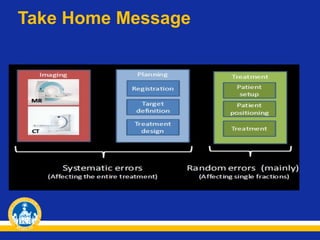
Take Home Message
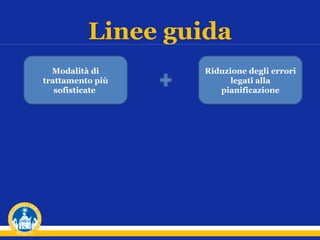
Linee guida
Modalità di
trattamento più
sofisticate

Riduzione degli errori
legati alla
pianificazione
Linee guida
Modalità di
trattamento più
sofisticate

Riduzione degli errori
legati alla
pianificazione

Adeguata conoscenza dei volumi da irradiare e
una loro precisa delimitazione
Linee guida
Modalità di
trattamento più
sofisticate

Riduzione degli errori
legati alla
pianificazione

Adeguata conoscenza dei volumi da irradiare e
una loro precisa delimitazione

LINEE GUIDA
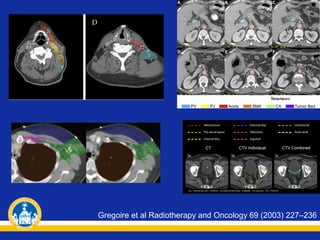
Gregoire et al Radiotherapy and Oncology 69 (2003) 227–236
Linee guida

Vantaggi

• definizione di un
linguaggio
multispecialistico
• standardizzazione
delle modalità di
contornazione
intraspecialistico
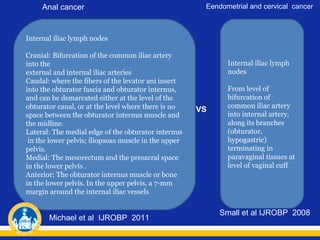
Anal cancer

Eendometrial and cervical cancer

Internal iliac lymph nodes
Cranial: Bifurcation of the common iliac artery
into the
external and internal iliac arteries
Caudal: where the fibers of the levator ani insert
into the obturator fascia and obturator internus,
and can be demarcated either at the level of the
obturator canal, or at the level where there is no
space between the obturator internus muscle and
the midline.
Lateral: The medial edge of the obturator internus
in the lower pelvis; iliopsoas muscle in the upper
pelvis.
Medial: The mesorectum and the presacral space
in the lower pelvis .
Anterior: The obturator internus muscle or bone
in the lower pelvis. In the upper pelvis, a 7-mm
margin around the internal iliac vessels

Michael et al IJROBP 2011

Internal iliac lymph
nodes

VS

From level of
bifurcation of
common iliac artery
into internal artery,
along its branches
(obturator,
hypogastric)
terminating in
paravaginal tissues at
level of vaginal cuff

Small et al IJROBP 2008
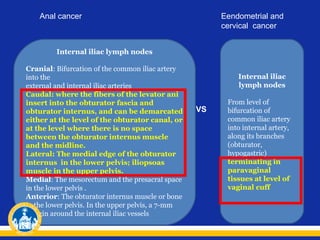
Anal cancer

Eendometrial and
cervical cancer

Internal iliac lymph nodes
Cranial: Bifurcation of the common iliac artery
into the
external and internal iliac arteries
Caudal: where the fibers of the levator ani
insert into the obturator fascia and
obturator internus, and can be demarcated
either at the level of the obturator canal, or
at the level where there is no space
between the obturator internus muscle
and the midline.
Lateral: The medial edge of the obturator
internus in the lower pelvis; iliopsoas
muscle in the upper pelvis.
Medial: The mesorectum and the presacral space
in the lower pelvis .
Anterior: The obturator internus muscle or bone
in the lower pelvis. In the upper pelvis, a 7-mm
margin around the internal iliac vessels

Internal iliac
lymph nodes

VS

From level of
bifurcation of
common iliac artery
into internal artery,
along its branches
(obturator,
hypogastric)
terminating in
paravaginal
tissues at level of
vaginal cuff
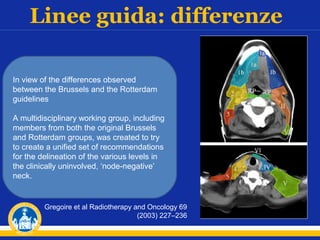
Linee guida: differenze
In view of the differences observed
between the Brussels and the Rotterdam
guidelines
A multidisciplinary working group, including
members from both the original Brussels
and Rotterdam groups, was created to try
to create a unified set of recommendations
for the delineation of the various levels in
the clinically uninvolved, ‘node-negative’
neck.

Gregoire et al Radiotherapy and Oncology 69
(2003) 227–236
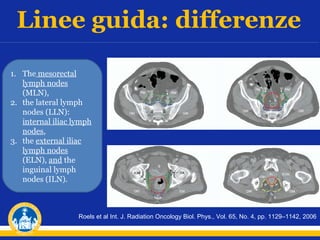
Linee guida: differenze
1. The mesorectal
lymph nodes
(MLN),
2. the lateral lymph
nodes (LLN):
internal iliac lymph
nodes,
3. the external iliac
lymph nodes
(ELN), and the
inguinal lymph
nodes (ILN).

Roels et al Int. J. Radiation Oncology Biol. Phys., Vol. 65, No. 4, pp. 1129–1142, 2006
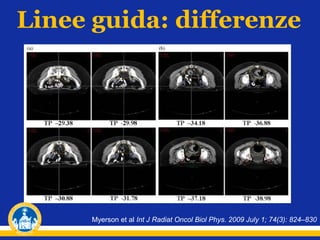
Linee guida: differenze

Myerson et al Int J Radiat Oncol Biol Phys. 2009 July 1; 74(3): 824–830
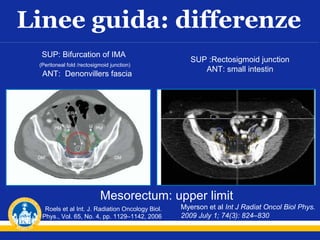
Linee guida: differenze
SUP: Bifurcation of IMA
(Peritoneal fold /rectosigmoid junction)

ANT: Denonvillers fascia

SUP :Rectosigmoid junction
ANT: small intestin

Mesorectum: upper limit
Roels et al Int. J. Radiation Oncology Biol.
Phys., Vol. 65, No. 4, pp. 1129–1142, 2006

Myerson et al Int J Radiat Oncol Biol Phys.
2009 July 1; 74(3): 824–830
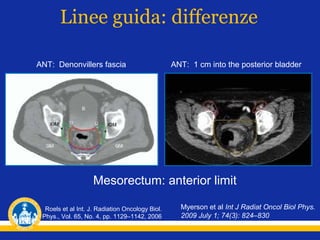
Linee guida: differenze
ANT: Denonvillers fascia

ANT: 1 cm into the posterior bladder

Mesorectum: anterior limit
Roels et al Int. J. Radiation Oncology Biol.
Phys., Vol. 65, No. 4, pp. 1129–1142, 2006

Myerson et al Int J Radiat Oncol Biol Phys.
2009 July 1; 74(3): 824–830
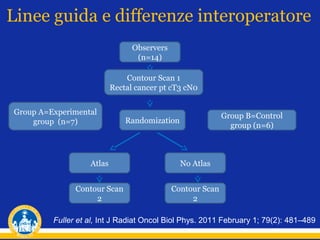
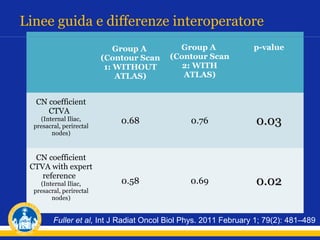
Linee guida e differenze interoperatore
Observers
(n=14)
Contour Scan 1
Rectal cancer pt cT3 cN0
Group A=Experimental
group (n=7)

Group B=Control
group (n=6)

Randomization

Atlas

No Atlas

Contour Scan
2

Contour Scan
2

Fuller et al, Int J Radiat Oncol Biol Phys. 2011 February 1; 79(2): 481–489
Linee guida e differenze interoperatore
Group A
(Contour Scan
1: WITHOUT
ATLAS)

Group A
(Contour Scan
2: WITH
ATLAS)

p-value

0.68

0.76

0.03

0.58

0.69

0.02

CN coefficient
CTVA
(Internal Iliac,
presacral, perirectal
nodes)

CN coefficient
CTVA with expert
reference
(Internal Iliac,
presacral, perirectal
nodes)

Fuller et al, Int J Radiat Oncol Biol Phys. 2011 February 1; 79(2): 481–489
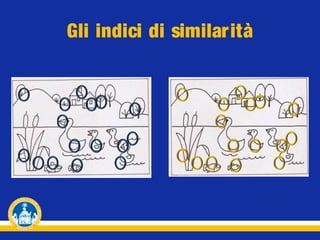
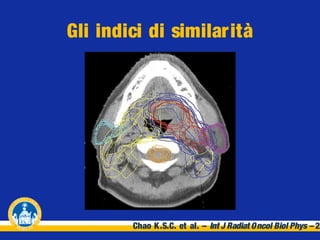
Gli indici di similarità

Chao K.S.C. et al. – Int J Radiat Oncol Biol Phys – 2
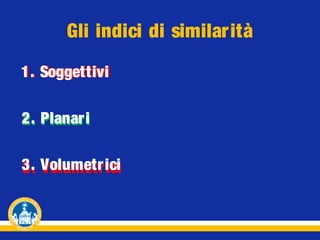
Gli indici di similarità
1. Soggettivi
2. Planari
3. Volumetr ici
Volumetrici
Gli indici di similarità planari
- Jaccard
- Hausdorff
- Dice
Gli indici di similarità planari
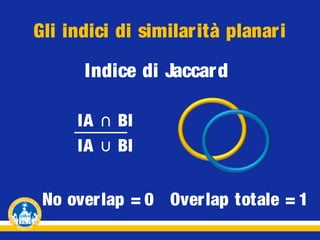
Indice di Jaccar d
IA ∩ BI
IA ⋃ BI

No overlap = 0 Overlap totale = 1
L’indice di Jaccard
-

Vale SOLO per 2 contornazioni
Molto sensibile a situazioni estreme
Poco usato in letteratura
Per confrontare > 2 volumi :
V comune contornato
IJ common :
V totale contornato
IJ pairs : media aritmetica IJ tutte possibili
coppie
Gli indici di similarità planari
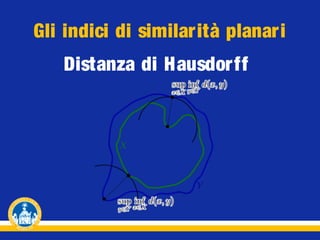
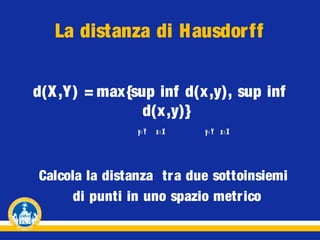
Distanza di Hausdorff
La distanza di Hausdor ff
d(X ,Y) = max {sup inf d(x,y), sup inf
d(x,y)}
y∊Y

x∊X

y∊Y x∊X

Calcola la distanza tra due sottoinsiemi
di punti in uno spazio metr ico
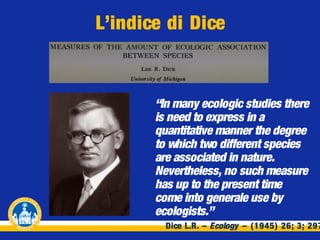
L’indice di Dice

“In many ecologic studies there
is need to express in a
quantitative manner the degree
to which two different species
are associated in nature.
Nevertheless, no such measure
has up to the present time
come into generale use by
ecologists.”

Dice L.R. – Ecology – (1945) 26; 3; 297
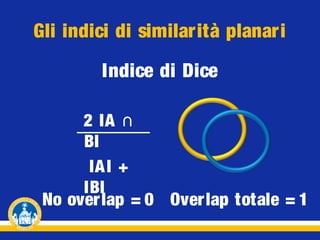
Gli indici di similarità planari
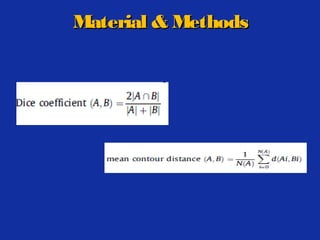
Indice di Dice
2 IA ∩
BI
IA I +
IBI
No overlap = 0 Overlap totale = 1
L’indice di Dice
- IA I + IBI sempre > IA ⋃ BI
- Intr oduzione del fattor e di
nor malizzazione 2
- Meno sensibile a situazioni estr eme
- Cr escita più lineare dell’ IJ
- Molto utilizzato in letteratura
L’indice di Dice
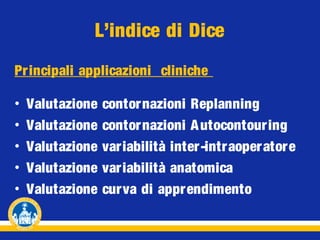
Pr incipali applicazioni cliniche
•
•
•
•
•

Valutazione
Valutazione
Valutazione
Valutazione
Valutazione

contornazioni Replanning
contornazioni A utocontour ing
variabilità inter-intraoper ator e
variabilità anatomica
curva di appr endimento
Gli indici di similarità
volumetrici
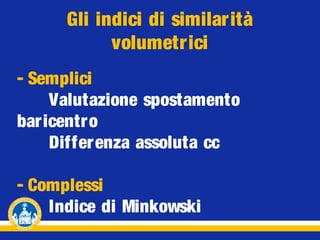
- Semplici
Valutazione spostamento
baricentro
Differenza assoluta cc
- Complessi
Indice di Minkowski
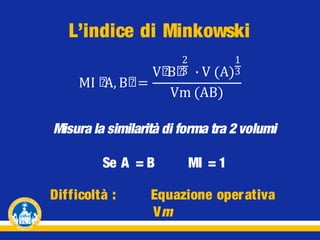
L’indice di Minkowski
MI ሺ Bሺ =
A,

2
Vሺ ሺ
B 3

1
(A)3

∙V
Vm (AB)

Misura la similarità di forma tra 2 volumi
Se A = B
Difficoltà :

MI = 1

Equazione oper ativa
Vm
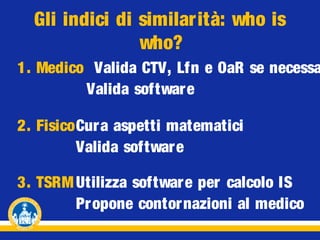
Gli indici di similarità: who is
who?

1. Medico Valida CTV, Lfn e OaR se necessa
Valida softwar e
2. FisicoCura aspetti matematici
Valida softwar e
3. TSRM Utilizza softwar e per calcolo IS
Propone contor nazioni al medico
Utilizzo clinico del sistema
MIM
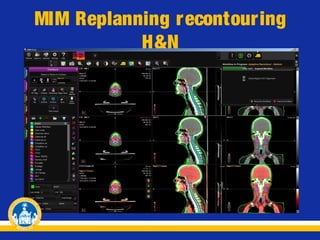
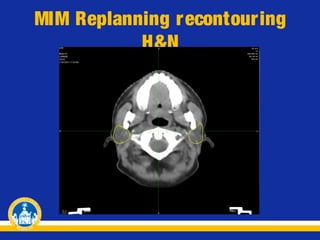
- Replanning r econtour ing H&N
- A cquisizione e definizione di volumi
da
imaging funzionale PET
Replanning recontouring H&N
Obiettivi
- Mantenere l’integr ità del piano iniziale
- A ssicurar e coper tur a CTV
- Preservare OaR
- Ottimizzare dosimetr ia su nuova
anatomia:
- r egr essione CTV
- per dita di peso
Replanning recontour ing H&N

Quando?
5°- 6° settimana / 36 Gy (7020
cGy)
Replanning recontour ing H&N

Come?
A utocontouring
Software di coregistrazione
deformabile
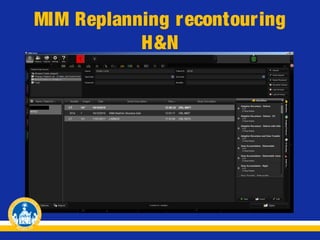
MIM Replanning recontouring
H&N
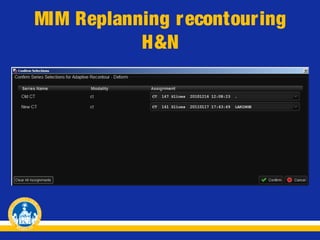
MIM Replanning r econtouring
H&N
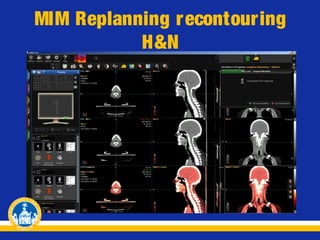
MIM Replanning r econtouring
H&N
MIM Replanning r econtouring
H&N

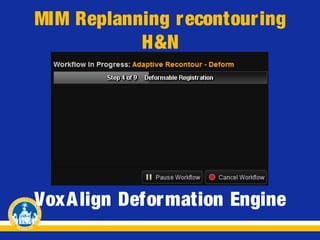
VoxA lign Deformation Engine
MIM Replanning r econtouring
H&N
MIM Replanning r econtouring
H&N
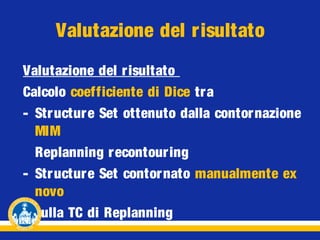
Valutazione del risultato
Calcolo coefficiente di Dice tra
- Str ucture Set ottenuto dalla contor nazione
MIM
Replanning recontouring
- Str ucture Set contornato manualmente ex
novo
sulla TC di Replanning
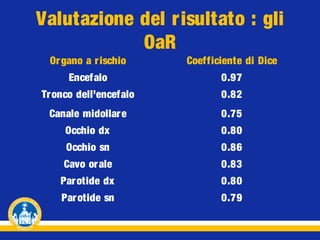
Valutazione del r isultato : gli
OaR
Or gano a r ischio

Coefficiente di Dice

Encefalo

0.97

Tr onco dell’encefalo

0.82

Canale midollar e

0.75

Occhio dx

0.80

Occhio sn

0.86

Cavo or ale

0.83

Par otide dx

0.80

Par otide sn

0.79
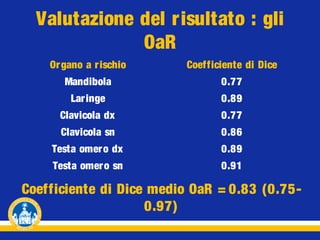
Valutazione del r isultato : gli
OaR
Or gano a r ischio

Coefficiente di Dice

Mandibola

0.77

Lar inge

0.89

Clavicola dx

0.77

Clavicola sn

0.86

Testa omer o dx

0.89

Testa omer o sn

0.91

Coefficiente di Dice medio OaR = 0.83 (0.750.97)
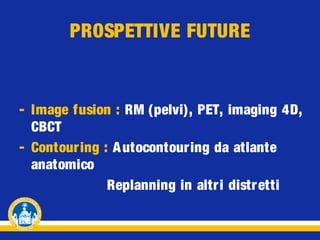
PROSPETTIVE FUTURE

- Image fusion : RM (pelvi), PET, imaging 4D,
CBCT
- Contour ing : A utocontouring da atlante
anatomico
Replanning in altri distr etti
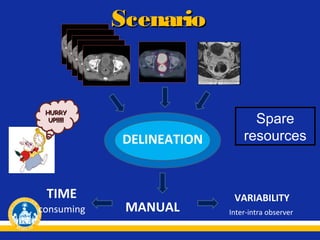
Scenario

HURRY
UP!!!!!

DELINEATION

TIME
consuming

MANUAL

Spare
resources

VARIABILITY
Inter-intra observer
SOFTW
ARE
MARKETING
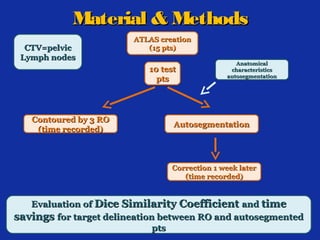
Material & Methods
CTV=pelvic
Lymph nodes

ATLAS creation
(15 pts)

10 test
pts

Contoured by 3 RO
(time recorded)

Anatomical
characteristics
autosegmentation

Autosegmentation

Correction 1 week later
(time recorded)

Evaluation of Dice Similarity Coefficient and time
savings for target delineation between RO and autosegmented
pts
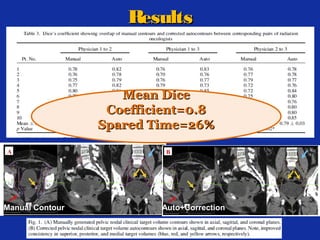
Results

Mean Dice
Coefficient=0.8
Spared Time=26%

Manual Contour

Auto+Correction
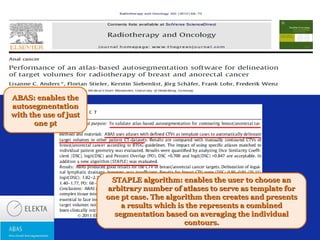
ABAS: enables the
autosegmentation
with the use of just
one pt

STAPLE algorithm: enables the user to choose an
arbitrary number of atlases to serve as template for
one pt case. The algorithm then creates and presents
a results which is the represents a combined
segmentation based on averaging the individual
contours.
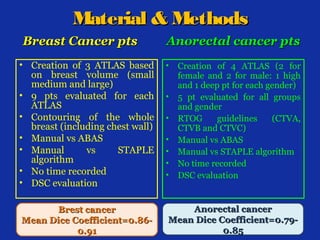
Material & Methods
Breast Cancer pts

Anorectal cancer pts

• Creation of 3 ATLAS based
on breast volume (small
medium and large)
• 9 pts evaluated for each
ATLAS
• Contouring of the whole
breast (including chest wall)
• Manual vs ABAS
• Manual
vs
STAPLE
algorithm
• No time recorded
• DSC evaluation

•

Brest cancer
Mean Dice Coefficient=0.860.91

Anorectal cancer
Mean Dice Coefficient=0.790.85

•
•
•
•
•
•

Creation of 4 ATLAS (2 for
female and 2 for male: 1 high
and 1 deep pt for each gender)
5 pt evaluated for all groups
and gender
RTOG
guidelines
(CTVA,
CTVB and CTVC)
Manual vs ABAS
Manual vs STAPLE algorithm
No time recorded
DSC evaluation
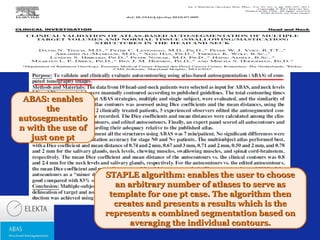
ABAS: enables
the
autosegmentatio
n with the use of
just one pt

STAPLE algorithm: enables the user to choose
an arbitrary number of atlases to serve as
template for one pt case. The algorithm then
creates and presents a results which is the
represents a combined segmentation based on
averaging the individual contours.
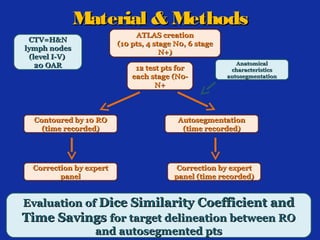
Material & Methods
CTV=H&N
lymph nodes
(level I-V)
20 OAR

Contoured by 10 RO
(time recorded)

Correction by expert
panel

ATLAS creation
(10 pts, 4 stage N0, 6 stage
N+)
12 test pts for
each stage (N0N+

Anatomical
characteristics
autosegmentation

Autosegmentation
(time recorded)

Correction by expert
panel (time recorded)

Evaluation of Dice Similarity Coefficient and
Time Savings for target delineation between RO
and autosegmented pts
Results

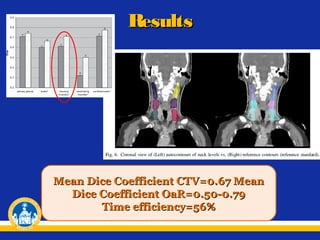
Mean Dice Coefficient CTV=0.67 Mean
Dice Coefficient OaR=0.50-0.79
Time efficiency=56%
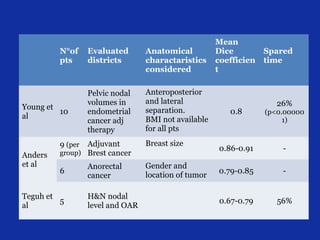
N°of
pts

Young et
10
al

Evaluated
districts

Anatomical
charactaristics
considered

Pelvic nodal
volumes in
endometrial
cancer adj
therapy

Anteroposterior
and lateral
separation.
BMI not available
for all pts

Adjuvant
group) Brest cancer
9 (per

Anders
et al

6

Teguh et
5
al

Anorectal
cancer
H&N nodal
level and OAR

Breast size
Gender and
location of tumor

Mean
Dice
coefficien
t

Spared
time

26%

0.8

(p<0.00000
1)

0.86-0.91

-

0.79-0.85

-

0.67-0.79

56%
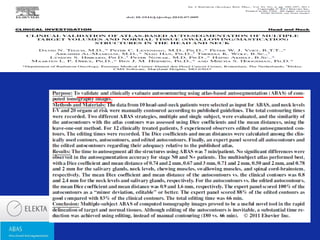
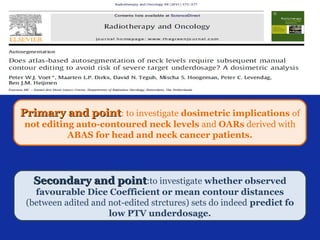
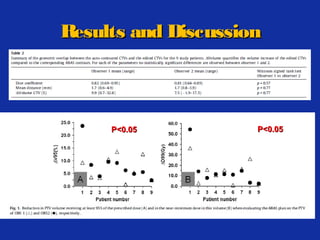
Primary and point: to investigate dosimetric implications of
not editing auto-contoured neck levels and OARs derived with
ABAS for head and neck cancer patients.

Secondary and point:to investigate whether observed
favourable Dice Coefficient or mean contour distances
(between adited and not-edited strctures) sets do indeed predict fo
low PTV underdosage.
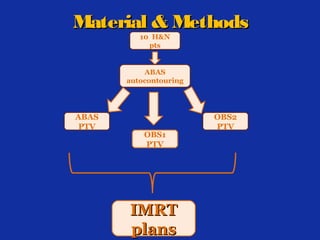
Material & Methods
10 H&N
pts

ABAS
autocontouring

ABAS
PTV

OBS1
PTV

IMRT
plans

OBS2
PTV
Material & Methods
Which parametres
investigated?

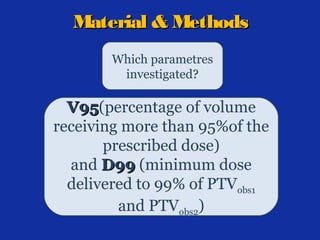
V95(percentage of volume
V95
receiving more than 95%of the
prescribed dose)
and D99 (minimum dose
delivered to 99% of PTVobs1
and PTVobs2)
Material & Methods
Results and Discussion

P<0.05

P<0.05
UCSC SS-Validation Program
Aimof the study

P
roof of Concept
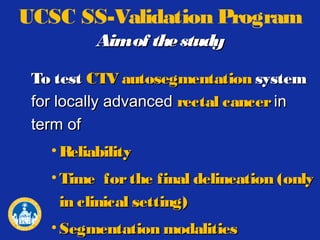
UCSC SS-Validation Program
Aimof the study
To test CTV autosegmentation system
for locally advanced rectal cancer in
term of
• Reliability
• Time for the final delineation (only
in clinical setting)
• Segmentation modalities
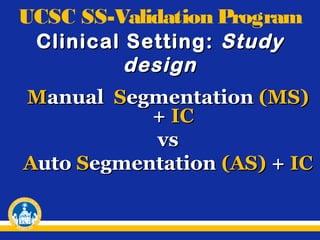
UCSC SS-Validation Program
Clinical Setting: Study
design
Manual Segmentation (MS)
+ IC
vs
Auto Segmentation (AS) + IC
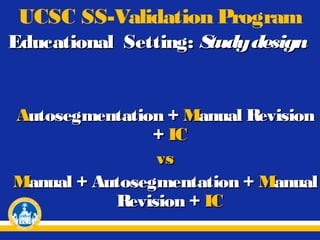
UCSC SS-Validation Program
Educational Setting: S
tudy design

Autosegmentation + Manual Revision
+ IC
vs
Manual + Autosegmentation + Manual
Revision + IC
UCSC SS-Validation Program
S
tudy design
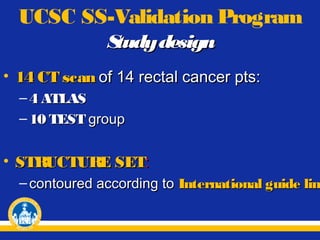
• 14 CT scan of 14 rectal cancer pts:
– 4 ATLAS
– 10 TEST group

• STRUCTURE SET:

– contoured according to International guide line
lin
UCSC SS-Validation Program
CTV definition

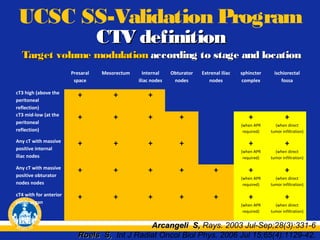
Target volume modulation according to stage and location
Presaral
space

Mesorectum

Internal
iliac nodes

cT3 high (above the
peritoneal
reflection)
cT3 mid-low (at the
peritoneal
reflection)

+

+

+

+

+

+

Any cT with massive
positive internal
iliac nodes

+

Any cT with massive
positive obturator
nodes nodes

+

cT4 with for anterior
pelvic organ

+

+

+
+

+
+

+
(when direct
tumor infiltration)

+

+
(when direct
tumor infiltration)

+

+

(when APR
required)

+

+

(when direct
tumor infiltration)

+

+

+

(when APR
required)

+

+

+

ischiorectal
fossa

(when APR
required)

+

Extrenal iliac
nodes

sphincter
complex

(when APR
required)

+

Obturator
nodes

(when direct
tumor infiltration)

Arcangeli S, Rays. 2003 Jul-Sep;28(3):331-6
Roels S, Int J Radiat Oncol Biol Phys. 2006 Jul 15;65(4):1129-42.
UCSC SS-Validation Program
P
roof of Concept

Results
UCSC SS-Validation Program
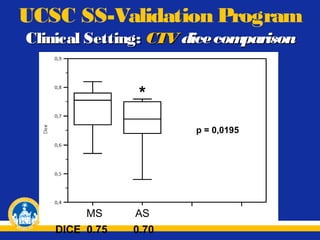
Clinical Setting: CTV dice com
parison

*
p = 0,0195

SM
MS

DICE 0.75

SA
AS

0.70
UCSC SS-Validation Program
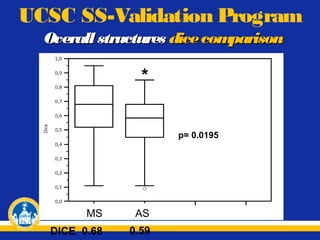
Overall structures dice com
parison

*

p= 0.0195

SM
MS

SA
AS

DICE 0.68

0.59
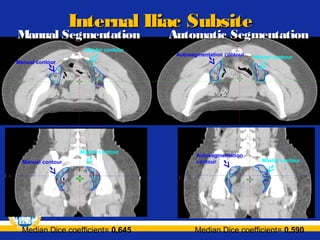
Internal Iliac Subsite

Manual Segmentation
Master contour

Automatic Segmentation
Autosegmentation contour

Manual contour

Master contour

Master contour

Manual contour

Autosegmentation
contour

Median Dice coefficient= 0,645

Median Dice coefficient= 0,590

Master contour
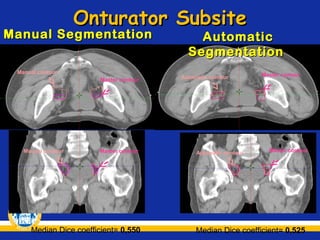
Onturator Subsite

Manual Segmentation
Manual contour
Master contour

Manual contour

Master contour

Median Dice coefficient= 0,550

Automatic
Segmentation

Automatic contour

Automatic contour

Master contour

Master contour

Median Dice coefficient= 0,525
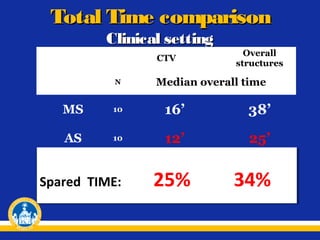
Total Time comparison
Clinical setting
CTV
N

Overall
structures

Median overall time

MS

10

16’

38’

AS

10

12’

25’

SA+M

10

27.6

73.1

Spared TIME:
SM+A

10

25%
15.5

34%
35.2
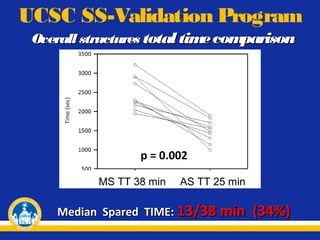
UCSC SS-Validation Program
Overall structures total tim com
e
parison

p = 0.002
MS TT 38 min

AS TT 25 min

Median Spared TIME: 13/38 min

(34%)
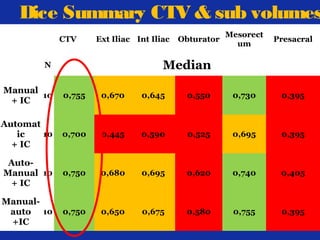
Dice Summary CTV & sub volumes
CTV

Ext Iliac Int Iliac

Obturator

Mesorect
um

Presacral

Median

N

Manual
10
+ IC

0,755

0,670

0,645

0,550

0,730

0,395

Automat
10
ic
+ IC

0,700

0,445

0,590

0,525

0,695

0,395

AutoManual 10
+ IC

0,750

0,680

0,695

0,620

0,740

0,405

Manualauto 10
+IC

0,750

0,650

0,675

0,580

0,755

0,395
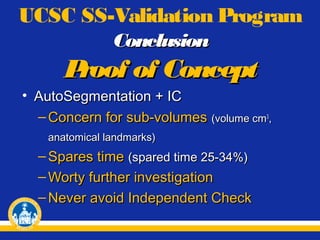
UCSC SS-Validation Program
Conclusion

P
roof of Concept
• AutoSegmentation + IC
– Concern for sub-volumes (volume cm3,
anatomical landmarks)

– Spares time (spared time 25-34%)
– Worty further investigation
– Never avoid Independent Check
N°of
pts

Evaluated
districts

Anatomical
charactaristics
considered

10

Pelvic nodal
volumes in
endometrial
cancer adj
therapy

Anteroposterior
and lateral
separation.
BMI not available
for all pts

9 (per

Adjuvant
Brest cancer

Breast size

6

Anorectal
cancer

Gender and
location of tumor

5

H&N nodal
level and OAR

Young et al,
Int. J. Radiation
Oncology Biol.
Phys., Vol. 79, No. 3,
pp. 943–947, 2011

Anders et al,
Radiotherapy and
Oncology 102
(2012) 68–73

group)

Teguh et al,

Int. J. Radiation
Oncology Biol. Phys.,
Vol. 81, No. 4, pp.
950–957, 2011

Gambacorta
et al,
10
Acta Oncol. 2013
Jan 22. [Epub ahead
of print]

Pelvic lymph
nodes in
locally
advanced
rectal cancer

Mean Dice
coefficient

0.8

Spared
time

26%
(p<0.000001)

-

0.79-0.85

-

0.67-0.79
Sex, age, weight, height,
BMI, menopausal state,
sacro-cocciegeal
distance, most anterior
distance between upper
iliac crests

0.86-0.91

56%

0.70

25-34%
UCSC SS-Validation Program
Clinical Setting

Perspective Study
UCSC SS-Validation Program
Clinical Setting: S
tudy design
• 44 CT scan of 44rectal cancer pts:
– 14 ATLAS
– 30 TEST group (Consecutive patients)

• STRUCTURE SET:

– contoured according to International guide line
lin
Arcangeli S, Rays. 2003 Jul-Sep;28(3):331-6
Roels S, Int J Radiat Oncol Biol Phys. 2006 Jul 15;65(4):1129-42.
UCSC SS-Validation Program
Rectal Cancer Subsites

• Subsites:
Subvolume1: Mesorectum+Presacral space
Subvolume 2a: Internal Iliac + Obturator Nodes
Subvolume 2b: External Iliac Nodes

• CTV:
– CTV_T3_mid ; CTV_T3_low, CTV_T4

• OAR:
B: Bladder; FH: Femural Head
Arcangeli S, Rays. 2003 Jul-Sep;28(3):331-6
Roels S, Int J Radiat Oncol Biol Phys. 2006 Jul 15;65(4):1129-42.
UCSC SS-Validation Program
Clinical Setting: Assignem
ent
• Operator 1 (junior) : TEST group 10
pts
• Segmentation (atlas based)
A. Manual Segmentation (MS)
B. Autosegmentation (AS)

• Time for each delineation modality
• Anonimized patients and segmentation
modalities

• Random segmentation
In each working-session different patient and
UCSC SS-Validation Program
Clinical Setting: Assignem
ent
Operator 2 (senior):
• Manual delineation (atlas based)
– Test 30 pts ( Manual Reference
Segmentation; MRS)
– never visible to operator 1

• Independent Check of all segmentation
modalities of all structures ;
• Time
UCSC SS-Validation Program
•
•
•
•
•
•
•
•

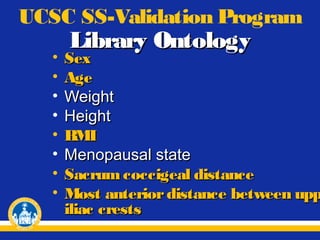
Library Ontology

Sex
Age
Weight
Height
BMI
Menopausal state
Sacrum coccigeal distance
Most anterior distance between upp
iliac crests
UCSC SS-Validation Program
Clinical Setting: Perspective Study

Results
UCSC SS-Validation Program
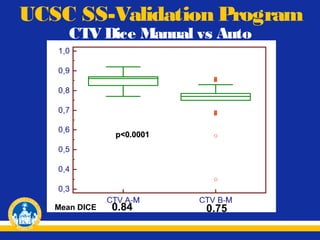
CTV Dice Manual vs Auto

p<0.0001

Mean DICE

0.84

0.75
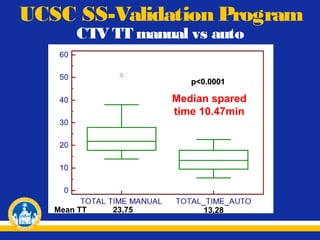
UCSC SS-Validation Program
CTV TT manual vs auto
p<0.0001

Median spared
time 10.47min

Mean TT

0.84
23,75

0.75
13,28
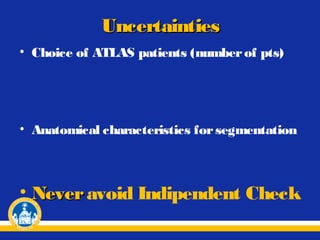
Uncertainties
• Choice of ATLAS patients (number of pts)

• Anatomical characteristics for segmentation

• Never avoid Indipendent Check
Conclusion
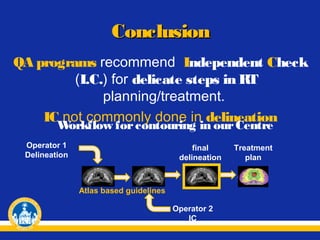
QA programs recommend Independent Check
(I.C.) for delicate steps in RT
planning/treatment.
IC not commonly done in delineation
W
orkflow for contouring in our Centre

Operator 1
Delineation

final
delineation

Atlas based guidelines
Operator 2
IC

Treatment
plan

Dice corso_27.02

  • 1.
    XXIII Corso Residenzialedi Aggiornamento Moderna Radioterapia e Diagnostica per Immagini: dalla definizione dei volumi alla radioterapia «adaptive» DICE il glossario per il corso M.A. Gambacorta, L. Boldrini, S. Longo, C. Valentini, D. Piccari
  • 2.
  • 3.
    Linee guida Modalità di trattamentopiù sofisticate Riduzione degli errori legati alla pianificazione
  • 4.
    Linee guida Modalità di trattamentopiù sofisticate Riduzione degli errori legati alla pianificazione Adeguata conoscenza dei volumi da irradiare e una loro precisa delimitazione
  • 5.
    Linee guida Modalità di trattamentopiù sofisticate Riduzione degli errori legati alla pianificazione Adeguata conoscenza dei volumi da irradiare e una loro precisa delimitazione LINEE GUIDA
  • 6.
    Gregoire et alRadiotherapy and Oncology 69 (2003) 227–236
  • 7.
    Linee guida Vantaggi • definizionedi un linguaggio multispecialistico • standardizzazione delle modalità di contornazione intraspecialistico
  • 8.
    Anal cancer Eendometrial andcervical cancer Internal iliac lymph nodes Cranial: Bifurcation of the common iliac artery into the external and internal iliac arteries Caudal: where the fibers of the levator ani insert into the obturator fascia and obturator internus, and can be demarcated either at the level of the obturator canal, or at the level where there is no space between the obturator internus muscle and the midline. Lateral: The medial edge of the obturator internus in the lower pelvis; iliopsoas muscle in the upper pelvis. Medial: The mesorectum and the presacral space in the lower pelvis . Anterior: The obturator internus muscle or bone in the lower pelvis. In the upper pelvis, a 7-mm margin around the internal iliac vessels Michael et al IJROBP 2011 Internal iliac lymph nodes VS From level of bifurcation of common iliac artery into internal artery, along its branches (obturator, hypogastric) terminating in paravaginal tissues at level of vaginal cuff Small et al IJROBP 2008
  • 9.
    Anal cancer Eendometrial and cervicalcancer Internal iliac lymph nodes Cranial: Bifurcation of the common iliac artery into the external and internal iliac arteries Caudal: where the fibers of the levator ani insert into the obturator fascia and obturator internus, and can be demarcated either at the level of the obturator canal, or at the level where there is no space between the obturator internus muscle and the midline. Lateral: The medial edge of the obturator internus in the lower pelvis; iliopsoas muscle in the upper pelvis. Medial: The mesorectum and the presacral space in the lower pelvis . Anterior: The obturator internus muscle or bone in the lower pelvis. In the upper pelvis, a 7-mm margin around the internal iliac vessels Internal iliac lymph nodes VS From level of bifurcation of common iliac artery into internal artery, along its branches (obturator, hypogastric) terminating in paravaginal tissues at level of vaginal cuff
  • 10.
    Linee guida: differenze Inview of the differences observed between the Brussels and the Rotterdam guidelines A multidisciplinary working group, including members from both the original Brussels and Rotterdam groups, was created to try to create a unified set of recommendations for the delineation of the various levels in the clinically uninvolved, ‘node-negative’ neck. Gregoire et al Radiotherapy and Oncology 69 (2003) 227–236
  • 11.
    Linee guida: differenze 1.The mesorectal lymph nodes (MLN), 2. the lateral lymph nodes (LLN): internal iliac lymph nodes, 3. the external iliac lymph nodes (ELN), and the inguinal lymph nodes (ILN). Roels et al Int. J. Radiation Oncology Biol. Phys., Vol. 65, No. 4, pp. 1129–1142, 2006
  • 12.
    Linee guida: differenze Myersonet al Int J Radiat Oncol Biol Phys. 2009 July 1; 74(3): 824–830
  • 13.
    Linee guida: differenze SUP:Bifurcation of IMA (Peritoneal fold /rectosigmoid junction) ANT: Denonvillers fascia SUP :Rectosigmoid junction ANT: small intestin Mesorectum: upper limit Roels et al Int. J. Radiation Oncology Biol. Phys., Vol. 65, No. 4, pp. 1129–1142, 2006 Myerson et al Int J Radiat Oncol Biol Phys. 2009 July 1; 74(3): 824–830
  • 14.
    Linee guida: differenze ANT:Denonvillers fascia ANT: 1 cm into the posterior bladder Mesorectum: anterior limit Roels et al Int. J. Radiation Oncology Biol. Phys., Vol. 65, No. 4, pp. 1129–1142, 2006 Myerson et al Int J Radiat Oncol Biol Phys. 2009 July 1; 74(3): 824–830
  • 15.
    Linee guida edifferenze interoperatore Observers (n=14) Contour Scan 1 Rectal cancer pt cT3 cN0 Group A=Experimental group (n=7) Group B=Control group (n=6) Randomization Atlas No Atlas Contour Scan 2 Contour Scan 2 Fuller et al, Int J Radiat Oncol Biol Phys. 2011 February 1; 79(2): 481–489
  • 16.
    Linee guida edifferenze interoperatore Group A (Contour Scan 1: WITHOUT ATLAS) Group A (Contour Scan 2: WITH ATLAS) p-value 0.68 0.76 0.03 0.58 0.69 0.02 CN coefficient CTVA (Internal Iliac, presacral, perirectal nodes) CN coefficient CTVA with expert reference (Internal Iliac, presacral, perirectal nodes) Fuller et al, Int J Radiat Oncol Biol Phys. 2011 February 1; 79(2): 481–489
  • 17.
    Gli indici disimilarità
  • 18.
    Gli indici disimilarità Chao K.S.C. et al. – Int J Radiat Oncol Biol Phys – 2
  • 19.
    Gli indici disimilarità 1. Soggettivi 2. Planari 3. Volumetr ici Volumetrici
  • 20.
    Gli indici disimilarità planari - Jaccard - Hausdorff - Dice
  • 21.
    Gli indici disimilarità planari Indice di Jaccar d IA ∩ BI IA ⋃ BI No overlap = 0 Overlap totale = 1
  • 22.
    L’indice di Jaccard - ValeSOLO per 2 contornazioni Molto sensibile a situazioni estreme Poco usato in letteratura Per confrontare > 2 volumi : V comune contornato IJ common : V totale contornato IJ pairs : media aritmetica IJ tutte possibili coppie
  • 23.
    Gli indici disimilarità planari Distanza di Hausdorff
  • 24.
    La distanza diHausdor ff d(X ,Y) = max {sup inf d(x,y), sup inf d(x,y)} y∊Y x∊X y∊Y x∊X Calcola la distanza tra due sottoinsiemi di punti in uno spazio metr ico
  • 25.
    L’indice di Dice “Inmany ecologic studies there is need to express in a quantitative manner the degree to which two different species are associated in nature. Nevertheless, no such measure has up to the present time come into generale use by ecologists.” Dice L.R. – Ecology – (1945) 26; 3; 297
  • 26.
    Gli indici disimilarità planari Indice di Dice 2 IA ∩ BI IA I + IBI No overlap = 0 Overlap totale = 1
  • 27.
    L’indice di Dice -IA I + IBI sempre > IA ⋃ BI - Intr oduzione del fattor e di nor malizzazione 2 - Meno sensibile a situazioni estr eme - Cr escita più lineare dell’ IJ - Molto utilizzato in letteratura
  • 28.
    L’indice di Dice Principali applicazioni cliniche • • • • • Valutazione Valutazione Valutazione Valutazione Valutazione contornazioni Replanning contornazioni A utocontour ing variabilità inter-intraoper ator e variabilità anatomica curva di appr endimento
  • 29.
    Gli indici disimilarità volumetrici - Semplici Valutazione spostamento baricentro Differenza assoluta cc - Complessi Indice di Minkowski
  • 30.
    L’indice di Minkowski MIሺ Bሺ = A, 2 Vሺ ሺ B 3 1 (A)3 ∙V Vm (AB) Misura la similarità di forma tra 2 volumi Se A = B Difficoltà : MI = 1 Equazione oper ativa Vm
  • 31.
    Gli indici disimilarità: who is who? 1. Medico Valida CTV, Lfn e OaR se necessa Valida softwar e 2. FisicoCura aspetti matematici Valida softwar e 3. TSRM Utilizza softwar e per calcolo IS Propone contor nazioni al medico
  • 32.
  • 33.
    - Replanning recontour ing H&N - A cquisizione e definizione di volumi da imaging funzionale PET
  • 34.
    Replanning recontouring H&N Obiettivi -Mantenere l’integr ità del piano iniziale - A ssicurar e coper tur a CTV - Preservare OaR - Ottimizzare dosimetr ia su nuova anatomia: - r egr essione CTV - per dita di peso
  • 35.
    Replanning recontour ingH&N Quando? 5°- 6° settimana / 36 Gy (7020 cGy)
  • 36.
    Replanning recontour ingH&N Come? A utocontouring Software di coregistrazione deformabile
  • 37.
  • 38.
    MIM Replanning recontouring H&N
  • 39.
    MIM Replanning recontouring H&N
  • 40.
    MIM Replanning recontouring H&N VoxA lign Deformation Engine
  • 41.
    MIM Replanning recontouring H&N
  • 42.
    MIM Replanning recontouring H&N
  • 43.
    Valutazione del risultato Valutazionedel risultato Calcolo coefficiente di Dice tra - Str ucture Set ottenuto dalla contor nazione MIM Replanning recontouring - Str ucture Set contornato manualmente ex novo sulla TC di Replanning
  • 44.
    Valutazione del risultato : gli OaR Or gano a r ischio Coefficiente di Dice Encefalo 0.97 Tr onco dell’encefalo 0.82 Canale midollar e 0.75 Occhio dx 0.80 Occhio sn 0.86 Cavo or ale 0.83 Par otide dx 0.80 Par otide sn 0.79
  • 45.
    Valutazione del risultato : gli OaR Or gano a r ischio Coefficiente di Dice Mandibola 0.77 Lar inge 0.89 Clavicola dx 0.77 Clavicola sn 0.86 Testa omer o dx 0.89 Testa omer o sn 0.91 Coefficiente di Dice medio OaR = 0.83 (0.750.97)
  • 46.
    PROSPETTIVE FUTURE - Imagefusion : RM (pelvi), PET, imaging 4D, CBCT - Contour ing : A utocontouring da atlante anatomico Replanning in altri distr etti
  • 47.
  • 48.
  • 50.
    Material & Methods CTV=pelvic Lymphnodes ATLAS creation (15 pts) 10 test pts Contoured by 3 RO (time recorded) Anatomical characteristics autosegmentation Autosegmentation Correction 1 week later (time recorded) Evaluation of Dice Similarity Coefficient and time savings for target delineation between RO and autosegmented pts
  • 51.
  • 52.
    ABAS: enables the autosegmentation withthe use of just one pt STAPLE algorithm: enables the user to choose an arbitrary number of atlases to serve as template for one pt case. The algorithm then creates and presents a results which is the represents a combined segmentation based on averaging the individual contours.
  • 53.
    Material & Methods BreastCancer pts Anorectal cancer pts • Creation of 3 ATLAS based on breast volume (small medium and large) • 9 pts evaluated for each ATLAS • Contouring of the whole breast (including chest wall) • Manual vs ABAS • Manual vs STAPLE algorithm • No time recorded • DSC evaluation • Brest cancer Mean Dice Coefficient=0.860.91 Anorectal cancer Mean Dice Coefficient=0.790.85 • • • • • • Creation of 4 ATLAS (2 for female and 2 for male: 1 high and 1 deep pt for each gender) 5 pt evaluated for all groups and gender RTOG guidelines (CTVA, CTVB and CTVC) Manual vs ABAS Manual vs STAPLE algorithm No time recorded DSC evaluation
  • 55.
    ABAS: enables the autosegmentatio n withthe use of just one pt STAPLE algorithm: enables the user to choose an arbitrary number of atlases to serve as template for one pt case. The algorithm then creates and presents a results which is the represents a combined segmentation based on averaging the individual contours.
  • 56.
    Material & Methods CTV=H&N lymphnodes (level I-V) 20 OAR Contoured by 10 RO (time recorded) Correction by expert panel ATLAS creation (10 pts, 4 stage N0, 6 stage N+) 12 test pts for each stage (N0N+ Anatomical characteristics autosegmentation Autosegmentation (time recorded) Correction by expert panel (time recorded) Evaluation of Dice Similarity Coefficient and Time Savings for target delineation between RO and autosegmented pts
  • 57.
    Results Mean Dice CoefficientCTV=0.67 Mean Dice Coefficient OaR=0.50-0.79 Time efficiency=56%
  • 58.
    N°of pts Young et 10 al Evaluated districts Anatomical charactaristics considered Pelvic nodal volumesin endometrial cancer adj therapy Anteroposterior and lateral separation. BMI not available for all pts Adjuvant group) Brest cancer 9 (per Anders et al 6 Teguh et 5 al Anorectal cancer H&N nodal level and OAR Breast size Gender and location of tumor Mean Dice coefficien t Spared time 26% 0.8 (p<0.00000 1) 0.86-0.91 - 0.79-0.85 - 0.67-0.79 56%
  • 59.
    Primary and point:to investigate dosimetric implications of not editing auto-contoured neck levels and OARs derived with ABAS for head and neck cancer patients. Secondary and point:to investigate whether observed favourable Dice Coefficient or mean contour distances (between adited and not-edited strctures) sets do indeed predict fo low PTV underdosage.
  • 60.
    Material & Methods 10H&N pts ABAS autocontouring ABAS PTV OBS1 PTV IMRT plans OBS2 PTV
  • 61.
    Material & Methods Whichparametres investigated? V95(percentage of volume V95 receiving more than 95%of the prescribed dose) and D99 (minimum dose delivered to 99% of PTVobs1 and PTVobs2)
  • 62.
  • 63.
  • 65.
    UCSC SS-Validation Program Aimofthe study P roof of Concept
  • 66.
    UCSC SS-Validation Program Aimofthe study To test CTV autosegmentation system for locally advanced rectal cancer in term of • Reliability • Time for the final delineation (only in clinical setting) • Segmentation modalities
  • 67.
    UCSC SS-Validation Program ClinicalSetting: Study design Manual Segmentation (MS) + IC vs Auto Segmentation (AS) + IC
  • 68.
    UCSC SS-Validation Program EducationalSetting: S tudy design Autosegmentation + Manual Revision + IC vs Manual + Autosegmentation + Manual Revision + IC
  • 69.
    UCSC SS-Validation Program S tudydesign • 14 CT scan of 14 rectal cancer pts: – 4 ATLAS – 10 TEST group • STRUCTURE SET: – contoured according to International guide line lin
  • 70.
    UCSC SS-Validation Program CTVdefinition Target volume modulation according to stage and location Presaral space Mesorectum Internal iliac nodes cT3 high (above the peritoneal reflection) cT3 mid-low (at the peritoneal reflection) + + + + + + Any cT with massive positive internal iliac nodes + Any cT with massive positive obturator nodes nodes + cT4 with for anterior pelvic organ + + + + + + + (when direct tumor infiltration) + + (when direct tumor infiltration) + + (when APR required) + + (when direct tumor infiltration) + + + (when APR required) + + + ischiorectal fossa (when APR required) + Extrenal iliac nodes sphincter complex (when APR required) + Obturator nodes (when direct tumor infiltration) Arcangeli S, Rays. 2003 Jul-Sep;28(3):331-6 Roels S, Int J Radiat Oncol Biol Phys. 2006 Jul 15;65(4):1129-42.
  • 71.
  • 72.
    UCSC SS-Validation Program ClinicalSetting: CTV dice com parison * p = 0,0195 SM MS DICE 0.75 SA AS 0.70
  • 73.
    UCSC SS-Validation Program Overallstructures dice com parison * p= 0.0195 SM MS SA AS DICE 0.68 0.59
  • 74.
    Internal Iliac Subsite ManualSegmentation Master contour Automatic Segmentation Autosegmentation contour Manual contour Master contour Master contour Manual contour Autosegmentation contour Median Dice coefficient= 0,645 Median Dice coefficient= 0,590 Master contour
  • 75.
    Onturator Subsite Manual Segmentation Manualcontour Master contour Manual contour Master contour Median Dice coefficient= 0,550 Automatic Segmentation Automatic contour Automatic contour Master contour Master contour Median Dice coefficient= 0,525
  • 76.
    Total Time comparison Clinicalsetting CTV N Overall structures Median overall time MS 10 16’ 38’ AS 10 12’ 25’ SA+M 10 27.6 73.1 Spared TIME: SM+A 10 25% 15.5 34% 35.2
  • 77.
    UCSC SS-Validation Program Overallstructures total tim com e parison p = 0.002 MS TT 38 min AS TT 25 min Median Spared TIME: 13/38 min (34%)
  • 78.
    Dice Summary CTV& sub volumes CTV Ext Iliac Int Iliac Obturator Mesorect um Presacral Median N Manual 10 + IC 0,755 0,670 0,645 0,550 0,730 0,395 Automat 10 ic + IC 0,700 0,445 0,590 0,525 0,695 0,395 AutoManual 10 + IC 0,750 0,680 0,695 0,620 0,740 0,405 Manualauto 10 +IC 0,750 0,650 0,675 0,580 0,755 0,395
  • 79.
    UCSC SS-Validation Program Conclusion P roofof Concept • AutoSegmentation + IC – Concern for sub-volumes (volume cm3, anatomical landmarks) – Spares time (spared time 25-34%) – Worty further investigation – Never avoid Independent Check
  • 80.
    N°of pts Evaluated districts Anatomical charactaristics considered 10 Pelvic nodal volumes in endometrial canceradj therapy Anteroposterior and lateral separation. BMI not available for all pts 9 (per Adjuvant Brest cancer Breast size 6 Anorectal cancer Gender and location of tumor 5 H&N nodal level and OAR Young et al, Int. J. Radiation Oncology Biol. Phys., Vol. 79, No. 3, pp. 943–947, 2011 Anders et al, Radiotherapy and Oncology 102 (2012) 68–73 group) Teguh et al, Int. J. Radiation Oncology Biol. Phys., Vol. 81, No. 4, pp. 950–957, 2011 Gambacorta et al, 10 Acta Oncol. 2013 Jan 22. [Epub ahead of print] Pelvic lymph nodes in locally advanced rectal cancer Mean Dice coefficient 0.8 Spared time 26% (p<0.000001) - 0.79-0.85 - 0.67-0.79 Sex, age, weight, height, BMI, menopausal state, sacro-cocciegeal distance, most anterior distance between upper iliac crests 0.86-0.91 56% 0.70 25-34%
  • 81.
    UCSC SS-Validation Program ClinicalSetting Perspective Study
  • 82.
    UCSC SS-Validation Program ClinicalSetting: S tudy design • 44 CT scan of 44rectal cancer pts: – 14 ATLAS – 30 TEST group (Consecutive patients) • STRUCTURE SET: – contoured according to International guide line lin Arcangeli S, Rays. 2003 Jul-Sep;28(3):331-6 Roels S, Int J Radiat Oncol Biol Phys. 2006 Jul 15;65(4):1129-42.
  • 83.
    UCSC SS-Validation Program RectalCancer Subsites • Subsites: Subvolume1: Mesorectum+Presacral space Subvolume 2a: Internal Iliac + Obturator Nodes Subvolume 2b: External Iliac Nodes • CTV: – CTV_T3_mid ; CTV_T3_low, CTV_T4 • OAR: B: Bladder; FH: Femural Head Arcangeli S, Rays. 2003 Jul-Sep;28(3):331-6 Roels S, Int J Radiat Oncol Biol Phys. 2006 Jul 15;65(4):1129-42.
  • 84.
    UCSC SS-Validation Program ClinicalSetting: Assignem ent • Operator 1 (junior) : TEST group 10 pts • Segmentation (atlas based) A. Manual Segmentation (MS) B. Autosegmentation (AS) • Time for each delineation modality • Anonimized patients and segmentation modalities • Random segmentation In each working-session different patient and
  • 85.
    UCSC SS-Validation Program ClinicalSetting: Assignem ent Operator 2 (senior): • Manual delineation (atlas based) – Test 30 pts ( Manual Reference Segmentation; MRS) – never visible to operator 1 • Independent Check of all segmentation modalities of all structures ; • Time
  • 86.
    UCSC SS-Validation Program • • • • • • • • LibraryOntology Sex Age Weight Height BMI Menopausal state Sacrum coccigeal distance Most anterior distance between upp iliac crests
  • 87.
    UCSC SS-Validation Program ClinicalSetting: Perspective Study Results
  • 88.
    UCSC SS-Validation Program CTVDice Manual vs Auto p<0.0001 Mean DICE 0.84 0.75
  • 89.
    UCSC SS-Validation Program CTVTT manual vs auto p<0.0001 Median spared time 10.47min Mean TT 0.84 23,75 0.75 13,28
  • 90.
    Uncertainties • Choice ofATLAS patients (number of pts) • Anatomical characteristics for segmentation • Never avoid Indipendent Check
  • 91.
    Conclusion QA programs recommendIndependent Check (I.C.) for delicate steps in RT planning/treatment. IC not commonly done in delineation W orkflow for contouring in our Centre Operator 1 Delineation final delineation Atlas based guidelines Operator 2 IC Treatment plan

Editor's Notes

  • #48 In accordance with improved technology
  • #50 End point
  • #78 Questo mi serve per clinical practice!! Per training voglio sapere differenza di tempo tra SM vs S M+A e SM vs S A+M. GIUSTO? Se queste sono statisticamente significative e a favore di chi. Ossia stesso grafico e dati di questa slide! (quindi 2 grafici)