DIBELS and RtI both focus on providing effective core instruction to all students, monitoring student progress through formative assessments, and identifying students who need additional support. DIBELS assessments are used within the RtI framework to determine the level of support individual students need (core, strategic, intensive) and to monitor their response to interventions in order to provide appropriate instruction and make adjustments as needed. The document provides guidance on how to use DIBELS data to write intervention plans for students identified as needing strategic or intensive support.
Explains how DIBELS (Dynamic Indicators of Basic Early Literacy Skills) tools fit within RtI (Response to Intervention) framework for early student literacy assessment and support.
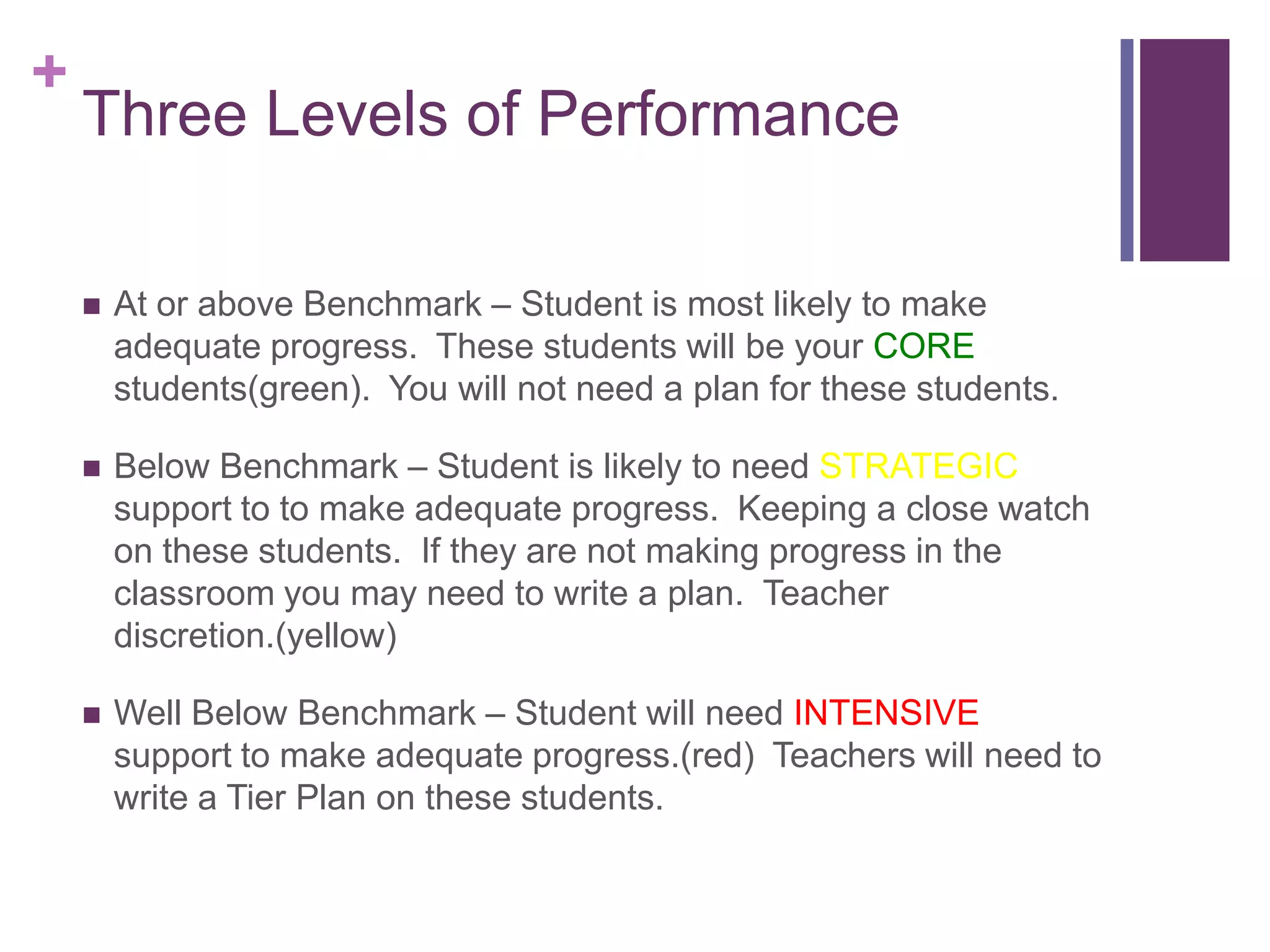
Describes three levels of student performance based on DIBELS assessments: Benchmark, Below Benchmark, and Well Below Benchmark, detailing required supports for each.
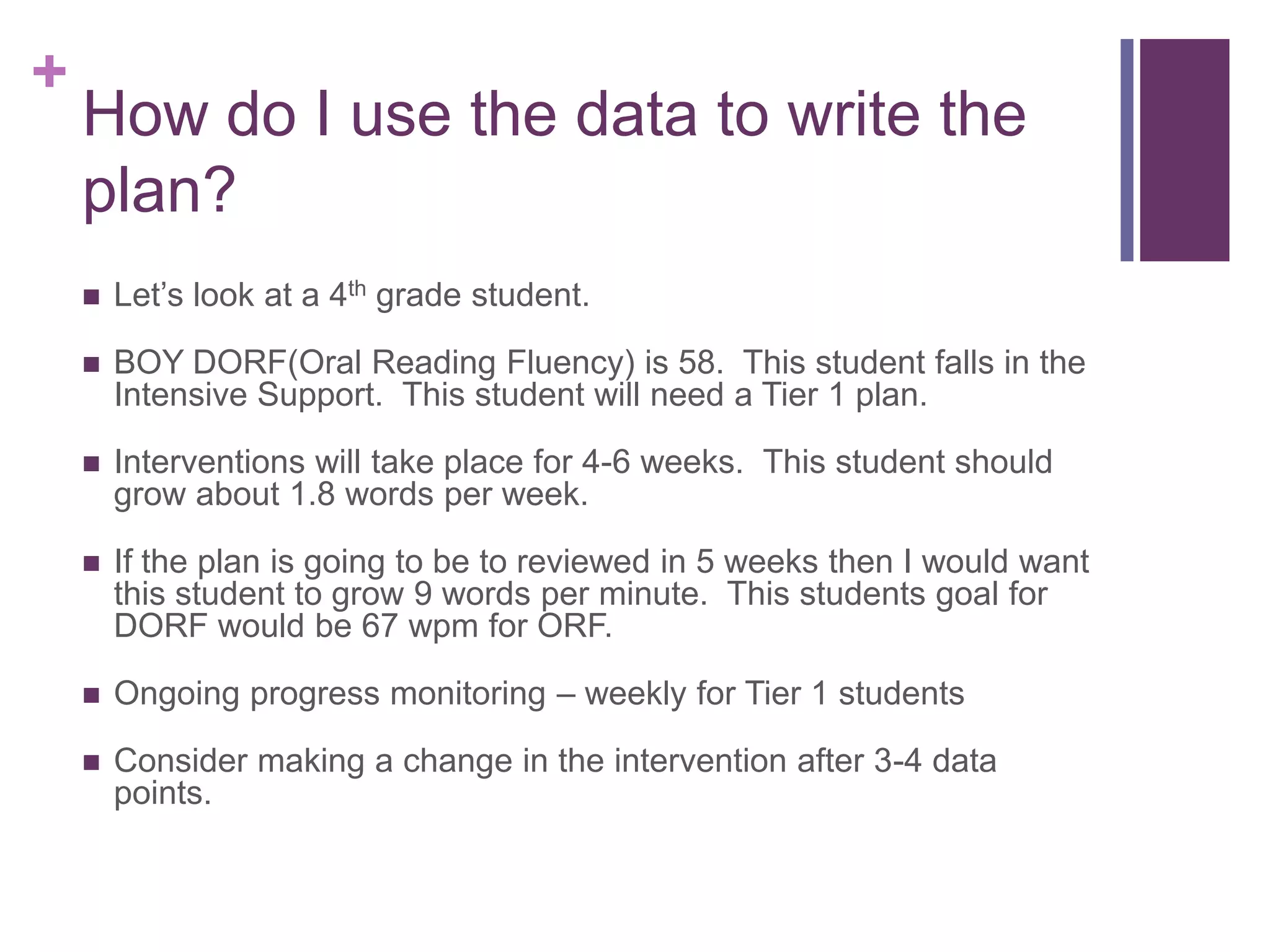
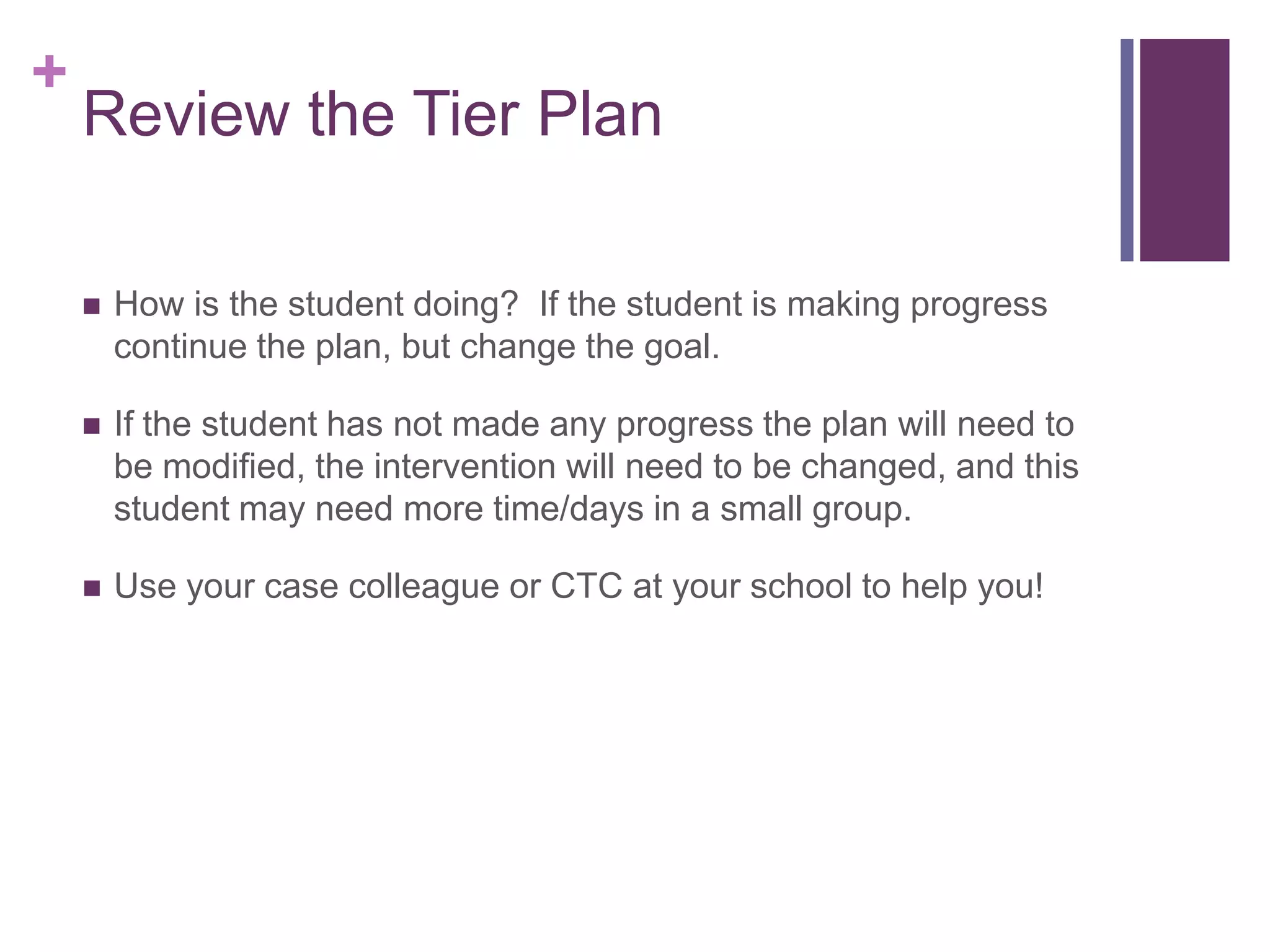
Outlines steps for creating intervention plans, monitoring student progress, adjusting goals, and modifying interventions to meet individual student needs.
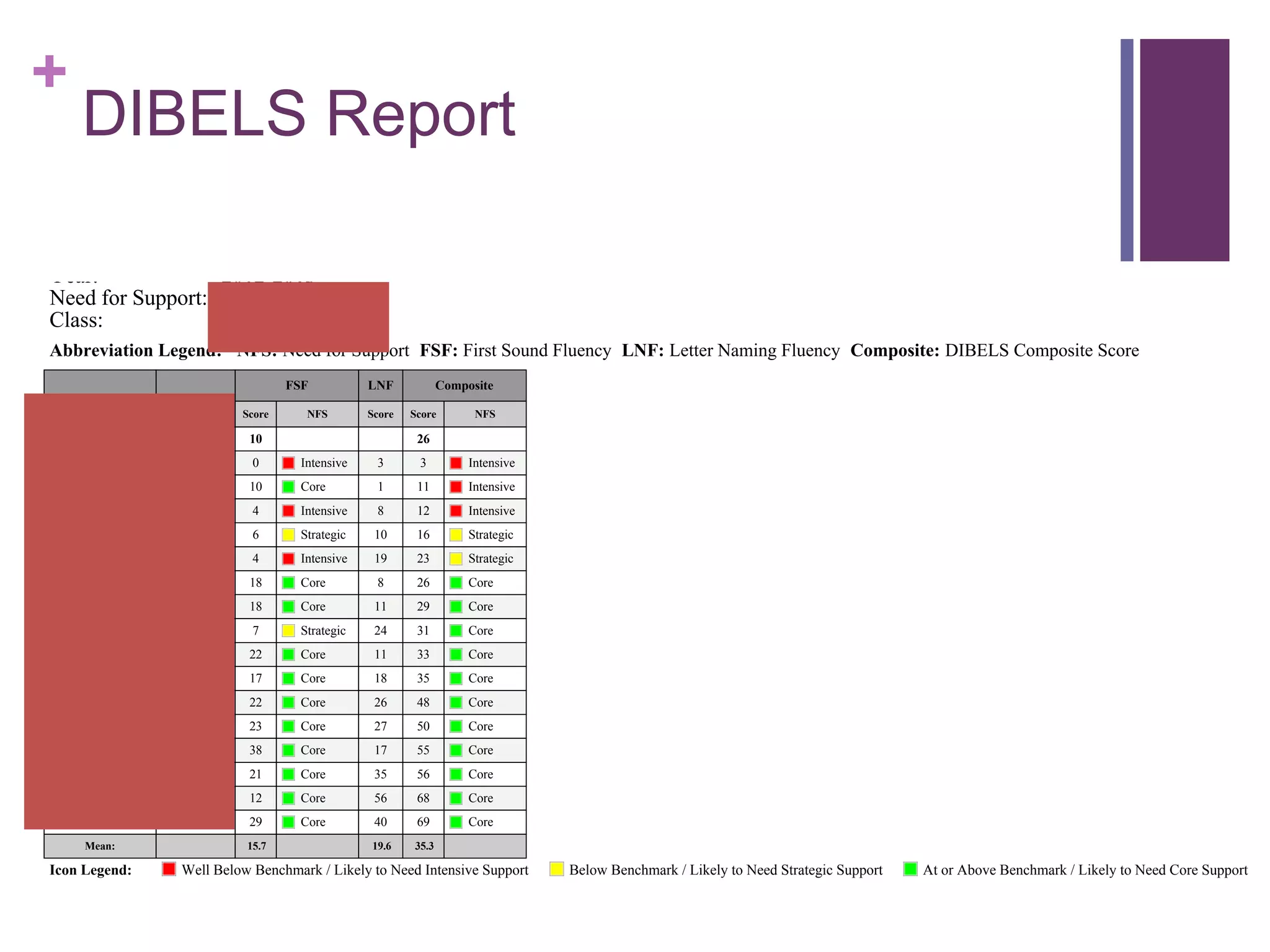
Presents a DIBELS report for a kindergarten class, showing individual student scores, support needs, and overall mean scores for basic literacy skills.
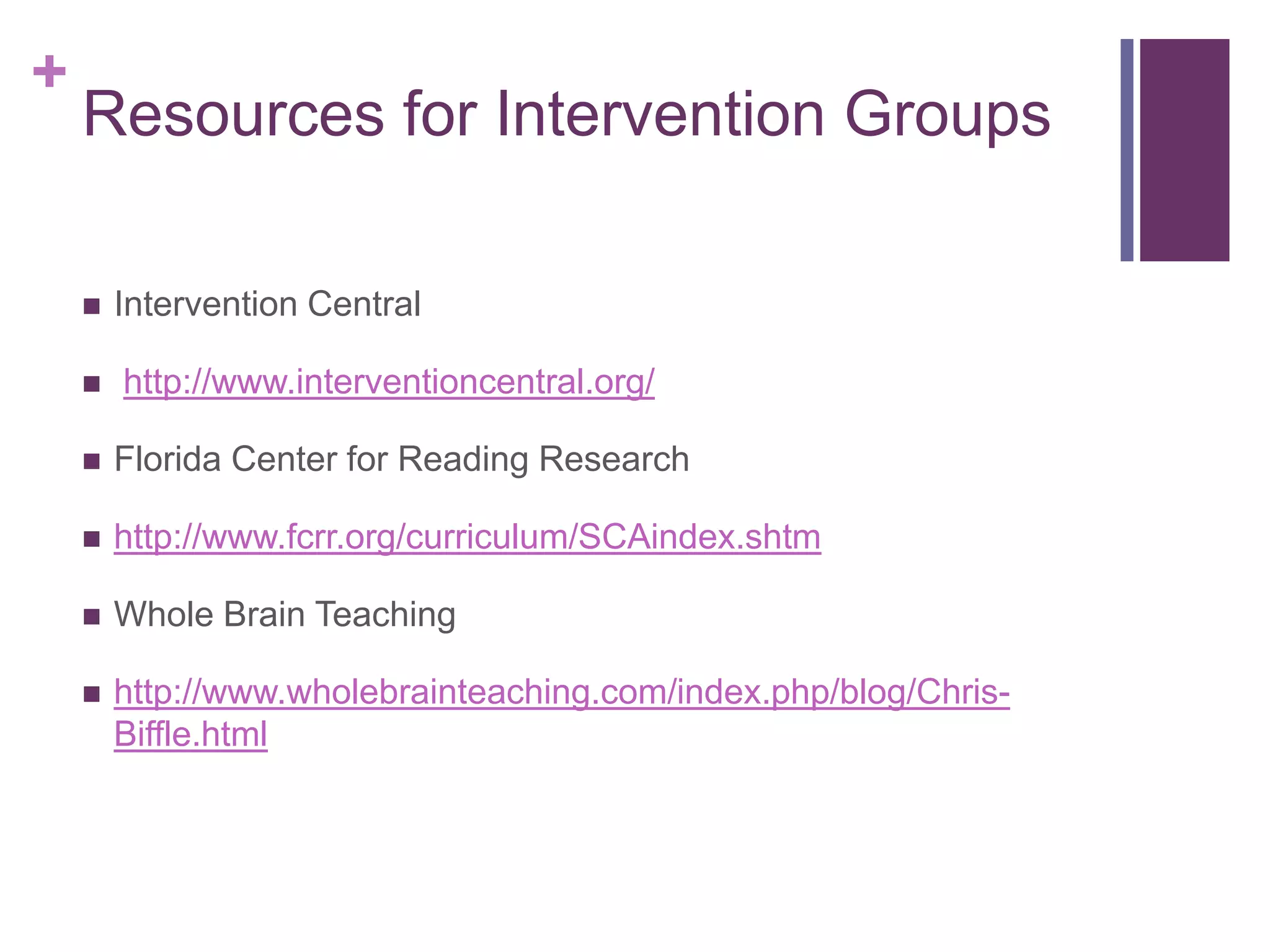
Lists resources and websites for intervention strategies to assist teachers in supporting students in need of additional literacy support.
+
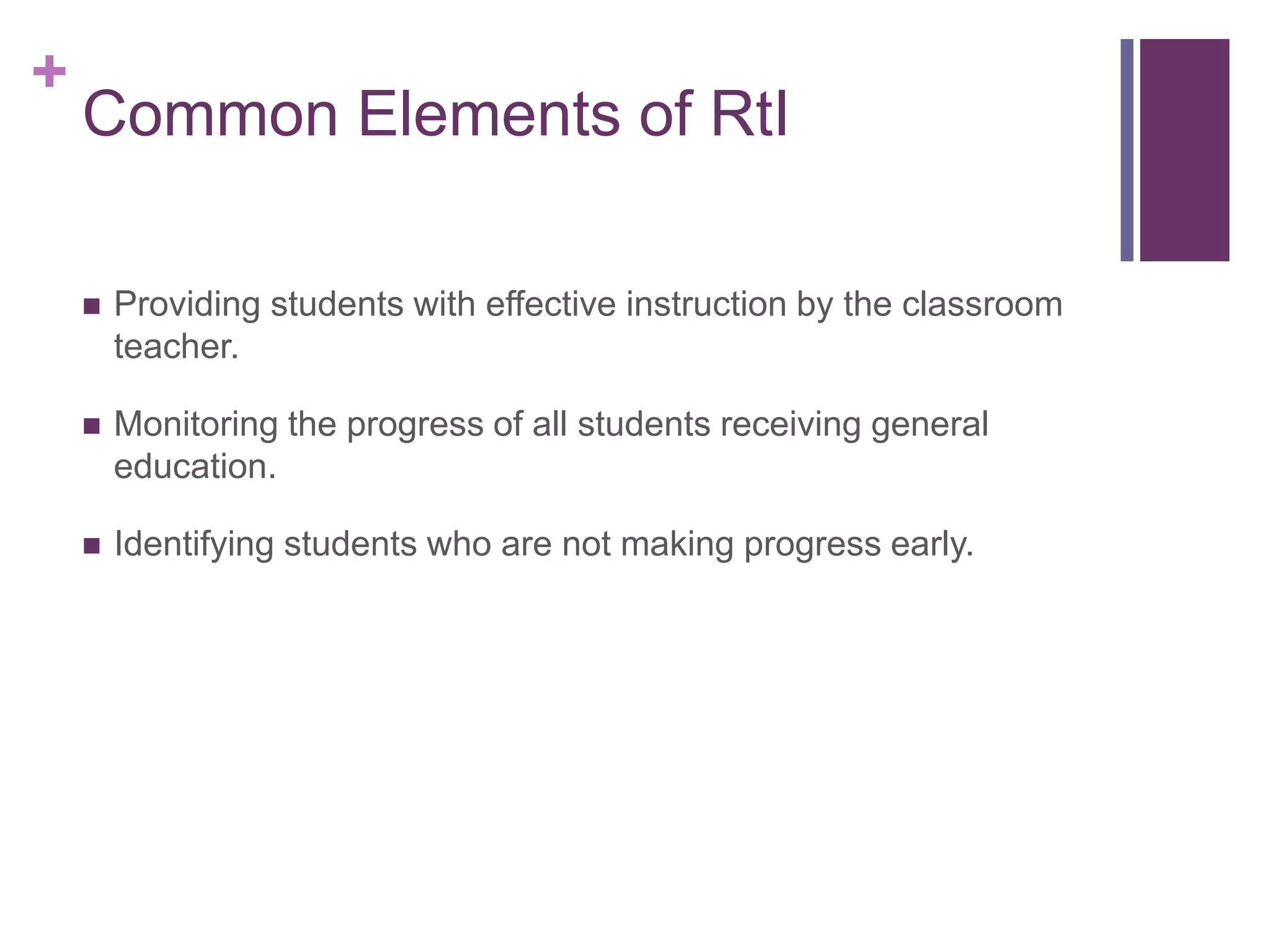
Common Elements of RtI
Providing students with effective instruction by the classroom
teacher.
Monitoring the progress of all students receiving general
education.
Identifying students who are not making progress early.
3.
+
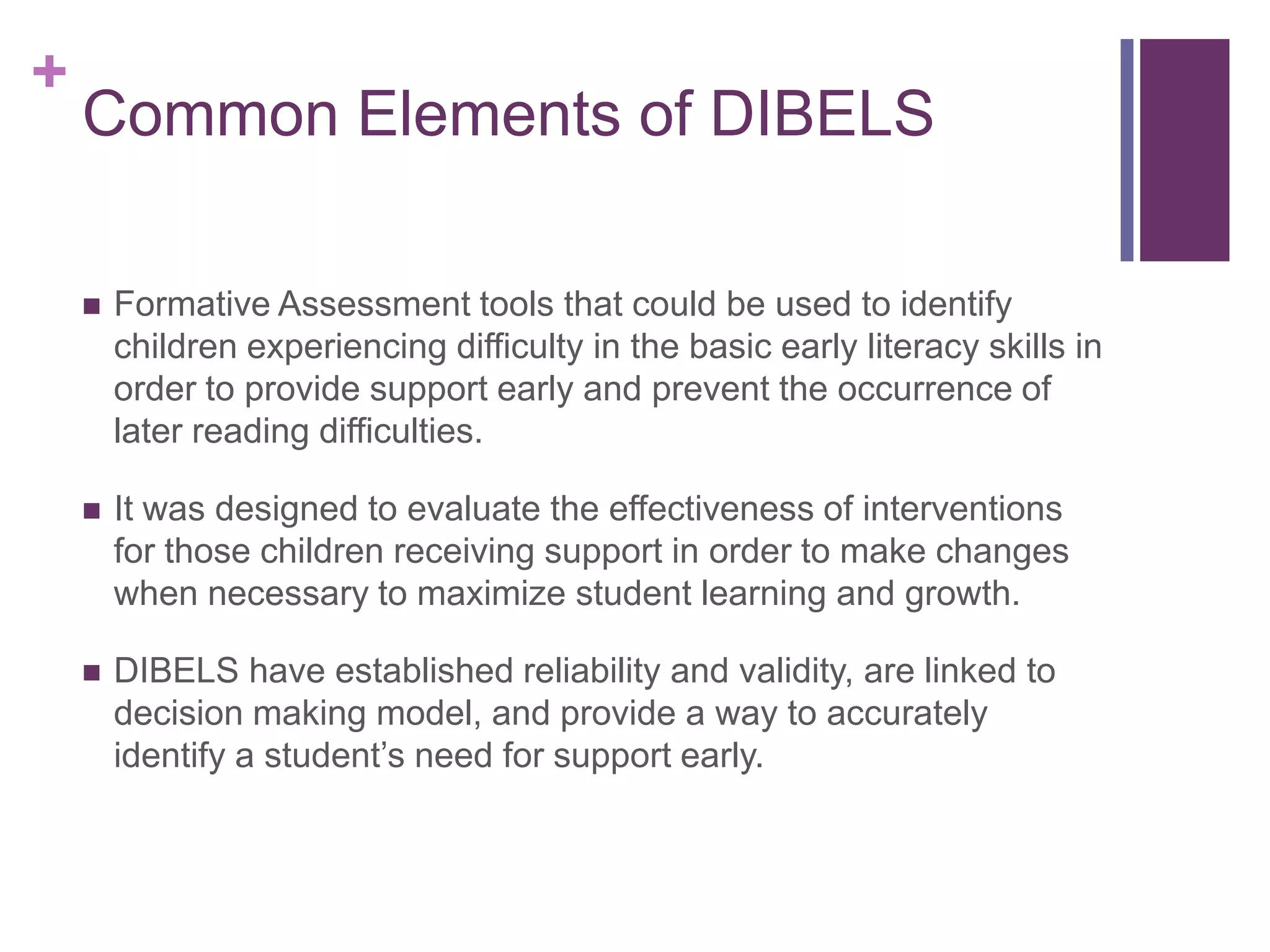
Common Elements of DIBELS
Formative Assessment tools that could be used to identify
children experiencing difficulty in the basic early literacy skills in
order to provide support early and prevent the occurrence of
later reading difficulties.
It was designed to evaluate the effectiveness of interventions
for those children receiving support in order to make changes
when necessary to maximize student learning and growth.
DIBELS have established reliability and validity, are linked to
decision making model, and provide a way to accurately
identify a student’s need for support early.
4.
+
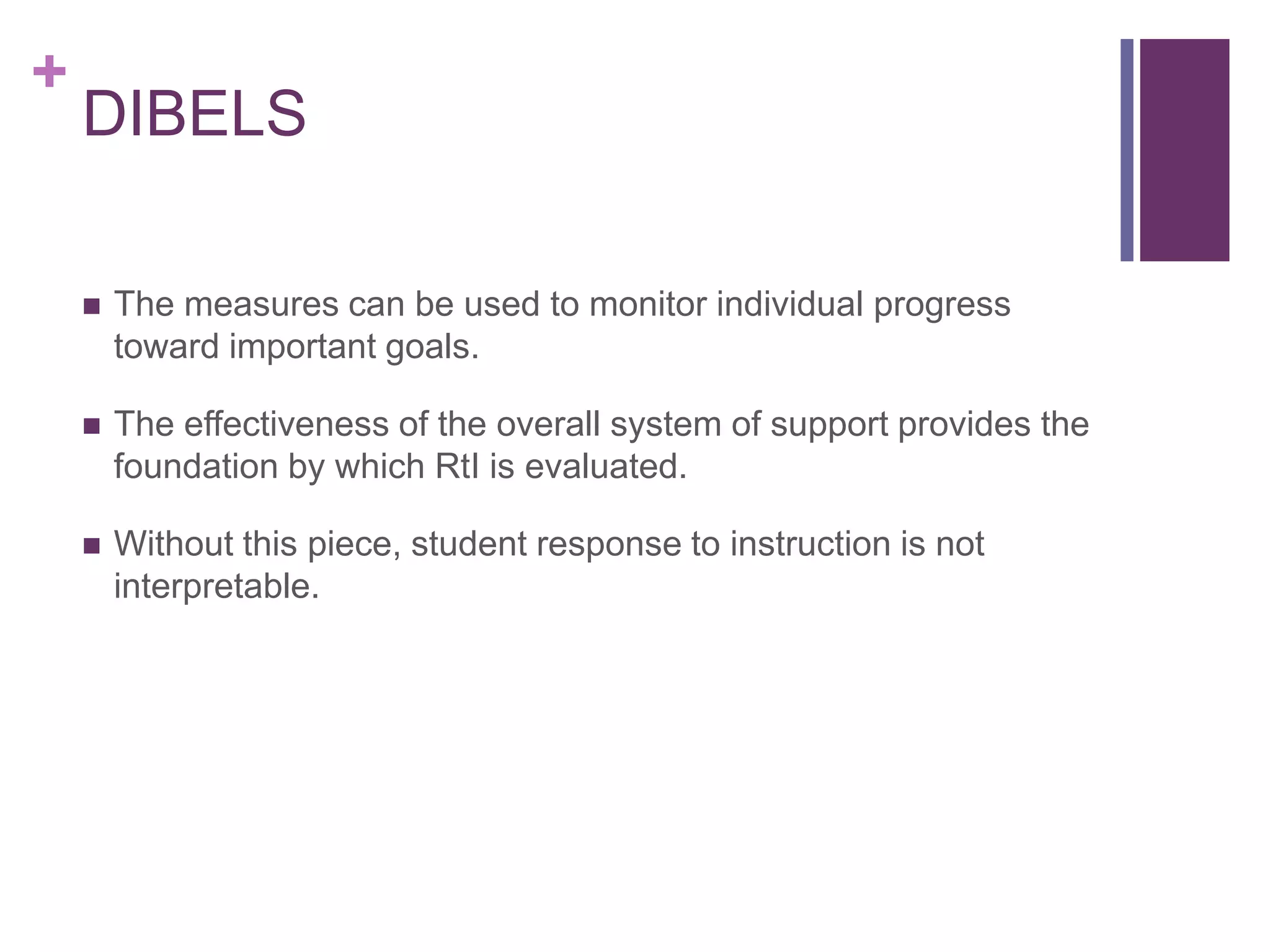
DIBELS
The measures can be used to monitor individual progress
toward important goals.
The effectiveness of the overall system of support provides the
foundation by which RtI is evaluated.
Without this piece, student response to instruction is not
interpretable.
5.
+
Three Levels of Performance
At or above Benchmark – Student is most likely to make
adequate progress. These students will be your CORE
students(green). You will not need a plan for these students.
Below Benchmark – Student is likely to need STRATEGIC
support to to make adequate progress. Keeping a close watch
on these students. If they are not making progress in the
classroom you may need to write a plan. Teacher
discretion.(yellow)
Well Below Benchmark – Student will need INTENSIVE
support to make adequate progress.(red) Teachers will need to
write a Tier Plan on these students.
6.
+
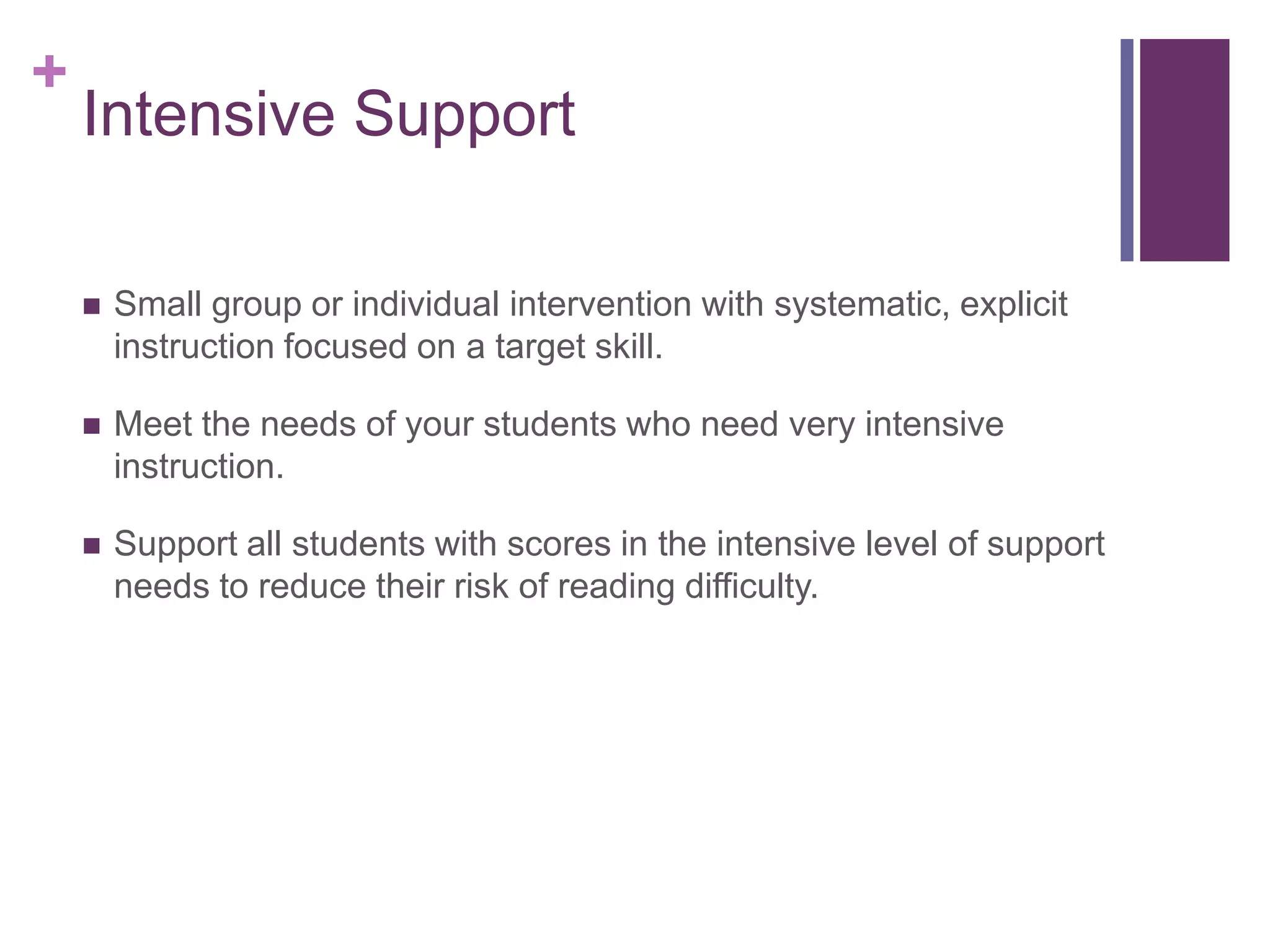
Intensive Support
Small group or individual intervention with systematic, explicit
instruction focused on a target skill.
Meet the needs of your students who need very intensive
instruction.
Support all students with scores in the intensive level of support
needs to reduce their risk of reading difficulty.
7.
+
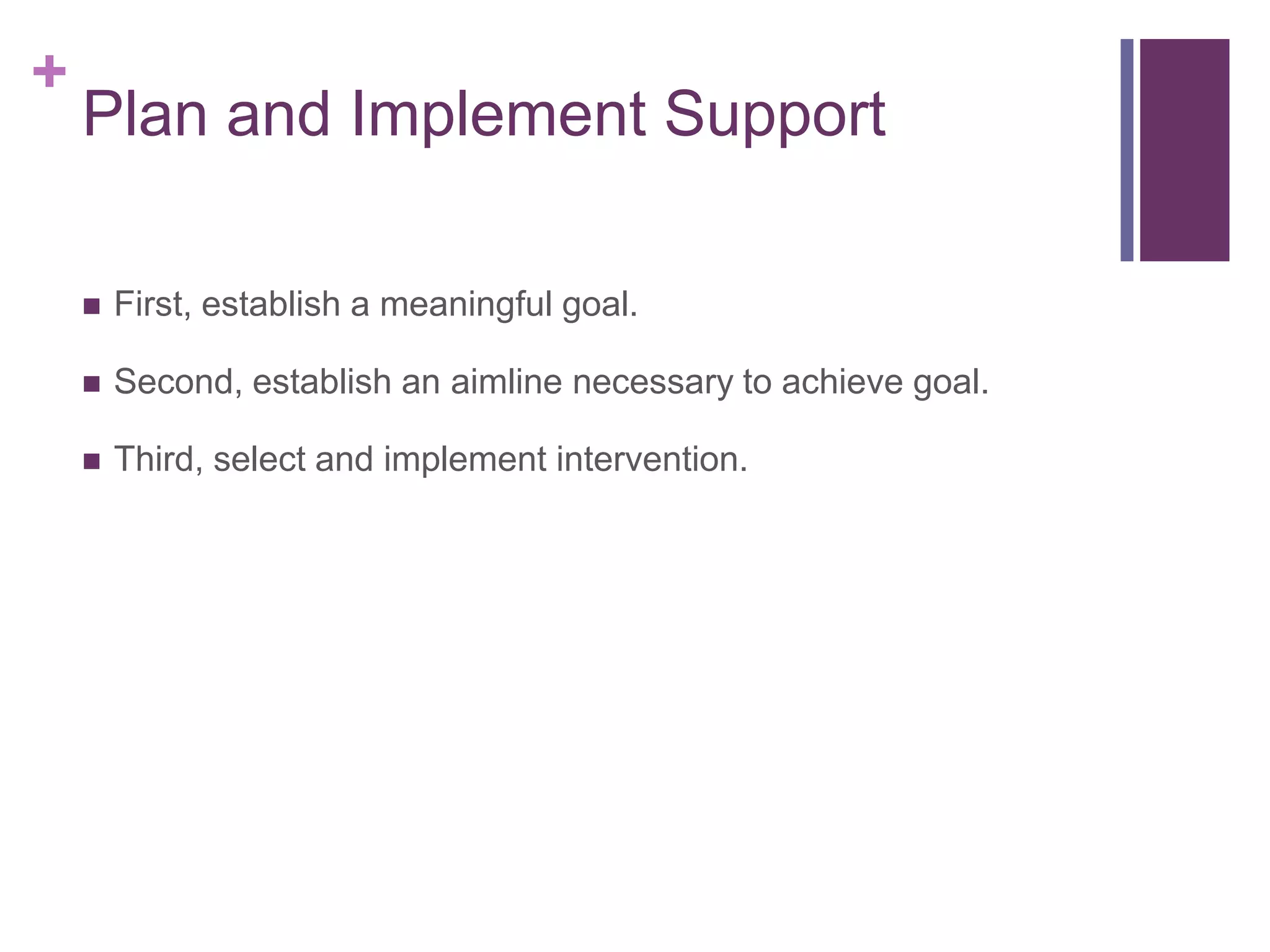
Plan and Implement Support
First, establish a meaningful goal.
Second, establish an aimline necessary to achieve goal.
Third, select and implement intervention.
8.
+
How do I use the data to write the
plan?
Let’s look at a 4th grade student.
BOY DORF(Oral Reading Fluency) is 58. This student falls in the
Intensive Support. This student will need a Tier 1 plan.
Interventions will take place for 4-6 weeks. This student should
grow about 1.8 words per week.
If the plan is going to be to reviewed in 5 weeks then I would want
this student to grow 9 words per minute. This students goal for
DORF would be 67 wpm for ORF.
Ongoing progress monitoring – weekly for Tier 1 students
Consider making a change in the intervention after 3-4 data
points.
9.
+
Review the Tier Plan
How is the student doing? If the student is making progress
continue the plan, but change the goal.
If the student has not made any progress the plan will need to
be modified, the intervention will need to be changed, and this
student may need more time/days in a small group.
Use your case colleague or CTC at your school to help you!
10.
+
DIBELS Report
Class List Report - DIBELS Next
District: Cleveland County Schools
School: West Elementary
Grade: Kindergarten - Beginning
Year: 2012-2013
Need for Support: Former Goals
Class: D Haskett
Abbreviation Legend: NFS: Need for Support FSF: First Sound Fluency LNF: Letter Naming Fluency Composite: DIBELS Composite Score
FSF LNF Composite
Student Student ID
Score NFS Score Score NFS
Benchmark Goals 10 26
Putnam, Kinley 12551647 0 Intensive 3 3 Intensive
McGinnis, Vagan 12590863 10 Core 1 11 Intensive
Holmer, Eddie 12591644 4 Intensive 8 12 Intensive
Hernandez, Liliana 124126723 6 Strategic 10 16 Strategic
Bradley, Ethan 12583073 4 Intensive 19 23 Strategic
Cruz, Leslie 12535654 18 Core 8 26 Core
Hodge, Lauryn 12542252 18 Core 11 29 Core
Carroll, Alex 12349870 7 Strategic 24 31 Core
Linney, Kee'donn 12416738 22 Core 11 33 Core
Bumgardner, Caleb 12416531 17 Core 18 35 Core
McClain, Khyann 12551840 22 Core 26 48 Core
Allen, Gideon 12534866 23 Core 27 50 Core
Smith, Gunnar 12416837 38 Core 17 55 Core
Broome, Landon 12406287 21 Core 35 56 Core
Gillespie, Joshua 12542182 12 Core 56 68 Core
Safrit, Joseph 12551671 29 Core 40 69 Core
Mean: 15.7 19.6 35.3
Icon Legend: Well Below Benchmark / Likely to Need Intensive Support Below Benchmark / Likely to Need Strategic Support At or Above Benchmark / Likely to Need Core Support
11.
+
Resources for Intervention Groups
Intervention Central
http://www.interventioncentral.org/
Florida Center for Reading Research
http://www.fcrr.org/curriculum/SCAindex.shtm
Whole Brain Teaching
http://www.wholebrainteaching.com/index.php/blog/Chris-
Biffle.html