Understanding Data:
A Principal’s Perspective


                      Dr. Glenn E. Malone
               Washington State University
                                 11/15/12
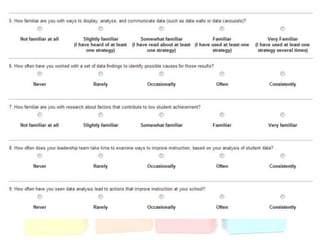
Poll Everywhere
Essential Questions
1. What does a principal candidate need to
   know about data to get hired?
2. What is the current state of data-laden
   initiatives?
3. What resources are available to help
   principals explore data?
4. What tools or strategies can a principal use
   to help?
5. What examples are available?
What should a Principal
Candidate know
About Data
To
Get
Hired?
Relationships Precede Learning!
Attitude is Everything!
All Children Can Learn!
When hiring what are the most important skills
 you are looking for in a principal candidate?
1.   A deep awareness that relationships at every point on the
     continuum are the base from which we work.

2.   A great attitude, willingness, a smile and kindness.

1.   The genuine belief that "each child" can learn and succeed.
2.   A deep understanding of quality instruction, and the desire to do a
     little extra every day to serve each child.

3.   The use of formative and summative data to inform and
     differentiate instruction.


                              Dr. Tim Yeomans, Superintendent
Wildwood’s Turnaround
2 Years of NOT making AYP
School of Improvement Status
Sanctions

             The Role of Data?

                                      35 Schools
                            School of Distinction
                  Washington Achievement Award
What is the
Current State
of
Data-laden
Initiatives ?
Miss South Carolina
ESEA Flexibility Waiver


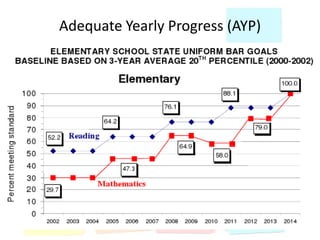
           AYP
        Sanctions
       Uniform Bar
Flexibility Waiver
                  From:
Current annual measurable goals for determining
adequate yearly progress (AYP) and associated
sanctions


                  To:
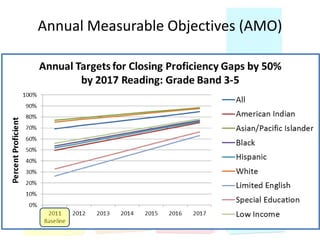
New “ambitious but achievable” annual measurable
objectives (AMO) to guide improvement efforts for
reading, mathematics, and graduation rates
Adequate Yearly Progress (AYP)
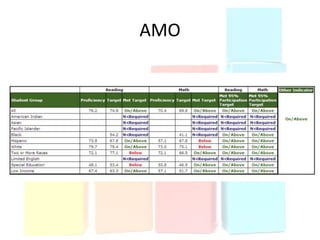
Annual Measurable Objectives (AMO)
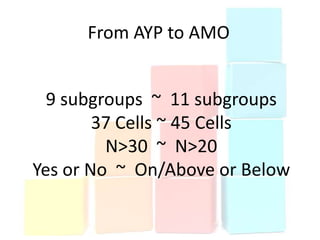
From AYP to AMO


  9 subgroups ~ 11 subgroups
        37 Cells ~ 45 Cells
         N>30 ~ N>20
Yes or No ~ On/Above or Below
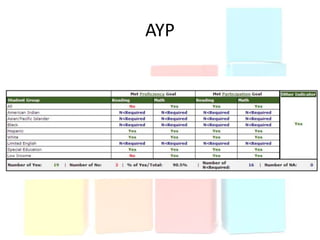
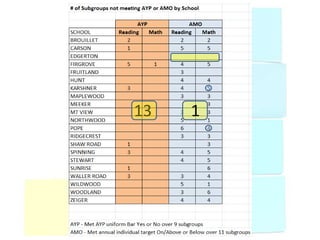
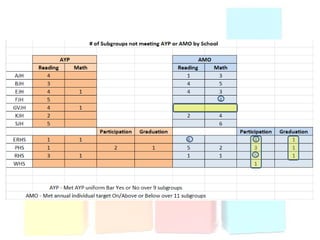
AYP
AMO
13   1
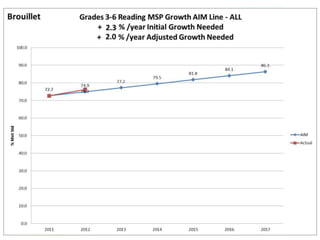
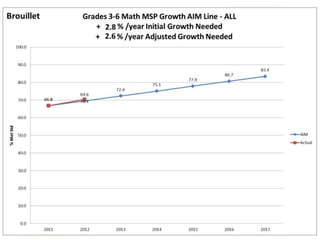
Brouillet                  Grades 3-6 Reading MSP Growth AIM Line - ALL
                               + 2.3 % /year Initial Growth Needed
                               + 2.0 % /year Adjusted Growth Needed
            100.0


             90.0                                                         86.3
                                                                  84.1
                                                        81.8
                                               79.5
             80.0                    77.2
                           74.9
                    72.7   76.2
             70.0


             60.0
% Met Std


             50.0                                                                AIM
                                                                                 Actual
             40.0


             30.0


             20.0


             10.0


              0.0
                    2011   2012      2013      2014     2015      2016    2017
Brouillet                  Grades 3-6 Reading MSP Growth AIM Line - ALL
                               + 2.3 % /year Initial Growth Needed
                               + 2.0 % /year Adjusted Growth Needed
            100.0


             90.0                                                         86.3
                                                                  84.1
                                                        81.8
                                               79.5
             80.0                    77.2
                           74.9
                    72.7   76.2
             70.0


             60.0
% Met Std


             50.0                                                                AIM
                                                                                 Actual
             40.0


             30.0


             20.0


             10.0


              0.0
                    2011   2012      2013      2014     2015      2016    2017
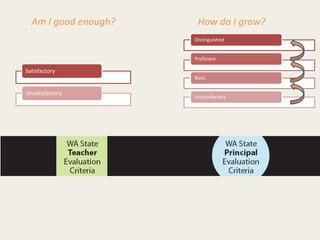
Am I good enough?    How do I grow?
                      Distinguished


                      Proficient

Satisfactory
                      Basic

Unsatisfactory
                      Unsatisfactory
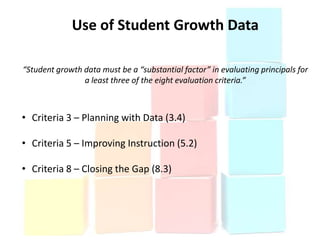
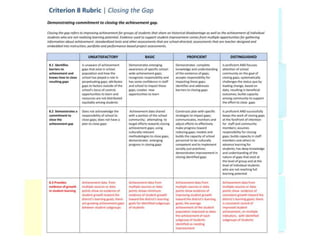
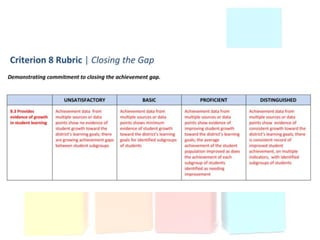
Use of Student Growth Data

“Student growth data must be a “substantial factor” in evaluating principals for
                a least three of the eight evaluation criteria.”


• Criteria 3 – Planning with Data (3.4)

• Criteria 5 – Improving Instruction (5.2)

• Criteria 8 – Closing the Gap (8.3)
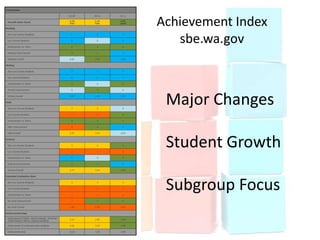
Achievement Index
   sbe.wa.gov


 Major Changes

 Student Growth

 Subgroup Focus
Let’s Explore Some Web Tools
Washington Query
eds.ospi.k12.wa.us
OSPI Report Card
reportcard.ospi.k12.wa.us
WADE
www.cedr.us
Smarter Balanced
         Sample Items
sampleitems.smarterbalanced.org
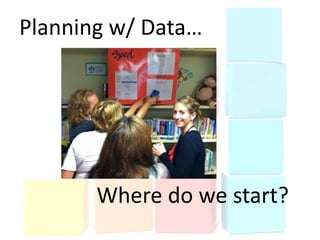
Planning w/ Data…


       Where do we start?
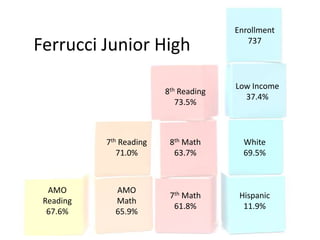
Ferrucci Junior High School

                 Dr. Aileen Baxter &
                 Mr. Michael Kraft

                  Success at the Core
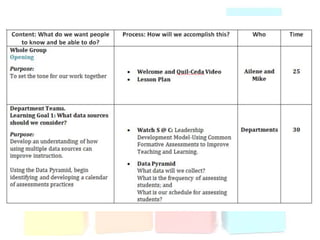
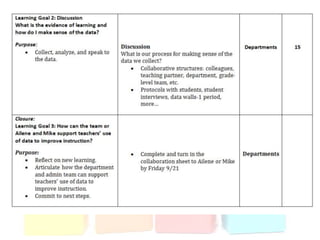
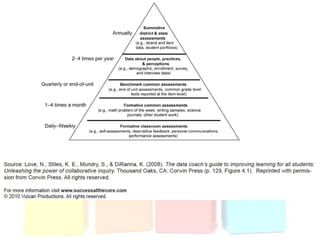
                  TERC Using Data
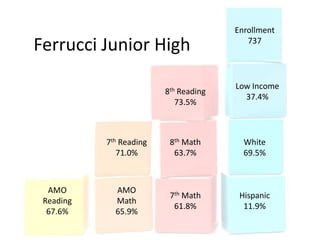
Enrollment
Ferrucci Junior High                      737


                                       Low Income
                         8th Reading
                                         37.4%
                            73.5%


           7th Reading    8th Math       White
              71.0%        63.7%         69.5%


  AMO        AMO
                          7th Math      Hispanic
 Reading     Math
                           61.8%         11.9%
  67.6%      65.9%
Enrollment
Ferrucci Junior High                      737


                                       Low Income
                         8th Reading
                                         37.4%
                            73.5%


           7th Reading    8th Math       White
              71.0%        63.7%         69.5%


  AMO        AMO
                          7th Math      Hispanic
 Reading     Math
                           61.8%         11.9%
  67.6%      65.9%
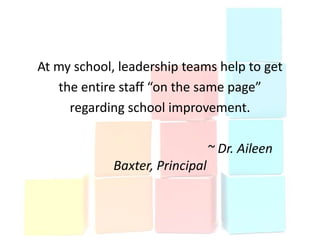
At my school, leadership teams help to get
   the entire staff “on the same page”
     regarding school improvement.

                                 ~ Dr. Aileen
             Baxter, Principal
Glacier View Junior High
 Mr. Mark Vetter
 Mr. Brian Curtis &
 Mrs. Rachel Johnson

                       Action Research
                       Data Analysis


   Collaborative Inquiry
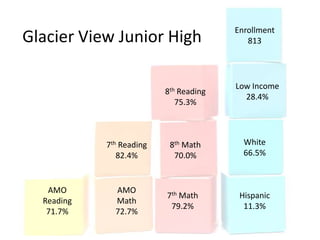
Enrollment
Glacier View Junior High                   813


                                        Low Income
                          8th Reading
                                          28.4%
                             75.3%


            7th Reading    8th Math       White
               82.4%        70.0%         66.5%


   AMO        AMO
                          7th Math       Hispanic
  Reading     Math
                           79.2%          11.3%
   71.7%      72.7%
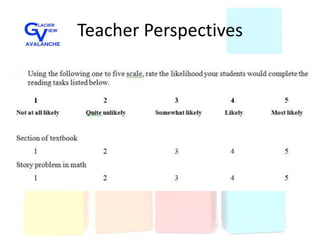
Teacher Perspectives
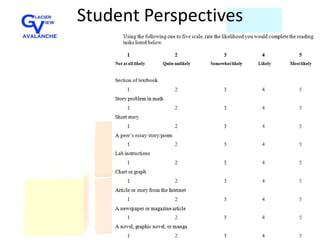
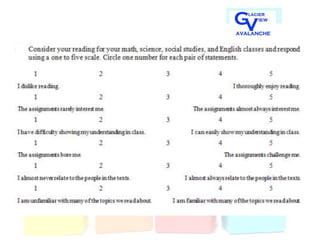
Student Perspectives
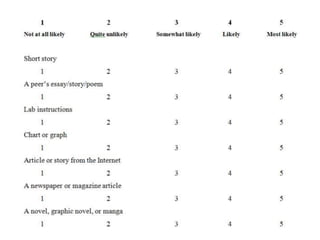
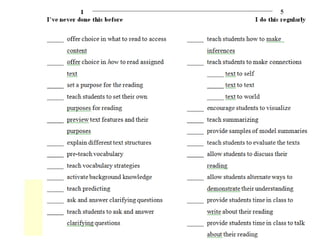
When we took our teacher
  questionnaires, student questionnaires, and
testing outcomes together, there was MUCH to
                  talk about.

                      ~ Rachel Johnson, 9th grade
                   teacher
The Findings
• Teachers in the group communicated a
  number of false assumptions about students’
  literacy skills and reading preferences
• Analysis of student data was useful in raising
  awareness of student literacy needs
• Teachers changed perspectives and made
  initial changes in their practices
The beauty is the results were difficult to argue
 with. It didn't leave me in a position of having to
  highlight the disconnect; it was laid bare in the
      numbers and student quotations. Using
collaborative inquiry was less threatening for all of
   us. And it was motivating too, in a way that it
       might not have been without the data.


                               ~ Rachel Johnson, 9th
                    grade teacher
Free Resources

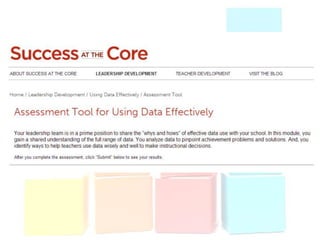
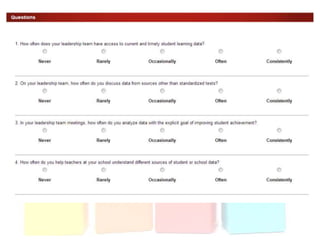
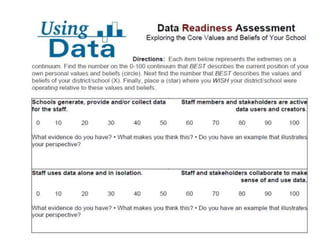
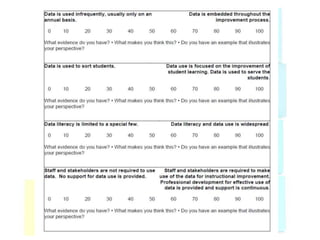
Data Readiness Assessments
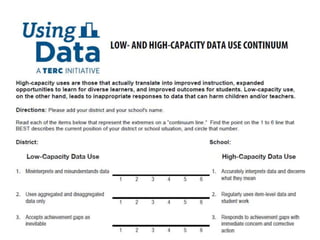
Low & High Capacity Data Use
Ready-made Modules & Videos
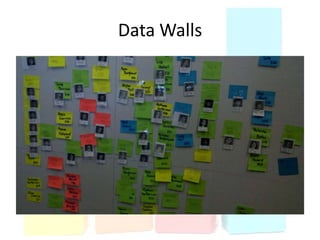
Data Walls
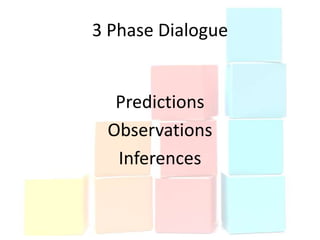
3 Phase Dialogue


  Predictions
 Observations
  Inferences
Go Visual


Stoplight Highlighting
to emphasize patterns
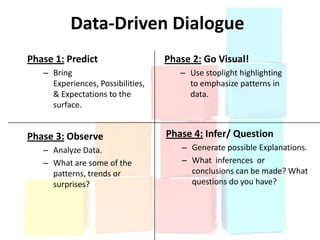
Data-Driven Dialogue
Phase 1: Predict                   Phase 2: Go Visual!
   – Bring                            – Use stoplight highlighting
     Experiences, Possibilities,        to emphasize patterns in
     & Expectations to the              data.
     surface.


Phase 3: Observe                   Phase 4: Infer/ Question
   – Analyze Data.                    – Generate possible Explanations.
   – What are some of the             – What inferences or
     patterns, trends or                conclusions can be made? What
     surprises?                         questions do you have?
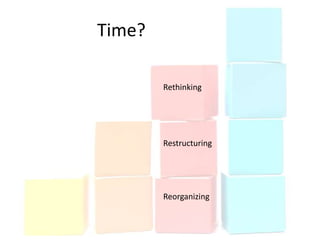
Time?

        Rethinking


        Restructuring


        Reorganizing
COLLABORATION IS KEY!
Questions

Wsu 11.15 Presentation

  • 1.
    Understanding Data: A Principal’sPerspective Dr. Glenn E. Malone Washington State University 11/15/12
  • 2.
  • 3.
    Essential Questions 1. Whatdoes a principal candidate need to know about data to get hired? 2. What is the current state of data-laden initiatives? 3. What resources are available to help principals explore data? 4. What tools or strategies can a principal use to help? 5. What examples are available?
  • 4.
    What should aPrincipal Candidate know About Data To Get Hired?
  • 5.
  • 6.
  • 7.
  • 8.
    When hiring whatare the most important skills you are looking for in a principal candidate? 1. A deep awareness that relationships at every point on the continuum are the base from which we work. 2. A great attitude, willingness, a smile and kindness. 1. The genuine belief that "each child" can learn and succeed. 2. A deep understanding of quality instruction, and the desire to do a little extra every day to serve each child. 3. The use of formative and summative data to inform and differentiate instruction. Dr. Tim Yeomans, Superintendent
  • 9.
    Wildwood’s Turnaround 2 Yearsof NOT making AYP School of Improvement Status Sanctions The Role of Data? 35 Schools School of Distinction Washington Achievement Award
  • 10.
    What is the CurrentState of Data-laden Initiatives ?
  • 11.
  • 12.
    ESEA Flexibility Waiver AYP Sanctions Uniform Bar
  • 13.
    Flexibility Waiver From: Current annual measurable goals for determining adequate yearly progress (AYP) and associated sanctions To: New “ambitious but achievable” annual measurable objectives (AMO) to guide improvement efforts for reading, mathematics, and graduation rates
  • 14.
  • 15.
  • 16.
    From AYP toAMO 9 subgroups ~ 11 subgroups 37 Cells ~ 45 Cells N>30 ~ N>20 Yes or No ~ On/Above or Below
  • 17.
  • 18.
  • 19.
    13 1
  • 21.
    Brouillet Grades 3-6 Reading MSP Growth AIM Line - ALL + 2.3 % /year Initial Growth Needed + 2.0 % /year Adjusted Growth Needed 100.0 90.0 86.3 84.1 81.8 79.5 80.0 77.2 74.9 72.7 76.2 70.0 60.0 % Met Std 50.0 AIM Actual 40.0 30.0 20.0 10.0 0.0 2011 2012 2013 2014 2015 2016 2017
  • 22.
    Brouillet Grades 3-6 Reading MSP Growth AIM Line - ALL + 2.3 % /year Initial Growth Needed + 2.0 % /year Adjusted Growth Needed 100.0 90.0 86.3 84.1 81.8 79.5 80.0 77.2 74.9 72.7 76.2 70.0 60.0 % Met Std 50.0 AIM Actual 40.0 30.0 20.0 10.0 0.0 2011 2012 2013 2014 2015 2016 2017
  • 25.
    Am I goodenough? How do I grow? Distinguished Proficient Satisfactory Basic Unsatisfactory Unsatisfactory
  • 27.
    Use of StudentGrowth Data “Student growth data must be a “substantial factor” in evaluating principals for a least three of the eight evaluation criteria.” • Criteria 3 – Planning with Data (3.4) • Criteria 5 – Improving Instruction (5.2) • Criteria 8 – Closing the Gap (8.3)
  • 28.
    Achievement Index sbe.wa.gov Major Changes Student Growth Subgroup Focus
  • 31.
  • 32.
  • 33.
  • 34.
  • 35.
    Smarter Balanced Sample Items sampleitems.smarterbalanced.org
  • 36.
    Planning w/ Data… Where do we start?
  • 37.
    Ferrucci Junior HighSchool Dr. Aileen Baxter & Mr. Michael Kraft Success at the Core TERC Using Data
  • 38.
    Enrollment Ferrucci Junior High 737 Low Income 8th Reading 37.4% 73.5% 7th Reading 8th Math White 71.0% 63.7% 69.5% AMO AMO 7th Math Hispanic Reading Math 61.8% 11.9% 67.6% 65.9%
  • 39.
    Enrollment Ferrucci Junior High 737 Low Income 8th Reading 37.4% 73.5% 7th Reading 8th Math White 71.0% 63.7% 69.5% AMO AMO 7th Math Hispanic Reading Math 61.8% 11.9% 67.6% 65.9%
  • 47.
    At my school,leadership teams help to get the entire staff “on the same page” regarding school improvement. ~ Dr. Aileen Baxter, Principal
  • 48.
    Glacier View JuniorHigh Mr. Mark Vetter Mr. Brian Curtis & Mrs. Rachel Johnson Action Research Data Analysis Collaborative Inquiry
  • 49.
    Enrollment Glacier View JuniorHigh 813 Low Income 8th Reading 28.4% 75.3% 7th Reading 8th Math White 82.4% 70.0% 66.5% AMO AMO 7th Math Hispanic Reading Math 79.2% 11.3% 71.7% 72.7%
  • 50.
  • 52.
  • 53.
  • 55.
    When we tookour teacher questionnaires, student questionnaires, and testing outcomes together, there was MUCH to talk about. ~ Rachel Johnson, 9th grade teacher
  • 57.
    The Findings • Teachersin the group communicated a number of false assumptions about students’ literacy skills and reading preferences • Analysis of student data was useful in raising awareness of student literacy needs • Teachers changed perspectives and made initial changes in their practices
  • 58.
    The beauty isthe results were difficult to argue with. It didn't leave me in a position of having to highlight the disconnect; it was laid bare in the numbers and student quotations. Using collaborative inquiry was less threatening for all of us. And it was motivating too, in a way that it might not have been without the data. ~ Rachel Johnson, 9th grade teacher
  • 59.
    Free Resources Data ReadinessAssessments Low & High Capacity Data Use Ready-made Modules & Videos
  • 66.
  • 67.
    3 Phase Dialogue Predictions Observations Inferences
  • 68.
  • 69.
    Data-Driven Dialogue Phase 1:Predict Phase 2: Go Visual! – Bring – Use stoplight highlighting Experiences, Possibilities, to emphasize patterns in & Expectations to the data. surface. Phase 3: Observe Phase 4: Infer/ Question – Analyze Data. – Generate possible Explanations. – What are some of the – What inferences or patterns, trends or conclusions can be made? What surprises? questions do you have?
  • 71.
    Time? Rethinking Restructuring Reorganizing
  • 73.
  • 74.

Editor's Notes

  • #27 Teachers and principals are mutually responsible for most elements of the work of teaching and learning. Principals are alone in being charged with closing the achievement gap and managing resources.
  • #53 Content Area Literacy Instruction