BY : CHARU KAIM
2nd year medial student
PATHOPHYSIOLOGY
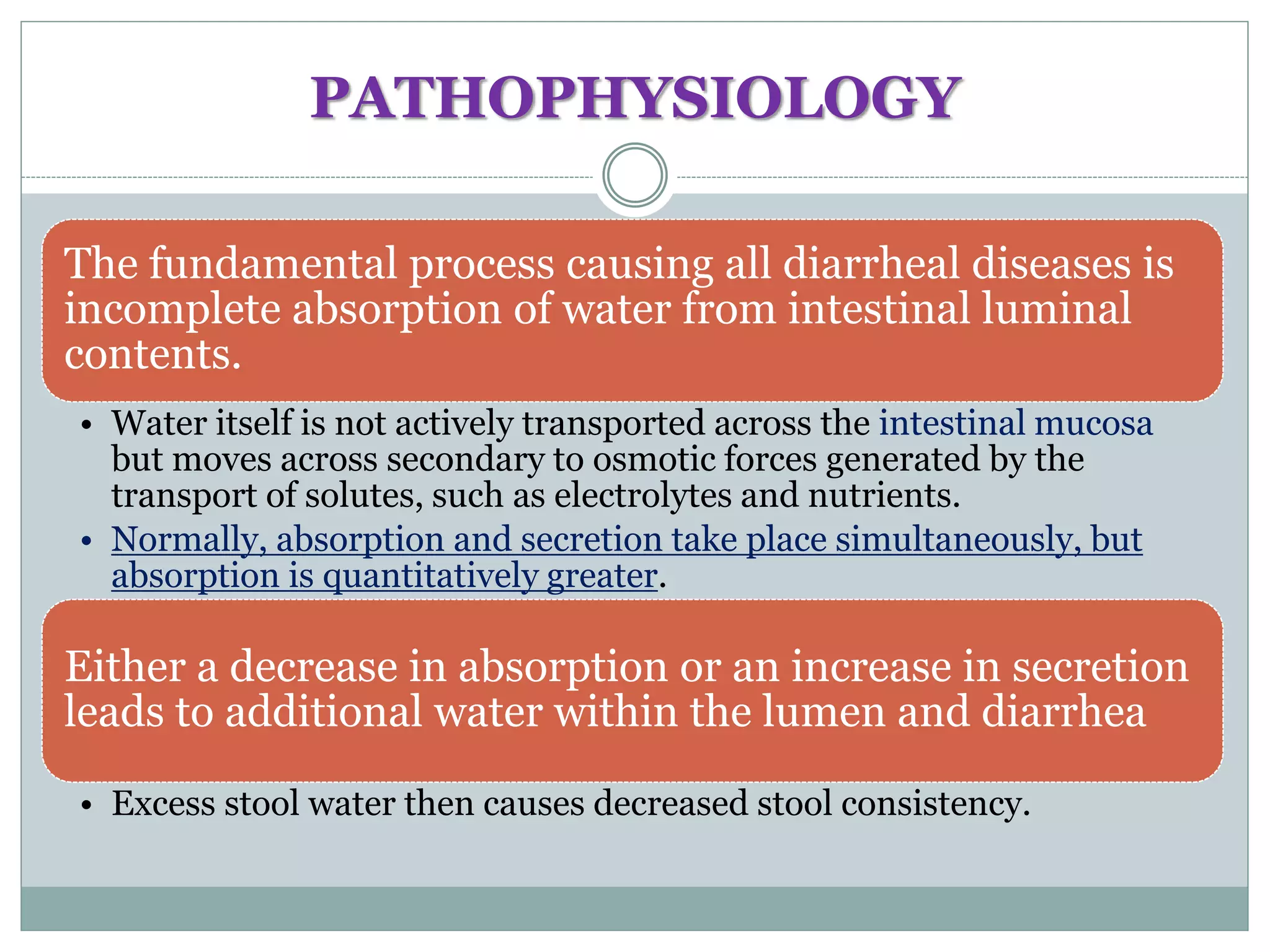
The fundamental process causing all diarrheal diseases is
incomplete absorption of water from intestinal luminal
contents.
• Water itself is not actively transported across the intestinal mucosa
but moves across secondary to osmotic forces generated by the
transport of solutes, such as electrolytes and nutrients.
• Normally, absorption and secretion take place simultaneously, but
absorption is quantitatively greater.
Either a decrease in absorption or an increase in secretion
leads to additional water within the lumen and diarrhea
• Excess stool water then causes decreased stool consistency.
Flow Chart of Pathophysiology
ETIOLOGY
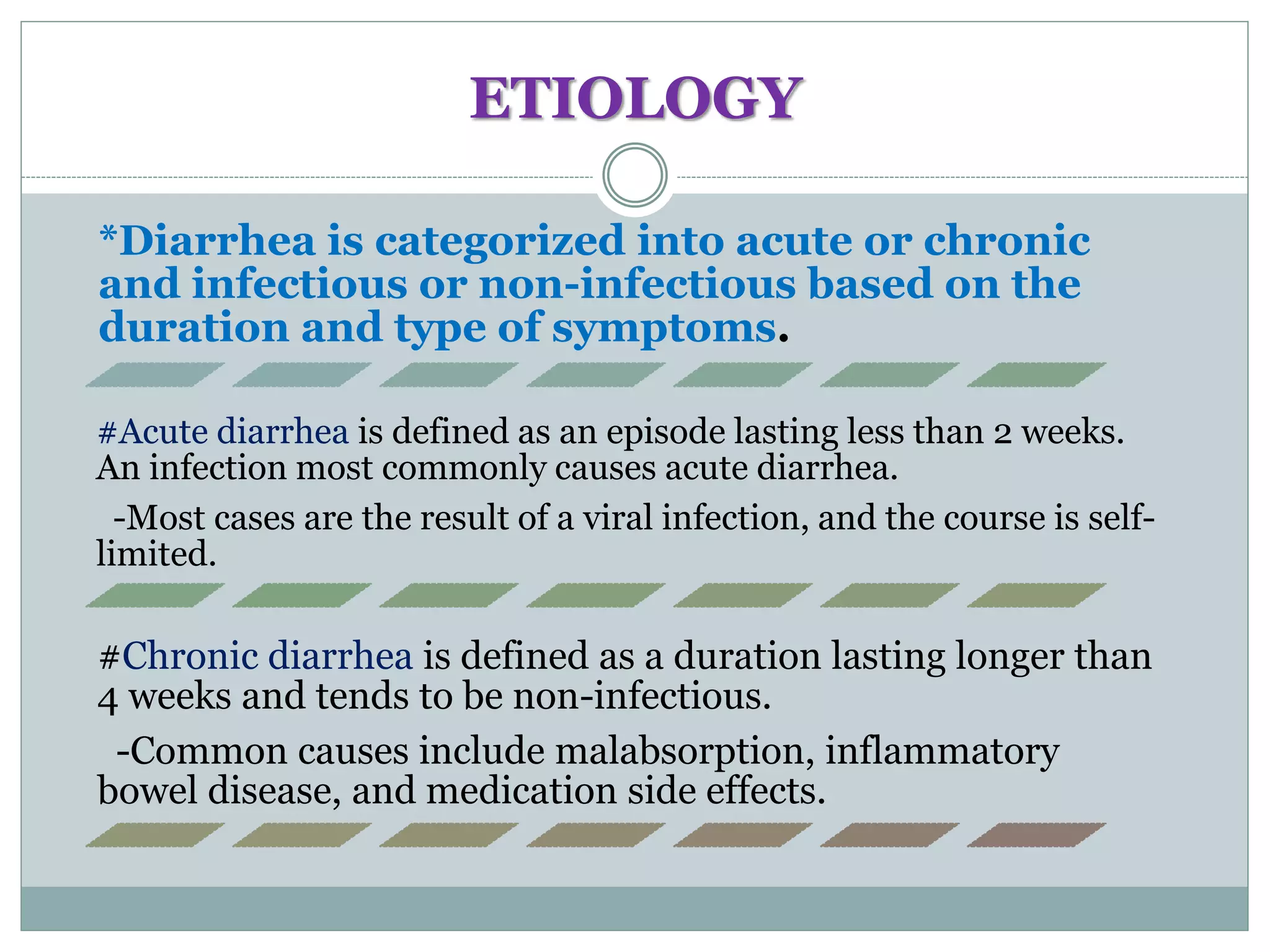
*Diarrhea is categorized into acute or chronic
and infectious or non-infectious based on the
duration and type of symptoms.
#Acute diarrhea is defined as an episode lasting less than 2 weeks.
An infection most commonly causes acute diarrhea.
-Most cases are the result of a viral infection, and the course is self-
limited.
#Chronic diarrhea is defined as a duration lasting longer than
4 weeks and tends to be non-infectious.
-Common causes include malabsorption, inflammatory
bowel disease, and medication side effects.
EPIDEMIOLOGY
CAUSABLE ORGANISMS OF DIARRHEA
PATHOGEN & INCUBATION PERIOD
SYMPTOMS
Projectile
Vomiting
Abdominal
cramps &
Bloating
Headache,
Fever & Achy
Joints
Dizziness &
Nausea
Loose or
Liquid Bowel
Movements
DIAGNOSIS
DIAGNOSISOFACUTE
DIARROHEA
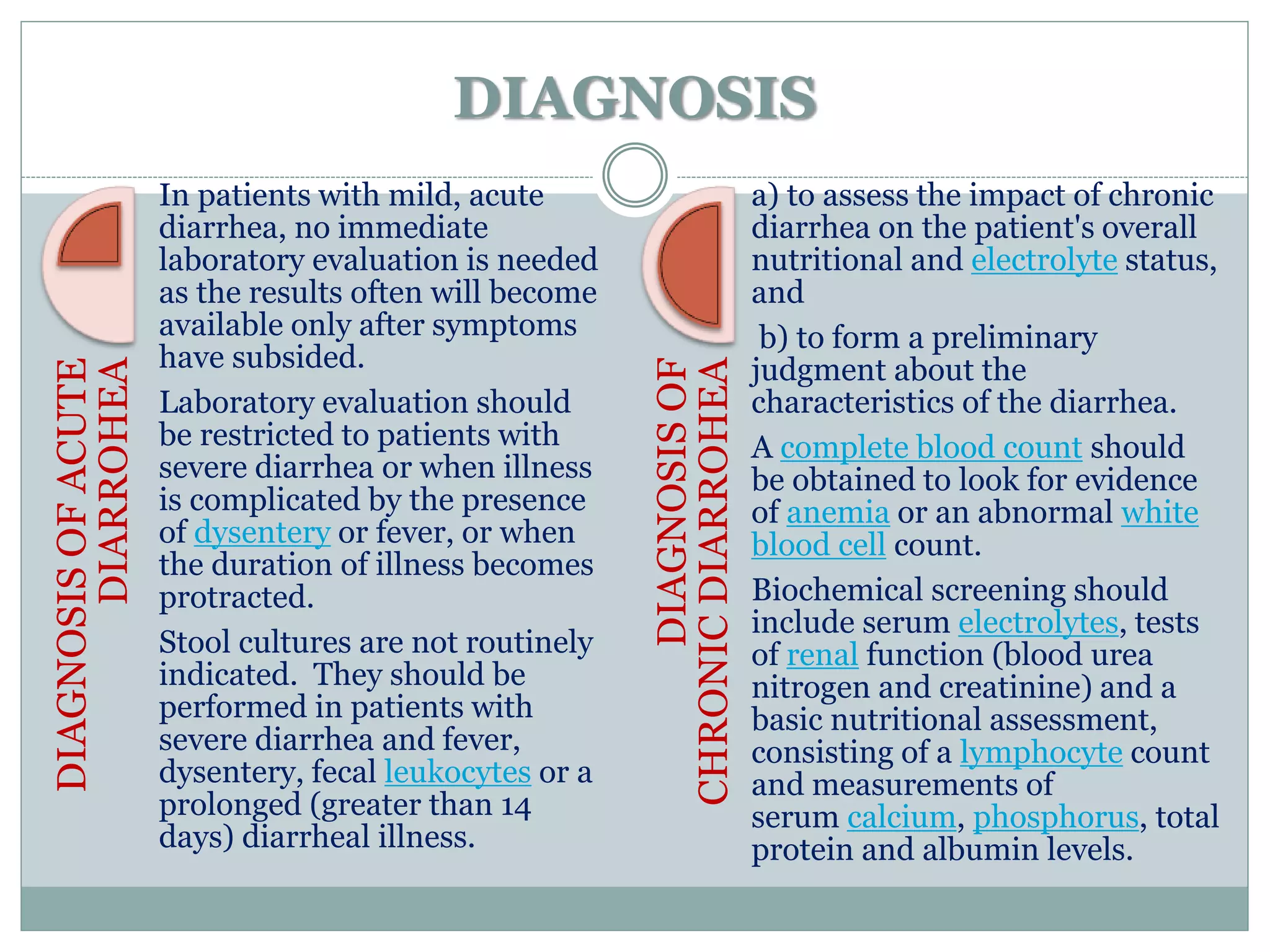
In patients with mild, acute
diarrhea, no immediate
laboratory evaluation is needed
as the results often will become
available only after symptoms
have subsided.
Laboratory evaluation should
be restricted to patients with
severe diarrhea or when illness
is complicated by the presence
of dysentery or fever, or when
the duration of illness becomes
protracted.
Stool cultures are not routinely
indicated. They should be
performed in patients with
severe diarrhea and fever,
dysentery, fecal leukocytes or a
prolonged (greater than 14
days) diarrheal illness.
DIAGNOSISOF
CHRONICDIARROHEA
a) to assess the impact of chronic
diarrhea on the patient's overall
nutritional and electrolyte status,
and
b) to form a preliminary
judgment about the
characteristics of the diarrhea.
A complete blood count should
be obtained to look for evidence
of anemia or an abnormal white
blood cell count.
Biochemical screening should
include serum electrolytes, tests
of renal function (blood urea
nitrogen and creatinine) and a
basic nutritional assessment,
consisting of a lymphocyte count
and measurements of
serum calcium, phosphorus, total
protein and albumin levels.
STOOL TEST
TREATMENT
 ORAL REHYDRATION WITH ZINC
 Nitazoxanide, a newer anthelmintic, is effective against C parvum
 Aeromonas species: Use cefixime and most third-generation and fourth-generation
cephalosporins
 Campylobacter species:Erythromycin shortens illness duration and shedding
 Entamoeba histolytica: Metronidazole followed by iodoquinol or paromomycin is
administered in symptomatic patients.
 E coli: Trimethoprim-sulfamethoxazole (TMP-SMX) should be administered if
moderate or severe diarrhea i
REFERENCES
 http://www.worldgastroenterology.org/guidelines/global-guidelines/acute-
diarrhea/acute-diarrhea-english
 http://www.zen104556.zen.co.uk/Medicine/Pathology/Microbiology/Diarrhoea.html
 Diarrhea
 Valerie Nemeth; Nicholas Pfleghaar1.
 https://www.ncbi.nlm.nih.gov/books/NBK448082/
 Evaluating the Patient With Diarrhea: A Case-Based Approach
https://www.ncbi.nlm.nih.gov/pmc/articles/PMC3538472/
 https://emedicine.medscape.com/article/928598-
treatment?pa=eT8Wqu6zXg1MqeTtyzimWAT1LoCLbrgh82evQGTQgIVsyV%
2BchIRn0Rs3rIBx7kYc2tgf%2BCCur4%2BoFHkvqNu5YRfnSE30kjrIlVY6fLg
rATI%3D
 Diarrhea Treatment & Management Author: Stefano Guandalini, MD; Chief Editor:
Carmen Cuffari, MD
Thank You !!

Diarrhea

  • 1.
    BY : CHARUKAIM 2nd year medial student
  • 2.
    PATHOPHYSIOLOGY The fundamental processcausing all diarrheal diseases is incomplete absorption of water from intestinal luminal contents. • Water itself is not actively transported across the intestinal mucosa but moves across secondary to osmotic forces generated by the transport of solutes, such as electrolytes and nutrients. • Normally, absorption and secretion take place simultaneously, but absorption is quantitatively greater. Either a decrease in absorption or an increase in secretion leads to additional water within the lumen and diarrhea • Excess stool water then causes decreased stool consistency.
  • 3.
    Flow Chart ofPathophysiology
  • 4.
    ETIOLOGY *Diarrhea is categorizedinto acute or chronic and infectious or non-infectious based on the duration and type of symptoms. #Acute diarrhea is defined as an episode lasting less than 2 weeks. An infection most commonly causes acute diarrhea. -Most cases are the result of a viral infection, and the course is self- limited. #Chronic diarrhea is defined as a duration lasting longer than 4 weeks and tends to be non-infectious. -Common causes include malabsorption, inflammatory bowel disease, and medication side effects.
  • 7.
  • 10.
  • 11.
  • 12.
    SYMPTOMS Projectile Vomiting Abdominal cramps & Bloating Headache, Fever &Achy Joints Dizziness & Nausea Loose or Liquid Bowel Movements
  • 13.
    DIAGNOSIS DIAGNOSISOFACUTE DIARROHEA In patients withmild, acute diarrhea, no immediate laboratory evaluation is needed as the results often will become available only after symptoms have subsided. Laboratory evaluation should be restricted to patients with severe diarrhea or when illness is complicated by the presence of dysentery or fever, or when the duration of illness becomes protracted. Stool cultures are not routinely indicated. They should be performed in patients with severe diarrhea and fever, dysentery, fecal leukocytes or a prolonged (greater than 14 days) diarrheal illness. DIAGNOSISOF CHRONICDIARROHEA a) to assess the impact of chronic diarrhea on the patient's overall nutritional and electrolyte status, and b) to form a preliminary judgment about the characteristics of the diarrhea. A complete blood count should be obtained to look for evidence of anemia or an abnormal white blood cell count. Biochemical screening should include serum electrolytes, tests of renal function (blood urea nitrogen and creatinine) and a basic nutritional assessment, consisting of a lymphocyte count and measurements of serum calcium, phosphorus, total protein and albumin levels.
  • 14.
  • 15.
    TREATMENT  ORAL REHYDRATIONWITH ZINC  Nitazoxanide, a newer anthelmintic, is effective against C parvum  Aeromonas species: Use cefixime and most third-generation and fourth-generation cephalosporins  Campylobacter species:Erythromycin shortens illness duration and shedding  Entamoeba histolytica: Metronidazole followed by iodoquinol or paromomycin is administered in symptomatic patients.  E coli: Trimethoprim-sulfamethoxazole (TMP-SMX) should be administered if moderate or severe diarrhea i
  • 16.
    REFERENCES  http://www.worldgastroenterology.org/guidelines/global-guidelines/acute- diarrhea/acute-diarrhea-english  http://www.zen104556.zen.co.uk/Medicine/Pathology/Microbiology/Diarrhoea.html Diarrhea  Valerie Nemeth; Nicholas Pfleghaar1.  https://www.ncbi.nlm.nih.gov/books/NBK448082/  Evaluating the Patient With Diarrhea: A Case-Based Approach https://www.ncbi.nlm.nih.gov/pmc/articles/PMC3538472/  https://emedicine.medscape.com/article/928598- treatment?pa=eT8Wqu6zXg1MqeTtyzimWAT1LoCLbrgh82evQGTQgIVsyV% 2BchIRn0Rs3rIBx7kYc2tgf%2BCCur4%2BoFHkvqNu5YRfnSE30kjrIlVY6fLg rATI%3D  Diarrhea Treatment & Management Author: Stefano Guandalini, MD; Chief Editor: Carmen Cuffari, MD
  • 17.