Diagnosis and management of nonvariceal upper
gastrointestinal hemorrhage (NVUGIH): European
Society of Gastrointestinal Endoscopy (ESGE)
Guideline 2015
D R . W A L E E D K H . S . M A H R O U S
G A S T R O E N T E R O L O G Y A N D H E P A T O L O G Y
C O N S U L T A N T
‫محروس‬ ‫خالد‬ ‫وليد‬Waleed Khalid Mahrous
NVIGIH
‫محروس‬ ‫خالد‬ ‫وليد‬Waleed Khalid Mahrous
Main Recommendations
‫محروس‬ ‫خالد‬ ‫وليد‬Waleed Khalid Mahrous
NVUGIH - MR1 - 1
 ESGE recommends immediate assessment of
hemodynamic status in patients who present with
acute upper gastrointestinal hemorrhage (UGIH),
with prompt intravascular volume replacement
initially using crystalloid fluids if hemodynamic
instability exists .
(strong recommendation, moderate quality evidence).
Nonvariceal upper gastrointestinal hemorrhage: ESGE Guideline 2015
‫محروس‬ ‫خالد‬ ‫وليد‬Waleed Khalid Mahrous
 ESGE recommends a restrictive red blood cell
transfusion strategy that aims for a target
hemoglobin between 7 g/dL and 9 g/dL.
 A higher target hemoglobin should be
considered in patients with significant co-
morbidity (e. g., ischemic cardiovascular disease) .
(strong recommendation, moderate quality evidence).
NVUGIH – MR2 - 2
Nonvariceal upper gastrointestinal hemorrhage: ESGE Guideline 2015
‫محروس‬ ‫خالد‬ ‫وليد‬Waleed Khalid Mahrous
Main Recommendations
‫محروس‬ ‫خالد‬ ‫وليد‬Waleed Khalid Mahrous
NVUGIH - 3
 ESGE recommends the use of a validated risk
stratification tool to stratify patients into high
and low risk groups.
 Risk stratification can aid clinical decision making
regarding timing of endoscopy and hospital
discharge.
(strong recommendation, moderate quality evidence).
Nonvariceal upper gastrointestinal hemorrhage: ESGE Guideline 2015
‫محروس‬ ‫خالد‬ ‫وليد‬Waleed Khalid Mahrous
 ESGE recommends the use of the Glasgow-
Blatchford Score (GBS) for pre-endoscopy risk
stratification.
 Outpatients determined to be at very low risk,
based upon a GBS score of 0 – 1, do not require
early endoscopy nor hospital admission.
 Discharged patients should be informed of the risk of
recurrent bleeding and be advised to maintain contact
with the discharging hospital
(strong recommendation, moderate quality evidence).
NVUGIH – MR3 - 4
Nonvariceal upper gastrointestinal hemorrhage: ESGE Guideline 2015
Glasgow-
Blatchford
Score (GBS)
Main Recommendations
NVUGIH – 5
 For patients taking vitamin K antagonists (VKAs), ESGE
recommends withholding the VKA and correcting
coagulopathy while taking into account the patient's
cardiovascular risk in consultation with a cardiologist.
 In patients with hemodynamic instability,
administration of vitamin K, supplemented with
intravenous prothrombin complex concentrate (PCC) or
fresh frozen plasma (FFP) if PCC is unavailable, is
recommended .
(strong recommendation, low quality evidence).
Nonvariceal upper gastrointestinal hemorrhage: ESGE Guideline 2015
NVUGIH – 6
 If the clinical situation allows, ESGE suggests an
international normalized ratio (INR) value < 2.5
before performing endoscopy with or without
endoscopic hemostasis .
(weak recommendation, moderate quality evidence).
NVUGIH – 7
 ESGE recommends temporarily withholding new
direct oral anticoagulants (DOACs) in
patients with suspected acute NVUGIH in
coordination/consultation with the local
hematologist/cardiologist .
(strong recommendation, very low quality evidence).
Nonvariceal upper gastrointestinal hemorrhage: ESGE Guideline 2015
NVUGIH – 8
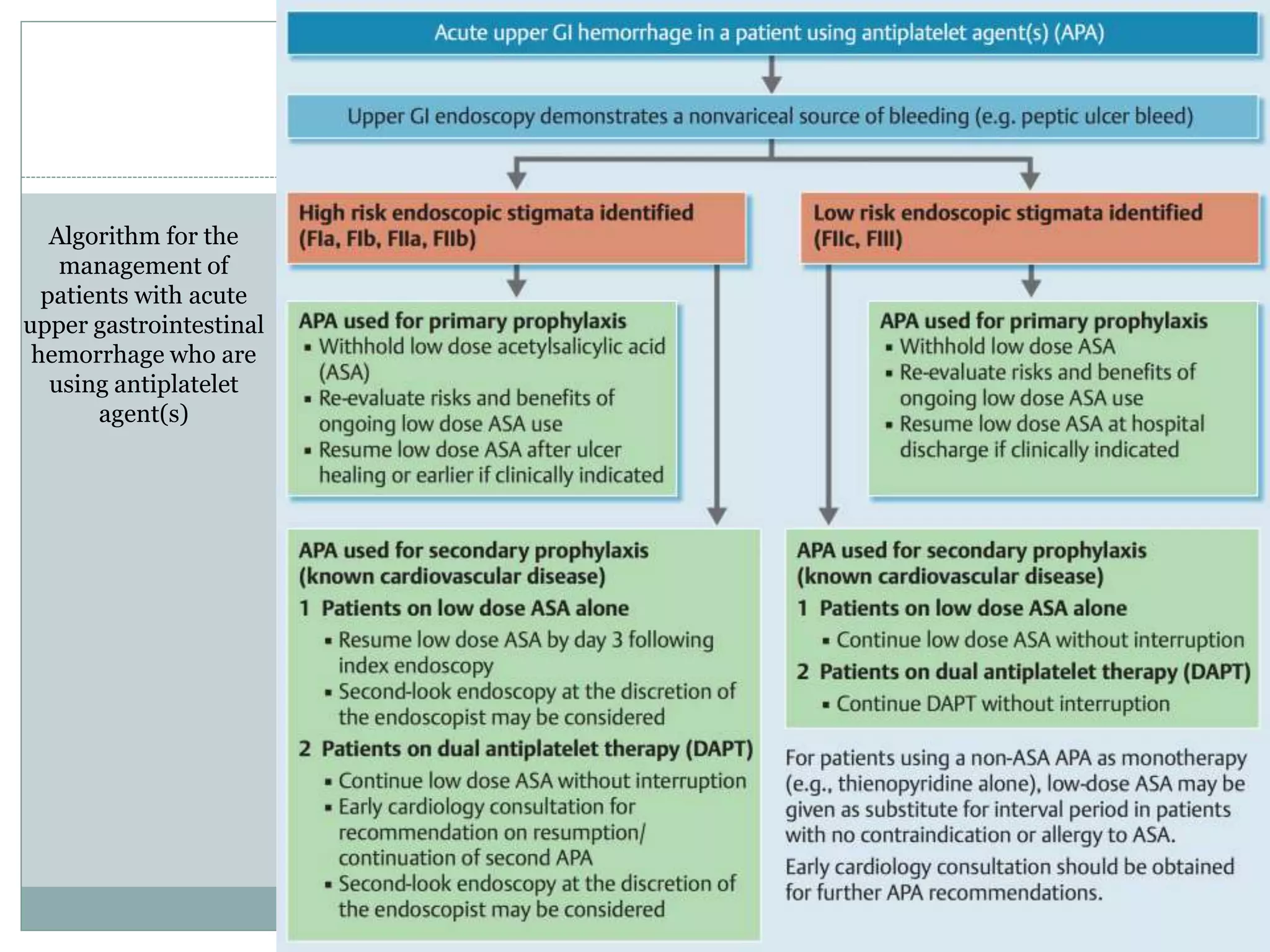
 For patients using antiplatelet agents, ESGE
recommends the management algorithm detailed.
(strong recommendation, moderate quality evidence).
Nonvariceal upper gastrointestinal hemorrhage: ESGE Guideline 2015
 ESGE recommends initiating high dose
intravenous proton pump inhibitors (PPI),
intravenous bolus followed by continuous infusion
(80 mg then 8 mg/hour), in patients presenting
with acute UGIH awaiting upper endoscopy.
 However, PPI infusion should not delay the
performance of early endoscopy
(strong recommendation, high quality evidence).
NVUGIH - MR4 - 9
Nonvariceal upper gastrointestinal hemorrhage: ESGE Guideline 2015
NVUGIH – 10
 ESGE does not recommend the use of tranexamic
acid in patients with NVUGIH .
(strong recommendation, low quality evidence).
Nonvariceal upper gastrointestinal hemorrhage: ESGE Guideline 2015
NVUGIH – 11
 ESGE does not recommend the use of
somatostatin, or its analogue octreotide, in
patients with NVUGIH.
(strong recommendation, low quality evidence).
Nonvariceal upper gastrointestinal hemorrhage: ESGE Guideline 2015
NVUGIH – MR5 - 12
 ESGE recommends intravenous erythromycin
(single dose, 250 mg given 30 – 120 minutes prior to
upper gastrointestinal [GI] endoscopy) in patients
with clinically severe or ongoing active UGIH.
 In selected patients, pre-endoscopic infusion of
erythromycin significantly improves endoscopic
visualization, reduces the need for second- look
endoscopy, decreases the number of units of
blood transfused, and reduces duration of
hospital stay.
(strong recommendation, high quality evidence).
Nonvariceal upper gastrointestinal hemorrhage: ESGE Guideline 2015
 ESGE does not recommend the routine use of
nasogastric or orogastric aspiration/lavage in
patients presenting with acute UGIH .
(strong recommendation, moderate quality evidence).
NVUGIH – MR6 - 13
Nonvariceal upper gastrointestinal hemorrhage: ESGE Guideline 2015
NVUGIH – 14
 In an effort to protect the patient's airway from
potential aspiration of gastric contents, ESGE
suggests endotracheal intubation prior to
endoscopy in patients with ongoing active
hematemesis, encephalopathy, or agitation .
(weak recommendation, low quality evidence).
Nonvariceal upper gastrointestinal hemorrhage: ESGE Guideline 2015
NVUGIH – 15
 ESGE recommends adopting the following
definitions regarding the timing of upper GI
endoscopy in acute overt UGIH relative to patient
presentation: very early < 12 hours, early ≤ 24
hours, and delayed > 24 hours.
(strong recommendation, moderate quality evidence).
 Following hemodynamic resuscitation, ESGE
recommends early (≤24 hours) upper GI endoscopy.
 Very early (<12 hours) upper GI endoscopy may be
considered in patients with high risk clinical
features, namely: hemodynamic instability
(tachycardia, hypotension) that persists despite
ongoing attempts at volume resuscitation; in
hospital bloody emesis/nasogastric aspirate; or
contraindication to the interruption of
anticoagulation.
(strong recommendation, moderate quality evidence).
NVUGIH - MR7 - 16
Nonvariceal upper gastrointestinal hemorrhage: ESGE Guideline 2015
NVUGIH - 17
 ESGE recommends the availability of both an on-call
GI endoscopist proficient in endoscopic hemostasis
and on-call nursing staff with technical expertisein
the use of endoscopic devices to allow performance
of endoscopy on a 24 /7 basis .
(strong recommendation, moderate quality evidence).
Nonvariceal upper gastrointestinal hemorrhage: ESGE Guideline 2015
Main Recommendations
NVUGIH - 18
 ESGE recommends the Forrest (F) classification
be used in all patients with peptic ulcer
hemorrhage in order to differentiate low and high
risk endoscopic stigmata .
(strong recommendation, high quality evidence).
Nonvariceal upper gastrointestinal hemorrhage: ESGE Guideline 2015
NVUGIH - MR8 - 19
 ESGE recommends that peptic ulcers with spurting
or oozing bleeding (Forrest classification Ia
and Ib, respectively) or with a nonbleeding
visible vessel (Forrest classification IIa)
receive endoscopic hemostasis because these lesions
are at high risk for persistent bleeding or
rebleeding .
(strong recommendation, high quality evidence).
Nonvariceal upper gastrointestinal hemorrhage: ESGE Guideline 2015
NVUGIH – MR9 - 20
 ESGE recommends that peptic ulcers with an
adherent clot (Forrest classification IIb) be
considered for endoscopic clot removal.
 Once the clot is removed, any identified underlying
active bleeding (Forrest classification Ia or Ib) or
nonbleeding visible vessel (Forrest classification IIa)
should receive endoscopic hemostasis.
(weak recommendation, moderate quality evidence).
Nonvariceal upper gastrointestinal hemorrhage: ESGE Guideline 2015
NVUGIH – MR10 - 21
 In patients with peptic ulcers having a flat
pigmented spot (Forrest classification IIc) or
clean base (Forrest classification III), ESGE
does not recommend endoscopic hemostasis as
these stigmata present a low risk of recurrent
bleeding.
 In selected clinical settings, these patients may
be discharged to home on standard PPI
therapy, e. g., oral PPI once-daily .
(strong recommendation, moderate quality evidence).
Nonvariceal upper gastrointestinal hemorrhage: ESGE Guideline 2015
NVUGIH – 22
 ESGE does not recommend the routine use of
Doppler ultrasound or magnification
endoscopy in the evaluation of endoscopic stigmata
of peptic ulcer bleeding.
(strong recommendation, low quality evidence).
Nonvariceal upper gastrointestinal hemorrhage: ESGE Guideline 2015
NVUGIH – MR11 – 23 - 24
 For patients with actively bleeding ulcers (FIa,
FIb), ESGE recommends combining epinephrine
injection with a second hemostasis modality
(contact thermal, mechanical therapy, or injection of a
sclerosing agent).
 ESGE recommends that epinephrine injection therapy
not be used as endoscopic monotherapy.
(strong recommendation, high quality evidence).
Nonvariceal upper gastrointestinal hemorrhage: ESGE Guideline 2015
NVUGIH – 25
 For patients with active NVUGIH bleeding not
controlled by standard endoscopic
hemostasis therapies, ESGE suggests the use of a
topical hemostatic spray or over-the-scope
clip as salvage endoscopic therapy.
(weak recommendation, low quality evidence).
Nonvariceal upper gastrointestinal hemorrhage: ESGE Guideline 2015
Main Recommendations
NVUGIH – 26
 For patients with acid-related causes of
NVUGIH different from peptic ulcers (e. g.,
erosive esophagitis, gastritis, duodenitis),
ESGE recommends treatment with high dose PPI.
Endoscopic hemostasis is usually not required and
selected patients may be discharged early.
(strong recommendation, low quality evidence).
Nonvariceal upper gastrointestinal hemorrhage: ESGE Guideline 2015
NVUGIH – 27
 ESGE recommends that patients with a Mallory –
Weiss lesion that is actively bleeding receive
endoscopic hemostasis.
 There is currently inadequate evidence to
recommend a specific endoscopic hemostasis
modality.
 Patients with a Mallory – Weiss lesion and no active
bleeding can receive high dose PPI therapy
alone.
(strong recommendation, moderate quality evidence).
Nonvariceal upper gastrointestinal hemorrhage: ESGE Guideline 2015
NVUGIH – 28
 ESGE recommends that a Dieulafoy lesion receive
endoscopic hemostasis using thermal, mechanical
(hemoclip or band ligation), or combination
therapy (dilute epinephrine injection combined with
contact thermal or mechanical therapy).
(strong recommendation, moderate quality evidence).
Nonvariceal upper gastrointestinal hemorrhage: ESGE Guideline 2015
‫محروس‬ ‫خالد‬ ‫وليد‬Waleed Khalid Mahrous
NVUGIH – 29
 In patients bleeding from upper GI angioectasias,
ESGE recommends endoscopic hemostasis
therapy.
 However, there is currently inadequate evidence to
recommend a specific endoscopic hemostasis
modality.
(strong recommendation, low quality evidence).
Nonvariceal upper gastrointestinal hemorrhage: ESGE Guideline 2015
‫محروس‬ ‫خالد‬ ‫وليد‬Waleed Khalid Mahrous
NVUGIH – 30
 In patients bleeding from upper GI neoplasia,
ESGE recommends considering endoscopic
hemostasis in order to avert urgent surgery and
reduce blood transfusion requirements.
 However, no currently available endoscopic
treatment appears to have long-term efficacy.
(weak recommendation, low quality evidence).
Nonvariceal upper gastrointestinal hemorrhage: ESGE Guideline 2015
‫محروس‬ ‫خالد‬ ‫وليد‬Waleed Khalid Mahrous
NVUGIH – 30
 Transcatheter angiographic embolization
(TAE) or surgery should be considered if
endoscopic treatment fails or is not technically
feasible .
(strong recommendation, low quality evidence).
Nonvariceal upper gastrointestinal hemorrhage: ESGE Guideline 2015
‫محروس‬ ‫خالد‬ ‫وليد‬Waleed Khalid Mahrous
Main Recommendations
‫محروس‬ ‫خالد‬ ‫وليد‬Waleed Khalid Mahrous
NVUGIH – MR12 -31
 ESGE recommends PPI therapy for patients who
receive endoscopic hemostasis and for
patients with adherent clot not receiving
endoscopic hemostasis. PPI therapy should
be high dose and administered as an
intravenous bolus followed by continuous
infusion (80 mg then 8 mg/hour) for 72 hours post
endoscopy
(strong recommendation, high quality evidence).
Nonvariceal upper gastrointestinal hemorrhage: ESGE Guideline 2015
‫محروس‬ ‫خالد‬ ‫وليد‬Waleed Khalid Mahrous
NVUGIH – 32
 ESGE suggests considering PPI therapy as
intermittent intravenous bolus dosing (at least
twice-daily) for 72 hours post endoscopy for
patients who receive endoscopic hemostasis
and for patients with adherent clot not
receiving endoscopic hemostasis.
 If the patient’s condition permits, high dose oral
PPI may also be an option in those able to tolerate
oral medications.
(weak recommendation, moderate quality evidence).
Nonvariceal upper gastrointestinal hemorrhage: ESGE Guideline 2015
‫محروس‬ ‫خالد‬ ‫وليد‬Waleed Khalid Mahrous
NVUGIH – MR13 – 33- 34
 ESGE does not recommend routine second-look
endoscopy as part of the management of nonvariceal
upper gastrointestinal hemorrhage (NVUGIH).
 However, in patients with clinical evidence of
rebleeding following successful initial endoscopic
hemostasis, ESGE recommends repeat upper
endoscopy with hemostasis if indicated.
 In the case of failure of this second attempt at
hemostasis, transcatheter angiographic
embolization (TAE) or surgery should be
considered .
(strong recommendation, high quality evidence).
Nonvariceal upper gastrointestinal hemorrhage: ESGE Guideline 2015
‫محروس‬ ‫خالد‬ ‫وليد‬Waleed Khalid Mahrous
NVUGIH – MR14 - 35
 In patients with NVUGIH secondary to peptic ulcer,
ESGE recommends investigating for the presence of
Helicobacter pylori in the acute setting with initiation
of appropriate antibiotic therapy when H. pylori is
detected.
 Retesting for H. pylori should be performed in those
patients with a negative test in the acute setting.
 Documentation of successful H. pylori
eradication is recommended .
(strong recommendation, high quality evidence).
Nonvariceal upper gastrointestinal hemorrhage: ESGE Guideline 2015
‫محروس‬ ‫خالد‬ ‫وليد‬Waleed Khalid Mahrous
NVUGIH – 36
 ESGE recommends restarting anticoagulant therapy
following NVUGIH in patients with an indication for
long-term anticoagulation.
 The timing for resumption of anticoagulation should be
assessed on a patient by patient basis.
 Resuming warfarin between 7 and 15 days
following the bleeding event appears safe and effective in
preventing thromboembolic complications for most
patients.
 Earlier resumption, within the first 7 days, may
be indicated for patients at high thrombotic risk.
(strong recommendation, moderate quality evidence).
Nonvariceal upper gastrointestinal hemorrhage: ESGE Guideline 2015
‫محروس‬ ‫خالد‬ ‫وليد‬Waleed Khalid Mahrous
NVUGIH – 37
 In patients receiving low dose aspirin for primary
cardiovascular prophylaxis who develop peptic
ulcer bleeding, ESGE recommends withholding
aspirin, revaluating the risks/benefits of ongoing
aspirin use in consultation with a cardiologist, and
resuming low dose aspirin following ulcer healing or
earlier if clinically indicated.
(strong recommendation, low quality evidence).
‫محروس‬ ‫خالد‬ ‫وليد‬Waleed Khalid Mahrous
NVUGIH – MR15 - 38
 In patients receiving low dose aspirin for secondary
cardiovascular prophylaxis who develop peptic ulcer
bleeding, ESGE recommends aspirin be resumed
immediately following index endoscopy if the
risk of rebleeding is low (e. g., FIIc, FIII).
 In patients with high risk peptic ulcer (FIa, FIb, FIIa,
FIIb), early reintroduction of aspirin by day 3 after
index endoscopy is recommended, provided that
adequate hemostasis has been established .
(strong recommendation, moderate quality evidence).
Nonvariceal upper gastrointestinal hemorrhage: ESGE Guideline 2015
‫محروس‬ ‫خالد‬ ‫وليد‬Waleed Khalid Mahrous
Algorithm for the
management of
patients with acute
upper gastrointestinal
hemorrhage who are
using antiplatelet
agent(s)
NVUGIH – MR39
 In patients receiving dual antiplatelet therapy
(DAPT) who develop peptic ulcer bleeding, ESGE
recommends continuing low dose aspirin
therapy.
 Early cardiology consultation should be obtained
regarding the timing of resuming the second
antiplatelet agent.
(strong recommendation, low quality evidence).
Nonvariceal upper gastrointestinal hemorrhage: ESGE Guideline 2015
‫محروس‬ ‫خالد‬ ‫وليد‬Waleed Khalid Mahrous
NVUGIH – MR40
 In patients requiring dual antiplatelet therapy
(DAPT) and who have had NVUGIH, ESGE
recommends the use of a PPI as co-therapy.
(strong recommendation, moderate quality evidence).
Nonvariceal upper gastrointestinal hemorrhage: ESGE Guideline 2015
‫محروس‬ ‫خالد‬ ‫وليد‬Waleed Khalid Mahrous
Diagnosis and management of nonvariceal upper gastrointestinal hemorrhage (NVUGIH): European Society of Gastrointestinal Endoscopy (ESGE) Guideline  2015

Diagnosis and management of nonvariceal upper gastrointestinal hemorrhage (NVUGIH): European Society of Gastrointestinal Endoscopy (ESGE) Guideline 2015

  • 1.
    Diagnosis and managementof nonvariceal upper gastrointestinal hemorrhage (NVUGIH): European Society of Gastrointestinal Endoscopy (ESGE) Guideline 2015 D R . W A L E E D K H . S . M A H R O U S G A S T R O E N T E R O L O G Y A N D H E P A T O L O G Y C O N S U L T A N T ‫محروس‬ ‫خالد‬ ‫وليد‬Waleed Khalid Mahrous
  • 2.
    NVIGIH ‫محروس‬ ‫خالد‬ ‫وليد‬WaleedKhalid Mahrous ‫محروس‬ ‫خالد‬ ‫وليد‬Waleed Khalid Mahrous
  • 3.
    Main Recommendations ‫محروس‬ ‫خالد‬‫وليد‬Waleed Khalid Mahrous
  • 4.
    NVUGIH - MR1- 1  ESGE recommends immediate assessment of hemodynamic status in patients who present with acute upper gastrointestinal hemorrhage (UGIH), with prompt intravascular volume replacement initially using crystalloid fluids if hemodynamic instability exists . (strong recommendation, moderate quality evidence). Nonvariceal upper gastrointestinal hemorrhage: ESGE Guideline 2015 ‫محروس‬ ‫خالد‬ ‫وليد‬Waleed Khalid Mahrous
  • 5.
     ESGE recommendsa restrictive red blood cell transfusion strategy that aims for a target hemoglobin between 7 g/dL and 9 g/dL.  A higher target hemoglobin should be considered in patients with significant co- morbidity (e. g., ischemic cardiovascular disease) . (strong recommendation, moderate quality evidence). NVUGIH – MR2 - 2 Nonvariceal upper gastrointestinal hemorrhage: ESGE Guideline 2015 ‫محروس‬ ‫خالد‬ ‫وليد‬Waleed Khalid Mahrous
  • 6.
    Main Recommendations ‫محروس‬ ‫خالد‬‫وليد‬Waleed Khalid Mahrous
  • 7.
    NVUGIH - 3 ESGE recommends the use of a validated risk stratification tool to stratify patients into high and low risk groups.  Risk stratification can aid clinical decision making regarding timing of endoscopy and hospital discharge. (strong recommendation, moderate quality evidence). Nonvariceal upper gastrointestinal hemorrhage: ESGE Guideline 2015 ‫محروس‬ ‫خالد‬ ‫وليد‬Waleed Khalid Mahrous ‫محروس‬ ‫خالد‬ ‫وليد‬Waleed Khalid Mahrous
  • 8.
     ESGE recommendsthe use of the Glasgow- Blatchford Score (GBS) for pre-endoscopy risk stratification.  Outpatients determined to be at very low risk, based upon a GBS score of 0 – 1, do not require early endoscopy nor hospital admission.  Discharged patients should be informed of the risk of recurrent bleeding and be advised to maintain contact with the discharging hospital (strong recommendation, moderate quality evidence). NVUGIH – MR3 - 4 Nonvariceal upper gastrointestinal hemorrhage: ESGE Guideline 2015
  • 9.
  • 10.
  • 11.
    NVUGIH – 5 For patients taking vitamin K antagonists (VKAs), ESGE recommends withholding the VKA and correcting coagulopathy while taking into account the patient's cardiovascular risk in consultation with a cardiologist.  In patients with hemodynamic instability, administration of vitamin K, supplemented with intravenous prothrombin complex concentrate (PCC) or fresh frozen plasma (FFP) if PCC is unavailable, is recommended . (strong recommendation, low quality evidence). Nonvariceal upper gastrointestinal hemorrhage: ESGE Guideline 2015
  • 12.
    NVUGIH – 6 If the clinical situation allows, ESGE suggests an international normalized ratio (INR) value < 2.5 before performing endoscopy with or without endoscopic hemostasis . (weak recommendation, moderate quality evidence).
  • 13.
    NVUGIH – 7 ESGE recommends temporarily withholding new direct oral anticoagulants (DOACs) in patients with suspected acute NVUGIH in coordination/consultation with the local hematologist/cardiologist . (strong recommendation, very low quality evidence). Nonvariceal upper gastrointestinal hemorrhage: ESGE Guideline 2015
  • 14.
    NVUGIH – 8 For patients using antiplatelet agents, ESGE recommends the management algorithm detailed. (strong recommendation, moderate quality evidence). Nonvariceal upper gastrointestinal hemorrhage: ESGE Guideline 2015
  • 16.
     ESGE recommendsinitiating high dose intravenous proton pump inhibitors (PPI), intravenous bolus followed by continuous infusion (80 mg then 8 mg/hour), in patients presenting with acute UGIH awaiting upper endoscopy.  However, PPI infusion should not delay the performance of early endoscopy (strong recommendation, high quality evidence). NVUGIH - MR4 - 9 Nonvariceal upper gastrointestinal hemorrhage: ESGE Guideline 2015
  • 17.
    NVUGIH – 10 ESGE does not recommend the use of tranexamic acid in patients with NVUGIH . (strong recommendation, low quality evidence). Nonvariceal upper gastrointestinal hemorrhage: ESGE Guideline 2015
  • 18.
    NVUGIH – 11 ESGE does not recommend the use of somatostatin, or its analogue octreotide, in patients with NVUGIH. (strong recommendation, low quality evidence). Nonvariceal upper gastrointestinal hemorrhage: ESGE Guideline 2015
  • 19.
    NVUGIH – MR5- 12  ESGE recommends intravenous erythromycin (single dose, 250 mg given 30 – 120 minutes prior to upper gastrointestinal [GI] endoscopy) in patients with clinically severe or ongoing active UGIH.  In selected patients, pre-endoscopic infusion of erythromycin significantly improves endoscopic visualization, reduces the need for second- look endoscopy, decreases the number of units of blood transfused, and reduces duration of hospital stay. (strong recommendation, high quality evidence). Nonvariceal upper gastrointestinal hemorrhage: ESGE Guideline 2015
  • 20.
     ESGE doesnot recommend the routine use of nasogastric or orogastric aspiration/lavage in patients presenting with acute UGIH . (strong recommendation, moderate quality evidence). NVUGIH – MR6 - 13 Nonvariceal upper gastrointestinal hemorrhage: ESGE Guideline 2015
  • 21.
    NVUGIH – 14 In an effort to protect the patient's airway from potential aspiration of gastric contents, ESGE suggests endotracheal intubation prior to endoscopy in patients with ongoing active hematemesis, encephalopathy, or agitation . (weak recommendation, low quality evidence). Nonvariceal upper gastrointestinal hemorrhage: ESGE Guideline 2015
  • 22.
    NVUGIH – 15 ESGE recommends adopting the following definitions regarding the timing of upper GI endoscopy in acute overt UGIH relative to patient presentation: very early < 12 hours, early ≤ 24 hours, and delayed > 24 hours. (strong recommendation, moderate quality evidence).
  • 23.
     Following hemodynamicresuscitation, ESGE recommends early (≤24 hours) upper GI endoscopy.  Very early (<12 hours) upper GI endoscopy may be considered in patients with high risk clinical features, namely: hemodynamic instability (tachycardia, hypotension) that persists despite ongoing attempts at volume resuscitation; in hospital bloody emesis/nasogastric aspirate; or contraindication to the interruption of anticoagulation. (strong recommendation, moderate quality evidence). NVUGIH - MR7 - 16 Nonvariceal upper gastrointestinal hemorrhage: ESGE Guideline 2015
  • 24.
    NVUGIH - 17 ESGE recommends the availability of both an on-call GI endoscopist proficient in endoscopic hemostasis and on-call nursing staff with technical expertisein the use of endoscopic devices to allow performance of endoscopy on a 24 /7 basis . (strong recommendation, moderate quality evidence). Nonvariceal upper gastrointestinal hemorrhage: ESGE Guideline 2015
  • 25.
  • 26.
    NVUGIH - 18 ESGE recommends the Forrest (F) classification be used in all patients with peptic ulcer hemorrhage in order to differentiate low and high risk endoscopic stigmata . (strong recommendation, high quality evidence). Nonvariceal upper gastrointestinal hemorrhage: ESGE Guideline 2015
  • 27.
    NVUGIH - MR8- 19  ESGE recommends that peptic ulcers with spurting or oozing bleeding (Forrest classification Ia and Ib, respectively) or with a nonbleeding visible vessel (Forrest classification IIa) receive endoscopic hemostasis because these lesions are at high risk for persistent bleeding or rebleeding . (strong recommendation, high quality evidence). Nonvariceal upper gastrointestinal hemorrhage: ESGE Guideline 2015 Nonvariceal upper gastrointestinal hemorrhage: ESGE Guideline 2015
  • 28.
    NVUGIH – MR9- 20  ESGE recommends that peptic ulcers with an adherent clot (Forrest classification IIb) be considered for endoscopic clot removal.  Once the clot is removed, any identified underlying active bleeding (Forrest classification Ia or Ib) or nonbleeding visible vessel (Forrest classification IIa) should receive endoscopic hemostasis. (weak recommendation, moderate quality evidence). Nonvariceal upper gastrointestinal hemorrhage: ESGE Guideline 2015
  • 29.
    NVUGIH – MR10- 21  In patients with peptic ulcers having a flat pigmented spot (Forrest classification IIc) or clean base (Forrest classification III), ESGE does not recommend endoscopic hemostasis as these stigmata present a low risk of recurrent bleeding.  In selected clinical settings, these patients may be discharged to home on standard PPI therapy, e. g., oral PPI once-daily . (strong recommendation, moderate quality evidence). Nonvariceal upper gastrointestinal hemorrhage: ESGE Guideline 2015
  • 30.
    NVUGIH – 22 ESGE does not recommend the routine use of Doppler ultrasound or magnification endoscopy in the evaluation of endoscopic stigmata of peptic ulcer bleeding. (strong recommendation, low quality evidence). Nonvariceal upper gastrointestinal hemorrhage: ESGE Guideline 2015
  • 31.
    NVUGIH – MR11– 23 - 24  For patients with actively bleeding ulcers (FIa, FIb), ESGE recommends combining epinephrine injection with a second hemostasis modality (contact thermal, mechanical therapy, or injection of a sclerosing agent).  ESGE recommends that epinephrine injection therapy not be used as endoscopic monotherapy. (strong recommendation, high quality evidence). Nonvariceal upper gastrointestinal hemorrhage: ESGE Guideline 2015
  • 32.
    NVUGIH – 25 For patients with active NVUGIH bleeding not controlled by standard endoscopic hemostasis therapies, ESGE suggests the use of a topical hemostatic spray or over-the-scope clip as salvage endoscopic therapy. (weak recommendation, low quality evidence). Nonvariceal upper gastrointestinal hemorrhage: ESGE Guideline 2015
  • 33.
  • 34.
    NVUGIH – 26 For patients with acid-related causes of NVUGIH different from peptic ulcers (e. g., erosive esophagitis, gastritis, duodenitis), ESGE recommends treatment with high dose PPI. Endoscopic hemostasis is usually not required and selected patients may be discharged early. (strong recommendation, low quality evidence). Nonvariceal upper gastrointestinal hemorrhage: ESGE Guideline 2015
  • 35.
    NVUGIH – 27 ESGE recommends that patients with a Mallory – Weiss lesion that is actively bleeding receive endoscopic hemostasis.  There is currently inadequate evidence to recommend a specific endoscopic hemostasis modality.  Patients with a Mallory – Weiss lesion and no active bleeding can receive high dose PPI therapy alone. (strong recommendation, moderate quality evidence). Nonvariceal upper gastrointestinal hemorrhage: ESGE Guideline 2015
  • 36.
    NVUGIH – 28 ESGE recommends that a Dieulafoy lesion receive endoscopic hemostasis using thermal, mechanical (hemoclip or band ligation), or combination therapy (dilute epinephrine injection combined with contact thermal or mechanical therapy). (strong recommendation, moderate quality evidence). Nonvariceal upper gastrointestinal hemorrhage: ESGE Guideline 2015 ‫محروس‬ ‫خالد‬ ‫وليد‬Waleed Khalid Mahrous
  • 37.
    NVUGIH – 29 In patients bleeding from upper GI angioectasias, ESGE recommends endoscopic hemostasis therapy.  However, there is currently inadequate evidence to recommend a specific endoscopic hemostasis modality. (strong recommendation, low quality evidence). Nonvariceal upper gastrointestinal hemorrhage: ESGE Guideline 2015 ‫محروس‬ ‫خالد‬ ‫وليد‬Waleed Khalid Mahrous
  • 38.
    NVUGIH – 30 In patients bleeding from upper GI neoplasia, ESGE recommends considering endoscopic hemostasis in order to avert urgent surgery and reduce blood transfusion requirements.  However, no currently available endoscopic treatment appears to have long-term efficacy. (weak recommendation, low quality evidence). Nonvariceal upper gastrointestinal hemorrhage: ESGE Guideline 2015 ‫محروس‬ ‫خالد‬ ‫وليد‬Waleed Khalid Mahrous
  • 39.
    NVUGIH – 30 Transcatheter angiographic embolization (TAE) or surgery should be considered if endoscopic treatment fails or is not technically feasible . (strong recommendation, low quality evidence). Nonvariceal upper gastrointestinal hemorrhage: ESGE Guideline 2015 ‫محروس‬ ‫خالد‬ ‫وليد‬Waleed Khalid Mahrous
  • 40.
    Main Recommendations ‫محروس‬ ‫خالد‬‫وليد‬Waleed Khalid Mahrous ‫محروس‬ ‫خالد‬ ‫وليد‬Waleed Khalid Mahrous
  • 41.
    NVUGIH – MR12-31  ESGE recommends PPI therapy for patients who receive endoscopic hemostasis and for patients with adherent clot not receiving endoscopic hemostasis. PPI therapy should be high dose and administered as an intravenous bolus followed by continuous infusion (80 mg then 8 mg/hour) for 72 hours post endoscopy (strong recommendation, high quality evidence). Nonvariceal upper gastrointestinal hemorrhage: ESGE Guideline 2015 ‫محروس‬ ‫خالد‬ ‫وليد‬Waleed Khalid Mahrous
  • 42.
    NVUGIH – 32 ESGE suggests considering PPI therapy as intermittent intravenous bolus dosing (at least twice-daily) for 72 hours post endoscopy for patients who receive endoscopic hemostasis and for patients with adherent clot not receiving endoscopic hemostasis.  If the patient’s condition permits, high dose oral PPI may also be an option in those able to tolerate oral medications. (weak recommendation, moderate quality evidence). Nonvariceal upper gastrointestinal hemorrhage: ESGE Guideline 2015 ‫محروس‬ ‫خالد‬ ‫وليد‬Waleed Khalid Mahrous
  • 43.
    NVUGIH – MR13– 33- 34  ESGE does not recommend routine second-look endoscopy as part of the management of nonvariceal upper gastrointestinal hemorrhage (NVUGIH).  However, in patients with clinical evidence of rebleeding following successful initial endoscopic hemostasis, ESGE recommends repeat upper endoscopy with hemostasis if indicated.  In the case of failure of this second attempt at hemostasis, transcatheter angiographic embolization (TAE) or surgery should be considered . (strong recommendation, high quality evidence). Nonvariceal upper gastrointestinal hemorrhage: ESGE Guideline 2015 ‫محروس‬ ‫خالد‬ ‫وليد‬Waleed Khalid Mahrous
  • 44.
    NVUGIH – MR14- 35  In patients with NVUGIH secondary to peptic ulcer, ESGE recommends investigating for the presence of Helicobacter pylori in the acute setting with initiation of appropriate antibiotic therapy when H. pylori is detected.  Retesting for H. pylori should be performed in those patients with a negative test in the acute setting.  Documentation of successful H. pylori eradication is recommended . (strong recommendation, high quality evidence). Nonvariceal upper gastrointestinal hemorrhage: ESGE Guideline 2015 ‫محروس‬ ‫خالد‬ ‫وليد‬Waleed Khalid Mahrous
  • 45.
    NVUGIH – 36 ESGE recommends restarting anticoagulant therapy following NVUGIH in patients with an indication for long-term anticoagulation.  The timing for resumption of anticoagulation should be assessed on a patient by patient basis.  Resuming warfarin between 7 and 15 days following the bleeding event appears safe and effective in preventing thromboembolic complications for most patients.  Earlier resumption, within the first 7 days, may be indicated for patients at high thrombotic risk. (strong recommendation, moderate quality evidence). Nonvariceal upper gastrointestinal hemorrhage: ESGE Guideline 2015 ‫محروس‬ ‫خالد‬ ‫وليد‬Waleed Khalid Mahrous
  • 46.
    NVUGIH – 37 In patients receiving low dose aspirin for primary cardiovascular prophylaxis who develop peptic ulcer bleeding, ESGE recommends withholding aspirin, revaluating the risks/benefits of ongoing aspirin use in consultation with a cardiologist, and resuming low dose aspirin following ulcer healing or earlier if clinically indicated. (strong recommendation, low quality evidence). ‫محروس‬ ‫خالد‬ ‫وليد‬Waleed Khalid Mahrous
  • 47.
    NVUGIH – MR15- 38  In patients receiving low dose aspirin for secondary cardiovascular prophylaxis who develop peptic ulcer bleeding, ESGE recommends aspirin be resumed immediately following index endoscopy if the risk of rebleeding is low (e. g., FIIc, FIII).  In patients with high risk peptic ulcer (FIa, FIb, FIIa, FIIb), early reintroduction of aspirin by day 3 after index endoscopy is recommended, provided that adequate hemostasis has been established . (strong recommendation, moderate quality evidence). Nonvariceal upper gastrointestinal hemorrhage: ESGE Guideline 2015 ‫محروس‬ ‫خالد‬ ‫وليد‬Waleed Khalid Mahrous
  • 48.
    Algorithm for the managementof patients with acute upper gastrointestinal hemorrhage who are using antiplatelet agent(s)
  • 49.
    NVUGIH – MR39 In patients receiving dual antiplatelet therapy (DAPT) who develop peptic ulcer bleeding, ESGE recommends continuing low dose aspirin therapy.  Early cardiology consultation should be obtained regarding the timing of resuming the second antiplatelet agent. (strong recommendation, low quality evidence). Nonvariceal upper gastrointestinal hemorrhage: ESGE Guideline 2015 ‫محروس‬ ‫خالد‬ ‫وليد‬Waleed Khalid Mahrous
  • 50.
    NVUGIH – MR40 In patients requiring dual antiplatelet therapy (DAPT) and who have had NVUGIH, ESGE recommends the use of a PPI as co-therapy. (strong recommendation, moderate quality evidence). Nonvariceal upper gastrointestinal hemorrhage: ESGE Guideline 2015 ‫محروس‬ ‫خالد‬ ‫وليد‬Waleed Khalid Mahrous