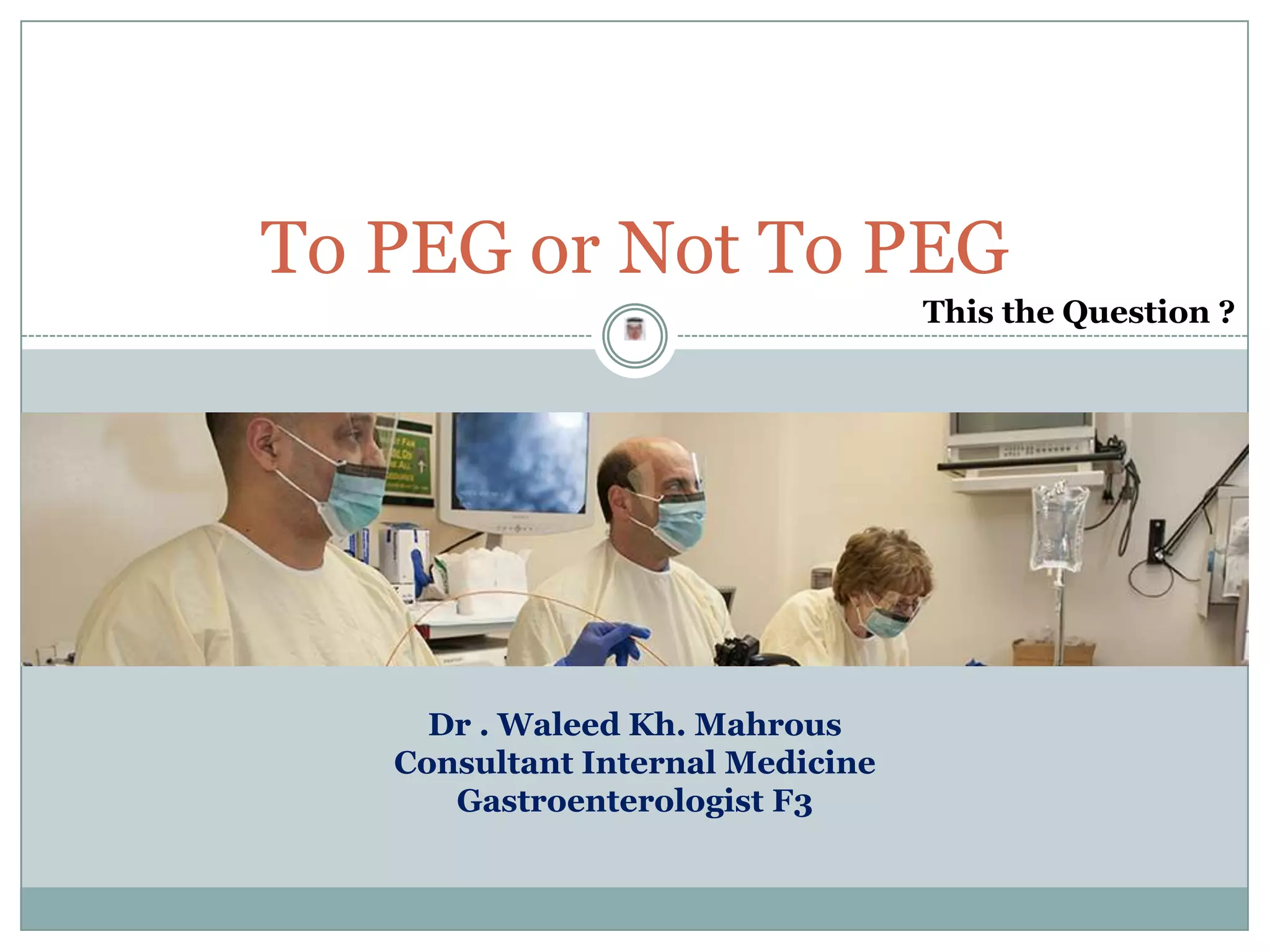
To PEG or Not To PEG
This the Question ?

Dr . Waleed Kh. Mahrous
Consultant Internal Medicine
Gastroenterologist F3
Percutaneous Endoscopic Gastrostomy

 Physicians poorly inform patients

and families regarding PEG tube
benefits, burdens, and
alternatives, often perform nonbeneficial PEG tube placements
to avoid difficult discussions
with patients, families, or
colleagues
Percutaneous Endoscopic Gastrostomy

 PEG tubes have a limited role in

only a few conditions, that
even in these conditions their
advantage over nasogastric (NG)
tubes or medical therapy is
questionable, and that they are
widely overused in current
practice.
Percutaneous Endoscopic Gastrostomy

Those who argue a PEG tube
is not a medical
intervention have likely
never seen one placed.
Percutaneous Endoscopic Gastrostomy

Creating a hole into the

stomach through the anterior
abdominal wall is
surgery, regardless of
who does the procedure.
Percutaneous Endoscopic Gastrostomy

PEG is usually performed in

patients with serious disease
conditions who are usually
elderly and closer towards the
end of their life span.
PEG outcomes

Making life longer
(improving mortality) or
2. Better (improving quality
of life).
1.
Mortality

The overall mortality post-

PEG placement is high due to
underlying co-morbidity .

Prevention and Management of Complications of Percutaneous Endoscopic Gastrostomy (PEG) Tubes PRACTICAL GASTROENTEROLOGY • NOVEMBER 2004
30-Day Mortality
 The rate of procedure- related

mortality and 30-day mortality
attributable to PEG placement
itself are extremely low (0% to
2% and 1.5% to 2.1% respectively)

Prevention and Management of Complications of Percutaneous Endoscopic Gastrostomy (PEG) Tubes PRACTICAL GASTROENTEROLOGY • NOVEMBER 2004
30-Day Mortality

In one study, the 30-day

mortality after PEG tube
placement rise to 8% and its use
for non-evidence-based
indications rise up to 16%
Percutaneous Endoscopic Gastrostomy
 Such data led many to question the

possible overuse and misuse of this
procedure.
 While safe and effective in the short
term, it began to be recognized as an
invasive artificial means of life support
with multiple serious long-term
complications
Burdens and Complications Associated with PEG
Poor prognostic indicators for PEG placement
DEMENTIA
 Studies have documented a poor

prognosis for hospitalized patients
with advanced dementia (50%
mortality at 6 months) that PEG
failed to improve
DEMENTIA

PEG “are generally ineffective

in patients with advanced
dementia in form of:
1. prolonging life,
2. preventing aspiration, and
3. providing adequate
nourishment
CANCER

No evidence support the role of

PEG in nutrition support to most
patients with cancer
In Head and neck cancer, PEG
can only improve QoL but not
mortality
CANCER
 In head and neck cancer, a recent

study showed fatal or severe
complications of PEG placement
have occurred in 26% of cases
 Theoretically, easy procedure
could turn into a potentially
dangerous operation
NEUROMUSCULAR DEGENERATIVE DISEASE

 In Neuromuscular Degenerative

Disease, PEG use has been shown to
improve Qol scores and weight but
not mortality
STROKE

In multicenter trial found no

benefit in early versus delayed
PEG feeding and an increased
risk of death or poor
neurologic outcome with PEG
compared to NG use
STROKE

 Other studies have found high

30-day mortality and
complication rates associated with
PEG tube use after stroke.
30 days after hospital discharge

A waiting period also allows

adequate time for recovery of
swallowing function after a
stroke or to assess any signs of
improvement.
Factors predicting early disc harge and mortality in post-percutaneous endoscopic
gastrostomy patients - Annals of Gastroenterology (2014) 27, 1-7
30 days after hospital discharge

Studies indicate that 37% of

patients with dysphagia after a
stroke recover swallowing
function within 8 days and 87%
maybe swallowing normally by
day 14
Factors predicting early disc harge and mortality in post-percutaneous endoscopic
gastrostomy patients - Annals of Gastroenterology (2014) 27, 1-7
ASPIRATION PNEUMONIA

Aspiration pneumonia is the

most common cause of
death after PEG placement
ASPIRATION PNEUMONIA

All types of feeding

(NG, PEG, jejunostomy, or
post-pyloric tubes) in
Neurogenic dysphagia patients
have similar rates of
aspiration pneumonia
SETTING OF PEG TUBE PLACEMENT

 Inpatients have significantly

higher 30-day mortality
compared with outpatients PEG
insertion.
TIMING OF PEG TUBE PLACEMENT

 Stroke patients who received PEG

placement 30 days after hospital
discharge have significantly
lower 30-day mortality than
those who received PEG placement
during their hospitalization
ETHICAL ISSUES

 Our culture attaches great

emotional symbolism to providing
nutrition to loved ones.
 Many physicians feel they
cannot refuse PEG tube
placement if it is requested by the
patient or family.
ETHICAL ISSUES

 Results from one study have shown

that adequate procedurespecific benefits, burdens, and
alternatives were only
discussed with 0.6% of patients.
ETHICAL ISSUES


Most physicians would refuse a
family request to repair a ventral
hernia in an elderly demented
patient, but many are willing to
place a PEG tube in the same
individual, even though both
procedures are
safe, effective, and nonbeneficial.
BARRIERS TO APPROPRIATE USE


Many physicians, including many
gastroenterologists, are
unfamiliar with the evidencebased indications for PEG
tubes and continue to recommend
them for aspiration, advanced
dementia, and late-stage
cancer
BARRIERS TO APPROPRIATE USE


Physicians in training often are
taught not to question PEG
placement decisions and to
insert them even for
inappropriate indications.
BARRIERS TO APPROPRIATE USE

Physicians often find it

easier to recommend a
nonbeneficial procedure
than to confront difficult endof-life issues.
Percutaneous Endoscopic Gastrostomy
PRACTICE GUIDELINES
PRACTICE GUIDELINES
 Consideration of PEG placement in

only four conditions:
- Head and neck cancer
- Acute stroke with dysphagia, 30
days after hospital discharge
- Neuromuscular dystrophy
syndromes
- Gastric decompression.
Do not Offer
 Aspiration

 Dementia
 Cancer short life expectancy
 Cancer cachexia
 Advanced progressive unresponsive

cancer
 Anorexia Cachexia Syndrome
 Prognosis <2 months
INTERVENTIONS TO REDUCE
INAPPROPRIATE USE

 Use of hospital specific guidelines

 Staff education
 Mandatory palliative care

consultations
To PEG or Not to PEG

To PEG or Not to PEG

  • 1.
    To PEG orNot To PEG This the Question ? Dr . Waleed Kh. Mahrous Consultant Internal Medicine Gastroenterologist F3
  • 2.
    Percutaneous Endoscopic Gastrostomy Physicians poorly inform patients and families regarding PEG tube benefits, burdens, and alternatives, often perform nonbeneficial PEG tube placements to avoid difficult discussions with patients, families, or colleagues
  • 3.
    Percutaneous Endoscopic Gastrostomy PEG tubes have a limited role in only a few conditions, that even in these conditions their advantage over nasogastric (NG) tubes or medical therapy is questionable, and that they are widely overused in current practice.
  • 4.
    Percutaneous Endoscopic Gastrostomy Thosewho argue a PEG tube is not a medical intervention have likely never seen one placed.
  • 5.
    Percutaneous Endoscopic Gastrostomy Creatinga hole into the stomach through the anterior abdominal wall is surgery, regardless of who does the procedure.
  • 12.
    Percutaneous Endoscopic Gastrostomy PEGis usually performed in patients with serious disease conditions who are usually elderly and closer towards the end of their life span.
  • 13.
    PEG outcomes Making lifelonger (improving mortality) or 2. Better (improving quality of life). 1.
  • 14.
    Mortality The overall mortalitypost- PEG placement is high due to underlying co-morbidity . Prevention and Management of Complications of Percutaneous Endoscopic Gastrostomy (PEG) Tubes PRACTICAL GASTROENTEROLOGY • NOVEMBER 2004
  • 15.
    30-Day Mortality  Therate of procedure- related mortality and 30-day mortality attributable to PEG placement itself are extremely low (0% to 2% and 1.5% to 2.1% respectively) Prevention and Management of Complications of Percutaneous Endoscopic Gastrostomy (PEG) Tubes PRACTICAL GASTROENTEROLOGY • NOVEMBER 2004
  • 16.
    30-Day Mortality In onestudy, the 30-day mortality after PEG tube placement rise to 8% and its use for non-evidence-based indications rise up to 16%
  • 17.
    Percutaneous Endoscopic Gastrostomy Such data led many to question the possible overuse and misuse of this procedure.  While safe and effective in the short term, it began to be recognized as an invasive artificial means of life support with multiple serious long-term complications
  • 18.
    Burdens and ComplicationsAssociated with PEG
  • 19.
    Poor prognostic indicatorsfor PEG placement
  • 20.
    DEMENTIA  Studies havedocumented a poor prognosis for hospitalized patients with advanced dementia (50% mortality at 6 months) that PEG failed to improve
  • 21.
    DEMENTIA PEG “are generallyineffective in patients with advanced dementia in form of: 1. prolonging life, 2. preventing aspiration, and 3. providing adequate nourishment
  • 22.
    CANCER No evidence supportthe role of PEG in nutrition support to most patients with cancer In Head and neck cancer, PEG can only improve QoL but not mortality
  • 23.
    CANCER  In headand neck cancer, a recent study showed fatal or severe complications of PEG placement have occurred in 26% of cases  Theoretically, easy procedure could turn into a potentially dangerous operation
  • 24.
    NEUROMUSCULAR DEGENERATIVE DISEASE In Neuromuscular Degenerative Disease, PEG use has been shown to improve Qol scores and weight but not mortality
  • 25.
    STROKE In multicenter trialfound no benefit in early versus delayed PEG feeding and an increased risk of death or poor neurologic outcome with PEG compared to NG use
  • 26.
    STROKE  Other studieshave found high 30-day mortality and complication rates associated with PEG tube use after stroke.
  • 27.
    30 days afterhospital discharge A waiting period also allows adequate time for recovery of swallowing function after a stroke or to assess any signs of improvement. Factors predicting early disc harge and mortality in post-percutaneous endoscopic gastrostomy patients - Annals of Gastroenterology (2014) 27, 1-7
  • 28.
    30 days afterhospital discharge Studies indicate that 37% of patients with dysphagia after a stroke recover swallowing function within 8 days and 87% maybe swallowing normally by day 14 Factors predicting early disc harge and mortality in post-percutaneous endoscopic gastrostomy patients - Annals of Gastroenterology (2014) 27, 1-7
  • 29.
    ASPIRATION PNEUMONIA Aspiration pneumoniais the most common cause of death after PEG placement
  • 30.
    ASPIRATION PNEUMONIA All typesof feeding (NG, PEG, jejunostomy, or post-pyloric tubes) in Neurogenic dysphagia patients have similar rates of aspiration pneumonia
  • 31.
    SETTING OF PEGTUBE PLACEMENT  Inpatients have significantly higher 30-day mortality compared with outpatients PEG insertion.
  • 32.
    TIMING OF PEGTUBE PLACEMENT  Stroke patients who received PEG placement 30 days after hospital discharge have significantly lower 30-day mortality than those who received PEG placement during their hospitalization
  • 33.
    ETHICAL ISSUES  Ourculture attaches great emotional symbolism to providing nutrition to loved ones.  Many physicians feel they cannot refuse PEG tube placement if it is requested by the patient or family.
  • 34.
    ETHICAL ISSUES  Resultsfrom one study have shown that adequate procedurespecific benefits, burdens, and alternatives were only discussed with 0.6% of patients.
  • 35.
    ETHICAL ISSUES  Most physicianswould refuse a family request to repair a ventral hernia in an elderly demented patient, but many are willing to place a PEG tube in the same individual, even though both procedures are safe, effective, and nonbeneficial.
  • 36.
    BARRIERS TO APPROPRIATEUSE  Many physicians, including many gastroenterologists, are unfamiliar with the evidencebased indications for PEG tubes and continue to recommend them for aspiration, advanced dementia, and late-stage cancer
  • 37.
    BARRIERS TO APPROPRIATEUSE  Physicians in training often are taught not to question PEG placement decisions and to insert them even for inappropriate indications.
  • 38.
    BARRIERS TO APPROPRIATEUSE Physicians often find it easier to recommend a nonbeneficial procedure than to confront difficult endof-life issues.
  • 39.
  • 40.
  • 41.
    PRACTICE GUIDELINES  Considerationof PEG placement in only four conditions: - Head and neck cancer - Acute stroke with dysphagia, 30 days after hospital discharge - Neuromuscular dystrophy syndromes - Gastric decompression.
  • 42.
    Do not Offer Aspiration  Dementia  Cancer short life expectancy  Cancer cachexia  Advanced progressive unresponsive cancer  Anorexia Cachexia Syndrome  Prognosis <2 months
  • 43.
    INTERVENTIONS TO REDUCE INAPPROPRIATEUSE  Use of hospital specific guidelines  Staff education  Mandatory palliative care consultations