D.H. Lawrence (1885-1930) St Mawr , 1925
1885, David Herbert Richards Lawrence, b. Eastwood, Notts. Fourth child of Arthur John Lawrence, collier, and Lydia (née Beardsall). 1908-11, works in Croydon as elementary teacher.  Reads Nietzsche, 1909 . 1910, mother dies. Engaged to Louie Burrows. 1912, ends engagement. Meets Frieda Weekley (née Von Richtofen). Goes to Germany & Italy with Frieda, who leaves her husband, two daughters and son. 1913,  Sons and Lovers  published in May. Katherine Mansfield and John Middleton Murry. Italy in September. 1914, marries Frieda in July. War. Ottoline Morrell, Bertrand Russell, E.M. Forster. 1915,  The Rainbow  published in September and banned for obscenity in November. Cornwall until 1917.
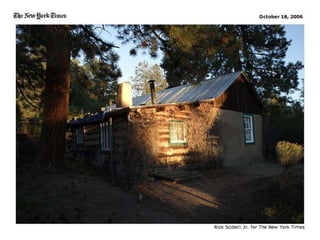
1916,  Women in Love   (US 1920, UK 1921) 1919, in Italy with Frieda, to Capri. 1920,  Psychoanalysis and the Unconscious . Taormina, Sicily.  The Lost Girl .  Birds, Beasts and Flowers. 1921, Sardinia.  Sea and Sardinia .  Fantasia of the Unconscious .  1922, Ceylon, Australia.  Kangaroo . Taos, New Mexico. Del Monte ranch in December.  1923, England in December. 1924, returns to New Mexico, Kiowa ranch with Frieda and Dorothy Brett.  St Mawr .  The Woman Who Rode Away .  Bronchial haemorrhage in August.


1925,  The Plumed Serpent . TB diagnosis in March. September in England for a month, then Italy. Aldous and Maria Huxley. Painting. 1928,  Lady Chatterley’s Lover , published in Florence. 1929, paintings seized in London. ‘Introduction to these paintings.’ 1930, February in sanatorium in Vence, South of France. Dies at Villa Robermond, Vence on March 2nd.
Crisis of Western civilisation: industrialisation, urbanisation, mass culture and WWI Post-Christian ethics: Nietzsche, self-becoming Romantic sensibility = pantheism Darwin & Bergson: naturalism & vitalism Sexuality and bodily knowledge; idiosyncratic version of psychoanalysis The Fall? Phusis cf natura
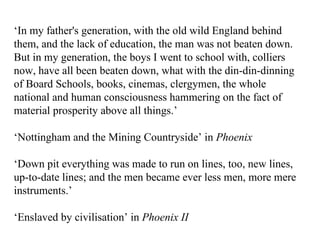
‘ In my father's generation, with the old wild England behind them, and the lack of education, the man was not beaten down. But in my generation, the boys I went to school with, colliers now, have all been beaten down, what with the din-din-dinning of Board Schools, books, cinemas, clergymen, the whole national and human consciousness hammering on the fact of material prosperity above all things.’ ‘ Nottingham and the Mining Countryside’ in  Phoenix ‘ Down pit everything was made to run on lines, too, new lines, up-to-date lines; and the men became ever less men, more mere instruments.’ ‘ Enslaved by civilisation’ in  Phoenix II
Nietzsche’s influence on Lawrence  religious morality can only ever be a morbid abstraction that denies the way in which we live our lives now to imagine that a detached, peaceable & pure life is better than the dynamic struggles and pleasures of bodily experience is immoral ‘ I know the greatness of Christianity: it is a past greatness. […] But now I live in 1924 and the Christian venture is done. The adventure is gone out of Christianity. We must start on a new venture towards God.’  ‘ Books’ (1924), published in  Phoenix  (1936)
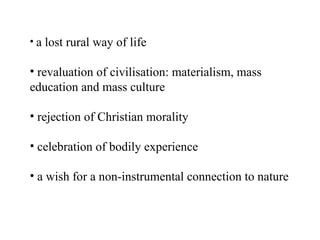
a lost rural way of life revaluation of civilisation: materialism, mass education and mass culture rejection of Christian morality celebration of bodily experience a wish for a non-instrumental connection to nature
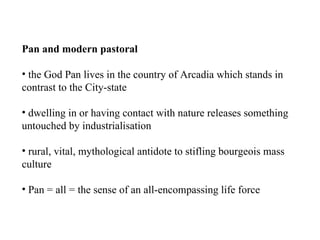
Pan and modern pastoral the God Pan lives in the country of Arcadia which stands in contrast to the City-state dwelling in or having contact with nature releases something untouched by industrialisation rural, vital, mythological antidote to stifling bourgeois mass culture Pan = all = the sense of an all-encompassing life force
‘‘ Everywhere we see the vulgarity of desolation spreading. […] to me the mere thought that a tree is convertible into cash is disgusting. It is through us, and to our shame […] that the woods no longer give shelter to Pan. Pan is dead. That is why the woods do not shelter him.’ And he began to tell the striking story of the mariners who were sailing near the coast at the time of the birth of Christ, and three times heard a loud voice saying: ‘The great God Pan is dead.’’ E.M. Forster, ‘The Story of a Panic’, 1902,  Collected Short Stories
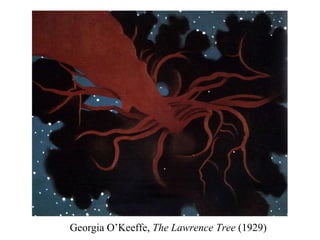
‘ And yet here, in America, the oldest of all, old Pan is still alive. […] In the days before man got too much separated off from the universe, he was Pan, along with all the rest. As a tree still is. […] And the tree is still within the allness of Pan. […] Of course, if I like to cut myself off, and say it is all bunk, a tree is merely so much lumber not yet sawn, then in a great measure I shall be cut off. […] One can shut many, many doors of receptivity in oneself; or one can open many doors that are shut.’ ‘ Pan in America’,  Phoenix
Georgia O’Keeffe,  The Lawrence Tree  (1929)
 
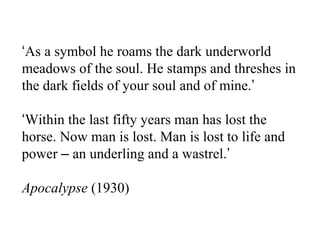
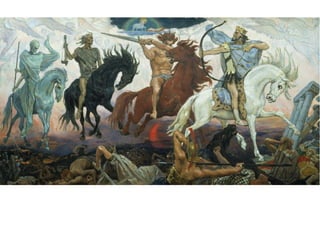
‘ As a symbol he roams the dark underworld meadows of the soul. He stamps and threshes in the dark fields of your soul and of mine. ’ ‘ Within the last fifty years man has lost the horse. Now man is lost. Man is lost to life and power  –  an underling and a wastrel. ’ Apocalypse  (1930)


‘ This was the death of the great Pan. The idea and the engine came between man and all things, like a death. The old connexion, the old Allness, was severed, and can never be ideally restored. Great Pan is dead. […] A conquered universe, a dead Pan, leaves us nothing to live with. You have to abandon the conquest, before Pan will live again.’ ‘ Pan in America’,  Phoenix
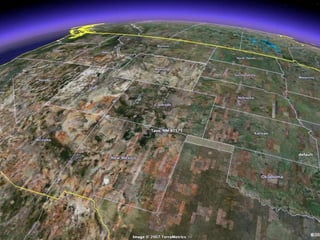
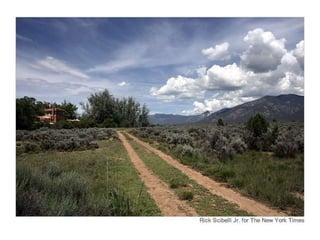
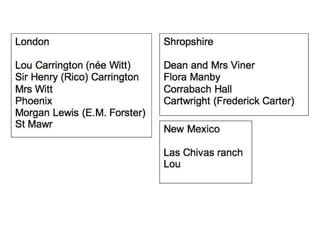
The new vision is that given to Lou at the Las Chivas ranch - a bodily struggle with the changing flux of the world and not a fixed relation of will. She finds her pantheistic epiphany in the physicality of the New Mexico landscape. Here is a difference that cannot be displaced onto questions of taste, psychology, morality or culture.
‘ I think New Mexico was the greatest experience from the outside world that I have ever had. It certainly changed me forever. Curious as it may sound, it was New Mexico that liberated me from the present era of civilization, the great era of material and mechanical development. […] And years, even in the exquisite beauty of Sicily, right among the old Greek paganism that still lives there, had not shattered the essential Christianity on which my character was established. […] In the magnificent fierce morning of New Mexico one sprang awake, a new part of the soul woke up suddenly, and the old world gave way to a new.’ ‘ New Mexico’

D.H. Lawrence - St Mawr - lecture slides

  • 1.
  • 2.
    1885, David HerbertRichards Lawrence, b. Eastwood, Notts. Fourth child of Arthur John Lawrence, collier, and Lydia (née Beardsall). 1908-11, works in Croydon as elementary teacher. Reads Nietzsche, 1909 . 1910, mother dies. Engaged to Louie Burrows. 1912, ends engagement. Meets Frieda Weekley (née Von Richtofen). Goes to Germany & Italy with Frieda, who leaves her husband, two daughters and son. 1913, Sons and Lovers published in May. Katherine Mansfield and John Middleton Murry. Italy in September. 1914, marries Frieda in July. War. Ottoline Morrell, Bertrand Russell, E.M. Forster. 1915, The Rainbow published in September and banned for obscenity in November. Cornwall until 1917.
  • 3.
    1916, Womenin Love (US 1920, UK 1921) 1919, in Italy with Frieda, to Capri. 1920, Psychoanalysis and the Unconscious . Taormina, Sicily. The Lost Girl . Birds, Beasts and Flowers. 1921, Sardinia. Sea and Sardinia . Fantasia of the Unconscious . 1922, Ceylon, Australia. Kangaroo . Taos, New Mexico. Del Monte ranch in December. 1923, England in December. 1924, returns to New Mexico, Kiowa ranch with Frieda and Dorothy Brett. St Mawr . The Woman Who Rode Away . Bronchial haemorrhage in August.
  • 4.
  • 5.
  • 6.
  • 7.
    1925, ThePlumed Serpent . TB diagnosis in March. September in England for a month, then Italy. Aldous and Maria Huxley. Painting. 1928, Lady Chatterley’s Lover , published in Florence. 1929, paintings seized in London. ‘Introduction to these paintings.’ 1930, February in sanatorium in Vence, South of France. Dies at Villa Robermond, Vence on March 2nd.
  • 8.
    Crisis of Westerncivilisation: industrialisation, urbanisation, mass culture and WWI Post-Christian ethics: Nietzsche, self-becoming Romantic sensibility = pantheism Darwin & Bergson: naturalism & vitalism Sexuality and bodily knowledge; idiosyncratic version of psychoanalysis The Fall? Phusis cf natura
  • 9.
    ‘ In myfather's generation, with the old wild England behind them, and the lack of education, the man was not beaten down. But in my generation, the boys I went to school with, colliers now, have all been beaten down, what with the din-din-dinning of Board Schools, books, cinemas, clergymen, the whole national and human consciousness hammering on the fact of material prosperity above all things.’ ‘ Nottingham and the Mining Countryside’ in Phoenix ‘ Down pit everything was made to run on lines, too, new lines, up-to-date lines; and the men became ever less men, more mere instruments.’ ‘ Enslaved by civilisation’ in Phoenix II
  • 10.
    Nietzsche’s influence onLawrence religious morality can only ever be a morbid abstraction that denies the way in which we live our lives now to imagine that a detached, peaceable & pure life is better than the dynamic struggles and pleasures of bodily experience is immoral ‘ I know the greatness of Christianity: it is a past greatness. […] But now I live in 1924 and the Christian venture is done. The adventure is gone out of Christianity. We must start on a new venture towards God.’ ‘ Books’ (1924), published in Phoenix (1936)
  • 11.
    a lost ruralway of life revaluation of civilisation: materialism, mass education and mass culture rejection of Christian morality celebration of bodily experience a wish for a non-instrumental connection to nature
  • 12.
    Pan and modernpastoral the God Pan lives in the country of Arcadia which stands in contrast to the City-state dwelling in or having contact with nature releases something untouched by industrialisation rural, vital, mythological antidote to stifling bourgeois mass culture Pan = all = the sense of an all-encompassing life force
  • 13.
    ‘‘ Everywhere wesee the vulgarity of desolation spreading. […] to me the mere thought that a tree is convertible into cash is disgusting. It is through us, and to our shame […] that the woods no longer give shelter to Pan. Pan is dead. That is why the woods do not shelter him.’ And he began to tell the striking story of the mariners who were sailing near the coast at the time of the birth of Christ, and three times heard a loud voice saying: ‘The great God Pan is dead.’’ E.M. Forster, ‘The Story of a Panic’, 1902, Collected Short Stories
  • 14.
    ‘ And yethere, in America, the oldest of all, old Pan is still alive. […] In the days before man got too much separated off from the universe, he was Pan, along with all the rest. As a tree still is. […] And the tree is still within the allness of Pan. […] Of course, if I like to cut myself off, and say it is all bunk, a tree is merely so much lumber not yet sawn, then in a great measure I shall be cut off. […] One can shut many, many doors of receptivity in oneself; or one can open many doors that are shut.’ ‘ Pan in America’, Phoenix
  • 15.
    Georgia O’Keeffe, The Lawrence Tree (1929)
  • 16.
  • 17.
    ‘ As asymbol he roams the dark underworld meadows of the soul. He stamps and threshes in the dark fields of your soul and of mine. ’ ‘ Within the last fifty years man has lost the horse. Now man is lost. Man is lost to life and power – an underling and a wastrel. ’ Apocalypse (1930)
  • 18.
  • 19.
  • 20.
  • 21.
    ‘ This wasthe death of the great Pan. The idea and the engine came between man and all things, like a death. The old connexion, the old Allness, was severed, and can never be ideally restored. Great Pan is dead. […] A conquered universe, a dead Pan, leaves us nothing to live with. You have to abandon the conquest, before Pan will live again.’ ‘ Pan in America’, Phoenix
  • 22.
    The new visionis that given to Lou at the Las Chivas ranch - a bodily struggle with the changing flux of the world and not a fixed relation of will. She finds her pantheistic epiphany in the physicality of the New Mexico landscape. Here is a difference that cannot be displaced onto questions of taste, psychology, morality or culture.
  • 23.
    ‘ I thinkNew Mexico was the greatest experience from the outside world that I have ever had. It certainly changed me forever. Curious as it may sound, it was New Mexico that liberated me from the present era of civilization, the great era of material and mechanical development. […] And years, even in the exquisite beauty of Sicily, right among the old Greek paganism that still lives there, had not shattered the essential Christianity on which my character was established. […] In the magnificent fierce morning of New Mexico one sprang awake, a new part of the soul woke up suddenly, and the old world gave way to a new.’ ‘ New Mexico’