James Joyce
 Dubliners
          Edited by :
         ALESSANDRA
           SEMERARO
                 5^D
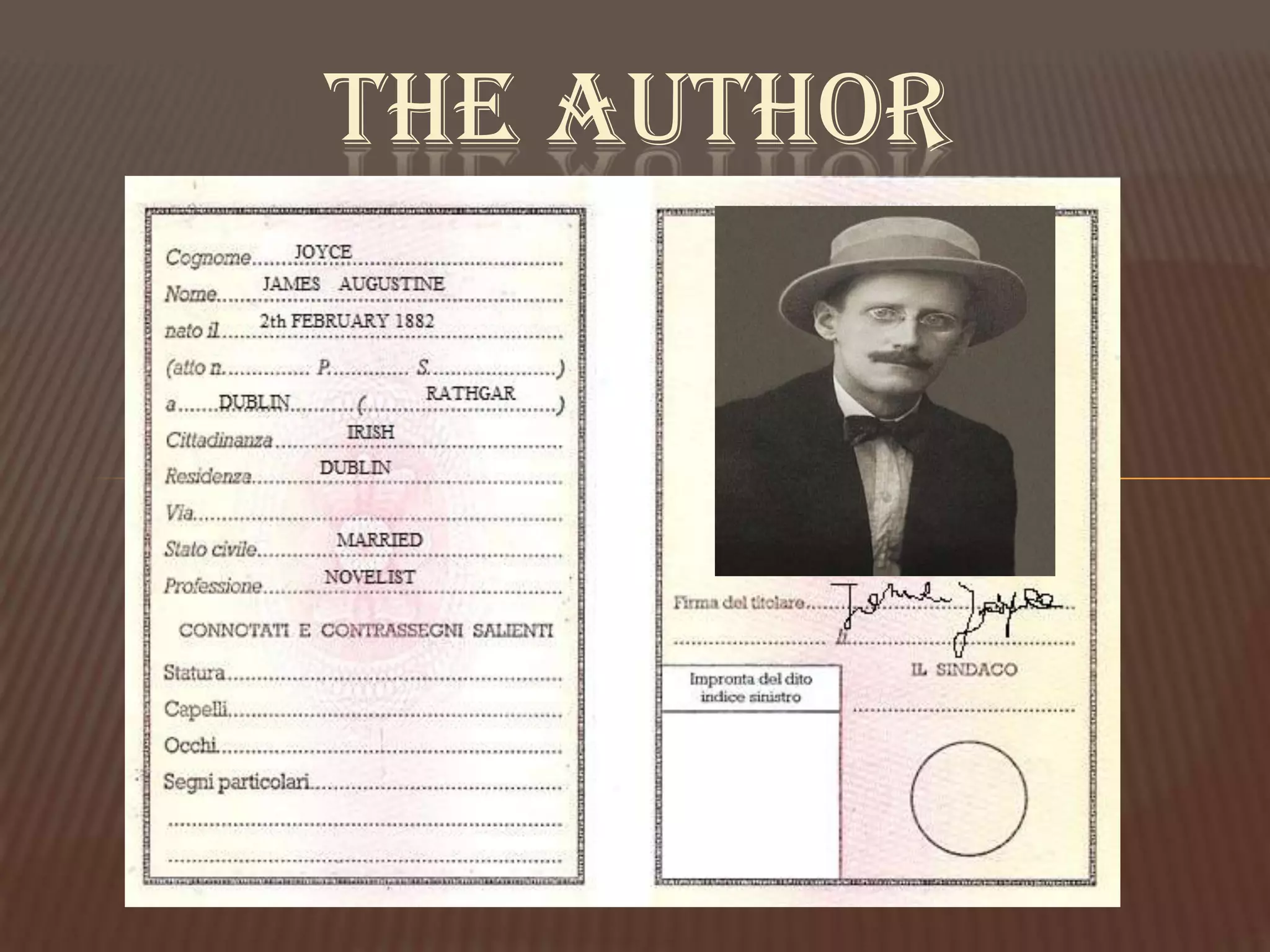
THE AUTHOR
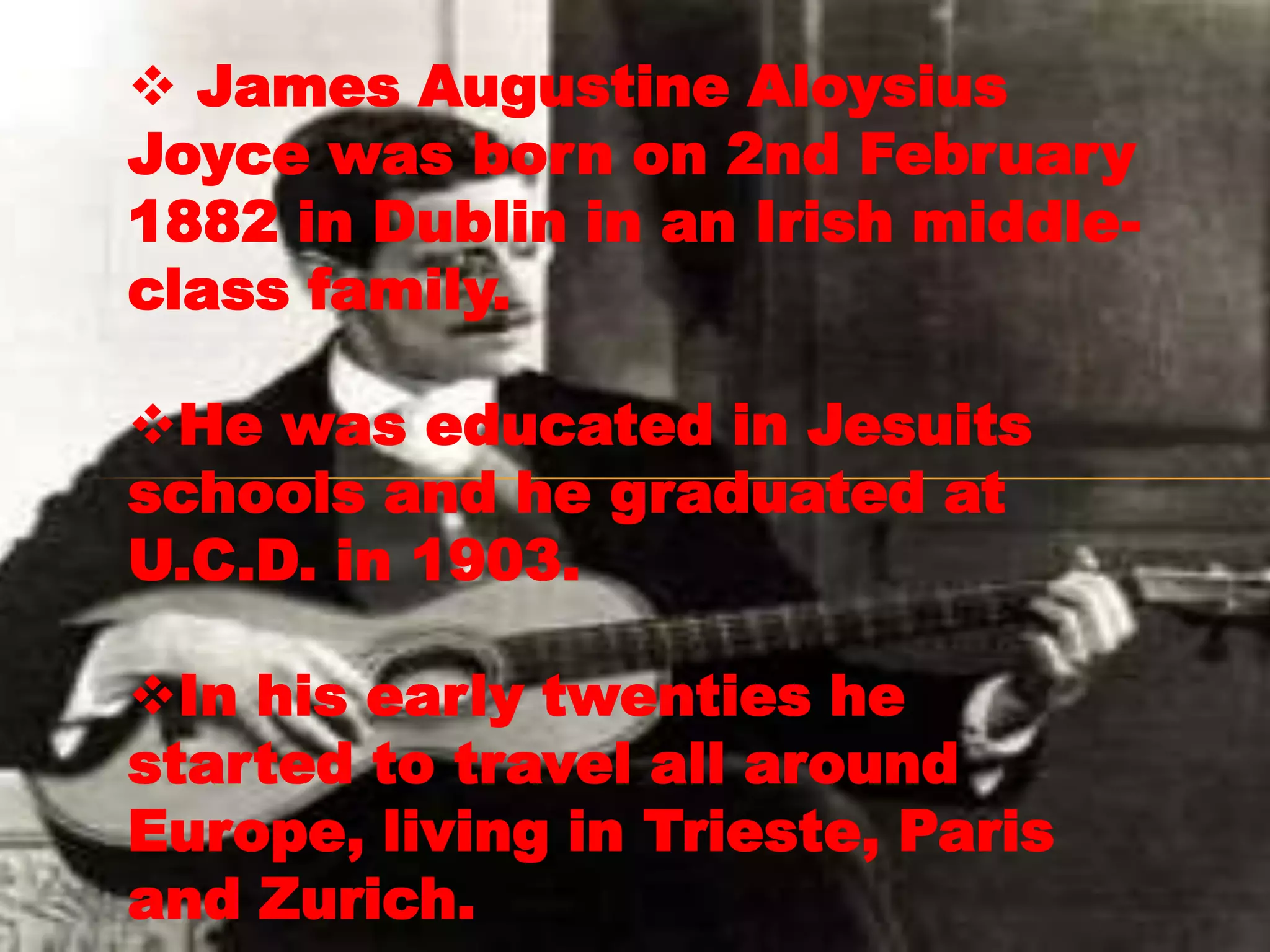
 James Augustine Aloysius
Joyce was born on 2nd February
1882 in Dublin in an Irish middle-
class family.

He was educated in Jesuits
schools and he graduated at
U.C.D. in 1903.

In his early twenties he
started to travel all around
Europe, living in Trieste, Paris
and Zurich.
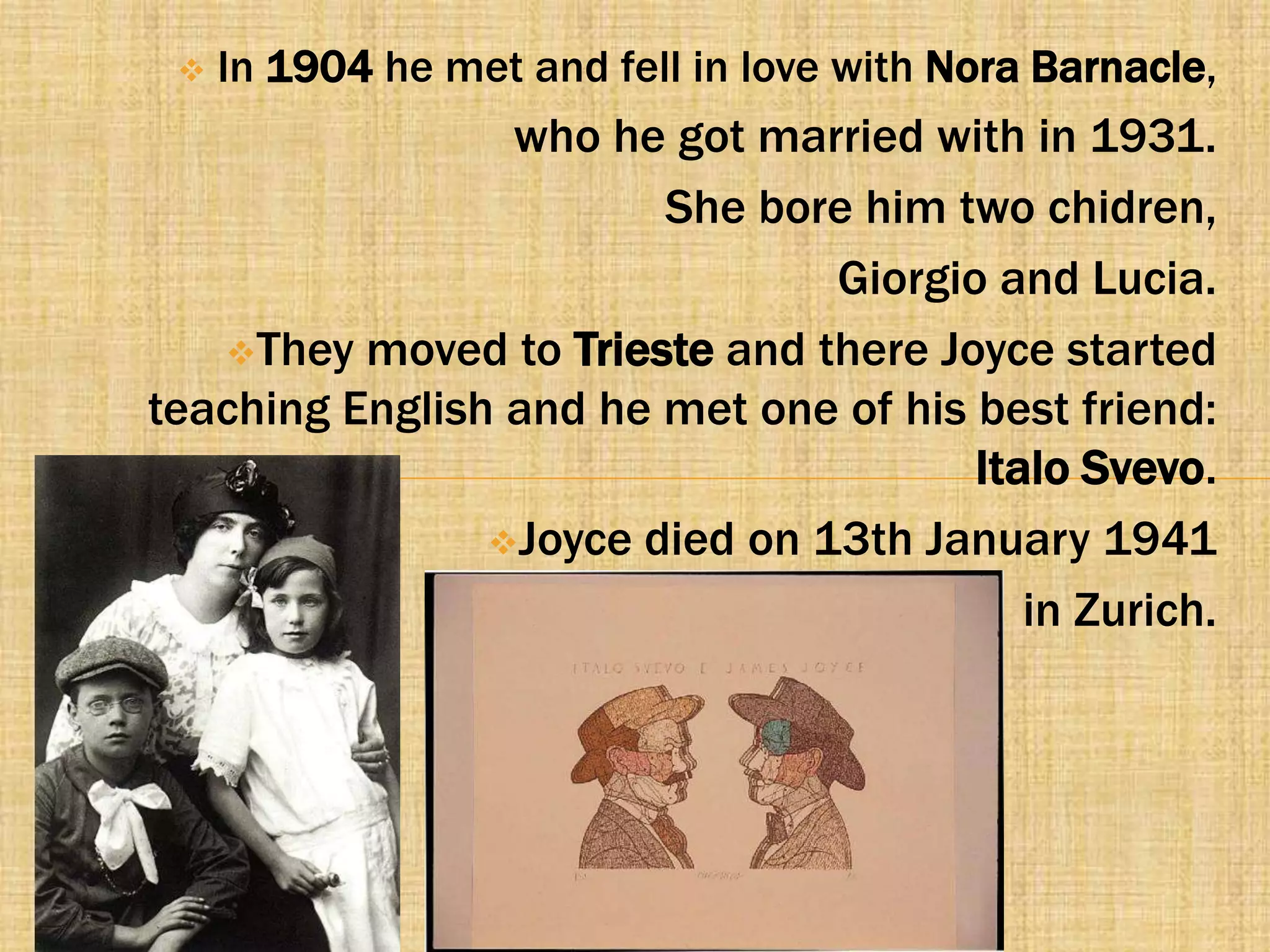
   In 1904 he met and fell in love with Nora Barnacle,
                 who he got married with in 1931.
                        She bore him two chidren,
                                Giorgio and Lucia.
   They moved to Trieste and there Joyce started
teaching English and he met one of his best friend:
                                       Italo Svevo.
                Joyce died on 13th January 1941

                                          in Zurich.
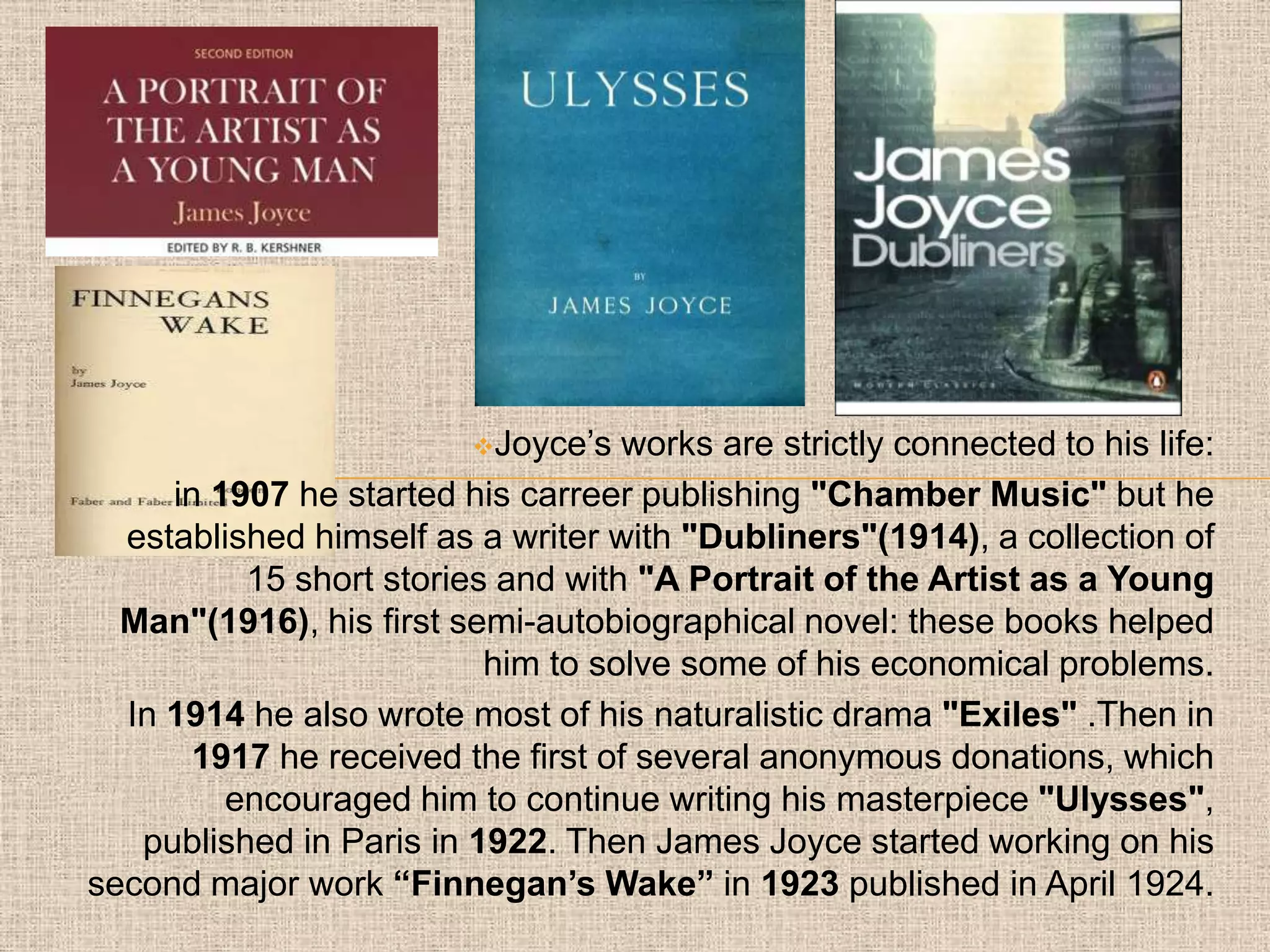
Joyce’s  works are strictly connected to his life:
     in 1907 he started his carreer publishing "Chamber Music" but he
  established himself as a writer with "Dubliners"(1914), a collection of
          15 short stories and with "A Portrait of the Artist as a Young
  Man"(1916), his first semi-autobiographical novel: these books helped
                          him to solve some of his economical problems.
  In 1914 he also wrote most of his naturalistic drama "Exiles" .Then in
       1917 he received the first of several anonymous donations, which
         encouraged him to continue writing his masterpiece "Ulysses",
   published in Paris in 1922. Then James Joyce started working on his
second major work “Finnegan’s Wake” in 1923 published in April 1924.
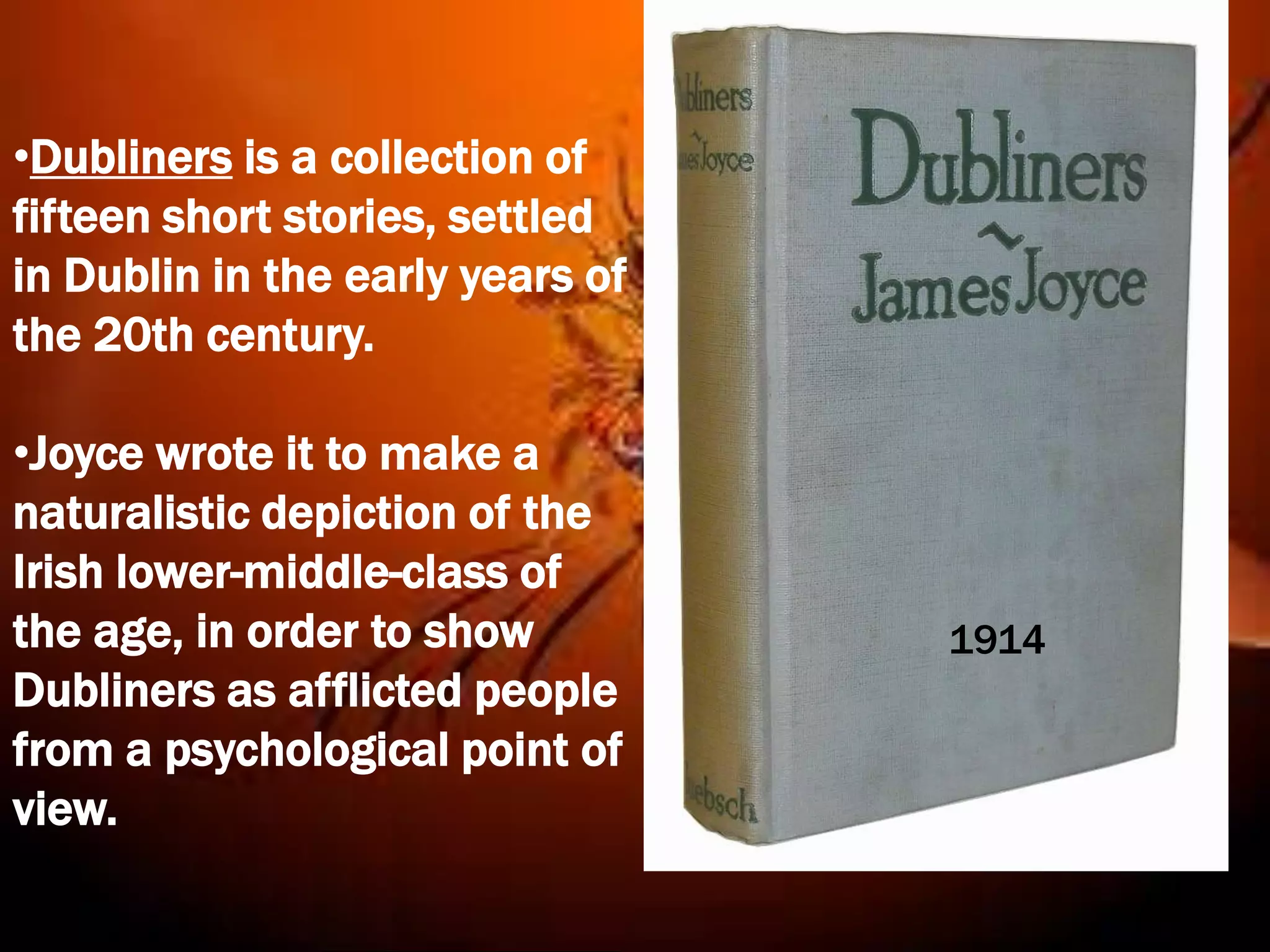
•Dubliners is a collection of
fifteen short stories, settled
in Dublin in the early years of
the 20th century.

•Joyce wrote it to make a
naturalistic depiction of the
Irish lower-middle-class of
the age, in order to show         1914
Dubliners as afflicted people
from a psychological point of
view.
•His central idea was to know the
innermost thoughts of characters, as
an omniscent narrator, but from an
inner view.
The stories
The Sisters – After the priest Father Flynn
dies, a young boy who was close to him and
his family deal with it only superficially.
An Encounter – Two schoolboys playing truant
encounter an elderly man.
Araby – A boy falls in love with the sister of
his friend, but fails in his quest to buy her a
worthy gift from the Araby bazaar.
Eveline – A young woman abandons her plans
to leave Ireland with a sailor.
After the Race – a College student Jimmy
Doyle tries to fit in with his wealthy friends.
Two Gallants – Two men, Lenehan and Corley,
find a maid who is willing to steal from her
employer.
The Boarding House – Mrs. Mooney
successfully manoeuvres her daughter Polly
into an upwardly mobile marriage with her
lodger Mr. Doran.
A Little Cloud – Little Chandlers's dinner with his old friend
Ignatius Gallaher casts fresh light on his own failed literary
dreams. The story reflects also on Chandler's mood upon
realizing his baby son has replaced him as the centre of
his wife's affections.
Counterparts – Farrington, a lumbering alcoholic scrivener,
takes out his frustration in pubs and on his son Tom.
Clay – The old maid Maria, a laundress, celebrates
Halloween with her former foster child Joe Donnelly and
his family.
A Painful Case – Mr. Duffy rebuffs Mrs. Sinico, then four
years later realizes he has condemned her to loneliness
and death.
Ivy Day in the Committee Room – Minor politicians fail to
live up to the memory of Charles Stewart Parnell.
A Mother – Mrs. Kearney tries to win a place of pride for
her daughter, Kathleen, in the Irish cultural movement, by
starring her in a series of concerts, but ultimately fails.
Grace – After Mr. Kernan injures himself falling down the
stairs in a bar, his friends tries to reform him through
Catholicism.
The Dead – Gabriel Conroy attends a party, and later, as he
speaks with his wife, has an epiphany about the nature of
life and death. At 15–16,000 words this story has also been
classified as a novella.
T
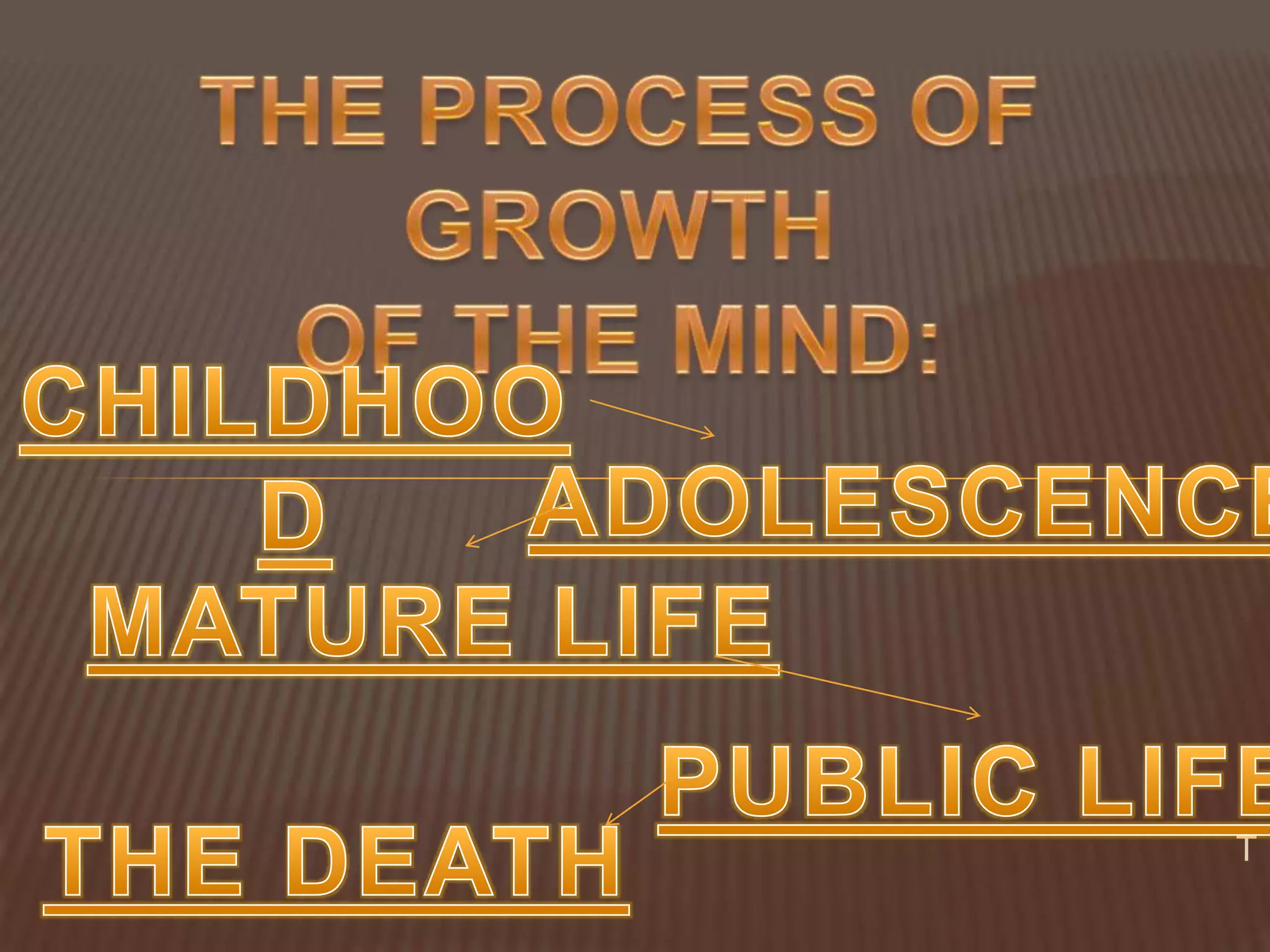
CHILDHOOD: The Sisters, An Encounter, Araby

ADOLESCENCE: After the Race, The Boarding House,
                             Eveline, Two Galliants

MATURE LIFE: A Little Cloud, Clay, Counterparts,
                                 A Painful Case
 PUBLIC LIFE: Ivy Day in Committee Room,
                                A Mother, Grace
THE DEATH: The Dead, which is the climax and
the summary of "Dubliners".
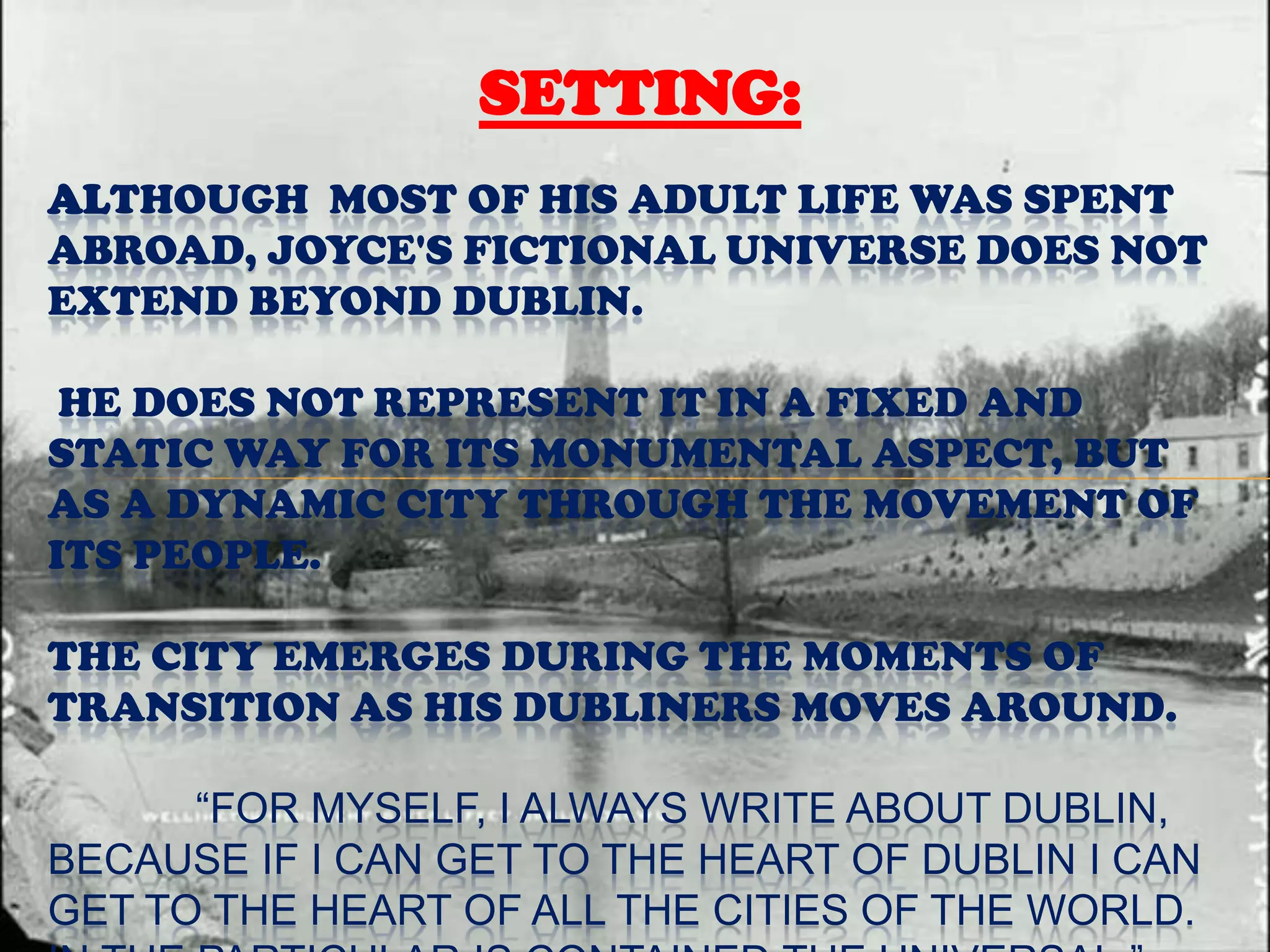
SETTING:
ALTHOUGH MOST OF HIS ADULT LIFE WAS SPENT
ABROAD, JOYCE'S FICTIONAL UNIVERSE DOES NOT
EXTEND BEYOND DUBLIN.

 HE DOES NOT REPRESENT IT IN A FIXED AND
STATIC WAY FOR ITS MONUMENTAL ASPECT, BUT
AS A DYNAMIC CITY THROUGH THE MOVEMENT OF
ITS PEOPLE.

THE CITY EMERGES DURING THE MOMENTS OF
TRANSITION AS HIS DUBLINERS MOVES AROUND.

      “FOR MYSELF, I ALWAYS WRITE ABOUT DUBLIN,
BECAUSE IF I CAN GET TO THE HEART OF DUBLIN I CAN
GET TO THE HEART OF ALL THE CITIES OF THE WORLD.
The Prison of Routine: Restrictive routines and the
repetitive, mundane details of everyday life mark the lives
of Joyce’s Dubliners and trap them in circles of frustration,
restraint, and violence.
The Desire of Escape: The characters in Dubliners may be
citizens of the Irish capital, but many of them long for an
escape and adventure in other countries.
The Intersection of life and death: The monotony of Dublin
life leads Dubliners to live in a suspended state between
life and death.
MOTIFS:

•Paralysis: In most of the stories of Dubliners, a character has a
desire, faces obstacles to it, then ultimately relents and
suddenly stops all action. These moments of paralysis show the
characters’ inability to change their lives and reverse the
routines that hamper their wishes.
•Epiphany: Epiphanies are ''sudden spiritual manifestations",
caused by a trivial gesture, an external object or a banal
situation, that allow characters to better understand their
particular circumstances and lives, which they then return to
with resignation and frustration.
•Betrayal: Nearly every relationship in Dubliners' stories is
affected by this feeling, which evokes the sense of displacement
and humiliation that all of these Dubliners fear.
•Religion: The presence of so many religious references also
suggests that religion traps Dubliners into their thinking about
their lives after death.
speech or of gesture or in a
    memorable phase of the mind
  itself. He believed that it was
for the man of letters to record
  these epiphanies with extreme
           care, seeing that they
        themselves are the most
     delicate and evanescent of
                        moments."
                       -Stephen Hero-
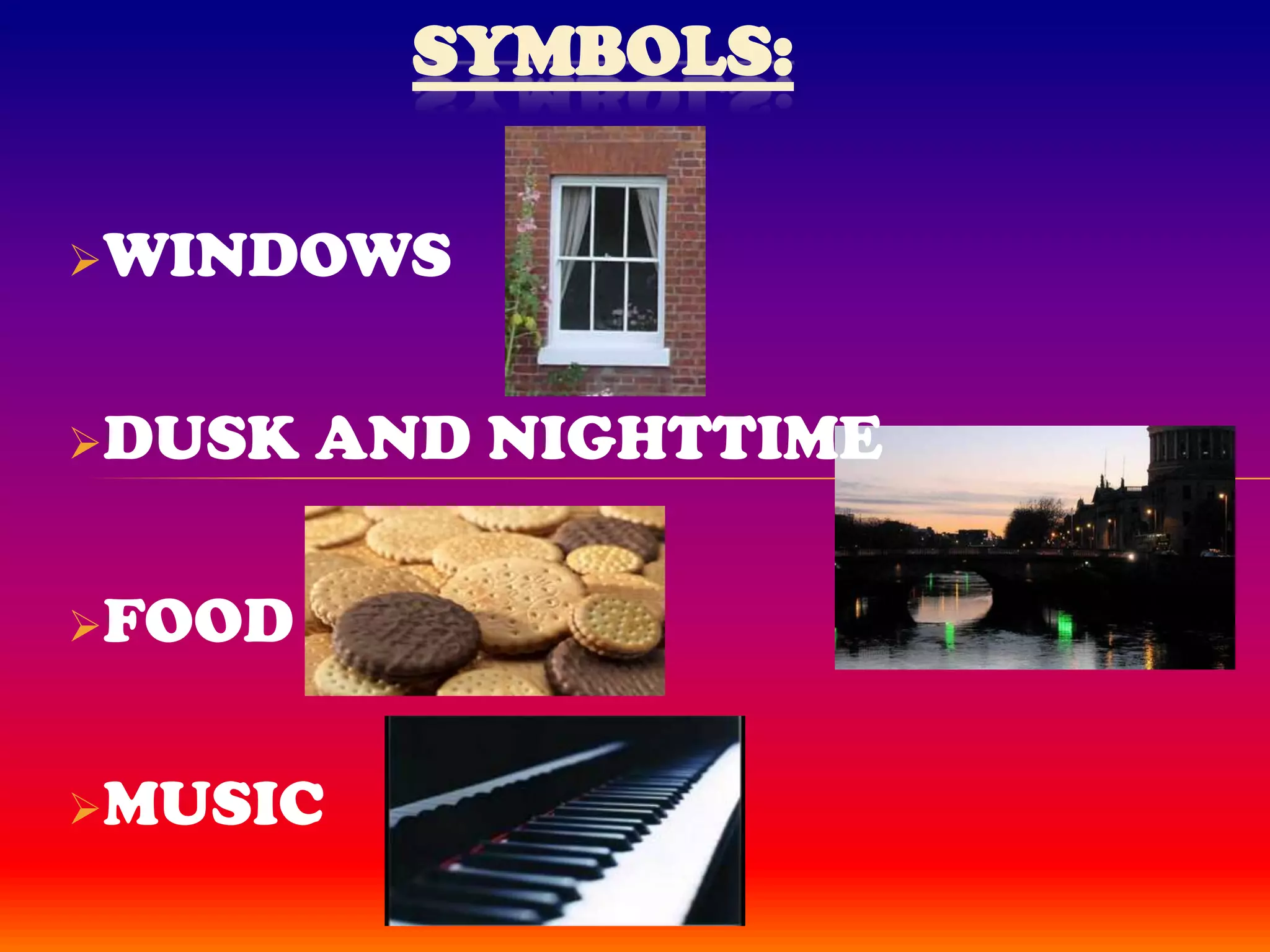
SYMBOLS:

WINDOWS


DUSK   AND NIGHTTIME

FOOD


MUSIC
Joyce rarely uses hyperboles or emotive language,
  preferring simplicity and close details to create a
                                   realistic setting.

The   linguistic register is varied, in order to reflect
                  character’s role, age and social class.

He   does not tell readers what to think, rather they
            are left to come to their own conclusions,
       contrasting the moral judgement displayed by
         writers like Charles Dickens.:the omniscient
      narrator and a single point of view are rejected.

           Using
                the STREAM OF CONSCIOUSNESS,
 character’s point of view emerges, rather than the
                                      author’s one.
1-Joyce was attacked by a dog as a young boy and
ended up with a severe canine phobia that
persisted throughout his life. He was also afraid of
thunderstorms because his grandmother once told
him that storms were a sign of God’s wrath.

2-Dedham, Massachusetts, in august hosts an
annual James Joyce Ramble, which is a 10K race.
Each mile is dedicated to one of Joyce’s works,
and actors line the streets and read from his
novels as the runners pass.

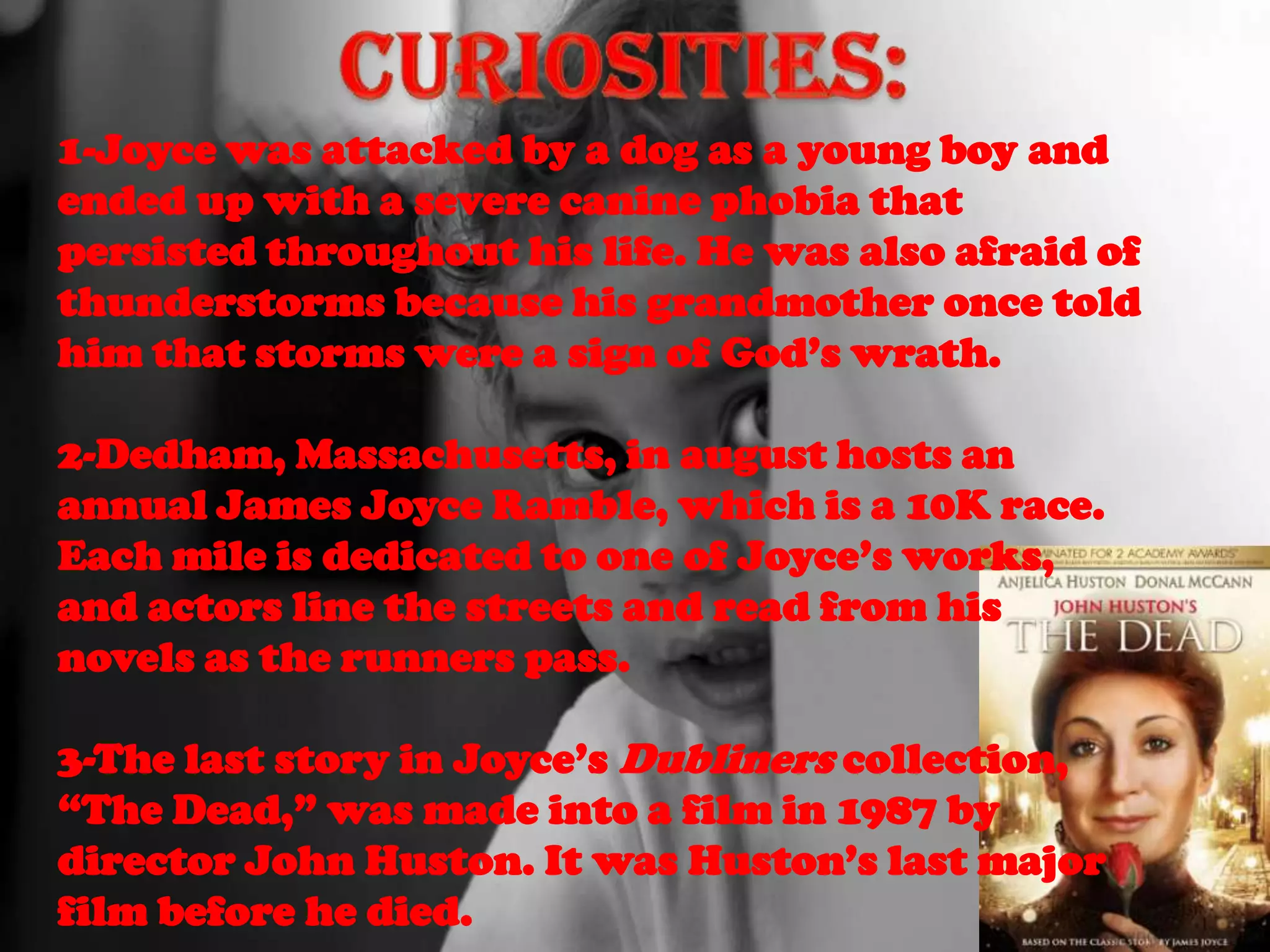
3-The last story in Joyce’s Dubliners collection,
“The Dead,” was made into a film in 1987 by
director John Huston. It was Huston’s last major
film before he died.
4-Joyce’s grandson, Stephen, has
supposedly destroyed many letters
written by his grandfather.

5-The library at the University College
in Dublin is named after James Joyce.

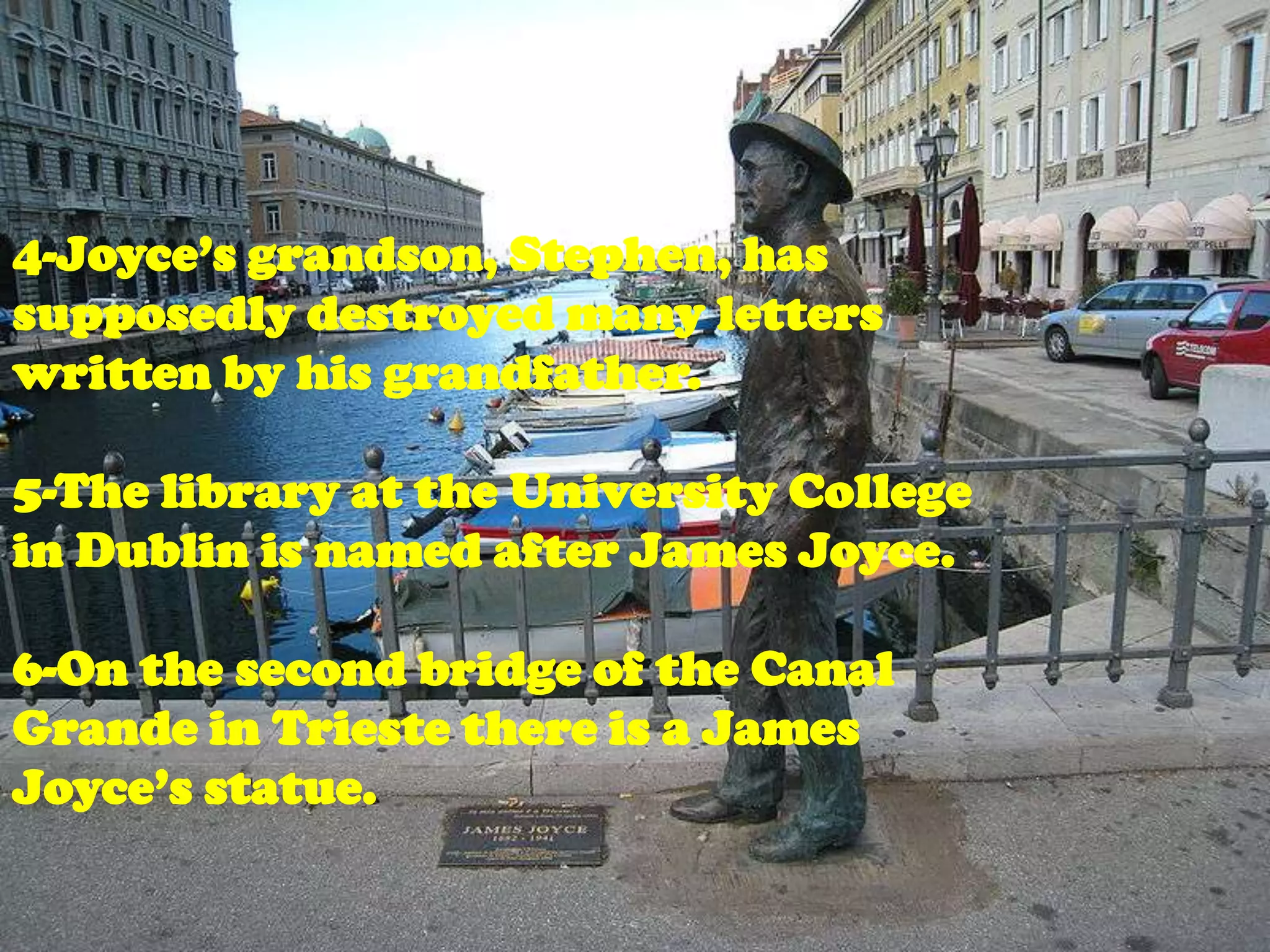
6-On the second bridge of the Canal
Grande in Trieste there is a James
Joyce’s statue.
Dubliners by joyce

Dubliners by joyce

  • 1.
    James Joyce Dubliners Edited by : ALESSANDRA SEMERARO 5^D
  • 2.
  • 3.
     James AugustineAloysius Joyce was born on 2nd February 1882 in Dublin in an Irish middle- class family. He was educated in Jesuits schools and he graduated at U.C.D. in 1903. In his early twenties he started to travel all around Europe, living in Trieste, Paris and Zurich.
  • 4.
    In 1904 he met and fell in love with Nora Barnacle, who he got married with in 1931. She bore him two chidren, Giorgio and Lucia. They moved to Trieste and there Joyce started teaching English and he met one of his best friend: Italo Svevo. Joyce died on 13th January 1941 in Zurich.
  • 5.
    Joyce’s worksare strictly connected to his life: in 1907 he started his carreer publishing "Chamber Music" but he established himself as a writer with "Dubliners"(1914), a collection of 15 short stories and with "A Portrait of the Artist as a Young Man"(1916), his first semi-autobiographical novel: these books helped him to solve some of his economical problems. In 1914 he also wrote most of his naturalistic drama "Exiles" .Then in 1917 he received the first of several anonymous donations, which encouraged him to continue writing his masterpiece "Ulysses", published in Paris in 1922. Then James Joyce started working on his second major work “Finnegan’s Wake” in 1923 published in April 1924.
  • 6.
    •Dubliners is acollection of fifteen short stories, settled in Dublin in the early years of the 20th century. •Joyce wrote it to make a naturalistic depiction of the Irish lower-middle-class of the age, in order to show 1914 Dubliners as afflicted people from a psychological point of view.
  • 7.
    •His central ideawas to know the innermost thoughts of characters, as an omniscent narrator, but from an inner view.
  • 8.
    The stories The Sisters– After the priest Father Flynn dies, a young boy who was close to him and his family deal with it only superficially. An Encounter – Two schoolboys playing truant encounter an elderly man. Araby – A boy falls in love with the sister of his friend, but fails in his quest to buy her a worthy gift from the Araby bazaar. Eveline – A young woman abandons her plans to leave Ireland with a sailor. After the Race – a College student Jimmy Doyle tries to fit in with his wealthy friends. Two Gallants – Two men, Lenehan and Corley, find a maid who is willing to steal from her employer. The Boarding House – Mrs. Mooney successfully manoeuvres her daughter Polly into an upwardly mobile marriage with her lodger Mr. Doran.
  • 9.
    A Little Cloud– Little Chandlers's dinner with his old friend Ignatius Gallaher casts fresh light on his own failed literary dreams. The story reflects also on Chandler's mood upon realizing his baby son has replaced him as the centre of his wife's affections. Counterparts – Farrington, a lumbering alcoholic scrivener, takes out his frustration in pubs and on his son Tom. Clay – The old maid Maria, a laundress, celebrates Halloween with her former foster child Joe Donnelly and his family. A Painful Case – Mr. Duffy rebuffs Mrs. Sinico, then four years later realizes he has condemned her to loneliness and death. Ivy Day in the Committee Room – Minor politicians fail to live up to the memory of Charles Stewart Parnell. A Mother – Mrs. Kearney tries to win a place of pride for her daughter, Kathleen, in the Irish cultural movement, by starring her in a series of concerts, but ultimately fails. Grace – After Mr. Kernan injures himself falling down the stairs in a bar, his friends tries to reform him through Catholicism. The Dead – Gabriel Conroy attends a party, and later, as he speaks with his wife, has an epiphany about the nature of life and death. At 15–16,000 words this story has also been classified as a novella.
  • 10.
  • 11.
    CHILDHOOD: The Sisters,An Encounter, Araby ADOLESCENCE: After the Race, The Boarding House, Eveline, Two Galliants MATURE LIFE: A Little Cloud, Clay, Counterparts, A Painful Case PUBLIC LIFE: Ivy Day in Committee Room, A Mother, Grace THE DEATH: The Dead, which is the climax and the summary of "Dubliners".
  • 12.
    SETTING: ALTHOUGH MOST OFHIS ADULT LIFE WAS SPENT ABROAD, JOYCE'S FICTIONAL UNIVERSE DOES NOT EXTEND BEYOND DUBLIN. HE DOES NOT REPRESENT IT IN A FIXED AND STATIC WAY FOR ITS MONUMENTAL ASPECT, BUT AS A DYNAMIC CITY THROUGH THE MOVEMENT OF ITS PEOPLE. THE CITY EMERGES DURING THE MOMENTS OF TRANSITION AS HIS DUBLINERS MOVES AROUND. “FOR MYSELF, I ALWAYS WRITE ABOUT DUBLIN, BECAUSE IF I CAN GET TO THE HEART OF DUBLIN I CAN GET TO THE HEART OF ALL THE CITIES OF THE WORLD.
  • 13.
    The Prison ofRoutine: Restrictive routines and the repetitive, mundane details of everyday life mark the lives of Joyce’s Dubliners and trap them in circles of frustration, restraint, and violence. The Desire of Escape: The characters in Dubliners may be citizens of the Irish capital, but many of them long for an escape and adventure in other countries. The Intersection of life and death: The monotony of Dublin life leads Dubliners to live in a suspended state between life and death.
  • 14.
    MOTIFS: •Paralysis: In mostof the stories of Dubliners, a character has a desire, faces obstacles to it, then ultimately relents and suddenly stops all action. These moments of paralysis show the characters’ inability to change their lives and reverse the routines that hamper their wishes. •Epiphany: Epiphanies are ''sudden spiritual manifestations", caused by a trivial gesture, an external object or a banal situation, that allow characters to better understand their particular circumstances and lives, which they then return to with resignation and frustration. •Betrayal: Nearly every relationship in Dubliners' stories is affected by this feeling, which evokes the sense of displacement and humiliation that all of these Dubliners fear. •Religion: The presence of so many religious references also suggests that religion traps Dubliners into their thinking about their lives after death.
  • 15.
    speech or ofgesture or in a memorable phase of the mind itself. He believed that it was for the man of letters to record these epiphanies with extreme care, seeing that they themselves are the most delicate and evanescent of moments." -Stephen Hero-
  • 16.
    SYMBOLS: WINDOWS DUSK AND NIGHTTIME FOOD MUSIC
  • 17.
    Joyce rarely useshyperboles or emotive language, preferring simplicity and close details to create a realistic setting. The linguistic register is varied, in order to reflect character’s role, age and social class. He does not tell readers what to think, rather they are left to come to their own conclusions, contrasting the moral judgement displayed by writers like Charles Dickens.:the omniscient narrator and a single point of view are rejected. Using the STREAM OF CONSCIOUSNESS, character’s point of view emerges, rather than the author’s one.
  • 18.
    1-Joyce was attackedby a dog as a young boy and ended up with a severe canine phobia that persisted throughout his life. He was also afraid of thunderstorms because his grandmother once told him that storms were a sign of God’s wrath. 2-Dedham, Massachusetts, in august hosts an annual James Joyce Ramble, which is a 10K race. Each mile is dedicated to one of Joyce’s works, and actors line the streets and read from his novels as the runners pass. 3-The last story in Joyce’s Dubliners collection, “The Dead,” was made into a film in 1987 by director John Huston. It was Huston’s last major film before he died.
  • 19.
    4-Joyce’s grandson, Stephen,has supposedly destroyed many letters written by his grandfather. 5-The library at the University College in Dublin is named after James Joyce. 6-On the second bridge of the Canal Grande in Trieste there is a James Joyce’s statue.