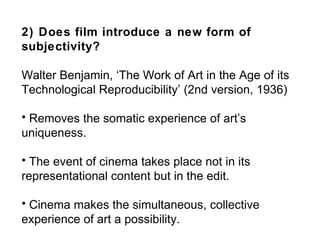
The document discusses the history and development of modernism in film from 1895 to the 1920s. It covers key events like the first public film screening by the Lumière brothers in 1895. The impact of WWI led American films to dominate European markets. In the 1920s, Europe developed a new self-conscious film culture influenced by modernist art. Writers like Ricciotto Canudo and Virginia Woolf explored whether film was a new seventh art form and how the medium might influence thought, emotion, and subjectivity. Filmmakers like Dziga Vertov and Len Lye experimented with techniques like montage and editing to develop a cinematic language.




![‘ But what then are its devices? If it ceased to be a parasite, how would it walk erect? [ … ] At a performance of Dr Caligari the other day, a shadow shaped like a tadpole suddenly appeared at the corner of the screen. It swelled to an immense size, quivered, bulged, and sank back again into non-entity. [ … ] For a moment it seemed as if thought could be conveyed by shape more effectively than by words [...] It seems plain that the cinema has within its grasp innumerable symbols for emotions that have so far failed to find expression [ … ] Is there, we ask, some secret language, which we feel and see, but never speak, and if so, could this be made visible to the eye? ’ Virginia Woolf, ‘ The Cinema ’ , Nation and Athenaeum, 1926](https://image.slidesharecdn.com/modernistcinema1011-110415062720-phpapp02/85/Modernist-cinema-7-320.jpg)

![Len Lye Tusalava http://www.youtube.com/watch?v=flJOXMln4C0&feature=related UK [1929]](https://image.slidesharecdn.com/modernistcinema1011-110415062720-phpapp02/85/Modernist-cinema-9-320.jpg)
![2) Does the medium alter the way we think and feel? Does film introduce a new form of subjectivity? Is there a pre-cinema worldview, and a post-cinema worldview? ‘ The horse will not knock us down. The king will not grasp our hands. The wave will not wet our feet. ’ ‘ This beauty will continue, and this beauty will flourish whether we behold it or not. ’ Film shows us a world that is real but ‘ real with a different reality from that which we perceive in daily life. We behold [it] as [it is] when we are not there. We see life as it is when we have no part in it. ’ Woolf, ‘The Cinema’, Nation and Athenaeum , 1926](https://image.slidesharecdn.com/modernistcinema1011-110415062720-phpapp02/85/Modernist-cinema-10-320.jpg)
![Dziga Vertov Man with a movie camera USSR [1929]](https://image.slidesharecdn.com/modernistcinema1011-110415062720-phpapp02/85/Modernist-cinema-12-320.jpg)
![‘ WE: variant of a manifesto ’ , 1922 ‘ We are cleansing cinema of foreign matter [...] We seek our own rhythm, one lifted from nowhere else. We find it in the movements of things. The psychological prevents man from being as precise as a stopwatch, it interferes with his desire for kinship with the machine [...] Our path leads through the poetry of machines, through the bungling citizen to the perfect, electric man [...] We introduce creative joy into all mechanical labour [...] We foster new people. ’](https://image.slidesharecdn.com/modernistcinema1011-110415062720-phpapp02/85/Modernist-cinema-13-320.jpg)


